Summary
Table of Content

Bio-Based Platform Chemicals Market
Get a free sample of this report
Form submitted successfully!
Error submitting form. Please try again.
Thank you!
Your inquiry has been received. Our team will reach out to you with the required details via email. To ensure that you don't miss their response, kindly remember to check your spam folder as well!
Request Sectional Data
Thank you!
Your inquiry has been received. Our team will reach out to you with the required details via email. To ensure that you don't miss their response, kindly remember to check your spam folder as well!
Form submitted successfully!
Error submitting form. Please try again.
Bio-Based Platform Chemicals Market Size
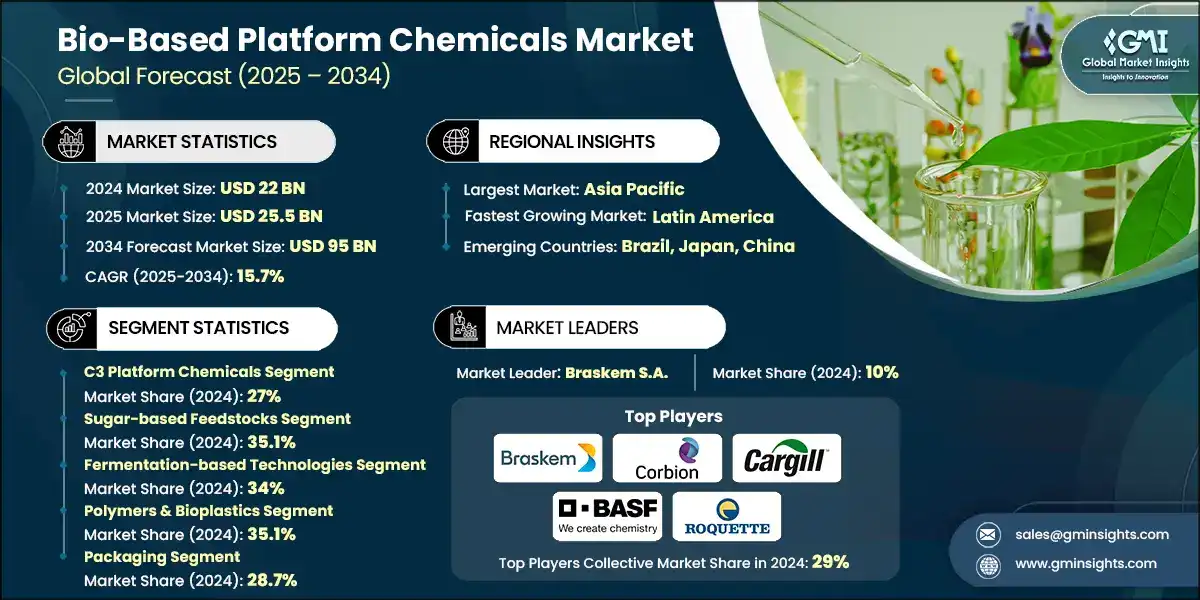
The global bio-based platform chemicals market was valued at USD 22 billion in 2024. The market is expected to grow from USD 25.5 billion in 2025 to USD 95 billion in 2034, at a CAGR of 15.7%, according to latest report published by Global Market Insights Inc.
To get key market trends
- With the emphasis on sustainability and the push of technology, bio-based platform chemicals have moved from a niche segment to that of mainstream industrial interest. This sector is witnessing growth rates that far exceed those of the traditional chemical industry, indicating that it is strategically poised to impact decarbonization and circular-economy initiatives; such frameworks are undergirded by an array of policy settings and mounting corporate commitments to climate neutrality: bio-based chemicals should, therefore, be seen as anchors of future industrial ecosystems.
- Market growth proceeds, primarily, with investment flows and resource dynamics. With abundant biomass and mature fermentation techniques, scalable production is feasible. Regional growth patterns indicate an Asia Pacific resource, Europe a regulatory environment, and North America feedstock, thus creating a globally diversified growth arena. Relevant segments such as C3 platform chemicals, sugar-based feedstocks, and bioplastics are driving acceptance in packaging, polymers, and specialty applications.
- Apart from commercial opportunity, bio-based chemicals confer essential environmental advantages, producing major reductions in greenhouse gas intensity when compared to fossil-based counterparts. Feedstock resources are available in much larger quantities than projected demand thus, at a global level, supply constraints are not expected to impede growth, but they may vary to some extent regionally with regard to logistics. Bio-based solutions, as pursued by the chemical industry in its quest for climate neutrality, represent a highly transformative pathway that combines economic feasibility with sustainability impact.
Bio-Based Platform Chemicals Market Report Attributes
| Key Takeaway | Details |
|---|---|
| Market Size & Growth | |
| Base Year | 2024 |
| Market Size in 2024 | USD 22 Billion |
| Market Size in 2025 | USD 25.5 Billion |
| Forecast Period 2025 - 2034 CAGR | 15.7% |
| Market Size in 2034 | USD 95 Billion |
| Key Market Trends | |
| Drivers | Impact |
| Stringent sustainability mandates & carbon neutrality targets | Pushing the supply chains for companies to fast-track their adoption of bio-based products owing to the fulfillment of their regulatory and ESG commitments |
| Consumer demand for bio-based & biodegradable products | Strong pull for sustainable materials in packaging and consumer goods |
| Technological advances in synthetic biology & metabolic engineering | Enhance process efficiency and scalability thereby increasing reliance on fossil feedstocks |
| Pitfalls & Challenges | Impact |
| High production costs vs. petrochemicals | Limit competitiveness and slow down the large-scale substitution |
| Feedstock variability & logistics challenges | Supply chain complexity increases and also affects the predictability of cost |
| Opportunities: | Impact |
| Lignin valorization for aromatic platform chemicals | Unlock high-value applications of polymers and specialty chemicals |
| C1 Gas utilization (CO2, CO, CH4) via gas fermentation | Broaden the feedstock base and allow recycling of carbon for sustainment |
| Market Leaders (2024) | |
| Market Leaders |
10% market share |
| Top Players |
Collective market share in 2024 is 29% |
| Competitive Edge |
|
| Regional Insights | |
| Largest Market | Asia Pacific |
| Fastest growing market | Latin America |
| Emerging countries | Brazil, Japan, China |
| Future outlook |
|
What are the growth opportunities in this market?
Bio-Based Platform Chemicals Market Trends
- Lignin valorization is emerging as a way of transforming bio-based chemistry and is perhaps the only renewable pathway to aromatic platform chemicals usually derived from petroleum. Historically, lignin has been looked at as an infinitely low-value byproduct of pulping, but now it has come to the fore in the more advanced biorefinery constructs that would unlock its lone identity as the only natural source of aromatics. In this way, several high-value products such as vanillin and phenolics can be made possible with sustainable alternatives to some petrochemical building blocks used in making polymers, resins, and specialty chemicals.
- Technological advancements are being the driving force for a transition to the selective lignin depolymerization techniques and better economics for processing using catalytic systems and solvent engineering. Such integrated biorefineries simultaneously make cellulosic sugars, lignin-derived aromatics, and other intermediates, maximizing carbon utilization and minimizing waste. Therefore, they make lignin-based products commercially attractive and, at the same time, address important sustainability concerns by making residents dependent on fossil resources less.
- The other paradigm shift brought about by gas fermentation is that one can now have different feedstock sources beyond biomass into which industrial off-gases and even captured carbon are included. This unique approach, adopting specialized microorganisms, will convert single carbon gases into high-value chemicals and thus support the carbon capture and utilization goals. Gas fermentation possesses the flexibility to operate under low energy requirements. By integrating it with hard-to-abate sectors, one could further improve scaling in producing platform chemicals, making it even more relevant in shaping the future of sustainable chemical production.
Bio-Based Platform Chemicals Market Analysis

Learn more about the key segments shaping this market
Based on product type, the market is segmented into C2 platform chemicals, C3 platform chemicals, C4 platform chemicals, C5 platform chemicals, C6 platform chemicals, other platform chemicals. C3 platform chemicals dominated the market with an approximate market share of 27% in 2024 and is expected to grow with a CAGR of 15.1% by 2034.
- C3 platform chemicals dominates the market with fermentation routes already established. These molecules, such as lactic acid and its glycerol derivatives, have fed the development of well-established polymers such as polylactic acid and polytrimethylene terephthalate, primarily for packaging, textiles, and specialty applications. This segment has the advantage of available feedstock and proven scalability, thus forming the backbone of bio-based polymer markets.
- The C2 and C4 platforms are emerging amidst existing petrochemical infrastructure and varied downstream applications. Bio-ethylene and its derivatives fit well into a polyethylene and PET market, whereas succinic acid and 1,4-butanediol go into polyesters, polyurethanes, and specialty chemicals.
- The emerging platforms such as C5 and C6 and specialty molecules from lignin valorization would be the next wave of innovations. Furfural, 5-HMF, and isosorbide not only provide the opportunity for high-performance polymers but also access new applications in packaging and engineering plastics. The start of commercialization using advanced metabolic engineering and integrated biorefinery concepts is progressively widening the horizon of bio-based chemistry.
Learn more about the key segments shaping this market
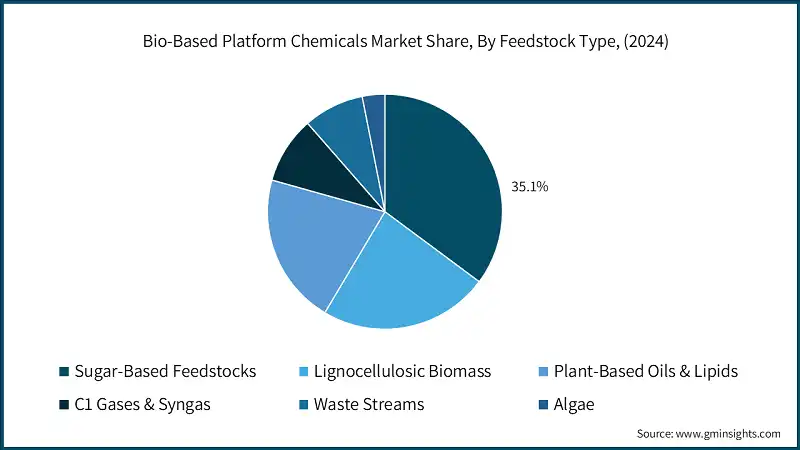
Based on feedstock type, the bio-based platform chemicals market is segmented into sugar-based feedstocks, lignocellulosic biomass, plant-based oils & lipids, C1 gases & syngas, waste streams, and algae. Sugar-based feedstocks held the largest market share of 35.1% in 2024 and is expected to grow at a CAGR of 14.8% during 2025-2034.
- Sugar-based feedstocks remain the most established basis for bio-based chemical production with the support of mature processing infrastructure and the compatibility with fermentation technologies. Sugar-based feedstocks have high fermentable sugar content and proven scalability of the current production model. However, sustainability issues concerning the land occupation and competition with food production are slowly ushering in a different era of feedstock consideration. Lignocellulosic biomass is being positioned as respectable second-generation feedstocks that will attempt to sustain agricultural and forestry residues, energy crops, and woody materials to produce biobased chemicals.
- Other feedstock types like plant oils, C1 gases, waste streams, and algae will continue to increase the diversity and resilience of the markets. Oils and lipids afford the opportunity for producing fatty acids and derivatives of glycerol, whereas gas fermentation provides a route for the conversion of industrial emissions into valuable chemicals. Waste valorization represents a circular economy mechanism in which organic waste is thus converted into feedstock, when compared to algae cultivation, which stands as one high-potential method that bypass land constraints and promotes carbon capture. Together, all these innovations will synergistically alter the landscape of feedstock for bio-based platform chemicals.
Based on production technology, the bio-based platform chemicals market is segmented into fermentation-based technologies, synthetic biology & metabolic engineering, enzymatic conversion, catalytic & chemical conversion, thermochemical conversion, and hybrid chemo-biological routes. Fermentation-based technologies segment dominated the market with an approximate market share of 34% in 2024 and is expected to grow with the CAGR of 14.6% by 2034.
- Fermentation-based technologies have remained the most established production route for bio-platform chemicals-from matured operations with proven scalability. Such systems lend themselves to high selectivity, mild operating conditions, and the ability to make complex molecules at very highly efficient rates.
- The current revolution could even be sustained in the market with new emergent biological approaches, such as synthetic biology and even metabolic engineering, to make newer molecules or get processes efficiency enhancements. Scope is further broadened with the advent of the new techniques-genome editing, pathway design, and high throughput screening-for chemicals amenable for production by biological routes. Enzymatic conversion will give specific transformations which are otherwise very difficult with chemical catalysts, especially in the case of multifunctional molecules, thereby complementing these new technologies.
- Catalytic and hybrid chemo-biological processes are the alternative strategy for relaxing the straitjacket of current technologies. Chemical catalysts provide that dose of productivity and versatility required for transforming biomass-derived intermediates, whereas hybrid processes bring in an integrated pathway to obtain complex products through fusing biological selectivity and chemical effectiveness.
Based on application, the bio-based platform chemicals market is segmented into polymers & bioplastics, solvents, pharmaceuticals & nutraceuticals, cosmetics & personal care, paints, coatings, inks & dyes, surfactants & detergents, adhesives & sealants, lubricants, textiles & fibers. Polymers & bioplastics segment dominated the market with an approximate market share of 35.1% in 2024 and is expected to grow with the CAGR of 14.8% by 2034.
- Bio-based platform chemicals are increasingly anticipated to grow as far as application is concerned, as they represent the most promising area of polymers and bioplastics which provide sustainable packaging as well as to recognize efforts in legislation that regulate plastic. These advantages are substantially environmental, especially in terms of reduced emissions of greenhouse gases and compostability, where polylactic acid emerges as the future solution in packaging, textiles, and consumer goods.
- Other important applications include solvents and pharmaceuticals, where toxic-free and biodegradable alternatives can be developed from bioresourced raw materials either through the production of molecules that are structurally impossible or almost impossible using conventional chemical synthesis or through the production of very complex molecules that are difficult to obtain through conventional synthesis. Enzymatic and metabolic engineering routes make it possible to produce value-added compounds-that are nutraceuticals and active pharmaceutical ingredients-which support the health and wellness markets.
- Other areas of growth include cosmetics, coatings, surfactants, adhesives, lubricants, and textiles, all responding to sustainability trends and performance requirements. Bio-based surfactants and emulsifiers replace petroleum-derived ingredients in personal care and cleaning products. Lignin-derived compounds and plant-based polyols have gained popularity in coatings and adhesives. Textile applications depend on bio-based fibers and polymers as renewable, biodegradable alternatives, thereby reinforcing the market’s ability to further enabling circular economy principles across multi-industries.
Based on end use, the bio-based platform chemicals market is segmented into packaging, automotive, textiles & apparel, construction & building materials, agriculture, pharmaceuticals & healthcare, food & beverage, personal care & cosmetics, and energy. Packaging segment dominated the market with an approximate market share of 28.7% in 2024 and is expected to grow with the CAGR of 13.9% by 2034.
- Packaging remains the most established application for bio-based materials, driven by regulatory measures targeting single-use plastics, corporate sustainability commitments, and consumer demand for eco-friendly solutions. Further with programs such as extended producer responsibility and banishment of conventional plastic striding into further momentum globally, bio-based polymers are increasingly being accepted from packaging applications that are inclusive of films to rigid containers.
- Bio-based materials are being attracted to research concerning sustainability and regulatory compliance in automotive, textiles, construction, and agriculture. Lightweight composites, bio-based foams, and bio-based lubricants reduce emissions and enhance performance in automotive applications. Fibers and polymers are renewed for textiles and apparel, addressing environmental issues in the fashion industry. In construction, bio-based insulation, adhesives, and coatings provide green building requirements. Bio-based films are supported by agricultural biodegradable films and biodegradable crop-protection products, and soil amendments are used to increase productivity with an environmental cost to their minimum.
- The areas like pharmaceutical, food, beverages, personal care products, and energy are putting high-value bio-based solutions in the support of innovation. Pharmaceuticals and healthcare use fermentation and synthetic biology to produce complex molecules and biodegradable medical materials.
Looking for region specific data?
The North America bio-based platform chemicals industry is growing rapidly on the global level with a market share of 25.9% in 2024.
- North America appears to be developing into a key growth region for bio-based platform chemicals. In sugar feedstock generation, established agricultural systems would be complemented by widespread amounts of lignocellulosic biomass and a mature bioethanol industry on which chemical production could be built. Research institutions and government programs are taking a very active role in technology development, while market growth is being enabled by climate policy and clean energy incentives.
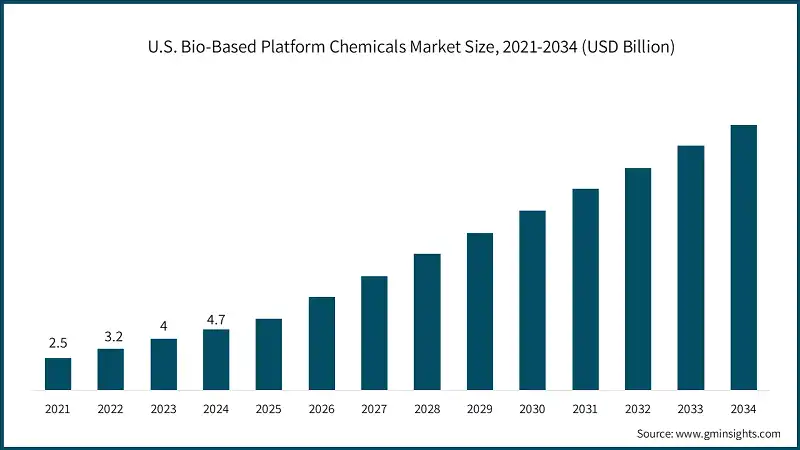
U.S. dominates the North America bio-based platform chemicals market, showcasing strong growth potential.
- The U.S. takes the lead in shaping a regional growth narrative with strong policy support covering carbon reduction targets, renewable energy mandates, and fiscal incentives for low-carbon manufacturing. Given the strong momentum, fragilities do exist in the form of variable policy mechanisms, competition from lower-cost fossil-based chemicals, and logistics limitations in the collection of biomass, all issues that must be contemplated for any scale-up of production.
Europe market leads the industry with revenue of USD 6.4 billion in 2024 and is anticipated to show lucrative growth over the forecast period.
- The successful regional thrust for bio-based platform chemicals is enriched by robust policy and ambitious emissions reduction targets, which would strengthen demand for sustainable alternatives. To enhance competitive advantages for bio-based production in Europe, policies such as the Green Deal, emissions trading mechanisms, and renewable energy directives have been put in place.
Germany dominates the European bio-based platform chemicals market, showcasing strong growth potential.
- Germany channels investments by its chemical industry into bio-based technologies within its energy transition strategy. Programs specifically tailored for bioeconomy growth are created, while all other nations fall under common EU sustainability goals.
The Asia Pacific market is anticipated to grow at a CAGR of 15.8% during the analysis timeframe.
- Asia Pacific being rich in biomass resources, large-scale manufacturing capacities, and with government support for sustainability and circular economy principles drives the international bio-based platform chemicals market. Apparent growth of consumer markets in the region is also pairing with policy frameworks that create favorable conditions for investment in bio-based industries toward technology adoption and commercialization.
China bio-based platform chemicals market is estimated to grow with a significant CAGR in the Asia Pacific region.
- In China, a demand for bio-based solutions created by a mixture of abundant feedstock availability and a sturdy national chemical industry. Government intervention in this regard is enacted through means of subsidies, tax incentives, and public procurement policies. Management of the impediments such as feedstock logistics and infrastructure deficit is presently under serious consideration in scaling production.
Latin America bio-based platform chemicals accounted for 7% market share in 2024 and is anticipated to show highest growth over the forecast period.
- Latin America is categorized as one among the fastest-growing territories for biobased platform chemicals, a huge area of biomass resources, well-established sugar processing industry, and compelling demand for sustainable solutions supports such a status. Good climatic conditions for high biomass productivity, lucid regional policies, and biofuel mandates give a far better environment to bio-based production.
Brazil leads the Latin American bio-based platform chemicals market, exhibiting remarkable growth during the analysis period.
- Brazil supports regional growth with its sugarcane-based bioethanol production, also the establishment of commercial-scale bio-based polymer production. Supportive government initiatives such as carbon credit programs and renewable energy targets enhance the economics of bio-based manufacturing in the country.
Middle East & Africa bio-based platform chemicals accounted for 5% market share in 2024 and is anticipated to show lucrative growth over the forecast period.
- The market for bio-based platform chemicals in the Middle East and Africa is driven by economic diversification strategies and increasing social awareness of sustainability. Keeping in view the traditional usage of low-cost petroleum resources by the manufacturers in the chemical industry of the region, emerging initiatives relating to bioeconomy development and renewable integration are creating opportunities ahead.
Saudi Arabia bio-based platform chemicals industry to experience substantial growth in the Middle East and Africa market in 2024.
- In a larger framework of economic diversification, Saudi Arabia occupies bio-based industries, with backing from green growth policies and investment in advanced technology. In this strategy, focus is laid on using renewable energy resources and including bio-based production in the industrial ecosystem.
Bio-Based Platform Chemicals Market Share
The top 5 companies in bio-based platform chemicals industry include Braskem S.A., Corbion N.V., Cargill Incorporated, BASF SE, and Roquette Frères. These are prominent companies operating in their respective regions covering approximately 29% of the market share in 2024. These companies hold strong positions due to their extensive experience in bio-based platform chemicals market. Their diverse product portfolios, backed by robust production capabilities and distribution networks, enable them to meet the rising demand across various regions.
- Braskem S.A.'s product portfolio is diversified, ranging from polyolefins and vinyls to chemical intermediates. It has undertaken some investments in renewable solutions such as bio-based polyethylene obtained from sugarcane ethanol, and continues to develop recycling and sustainable material advances as part of a complementary strategy around its circular economy initiatives.
- Corbion N.V. designs portions of sustainable ingredient solutions for food, biochemicals, and biomaterials. The offerings belonging to the core of business include lactic acid and its derivatives, which forms the essential portions of bioplastics and specialty chemicals.
- Cargill Industries operates on agriculture, food and industrial segments, but the rapidly growing area where it concentrates is still mainly on bio-based chemicals and materials. Activities include the production of biopolymers, bio-intermediates and renewable chemicals from agriculture feedstocks.
- BASF SE is a global chemical company that has a very wide array of products that cover chemicals, materials, industrial solutions, and agricultural products. Among others, BASF develops biomass-balanced intermediates, bio-based polymers, and catalytic technologies concerning the renewable feedstock conversion in the bio-based segment.
- Roquette Frères portfolio is plant-based, with applications covering food, nutrition, pharmaceuticals, and industrial-related applications. Starches, polyols, and a range of specialty chemicals derived from renewable resources make up its portfolio.
Bio-Based Platform Chemicals Market Companies
Major players operating in the bio-based platform chemicals industry include:
- Braskem S.A.
- Corbion N.V.
- Cargill, Incorporated
- BASF SE
- Roquette Frères
- DuPont de Nemours, Inc.
- Genomatica, Inc.
- Evonik Industries AG
- Avantium N.V.
- Mitsubishi Chemical Holdings Corporation
- Royal DSM N.V.
- PTT Global Chemical Public Company Limited
- Novozymes A/S
Bio-Based Platform Chemicals Industry News
- In October 2024, Avantium announced progress on its flagship FDCA (2,5-furandicarboxylic acid) plant in the Netherlands, with mechanical completion achieved and commissioning activities underway. The facility produced FDCA, the monomer for polyethylene furanoate (PEF), at commercial scale targeting beverage bottle applications where PEF's superior barrier properties provided performance advantages over conventional PET.
- In September 2024, BASF and Sinopec announced a joint venture to produce bio-based chemicals in China, leveraging Sinopec's market access and feedstock resources with BASF's technology. The partnership initially focused on bio-based succinic acid and 1,4-butanediol production, with potential expansion to additional platform chemicals.
- In August 2023, Corbion and TotalEnergies announced capacity expansion plans for their PLA joint venture in France, responding to growing demand from packaging and textile applications. The expansion aimed to increase capacity by 50%, with completion targeted for 2026.
This bio-based platform chemicals market research report includes in-depth coverage of the industry, with estimates & forecasts in terms of revenue (USD Billion) and volume (Kilo Tons) from 2025 to 2034, for the following segments:
Market, By Product Type
- C2 platform chemicals
- Bio-ethylene
- Bio-ethanol
- Bio-ethylene glycol
- C3 platform chemicals
- Lactic acid
- 1,3-propanediol (1,3-PDO)
- 3-hydroxypropionic acid (3-HPA)
- C4 platform chemicals
- Succinic acid
- 1,4-butanediol (BDO)
- N-butanol
- C5 platform chemicals
- Furfural
- Isoprene
- Glutaric acid
- Cadaverine
- Δ-Valerolactam
- 1,5-pentanediol
- C6 platform chemicals
- 2,5-furandicarboxylic acid (FDCA)
- Adipic acid
- Cis,cis-muconic acid
- Caprolactam
- 1,6-hexamethylenediamine (HMDA)
- Other platform chemicals
- Levulinic acid
- Itaconic acid
- Bio-glycerol
- 5-hydroxymethylfurfural (5-HMF)
Market, By Feedstock Type
- Sugar-based feedstocks
- C6 sugars (corn, sugarcane, sugar beet)
- C5/C6 mixed sugars (lignocellulosic hydrolysis)
- Lignocellulosic biomass
- Agricultural residues
- Forest resources
- Plant-based oils & lipids
- Vegetable oils
- Waste lipids
- Oilseeds (second-crop)
- C1 gases & syngas
- Carbon dioxide (Co2)
- Carbon monoxide (Co) & syngas
- Methane (Ch4) & methanol
- Waste streams
- Municipal solid waste (MSW)
- Industrial organic waste
- Plastic waste
- Algae
- Microalgae
- Macroalgae
Market, By Production Technology
- Fermentation-based technologies
- Microbial fermentation
- Consolidated bioprocessing (CBP)
- Synthetic biology & metabolic engineering
- Crispr/CAS-based strain engineering
- Pathway engineering
- High-throughput screening & directed evolution
- Enzymatic conversion
- Enzymatic hydrolysis
- Enzymatic depolymerization
- Catalytic & chemical conversion
- Acid/base catalysis
- Metal catalysis
- Thermochemical conversion
- Pyrolysis
- Gasification
- Hybrid chemo-biological routes applications
Market, By Application
- Polymers & bioplastics
- Polylactic acid (PLA)
- Polyhydroxyalkanoates (PHA)
- Polybutylene succinate (PBS)
- Polyethylene furanoate (PEF)
- Bio-polyethylene (bio-pe)
- Other bioplastics (Bio-PET, Bio-PA, Bio-PP)
- Solvents
- Pharmaceuticals & nutraceuticals
- Cosmetics & personal care
- Paints, coatings, inks & dyes
- Surfactants & detergents
- Adhesives & sealants
- Lubricants
- Textiles & fibers
Market, By End Use
- Packaging
- Automotive
- Textiles & apparel
- Construction & building materials
- Agriculture
- Pharmaceuticals & healthcare
- Food & beverage
- Personal care & cosmetics
- Energy
The above information is provided for the following regions and countries:
- North America
- U.S.
- Canada
- Europe
- Germany
- UK
- France
- Spain
- Italy
- Rest of Europe
- Asia Pacific
- China
- India
- Japan
- Australia
- South Korea
- Rest of Asia Pacific
- Latin America
- Brazil
- Mexico
- Argentina
- Rest of Latin America
- Middle East and Africa
- Saudi Arabia
- South Africa
- UAE
- Rest of Middle East and Africa
Frequently Asked Question(FAQ) :
Who are the key players in the bio-based platform chemicals market?
Major companies include Braskem S.A., Corbion N.V., Cargill Incorporated, BASF SE, Roquette Frères, DuPont de Nemours, Genomatica, Evonik Industries, Avantium N.V., Mitsubishi Chemical Holdings, Royal DSM, PTT Global Chemical, and Novozymes.
What is the market share of the North America bio-based platform chemicals industry in 2024?
North America held 25.9% of the global bio-based platform chemicals market in 2024. This strong position is supported by abundant biomass availability, a mature bioethanol industry, and robust policy incentives that accelerate the adoption of low-carbon and sustainable chemical production.
What are the upcoming trends in the bio-based platform chemicals industry?
Key trends include lignin valorization for aromatic chemicals, rapid adoption of gas-fermentation technologies for CO₂ and CH₄ utilization, and rising commercialization of advanced bioplastics.
What is the growth outlook for fermentation-based technologies from 2025 to 2034?
Fermentation-based technologies are expected to grow at a 14.6% CAGR through 2034. Rising investments in microbial fermentation and advancements in metabolic engineering continue to enhance process efficiency and scalability.
What was the market share of sugar-based feedstocks in 2024?
Sugar-based feedstocks accounted for 35.1% market share in 2024. Their widespread use stems from mature infrastructure, high fermentable sugar content, and compatibility with large-scale fermentation processes.
How much revenue did the C3 platform chemicals segment generate in 2024?
C3 platform chemicals held the leading share of approximately 27% in 2024. Its dominance is driven by well-established fermentation routes, scalable feedstock availability, and high demand for lactic acid–based polymers.
What is the market size of the bio-based platform chemicals industry in 2024?
The market size for bio-based platform chemicals was valued at USD 22 billion in 2024. Strong demand for bio-based and biodegradable materials along with carbon-neutrality mandates is driving industry growth.
What is the projected value of the bio-based platform chemicals market by 2034?
The bio-based platform chemicals industry is expected to reach USD 95 billion by 2034, growing at a 15.7% CAGR. This long-term expansion is powered by synthetic biology innovation, circular-economy initiatives, and the shift toward renewable chemical building blocks.
What is the current bio-based platform chemicals market size in 2025?
The market size is projected to reach USD 25.5 billion in 2025. This growth is supported by rising adoption of sustainable feedstocks and expanded fermentation-based production capacities.
Bio-Based Platform Chemicals Market Scope
Related Reports