Summary
Table of Content

Bifacial Solar PV Module Market
Get a free sample of this report
Form submitted successfully!
Error submitting form. Please try again.
Thank you!
Your inquiry has been received. Our team will reach out to you with the required details via email. To ensure that you don't miss their response, kindly remember to check your spam folder as well!
Request Sectional Data
Thank you!
Your inquiry has been received. Our team will reach out to you with the required details via email. To ensure that you don't miss their response, kindly remember to check your spam folder as well!
Form submitted successfully!
Error submitting form. Please try again.
Bifacial Solar PV Module Market Size
The bifacial solar PV module market size was valued at more than USD 84.3 million in 2024. The market is expected to grow from USD 86.8 million in 2025 to USD 127.1 million by 2034, at a CAGR of 4.3%, according to Global Market Insights, Inc.
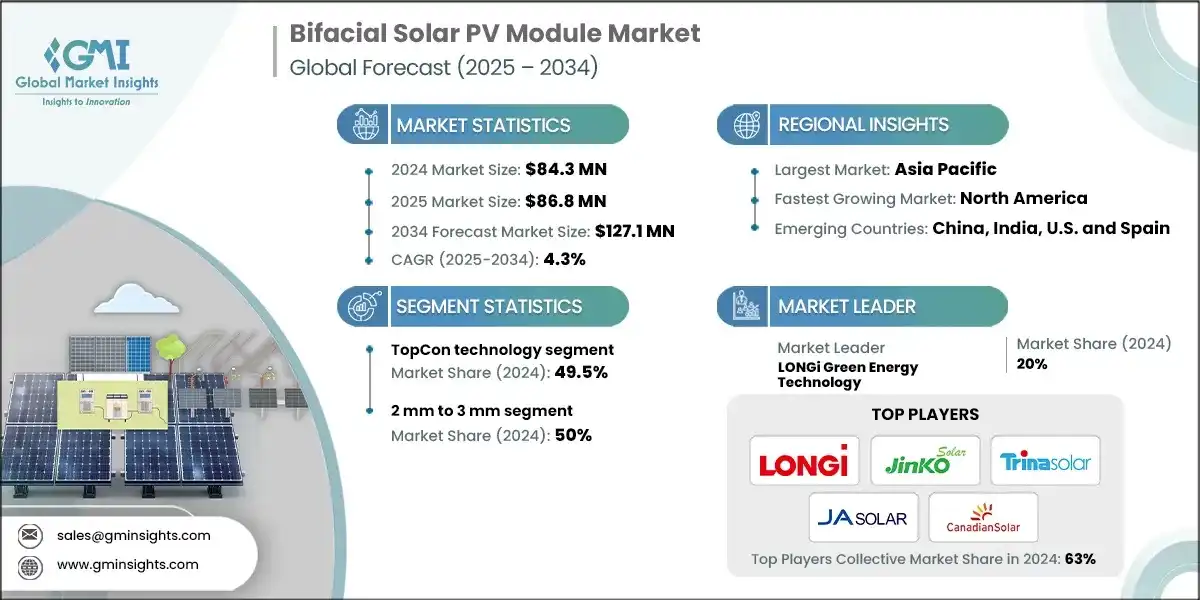
To get key market trends
- Global shift towards utility-scale solar is the most significant driver for bifacial module deployment. The utility-scale projects benefit most from bifacial technology owing to the ability to optimize site design and pair modules with advanced trackers, maximizing rear-side energy gain and overall system yield, thereby contributing to the market growth.
- Bifacial modules along with single-axis trackers (SAT) are the dominant configuration for new ground-mounted installations, with more than 50% of installed systems globally now using SAT. Various techno-economic studies demonstrate that bifacial plus SAT configurations achieve the lowest LCOE, with typical energy yield gains of 15-20% from tracking and an additional 2-10% from bifacial gain, driving the market scenario.
- Rapid transition from PERC to n-type cell technologies such as TOPCon offer higher bifaciality factors including improved temperature coefficients, and superior performance in high-irradiance and high-temperature environments, leading to enhanced product demand. Moreover, in hot, high-albedo regions comprising of Dubai among others, the bifacial modules demonstrate energy yield premiums that can justify price premiums of up to USD 0.043/Wdc over PERC modules, accelerating the business landscape.
- Key features including enhanced durability, improved moisture resistance, and superior rear-side light capture is set to augment the market growth. These modules are particularly well-suited for bifacial applications, as they support longer operational lifetimes and reduce degradation risks such as potential-induced degradation (PID) and encapsulant delamination, creating a favorable business momentum.
- Single-axis tracking is standard for new utility-scale plants, thereby boosting the energy yields by 15-20% over fixed-tilt systems. The tracker manufacturers have developed bifacial-optimized tracking algorithms, including backtracking, slope-aware controls, and albedo-responsive strategies, augmenting the business landscape. Furthermore, feed-in tariffs, renewable portfolio standards, net metering, and competitive auction mechanisms will continue to enhance adoption across the major markets.
- Sustainability in manufacturing is emerging as a procurement criterion, especially in Europe and North America regions. For instance, IRENA projects that PV panel waste could reach 1.7-8 million tons by the early 2030s, thereby driving the demand for circular economy solutions. The dual-glass modules are preferred for their superior durability, enhanced rear-side irradiance capture, and reduced degradation risks providing excellent moisture resistance, minimizing potential-induced degradation (PID) and encapsulant delamination for long-term performance in utility-scale projects
- Ongoing shift toward dual-glass architectures is driven by utility-scale developers seeking to maximize energy yield and minimize long-term O&M costs. These modules are particularly well-suited for bifacial applications, as the transparent rear surface allows for optimal light transmission and rear-side energy capture. Moreover, the backsheet modules offer a balance between cost and performance, as they are more susceptible to moisture ingress and edge-seal failures, leading to drive the business outlook.
Bifacial Solar PV Module Market Report Attributes
| Key Takeaway | Details |
|---|---|
| Market Size & Growth | |
| Base Year | 2024 |
| Market Size in 2024 | USD 84.3 Million |
| Market Size in 2025 | USD 86.8 Million |
| Forecast Period 2025 – 2034 CAGR | 4.3% |
| Market Size in 2034 | USD 127.1 Million |
| Key Market Trends | |
| Drivers | Impact |
| Ongoing decarbonization of the heating sector | Accelerating shift toward electrified heating solutions such as heat pumps, electric boilers, and district heating systems powered by renewable electricity which significantly increases the overall electricity demand. |
| Rising advancements in material innovations | Innovations such as n-type TOPCon and HJT cells, high-transmittance glass, anti-reflective and anti-soiling coatings, transparent backsheets, and advanced encapsulants are enhancing bifaciality ratios and boosting rear-side power generation. |
| Hybridization and system integration | Integrating bifacial modules with energy storage systems, solar-tracking technologies, and hybrid renewable setups such as solar-plus-wind creating more reliable, dispatchable power profiles and enhances overall system performance. |
| Pitfalls & Challenges | Impact |
| High system complexity & installation requirements | Bifacial systems require careful consideration of ground albedo, tilt angle, row spacing, tracker compatibility, and shading impacts to fully capture rear-side gains. This adds engineering and operational challenges, as suboptimal site design can significantly reduce the expected bifacial boost, impacting project economics. |
| Lack of standardized methods | Bifacial energy output depends heavily on site-specific variables ground reflectivity, soiling behavior, irradiance distribution, and tracker shading patterns making it difficult for developers and investors to confidently forecast long-term yields. Industry standards for bifacial testing and performance rating are still evolving, leading to inconsistencies in manufacturer specifications and energy yield predictions. |
| Opportunities: | Impact |
| Rapid expansion of utility scale projects | Large projects in the U.S., China, India, Middle East, and Latin America are now specifying bifacial as the preferred technology, opening significant demand for dual-glass and high-efficiency n-type module variants. |
| Growth of Tracker-Optimized Installations | Strong opportunities for deployment in cold climates including Canada, Nordic region, Middle Eastern deserts, and large tracker-based solar farms will drive the market growth. Manufacturers can capitalize by designing site-optimized bifacial systems and working with tracker companies to maximize rear-side performance. |
| Transition to N-Type Technologies | Global shift toward n-type cells provides a major opportunity for bifacial modules because these technologies inherently offer higher bifaciality, better durability, and superior efficiency. |
| Market Leaders (2024) | |
| Market Leaders |
20% market share |
| Top Players |
Collective market share in 2024 is 63% |
| Competitive Edge |
|
| Regional Insights | |
| Largest Market | Asia Pacific |
| Fastest Growing Market | North America |
| Emerging Countries | China, India, U.S. and Spain |
| Future outlook |
|
What are the growth opportunities in this market?
Bifacial Solar PV Module Market Trends
- The framed modules offer structural rigidity, ease of installation, and compatibility with standard mounting systems, making them the preferred option for utility-scale and commercial installations. Furthermore, frameless modules also offer potential advantages in soiling mitigation, as the absence of a frame reduces dust accumulation at module edges, stimulating the product penetration.
- Frameless designs are gaining traction in specialized applications such as agrivoltaics, floating PV, and building-integrated photovoltaics (BIPV), where reduced weight, improved aesthetics, and flexible mounting options will influence the business statistics. The USDA Natural Resources Conservation Service has further highlighted vertical bifacial frameless modules as a promising configuration for dual-use agricultural systems, thereby allowing for greater row spacing and simultaneous crop production.
- The utility-scale projects benefit most from bifacial technology owing to economies of scale, optimized site design, and integration with single-axis trackers. According to IRENA, the projected solar PV capacity will exceed to 5,400 GW by 2030, thereby driving the overall market outlook. Bifacial modules are increasingly specified for rooftop and ground-mounted C&I systems where space is limited and maximizing energy yield per square meter is critical. In addition, emerging markets with high electricity costs and abundant rooftop space are beginning to adopt bifacial modules for distributed generation.
Bifacial Solar PV Module Market Analysis
Learn more about the key segments shaping this market
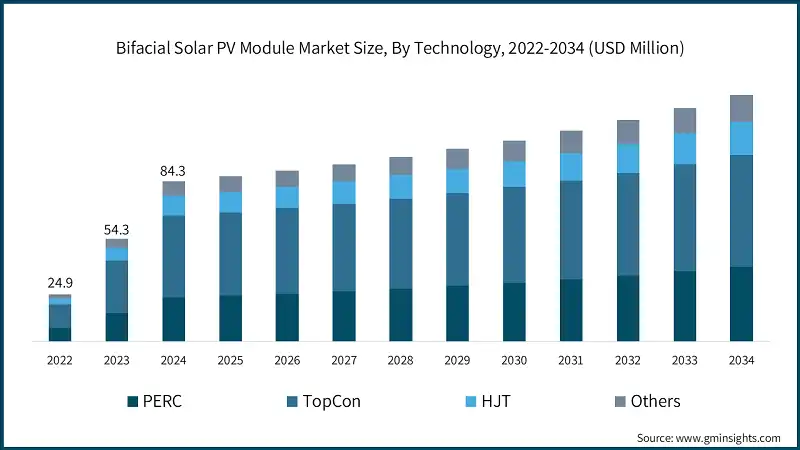
- Based on technology, the bifacial solar PV module market is segmented into PERC, TopCon, HJT and others. The TopCon technology dominates the market with 49.5% share in 2024, growing at over 6.5% CAGR through 2034.
- The TOPCon modules offers higher bifaciality of approximately 80%, improved temperature coefficients, and superior performance in high-irradiance environments, driving the business scenario. Many field studies in desert climates further confirm that TOPCon modules deliver higher specific energy yields and lower degradation rates, stimulating the technology demand.
- PERC market will grow to more than USD 540 million by 2034 and remains a mature and cost-competitive technology. Modern advanced designs with optimized bill-of-materials (BOM) and manufacturing processes continue to demonstrate competitive field performance, thereby maintaining a competitive share.
- HJT segment is anticipated to grow over 8.5% CAGR by 2034, on account of the highest bifaciality (up to 90%), superior temperature coefficients, and excellent low-light performance. However, higher manufacturing costs and encapsulant delamination risks have limited its widespread adoption. Furthermore, ongoing R&D efforts are focused on improving encapsulant durability and reducing production costs, influencing the business statistics.
- Other technologies include tandem, multi-junction, and emerging cell designs which hold a 6.4% share and will continue to grow with a CAGR of 9.9% by 2034. These technologies promise further efficiency gains and are the focus of significant R&D investment.
Learn more about the key segments shaping this market
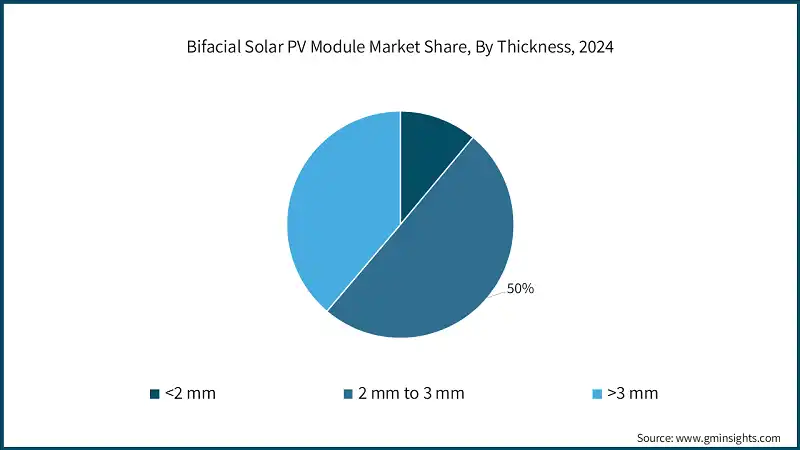
- Based on thickness, the bifacial solar PV module market is segmented into < 2 mm, 2 mm to 3 mm and > 3 mm. The 2 mm to 3 mm dominates with 50% market share and are anticipated to reach over 3.5% CAGR through 2034, on account of balancing cost, durability, and ease of installation. This thickness range is the industry standard for utility-scale projects, offering adequate mechanical strength and compatibility with automated manufacturing processes.
- The > 3 mm bifacial solar modules will grow to more than USD 50 million by 2034, owing to enhanced robustness for harsh environments, including high-wind zones, hail-prone regions, and desert climates with extreme temperature cycling. These modules are preferred for projects with stringent durability requirements, leading to enhanced market landscape.
- The < 2 mm market is set to grow over 5% CAGR by 2034, on account of greater utilization in lightweight and specialty applications such as building-integrated photovoltaics (BIPV) and portable solar systems, where weight reduction is critical. They further reduce module weight while maintaining adequate mechanical strength, which helps lower shipping, handling, and BOS (balance-of-system) costs, especially for rooftop and tracker-based installations, stimulating product adoption.
Looking for region specific data?
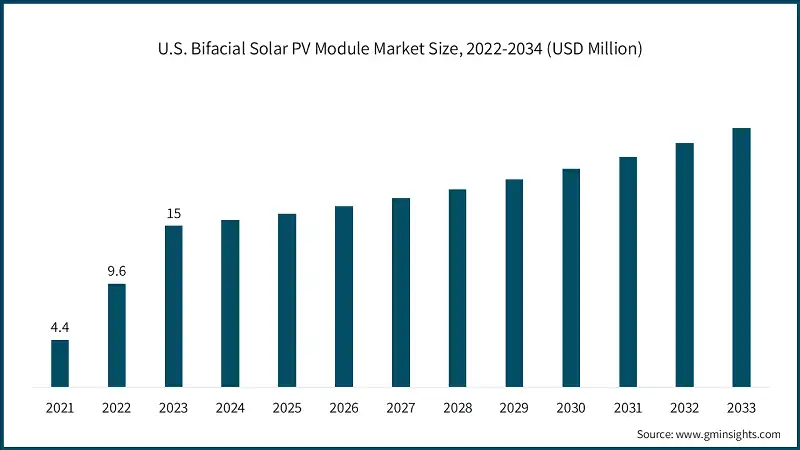
- The U.S. solar PV module market recorded a valuation of USD 4.4 million in 2022, reached USD 9.6 million in 2023 and will reach to USD 15 million by 2024. North America accounted for 19.9% of the global market share in 2024 characterized by the U.S. Inflation Reduction Act (IRA), state-level renewable portfolio standards, and a robust pipeline of utility-scale solar projects.
- The U.S. utility-scale market uses trackers in approximately 90% of projects, creating strong demand for bifacial modules. Further, NREL projects that bifaciality factors will increase from 0.65 in 2021 to 0.85 by 2035 in moderate and advanced scenarios, supporting higher capacity factors and LCOE reductions.
- Europe maintains 13.3% market share in 2024 and is anticipated to grow to more than 6% CAGR, supported by decarbonization mandates, the EU Green Deal, and repowering of legacy solar sites with higher-efficiency bifacial modules. Growing tracker penetration in the region is anticipated to rise to 55-60% in the forecasted times, leading to enhanced penetration in the region.
- Asia Pacific represents the fastest-growing region with over 3% CAGR anticipated by 2034. The region is led by China and India, which benefits from large-scale manufacturing, aggressive renewable energy targets, and supportive policy frameworks. China accounted for over 57% of global solar PV additions in 2024, with bifacial modules representing the majority of new installations. Additionally, India is rapidly expanding its bifacial manufacturing capacity through Production Linked Incentives (PLI), contributing to the overall business scenario.
- The Middle East and Africa region has a steady increase in the bifacial solar PV module adoption, are emerging as growth markets, supported by abundant land, high solar resource, and international development finance. Further, organizations including the World Bank and IRENA have established partnerships to scale renewable energy projects in these regions, providing risk mitigation and capital mobilization.
Bifacial Solar PV Module Market Share
- The top five players operating in the industry include LONGi Green Energy Technology, JA Solar, Jinko Solar, Canadian Solar and Trina Solar. These industry leaders have maintained their positions through vertical integration, global manufacturing footprints, and continuous investment in R&D for advanced bifacial and n-type cell technologies.
- Market concentration is expected to persist, as economies of scale, technology leadership, and supply chain integration remain decisive factors. China's vertical integration and manufacturing dominance have created significant cost advantages, with Chinese manufacturers accounting for over 80% of global polysilicon, wafer, cell, and module production.
- Further, the next tier of players including 3Sun, Hanwha Q CELLS, Meyer Burger, REC Group, and Risen Energy, Sharp Corporation, among others compete on innovation, regional market access, and strategic partnerships. The leading players are expanding manufacturing capacity for n-type and bifacial modules, with a focus on TOPCon and HJT technologies.
- Manufacturers are securing long-term supply agreements with utility-scale developers, EPCs, and project financiers to ensure stable demand and reduce exposure to spot market volatility. Surging investment in advanced module designs along with ongoing module development optimized for specific applications such as agrivoltaics, floating PV, and building-integrated systems will contribute to market growth.
- The Merger & Acquisition activity has intensified, with major players acquiring technology startups and regional manufacturers to accelerate innovation and market reach. Strategic alliances with tracker suppliers, inverter manufacturers, and digital O&M platforms are increasingly common, supporting turnkey project delivery and bankability.
Bifacial Solar PV Module Market Companies
Eminent players operating in the bifacial solar PV module industry are:
- 3Sun
- Astroenergy
- Boviet Solar Group
- Canadian Solar
- First Solar
- Hanwha Q CELLS Co., Ltd.
- JA Solar Technology
- JinkoSolar Holding Co., Ltd.
- LONGi Green Energy Technology
- Meyer Burger
- REC Group
- Reliance New Energy
- Risen Energy
- Sharp Corporation
- Seraphim Solar
- Solaria Corporation
- Sunergy
- SunPower Corporation
- Trina Solar
- Vikram Solar
- LONGi Green Energy is developing solutions for large-scale power plants, for different industries and households with its innovation-focused development. In 2024, the company recorded an annual revenue of USD 11.9 Billion. The company along with Jinko Solar have established dominant positions in Asia and are rapidly expanding in overseas markets, leveraging cost leadership and advanced n-type technologies. They have announced major capacity expansions for TOPCon and HJT cell and module production.
- JA Solar is tailoring modules for challenging environments like offshore, desert, and high-altitude regions using its Bycium+ cell tech. The company invested nearly 5.7% of its overall revenue on research and development activities. They further launched 0-busbar (0BB) high-efficiency modules and single-glass anti-dust accumulation modules, which are likely to be relevant in bifacial/high-durability applications.
- Trina Solar has secured strategic partnerships with leading tracker manufacturers to deliver integrated bifacial plus tracker solutions for North American solar farms, addressing the growing demand for turnkey project delivery. In the first half of 2024, Trina Solar reported USD 6.047 billion in revenue and a net profit of USD 74.1 million. Further, in December 2024, Trina launched its i-TOPCon Ultra series (Vertex N family) with 760 W utility modules, 24.5% efficiency, and a bifaciality factor of 90%.
- Canadian Solar is expanding its dual-glass module production capacity in Southeast Asia to meet rising demand in emerging markets, while also investing in energy storage and project development to create vertically integrated offerings. In 2024, the company revenue amounted to USD 1.5 billion. Further, they are investing in vertical integration expanding N-type TOPCon capacity, increasing its battery-energy-storage business (e-STORAGE), and building out its U.S. manufacturing/supply chain.
- First Solar continues to lead in thin-film technology but is exploring bifacial cadmium telluride (CdTe) designs to compete with crystalline silicon bifacial modules in utility-scale applications. The company is selectively pursuing bookings: it is leveraging its backlog and favors long-term partnerships, focusing on customers that value its thin-film CdTe technology and its differentiated cost/performance profile.
Bifacial Solar PV Module Industry News
- In January 2025, LONGi Green Energy announced the commissioning of a new 10 GW n-type TOPCon cell manufacturing plant in China, further strengthening its leadership in advanced bifacial module supply. The investment reinforces LONGi’s strategic shift toward next-generation n-type technologies and strengthens its competitive position in the global bifacial module market, where TOPCon-based bifacial panels are experiencing rapid adoption due to their higher bifaciality, superior low-light performance, and better degradation rates.
- In December 2024, Jinko Solar launched a new line of high-bifaciality HJT modules, targeting utility-scale projects in high-albedo regions such as deserts and snow-covered areas. These modules leverage HJT’s inherently superior bifacial response and low-temperature coefficient, enabling higher energy yields in extreme climates. The launch strengthens Jinko Solar’s positioning in the premium high-efficiency segment and supports its strategy to increase market share in large-scale bifacial solar deployments.
- In November 2024, Trina Solar secured a strategic partnership with a leading tracker manufacturer to deliver integrated bifacial plus tracker solutions for North American solar farms, addressing the growing demand for turnkey project delivery. This collaboration is aimed at optimizing rear-side energy capture, improving system-level performance, and meeting the region’s accelerating demand for turnkey, high-performance solar farm solutions. The partnership strengthens Trina Solar’s competitive positioning in the large-scale bifacial segment and supports its broader strategy of offering vertically integrated, high-yield project technologies.
- In October 2024, Canadian Solar expanded its dual-glass module production capacity in Southeast Asia to meet rising demand in emerging markets, with a focus on utility-scale and C&I applications. The additional capacity is geared toward supporting both utility-scale solar farms and the commercial & industrial segment, where dual-glass modules are increasingly preferred for their enhanced durability, lower degradation, and stronger long-term energy yield. This move aligns with Canadian Solar’s strategy to strengthen its global manufacturing footprint and capture rising demand for high-performance bifacial technologies.
This bifacial solar PV module market research report includes an in-depth coverage of the industry with estimates & forecast in terms of revenue and volume in “USD Million and MW” from 2021 to 2034, for the following segments:
Market, By Type
- Dual glass
- Glass backsheet
Market, By Technology
- PERC
- TopCon
- HJT
- Others
Market, By Application
- Residential
- Commercial & Industrial
- Utility
Market, By Thickness
- < 2 mm
- 2 mm to 3 mm
- > 3 mm
Market, By Frame Type
- Framed
- Frameless
The above information has been provided for the following regions and countries:
- North America
- U.S.
- Canada
- Mexico
- Europe
- Germany
- UK
- France
- Netherlands
- Spain
- Asia Pacific
- China
- India
- Japan
- South Korea
- Australia
- Middle East & Africa
- UAE
- Saudi Arabia
- South Africa
- Qatar
- Egypt
- Latin America
- Brazil
- Chile
- Argentina
Frequently Asked Question(FAQ) :
Who are the key players in the bifacial solar PV module market?
Key players include LONGi Green Energy Technology, Jinko Solar, Trina Solar, JA Solar, Canadian Solar, 3Sun, Astroenergy, Boviet Solar Group, First Solar, Hanwha Q CELLS, Meyer Burger, REC Group, Reliance New Energy, Risen Energy, Sharp Corporation, Seraphim Solar, Solaria Corporation, Sunergy, SunPower Corporation, and Vikram Solar.
What are the upcoming trends in the bifacial solar PV module market?
Key trends include transition to n-type technologies (TopCon and HJT), integration with single-axis trackers, dual-glass architecture adoption, and hybridization with energy storage systems for enhanced system performance.
Which region leads the bifacial solar PV module market?
North America held 19.9% of the global market in 2024, supported by the IRA, strong state renewable mandates, and a growing pipeline of utility-scale solar projects.
What is the growth outlook for HJT technology from 2025 to 2034?
HJT segment is projected to grow at over 8.5% CAGR by 2034, due to the highest bifaciality of up to 90%, superior temperature coefficients, and excellent low-light performance.
What was the valuation of the 2 mm to 3 mm thickness segment in 2024?
The 2 mm to 3 mm thickness segment held 50% market share in 2024 and is anticipated to grow at over 3.5% CAGR through 2034, balancing cost, durability, and ease of installation for utility-scale projects.
How much revenue did the TopCon technology segment generate in 2024?
TopCon technology dominated the market with 49.5% share in 2024, driven by approximately 80% bifaciality, improved temperature coefficients, and superior performance in high-irradiance environments.
What is the current bifacial solar PV module market size in 2025?
The market size is projected to reach USD 86.8 million in 2025.
What is the market size of the bifacial solar PV module in 2024?
The market size was USD 84.3 million in 2024, with a CAGR of 4.3% expected through 2034 driven by the global shift toward utility-scale solar installations and integration with single-axis tracking systems.
What is the projected value of the bifacial solar PV module market by 2034?
The bifacial solar PV module market is expected to reach USD 127.1 million by 2034, propelled by n-type technology adoption, tracker optimization, and declining LCOE in utility-scale projects.
Bifacial Solar PV Module Market Scope
Related Reports