Summary
Table of Content

Beverage Container Recycling Market
Get a free sample of this report
Form submitted successfully!
Error submitting form. Please try again.
Thank you!
Your inquiry has been received. Our team will reach out to you with the required details via email. To ensure that you don't miss their response, kindly remember to check your spam folder as well!
Request Sectional Data
Thank you!
Your inquiry has been received. Our team will reach out to you with the required details via email. To ensure that you don't miss their response, kindly remember to check your spam folder as well!
Form submitted successfully!
Error submitting form. Please try again.
Beverage Container Recycling Market Size
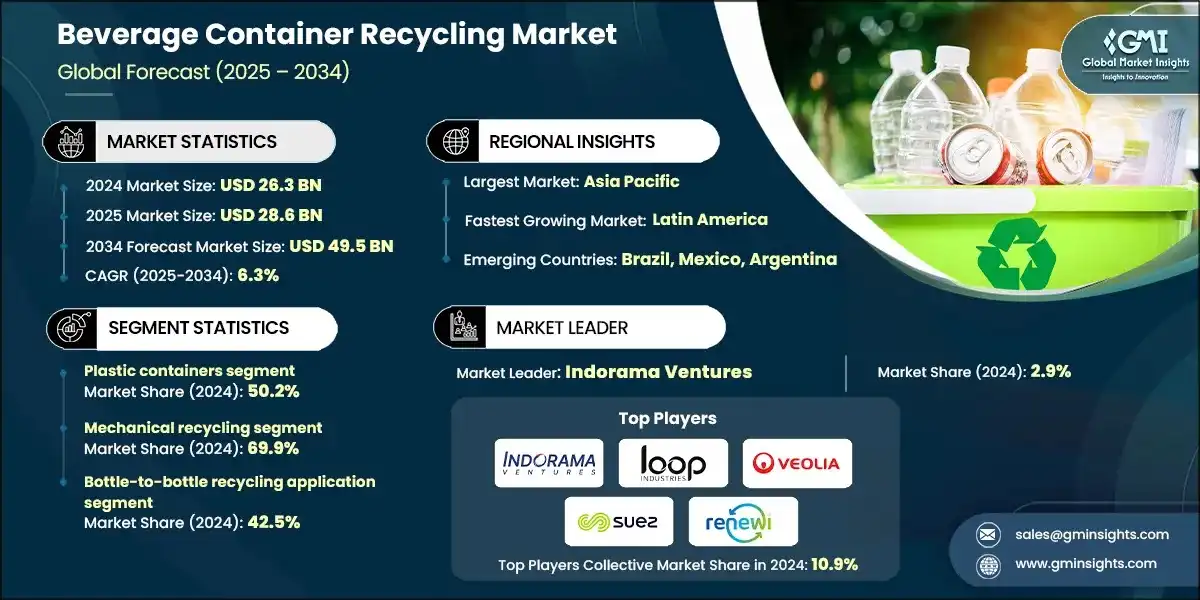
The global beverage container recycling market was estimated at USD 26.3 billion in 2024. The market is expected to grow from USD 28.6 billion in 2025 to USD 49.5 billion in 2034, at a CAGR of 6.3%, according to latest report published by Global Market Insights Inc.
Beverage Container Recycling Market Key Takeaways
Market Size & Growth
- 2024 Market Size: USD 26.3 Billion
- 2025 Market Size: USD 28.6 Billion
- 2034 Forecast Market Size: USD 49.5 Billion
- CAGR (2025–2034): 6.3%
Key Market Drivers
- Rising beverage consumption.
- Corporate sustainability commitments.
- Investment in recycling infrastructure.
Challenges
- High recycling costs.
- Contamination of recyclables.
Opportunity
- Growing consumer environmental awareness.
- Technological advancements in recycling.
- Regulatory push and legislation.
Key Players
- Market Leader: Indorama Ventures led with over 2.9% market share in 2024.
- Leading Players: Top 5 players in this market include Indorama Ventures, Loop Industries, Veolia Environmental Services, SUEZ, Renewi, which collectively held a market share of 10.9% in 2024.
Get Market Insights & Growth Opportunities
- The beverage container recycling market is driven by growing environmental awareness and stricter regulations to limit plastic waste. With increasing consciousness toward sustainability, consumer demands for sustainable packaging solutions have reached an all-time high. Governments from every region are establishing policies supporting recycling and restricting single-use plastics which encourages the recycling market. In addition, with eco-labels and corporate social responsibility initiatives making an enormous impact on market trends more companies are now focusing on sustainability through their choice of brands and recyclable packaging materials.
- Beyond the ecological advantages, the recycling market for beverage containers offers economic avenues through job creation and fostering of a circular economy. The recycled materials can be molded into new beverage containers, thereby minimizing the dependency on raw materials and reducing the costs of production. The market presents a very wide scope to be tapped especially for countries with emerging economies as they experience urbanization and disposable income level surges. Innovations in collection systems, deposit return schemes, and consumer engagement strategies will further promote recycling rates.
- Asia Pacific is the largest market for beverage container recycling due to advancement in technology and research facilities in China, India, Japan and other countries.
- Latin America is the fastest growing region for beverage container recycling market, due to increasing recycling facilities growth, also the region can enhance its performance in this market in the coming years.
To get key market trends
Beverage Container Recycling Market Trends
- The beverage container recycling industry is on the rise with various dynamics. Technological advancements, changes in regulatory frameworks, and product innovations are the key drivers behind this growth. Advancement in technology such as development of advanced sorting systems, chemical recycling, and automation supported by AI have enhanced the recycling efficiencies and material qualities considerably. These innovations permit better separation of recyclables, reduce contamination, and widen the horizon of recyclable materials, raising recovery rates and reducing environmental impacts.
- With increasing stringent regulatory frameworks, the different governments initiate the imposition of stricter regulation, deposit return schemes, and incentives to promote recycling. In various regions such as North America and Europe, policies that require higher recycling targets along with extended producer responsibility (EPR) are nudging companies to invest in sustainable practices. These regulations also inspire innovations in collection and sorting infrastructure aimed at developing a more circular economy.
- Product innovations are among the factors aiding the growth of this market as companies are developing lightweight, recyclable and eco-friendly packaging options to satisfy consumer demand for sustainability. Recycled PET (rPET) is found to be used more extensively in beverage bottles backed up by innovations in chemical recycling that allow for high-quality food-grade recycled plastics. Smart packaging, such as the inclusion of tracking and RFID technologies has enhanced supply chain transparency and consumer engagement.
Beverage Container Recycling Market Analysis
Learn more about the key segments shaping this market
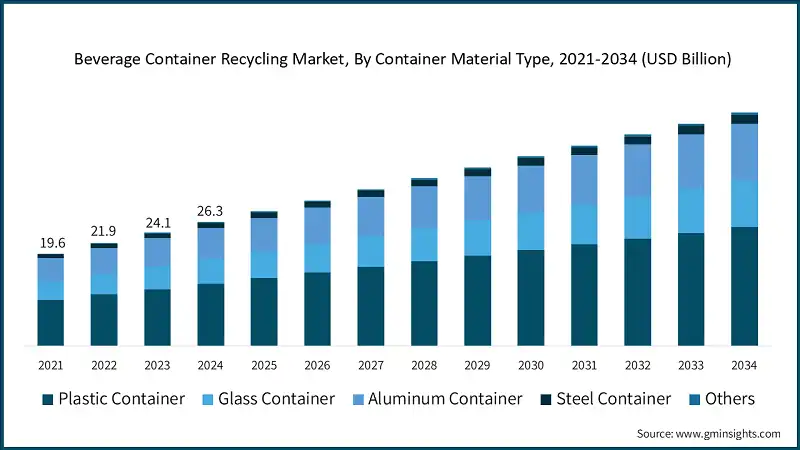
Based on container material type, the market is segmented into plastic container, glass container, aluminum container, steel container, and others.
- Plastic containers are the largest segment in beverage container recycling industry accounted 50.2% market share in 2024. Maintaining this top position, the segment is expected to witness strong growth at a CAGR of 6.4% through 2034 due to the volume of plastic beverage containers in circulation and regulatory pressure for plastic waste management.
- There is improved acceptance of glass containers particularly in the beverages and cosmetics sectors because of their recyclability, chemical inertness and premium look. With the consumers' inclination toward sustainable and premium packaging options, these factors boost the use of glass, accompanied by advancements in manufacturing and recycling technologies.
- Aluminum containers represent 24.9% of the market share in beverage container recycling market in 2024, expected to grow at 6.1% CAGR for the duration of the forecast period. The recyclability of aluminum cans is typically far better than that of any other container type. They can be recycled infinitely, without loss of quality, which makes them vital for the circular economy.
Learn more about the key segments shaping this market
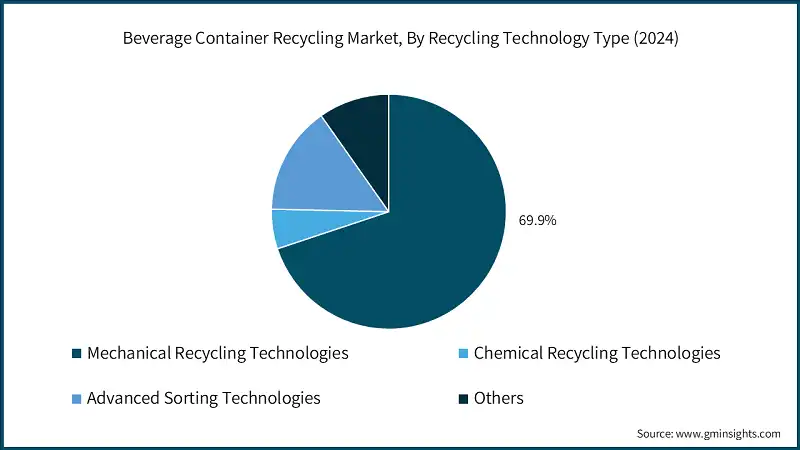
Based on recycling technology type, the beverage container recycling market is segmented into mechanical recycling technologies, chemical recycling technologies, advanced sorting technologies, and others.
- Mechanical recycling is the primary mode of recycling for beverage containers, with a market share of 69.9% in 2024. It has been practiced over some decades as the most traditional and widely used approach in recycling beverage containers. This segment included conventional physical processing methods such as collection, sorting, washing, shredding, melting, and pelletizing to get old containers transformed into recycled material ready for product manufacture. This portion of mechanical recycling is expected to grow at a CAGR of 6.2%, reflecting continuous improvements in the areas of sorting accuracy, contamination reduction, and processing efficiency.
- Chemical recycling technologies segment is expected to grow with a market share of 5.5% in 2024, showing increased investment and commercial deployment of these advanced processes. Chemical recycling, or advanced recycling, processes the breaking of polymer chains completely at a molecular level and reconstructs them into virgin-quality materials fit for use in applications for contact for food without quality limitations.
- Advancements in sorting technologies consist of AI, robotics, and sensor-based systems. These have growth potential as they contribute to the efficiency and accuracy of waste separation. Adoption of such innovative sorting systems is expanding across waste management facilities worldwide.
Based on end use applications, the beverage container recycling market is segmented into bottle-to-bottle recycling applications, fiber & textile applications, construction materials applications, non-food contact container manufacturing, and others.
- The bottle-to-bottle recycling application segment leads to a market share of 42.5% in 2024 and a CAGR of 6.7% in the forecasted period, thus being the highest-appreciated application for recycled beverage containers. This closed-loop application allows to produce food-grade recycled materials, therefore fulfilling the sustainability targets of beverage producers. Among other major global brands, Coca-Cola, PepsiCo, and Danone have set ambitious targets for all their brands globally to use recycled content in the range of 25-50% in their plastic bottles by 2025-2030, thereby creating a sustained demand for high-quality recycled materials.
- The fiber and textile applications segment has a market share of 24.8% in 2024. Recycled PET bottles are processed into polyester fibers for use in clothing, carpets, automotive textiles, and industrial applications. This segment provides an extremely important outlet for lower-grade materials that may not meet food-contact specifications in such a way as to maximize both recovery rates for the materials and the economic return from the whole recycling activity.
- Construction materials applications are gaining acceptance as this industry develops from incorporating recycled plastics into building and construction products, such as pipes, insulation, and decking. The durability and cost advantages of recycled materials combine with the enormous construction activity impetus, and these factors will boost growth for the segment.
- In the non-food contact container manufacturing segment, these recycled plastics are used to manufacture several packaging solutions that do not come into direct contact with food, such as household chemical bottles, and personal care products. Increasingly, this sector is driven by the demand for green packaging options and laws targeted at banning single-use plastic.
Looking for region specific data?
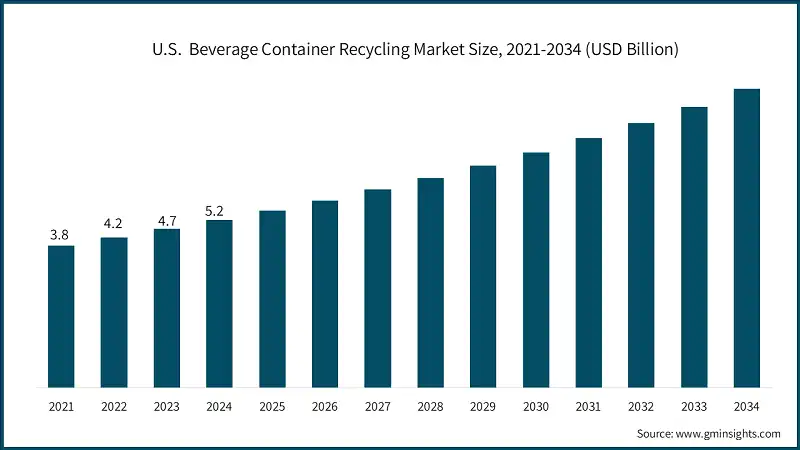
North America accounted for a decent share of the global beverage container recycling market with 24.2% of the market share in 2024 and 6.6% CAGR through 2034.
- With stricter environmental regulations, coupled with growing environmental awareness and corporate sustainability initiatives, the North American beverage container recycling market is growing at a healthy rate. Extended producer responsibility or EPR policies are becoming popular in countries such as the U.S. and Canada to encourage manufacturers to recycle their products after use. The advanced recycling technologies coupled with the presence of leading beverage companies now embarking on sustainability have triggered further growth of the market.
Europe beverage container recycling accounted for USD 9.1 billion in 2024 and is anticipated to show steady growth over the forecast period.
- Different recycling rate targets imposed by European Union and the ban on single-use plastics have led to growth in investments in the integrated and innovative recycling infrastructures. Countries like Germany, Italy and UK have adopted modern sorting and chemical recycling technologies to achieve the desired sustainability upfront. The rising consumer awareness along with the trend toward eco-friendly packaging are other reasons contributing to the expansion of the market. Overall, Europe is likely to retain its leading position in beverage container recycling.
The Asia Pacific market is anticipated to grow at the CAGR of 6% during the analysis timeframe.
- Asia Pacific has been experiencing a rapid pace in the development of the beverage container recycling market, as driven by rapid urbanization, the grown economic development rate, and the raised middle class. Countries include China, India, and Japan are taking stricter measures regarding the regulations invested in recycling infrastructure. The large population base in the region generates a considerable amount of plastic waste; hence, challenges and opportunities for recycling will exist. Innovations in recycling technology and collaborative projects between governments and private players will increase revenue into the market.
Latin America beverage container recycling accounted for 3.8% market share in 2024 and is anticipated to show fastest growth over the forecast period.
- Latin America is increasingly taking shape as an important and emerging region in the field of beverage container recycling. Brazil and Mexico, for example, are developing recycling infrastructure and prompting public participation programs. The region has some waste management infrastructural challenges but has witnessed improvements in recycling rates from several ongoing initiatives that have resulted in positive trends for the market. Towards that end, more multinational companies are adopting sustainable practices, further bolstering the growth potential of the market region.
Middle East & Africa beverage container recycling accounted for 1.8% market share in 2024 and is anticipated to show lucrative growth over the forecast period.
- The Middle East and Africa is growing in the beverage container recycling market, though with all indications it is showing promising growth. Growing environmental awareness coupled with the government's move towards reduction of plastic waste is attracting investments into recycling infrastructure. In countries such as South Africa, UAE, recycling policies and infrastructures are just beginning to take shape. Other organizations are increasingly investing in sustainable waste management practices in several countries, which would in turn fund market growth.
Beverage Container Recycling Market Share
The top 5 companies in the beverage container recycling industry include Indorama Ventures, Loop Industries, Veolia Environmental Services, SUEZ, and Renewi. These are prominent companies operating in their respective regions covering 10.9% of the market share in 2024. These companies hold strong positions globally due to their experience in beverage container recycling market. Their diverse product portfolios, backed by robust production capabilities and distribution networks, enable them to meet the rising demand across various regions.
- Indorama Ventures is a strong player in PET manufacturing and is quite actively making investments to enhance its recycling capabilities to meet circular economic requirements. Coupled with its huge manufacturing network and strategic partnering with brand owners, the company is highly positioned to integrate recycled materials into packaging.
- Loop Industries has an extremely unique chemical recycling technology, which deploys PET plastics to their simple building blocks. Loop is aligned with top-tier consumer brands and packaging manufacturers, thus positioning itself in front of the line toward making high-value recycled materials available to the beverage container market.
- Veolia is a prominent name in waste management and recycling companies with extensive geographical reach. Veolia's leverage includes extensive infrastructure availability and technological strength, enhancing the company's recycling efficiency and increasing market share especially in regions with considerable support from regulatory frameworks for waste recovery and sustainability initiatives.
- SUEZ is a global resource management company offering new technologies for waste recovery and recycling. Advanced sorting and recycling technologies, chemical recycling among them, are used on some complex plastics typically found in beverage containers. SUEZ's sustainable approach nowadays and rich global geographical footprint enables the company to seize opportunities arising from an ever-increasing repertoire of tracked environmental regulations and rising demand for green packaging from consumers.
- Renewi is gradually taking on the position of a regional player specializing in waste management and recycling solutions specifically for the beverage container segment. The company explicates sorting technologies that are innovative and engages with the local government and beverage brands to develop infrastructures around efficient recycling.
Beverage Container Recycling Market Companies
Major players operating in the beverage container recycling industry include:
- Biffa
- Indorama Ventures
- Loop Industries
- Recycleye
- Remondis SE & Co. KG
- Renewi plc
- Sims Limited
- Stericycle Inc.
- SUEZ
- Veolia Environmental Services
- Waste Management Inc.
Beverage Container Recycling Market Report Attributes
| Key Takeaway | Details |
|---|---|
| Market Size & Growth | |
| Base Year | 2024 |
| Market Size in 2024 | USD 26.3 Billion |
| Market Size in 2025 | USD 28.6 Billion |
| Forecast Period 2025 - 2034 CAGR | 6.3% |
| Market Size in 2034 | USD 49.5 Billion |
| Key Market Trends | |
| Drivers | Impact |
| Rising beverage consumption | Growing urbanization and changing lifestyles are increasing demand for bottled and canned beverages, boosting the need for sustainable packaging solutions. |
| Corporate sustainability commitments | Beverage companies are setting sustainability targets, investing in recyclable packaging to meet consumer and regulatory expectations. |
| Investment in recycling infrastructure | Expansion and modernization of recycling facilities enhance collection efficiency and recycling rates, supporting market growth. |
| Pitfalls & Challenges | Impact |
| High recycling costs | The expenses associated with collection, sorting, and processing recyclables can hinder profitability and market expansion. |
| Contamination of recyclables | Improper disposal and contamination of containers reduce recycling efficiency and increase processing challenges. |
| Opportunities: | Impact |
| Growing consumer environmental awareness | Increasing awareness about plastic pollution and environmental impact is driving consumers to prefer brands that use recyclable packaging. |
| Technological advancements in recycling | Innovations in recycling technologies, such as automated sorting and chemical recycling, are improving efficiency and recycling rates. |
| Regulatory push and legislation | Governments worldwide are implementing stricter regulations, bans on single-use plastics, and incentives for recycling, which are shaping the market dynamics. |
| Market Leaders (2024) | |
| Market Leaders |
2.9% |
| Top Players |
Collective Market Share 10.9% in 2024 |
| Competitive Edge |
|
| Regional Insights | |
| Largest Market | Asia Pacific |
| Fastest Growing Market | Latin America |
| Emerging Country | Brazil, Mexico, Argentina |
| Future Outlook |
|
What are the growth opportunities in this market?
Beverage Container Recycling Industry News
- In November 2025, Carbios signed an agreement with Wankai New Materials, which is a subsidiary of Zhink Group, to deploy PET biorecycling technologies at large scale with the starting construction of a new stage in China.
- In September 2024, Indorama Ventures Public Company Limited established a subsidiary, IVL Dhunseri Petrochem Industries Limited, and formed a joint venture with Dhunseri Ventures Limited and Varun Beverages Limited, to develop several greenfield state-of-the-art PET recycling facilities in India.
This beverage container recycling market research report includes in-depth coverage of the industry, with estimates & forecasts in terms of revenue (USD Billion) and volume (Kilo Tons) from 2025 to 2034, for the following segments:
Market, By Container Material Type
- Plastic container
- PET bottle
- HDPE container
- Other polymer
- Glass container
- Aluminum container
- Steel container
- Others
Market By Recycling Technology Type
- Mechanical recycling technologies
- Chemical recycling technologies
- Advanced sorting technologies
- Others
Market By End Use Application
- Bottle-to-bottle recycling applications
- Food-grade rPET for beverage containers
- Glass cullet for new bottle manufacturing
- Aluminum can-to-can recycling
- Fiber & textile applications
- Construction materials applications
- Non-food contact container manufacturing
- Personal care & cosmetic packaging
- Household & industrial chemical containers
- Others
- Others
The above information is provided for the following regions and countries:
- North America
- U.S.
- Canada
- Europe
- Germany
- UK
- France
- Spain
- Italy
- Rest of Europe
- Asia Pacific
- China
- India
- Japan
- Australia
- South Korea
- Rest of Asia Pacific
- Latin America
- Brazil
- Mexico
- Argentina
- Rest of Latin America
- Middle East and Africa
- Saudi Arabia
- South Africa
- UAE
- Rest of Middle East and Africa
Frequently Asked Question(FAQ) :
What is the market size of the beverage container recycling industry in 2024?
The market size for beverage container recycling was valued at USD 26.3 billion in 2024, with a CAGR of 6.3% projected through 2034 driven by rising beverage consumption and sustainability initiatives.
What is the current beverage container recycling market size in 2025?
The market size is expected to reach USD 28.6 billion in 2025, supported by increasing urbanization, beverage demand, and advancements in recycling infrastructure.
What is the projected value of the beverage container recycling market by 2034?
The beverage container recycling industry is forecasted to reach USD 49.5 billion by 2034, fueled by stricter environmental regulations, corporate sustainability commitments, and technological innovations in recycling.
How much revenue did the plastic container segment generate in 2024?
Plastic containers accounted for 50.2% of the beverage container recycling market in 2024, maintaining dominance due to the high volume of PET and HDPE bottles in circulation. Regulatory pressure for plastic waste management continues to drive growth in this segment.
What was the valuation of the aluminum container segment in 2024?
Aluminum containers represented 24.9% of the market share in 2024, growing at a CAGR of 6.1% through 2034. Their infinite recyclability and cost efficiency make aluminum vital for the circular economy in the beverage recycling industry.
What is the growth outlook for bottle-to-bottle recycling applications from 2025 to 2034?
The bottle-to-bottle recycling application segment held 42.5% share in 2024 and is expected to grow at a 6.7% CAGR till 2034. Increasing use of food-grade rPET by beverage brands such as Coca-Cola and PepsiCo drives this sustained growth.
Which region leads the beverage container recycling market?
North America accounted for 24.2% of the global market in 2024, expanding at a 6.6% CAGR through 2034. Growth is supported by strict environmental regulations, adoption of extended producer responsibility (EPR) programs, and strong corporate recycling initiatives.
What are the upcoming trends in the beverage container recycling industry?
Key trends include expansion of chemical and mechanical recycling technologies, smart sorting systems using AI and robotics, and growing investment in circular economy infrastructure by global beverage brands.
Who are the key players in the beverage container recycling market?
Major companies include Indorama Ventures, Loop Industries, Veolia Environmental Services, SUEZ, Renewi, Biffa, Recycleye, Remondis SE & Co. KG, Sims Limited, Stericycle Inc., and Waste Management Inc.
Beverage Container Recycling Market Scope
Related Reports