Summary
Table of Content

Battery Recycling Chemicals Market
Get a free sample of this report
Form submitted successfully!
Error submitting form. Please try again.
Thank you!
Your inquiry has been received. Our team will reach out to you with the required details via email. To ensure that you don't miss their response, kindly remember to check your spam folder as well!
Request Sectional Data
Thank you!
Your inquiry has been received. Our team will reach out to you with the required details via email. To ensure that you don't miss their response, kindly remember to check your spam folder as well!
Form submitted successfully!
Error submitting form. Please try again.
Battery Recycling Chemicals Market Size
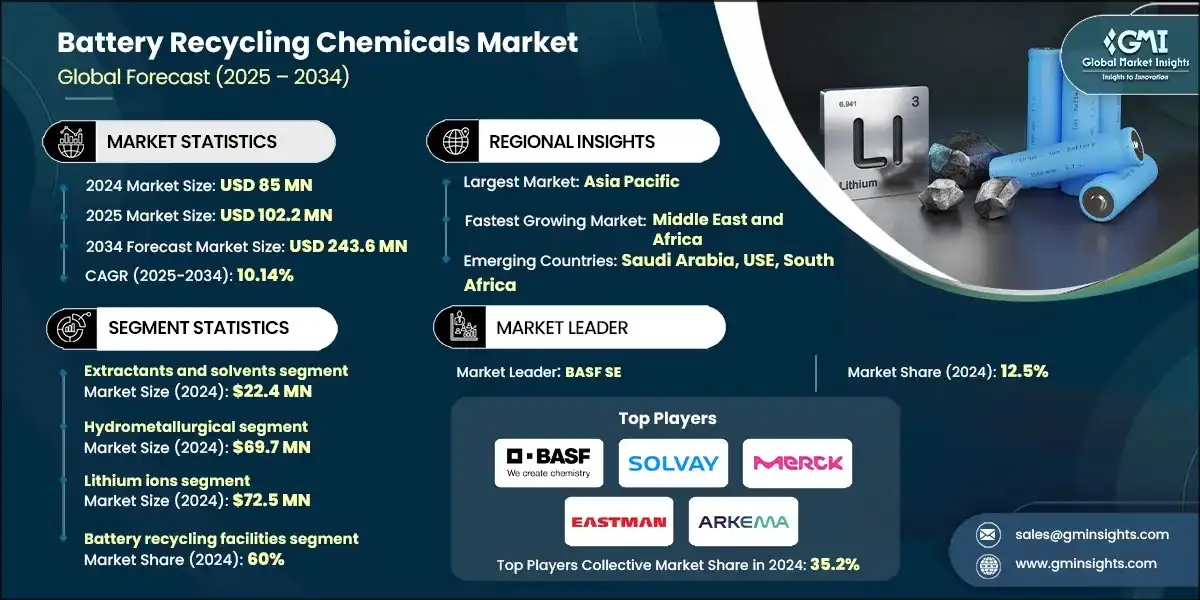
The global battery recycling chemicals market was valued at USD 85 million in 2024. The market is expected to grow from USD 102.2 million in 2025 to USD 243.6 million in 2034, at a CAGR of 10.14% according to the latest report published by Global Market Insights Inc.
To get key market trends
- Chemical recycling catalysts are specific compounds that facilitate chemical reaction transformations for breaking down waste polymers and plastics to original monomers or other useful compounds. Chemical recycling works differently than mechanical recycling, as it does not physically treat the waste plastics but uses catalysts to renew or change material at a molecular level so that it can be effective in high-quality feedstock recovery. These catalysts have been developed to augment reaction efficiency, selectivity, and sustainability, forming a very foundation for advanced recycling technologies.
- Development of battery recycling chemicals market is catered by technological shift in waste management and circular economy strategies. Conventional recycling usually leads to downcycled products of lesser quality, whereas chemical recycling with the help of effective catalysts allows for nearly full restoration of material properties. This shift is due to increasing environmental awareness, stricter regulations, and the search for sustainable solutions for the plastics industry.
- Chemical recycling catalysts lower the amount of the energy required by chemical reactions that break the bonds in polymers. Depending on the composition of these catalysts, pyrolysis, hydrolysis or depolymerization occur. Metal catalysts provide active sites for bond-cleavage reactions and therefore, accelerate the reactions. Acid-base catalysis, in contrast, will promote hydrolytic cleavage or the esterification process. A new classification of catalysts is relative to the parameter of high yield, selectivity toward the desired product, and mild conditions to minimize energy consumption and environmental impact.
Battery Recycling Chemicals Market Report Attributes
| Key Takeaway | Details |
|---|---|
| Market Size & Growth | |
| Base Year | 2024 |
| Market Size in 2024 | USD 85 Million |
| Market Size in 2025 | USD 102.2 Million |
| Forecast Period 2025 - 2034 CAGR | 10.14% |
| Market Size in 2034 | USD 243.6 Million |
| Key Market Trends | |
| Drivers | Impact |
| Surge in EVs & energy-storage drives supply surge | Widespread adoption of electric vehicles and growth in grid/renewable energy storage are flooding the market with spent batteries. As more batteries retire from cars, electronics, and storage installations, recyclers and chemical-suppliers get a steady stream of input material boosting demand for recycling processes and related chemicals. |
| Adoption of advanced recovery technologies | Hydrometallurgical and direct-recycling technologies are gaining prominence due to higher efficiency, lower energy use, and improved metal recovery. These innovations allow recyclers to process diverse battery chemistries, enabling broader adoption of chemical-based recycling solutions and boosting overall market growth. |
| Rising demand from emerging battery chemistries | The growth of new battery types, including sodium-ion and solid-state batteries, is creating demand for tailored chemical solutions. Recycling these advanced chemistries requires innovative leaching agents, solvents, and extractants, providing opportunities for chemical suppliers to expand offerings and capture emerging market segments. |
| Pitfalls & Challenges | Impact |
| High capital and operational costs | Setting up advanced chemical recycling facilities requires significant investment in technology, equipment, and safety infrastructure. Ongoing operational costs for chemicals, energy, and waste management can also be substantial, limiting entry for smaller players. |
| Complex and diverse battery chemistries | Batteries vary widely in their chemistries (lithium-ion, LFP, sodium-ion, solid-state), which makes designing universal chemical recovery processes challenging. This complexity can reduce efficiency and increase R&D costs for recycling solutions. |
| Opportunities: | Impact |
| Innovation in specialized chemicals | The rise of new battery chemistries, such as sodium-ion and solid-state, requires tailored chemical solutions for efficient recovery. Developing these specialized reagents presents a significant growth opportunity for manufacturers. |
| Integration with circular economy initiatives | Governments and industries are emphasizing sustainable resource use and material circularity. Companies can capitalize on this trend by providing chemical solutions that enable efficient metal recovery and reuse, reducing dependence on virgin raw materials. |
| Expansion in emerging markets | Developing regions in Asia, Latin America, and Africa are investing in battery recycling infrastructure. This creates new markets for chemical suppliers and allows early entrants to establish a strong foothold. |
| Market Leaders (2024) | |
| Market Leaders |
12.5% |
| Top Players |
Collective market share of 35.2% in 2024 |
| Competitive Edge |
|
| Regional Insights | |
| Largest Market | Asia Pacific |
| Fastest Growing Market | Middle East and Africa |
| Emerging Country | Saudi Arabia, USE, South Africa |
| Future Outlook |
|
What are the growth opportunities in this market?
Battery Recycling Chemicals Market Trends
- The chemical recycling catalyst market is growing due to the increasing focus on sustainable and circular economy principles. Industries have come forward to invest in advanced catalysts using valuable chemicals, monomers, or fuels converting post-consumer plastics and mixed waste streams, thereby reducing the dependency in virgin fossil-based resources and operating under sustainable conditions.
- Technological developments in catalyst design are enhancing the catalysis efficiency, selectivity, and lifespan, and there are multi-feedstock catalysts becoming available that can process heterogeneous and contaminated plastic streams. These progressions put chemical recycling economically viable and largescale, resolving one of the major challenges in handling plastic waste.
- Rising demand for recycled chemicals and polymers is noted in industries such as packaging, that is driven by corporate sustainability goals and in compliance with emerging regulations. This trend further open collaboration between catalyst manufacturers, recycling industry stakeholders and end-use industries for comparability on quality and supply in recycled outputs.
- Supporting government policies which include waste management regulations, mandates to recycle and incentives for sustainable technology are likely to speed up the market growth with an augmentation of increasing private investments in commercially scaled plants. Competition-based businesses would be aligned with the establishment of high-performance battery recycling chemicals.
Battery Recycling Chemicals Market Analysis
Learn more about the key segments shaping this market
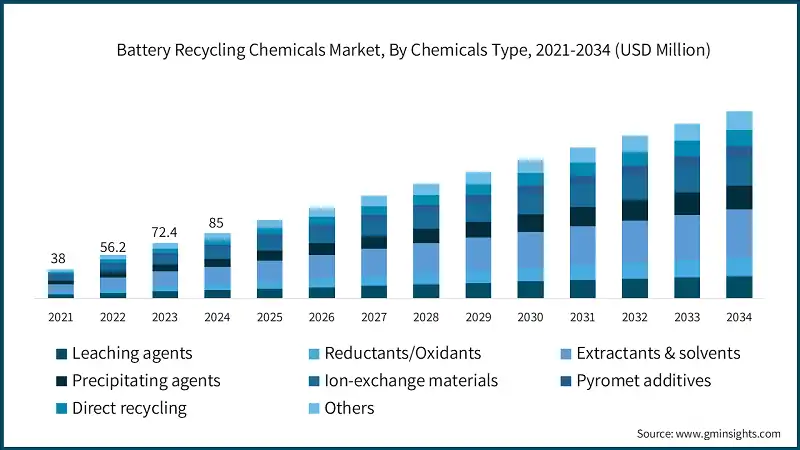
The battery recycling chemicals industry by chemicals type is segmented into leaching agents, reductants/oxidants, extractants & solvents, precipitating agents, ion-exchange materials, pyromet additives, direct recycling and others. Extractants and solvents hold the largest market value of USD 22.4 million in 2024.
- The leaching agents component plays an important role in different processes of chemical and battery recycling, as a means of extraction for required metals from secondary or newly processed raw materials. Reductive and oxidizing agents will normally be used with any of these chemicals based on the desired change, thus improving recovery efficiency. Extractants where solvents are used specifically for the separation and purification of certain components lead to enhanced material processing. Precipitating agents recover metals or compounds from a solution that will be reused in the overall process sustainability.
- Ion-exchange materials and pyrometallurgical additives are widely used to improve selective recycling and refining operations. Direct material recovery recycling processes are intended to recover functional materials with minimal chemical modification, thereby maintaining value and reducing environmental impact. Others include chemicals and materials for supplementary processes that provide flexibility to the different feedstocks and operational conditions. All these segments combined give impetus for the advancement of chemical recovery and material recycling technologies.
The battery recycling chemicals market by process type is segmented into hydrometallurgical, pyrometallurgical, direct & physical, bioleaching and hybrid process. Hydrometallurgical holds the largest market value of USD 69.7 million in 2024.
- Hydrometallurgical processes are versatile technologies that could be used to extract metals from spent batteries and materials found in chemical solutions to create precisely controlled recoveries and allow for the efficient separation of valuable elements. On the other hand, pyrometallurgical processes involve high-temperature treatment to recover metals which basically simplify complex materials and require energy input.
- Direct and Physical processes are used for mechanical separations of components without much chemical treatment, allowing for faster processing and less chemical consumption in some applications. In bioleaching, microorganisms promote the extraction of metals from ore or waste. This process offers a low-energy alternative that could be adapted to a variety of feed stocks. Hybrid processes integrate chemical, thermal, and biological methods to optimize recovery efficiency, purity of material, and environmental impact.
The battery recycling chemicals market by battery chemistry is segmented into lithium-ion, lead-acid, nickel-based, alkaline & others. Lithium ions hold the highest market value of USD 72.5 million in 2024.
- The battery chemistry landscape is diversifying rapidly with technologies being adopted in different ways across consumer, industrial, and energy storage applications. Lithium-ion continues to grow because of its high energy density and suitability for portable electronics and electric mobility, while the classic lead-acid battery is preferred where cost and reliability are the key factors as in backup power systems or automotive starting batteries. Nickel-based options are essential in areas where high durability, temperature tolerance, and long cycle life are the top priorities, especially in niche industrial environments.
- At the same time, alkaline and other developing chemistries comprise those segments requiring power affordably, easily available, and disposable, especially for household and to be used devices. In unison, these categories reflect an increasing market toward better performance and sustainability under current chemistries for the sake of stability and lower-cost deployment. The combination of older and newer technologies indicates continued innovation with stable but persistent demand over a wide range of characteristics for energy storage.

Learn more about the key segments shaping this market
The battery recycling chemicals market by end use industry is segmented into battery recycling facilities, metal refineries & smelters, chemical processing plants, automotive OEMS, electronics recyclers and industrial battery recyclers. Battery recycling facilities holds the highest market share of 60% in 2024.
- These days, with major countries focusing on sustainability using resources more efficiently, battery recycling, metal refining, chemical processing, automotive manufacturing, and electronics recycling continue to grow. With electric vehicles, energy storage systems, and electronics, the demand for recovery from end-of-life products is increasing for valuable metals and materials. Recycling and refining processes helps in reducing environmental impact and thus ensuring a reliable supply of critical materials like lithium, cobalt, and nickel.
- Furthermore, automotive OEMs, electronics recyclers, and chemical processing plants are increasingly applying recovered materials into their new products, thereby supporting the practice of circular economy. These industries are also benefiting from technological advancements to improve extraction and reuse. In sum, the three areas have been growing across the end-users due to a common emphasis on sustainable production, waste reduction, and supply chain resilience.
Looking for region specific data?
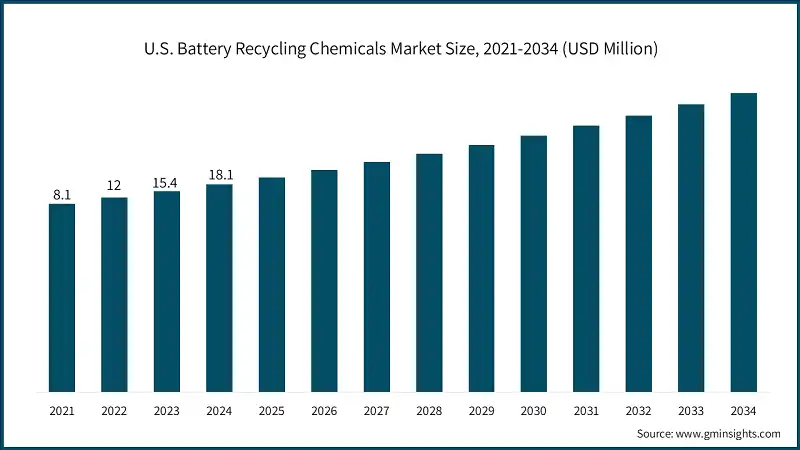
The U.S. battery recycling chemicals market accounted for USD 18.1 million in 2024.
- In North America, which includes the U.S. and Canada, the battery recycling chemicals industry is growing as companies focusing on the recovery of critical metals like lithium, cobalt, and nickel through advanced chemical processes. The growing adoption of electric vehicles and energy storage systems is stimulating the demand for efficient hydrometallurgical and chemical treatments, and regulatory support for environmentally sustainable recycling activities further enhances investment in chemical solutions for battery recovery.
The Germany battery recycling chemicals market is expected to experience significant growth from 2025 to 2034.
- The growth of batteries recyclable chemicals market in Europe is catered by strict regulations on environment and recycling economy. Countries such as Germany, France, and the UK have been giving emphasis to the use of specialized chemicals used for effectively recovering metals from batteries while reducing industrial waste. All this is facilitated by the combination of regulatory mandates, increasing adoption of EVs and by developing measures to promote sustainability, all of which lead to increase in demand of advanced chemical processes and solutions with regard to operations in battery recycling.
The China battery recycling chemicals market is expected to experience notable growth from 2025 to 2034.
- The Asia-Pacific region is the growing at a faster pace for battery recycling chemicals, as there is high production and consumption of batteries, especially within China, Japan, and South Korea. These include the application of chemical processes for the efficient recovery of lithium, nickel, cobalt, and such materials, which are needed for the extensive EV and electronics manufacturing industries. Government policies favoring recycling and resource efficiency are likely to induce increased uptake of these special chemicals involved in battery recovery.
UAE battery recycling chemicals market is expected to experience promising growth from 2025 to 2034.
- In the Middle East and Africa region, the battery recycling chemicals industry is still in its early stages, which is further characterized by development of industrial hubs and newly emerged urban centres. Increasingly, countries are looking at environmentally safe disposal of batteries in various industries, particularly in telecom, energy storage, and automotive. The technological advancement shapes the market, thus creating demand for partnerships and further investment for local recycling infrastructure, while the regulatory framework evolves to support sound sustainability choices.
Brazil battery recycling chemicals market is expected to experience growth from 2025 to 2034.
- In Latin America, the battery recycling chemicals industry is driven by abundance of natural resources and increasing interests in electric mobility. To minimize waste in local supply chains countries like Brazil, Chile, and Argentina are using chemical recovery methods to recover lithium, cobalt, and nickel from spent batteries. The market development is due to environmentally friendly practice and increased EV adoption, along with initiatives to implement recycling in industrial operations, makes Latin America a very dynamic area for innovative chemical recycling solutions.
Battery Recycling Chemicals Market Share
- Chemical recycling catalysts markets are moderately consolidated with players like BASF SE, Solvay SA, Merck KGaA, Eastman Chemical Company, Arkema SA holding 35.2% of market share and BASF SE being the market leader holding the market share of 12.5% in 2024.
- End-to-end integration is fast emerging as a major determinant of competition in the battery recycling chemicals market. This makes players take control of an entire chain, from collection and dismantling of spent batteries up to chemical processing and recovery of metals like lithium, cobalt, and nickel. Such vertical integration thus guarantees a stable supply of raw materials along with a consistent quality of recycled outputs, reinforcing long-term holdings for each company in this fast-growing market.
- Innovation in chemical processes is a major force driving competition. Companies are adopting more advanced techniques like direct recycling of battery components with hybrid chemical-mechanical recovery techniques introduced for hydrometallurgical and efficient treatments to the company's processes, which then increases metal recovery rates while consuming less energy and damaging the environment lesser, allowing companies with better technology to compete and sustain any market leadership.
- Another competitive strategy is linked to partnerships and supply chain agreements. Companies are increasingly working closer with battery makers and OEMs in the automotive and electronics industries to ensure a steady flow of end-of-life batteries. Those partnerships not only guarantee continuity in input materials but also provide an assured outlet for recycled metals and, therefore, help stabilize operations and enhance relationships with key stakeholders in the circular economy.
Battery Recycling Chemicals Market Companies
Major players operating in the battery recycling chemicals industry are:
- BASF SE
- Solvay SA
- Merck KGaA
- Eastman Chemical Company
- Arkema SA
- Umicore NV
- Redwood Materials Inc
- Ascend Elements Inc
- Fortum Corporation
- Guangdong Brunp Recycling Technology Co Ltd (GEM)
- Contemporary Amperex Technology Co Limited (CATL)
- Hydrovolt AS
- RecycLiCo Battery Materials Inc
- Cylib GmbH
- Glencore PLC
- Sibanye-Stillwater Limited
- Terrafame Oy
- American Battery Technology Company
- Aqua Metals Inc
- Neometals Ltd
- EnviroLeach Technologies Inc
- Battery Resourcers Inc
BASF SE is a multinational chemical manufacturing company that produces performance chemicals, catalysts, and functional solutions. The industries served include automotive, electronics, building, and energy. The company is into large-scale chemical production mainly, innovation, and sustainability in its operations. BASF operates globally and maintains a diversified product portfolio in order to meet industrial demands.
Solvay SA is an international company for specialty chemicals producing high-performance chemicals and materials for industries such as transportation, electronics, consumer goods, and industrial manufacturing. It places a strong focus on innovation, sustainability, and efficiency in chemical production. Solvay offers a diversified portfolio that includes polymers, solvents, peroxides, and specialty materials.
Merck KGaA is a science and technology company based in Germany, producing high-purity specialty chemicals, advanced materials, and laboratory products. Merck emphasizes quality, innovation, and precision in the manufacture of chemicals. The company carries out its global operations to support research-driven production and advanced materials development. The company is particularly focused on reliability, scalability, and operational excellence.
Eastman Chemical Company is a manufacturer of specialty chemicals, polymers, and performance materials for industries ranging from automotive to construction to consumer goods. The company produces scalable, high-quality chemical solutions for industrial applications. Eastman places emphasis on innovation, sustainability, and operational efficiency of its manufacture process.
Arkema SA is a chemical company that manufactures specialty chemicals, advanced materials, and industrial solutions. It can be used in sectors such as automotive, electronics, construction, and consumer goods. The company advocates innovation, sustainability, and performance-driven chemical manufacturing. Its presence is all over the globe and provide reliable and scalable chemical products.
Battery Recycling Chemicals Industry News
- In November 2025, (Sinopec) and LG Chem have signed a joint development agreement to collaborate on anode materials and cathodes for sodium-ion batteries. The collaboration is directed toward the development of applications in energy storage systems and low-speed electric vehicles for China and the global market. The partnership will focus on accelerating commercialization and safety charging performance for sodium-ion battery technology and provide a broader view for their cooperation in exploring upcoming opportunities in new energy and high-value materials further enhancing the technology capability and market competitiveness of both companies.
The battery recycling chemicals market research report includes an in-depth coverage of the industry with estimates and forecast in terms of revenue in USD Million and volume in terms of kilo tons from 2021–2034 for the following segments:
Market, By Chemicals Type
- Leaching agents
- Reductants/Oxidants
- Extractants & solvents
- Precipitating agents
- Ion-exchange materials
- Pyromet additives
- Direct recycling
- Others
Market, By Process Type
- Hydrometallurgical
- Pyrometallurgical
- Direct & physical
- Bioleaching
- Hybrid process
Market, By Battery Chemistry
- Lithium-Ion
- Lead-Acid
- Nickel-Based
- Alkaline & Others
Market, By End Use Industry
- Battery recycling facilities
- Metal refineries & smelters
- Chemical processing plants
- Automotive OEMs
- Electronics recyclers
- Industrial battery recyclers
The above information is provided for the following regions and countries:
- North America
- U.S.
- Canada
- Europe
- Germany
- UK
- France
- Spain
- Italy
- Rest of Europe
- Asia Pacific
- China
- India
- Japan
- Australia
- South Korea
- Rest of Asia Pacific
- Latin America
- Brazil
- Mexico
- Argentina
- Rest of Latin America
- Middle East and Africa
- Saudi Arabia
- South Africa
- UAE
- Rest of Middle East & Africa
Frequently Asked Question(FAQ) :
Who are the key players in the battery recycling chemicals market?
Key industry players include BASF SE, Solvay SA, Merck KGaA, Eastman Chemical Company, Arkema SA, Umicore NV, Redwood Materials, Ascend Elements, Fortum, GEM, CATL, Hydrovolt.
Which region leads the battery recycling chemicals market?
The U.S. led the market with USD 18.1 million in 2024. Strong EV adoption and expanding energy-storage systems drive the region’s dominance.
What are the upcoming trends in the battery recycling chemicals industry?
Key trends include adoption of hydrometallurgical and direct-recycling innovations, rising use of chemical agents tailored for new chemistries like sodium-ion, and increasing integration of recycling in circular-economy frameworks.
What was the valuation of the hydrometallurgical process segment in 2024?
The hydrometallurgical process segment generated USD 69.7 million in 2024, dominating the market.
What is the growth outlook for lithium-ion battery chemistry from 2025 to 2034?
Lithium-ion chemistry accounted for USD 72.5 million in 2024, the highest among chemistries, and is forecast to grow steadily through 2034.
How much revenue did the extractants & solvents segment generate in 2024?
Extractants & solvents generated USD 22.4 million in 2024, making it the leading chemicals category.
What is the market size of the battery recycling chemicals industry in 2024?
The market size was USD 85 million in 2024, with a CAGR of 10.14% expected through 2034 driven by rising EV deployment and demand for efficient chemical-based metal recovery.
What is the current battery recycling chemicals market size in 2025?
The market size is projected to reach USD 102.2 million in 2025.
What is the projected value of the battery recycling chemicals market by 2034?
The battery recycling chemicals industry is expected to reach USD 243.6 million by 2034, supported by advanced hydrometallurgical recovery, circular-economy initiatives, and growth in new battery chemistries.
Battery Recycling Chemicals Market Scope
Related Reports