Summary
Table of Content

Ball Valve Market
Get a free sample of this report
Form submitted successfully!
Error submitting form. Please try again.
Thank you!
Your inquiry has been received. Our team will reach out to you with the required details via email. To ensure that you don't miss their response, kindly remember to check your spam folder as well!
Request Sectional Data
Thank you!
Your inquiry has been received. Our team will reach out to you with the required details via email. To ensure that you don't miss their response, kindly remember to check your spam folder as well!
Form submitted successfully!
Error submitting form. Please try again.
Ball Valve Market Size
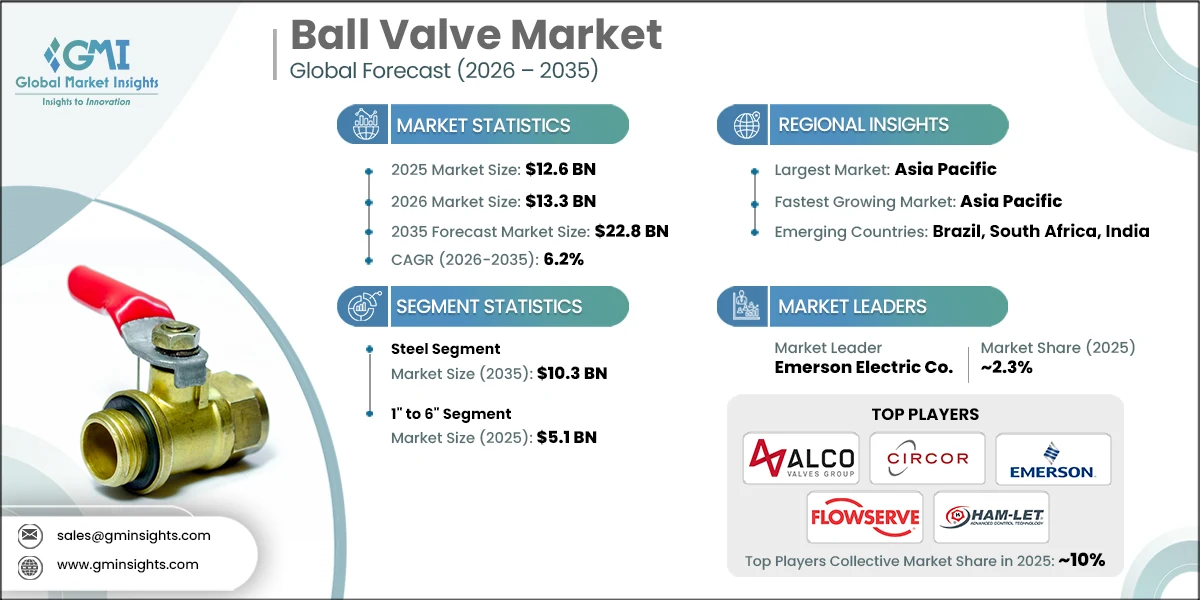
The global ball valve market was estimated at USD 12.6 billion in 2025. The market is expected to grow from USD 13.3 billion in 2026 to USD 22.8 billion in 2035 at a CAGR of 6.2% according to latest report published by Global Market Insights Inc.
Ball Valve Market Key Takeaways
Market Size & Growth
- 2025 Market Size: USD 12.6 Billion
- 2026 Market Size: USD 13.3 Billion
- 2035 Forecast Market Size: USD 22.8 Billion
- CAGR (2026–2035): 6.2%
Regional Dominance
- Largest Market: Asia Pacific
- Fastest Growing Region: Asia Pacific
Key Market Drivers
- Expansion of Oil & Gas and Pipeline Infrastructure.
- Industrial Automation and Smart Manufacturing Adoption.
- Government Investments in Energy Infrastructure.
Challenges
- Stringent Environmental Regulations and Compliance Costs.
- Raw Material Price Volatility.
Opportunity
- Integration of IoT and Smart Valve Technologies.
- Expansion into Hydrogen and LNG Infrastructure.
Key Players
- Market Leader: Emerson Electric Co. led with over 2.3% market share in 2025.
- Leading Players: Top 5 players in this market include Alco Valves Group, Circor International, Emerson Electric Co, Flowserve Corporation, HAM-LET Group, which collectively held a market share of 10% in 2025.
Get Market Insights & Growth Opportunities
The need for security of energy supplies and the modernization of old and obsolete pipeline systems is driving the expansion of ball valve use across the world. Ball valves are known as isolating or shutting off valves because they are essential in the oil and gas pipeline industry for isolating (stopping) the flow of oil/gas to avoid potential leaks and to provide a method for shutting down a pipeline quickly when an incident occurs. "PHMSA", the U.S. pipeline regulatory agency, has published regulations mandating that rupture mitigation valves must be used on all new and/or replacement pipelines that are 6" diameters or greater. Regulation will continue to be published for the purpose of preventing damage to the environment and to provide for the safety of pipeline operators and people working in the vicinity of the pipeline systems. One reason for the large amount of production of crude oil and natural gas in major shale formations in the United States in the middle of the year 2024 as reported by the EIA, is due to the fact that so many new pipelines and associated valves are owned by oil and gas companies for use in their upstream and midstream markets as a result of increased demand for Crude Oil. The continued increase in the worldwide demand for energy will undoubtedly create an environment where companies will continue to expand their investments into the Asia Pacific region and Middle East for the creation of similar infrastructures.
Higher sales of advanced flow control devices like automated ball valves (ABVs) are attributed to integrating automation into both the manufacturing and processing industries. Smart Manufacturing initiatives emphasize digitalization, the use of robots, and monitoring through sensors to enhance the manufacturer’s ability to execute their work, reduce machine downtime, and improve efficiency. Remote operation of valves is facilitated by the simultaneous use of IoT-enabled sensors and Actuators with ABVs and their ability to provide predictive analytics. The U.S. Department of energy’s industrial technologies office states that the U.S. manufacturing industry accounts for $4.8 trillion of the U.S. economy and supports approximately 21 million jobs. Automated valves offer potential advantages in terms of increasing energy efficiency and improving process optimization in the areas of reducing costs and improving safety for the chemical, pharmaceutical, and food processing industries.
As a result of great public and private investment in energy infrastructure through the U.S. Bipartisan Infrastructure Law and the Inflation Reduction Act, there is a growing demand for valves for power generation, LNG terminals and Renewable Energy projects. The department of energy has allocated over $170 billion in funding for energy infrastructure projects including modernization of the Electricity Grid and Industrial Innovation, plus an additional matching $104 billion in private capital. Valve solutions for the handling of fluids through hydrogen, carbon capture and clean energy systems will be required as part of these projects. Capital expenditures for electricity transmission increased almost 300% from 2003-2023 to reach $27.7 billion due to grid upgrades and renewable energy integration. Ball valves provide isolation and safety applications in the electricity grid, creating more opportunities for the use of ball valves in high-pressure and cryogenic systems such as LNG and hydrogen storage.
To get key market trends
Ball Valve Market Trends
- The ball valve industry is being redirected by an increasing number of businesses utilizing digital and smart technologies. companies with operations within oil and gas, chemical production and power generation, are combining sensors and actuators to create IoT-connected ball valves that will enable real-time monitoring, remote control and predictive maintenance to enhance operational performance, reduce downtime and comply with strict safety and ecological standards. as innovative industry 4.0 initiatives proliferate on a global scale, the demand for intelligent valve solutions is poised to grow dramatically, thereby converting traditional flow control systems, into data-driven assets that support increased productivity and sustainability.
- The biggest technological advancement is the continued integration of IoT-enabled smart valves into industrial applications. This advancement is due to the growth in the implementation of I40 through automation, predictive maintenance, and real-time monitoring. the combination of smart ball valves equipped with sensors and actuators allows for remote control and data-based diagnostic capabilities; thus, it decreases operators' runtimes and improves operational performance. a recent report from the national institute of standards and technology (NIST) discussed that Industry 4.0 initiatives are a catalyst for the transformation of traditional processes through the support of advanced manufacturing technologies such as IoT and robotics and allow for the use of predictive analytics and automated control systems. Implementing these technologies enables companies to enhance their offerings by becoming strategic partners to organizations throughout the oil & gas, chemical processing, and water treatment supply chain in their digital transformation projects.
- Investment in hydrogen and LNG infrastructure will increase due to global decarbonization efforts creating a need for specialized ball valves to support cryogenic temperature applications and high-pressure environments. Hydrogen blended into natural gas pipelines is a key enabler for carbon neutrality according to the U.S. department of energy, as well as dedicated means of transporting hydrogen through pipeline systems. As a result, there are opportunities to develop ball valves with new sealing technologies and hydrogen embrittlement resistant materials. The Annual Energy Outlook published by the department of energy shows that there is a significant need for hydrogen in the industrial sector and for power generation, along with tax credits and incentives for hydrogen development from the inflation reduction act. Manufacturers that invest time and resources into this space can secure long-term contracts on new clean energy projects that will be developed globally.
- The valve industry has been affected by the trend towards Reshoring, or bringing back the production and manufacturing of goods to within a country’s borders and establishing localized supply chains. By resourcing and relocating their production closer to their End market, manufacturers of valves can build resiliency, improve response time and create competitive advantage for themselves and their customers as a result of geopolitical instability, tariff changes and pandemic disruption. According to the U.S. department of commerce and NIST, participants in this initiative are becoming more popular as they attempt to reduce risks associated with Global supply chains and make sure that their products comply to domestic standards. For Ball valve manufacturers, this means the need to build regional manufacturing hubs and partner with local suppliers. Manufacturers who act quickly can expect to gain decreased logistics costs, increased responsiveness, and better relationships with customers in regulated sectors such as oil & gas and power generation.
Ball Valve Market Analysis
Learn more about the key segments shaping this market
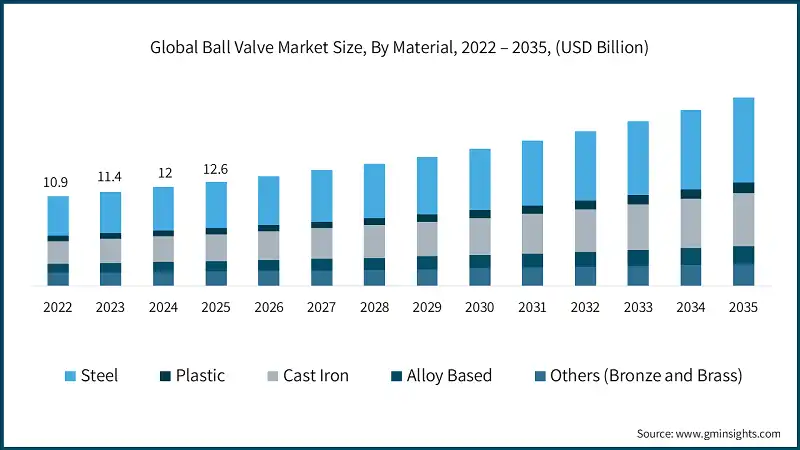
Based on the material, the market is segmented into steel, plastic, cast iron, alloy based, and others (bronze and brass). The steel segment was valued at USD 5.6 billion in 2025 and is projected to reach USD 10.3 billion by 2035.
- The Global ball valve market is mostly made of valves constructed with steel due to its high mechanical strength, durability and adaptability to high-pressure/high-temperature situations. Stainless steel and carbon steel provide excellent resistance to corrosion, thereby making them the material of choice for a number of critical industries, such as oil and gas, petrochemicals, power generation and wastewater treatment, where reliability and safety are the highest priorities.
- Both steel and plastic valves must meet similar performance requirements to provide reliable, leak-free service in harsh environments exposed to corrosive fluids and high temperature. Because of this capability, steel valves also support full-scale pressure ranges (expected to be thousands of psi) and since they can be operated manually and/or automatically through a wide array of actuation systems, steel valves are used extensively throughout the oil, gas and petrochemical pipeline systems, LNG terminals and the overall industrial automation sector to provide a reliable and safe method for controlling flow through the sizeable pipeline infrastructure necessary to maintain and distribute energy.
Learn more about the key segments shaping this market
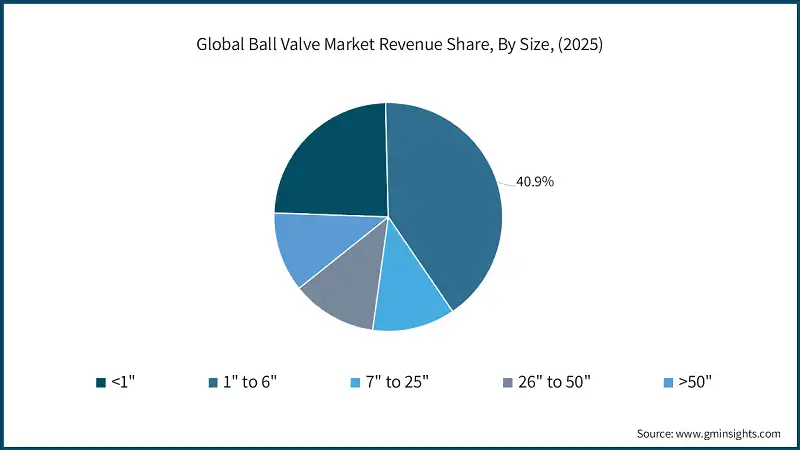
The ball valve market by size is segmented into <1", 1" to 6", 7" to 25", 26" to 50", and >50". The 1" to 6" segment was worth USD 5.1 billion and has a market share of around 40.9% in 2025.
- The size range of 1" to 6" is dominant in the market because it represents the largest segment of the total ball valve size range that is used in industrial and commercial applications. This size range is best suited for use in pipelines and systems that carry moderate flow rates (as opposed to large flow rates). This makes the 1" to 6" range the size range that is primarily used by oil and gas distribution companies, chemical processors, and water treatment facilities, as well as heating, ventilation and air conditioning (HVAC) system manufacturers. All these industries require a valve size with the right "size vs. capacity" balance, and the 1" to 6" range has this capability. Furthermore, as more and more manufacturers use automated actuation systems in their smart manufacturing and process automation solutions, the demand for 1" to 6" valves will continue to grow.
- From a cost and performance standpoint, 1" to 6" valves provide the best combination of performance vs. price. The larger diameter types of valve (>25") have been reserved for use in large capacity pipelines, and the smaller diameter type valves (<1") are generally only used in very specialized niche instrumentation applications. The 1" to 6" size range, however, serves the general market for industrial pipelines, utility systems, and the midstream portion of oil and gas networks, where the quantity of fluid is significant, but the infrastructure is not required to be oversized to handle these flows. The countless industrial uses and the ease of integrating these valves into automated systems makes them the leading segment of all ball valve products worldwide.
Looking for region specific data?
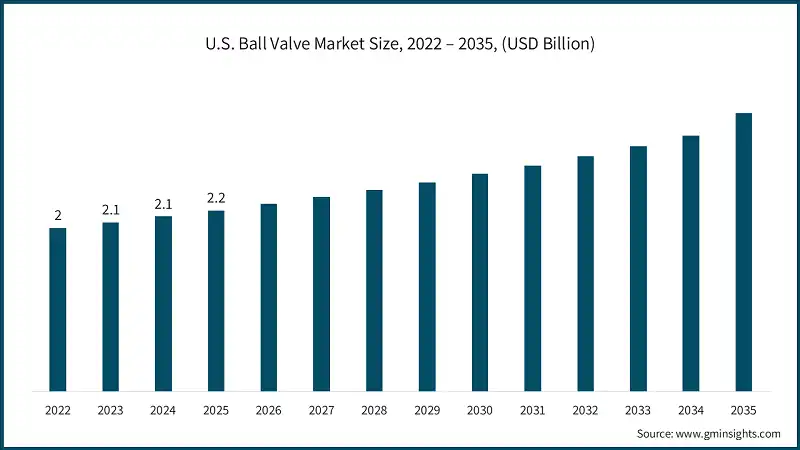
The U.S. ball valve market was valued at around USD 2.2 billion in 2025 and is anticipated to register a CAGR of 4.5% between 2026 and 2035.
- The United States has the highest production levels in North America for both oil and gas; therefore, the demand for ball valves in upstream/midstream/downstream sectors. The U.S. energy information administration (EIA) indicates that crude oil output was more than 427 million barrels in August 2025, while the total amount of natural gas extracted on a daily basis was greater than 99 billion cubic feet. With this scale of production, extensive amounts of pipelines will be required that are equipped with high quality valves for isolating and controlling flow. Additionally, the valve rule implemented by the PHMSA requires rupture mitigation valves to be placed on new pipeline installations resulting in increased need for higher-end ball valves used within the United States.
- A resurgence in U.S. manufacturing is occurring as a result of several federal programs such as the CHIPS and science act and the inflation reduction act resulting in record levels of investment into industrial infrastructure by companies. According to the department of commerce, the manufacturing industry accounted for USD 2.65 trillion dollars of the gross domestic product (GDP), generates almost 13 million jobs, and has over USD 910 billion of private-sector investments planned for use in manufacturing across the country. Increased levels of manufacturing increase the need for automated ball valves that incorporate smart technology capabilities to meet the goals of Industry 4.0 including predictive maintenance and remote monitoring.
The Asia Pacific ball valve market was valued at around USD 4.8 billion in 2025 and is anticipated to register a CAGR of 7.7% between 2026 and 2035.
- Asia Pacific is poised to be the fastest growing region in terms of demand for ball valves, largely because of rapid industrialization and energy infrastructure building. In fact, based on information obtained from EIA, Asia Pacific crude oil production will continue to increase significantly, as both China and India ramp up their oil and gas production to meet rising energy demands. Specifically, between now and 2050, China and India will play a large role in driving global oil and gas production increase (as evidenced by their projected production increases of 1.4% and 1.9% respectively). In addition to the increasing demand for ball valves as a result of their production, Asia is increasingly developing its LNG terminals, and its pipeline projects. All of these developments require high performance ball valves for efficient flow control and meeting safety regulations. Therefore, according to the Asian development bank, the total investment requirement for Asia's infrastructure projects by 2030 may exceed USD 26 trillion, illustrating the vast scope of industrial and energy projects that will consume ball valves in Asia.
- Another major element impacting the market for specialty valves in the APEC region is the accelerated move toward an energy transition and the adoption of clean technologies throughout the Asia-Pacific region, including generating increased demand for valves specialized for hydrogen and renewable energy applications. The Asia-Pacific Energy Working Group states that increasing numbers of Asia-Pacific economies have created national hydrogen strategies and are putting substantial resources into building green hydrogen infrastructures with a goal of achieving net zero emissions by 2050. Countries like Japan, South Korea and India are already developing hydrogen-ready pipeline and LNG facility capabilities and building up the necessary infrastructure, creating a substantial opportunity to develop a market for cryogenic ball valves and high-pressure ball valves. In addition to this, the initiatives stated above, through the Indo-Pacific Economic Framework (IPEF), have already identified USD 23 billion of investment opportunities within sustainable infrastructure and clean energy and industrial modernization projects throughout the region, positioning Asia-Pacific as the world leader in terms of growth in demand due to a combination of industrial expansion, energy diversification and significant infrastructure investments.
Europe ball valve market was valued at around USD 3.4 billion in 2025 and is anticipated to register a CAGR of 5.3% between 2026 and 2035.
- The increased demand for ball valves across Europe is mainly driven by an increase in energy diversification and the expansion of the Liquefied Natural Gas (LNG) Industry. After the geopolitical disruption due to the Russian invasion of Ukraine, the European Union launched the REPowerEU initiative to reduce its dependence on Russian fossil fuels as well as accelerate its transition towards a green economy. This initiative includes the construction of new LNG terminals and the development of hydrogen-ready infrastructure. According to the European union agency for the cooperation of energy regulators (ACER), the LNG import capacity of Europe has increased by 31% since February of 2022. Furthermore, as part of the REPowerEU strategy, the European Union will also deploy an estimated 20 million tons of hydrogen by 2030 as part of the Projects of Common Interest (PCI) under the Trans-European networks for energy initiative, which prioritizes funding for projects that promote the development of energy infrastructure across borders. To support such projects, Europe will require advanced ball valves for cryogenic and high pressure applications, which will further solidify Europe’s status as a leading consumer in this space.
- One other point to be noted is that Europe is committed to achieving its Net Zero Emission by 2050 and has implemented strict regulations to promote the investment in renewable energies and the modernization of industrial processes and infrastructures. The U.S.-EU Energy Council states that by the beginning of Winter 2023–24, Europe has filled 99% of its natural gas storage capacity and is continuously investing in supportive yet resilient energy systems to assure security and sustainability.
Ball Valve Market Share
- The top 5 companies in the ball valve industry, such as Alco Valves Group, Circor International, Emerson Electric Co, Flowserve Corporation, and HAM-LET Group hold a market share of 10%.
- The Alco Valves Group takes product diversification and engineering excellence as a method of gaining a competitive advantage in the marketplace. Alco Valves continues to grow its portfolio of high-integrity valve products with strong offerings such as double block and bleed valves and subsea valves; oil and gas and petrochemical markets are served through these types of valves. Alco Valves has a strategy which places a heavy emphasis on providing custom solutions for critical use, meeting very strict international standards. As a result of investing in precision manufacturing and maintaining high-quality relationships with EPC contractors, Alco Valves will ensure repeat business on high-value projects and manage to defend itself against competition by being considered a trusted partner of choice for specialized, safety-critical valve solutions.
- Circor International uses the strategy of acquiring companies and expanding its global footprint and position within the ball valve market through these acquisitions. Circor has expanded its product offering by acquiring niche companies such as Pibiviesse and Leslie Controls, which contributes significantly to the company’s expansion into serious service type and cryogenic applications. By concentrating on aftermarket support and lifecycle assistance, Circor also ensures that its customers will continue to use its products and services for long periods of time, thus minimizing the extent to which it has to compete on pricing. In addition, Circor has developed digital platforms that support and provide for predictive maintenance in accordance with the trend toward Industry 4.0; these products and services make Circor an extremely desirable choice for clients who are looking for both reliability and efficient operations for their mission-critical environments.
- Emerson is a technology leader in the valve industry, providing advanced technology through its Final Control segment via the development of smart ball valves with automation and IoT functionality for use in end-user applications (remote monitoring and predictive analytics). The company focuses on ongoing product enhancement and developing global service networks to provide rapid response to customer requirements. Furthermore, Emerson capitalizes on current trends towards the promotion of sustainability and has designed low-emission valves that meet stringent environmental requirements. These combined elements of ongoing innovation, meeting regulatory compliance requirements, and a global reach will allow Emerson to hold a dominant position in its respective marketplaces despite the presence of strong competition.
Ball Valve Market Companies
Major players operating in the ball valve industry are:
- Alco Valves Group
- Circor International
- Emerson Electric Co
- Flowserve Corporation
- HAM-LET Group
- Haskel International, Inc
- Hex Valve
- HOKE
- HY-LOK Corporation
- KITZ Corporation
- Maximator GmbH
- Oliver Valves Ltd
- Parker Hannifin
- SMC Corporation
- Swagelok Company
Flowserve focuses on its customer base when it comes to providing superior customer service and global distribution systems through an extensive dealer network. Flowserve has the ability to offer "engineered to order" solutions for the most complex industrial applications, backed by its extensive network of Quick Response Centers located all over the world. Flowserve is building upon its strategic plan by continuing to expand its digital capabilities through the use of the RedRaven IoT platform, which allows customers to monitor valve systems in real-time and perform predictive maintenance on those systems. By applying a combination of technical knowledge and local support along with digital transformation, Flowserve can reduce competitive pressures and create long-term contracts in projects within the oil & gas, power generation, and chemical processing industries.
The HAM-LET Group differentiates itself from the competition by specializing in the design and manufacture of high-performance instrumentation valves and fittings for use in such industries as semiconductor manufacturing, aerospace and energy. The HAM-LET Group's strategy is to continuously invest in Research & Development to develop valves that fulfil both ultra-clean and high-pressure applications. In addition to this, HAM-LET Group's distribution system allows it to offer rapid shipment capabilities, which allows customers to remain responsive to time sensitive projects. By developing its niche, high specification markets and maintaining a technological advantage, HAM-LET Group is able to resist the competitive forces that larger companies have in the general-purpose valve market.
Ball Valve Market Report Attributes
| Key Takeaway | Details |
|---|---|
| Market Size & Growth | |
| Base Year | 2025 |
| Market Size in 2025 | USD 12.6 Billion |
| Market Size in 2026 | USD 13.3 Billion |
| Forecast Period 2026 - 2035 CAGR | 6.2% |
| Market Size in 2035 | USD 22.8 Billion |
| Key Market Trends | |
| Drivers | Impact |
| Expansion of Oil & Gas and Pipeline Infrastructure | Drives significant demand for high-performance ball valves worldwide, particularly in upstream and midstream projects to ensure safety and flow control. |
| Industrial Automation and Smart Manufacturing Adoption | Accelerates global adoption of automated ball valves, enhancing operational efficiency and supporting Industry 4.0 initiatives across process industries. |
| Government Investments in Energy Infrastructure | Stimulates large-scale deployment of advanced ball valves in power generation, LNG, and renewable energy projects, reinforcing market growth across developed and emerging economies. |
| Pitfalls & Challenges | Impact |
| Stringent Environmental Regulations and Compliance Costs | Increase production complexity and raise operational costs, limiting price competitiveness and slowing adoption in cost-sensitive markets. |
| Raw Material Price Volatility | Drives unpredictable manufacturing expenses and margin pressure, leading to delayed projects and reduced capital investment in valve-intensive infrastructure. |
| Opportunities: | Impact |
| Integration of IoT and Smart Valve Technologies | The growing trend toward digitalization and predictive maintenance in industrial sectors creates a strong opportunity for ball valve manufacturers to integrate IoT-enabled sensors and smart actuators into their products. |
| Expansion into Hydrogen and LNG Infrastructure | The global energy transition is fueling investments in hydrogen production, LNG terminals, and carbon capture projects, all of which require specialized cryogenic and high-pressure ball valves. |
| Market Leaders (2025) | |
| Market Leaders |
Market share of ~2.3% |
| Top Players |
|
| Competitive Edge |
|
| Regional Insights | |
| Largest Market | Asia Pacific |
| Fastest growing market | Asia Pacific |
| Emerging countries | Brazil, South Africa, India |
| Future outlook |
|
What are the growth opportunities in this market?
Ball valve Industry News
- In February 2025, Emerson launched Anderson Greenwood Type 84 Pressure Relief Valve designed for hydrogen applications up to 21,756 psig. This will help the company in capturing growing hydrogen storage and refueling infrastructure market with leak-tight, embrittlement-resistant technology.
- In November 2024, Crane Company acquired Technifab Products for $40.5 million, adding vacuum insulated pipe systems and cryogenic valves to its portfolio. This will help the company in expanding its cryogenic capabilities for semiconductor, medical and pharmaceutical markets.
- In October 2024, Flowserve completed acquisition of MOGAS Industries for approximately $305 million, strengthening its severe-service valve portfolio. This will help the company in expanding its mining and mineral extraction market presence and enhancing aftermarket service opportunities.
- In August 2024, IMI secured a major anti-surge valve contract with a North Sea energy company for critical offshore operations. This will help the company in strengthening its presence in offshore energy markets and expanding its installed base for aftermarket services.
The ball valve market research report includes in-depth coverage of the industry, with estimates & forecasts in terms of revenue (USD Billion) and volume (Million Units) from 2022 to 2035, for the following segments:
Market, By Material
- Steel
- Plastic
- Cast iron
- Alloy based
- Others (bronze and brass)
Market, By Component
- Actuators
- Valve Body
- Others (Positioners and I/P Converters)
Market, By Size
- <1"
- 1" to 6"
- 7" to 25"
- 26" to 50"
- >50"
Market, By End Use
- Chemical
- Energy & utilities
- Construction
- Metal & mining
- Agriculture
- Pharmaceutical
- Food & beverage
- Pulp & paper
- Others (textile, glass, and semiconductor)
Market, By Distribution Channel
- Direct sales
- Indirect sales
The above information is provided for the following regions and countries:
- North America
- U.S.
- Canada
- Europe
- Germany
- U.K.
- France
- Italy
- Spain
- Asia Pacific
- China
- Japan
- India
- South Korea
- Australia
- Latin America
- Brazil
- Mexico
- Argentina
- MEA
- UAE
- Saudi Arabia
- South Africa
Frequently Asked Question(FAQ) :
What is the market size of the ball valve in 2025?
The market size was USD 12.6 billion in 2025, with a CAGR of 6.2% expected through 2035 driven by energy security needs and modernization of aging pipeline infrastructure worldwide.
What is the projected value of the ball valve market by 2035?
The ball valve market is expected to reach USD 22.8 billion by 2035, propelled by energy transition, industrial automation, infrastructure modernization, and integration of smart technologies including IoT-enabled monitoring and predictive maintenance.
What is the current ball valve market size in 2026?
The market size is projected to reach USD 13.3 billion in 2026.
How much revenue did the steel segment generate in 2025?
The steel segment was valued at USD 5.6 billion in 2025 and is projected to reach USD 10.3 billion by 2035, driven by its high mechanical strength, durability, and adaptability to high-pressure/high-temperature situations.
What was the market share of the 1" to 6" size segment in 2025?
The 1" to 6" segment was worth USD 5.1 billion and held a market share of around 40.9% in 2025, representing the largest segment used in industrial and commercial applications.
What is the growth outlook for the Asia Pacific ball valve market from 2026 to 2035?
The Asia Pacific ball valve market is anticipated to register a CAGR of 7.7% between 2026 and 2035, led by rapid industrialization, energy infrastructure building, and energy transition initiatives.
Which region leads the ball valve market?
The U.S. ball valve market size was USD 2.2 billion in 2024, with a CAGR of 4.5% expected through 2034, with strong demand driven by high oil and gas production levels.
What are the upcoming trends in the ball valve market?
Key trends include integration of IoT-enabled smart valves for real-time monitoring and predictive maintenance, investment in hydrogen and LNG infrastructure creating demand for specialized cryogenic valves, and reshoring initiatives to establish localized supply chains for improved resilience.
Who are the key players in the ball valve market?
Key players include Alco Valves Group, Circor International, Emerson Electric Co, Flowserve Corporation, HAM-LET Group, Haskel International Inc, Hex Valve, HOKE, HY-LOK Corporation, KITZ Corporation, Maximator GmbH, Oliver Valves Ltd, Parker Hannifin, SMC Corporation, and Swagelok Company.
Ball Valve Market Scope
Related Reports