Summary
Table of Content

Baby & Toddlers Carriers & Accessories Market
Get a free sample of this report
Form submitted successfully!
Error submitting form. Please try again.
Thank you!
Your inquiry has been received. Our team will reach out to you with the required details via email. To ensure that you don't miss their response, kindly remember to check your spam folder as well!
Request Sectional Data
Thank you!
Your inquiry has been received. Our team will reach out to you with the required details via email. To ensure that you don't miss their response, kindly remember to check your spam folder as well!
Form submitted successfully!
Error submitting form. Please try again.
Baby & Toddlers Carriers & Accessories Market Size
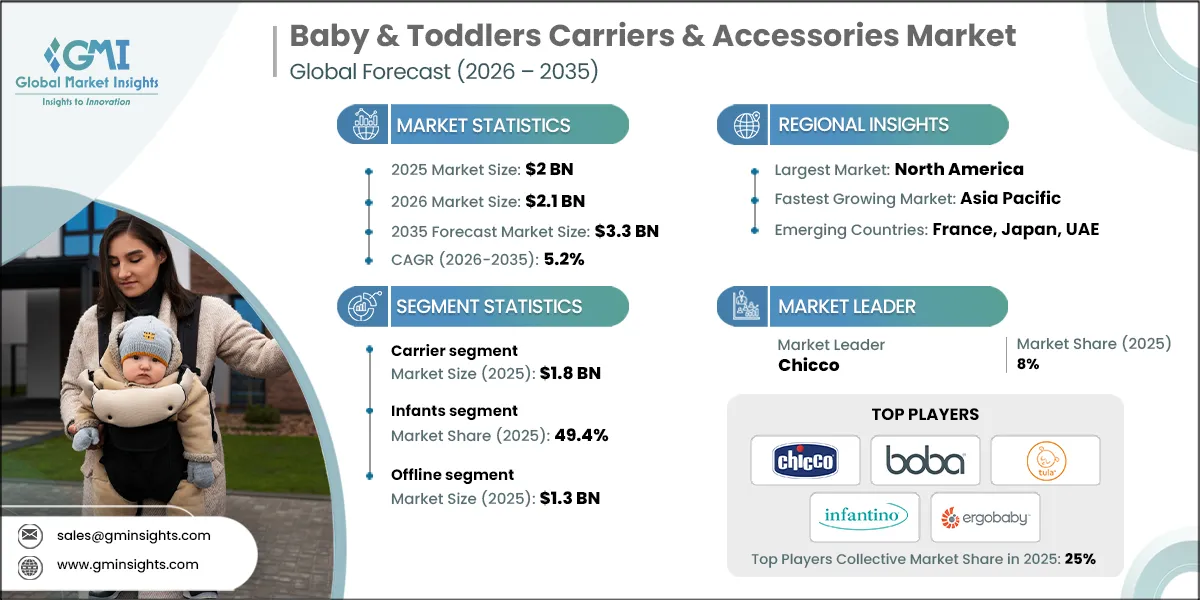
The global baby & toddlers carriers & accessories market size was estimated at USD 2 billion in 2025. The market is expected to grow from USD 2.1 billion in 2026 to USD 3.3 billion in 2035, at a CAGR of 5.2% according to latest report published by Global Market Insights Inc.
Baby & Toddlers Carriers & Accessories Market Key Takeaways
Market Size & Growth
- 2025 Market Size: USD 2 Billion
- 2026 Market Size: USD 2.1 Billion
- 2035 Forecast Market Size: USD 3.3 Billion
- CAGR (2026–2035): 5.2%
Regional Dominance
- Largest Market: North America
- Fastest Growing Region: Asia Pacific
Key Market Drivers
- Rise in working parents & urban lifestyles.
- Parental awareness of babywearing benefits.
- Focus on ergonomics & comfort.
Challenges
- Safety and compliance concerns.
- Quality control and counterfeit products.
Opportunity
- Accessory innovation.
- Tech-integrated products.
Key Players
- Market Leader: Chicco led with over 8% market share in 2025.
- Leading Players: Top 5 players in this market include Chicco, Boba, Baby Tula, Infantino, Ergobaby, which collectively held a market share of 25% in 2025.
Get Market Insights & Growth Opportunities
The rise of the dual-income family and urban living have created an environment for parents' choice of parenting products. As a result of the large number of working parents, many have been looking for solutions that allow them to have daycare facilities and balance their childcare duties with their work and personal commitments. The use of baby carriers gives parents the ability to carry their children in a hands-free manner while being able to engage in other tasks while maintaining contact with their children. The carriers have also become more practical than strollers in urban areas, where crowded streets, public transportation, and limited housing are more common. Thus, it is easier for urban parents to use these baby carriers for both convenience and mobility than to use strollers.
The trend towards urban living has emphasized efficiency and portability. Additionally, urban living has created a demand for parent products that fulfill the needs of today’s modern parents. Due to this demand, companies have developed a wide range of carriers that fit the aesthetic preferences of those parents who are fashionable, but also value functionality. Social media and e-commerce have also played a role in increasing demand for baby carriers among urban parents, as those parents frequently share stories and experiences with one another, leading to greater interest in carriers that support urban lifestyles and busy city routines.
Parents of newborns have developed new ways to raise their children through the understanding of how carrying babies can also be beneficial to their overall health and well-being as well as promote bonding with their child. Professional organizations have promoted the use of baby carriers for infant bonding and reducing infant stress. In addition, studies support the correct use of a baby carrier as being good for developing infants' hips properly.
With an increase in the trend toward holistic parenting and using natural care practices for their child, parents are becoming more aware of how using a baby carrier may be helpful for helping their baby with soothing and relaxing, sleeping patterns, and as an aid to breastfeeding. As this information becomes available, from, among many other places, the Internet, social networking sites, and parenting forums, there is a continuing demand for baby carriers that are designed to be comfortable and safe, providing brands with more opportunities to create innovative baby carriers and keep customers informed about their products.
To get key market trends
Baby & Toddlers Carriers & Accessories Market Trends
The emergence of both parents as major users of carrier systems and accessories is fostering a rapid evolution in the market for baby and toddler carriers and accessories. Modern parents use new types of products that include greater conveniences, options to be safer and have good design aesthetics. Innovations by manufacturers include enhanced ergonomic designs for comfort, eco-friendly materials, and smart technology. As e-commerce and celebrity influencers continue to build consumer interest & awareness, the demand for carriers will continue to increase dramatically.
- Today's parents are becoming more conscious of how the ergonomics of their own bodies and their babies impact their health and well-being. Therefore, many carriers now include features that allow users to adjust the carrier's strap system to achieve a better fit, have a padded shoulder support system, and a lumbar support to minimize stress on the back of the users when using the carrier for extended periods of time. Consequently, parents' desire to keep their children safe and supported comfortably, in addition to being fashionable, comes together as one in the development of healthy parenting practices.
- The trend towards eco-friendly parenting has significantly impacted on how baby carriers are being developed. The focus now is on sustainable materials such as organic cotton, bamboo mixtures, and recycled polyester. In addition to the materials used, consumers are concerned about the way baby carriers are manufactured and packaged. Additionally, premium quality baby carriers that have both a sustainable aspect and an aesthetic value tend to be higher-priced items, which creates opportunities for brand differentiation in a competitive market.
- Smart technology is beginning to appear in babywearing through smart baby carriers. Smart baby carriers may come with sensors and wireless capabilities to help parents monitor their child's vital signs like temperature, breathing, body position in real time while giving parents peace of mind. Some of the smart baby carriers offer a mobile app that sends alerts regarding your baby's vital signs and will provide helpful information about how to use the carrier. Although this category is still relatively niche in the overall baby carrier market, many technology-savvy parents and safety-concerned parents would be attracted to technology-enabled baby carriers, and we may see more collaboration between the baby gear market and the wearable technology market in the future.
- Baby carrier distribution is dominated by digital channels, such as online marketplaces, brand-specific sites and subscription services that make buying baby carriers easy and accessible to everyone. Digital platforms have also been important in educating consumers on baby carriers through social media influencers, parenting blogs, online communities and virtual fitting tools that provide virtual consultation to potential buyers about products they are considering purchasing. Community-driven marketing initiatives, such as partnerships with babywearing consultants or providing training videos online for parents attempting to use a carrier, assist brands in establishing trust and building brand loyalty and engagement among consumers. The current digital presence of a brand and how personalized each consumer’s experience will significantly affect that brand's growth potential going forward.
Baby & Toddlers Carriers & Accessories Market Analysis
Learn more about the key segments shaping this market
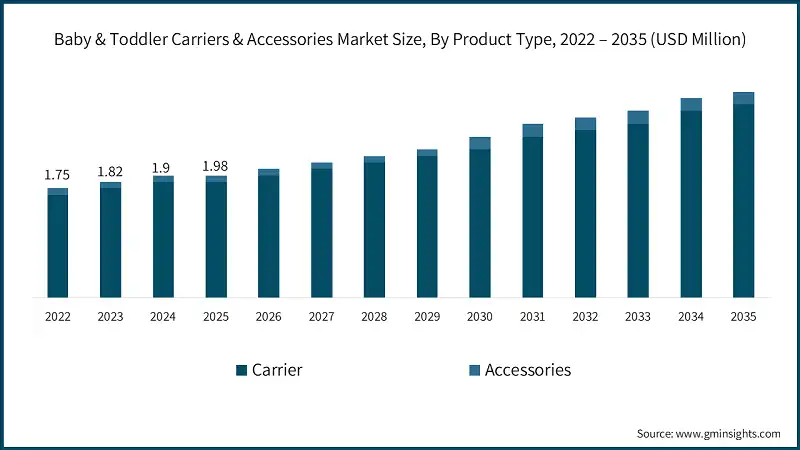
Based on product type, the market is divided into carrier and accessories. In 2025, carrier held the major market share, generating a revenue of USD 1.8 billion.
- A baby carrier is a type of carry device worn by caregivers to transport infants and toddlers while providing physical contact and hand-free functionality. Baby carriers are available in multiple styles that satisfy various age ranges, comfort preferences and carrier style preferences. Most parents rely heavily upon baby carriers to provide comfort to their children, to foster parent-child bonding through attachment to one another and to facilitate ergonomic positions and comfort during daily activities.
- Baby carriers are an extremely versatile product. They offer many benefits like fostering attachment between parent and child, alleviating stress on babies and encouraging healthy development in baby’s hips. When used properly, the baby carrier is very helpful in allowing parents/caregivers to do multiple tasks while ensuring that their child is kept as safe and secure as possible. Especially for urban dwellers who are often on the go, they tend to be a very popular option for active families.
- The baby carrier industry has progressed from simply creating carriers that function well; many companies now offer stylish designs, environmentally friendly materials, and improved ergonomic design. In addition to this, new premium brands are focusing on creating products that support sustainable practices and are aesthetically pleasing. There is also a small niche area being created by companies that offer tech-integrated carriers that include sensors for monitoring a child's health. To complement these advanced carriers, many manufacturers have developed accessories such as teething pads, storage pouches, and weather-resistant covers. These products illustrate a growing trend toward customization and providing convenience to users of baby carriers.
Learn more about the key segments shaping this market
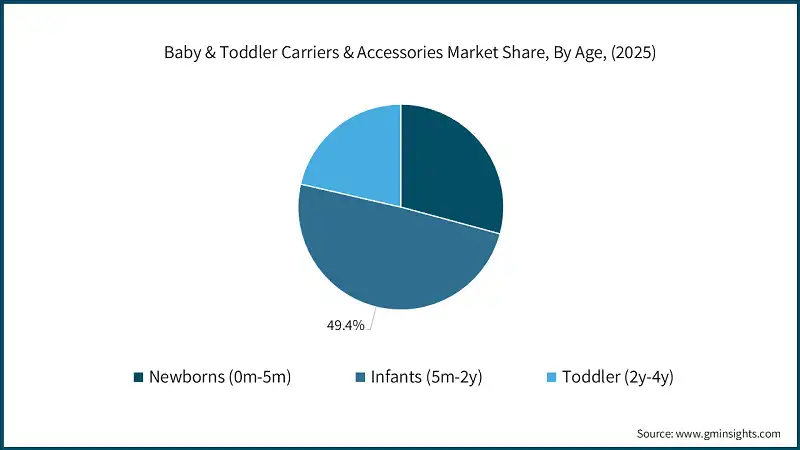
Based on age, the baby & toddlers carriers & accessories market is segmented into newborns (0m-5m), infants (5m-2y) and toddler (2y-4y). The infants segment held the largest share, accounting for 49.4% of the global market in 2025.
- Baby's growth and development from the age of 5 months to 2 years occur at an extremely fast rate with the baby developing both physical and cognitive functionality. Most babies are ready for more structured baby carriers by the age of 5 to 6 months because they can sit with the aid of a support mechanism and have good control of the head and neck as well as all other motions in their body. Currently prior to the time of crawling or walking, caregiver adaptation to their baby's increasing exploration of the physical world is vital to maintaining the bond between caregiver and baby through direct sensory exploration.
- During this time comfort and safety are very important to caregivers as babies will need proper support for their hips, spine, and head, especially if the caregiver is carrying the baby in a carrier for any extended period. As a result of this issue, ergonomic baby carriers designed specifically for babies in this age range provide caregivers with a more efficient means of distributing the weight of the child while reducing excessive physical stress on the caregiver's body (shoulders and back). Additionally, caregivers search for accessories that help promote cleanliness/hygiene and/or convenience like teething pads, bibs, and weather covers for baby carriers. Caregivers also search for baby carriers made of breathable fabric and adjustable designs so that the baby will remain comfortable regardless of season and/or growth.
- As babies become more engaging, parents look for multiple options for keeping their babies mobile and safe. Baby carriers targeted to this developmental stage often provide a variety of carry options—front, back, or hip based that fit a variety of activities and comfort preferences. Urban families and working parents have a growing desire for stylish, durable, and convenient carriers, as they want to be able to carry their babies without using their arms or hands to do so. As a result, urban and working parents also provide a significant amount of innovation in premium materials, accessories, and overall carrier design, making them a primary focus of brands that are trying to meet the needs of modern parents.
Based on distribution channel, the baby & toddlers carriers & accessories market is segmented into online and offline. In 2025, offline segment held a major market share, generating a revenue of USD 1.3 billion.
- To provide a more personal feel, parents can try out baby and toddler carriers at an offline location such as a physical retail store, specialty shops, or large-format stores, before making a purchase. Because parents will be able to see the prospective products for themselves, and be assured of their safety, quality, and comfort through an in-store demonstration and expert assistance, parents will build confidence as they choose their infant or toddler carrier, particularly first-time parents who rely heavily on personalized assistance and reassurance when choosing carriers.
- Offline distribution channels are also an important platform to build brand loyalty among customers. While retail stores typically have a huge variety of products, they also offer a lot of opportunity to sell related products, such as teething pads, drool bibs, weather covers, etc. Brands take advantage of these channels to engage consumers through experiential marketing and demonstrations, parenting workshops, and special events, giving customers the ability to connect directly with the brands that they use. This type of consumer engagement allows brands to build customer loyalty and enhance the overall shopping experience for their customers.
Looking for region specific data?
North America Baby & Toddlers Carriers & Accessories Market
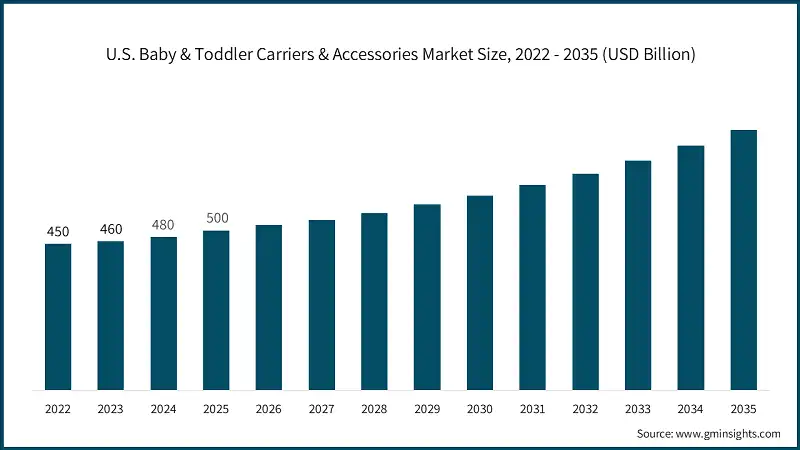
In 2025, the U.S dominated the North America market, accounting for around 78.6% and generating around USD 500 million revenue in the same year.
- There is a wealth of opportunity in the baby and toddler carrier & accessory business within the U.S. Parents here have the highest disposable income levels, support a culture of parenting/having kids in their lives, and have knowledge of the ergonomic & safety standards for baby carriers. As a result, parents are requesting carriers that are multifunctional, comfortable, stylish, and adhere to health guidelines more than ever before. Leading global brands, as well as a strong retail distribution system and the popularity of online shopping, also help make products available and provide consumers with many options. Further enhancing consumer education is influencer marketing and parenting communities located in the U.S., which will allow this region to continue to lead in the creation of premium/inventive carrier designs.
- In terms of global baby carrier market, North America dominates with the highest amount of buying power, due to both Canada and the U.S. having very strong economies and a preference for high-quality items. The region is benefitting from having advanced distribution channels which include specialty stores, many retail stores, and an increasing number of e-commerce options. The rise in awareness of babywearing is a result of both the growing number of people who lead active lifestyles and the changing nature of parenting; both have contributed to an increase in the number of parents who are adopting babywearing as a way of transporting their child.
- North America has been a leader in the trend towards more sustainable and technologically integrated baby products. Parents are showing strong interest in eco-friendly materials and smart carriers. The leadership that North America has in this industry has continued through ongoing product development and through aggressive marketing efforts toward the millennial and Gen Z market.
Europe Baby & Toddlers Carriers & Accessories Market
Europe market held 29.2% share in 2025 and is expected to grow at 5% during the forecast period.
- Europe's carrier sector focuses on compliance with EN safety standards and a strong consumer awareness of ergonomic benefits. Soft-structured carriers and premium-priced wraps and slings are viewed as the best choices for parents based on the following criteria: They offer the best options to keep your baby in a "hip-healthy" position; they are made from breathable textile materials, and they provide adequate lumbar support. Sustainability is a significant differentiating factor within the market for parents, as many are attracted to organic cotton, recycled polyester and ethical sourcing and manufacturing processes, all of which correlate with the values of EU consumers. As a result, it will be easier for smaller premium brands or boutique retailers to maintain their price integrity and compete against mass-market carriers.
- By supporting the use of specialty baby stores to assist consumers in obtaining proper fit checks and product demonstrations and augmenting the purchasing experience through an extensive e-commerce site, sellers can maximize the impressive performance of their merchandising playbooks, including localized certifications and labels, collaborating with babywearing consultants, attaching additional items to the carriers etc., to maximize order values. Northern and Western Europe are particularly aware of sustainability messaging; meanwhile, the growing adoption of smaller, more cost-effective carriers is being fueled by increased urban mobility in Southern and Eastern Europe.
Asia Pacific Baby & Toddlers Carriers & Accessories Market
The Asia Pacific held market share of around 24.9% in 2025 and is anticipated to grow with a CAGR of around 5.5% from 2026 to 2035.
- Asia-Pacific's growth has been characterized by Speed, variety, and a combination of urbanization, growth in disposable-income, and close ties between parents/employers and children/clients. There are two primary market categories based on growth potential in Asia-Pacific. First are the entry-level structured carriers in mass channels, and second are the more advanced design-led ergonomic models utilized in urban environments. Due to the climate in these regions, local weather conditions such as temperature and humidity increase the demand for carriers made with lightweight fabrics and/or mesh panels, as well as fabric that dries quickly.
- Successful strategies in APAC combine direct to consumer (D2C) or e-commerce dominance through various sales channels with selective physical retail presence. Consumer education will help reduce product misuse and returns. The development of climate-optimized accessory products and creating product value bundles has allowed manufacturers to convert more potential buyers. For example, in India and Southeast Asia, partnerships with maternity hospitals and parenting organizations have increased consumer trust in their brands, whereas in Japan and South Korea, consumers repeatedly purchase the same brand due to their premium ergonomic design and aesthetics.
Latin America Baby & Toddlers Carriers & Accessories Market
Latin America market is growing at a CAGR of 4.6% during the forecast period.
- The LATAM region is still emerging, with potential for future growth; this is partly because of the influences of both Brazil and Mexico. Inherent within both cultures is the shift to urbanized lifestyles and the utilization of changing family units; therefore, there is an increasing need for a product that provides hands-free capability and ergonomic design available at a reasonable cost to consumers. Consumers will typically want a product that has durable materials, comfortable and easily adjustable, with overall utility; therefore, mid-range soft structured carriers and hip seats are popular for use on an everyday basis.
- While offline retail continues to be significant within LATAM regions, the increasing number of online retailers far outweighs offline retail. Online retailers increase distribution and variety, especially to markets outside of capital cities within LATAM regions. Brands will continue to grow in popularity, due to localized educational content available to customers, use of payment plans, and additional products available through retail channels. The impact of social media influencers and communities creating events in support of proper product usage within LATAM communities, technology used for sustainability, and durable quality within climate conditions will all continue to grow in importance.
Baby & Toddlers Carriers & Accessories Market Share
Chicco is leading with 8% market share. Chicco, Boba, Baby Tula, Infantino, and Ergobaby collectively hold around 25%, indicating moderately fragmented market concentration. These prominent players are proactively involved in strategic endeavors, such as mergers & acquisitions, facility expansions & collaborations, to expand their product portfolios, extend their reach to a broad customer base, and strengthen their market position.
Chicco is an internationally recognized brand for the manufacture of childcare products. Their baby carriers are produced in a variety of styles with an emphasis on comfort, safety & price, Chicco baby carriers feature many innovative designs including padded shoulder straps, breathable material for everyday use, and most Chicco products have multiple positions available for use. Chicco's product offerings are aimed at a broad audience of consumers and therefore provide an excellent alternative for parents looking for style & quality.
Baby Tula is a leading manufacturer of baby carriers with a focus on function and aesthetics. Baby Tula's popular models include the Explore & Free-To-Grow baby carrier series these models allow multiple carrying positions as well as being adjustable to fit any size baby. The Baby Tula brand has an appeal to the modern family seeking to purchase premium quality products that promote healthy hip development while maintaining fashion.
Baby & Toddlers Carriers & Accessories Market Companies
Major players operating in the market are:
- Baby K'tan
- Baby Tula
- Be Lenka
- Boba
- Chicco
- Ergobaby
- Fidella
- Infantino
- Kinderkraft
- Kol Kol Baby Carrier
- LennyLamb
- Mabe
- MaMidea
- Tushbaby
- Wildbird
LennyLamb brand is a European company that specializes in woven wraps, ring sling carriers, and structured carriers made from the highest quality materials. Artisanal craftsmanship as a primary focus of the brand means that they create their products using a variety of techniques to ensure that their woven wraps are comfortable and visually appealing to parents who practice traditional forms of babywearing along with baby carriers with modern ergonomic features.
Fidella's baby carriers offer a premium quality with adjustment features to be used over an extended period. Types of Fidella baby carriers include buckle carriers, hybrid baby wraps and baby wraps with many ways to carry. All Fidella baby carrier products have elegant styling, soft-to-the-touch fabrics, and comply with ergonomic guidelines to provide all parents with an opportunity to wear their babies in an elegant and comfortable manner.
Baby & Toddlers Carriers & Accessories Market Report Attributes
| Key Takeaway | Details |
|---|---|
| Market Size & Growth | |
| Base Year | 2025 |
| Market Size in 2025 | USD 2 Billion |
| Market Size in 2026 | USD 2.1 Billion |
| Forecast Period 2026 - 2035 CAGR | 5.2% |
| Market Size in 2035 | USD 3.3 Billion |
| Key Market Trends | |
| Drivers | Impact |
| Rise in working parents & urban lifestyles | There is an increase in the need for portable, easy-to-carry products and accessories for busy lifestyles. |
| Parental awareness of babywearing benefits | A greater use of ergonomic carrying systems that provide enhanced attachment and developmental benefits. |
| Focus on ergonomics & comfort | This pushes brands to provide better distribution of weight, a more breathable cloth, and lumbar support. |
| Pitfalls & Challenges | Impact |
| Safety and compliance concerns | An increase in emphasis on certified products and compliance with safety standards. |
| Quality control and counterfeit products | An increase in the ability of brands to offer secure channels for verification and distribution. |
| Opportunities: | Impact |
| Accessory innovation | Diversifying base of products offered with additional storage options and sensory play toys. |
| Tech-integrated products | Creating expertise in high-end markets that provide smart capabilities for parents, i.e., mobile applications and temperature monitoring. |
| Market Leaders (2025) | |
| Market Leaders |
8% market share |
| Top Players |
|
| Competitive Edge |
|
| Regional Insights | |
| Largest market | North America |
| Fastest growing market | Asia Pacific |
| Emerging countries | France, Japan, UAE |
| Future outlook |
|
What are the growth opportunities in this market?
Baby & Toddlers Carriers & Accessories Industry News
- In November 2025, Boba's product line expanded, offering many options in its New Arrivals category, including several recently released carriers. The most popular item was the Linen Boba X Adjustable Carrier, which had numerous reviews, within months of its initial release. This success illustrates Boba's mission to create stylish, breathable, and versatile babywearing products.
- In April 2025, Infantino launched some bold and trendy updates to its best-selling Flip Advanced 4-in-1 Carrier with the addition of two brand-new prints: Black Leopard and Navy Floral. The company previously had additional color choices of: Black, Grey, Nature & Nurture, and Blue Camo, and of course, there is still Leopard Print. All these new prints provide parents with increased wardrobe options while still offering the ergonomic four-position design that parents have come to know and love from Flip Advanced.
- In January 2025, Ergobaby released the new Omni Deluxe in an updated version of its original Omni baby carriers, providing improved storage capabilities, a more modern looking design, and further enhancing the comfort of users with additional support. The brand launched another version of the Omni Deluxe which included mesh materials to provide breathability and support for parents who wish to wear their babies ergonomically.
- In January 2025, Be Lenka debuted the upgraded 4ever Neo ergonomic baby carrier, featuring multiple design enhancements to improve safety and user comfort. The new carrier is designed for babies from three months old to three years old, including magnetic chest clips for easy and quick fastening, a reinforced waist belt to help distribute the child's weight evenly, and improved safety buckles. This new model demonstrates Be Lenka's dedication to pushing the ergonomic innovation envelope and to providing modern parents with user-friendly carrying options.
- In November 2024, Baby Tula launched the Tula Stretchy Baby Wrap. Designed to suit the needs of parents during their baby's 'fourth trimester' the Tula Stretchy Baby Wrap is a new way to carry infants (newborns - 11.3kg/25lb) and is manufactured from 100% Tencel Lyocell material that has been crafted for comfort, breathability and moisture wicking; the wraps have been developed using an ergonomic design which encourages parental bonding during breastfeeding by stimulating the production of the hormone oxytocin. Lightweight yet stylish, Baby Tula will sell the Tula Stretchy Wrap in three colors based on natural earth tones.
The baby & toddlers carriers & accessories market research report includes in-depth coverage of the industry with estimates & forecasts in terms of revenue (USD Billion) & volume (Thousand Units) from 2022 to 2035, for the following segments:
Market, By Product Type
- Carrier
- Soft structured
- Wrap carriers
- Sling carriers
- Backpack carriers
- Others (Mei-tai carriers etc.)
- Accessories
- Hood
- Back support
- Drool pads
- Shoulder strap protectors
- Others (storage pouch etc.)
Market, By Material
- Cotton
- Nylon
- Linen
- Polyester
- Others (faux fur, neoprene etc.)
Market, By Age
- Newborns (0m-5m)
- Infants (5m-2y)
- Toddler (2y-4y)
Market, By Carry Positions
- Front facing
- Back facing
- Hip
Market, By Price
- Low
- Medium
- High
Market, By Distribution Channel
- Online
- E-commerce
- Company owned websites
- Offline
- Supermarket/hypermarket
- Specialty stores
- Others (individual stores, etc.)
The above information is provided for the following regions and countries:
- North America
- U.S.
- Canada
- Europe
- Germany
- UK
- France
- Italy
- Spain
- Asia Pacific
- China
- India
- Japan
- Australia
- South Korea
- Latin America
- Brazil
- Mexico
- Argentina
- Middle East and Africa
- South Africa
- Saudi Arabia
- UAE
Frequently Asked Question(FAQ) :
What is the market size of the baby & toddlers carriers & accessories market in 2025?
The global market size for baby & toddlers carriers & accessories was valued at USD 2 billion in 2025, supported by rising urbanization, dual-income households, and growing awareness of babywearing benefits.
What is the projected value of the baby & toddlers carriers & accessories market by 2035?
The market is expected to reach USD 3.3 billion by 2035, growing at a CAGR of 5.2% from 2026 to 2035, driven by ergonomic innovation, eco-friendly materials, and tech-enabled products.
What will be the market value of baby & toddlers carriers & accessories in 2026?
The market is projected to reach USD 2.1 billion in 2026, reflecting steady demand growth at the start of the forecast period.
Which product type generated the highest revenue in 2025?
Baby carriers dominated the market in 2025, generating approximately USD 1.8 billion in revenue due to their widespread adoption across newborn, infant, and toddler age groups.
Which age segment held the largest market share in 2025?
The infants segment (5 months–2 years) led the market, accounting for 49.4% share in 2025, supported by demand for ergonomic and adjustable carriers during key developmental stages.
Which distribution channel leads the market?
Offline distribution channels generated around USD 1.3 billion in 2025, leading the market due to in-store demonstrations, fit checks, and personalized assistance for parents.
Which region leads the baby & toddlers carriers & accessories market?
North America is the largest regional market, with the U.S. accounting for nearly 78.6% of the regional share and generating around USD 500 million in revenue in 2025.
Who are the key players in the baby & toddlers carriers & accessories market?
Key players include Chicco, Boba, Baby Tula, Infantino, Ergobaby, Baby K’tan, Be Lenka, Fidella, Kinderkraft, and LennyLamb.
Baby & Toddlers Carriers & Accessories Market Scope
Related Reports