Summary
Table of Content

Autonomous Vehicle Development Platform Market
Get a free sample of this report
Form submitted successfully!
Error submitting form. Please try again.
Thank you!
Your inquiry has been received. Our team will reach out to you with the required details via email. To ensure that you don't miss their response, kindly remember to check your spam folder as well!
Request Sectional Data
Thank you!
Your inquiry has been received. Our team will reach out to you with the required details via email. To ensure that you don't miss their response, kindly remember to check your spam folder as well!
Form submitted successfully!
Error submitting form. Please try again.
Autonomous Vehicle Development Platform Market Size
Machine learning and AI drastically enhance autonomous perception, decision-making and planning, allowing for the handling of difficult environments. For instance, in January 2026, NVIDIA launched its Alpamayo AI models/simulation and tools to enhance the development of safe reasoning-based autonomous vehicles.
Autonomous Vehicle Development Platform Market Key Takeaways
Market Size & Growth
- 2025 Market Size: USD 46.8 Billion
- 2026 Market Size: USD 60.5 Billion
- 2035 Forecast Market Size: USD 380.3 Billion
- CAGR (2026–2035): 22.7%
Regional Dominance
- Largest Market: North America
- Fastest Growing Region: Asia Pacific
Key Market Drivers
- Advanced AI and machine learning integration.
- Increasing adoption of ADAS and autonomous technologies.
- Growing investment from OEMs and tech companies.
- Expansion of cloud computing and simulation infrastructure.
Challenges
- High development and R&D costs.
- Regulatory uncertainty and compliance challenges.
Opportunity
- Rising demand for Level 4–5 autonomous vehicles.
- Integration of digital twin and simulation technologies.
- Partnerships between tech companies and automakers.
- Emerging markets adoption.
Key Players
- Market Leader: NVIDIA led with over 5% market share in 2025.
- Leading Players: Top 5 players in this market include Baidu (Apollo), GM, Mobileye, NVIDIA, Waymo, which collectively held a market share of 19% in 2025.
Get Market Insights & Growth Opportunities
There is an increasing integration of advanced driver assistance systems (ADAS) and autonomous functionality in OEM vehicles, driving the need for development, testing, and validation platforms for both full autonomy and incrementally.
There are many global automakers and technology companies contributing significantly to the growth of significant capital investments to accelerate innovation and increase platform capabilities; therefore, accelerating the ability of these companies to deploy their platforms commercially. In October 2025, Stellantis partnered with Nvidia, and Uber to deploy their Level 4 robotaxi globally.
Cloud based/simulated environments help to speed up development of platforms, allow for large scale testing of platforms and provide a collaborative workflow for distributed teams. For example, the SVDataFlow hybrid cloud AI data management platform was launched in late 2025 and provides additional training and labeling tools for the user.
The global autonomous vehicle development platform market was valued at USD 46.8 billion in 2025. The market is expected to grow from USD 60.5 billion in 2026 to USD 380.3 billion in 2035 at a CAGR of 22.7%, according to latest report published by Global Market Insights Inc.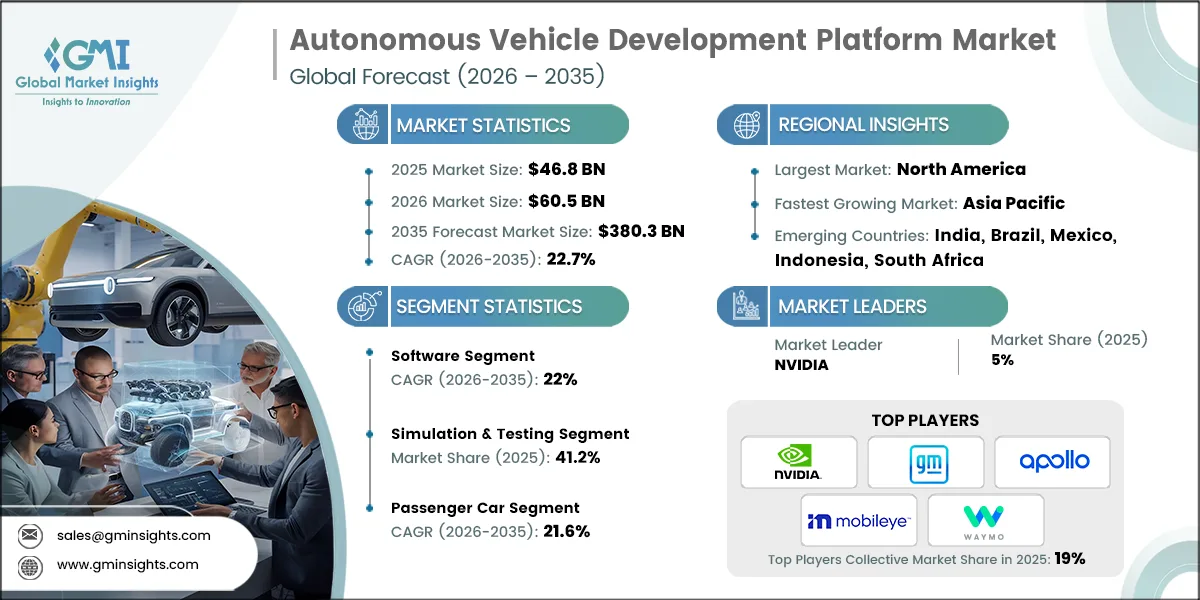
To get key market trends
Autonomous Vehicle Development Platform Market Trends
Cloud platforms are becoming a popular option to help large-scale autonomous vehicle (AV) simulation and validation workflows, allowing for easy collaboration with increased scalability, and significant reductions in the costs associated with physical test vehicles. This evolution started in June 2023 when Ansys launched AVxcelerate 2023 that includes artificial intelligence (AI)-based tooling for sensor and traffic modeling to accelerate level four simulation.
AI and machine learning are integrating with simulation platforms to help real-life edge-case scenarios, improving the models used for perception and decision making and lowering the need for expensive real-life testing. For instance, NVIDIA and Apex.AI partnered to enhance DRIVE-based AV simulations.
Partnerships exist between software/platform providers and automobile manufacturers for the purpose of building AV development capabilities, sharing data and standardizing tools. For instance, Stellantis partnered with NVIDIA, Uber, and Foxconn in level four autonomous vehicle development
Integrating virtual-physical platforms can provide much more robust testing using both real and simulated inputs, thereby improving accuracy and reducing risk. For instance, Foretellix expanded its verification platform to include the integration of the Volvo Group for the thorough simulation of truck scenarios.
Autonomous Vehicle Development Platform Market Analysis
Learn more about the key segments shaping this market
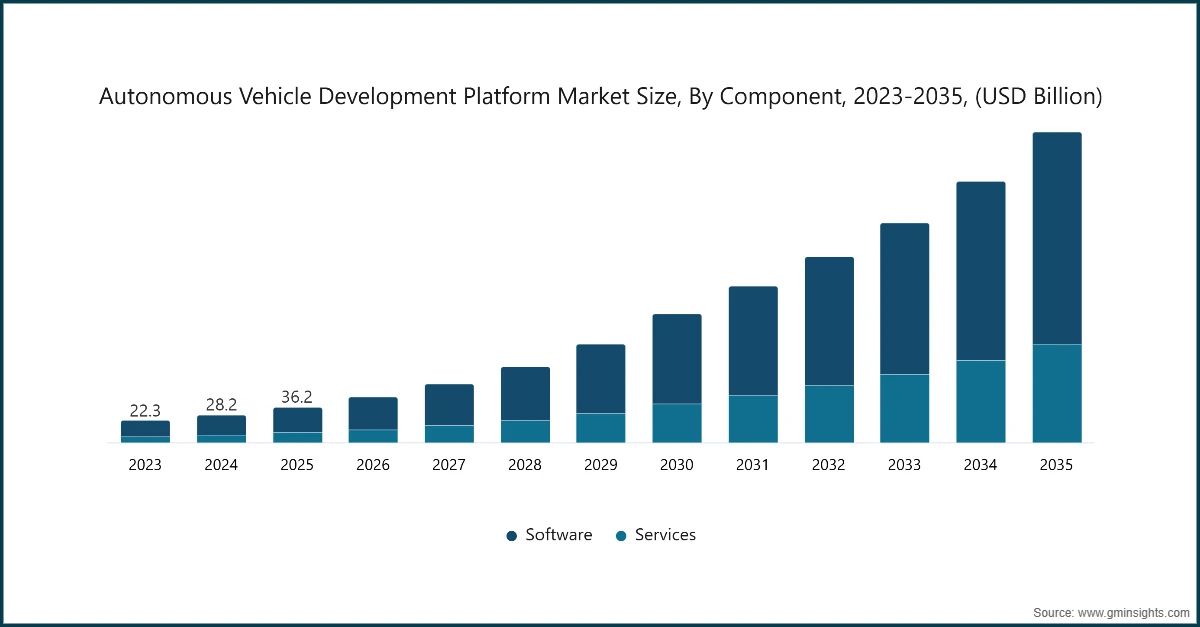
Based on component, the autonomous vehicle development platform market is divided into software and services. Software dominated the market, accounting for 72% in 2025 and is expected to grow at a CAGR of 22% through 2026 to 2035.
- Autonomous vehicle development software encompasses sensor simulation, perception modelling, mapping, localization, and decision-making frameworks, which provide virtual validation of various driving conditions.
- The software products include data collection, annotation, training, and validation of machine learning models. They process large datasets containing driving data to improve algorithms for object detection, path planning and control systems.
- Professional services provide support to automotive manufacturers and technology providers in the successful integration of autonomous platforms into the current vehicle architectures.
- The professional services support technical gaps, reduce implementation risks and ensure that the development platforms comply with industry standards and the new regulations surrounding autonomous driving.
- Managed services assist customers in deploying AV development platforms in an on-premises data centre or cloud/hybrid environment. Training programs enable engineering teams to have the required skillset and knowledge to use simulation tools, AI frameworks, and testing workflows.
Learn more about the key segments shaping this market
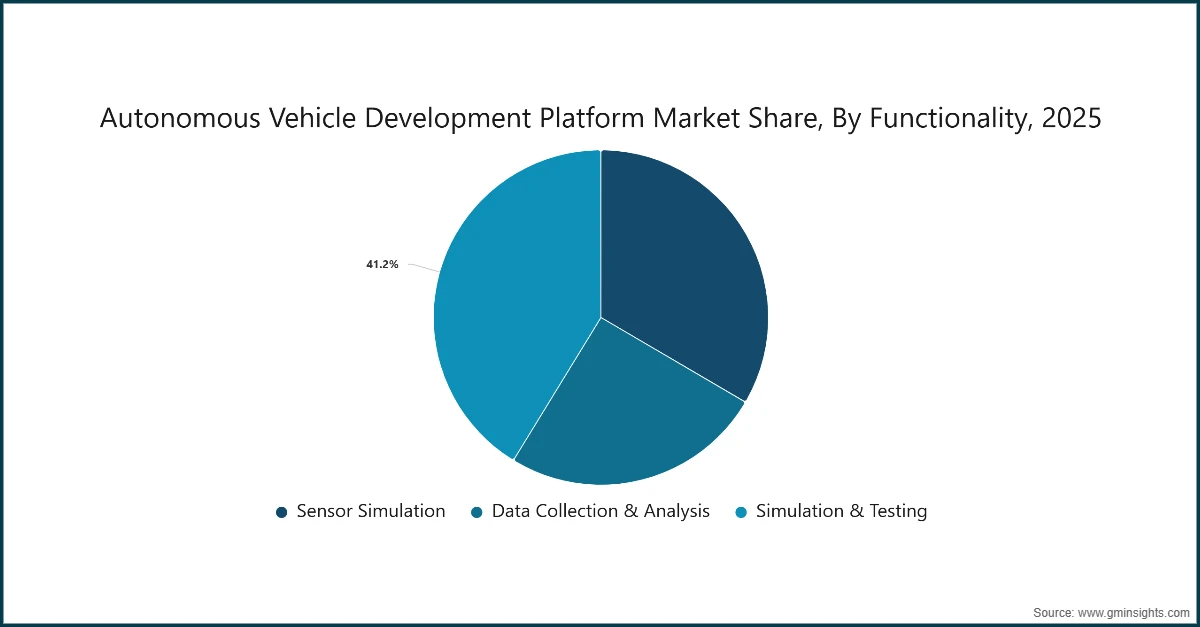
Based on functionality, the autonomous vehicle development platform market is segmented into sensor simulation, data collection & analysis and simulation & testing. Simulation & testing segment dominates the market with 41.2% share in 2025, and the segment is expected to grow at a CAGR of 23.5% from 2026 to 2035.
- Sensor Simulation technology creates highly detailed, accurate virtual environments that emulate the behavior of various sensors, such as LiDAR, radar, cameras and ultrasonic sensors, across differing weather, light and traffic conditions.
- Data collection and analysis are moving toward "cloud-hybrid", scalable infrastructures that can accommodate the processing of up to 1 petabyte of driving data in real time.
- The use of automated annotation, AI assisted annotation and continuously updated feedback remove many manual effort and errors from the process of producing accurate models.
- The evolution of Simulation and Testing platforms into combined Digital Twin Ecosystems will provide manufacturers and technical solution providers with a single, integrated environment for all forms of testing (virtual, hardware-in-the-loop and real-world). This trend will also help expedite the development of lifecycle for Level 3 to Level 5 autonomous vehicle technology validation.
Based on vehicle, the autonomous vehicle development platform market is segmented into passenger cars and commercial vehicles. The passenger car segment dominates the market with 62% share in 2025, and the segment is expected to grow at a CAGR of 21.6% from 2026 to 2035.
- Passenger cars implement features associated with Level 2+ and Conditional Level 3 autonomy at a rapid pace, therefore creating high demand for extensive development platforms.
- OEMs lean into simulation, sensor fusion software and AI validation tools as part of their strategy to deploy features quickly to comply with regulations, pass safety validation processes and integrate seamlessly into a connected vehicle ecosystem for OTA updates.
- Passenger vehicle platform development incorporates an emphasis on AI-driven personalization, predictive decision-making, and enhanced perception systems, development platforms provide capabilities for each of these attributes via large-scale data training and digital twin testing to advance the Urban Driving performance of passenger vehicles.
- The commercial vehicle market is experiencing substantial growth in pilot programs focused on autonomous trucking and logistics automation. Development platforms allow for large-scale simulation of highway driving scenarios, fleet-based learning, and optimizing fuel usage.
- Commercial vehicle trends indicate a focus on centralized data management, predictive maintenance, and real-time performance analytics. AV development platforms enable cloud-based simulations of fleets, modeling for optimal routes and hardware-in-the-loop validation.
Based on end use, the autonomous vehicle development platform market is segmented into automotive manufacturers, technology companies, research institutions & universities, government & defense and others. The automotive manufacturers segment is expected to dominate the market with a share of 33% in 2025.
- OEMs are increasingly integrating Level 3–5 autonomous systems into passenger and commercial vehicles. They are leveraging simulation platforms, digital twin environments, and AI-driven testing frameworks to accelerate development, reduce road-testing dependency, and ensure regulatory compliance.
- Technology companies are focusing on cloud-native AV platforms, AI-powered perception frameworks, and high-fidelity simulation tools. Investment in scalable ML training, data annotation, and hardware-in-the-loop testing supports multiple OEMs simultaneously.
- Research organizations are driving innovation in sensor fusion algorithms, AI perception models, and scenario-based validation techniques. Open-source platforms and collaborative research programs allow extensive testing of rare or extreme driving scenarios.
- Government and defense entities are adopting AV platforms for smart city mobility, autonomous public transport, and unmanned ground/military vehicles. Platforms are used to validate safety, interoperability, and V2X communications.
Looking for region specific data?
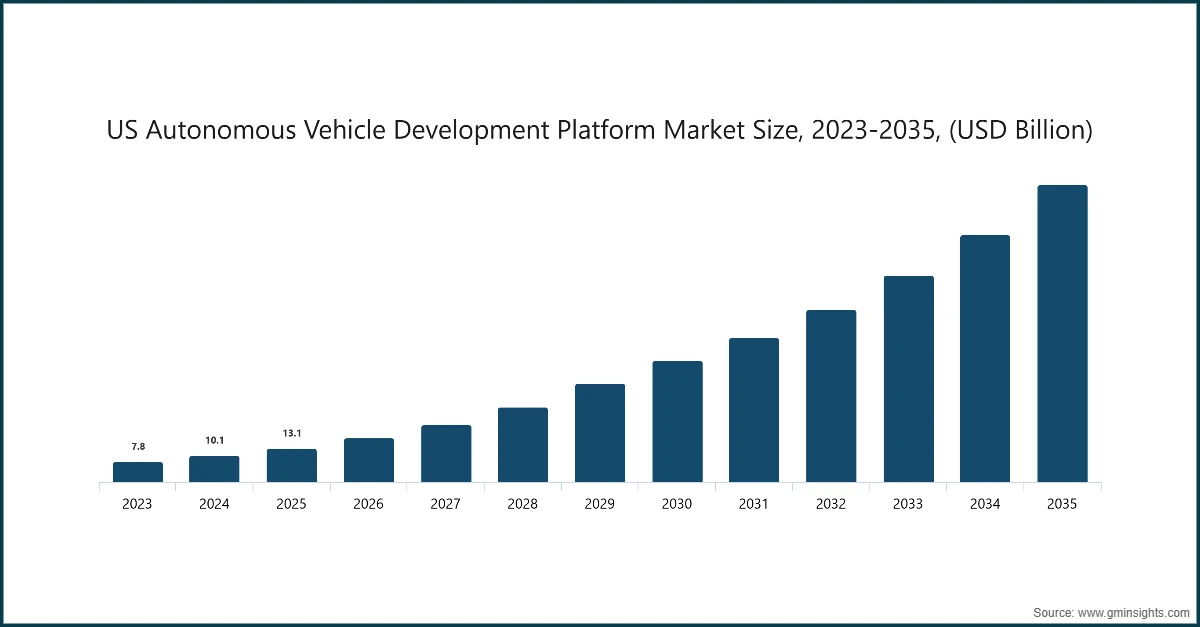
US autonomous vehicle development platform market reached USD 13.1 billion in 2025, growing from USD 10.1 billion in 2024.
- US is the clear leader in the development of autonomous vehicle (AV) platforms, due to the vast amount of AI, cloud services, and simulation expertise located in Silicon Valley.
- With many leading universities and research institutions working collaboratively with Original Equipment Manufacturers to innovate machine learning, perception, and decision-making frameworks, US has the largest concentration of researchers developing AV technologies.
- US is benefitting from a large amount of capital provided by venture-capital (VC) firms that are investing heavily in new start-ups and developing new technologies for AV platforms.
- Continued investment in digital-twin technology and providing high-fidelity testing capability to simulate different environments will greatly reduce the cost of physical-testing and the need for physical-testing environments.
- US maintains its superiority and ever-increasing computing-power capabilities and continues to collaborate across multiple industries, US will be at the forefront of delivering next-generation AV development tools and software platforms to the global marketplace.
North America dominated the autonomous vehicle development platform market with a market size of USD 15.8 billion in 2025.
- North America’s cloud infrastructure maturity supports scalable AV simulation and data management platforms. High adoption of advanced ADAS in passenger vehicles drives demand for software and validation tools.
- Presence of leading platform providers and tier‑1 suppliers ensures rapid deployment, testing, and integration of AV development frameworks across commercial, consumer, and mobility services sectors.
- Investments by tech giants and automotive OEMs in AV computing, simulation, and sensor fusion tools create robust vendor ecosystems.
- Partnerships across states and provinces incentivize innovation in end‑to‑end AV development platforms, promoting global technology leadership and commercialization readiness.
Europe autonomous vehicle development platform market accounted for a share of 24.4% and generated revenue of USD 11.4 billion in 2025.
- In Europe, Automated Vehicle (AV) development is supported through European research programs, funding schemes, and tools for data management, perception, and simulation.
- Cooperation and collaboration by member states will create a heterogeneous and dynamic ecosystem of AV technology providers, suppliers, educators, and vehicle manufacturers to further the development of AV through the creation of multiple automotive-based solutions that emphasize safety and sustainability.
- To promote safety and the protection of data, EU regulations and guidelines will create solid verification structures and protocols for testing. EU Countries and states create infrastructures for testing and how to create digital representations of physical assets (digital twin) using advanced technologies.
- The EU's emphasis on developing ethical artificial intelligence (AI) and supporting interoperability standards create reliable platforms for the widespread use of AV technologies in Europe and increase global competitiveness of AV platforms.
Germany dominates the autonomous vehicle development platform market, showcasing strong growth potential, with a CAGR of 24.7% from 2026 to 2035.
- Germany’s market benefits from strong automotive heritage, heavy OEM presence, and advanced engineering capabilities. German manufacturers invest in simulation tools, sensor fusion, and safety validation platforms to support autonomous driving technologies.
- Collaboration between research institutions and automotive leaders strengthens development frameworks for both passenger and commercial vehicles within European standards.
- Germany’s regulatory environment emphasizes safety and conformity, driving demand for high‑accuracy simulation and compliance testing platforms. German automotive software ecosystems integrate AI with traditional control systems, supporting autonomous use cases.
- Investments in digital infrastructure and testing corridors help Germany retain its leadership in autonomous system development within Europe and globally.
The Asia Pacific autonomous vehicle development platform market is anticipated to grow at the highest CAGR of 24.9% from 2026 to 2035 and generated revenue of USD 12.7 billion in 2025.
- The growth of the market in the APAC region is being driven by growing investments made in AI, simulation and cloud infrastructure by the nations of China, Japan, South Korea and India.
- Regional governments are also contributing to the rapid expansion of this market through their promotion of smart city pilots and test corridors that enable the validation of these platforms. The combination of local OEM participation, along with global software provider involvement will continue to drive robust adoption of the autonomous vehicle development frameworks.
- In APAC, partnerships established between the large technological corporations and manufacturers in the automotive sector will allow for the scaling up of their platforms. In addition, the provision of cloud-based data services supports the large-scale machine learning (ML) training and validation workflows.
- The contribution of APAC research facilities to the development of digital twins and sensor fusion technologies related to autonomous systems, has led to government policy initiatives designed to create a supportive environment for innovation that attract both private venture capital and foreign direct investments into autonomous vehicle platforms.
China autonomous vehicle development platform market is estimated to grow with a CAGR of 26% from 2026 to 2035.
- In China, government support, extensive testing zones, and considerable investments in AI, simulation, and sensor technologies are driving autonomous vehicle development (AVD) platform development market.
- In addition to government-sponsored initiatives, technology giants like Baidu and Pony.ai have stepped up to drive continued innovation across the AVD platform market in China.
- Cloud computing, high-performance data centres, and digital twin platforms will enable China to scale its simulation and validation of autonomous vehicles. There are growing levels of support within China's regulatory framework for city-level pilot programs, which help facilitate real-world testing and validation of autonomous vehicles.
- Research universities, research laboratories, and automotive manufacturers in China collaborate to develop new machine learning (ML) frameworks and provide high-fidelity testing methods.
- China promotes self-reliance in key technologies and strengthens the platform independence of the AVD platforms it develops from foreign suppliers. Investments in 5G, edge computing, and AI accelerators help to provide real-time data processing, which is critical for autonomous vehicles in commercial applications.
Latin America autonomous vehicle development platform market shows lucrative growth over the forecast period.
- The autonomous vehicle development market in Latin America is evolving with pilot projects in Brazil, Mexico, and Chile testing out how autonomous vehicles will have a positive impact on smart mobility.
- Universities and technology centers in Latin America are playing a role in developing open-source and simulation tools that support this technology. Global platform providers are partnering with local developers to develop and adapt autonomous vehicle development frameworks to meet the diverse urban conditions and variable infrastructure that exist throughout the region.
- Ongoing investment in cloud and data management systems will significantly increase the availability of AV development solutions to the various OEMs looking to utilize AV technology for their commercial fleets and to improve their logistics operations via AV platforms.
- Recent changes to the traffic patterns and road conditions typically found in LATAM are creating a need for the development of AV adaptive perception and decision-making systems. Partnerships between local companies and international technology companies are increasing strategies to deploy AV platforms or AV products in LATAM.
Mexico autonomous vehicle development platform market is estimated to grow with a CAGR of 20.6% from 2026 to 2035 and reach USD 9.5 billion in 2035.
- Mexico market is nascent but growing as research institutions and universities invest in simulation and perception tools. Partnerships with global platform providers enable access to advanced AI and testing frameworks adapted for Mexico traffic complexities. Infrastructure investments and pilot projects help validate AV platforms under varied environmental conditions.
- Mexico regulatory landscape evolves with safety and data protection standards, shaping demand for high‑fidelity simulation and compliance testing platforms. Local OEMs increasingly explore autonomous technologies for logistics and public transport. Integration of cloud platforms supports scalable data processing and collaboration across research and commercial initiatives.
- Mexico diverse road environments create opportunities for robust machine learning and digital twin tools to simulate real‑world challenges. Collaboration between government, academia, and private sector builds talent and accelerates platform adoption. While early stage, Mexico strategic position in Latin America fosters regional AV ecosystem development.
Middle East and Africa autonomous vehicle development platform market accounted for USD 3.1 billion in 2025 and is anticipated to show lucrative growth over the forecast period.
- The autonomous vehicle development platform in MEA is at a relatively nascent stage, with only limited pilot testbeds in UAE, Saudi Arabia and South Africa, which are testing integrated AV ecosystems.
- Regulators are focused on developing safety standard regulations that align with the internationally recognized safety standards aligned with other countries, to increase the uptake of the establishment of testing frameworks and develop high-fidelity simulation.
- Cloud-based OEM AV platforms will be limited only to scalable resource systems that will facilitate use of real-time data analytics. Collaboration with established global technology firms will support the development of local talent and provide a custom solution to the regional complexities of traffic management.
- The algorithms trained on regional data provide improved perception and decision-making capabilities in varying areas of climatic conditions; piloted implementations in the logistics and urban transport market will help to define the unique requirements of a local AV platform.
UAE market is expected to experience substantial growth in the Middle East and Africa autonomous vehicle development platform market, with a CAGR of 14.7% from 2026 to 2035.
- The UAE leads autonomous vehicle development platform interest within the MEA region with dedicated AV testing zones, regulatory sandboxes, and smart city initiatives such as Dubai Autonomous Transportation Strategy. Government backing accelerates adoption of simulation, perception, and mapping platforms tailored for desert and urban environments.
- The UAE partners with global AV platform providers to validate digital twin systems, sensor fusion tools, and cloud‑based testing infrastructures. Regulatory frameworks support real‑world trials, fostering platform refinement. Investments in 5G and edge computing enhance data throughput required for high‑fidelity simulations and machine learning workflows.
- Public transport and logistics pilots in the UAE integrate AV development platforms to optimize operational safety. Tech‑academia collaborations expand local expertise in autonomous algorithms and validation tools. The UAE’s strategic technology vision positions it as a Middle Eastern hub for autonomous platform research and innovation.
Autonomous Vehicle Development Platform Market Share
- The top 7 companies in the autonomous vehicle development platform industry are NVIDIA, Waymo, Mobileye, GM / Cruise, Baidu (Apollo), Toyota and Qualcomm contributing 25% of the market in 2025.
- NVIDIA develops the DRIVE AGX platform and Omniverse simulation tools, offering end-to-end AV software and AI computing solutions. Partnered with 25+ OEMs, it supports autonomous vehicle perception, mapping, and decision-making, enabling large-scale AI training and real-time simulation for AV development.
- Waymo, an Alphabet subsidiary, operates the Waymo Driver autonomous platform. It has driven 25M+ autonomous miles and licenses its technology to OEMs. The company focuses on L4 robotaxi solutions, high-fidelity simulation, and real-world validation of perception, decision-making, and control algorithms.
- Mobileye provides EyeQ chips, ADAS, and autonomous perception platforms. Deployed in over 125M vehicles, it partners with 50+ OEMs globally. Mobileye focuses on AI-based sensor fusion, mapping, driver assistance, and Level 2–4 autonomous system development and validation.
- General Motors cruise division manufactures level 4 and 5 autonomous vehicles for commercial use as well as ride-sharing services in cities, using AI-driven tools for creating simulations, managing fleets and testing vehicles in real life to ensure an efficient rollout and deployment of both driverless taxi services and commercial AVs.
- Apollo project from Baidu is globally one of the most prominent open-source platforms for developing autonomous vehicles, with over 40 million kilometers tested to date. It is now being utilized by more than 210 partners throughout the world, with a complete suite of software for vehicle automation, simulation, perception, mapping, and fleet management for both passenger vehicles and mobility services.
- Toyota is continuing its investment in developing vehicles that operate without human drivers by investing in software-defined platforms. Additionally, they are working with technology partners to test these vehicles in the real world, in addition to focusing on AI-based methods for perceiving their environment, creating realistic simulations, fusing data from multiple sensors and ultimately integrating autonomous systems into both passenger and commercial vehicles.
- Qualcomm's Snapdragon Ride platform offers several different platforms for developing AVs and comprises both AI processors and ADAS (advanced driver assistance systems) frameworks to be used by customers. Having partnerships with the likes of BMW, GM, and Volvo enables it to provide support for sensor fusion, training AI-based models, perceiving a vehicle's surroundings and controlling a vehicle in real-time, thus supporting the progress and implementation of AVs on a global basis.
Autonomous Vehicle Development Platform Market Companies
Major players operating in the autonomous vehicle development platform industry are:
- Baidu (Apollo)
- GM / Cruise
- Mercedes-Benz
- Microsoft
- Mobileye (Intel)
- NVIDIA
- Qualcomm
- Tesla
- Toyota
- Waymo (Alphabet)
- Companies are employing vertical integration to develop the full spectrum of capabilities necessary for an autonomous vehicle with respect to semiconductors (NVIDA, Tesla), sensors, software (NVIDA, Waymo, Tesla), and in some cases, operation of the vehicle (Waymo, Tesla, Cruise). This vertical integration allows for optimum cost savings to be achieved through the entire supply chain; however, it requires substantial capital investment and extensive technical knowledge across a wide variety of fields. Companies pursued vertical integration typically have greater performance advantages from co-optimizing hardware and software than those companies that have only utilized horizontal integration, however the latter may suffer from increased cost and complexity of providing for a diverse set of customer requirements and architecture outside of the vendor's reference architecture.
- Companies such as Microsoft (provides cloud infrastructure), Aurora (provides autonomous driving software), and simulation providers allow each to specialize in providing the best possible product to their respective market segments, while forming partnerships with other companies to create complete autonomous vehicle systems. their own best-of-breed solutions but have the added difficulty of potentially having to integrate multiple products from multiple vendors.
Autonomous Vehicle Development Platform Market Report Attributes
| Key Takeaway | Details |
|---|---|
| Market Size & Growth | |
| Base Year | 2025 |
| Market Size in 2025 | USD 46.8 Billion |
| Market Size in 2026 | USD 60.5 Billion |
| Forecast Period 2026-2035 CAGR | 22.7% |
| Market Size in 2035 | USD 380.3 Billion |
| Key Market Trends | |
| Drivers | Impact |
| Advanced AI and machine learning integration | Accelerates AV development and improves decision-making accuracy. |
| Increasing adoption of ADAS and autonomous technologies | drives demand for development and simulation platforms. |
| Growing investment from OEMs and tech companies | Accelerates innovation, platform development, and global market expansion. |
| Expansion of cloud computing and simulation infrastructure | Enables scalable testing, remote collaboration, and faster deployment cycles. |
| Pitfalls & Challenges | Impact |
| High development and R&D costs | Restricts smaller players from entering market, slowing innovation. |
| Regulatory uncertainty and compliance challenges | Delays platform adoption and limits commercial deployment. |
| Opportunities: | Impact |
| Rising demand for Level 4–5 autonomous vehicles | Drives requirement for advanced development, simulation, and testing platforms. |
| Integration of digital twin and simulation technologies | Improves testing accuracy, reduces real-world risks, accelerates deployment. |
| Partnerships between tech companies and automakers | Expands platform adoption and collaborative innovation opportunities. |
| Emerging markets adoption | Opens new regional growth, diversifying revenue streams for AV platforms. |
| Market Leaders (2025) | |
| Market Leader |
5% market share |
| Top Players |
Collective market share in 2025 is 19% |
| Competitive Edge |
|
| Regional Insights | |
| Largest Market | North America |
| Fastest growing market | Asia Pacific |
| Emerging countries | India, Brazil, Mexico, Indonesia, South Africa |
| Future outlook |
|
What are the growth opportunities in this market?
Autonomous Vehicle Development Platform Industry News
- In November 2025, Baidu Apollo Go reported 3.1 million fully driverless rides in Q3 2025, representing year‑over‑year growth (212%) and global expansion into Switzerland and Abu Dhabi. This milestone underscores rising adoption of autonomous systems powered by development platforms and real‑world validation in multiple international markets.
- In May 2025, Waymo announced a strategic manufacturing partnership with Magna International to build a new production plant in Arizona. The facility will produce vehicles equipped with Waymo’s self‑driving technology, producing over 2,000 autonomous units annually to scale Waymo One operations and support expansion into new U.S. markets.
- In August 2025, Baidu’s Apollo autonomous taxi service announced plans with Lyft to launch Level 4 driverless services in the UK and Germany by 2026, aiming to scale beyond China. The move reflects global commercialization ambitions for autonomous platforms and highlights rapid cross‑border technology deployment.
- In March 2025, At NVIDIA GTC 2025, NVIDIA introduced the NVIDIA DRIVE full‑stack autonomous vehicle software platform along with the Halos safety system, integrating AI model training, high‑fidelity simulation, and in‑vehicle compute. This expanded platform accelerates AV development for automakers, Tier‑1s, and tech partners worldwide, enhancing real‑time decision making and safety validation across autonomous initiatives.
The autonomous vehicle development platform market research report includes in-depth coverage of the industry with estimates & forecasts in terms of revenue ($ Mn/Bn) from 2022 to 2035, for the following segments:
Market, By Component
- Software
- Simulation & testing software
- Sensor fusion & perception software
- Machine Learning & AI frameworks
- Data management & annotation software
- Mapping & localization software
- Control & decision-making software
- Services
- Professional services
- Managed services
Market, By Functionality
- Sensor simulation
- Data collection & analysis
- Simulation & testing
Market, By End use
- Automotive manufacturers
- Technology companies
- Research institutions & universities
- Government & defense
- Others
Market, By Vehicle
- Passenger cars
- Hatchback
- SUV
- Sedan
- Commercial vehicle
- LCV
- MCV
- HCV
Market, By Deployment mode
- On‑premises platforms
- Cloud‑based platforms
- Hybrid deployment
The above information is provided for the following regions and countries:
- North America
- US
- Canada
- Europe
- Germany
- UK
- France
- Italy
- Spain
- Russia
- Nordics
- Poland
- Romania
- Asia Pacific
- China
- India
- Japan
- South Korea
- ANZ
- Vietnam
- Indonesia
- Philippines
- Latin America
- Brazil
- Mexico
- Argentina
- MEA
- South Africa
- Saudi Arabia
- UAE
Frequently Asked Question(FAQ) :
What was the market size of the autonomous vehicle development platform in 2025?
The market size was valued at USD 46.8 billion in 2025, growing at a CAGR of 22.7% till 2034. The market is driven by advancements in AI, machine learning, and cloud-based simulation platforms.
What is the projected value of the autonomous vehicle development platform market by 2035?
The market is expected to reach USD 380.3 billion by 2035, fueled by increasing adoption of AI and machine learning technologies.
What is the expected autonomous vehicle development platform industry size in 2026?
The market size is projected to grow to USD 60.5 billion in 2026.
What was the market share of the software segment in 2025?
The software segment accounted for 72% of the market in 2025 and is expected to grow at a CAGR of 22% up to 2035.
What was the valuation of the simulation & testing segment in 2025?
The simulation & testing segment held a 41.2% market share in 2025 and is set to expand at a CAGR of 23.5% through 2035.
What is the growth outlook for the passenger car segment from 2026 to 2035?
The passenger car segment, which dominated with a 62% market share in 2025, is expected to observe around 21.6% CAGR till 2035.
Which country leads the autonomous vehicle development platform sector?
The United States leads the market, with a valuation of USD 13.1 billion in 2025, supported by its strong AI, cloud services, and simulation expertise concentrated in Silicon Valley.
What are the upcoming trends in the autonomous vehicle development platform market?
The market is witnessing AI and machine learning integration for edge-case simulations, strategic automaker partnerships, and growing adoption of virtual-physical testing platforms to improve accuracy and minimize risks.
Who are the key players in the autonomous vehicle development platform industry?
Key players include Baidu (Apollo), GM / Cruise, Mercedes-Benz, Microsoft, Mobileye (Intel), NVIDIA, Qualcomm, Tesla, Toyota, and Waymo (Alphabet).
Autonomous Vehicle Development Platform Market Scope
Related Reports