Summary
Table of Content

Automotive Wheel Market
Get a free sample of this report
Form submitted successfully!
Error submitting form. Please try again.
Thank you!
Your inquiry has been received. Our team will reach out to you with the required details via email. To ensure that you don't miss their response, kindly remember to check your spam folder as well!
Request Sectional Data
Thank you!
Your inquiry has been received. Our team will reach out to you with the required details via email. To ensure that you don't miss their response, kindly remember to check your spam folder as well!
Form submitted successfully!
Error submitting form. Please try again.
Automotive Wheel Market Size
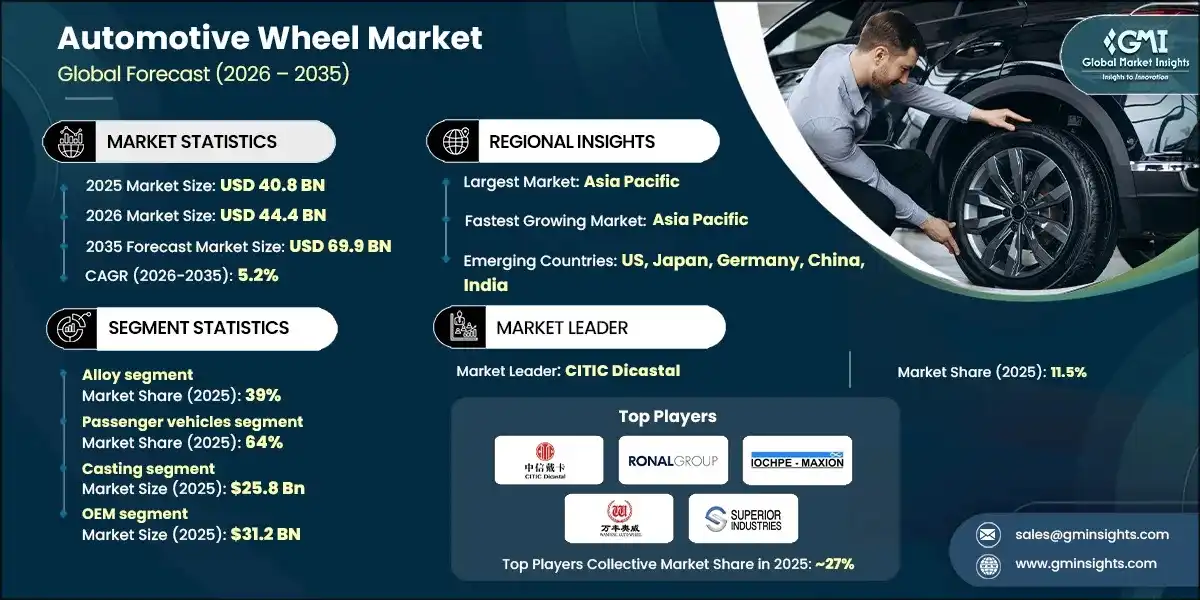
The global automotive wheel market size was valued at USD 40.8 billion in 2025 and is set to expand from USD 44.4 billion in 2026 to USD 69.9 billion by 2035, growing at an 5.2% CAGR from 2026 to 2035, according to latest report published by Global Market Insights Inc.
Automotive Wheel Market Key Takeaways
Market Size & Growth
- 2025 Market Size: USD 40.8 Billion
- 2026 Market Size: USD 44.4 Billion
- 2035 Forecast Market Size: USD 69.9 Billion
- CAGR (2026–2035): 5.2%
Key Market Drivers
- Rising Demand for SUVs and Premium Vehicles.
- Growth in Aftermarket Customization.
- Technological Advancements and Manufacturing Innovation.
- Expansion of Commercial and Off-Highway Vehicle Fleets.
Challenges
- Volatility in Raw Material Prices.
- High Capital Investment Requirements.
Opportunity
- Electrification-Driven Wheel Redesign.
- Emerging Markets and Localization Strategies.
Key Players
- Market Leader: CITIC Dicastal led with over 11.5% market share in 2025.
- Leading Players: Top 5 players in this market include CITIC Dicastal, RONAL, Iochpe-Maxion, Zhejiang Wanfeng Auto Wheel, Superior Industries International, which collectively held a market share of 27% in 2025.
Get Market Insights & Growth Opportunities
The automotive wheel market is experiencing sustained expansion driven by multiple converging factors including the accelerating global vehicle production, shifting consumer preferences toward premium and performance-oriented vehicles, and ongoing technological innovations in wheel manufacturing processes.
The market landscape is characterized by increasing adoption of lightweight materials particularly aluminum alloys, which are gaining prominence due to their superior strength-to-weight ratio and aesthetic appeal as per the Society of Automotive Engineers. According to industry data, the average wheel weight has decreased by approximately 18-22% over the past decade through advanced material science and manufacturing techniques, directly contributing to improved vehicle fuel efficiency and reduced emissions as per the U.S. Department of Energy.
The transition toward electric vehicles is fundamentally reshaping wheel design parameters and market dynamics. Electric vehicles require wheels that can accommodate heavier battery systems while maintaining optimal aerodynamic efficiency to maximize range capabilities. This has led to the development of specialized wheel designs with closed-spoke patterns and aerodynamic profiles that can reduce drag coefficients by 3-5% compared to conventional wheel designs according to the U.S. Environmental Protection Agency. Additionally, the regenerative braking systems in electric vehicles generate different thermal and mechanical stresses on wheels, necessitating enhanced material specifications and manufacturing precision.
In 2024, Ronal Group partnered with Lamborghini as a technical wheel supplier for the Lamborghini SC63 LMDh racing program. As part of this collaboration, Ronal Group developed and manufactured a forged racing wheel specifically engineered for high-performance endurance racing applications. The partnership was showcased at The Tire Cologne 2024, reinforcing RONAL’s positioning in premium and motorsport-grade wheel engineering.
The commercial vehicle segment represents a significant growth vector, particularly in emerging markets where infrastructure development and logistics expansion are driving demand for heavy-duty transport solutions. The global commercial vehicle fleet is projected to expand at a compound rate exceeding 6% through 2035, with strength in the Asia Pacific region where rapid urbanization and e-commerce growth are stimulating freight transportation requirements as per the World Bank. Commercial wheel manufacturers are responding by developing products with extended durability ratings, enhanced load-bearing capacities, and improved corrosion resistance to meet the demanding operational conditions of modern logistics operations.
To get key market trends
Automotive Wheel Market Trends
The automotive wheel industry is experiencing transformative evolution driven by converging technological, regulatory, and consumer preference dynamics that are fundamentally reshaping product specifications, manufacturing processes, and competitive positioning throughout the industry value chain. The accelerating transition toward lightweight materials represents perhaps the most consequential trend, with aluminum wheels expanding market share from approximately 38% of total unit volumes in 2020 to an estimated 42% by 2025 and projected to exceed 50% by 2035 as per the Society of Automotive Engineers.
The material transition is fundamentally driven by increasingly stringent global fuel economy and emission regulations including the Corporate Average Fuel Economy standards in the United States targeting 49 MPG by 2026, European Union CO2 emission standards requiring 95 grams per kilometer fleet average, and China's increasingly aggressive fuel consumption limits, collectively creating powerful regulatory imperatives for automotive manufacturers to reduce vehicle weight through all available pathways including wheel material optimization according to the U.S. Environmental Protection Agency.
Beyond regulatory compliance motivations, consumer preferences are increasingly favoring aluminum and alloy wheels due to their aesthetic advantages including enhanced design flexibility permitting more intricate spoke patterns and visual differentiation, superior surface finish options including machined faces, painted finishes, and premium coating applications unavailable on steel wheels, and brand associations connecting aluminum wheels with premium vehicle positioning and performance applications.
The electrification megatrend is creating distinct wheel market dynamics as battery electric vehicles fundamentally alter the design parameter space and performance priorities for wheel applications. Electric vehicles present unique engineering challenges including vehicle weight increases averaging 200-300 kg compared to equivalent internal combustion vehicles due to battery system mass, instant torque delivery characteristics creating different mechanical stress profiles on wheel structures, regenerative braking thermal management requirements as kinetic energy conversion to electrical energy generates heat that must be dissipated through brake and wheel systems, and range optimization imperatives creating heightened importance for aerodynamic efficiency in wheel designs according to the U.S. Department of Energy.
Digital commerce and e-commerce channels are transforming automotive wheel distribution dynamics, particularly within the aftermarket segment where online platforms enable consumers to research options, compare specifications and pricing, visualize wheel fitments through augmented reality applications, and complete purchases through digital channels with direct-to-consumer delivery.
Major aftermarket wheel retailers including Tire Rack, Discount Tire Direct, and regional specialists have developed sophisticated e-commerce platforms offering extensive product catalogs spanning thousands of wheel options, detailed fitment databases ensuring compatibility with specific vehicle applications, customer review systems providing social proof and quality feedback, and visualization tools enabling consumers to preview wheel appearances on their specific vehicle models.
Automotive Wheel Market Analysis
Learn more about the key segments shaping this market
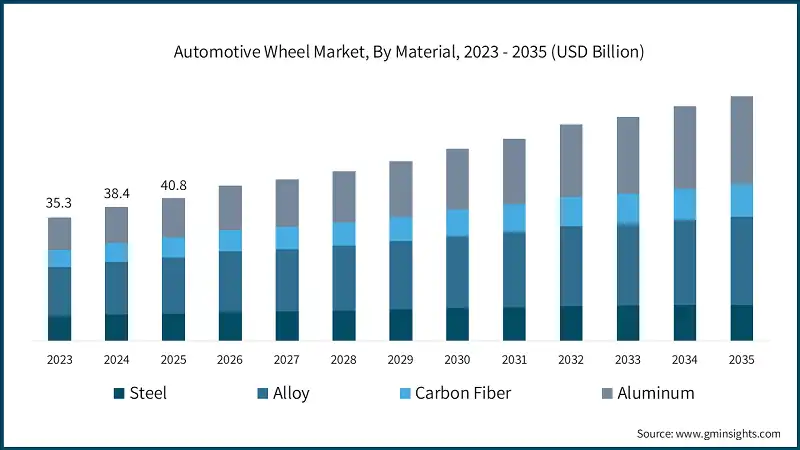
Based on material, the automotive wheel market is divided into steel, alloy, carbon fiber and aluminum. The alloy segment dominated the market accounting by around 39% in 2025 and is expected to grow at a CAGR of 4.3% from 2026 to 2035.
Alloy wheel’s ability to reduce unsprung mass by 25–30% compared to steel improves handling, acceleration, braking efficiency, and NVH performance. This makes alloy wheels a preferred choice for passenger vehicles, particularly in mid-to-premium segments where efficiency and design differentiation directly influence purchase decisions.
Technological evolution has strengthened the segment’s value proposition. Advancements such as flow forming, multi-axis machining, and hybrid alloy compositions allow manufacturers to deliver near-forged performance at lower cost. These innovations enable thinner barrel walls, higher stiffness, and improved thermal management while maintaining structural integrity under high loads and torque conditions.
From a manufacturing standpoint, alloy wheels benefit from scalable production models. Low-pressure die casting supports high-volume OEM programs, while flow forming and premium finishing techniques address performance and aesthetic demands. Integration of simulation tools finite element analysis and computational fluid dynamics has shortened development cycles and reduced scrap, improving capital efficiency and time-to-market.
Looking forward, alloy wheels will remain the dominant material category as sustainability, electrification, and premiumization converge. Increasing recycled aluminum content, low-carbon smelting, and surface treatments aligned with environmental regulations further enhance their attractiveness. As EV penetration rises, alloy wheels are expected to capture an even larger share of value due to their role in range optimization and thermal control.
Learn more about the key segments shaping this market
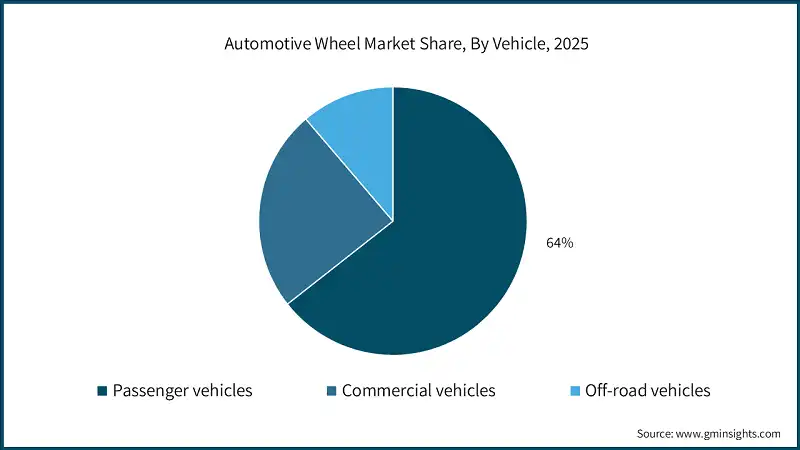
Based on vehicle, the automotive wheel market is categorized into passenger vehicles, commercial vehicles and off-road vehicles. Passenger vehicles segment dominates the market with around 64% share in 2025, and the segment is expected to grow at a CAGR of 4.5% between 2026 & 2035.
High production volumes and rising consumer expectations around aesthetics and performance. SUVs and crossovers continue to reshape this segment, pushing average wheel sizes upward and increasing demand for premium finishes, wider profiles, and higher load ratings.
Electrification is materially reshaping wheel specifications in this segment. EV platforms require wheels capable of supporting heavier curb weights, higher instantaneous torque, and regenerative braking forces. As a result, OEMs increasingly specify aero-optimized designs, reinforced structures, and enhanced thermal dissipation, which elevate both technical complexity and average selling prices.
Premiumization further accelerates value growth. Larger diameters (19–23 inches), multi-tone finishes, and forged or flow-formed options are becoming common even in upper-mid trims. This shift allows OEMs to extract higher margins per vehicle while maintaining differentiation across trim levels without major powertrain changes.
The aftermarket extends revenue potential across the vehicle lifecycle. Styling upgrades, performance enhancements, and replacement demand particularly in North America and urban Asia support sustained volumes. Together, these factors position passenger vehicles as the core revenue engine of the automotive wheel industry over the next decade.
Based on manufacturing process, the automotive wheel market is divided into casting, forging and flow forming. The casting segment dominate the market and was valued at USD 25.8 billion in 2025.
Low-pressure die casting and gravity casting together support high-volume programs with predictable quality and competitive unit economics, making casting the preferred process for mainstream passenger vehicles and light commercial applications.
Process improvements have significantly narrowed the performance gap between cast and higher-end alternatives. Advanced mold design, real-time quality monitoring, and automated inspection systems have improved yield rates and structural consistency. These advancements enable cast wheels to meet increasingly stringent OEM durability and safety standards.
Design freedom is a core strength of casting. Complex spoke geometries, variable wall thicknesses, and aesthetic surface treatments can be achieved without the cost burden associated with forging. This flexibility supports both mass-market styling trends and aftermarket differentiation, particularly for popular vehicle segments.
Flow-formed and forged wheels continue to gain share in performance-oriented and electrified platforms where weight savings translate directly into efficiency gains. As a result, casting will increasingly concentrate on high-volume, value-driven applications while ceding premium ground to advanced manufacturing methods.
Based on sales channel, the automotive wheel market is divided into OEM & aftermarket. The OEM segment dominates the market and was valued at USD 31.2 billion in 2025.
OEM supply relationships are characterized by multi-year agreements typically spanning 3–5 year vehicle platform lifecycles, formal supplier qualification processes requiring extensive quality management system certifications and financial stability demonstrations, and collaborative development partnerships where wheel manufacturers work directly with automotive engineering teams during vehicle development phases to optimize wheel specifications for specific platform requirements including load ratings, offset geometries, bolt patterns, and styling integration with overall vehicle design themes.
OEM wheel supply economics differ substantially from aftermarket dynamics, with pricing structures reflecting high-volume commitments, annual productivity improvement expectations typically requiring 2–3% year-over-year price reductions from suppliers, and intense competitive bidding processes during program award phases creating significant price pressure. However, OEM channels offer volume predictability enabling capacity planning and capital investment decisions, brand validation benefits as OEM supply relationships provide credibility and quality signaling valuable for aftermarket positioning, and technical collaboration opportunities allowing manufacturers to develop advanced capabilities and maintain technology leadership.
Asia Pacific represents the largest regional OEM market given the concentration of global automotive production in China, Japan, South Korea, India, and Thailand, with regional wheel manufacturing capacity similarly concentrated to serve these production centers through just-in-time delivery protocols minimizing inventory carrying costs and logistics complexity.
Looking for region specific data?
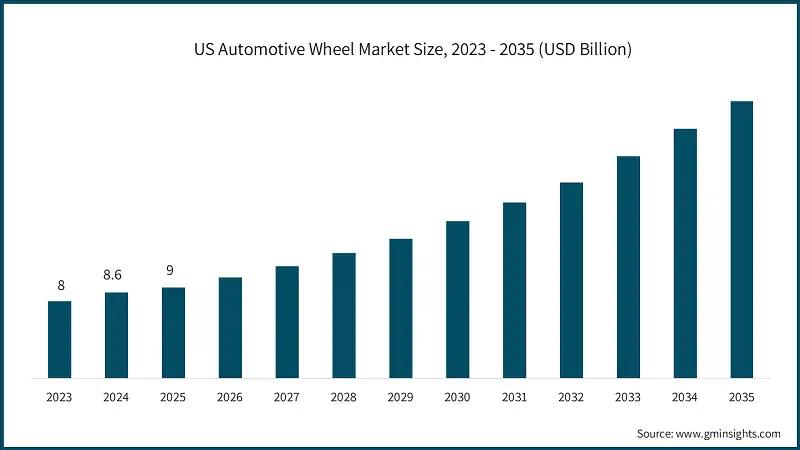
US dominated North America automotive wheel market with revenue of USD 9 billion in 2025.
US is driven by strong demand for SUVs, pickup trucks, and performance vehicles, which account for a large share of new vehicle sales. High average vehicle weights and preference for larger wheel diameters (18–22 inches) support higher value per unit, particularly in aluminum and forged wheel segments. OEM demand is closely tied to domestic production by Ford, GM, Stellantis, Tesla, and foreign OEMs operating U.S. plants.
The U.S. also has one of the world’s strongest aftermarket ecosystems, supported by high vehicle ownership, long vehicle lifecycles, and a strong customization culture. Aftermarket alloy wheels, off-road packages, and performance upgrades drive consistent replacement demand. E-commerce and specialty retail channels further amplify penetration and SKU diversity.
The U.S. combines domestic manufacturing with imports from Mexico and Asia. Proximity to OEM assembly plants supports just-in-time delivery models, while trade policies and tariff structures increasingly influence sourcing decisions. Electrification and truck electrification are expected to sustain demand for larger, higher-value wheels over the next decade.
China automotive wheel market will grow tremendously with CAGR of 5.4% between 2026 and 2035.
China is the world’s largest automotive wheel industry by volume, driven by unmatched vehicle production scale and rapid electrification. Domestic OEMs and EV startups generate massive demand for alloy wheels, supported by aggressive capacity expansion and cost-competitive manufacturing ecosystems. Aluminum wheel penetration is high and continues to increase as steel wheels are phased out in most passenger segments.
The Chinese market is highly vertically integrated, with local suppliers controlling casting, machining, and finishing operations at scale. This enables competitive pricing and fast response to OEM design changes. Export-oriented production also plays a key role, supplying OEMs and aftermarket channels across North America and Europe.
Electrification is a defining growth lever in China. EVs and plug-in hybrids require aero-optimized, lightweight wheels, accelerating innovation in flow forming and advanced surface coatings. Government policy support and scale economics position China as both the largest consumer and one of the most influential global suppliers of automotive wheels.
The automotive wheel market in Germany will experience robust growth during 2026-2035.
Germany represents the premium core of the automotive wheel industry, driven by high-end OEMs such as BMW, Mercedes-Benz, Audi, and Porsche. Wheel demand is characterized by precision engineering, lightweight design, and strict quality tolerances, with a strong emphasis on aluminum and forged wheel technologies. Premium vehicle mix supports higher ASPs despite lower overall unit volumes compared to mass-market regions.
The country plays a leading role in wheel innovation, with manufacturers closely integrated into OEM product development cycles. Advanced simulation, materials engineering, and tight integration with chassis and braking systems allow German suppliers to command premium positioning. Lightweighting, aerodynamic efficiency, and NVH optimization are key purchasing criteria.
EV and performance hybrid platforms demand higher load ratings, optimized thermal dissipation, and aerodynamic wheel designs. As a result, Germany remains a global reference market for high-performance and premium wheel solutions despite slower overall vehicle volume growth.
The automotive wheel market in Brazil will experience significant growth between 2026 & 2035.
Brazil is the largest automotive market in Latin America and a strategic manufacturing hub for regional OEM operations. Demand for automotive wheels is driven primarily by passenger vehicles and light commercial vehicles, with aluminum wheels gaining share as affordability improves and OEMs upgrade base trims.
The market favors cost-efficient manufacturing, with localized production critical due to import tariffs and logistics costs. Regional suppliers and global players operate local plants to serve OEMs such as Volkswagen, Stellantis, and General Motors. Wheel designs emphasize durability and adaptability to mixed road conditions rather than extreme performance.
Growth prospects are supported by gradual economic recovery, increasing motorization rates, and expanding exports to neighboring South American markets. Electrification remains nascent but is expected to accelerate later in the decade, creating opportunities for higher-value wheel offerings and technology upgrades.
From a manufacturing perspective, Brazil remains attractive due to its established supplier base, skilled workforce, and proximity to regional markets. Transmission suppliers increasingly design localized platforms that reuse global architectures while adapting gear ratios, cooling, and calibration for Brazilian driving conditions and fuel blends. This localization approach helps mitigate currency volatility and import exposure, strengthening Brazil’s role as both a consumption and export base for transmission systems across Latin America.
The automotive wheel market in Saudi Arabia is expected to experience robust growth between 2026 & 2035.
Saudi Arabia represents an emerging but strategically important automotive wheel industry driven by vehicle parc growth, premium vehicle penetration, and national industrial diversification initiatives. Demand is concentrated on SUVs and luxury vehicles, supporting larger wheel sizes and higher average selling prices.
The country is positioning itself as a regional automotive manufacturing and logistics hub under Vision 2030. Investments in local assembly, EV manufacturing, and industrial zones are expected to stimulate domestic demand for OEM wheel supply and encourage localization of component manufacturing over the medium term.
Climatic conditions and driving environments shape wheel requirements, emphasizing heat resistance, structural durability, and corrosion protection. As vehicle ownership continues to rise and EV adoption accelerates, Saudi Arabia is expected to evolve from a primarily import-driven market into a regional production and distribution center for automotive components, including wheels.
Automotive Wheel Market Share
The top 7 companies in the market are CITIC Dicastal, Ronal, Iochpe-Maxion, Zhejiang Wanfeng Auto Wheel, Superior Industries International, Borbet and Accuride Corporation. These companies hold around 31% of the market share in 2025.
CITIC Dicastal: Leverages unmatched global scale and deep integration with Chinese and international OEMs to deliver high-volume aluminum wheel solutions. Its strength lies in advanced casting and forging capabilities, strong R&D investment, and vertically integrated operations that enable cost leadership and rapid program execution across passenger and EV platforms.
RONAL: Excels in premium alloy wheel engineering with a strong focus on lightweight design, precision manufacturing, and OEM co-development. Its expertise in forged and flow-formed wheels, combined with strong European OEM relationships, positions RONAL as a preferred supplier for performance and luxury vehicle applications.
Iochpe-Maxion: Benefits from one of the most geographically diversified manufacturing footprints in the wheel industry, serving both passenger and commercial vehicles. Its dual strength in steel and aluminum wheels, combined with deep OEM partnerships and scale efficiencies, supports stable global supply and balanced exposure across regions.
Zhejiang Wanfeng Auto Wheel: Competes through cost-efficient, vertically integrated manufacturing and strong domestic OEM relationships in China. The company’s ability to scale production rapidly, expand exports, and invest in lightweight aluminum technologies positions it as a key global supplier in both mass-market and premium segments.
Superior Industries International: Leverages advanced casting technologies and strong North American OEM relationships to deliver high-quality aluminum wheels. Its operational focus is on lightweight design, manufacturing efficiency, and proximity to major vehicle assembly plants supports responsiveness and long-term supply agreements.
Borbet: Known for engineering excellence in aluminum wheel manufacturing, Borbet combines precision casting, advanced surface finishing, and strong OEM collaboration. Its strength lies in supplying premium and performance-oriented wheels to European automakers with high quality and design consistency.
Accuride: Specializes in steel and aluminum wheels for commercial vehicles, with a strong focus on durability, load-bearing performance, and fleet reliability. Its deep presence in truck and trailer markets and emphasis on lifecycle value position it as a leader in heavy-duty wheel solutions.
Automotive Wheel Market Companies
Major players operating in the automotive wheel industry include:
- CITIC Dicastal
- Ronal
- Iochpe-Maxion
- Enkei
- Borbet
- Superior Industries International
- Prime Wheel
- BBS Autotechnik
- Topy Industries
- Zhejiang Wanfeng Auto Wheel
- Accuride
CITIC Dicastal: Global aluminum leader with >70 million annual capacity across China and Southeast Asia, supplying major OEMs and EV platforms with advanced cast and flow-formed products in the automotive wheel market.
Iochpe-Maxion (Maxion Wheels): Steel wheel leader with broad OEM presence across light vehicles and trucks; expanding aluminum capabilities in strategic markets including the Americas and Europe.
Zhejiang Wanfeng: Scaled Chinese aluminum producer with OEM and aftermarket reach, advancing flow-formed offerings for performance applications.
Superior Industries: North America/Europe aluminum specialist with design-to-manufacturing integration and a refreshed capital structure following its go-private transaction.
Ronal: European premium supplier with large-diameter and EV-optimized program content, plus high-profile supercar collaborations.
Enkei and RAYS: Japanese performance mainstays leveraging forging and proprietary forming (e.g., MAT) for lightweight, motorsport-proven wheels.
BBS: Iconic performance brand revitalized under new ownership, focusing on forged and flow-formed lines and OEM special editions in the automotive wheel market.
Automotive Wheel Market Report Attributes
| Key Takeaway | Details |
|---|---|
| Market Size & Growth | |
| Base Year | 2025 |
| Market Size in 2025 | USD 40.8 Billion |
| Market Size in 2026 | USD 44.4 Billion |
| Forecast Period 2026-2035 CAGR | 5.2% |
| Market Size in 2035 | USD 69.9 Billion |
| Key Market Trends | |
| Drivers | Impact |
| Rising Demand for SUVs and Premium Vehicles | Premium vehicles increasingly use alloy, forged aluminum, and multi-spoke designs to enhance styling, performance, and braking efficiency, directly increasing value per vehicle for wheel manufacturers. |
| Growth in Aftermarket Customization | Consumers are increasingly personalizing vehicles through aftermarket wheel upgrades focused on design, size, finish, and performance. The growing influence of motorsports styling, social media, and lifestyle branding is accelerating demand for custom alloy wheels, particularly in North America, Europe, and parts of Asia-Pacific. |
| Technological Advancements and Manufacturing Innovation | Advancements such as flow-forming, forging, hybrid aluminum-steel wheels, and lightweight composite materials are enabling higher strength-to-weight ratios and improved fuel efficiency. Automation, digital simulation, and smart manufacturing techniques are also improving yield rates and production scalability. |
| Expansion of Commercial and Off-Highway Vehicle Fleets | Growth in logistics, construction, mining, and agricultural sectors is increasing demand for durable, high-load-bearing wheels for trucks, buses, and off-highway vehicles. Fleet electrification and infrastructure expansion further support demand for specialized wheel designs optimized for higher torque and payloads. |
| Pitfalls & Challenges | Impact |
| Volatility in Raw Material Prices | Fluctuating prices of aluminum, steel, magnesium, and alloys directly impact production costs and margins. Geopolitical instability, energy costs, and supply chain disruptions exacerbate pricing uncertainty, making long-term cost planning difficult for wheel manufacturers. |
| High Capital Investment Requirements | Manufacturing advanced wheels requires significant capital investment in forging presses, CNC machining, casting lines, and quality control systems. Smaller manufacturers face entry barriers, while existing players must continuously invest to meet OEM quality standards and lightweighting requirements. |
| Opportunities: | Impact |
| Electrification-Driven Wheel Redesign | Electric vehicles require wheels optimized for higher torque, increased vehicle weight, and aerodynamic efficiency. This creates opportunities for lightweight alloys, aero-optimized wheel designs, and integrated wheel–hub systems that enhance range and efficiency. |
| Emerging Markets and Localization Strategies | Rapid motorization in Asia-Pacific, Latin America, and parts of Africa is driving demand for cost-effective yet durable wheels. Local manufacturing partnerships and region-specific designs offer strong growth potential for global and regional players. |
| Market Leaders (2025) | |
| Market Leaders |
11.5% market share |
| Top Players |
|
| Competitive Edge |
|
| Regional Insights | |
| Largest Market | Asia Pacific |
| Fastest Growing Market | Asia Pacific |
| Emerging Country | US, Japan, Germany, China, India |
| Future Outlook |
|
What are the growth opportunities in this market?
Automotive Wheel Industry News
In 2024, Iochpe-Maxion, through its subsidiary Maxion Wheels, acquired a 50.1% stake in Polimetal (Argentina). This strategic acquisition strengthens Maxion’s aluminum wheel manufacturing footprint in South America, enhances regional supply capabilities, and supports growing demand from light-vehicle OEMs across the region.
In 2024, KW Automotive acquired key production assets of BBS Autotechnik’s facilities in Schiltach and Herbolzheim, Germany. The transaction followed BBS’s insolvency proceedings and enables KW Automotive to preserve premium wheel manufacturing capabilities while expanding its footprint in high-performance and aftermarket wheel segments.
In December 2025, Superior Industries International completed a go-private transaction led by a group of its existing term-loan investors. The transaction removed Superior from public markets, allowing greater strategic flexibility, cost restructuring, and long-term operational optimization amid ongoing industry transformation.
In 2025, Maxion Wheels announced the start of serial production of forged aluminum truck wheels at its Manisa, Türkiye facility. The production program, developed in partnership with ?nci Holding, supports growing demand for lightweight and high-durability commercial vehicle wheels and strengthens Maxion’s regional manufacturing and export capabilities.
The automotive wheel market research report includes in-depth coverage of the industry with estimates & forecasts in terms of revenue ($Bn) and shipment (Units) from 2022 to 2035, for the following segments:
Market, By Material
- Steel
- Alloy
- Carbon Fiber
- Aluminum
Market, By Vehicle
- Passenger vehicles
- Hatchback
- Sedan
- SUV / Crossover
- Commercial vehicles
- Light commercial vehicles (LCV)
- Medium commercial vehicles (MCV)
- Heavy commercial vehicles (HCV)
- Off-road vehicles
Market, By Manufacturing Process
- Casting
- Forging
- Flow forming
Market, By Rim Size
- 13–15 inches
- 16–18 inches
- 19-21 inches
- Above 21 inches
Market, By Sales Channel
- OEM
- Aftermarket
The above information is provided for the following regions and countries:
- North America
- US
- Canada
- Europe
- Germany
- UK
- France
- Italy
- Spain
- Russia
- Nordics
- Benelux
- Asia Pacific
- China
- India
- Japan
- Australia
- South Korea
- Philippines
- Indonesia
- Singapore
- Latin America
- Brazil
- Mexico
- Argentina
- Chile
- MEA
- South Africa
- Saudi Arabia
- UAE
Frequently Asked Question(FAQ) :
What is the market size of the automotive wheel in 2025?
The market size was valued at USD 40.8 billion in 2025, with a CAGR of 5.2% expected through 2035. The market is driven by rising demand for SUVs, premium vehicles, and lightweight wheel materials.
What is the projected value of the automotive wheel market by 2035?
The market is poised to reach USD 69.9 billion by 2035, due to vehicle production growth and electrification trends.
What is the expected size of the automotive wheel industry in 2026?
The market size is expected to reach USD 44.4 billion in 2026.
How much revenue did the alloy segment generate in 2025?
The alloy segment dominated the market with around 39% share in 2025 and is expected to grow at a CAGR of 4.3% up to 2035.
What was the valuation of the casting manufacturing process segment in 2025?
The casting segment was valued at USD 25.8 billion in 2025.
What is the growth outlook for the passenger vehicles segment from 2026 to 2035?
The passenger vehicles dominate the market with around 64% share in 2025 and is set to expand at a CAGR of over 4.5% till 2035.
Which region dominates the automotive wheel sector?
North America dominates, with the U.S. market reaching USD 9 billion in 2025, owing to high demand for SUVs, pickups, and larger wheels.
What are the upcoming trends in the automotive wheel market?
Trends include growth of aluminum wheels, regulatory-driven lightweight designs, EV-focused wheel engineering, aesthetic alloy preferences, and expansion of online sales channels.
Who are the key players in the automotive wheel industry?
Key players include CITIC Dicastal, RONAL, Iochpe-Maxion, Zhejiang Wanfeng Auto Wheel, Superior Industries International, Borbet, and Accuride Corporation.
Automotive Wheel Market Scope
Related Reports