Summary
Table of Content

Automotive Supply Chain Tracking Hardware Market
Get a free sample of this report
Form submitted successfully!
Error submitting form. Please try again.
Thank you!
Your inquiry has been received. Our team will reach out to you with the required details via email. To ensure that you don't miss their response, kindly remember to check your spam folder as well!
Request Sectional Data
Thank you!
Your inquiry has been received. Our team will reach out to you with the required details via email. To ensure that you don't miss their response, kindly remember to check your spam folder as well!
Form submitted successfully!
Error submitting form. Please try again.
Automotive Supply Chain Tracking Hardware Market Size
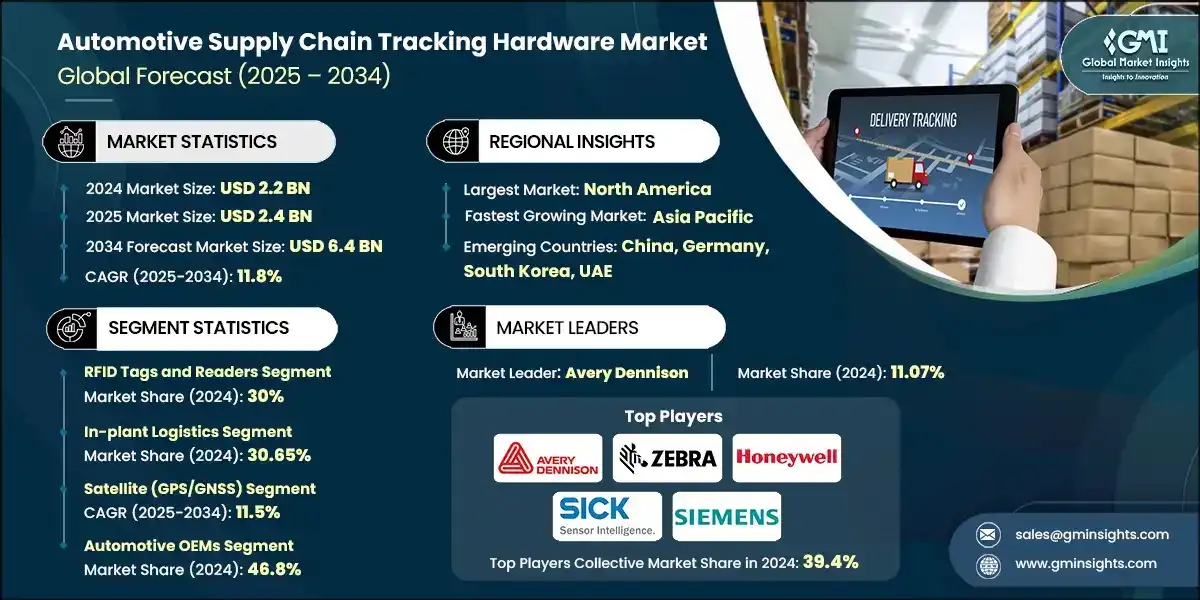
The global automotive supply chain tracking hardware market size was estimated at USD 2.2 billion in 2024. The market is expected to grow from USD 2.4 billion in 2025 to USD 6.4 billion in 2034, at a CAGR of 11.8% according to latest report published by Global Market Insights Inc.
Automotive Supply Chain Tracking Hardware Market Key Takeaways
Market Size & Growth
- 2024 Market Size: USD 2.2 Billion
- 2025 Market Size: USD 2.4 Billion
- 2034 Forecast Market Size: USD 6.4 Billion
- CAGR (2025–2034): 11.8%
Regional Dominance
- Largest Market: North America
- Fastest Growing Region: Asia Pacific
Key Market Drivers
- Rising digitalization of automotive supply chains.
- Expansion of EV and battery supply networks.
- Stringent traceability and compliance mandates.
- Integration of IoT, AI, and 5G in logistics operations.
- Growing focus on supply chain resilience and transparency.
Challenges
- High deployment and integration costs.
- Interoperability and data standardization issues.
Opportunity
- Adoption of IoT-enabled smart factories.
- Integration of AI and predictive analytics in fleet tracking.
- Use of low-power wide-area networks (LPWAN) and 5G.
- Growth in circular supply chain models.
Key Players
- Market Leader: Avery Dennison led with over 11.07% market share in 2024.
- Leading Players: Top 5 players in this market include Avery Dennison, Zebra Technologies, Honeywell International, SICK, Siemens, which collectively held a market share of 39.4% in 2024.
Get Market Insights & Growth Opportunities
The competitive landscape of the automotive supply chain tracking hardware market is rising, driven by growing digitalization, IoT and developments in connectivity and semiconductor technologies. The industry titans are focusing on developing low-power, high-efficiency hardware that enables real-time tracking of data, predictive analytics and intelligent communication among manufacturing and logistics networks.
The market will grow to USD 3.3 billion by 2029 and to USD 3.7 billion by 2030. The key drivers for growth include the growing demand for end-to-end visibility across the supply chain, the rising adoption of AI-based analytics, and the shift to connected and electric vehicle ecosystems.
Key players such as Zebra Technologies, Honeywell International, NXP Semiconductors, STMicroelectronics and Infineon Technologies are spearheading the creation of advanced tracking modules RFID tags, IoT sensors, GPS units and telematics gateways for the optimization of logistics, data precision, and supply chain transparency. The industry also finds itself being pushed by initiatives related to supply chain resilience, smart manufacturing and semiconductor localization in post-pandemic periods.
The Asia-Pacific region dominates the market with increasing automotive and electronics manufacturing platforms in China, Japan, South Korea and India. Automakers and Tier-1 suppliers are making substantial investments in connected logistics networks with IoT-based tracking modules, 5G connectivity and AI-enabled analytics platforms to optimize operational control and real-time monitoring.
Europe is becoming the fastest-growing region as it is driven by stringent EU regulations on sustainability, reducing carbon footprint and digital traceability. Leading OEMs such as Volkswagen, BMW and Mercedes-Benz are engaging with technology suppliers to introduce IoT-capable supply chain infrastructure to maintain regulatory adherence and support circular economic behaviors.
In North America, established players like Honeywell International, Zebra Technologies, and Qualcomm Technologies are deepening their hold through the development of AI-powered telematics devices and sensor networks for electric and connected cars. High priority for automation and predictive maintenance in the region continues to propel demand for precise tracking solutions.
To get key market trends
Automotive Supply Chain Tracking Hardware Market Trends
In early 2024, the market for automotive tracking hardware is expanding rapidly with OEM and Tier-1 players adopting intelligent, sensor-based solutions to digitize and protect global supply chain operations. The solutions are becoming essential for regulating communication among in-plant logistics units, fleet management systems, and aftermarket networks to maintain robust data capture, component traceability, and manufacturing efficiency.
As the automotive industry shifts toward multi-domain and zonal electronic architectures, next-generation tracking modules are co-created with edge processors, AI chips and IoT gateways to enable real-time analytics, automation and energy-friendly processing. The transformation is of most significance to electric and hybrid vehicles, where precise tracking of batteries, semiconductors and critical components guarantees safety, performance and sustainability compliance.
The expansion of EV usage is also creating new demand for ecologically resilient, low-latency monitoring tools that have the capacity to monitor the movement and health of powertrain and energy components. These tools include carbon footprint monitoring, temperature and vibration monitoring and offer transparency at every stage of the EV supply chain.
OEMs are now building sensor-equipped, AI-driven supply chain architectures that combine digital smarts with real-time visibility. With this union, manufacturers can dynamically manage logistics operations, maintain tamper-proof audit trails of material movement and validate components. As increasingly software-intensive and networked cars become the norm, hardware tracking lays the groundwork for safe, smart communication among factories, transport fleets and distribution facilities.
Moreover, future supply chain tracking will enable bidirectional data and energy transfer, and factories and vehicles will be capable of communicating in real time with smart infrastructure. OEMs are exploring hardware platforms with onboard security mechanisms, artificial intelligence processors, and 5G connectivity to support digital identity authentication, predictive maintenance, and sustainable logistics, so vehicles and components are verifiable, connected nodes on the global mobility network.
Automotive Supply Chain Tracking Hardware Market Analysis
Learn more about the key segments shaping this market
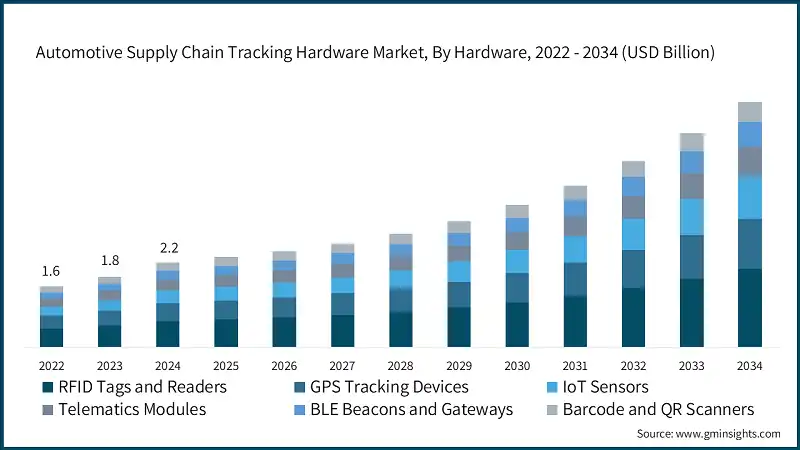
Based on hardware, automotive supply chain tracking hardware market is segmented into RFID tags and readers, GPS tracking devices, IoT sensors, telematics modules, BLE beacons & gateways and barcode and QR Scanners. The RFID tags and readers segment dominated the market with 30% share in 2024, and the segment is expected to grow at a CAGR of over 12.3% from 2025 to 2034.
- The RFID tags and readers segment accounted for 30.6% share in automotive supply chain tracking hardware market in 2024 and is expected to reach USD 2.04 billion by 2034. The dominance of this segment is reflective of the maturity, affordability and widespread usage of the technology in all automotive manufacturing and logistics activities.
- RFID technology provides accurate, hands-free identification and location capabilities for automotive components, returnable transportation assets, work orders, and finished vehicles throughout the supply base. The absence of requirements for line-of-sight and the ability to support bulk reading operations make the technology most valuable in high-volume automotive production applications.
- GPS technology makes the features for accurate location tracking mandatory to trace automotive parts and complete vehicles during transportation and storage. The segment continues to see improvement in satellite positioning accuracy, power-saving, and incorporation of cellular and Wi-Fi technology to enhance connectivity and data transfer capabilities.
- The IoT sensors segment holds the largest-growing hardware segment with a 13.5% CAGR. This tremendous growth is due to the automotive industry's faster adoption of sensor technology to provide end-to-end supply chain tracing and data capture.
Learn more about the key segments shaping this market
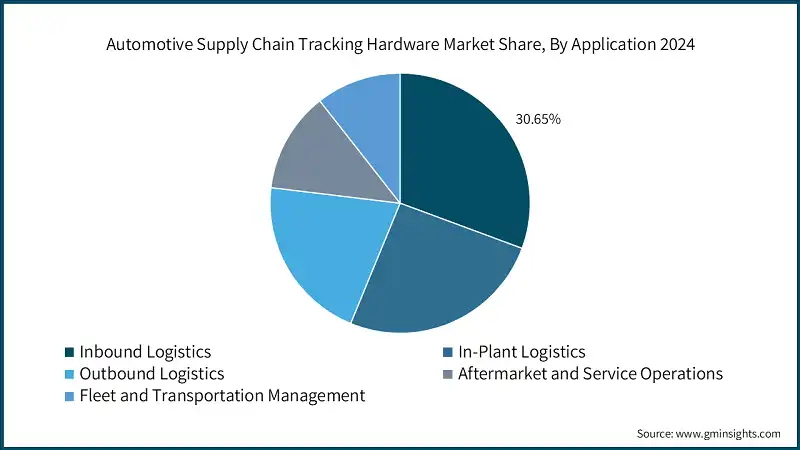
Based on application, automotive supply chain tracking hardware market is divided into inbound logistics, in-plant logistics, outbound logistics, aftermarket & service operations and fleet & transportation management. In-plant logistics segment dominated the market, accounting for around 30.65% share in 2024 and is expected to grow at a CAGR of 12.4% from 2025 to 2034.
- The segment involves tracking hardware utilized for surveillance of raw materials, components and sub-assemblies arriving from auto manufacturers' suppliers. The huge market share of the segment reflects the critical importance of inbound material visibility for just-in-time production processes and production planning optimization.
- Inbound logistics tracking hardware enables vehicle makers to monitor supplier performance, forecast material shipments, and optimize inventory control. Technology supports sophisticated features including automated receiving, integration of quality inspections, and monitoring of supplier compliance.
- In-plant logistics market comprises monitoring hardware that is installed within the auto production factory for monitoring work-in-progress, tools, and material movement within the factory. The market experiences growth as a result of increasing automation in auto production and the need to track parts precisely through advanced assembly processes.
- In-plant tracking systems support lean manufacturing principles with real-time visibility into production status, detection of bottlenecks, and material flow optimization. The technology provides for automated data collection for product quality, reporting on production and compliance with regulations. With integration into manufacturing execution systems, advanced production monitoring capabilities are established, which increase efficiency and reduce the cost of manufacturing.
Based on Technology, the automotive supply chain tracking hardware market is segmented into satellite (GPS/GNSS), radio frequency identification (RFID), bluetooth low energy (BLE), Wi-Fi and cellular (4G/5G), ultra-wideband (UWB) and near field communication (NFC). Satellite (GPS/GNSS) segment is projected to dominate the market with a CAGR of 11.5% from 2025 to 2034, owing to acceleration in vehicle and shipment tracking, regulatory mandates.
- The satellite technology has the capability to offer precise location tracking functionalities required for monitoring automotive parts and vehicles on the move via global supply chains. The sector is supported by successive improvements in the accuracy of satellite positioning, with modern systems boasting sub-meter accuracy suitable for high-precision supply chain tracking purposes.
- The growth of RFID technology owing to its mature, cost-friendly, and widely used in automobile supply chain applications. The technology supports both passive and active RFID systems, with passive tags providing low-cost identification of bulk items and active tags giving longer read distances and additional sensor functions for high-value items.
- RFID technology evolution includes enhanced security features, reading reliability, and interfacing with IoT platforms for end-to-end supply chain visibility. The ability of the technology to operate without direct line-of-sight and the ability to read multiple tags simultaneously makes it extremely suitable in automotive manufacturing environments that involve high component volumes and complex logistics processes.
Based on end use, the automotive supply chain tracking hardware market is divided into automotive OEMs, third-party logistics (3PL) providers, aftermarket and fleet operators. Automotive OEMs segment accounting for 46.8% share in 2024 and is expected to grow at a CAGR of 12% from 2025 to 2034.
- Automotive OEMs utilize advanced tracking hardware such as RFID, IoT sensors and telematics modules within their logistics and manufacturing infrastructure in order to gain end-to-end supply chain visibility. The hype for digital twins and cognitive manufacturing is propelling hardware uptake in predictive maintenance, quality monitoring and real-time data collection. OEMs are making investments in secure AI-based monitoring systems to improve transparency and productivity in global multi-tier supply chains.
- 3PL providers are rapidly deploying IoT-based tracking hardware to enhance logistics efficiency, visibility and asset utilization in automotive customers. Implementation of GPS trackers, RFID readers and BLE beacons makes possible real-time monitoring of shipments, warehouse operations and vehicle fleets.
- It allows avoiding transit delays, optimized routes and improved risk management. As there is mounting pressure on timely delivery and digital openness, 3PLs are integrating AI and 5G-based tracking technology into logistics platforms. These technologies allow predictive analytics, automatic reporting and temperature or vibration tracking necessary for shipping high-value automotive components along global and regional supply chains.
- In after-sales automobiles, tracking hardware uptake is driven by needs for enhanced parts traceability, counterfeiting protection and supply chain optimization. RFID tags, QR code and IoT sensors are being incorporated into components and packaging to enable authenticity checking and efficient stock management. Distribution and service providers are putting these technologies to use in monitoring parts movement, warranty validation and reverse logistics.
Looking for region specific data?
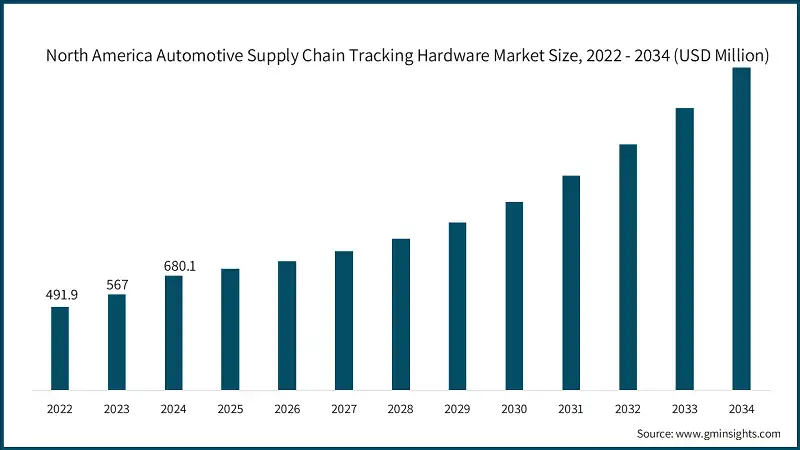
North America region dominated the automotive supply chain tracking hardware market with a revenue share of 30.6% in 2024.
- North America holds the largest regional market size of USD 680.1 million in 2024, with projected growth to reach USD 1.8 billion in 2034 at a CAGR of 11.4%. Regulatory requirements, advanced logistics infrastructure, and earlier adoption of tracking technologies by major automotive companies like General Motors, Ford, and Stellantis explain the region's dominance. The United States dominates the regional market with widespread automotive production activities and intricate supply chain management requirements.
- The North American market is supported by robust telecom infrastructure allowing advanced tracking technology such as pervasive 5G network access for real-time data transmission and IoT device connectivity.
- Mandates like NHTSA safety regulations and EPA environmental regulations drive demand for end-to-end tracking solutions to facilitate compliance reporting and quality assurance. The region's advanced automotive aftermarket also drives tracking hardware demand for service parts management and warranty tracking applications.
The US automotive supply chain tracking hardware market is growing at a high CAGR of 11.5% driven by presence of OEM and increasing government initiatives.
- Automotive supply chain tracking hardware adoption is gaining momentum in the United States, driven by digitalization and increasing connected car production. OEMs and logistics providers are embracing RFID tags, IoT sensors and GPS modules to provide enhanced visibility, traceability, and efficiency.
- Federal initiatives for supporting semiconductor resilience and EV adoption are helping more hardware deployment across plants and logistics hubs. US market focuses on AI-driven analytics, cyber security and regulatory compliance towards sustainability.
- 3PLs and OEMs invest heavily in cloud-associated tracking infrastructure, telematics platforms and proactive maintenance solutions to optimize the continuity of production and reduce supply chain risks.
Europe automotive supply chain tracking hardware market accounted for USD 566.8 million in 2024 and is anticipated to show growth of 12% CAGR over the forecast period.
- Europe's market is characterized by stringent regulatory requirements like EU emissions mandates, REACH regulations, and conflict mineral reporting that require extensive supply chain monitoring solutions.
- Germany leads the regional market with prominent automotive leaders like BMW, Mercedes-Benz, Volkswagen and Audi employing advanced tracking solutions.
- The European market is sustainability and environmental monitoring oriented, and tracking hardware is incorporating increasingly carbon footprint monitoring and environmental influence analysis functionality.
- The emphasis on regional circular economy ideas is driving demand for tracking solutions that allow component recycling, remanufacturing and end-of-life vehicle management. Brexit has added complexity to European supply chains and demand for tracking solutions that enable customs clearance and cross-border logistics management is more widespread.
Germany dominates the Europe automotive supply chain tracking hardware market, showcasing strong growth potential, with a significant CAGR of 10.7% from 2025 to 2034.
- The green and digitalized German automotive sector is driving strong demand for tracking devices as it responds to the need for more sustainable transportation.
- OEMs like BMW, Volkswagen and Mercedes-Benz are installing RFID, IoT sensors, and ultra-wideband tracking devices in their vehicles to facilitate efficient logistics, inventory management, and regulatory purposes.
- The nation's supply chain traceability and carbon neutrality initiative supports deployment of traceability hardware across manufacturing operations. The widespread application of automation combined with 5G networks and AI supports real-time tracking of material and part movement across smart factories.
- The highly regulated German auto industry offers high adoption of secure, interoperable and low-power consuming monitoring technology across OEM and vendor supply chains.
The Asia Pacific automotive supply chain tracking hardware market is anticipated to grow at a CAGR of 20.4% during the analysis timeframe.
- Growth in the region is driven by increased vehicle production volumes, infrastructure investments and supply chain digitization policies from the government. China leads the regional market with the world's largest automotive manufacturing capacity and significant investments in electric vehicle manufacturing that require specialized tracking solutions.
- India, Japan, and South Korea are major growth markets in the Asia Pacific and each of them contributes to overall market growth through domestic vehicle manufacturing expansion and export-led production.
- The market is facilitated by governmental support for the implementation of Industry 4.0, smart manufacturing technologies, and digitalization of supply chains. Middle-class population expansion and improved car ownership rates propel tremendous demand for automotive manufacturing, thus resulting in corresponding investment in supply chain monitoring equipment.
The automotive supply chain tracking hardware market in China is expected to experience significant and promising growth of 11.3% from 2025 to 2034.
- China is the largest consumer of automotive supply chain tracking hardware globally, driven by government-backed smart manufacturing and Industry 4.0. Regional Tier-1 manufacturers and suppliers are implementing IoT sensors, BLE beacons and RFID technologies across manufacturing and logistics networks for greater visibility and efficiency.
- With EV and battery manufacturing growing exponentially, hardware tracking is mandatory to authenticate component integrity, temperature and condition monitoring during transit. Seamless integration of AI and 5G connectivity enables real-time analysis and predictive logistics management.
- Partnerships between automakers and tech firms encourage mass-scale rollout of tracking hardware, enhancing system dependability, efficiency and vehicle traceability.
Brazil leads the Latin American automotive supply chain tracking hardware market, exhibiting remarkable growth of 11.7% during the forecast period of 2025 to 2034.
- The hardware market for tracking the supply chain of vehicles in Brazil is increasing steadily with the government vision to update industry and digitize logistics. Local original equipment manufacturers, logistics providers and fleet operators are purchasing RFID, IoT sensors and GPS to achieve increased visibility and remove operating inefficiencies from extensive transport networks.
- Higher auto exports and plans for EV assembly also boost demand for connected tracking devices. With connectivity to a platform of AI and telematics, it helps in supporting regulatory compliance, inventory visibility and route optimization.
- Despite infrastructure saturation, Brazil's focus on supply chain automation and intelligent logistics is driving wider adoption of affordable, hardened tracking hardware solutions.
United Arab Emirates to experience substantial growth in the Middle East and Africa automotive supply chain tracking hardware market in 2024.
- In the UAE, the demand for auto supply chain tracking hardware is picking up pace on the back of national digitization drives and expanding logistics and re-export nodes.
- Vehicle manufacturers, fleets and 3PL operators are adopting RFID and IoT-based tracking solutions to realize increased visibility across warehouses, free trade zones and ports.
- The country's focus on sustainable and smart mobility is supporting the hardware adoption of telematics, GPS trackers, and 5G sensors for real-time asset tracking.
- As UAE is expanding its EV charging points and manufacturing facilities, the hardware market for smart tracking is increasing to facilitate transparency, futuristic logistics and regulation compliance.
automotive supply chain tracking hardware Market Share
- The top 7 companies in the automotive supply chain tracking hardware industry are Zebra, Honeywell, Avery, Impinj, SICK, Siemens, and NXP Semiconductors contributed around 46.5% of the market share in 2024.
- Avery is a leading producer of RFID tags & smart labeling solutions and provides cost-effective tracking hardware for high-volume automotive component identification applications. Avery Dennison's RFID labels and tags facilitate a range of automotive applications including component tracking, work order management and quality control documentation.
- Siemens is industry-leading in providing end-to-end industrial automation and digitalization solutions tailored for application within automotive production processes. Siemens' tracking hardware products include RFID systems, IoT sensors and combined communication modules that connect to bigger production execution systems and enterprise software platforms. Siemens' solutions support features like predictive maintenance, quality assurance integration, and real-time monitoring of production, thus being particularly valuable for automotive manufacturers embracing Industry 4.0 strategies.
- Zebra Technologies is a leader in automatic data capture and identification solutions, such as rugged barcode scanners, RFID readers, and mobile computers for extreme automotive manufacturing environments. Its hardware solutions are complemented by warehouse management software, transportation management systems, and enterprise resource planning solutions to provide end-to-end visibility to supply chains.
- Honeywell International provides automation and sensing solutions for the industrial segment through IoT sensors, RFID technology, and communications modules for tracking in automotive supply chains. Honeywell's solutions emphasize integration into broader industrial IoT platforms and cloud-based analytical services, enabling automotive manufacturers to implement end-to-end monitoring and optimization strategies. Process automation and control system capabilities of Honeywell provide additional value for automotive manufacturers looking for an integrated tracking and manufacturing optimization solution.
- NXP Semiconductors uses semiconductor technology to provide enhanced RFID chips, IoT connectivity, and secure communication modules for automotive tracking applications. Company solutions address the automotive industry need for component authentication, supply chain security, and encrypted data transfer. Focus of NXP on automotive-grade semiconductors is in line with industry standards of reliability, temperature resistance, and electromagnetic compatibility.
- Impinj offers RAIN RFID solutions through tags, readers, and software platforms for item identification and tracking solutions. Impinj solutions offer high-speed, high-volume reading capability very beneficial for automotive manufacturing environments with complex material flows and inventory management requirements.
- SICK provides industrial sensing and identification technologies including barcode scanners, RFID systems, and vision systems for automated identification and tracking solutions for automotive manufacturing and logistic operations.
Automotive supply chain tracking hardware Market Companies
Major players operating in the automotive supply chain tracking hardware industry are:
- Zebra
- Honeywell
- Avery Dennison
- Impinj
- SICK
- Siemens
- NXP Semiconductors
- Tageos
- RFiD Discovery
- Zetes Industries
- The automotive supply chain tracking hardware market is experiencing rapid evolution, driven by a combination of global automotive OEMs and 3PL innovators who are transforming the way in which vehicles design and manufacturing. Each participant brings a unique technological focus, reflecting diverse strategies in the areas of tracking, automation, and secure integration.
- These companies are actively investing in research and development to advance tracking hardware capabilities including improved battery life, enhanced connectivity options, miniaturization, and integration with emerging technologies such as artificial intelligence and blockchain.
- Strategic partnerships and collaborations between hardware manufacturers and automotive companies are driving innovation and market expansion, with focus on developing industry-specific solutions that address unique automotive supply chain requirements.
Automotive Supply Chain Tracking Hardware Market Report Attributes
| Key Takeaway | Details |
|---|---|
| Market Size & Growth | |
| Base Year | 2024 |
| Market Size in 2024 | USD 2.2 Billion |
| Market Size in 2025 | USD 2.4 Billion |
| Forecast Period 2025 – 2034 CAGR | 11.8% |
| Market Size in 2034 | USD 6.4 Billion |
| Key Market Trends | |
| Drivers | Impact |
| Rising digitalization of automotive supply chains | Growing adoption of connected manufacturing and logistics networks is increasing demand for RFID, GPS, and IoT-based tracking hardware to improve visibility and reduce operational inefficiencies. |
| Expansion of EV and battery supply networks | The surge in electric vehicle production is driving demand for sensor-based hardware to track lithium batteries, raw materials, and components across complex global supply chains. |
| Stringent traceability and compliance mandates | Regulations by automotive and transport authorities are compelling OEMs and suppliers to deploy real-time tracking systems ensuring parts provenance, recall readiness, and sustainability compliance. |
| Integration of IoT, AI, and 5G in logistics operations | Advanced connectivity and analytics enhance end-to-end visibility, enabling predictive maintenance and optimized routing through smart tracking modules. |
| Growing focus on supply chain resilience and transparency | Post-pandemic supply disruptions have accelerated investments in multi-layered tracking hardware solutions that secure real-time insight into shipment status and inventory health. |
| Pitfalls & Challenges | Impact |
| High deployment and integration costs | Setting up end-to-end tracking hardware across global supply networks involves significant capex, sensor calibration, and IT infrastructure costs. |
| Interoperability and data standardization issues | Lack of unified data protocols between OEMs, suppliers, and logistics providers slows system adoption and complicates cross-platform integration. |
| Opportunities: | Impact |
| Adoption of IoT-enabled smart factories | Deployment of connected sensors and RFID systems within assembly plants to improve asset utilization and traceability. |
| Integration of AI and predictive analytics in fleet tracking | Enhance operational decision-making, enabling proactive maintenance and route optimization for OEM logistics. |
| Use of low-power wide-area networks (LPWAN) and 5G | Facilitates scalable, energy-efficient data transmission from tracking devices across global operations. |
| Growth in circular supply chain models | Hardware tracking supports sustainable materials recovery, remanufacturing, and reverse logistics in EV and battery life cycles. |
| Market Leaders (2024) | |
| Market Leaders |
11.07% Market Share |
| Top Players |
Collective market share in 2024 is 39.4% |
| Competitive Edge |
|
| Regional Insights | |
| Largest Market | North America |
| Fastest growing market | Asia Pacific |
| Emerging countries | China, Germany, South Korea, UAE |
| Future outlook |
|
What are the growth opportunities in this market?
Automotive Supply Chain Tracking Hardware Industry News
- In January 2025, Siemens AG announced the launch of its next-generation RFID tracking system specifically designed for electric vehicle battery component monitoring, featuring enhanced temperature sensing capabilities and 5G connectivity for real-time data transmission throughout the EV supply chain.
- In December 2024, Zebra Technologies completed the acquisition of a specialized IoT sensor manufacturer to expand its automotive supply chain tracking hardware portfolio, adding advanced vibration and shock monitoring capabilities for sensitive automotive components during transportation and handling.
- In November 2024, Honeywell introduced a new line of ultra-low-power IoT sensors designed for long-term deployment on automotive components, featuring battery life exceeding five years and integration with cloud-based analytics platforms for predictive maintenance applications.
- In October 2024, NXP Semiconductors launched advanced secure RFID chips incorporating blockchain integration capabilities, enabling immutable tracking records for automotive components and addressing growing concerns about counterfeit parts in the supply chain.
The automotive supply chain tracking hardware market research report includes in-depth coverage of the industry with estimates & forecasts in terms of revenue (USD Mn) and volume (units) from 2021 to 2034, for the following segments:
Market, By Hardware
- RFID Tags and Readers
- GPS Tracking Devices
- IoT Sensors
- Telematics Modules
- BLE Beacons and Gateways
- Barcode and QR Scanners
Market, By Application
- Inbound Logistics
- In-Plant Logistics
- Outbound Logistics
- Aftermarket and Service Operations
- Fleet and Transportation Management
Market, By Technology
- Satellite (GPS/GNSS)
- Radio Frequency Identification (RFID)
- Bluetooth Low Energy (BLE)
- Wi-Fi and Cellular (4G/5G)
- Ultra-Wideband (UWB)
- Near Field Communication (NFC)
Market, By End use
- Automotive OEMs
- Third-Party Logistics (3PL) Providers
- Aftermarket
- Fleet Operators
The above information is provided for the following regions and countries:
- North America
- US
- Canada
- Europe
- Germany
- UK
- France
- Italy
- Spain
- Russia
- Nordics
- Portugal
- Croatia
- Asia Pacific
- China
- India
- Japan
- Australia
- South Korea
- Singapore
- Thailand
- Indonesia
- Latin America
- Brazil
- Mexico
- Argentina
- MEA
- South Africa
- Saudi Arabia
- UAE
- Turkey
Frequently Asked Question(FAQ) :
What is the market size of the automotive supply chain tracking hardware in 2024?
The market size was USD 2.2 billion in 2024, with a CAGR of 11.8% expected through 2034. The growth is driven by advancements in digitalization, IoT, and semiconductor connectivity technologies.
What is the projected value of the automotive supply chain tracking hardware market by 2034?
The market is poised to reach USD 6.4 billion by 2034, fueled by the adoption of real-time tracking solutions, predictive analytics, and intelligent communication systems.
What is the expected size of the automotive supply chain tracking hardware industry in 2025?
The market size is projected to reach USD 2.4 billion in 2025.
How much revenue did the RFID tags and readers segment generate in 2024?
The RFID tags and readers segment accounted for 30% of the market share in 2024 and is expected to witness over 12.3% CAGR from 2025 to 2034.
What was the valuation of the in-plant logistics segment in 2024?
The in-plant logistics segment held approximately 30.65% of the market share in 2024 and is set to expand at a CAGR of 12.4% through 2034.
What is the growth outlook for the Satellite (GPS/GNSS) segment from 2025 to 2034?
The Satellite (GPS/GNSS) segment is anticipated to showcase around 11.5% CAGR till 2034, led by increased vehicle and shipment tracking and regulatory mandates.
Which region leads the automotive supply chain tracking hardware sector?
North America leads the market with a regional size of USD 680.1 million in 2024, projected to reach USD 1.8 billion by 2034.
What are the upcoming trends in the automotive supply chain tracking hardware market?
Trends include AI-driven supply chains, real-time analytics, energy-efficient processing, bidirectional data and energy transfer, and 5G-enabled platforms for predictive maintenance and sustainable logistics.
Who are the key players in the automotive supply chain tracking hardware industry?
Key players include Zebra, Honeywell, Avery Dennison, Impinj, SICK, Siemens, NXP Semiconductors, Tageos, RFiD Discovery, and Zetes Industries.
Automotive Supply Chain Tracking Hardware Market Scope
Related Reports