Summary
Table of Content

Automotive Radar Market
Get a free sample of this report
Form submitted successfully!
Error submitting form. Please try again.
Thank you!
Your inquiry has been received. Our team will reach out to you with the required details via email. To ensure that you don't miss their response, kindly remember to check your spam folder as well!
Request Sectional Data
Thank you!
Your inquiry has been received. Our team will reach out to you with the required details via email. To ensure that you don't miss their response, kindly remember to check your spam folder as well!
Form submitted successfully!
Error submitting form. Please try again.
Automotive Radar Market Size
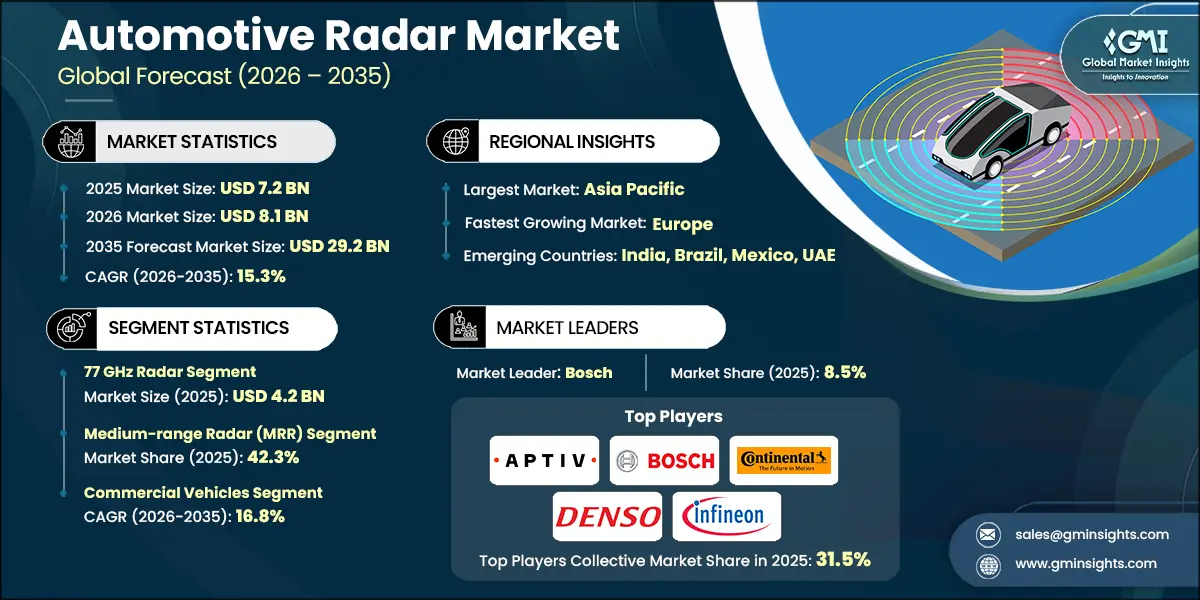
The global automotive radar market size was valued at USD 7.2 billion in 2025. The market is expected to grow from USD 8.1 billion in 2026 to USD 29.2 billion in 2035 at a CAGR of 15.3%, according to latest report published by Global Market Insights Inc.
Automotive Radar Market Key Takeaways
Market Size & Growth
- 2025 Market Size: USD 7.2 Billion
- 2026 Market Size: USD 8.1 Billion
- 2035 Forecast Market Size: USD 29.2 Billion
- CAGR (2026–2035): 15.3%
Regional Dominance
- Largest Market: Asia Pacific
- Fastest Growing Region: Europe
Key Market Drivers
- Rising adoption of advanced driver assistance systems (ADAS).
- Growing demand for autonomous and semi-autonomous vehicles.
- Increasing focus on collision avoidance and road safety.
- Expansion of electric and software-defined vehicles.
Challenges
- High cost of automotive radar systems and integration.
- Complexity in signal processing and calibration.
Opportunity
- Expansion of Level 2+ and Level 3 autonomous driving functions.
- Increasing adoption in commercial vehicles and fleet safety.
- Rapid growth of automotive radar in emerging markets.
- Rising demand for short-range radar in parking and blind spot applications.
Key Players
- Market Leader: Bosch led with over 8.5% market share in 2025.
- Leading Players: Top 5 players in this market include Aptiv, Bosch, Continental, Denso, Infineon, which collectively held a market share of 31.5% in 2025.
Get Market Insights & Growth Opportunities
Increasing penetration of ADAS has pushed the demand for automotive radars, as they are one of the main components of ADAS. The growing patent applications on ADAS simplify the continuous demand for radars.
In 2025, over 3,850 patents have been filed on Advanced Driver Assistance Systems (ADAS). It is up about 10% compared to 2024. Such increasing numbers every year reflect how key players are seeing potential opportunities with ADAS in the coming years.
Additionally, the automotive industry is seeing a growth in the connected vehicle landscape. A connected vehicle comes up with many radars to solve the industry need. It enables a car to be featured with basic ADAS, such as adaptive cruise control or automatic emergency braking.
According to Statista, it is projected that by 2025, there will be over 400 million connected cars in operation. Moreover, we estimate that the connected car market is expected to reach over USD 99 billion by 2034, showing an impressive CAGR between 2025 and 2034. Such statistics reflect the potential growth opportunities emerging within the connected vehicles domain.
Geographically, the Asia Pacific region has dominated the market because of China’s dominance in the passenger vehicle sales. In 2024, over 27.5 million passenger cars were sold in China, accounting for around 31% of global car sales. The increasing dominance and continuous will enable manufacturers to prioritize local production of cars that will support the region’s continuous dominance in the market.
To get key market trends
Automotive Radar Market Trends
AI and ML are being used in ADAS to make vehicles work better. These technologies use radar data in real time to help vehicles make quick decisions and predict actions. This helps vehicles avoid crashes, improve cruise control, and handle traffic more easily.
In October 2025, Gauzy launched its new Smart-Vision Camera Monitor System (CMS) for buses and coaches. This AI-powered advanced driver assistance system (ADAS) was shown at Gauzy's Booth 711 in Hall 7 and on four buses at Yutong's Booth 305 in Hall 3.
Short-range radar is becoming more important for parking assistance, blind-spot monitoring, and preventing low-speed collisions. It detects objects accurately at close range, making it easier to move in crowded city areas.
OEMs are combining short-range radar with cameras and ultrasonic sensors. This combination improves accuracy, works well in bad weather, and offers affordable solutions for passenger and commercial vehicles.
In the future, the market is moving toward vehicles with Level 2+ and Level 3 autonomy. Radar will help these vehicles sense their surroundings, navigate traffic safely, reduce how often drivers need to take control, and speed up the use of semi-autonomous vehicles worldwide.
For instance, in December 2025, China approved two electric sedan models with Level-3 autonomous driving features to operate on public roads for the first time. The Changan model can drive itself in a single lane at speeds of up to 50 km per hour during traffic jams.
Automotive Radar Market Analysis
Learn more about the key segments shaping this market
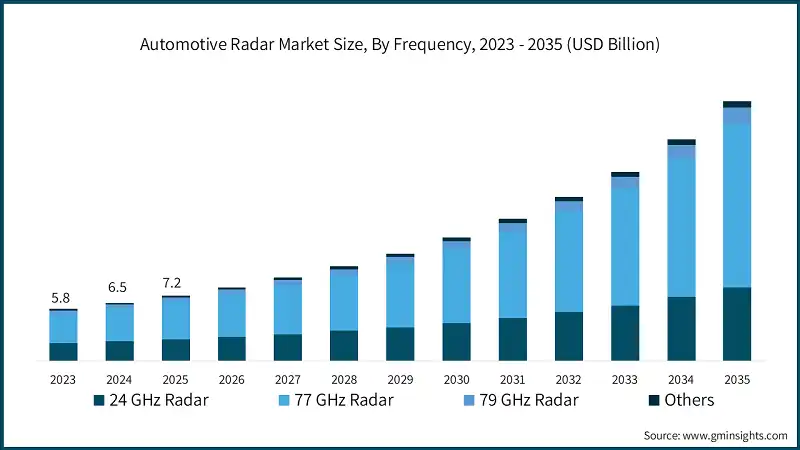
Based on frequency, the automotive radar market is divided into 24 GHz radar, 77 GHz radar, 79 GHz radar and others. The 77 GHz radar segment was valued at USD 4.2 billion in 2025.
- In 2025, the segment accounted for about 57.6% of the total market revenue because it offered a good balance of performance, cost, and regulatory approval.
- Compared to 24 GHz systems, 77 GHz radar provides better range and accuracy. It is dependable for detecting vehicles, pedestrians, and objects at both short and long distances. These features are essential for Advanced Driver-Assistance Systems (ADAS) like adaptive cruise control (ACC), autonomous emergency braking (AEB), forward collision warning, and blind-spot detection, which are now widely used or required in many regions.
- Looking ahead, the 77 GHz radar segment is expected to grow at a CAGR of 16.3% from 2026 to 2035. This growth will come from its increasing use in advanced ADAS and partial automation systems (Level 2 and Level 2+). Automakers are adding more radar systems, front, corner, and rear-most of which use 77 GHz sensors because they are reliable and scalable.
- For instance, in July 2025, Bosch introduced two new system-on-chips. The SX600 and the SX601 support a wide range of advanced driver assistance functions that fall under SAE level 2+ for vehicle autonomy. The SX600 and the SX601 operate in the 77 GHz frequency band.
Learn more about the key segments shaping this market
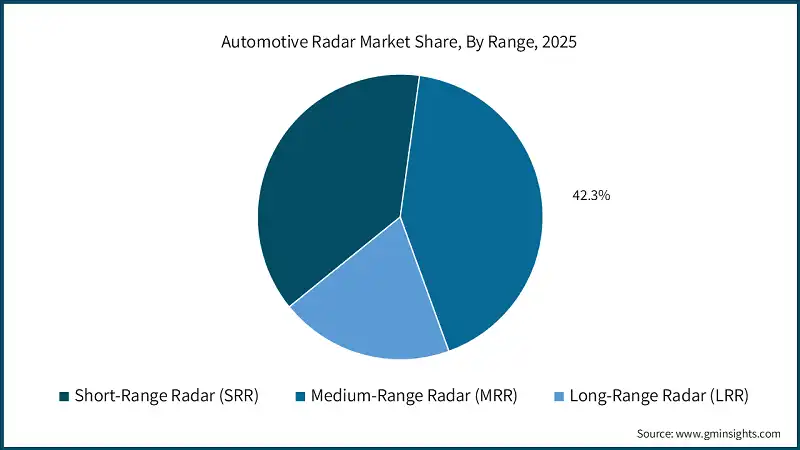
Based on range, the automotive radar market is divided into short-range radar (SRR), medium-range radar (MRR) and long-range radar (LRR). The medium-range radar (MRR) segment accounts for 42.3% in 2025 and is expected to reach USD 12.3 billion by 2035.
- Medium-Range Radar (MRR) is important for self-parking and collision avoidance in urban mobility, where an all-round view is necessary. As cities transition into smart transportation systems, ride-hailing fleets, electric vehicles, and last-mile delivery services are relying more on MRR for self-driving on road with heavy traffic.
- The growth of advanced transportation systems (ITS) is increasing the need for profitability for radar-based safety measures in commercial and passenger vehicles. Countries are adopting more vehicles to everything (V2X) communications where radars are integral in relaying the real-time traffic monitoring, predictive traffic analytics, and collaboration-based accident prevention.
- On the other hand, long-range radar (LRR) is expected to grow at the fastest CAGR of 17.3% between 2026 and 2035. As many vehicles are now increasingly shifting towards level2+ autonomy levels, the will be high demand for long-range radar in coming years.
Based on vehicle, the automotive radar market is divided into passenger cars and commercial vehicles. The commercial vehicles segment is expected to grow at the fastest CAGR of 16.8% between 2026 and 2035.
- Increasing adoption of ADAS in commercial vehicles boosts the demand for radars. By 2035, the commercial vehicle ADAS market is expected to reach USD 76.3 billion in 2035 at a CAGR of 17.7%. As the market increases, simultaneously demand for radar will be boosted.
- In recent years, the U.S. has reported between 143,000 and 166,000 truck accidents annually, according to FMCSA. Trucks were involved in about 6% of these accidents. Due to the rise in road accidents, fleet operators and governments are adopting Advanced Driver-Assistance Systems (ADAS) to help reduce such incidents.
- On the other hand, passenger vehicles will remain dominant in the market. As every year, the sale of passenger vehicles, specifically those which are now starting to come with at least a basic ADAS feature, are growing around the world. Thus, the automotive OEMs will support market growth.
Looking for region specific data?
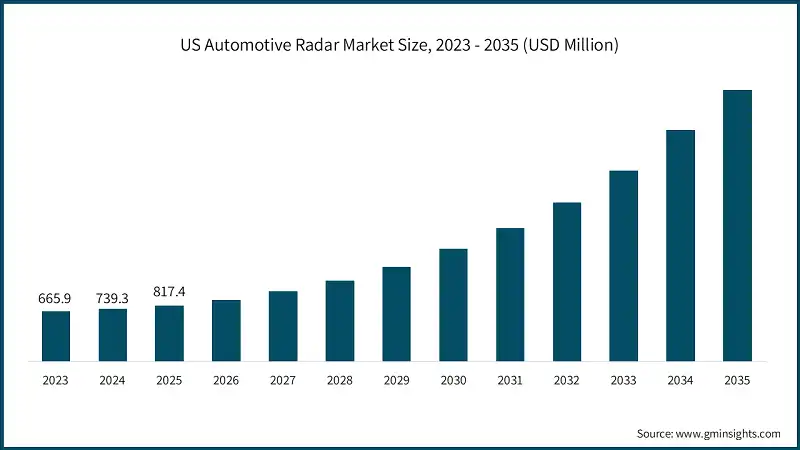
The US automotive radar market reached USD 817.4 million in 2025, growing from USD 739.3 million in 2024.
- Trucking fleets in the U.S. increasingly adopt radar-based detection systems to reduce highway collisions and enhance driver assistance on long routes. It’s being integrated into commercial and logistics vehicles for improved driver safety, blind-spot monitoring, and lane departure warnings.
- As passenger vehicles remain dominant because of the presence of major automotive OEMs like Tesla, who make autonomous passenger cars.
- For instance, Tesla's U.S. sales in 2024 totaled approximately 634,000 units. This sales figure shows how the U.S. is acquiring ADAS and autonomous vehicles to lead in the autonomous vehicle industry. As far as these vehicles' demand will increase, the radar market in the U.S. will grow.
The North America region is estimated to reach USD 3.4 billion by 2035 by growing at a CAGR of 14.4% between 2026 and 2035.
- The North American automotive radar market has grown fast in recent years because more cars in the U.S. and Canada are using advanced driver-assistance systems (ADAS). Radar sensors are important for features like adaptive cruise control, automatic emergency braking, blind-spot detection, and forward collision warnings.
- The demand for these sensors is growing because people want safer cars, and governments are making stricter rules. For example, the NHTSA recently proposed a rule to require automatic emergency braking in new cars in the U.S., which will increase the use of forward-looking radars.
- Some key trends in the market include improving radar hardware and software, combining radar with cameras and lidar through sensor fusion, and new uses like monitoring inside the car. Major companies, such as Robert Bosch, Continental, Denso, and Valeo, along with North American semiconductor firms like NXP and Texas Instruments, are working on better radar technologies.
The Europe automotive radar market accounted for USD 1.2 billion in 2025 and is anticipated to grow at the CAGR of 17.1% between 2026 and 2035.
- Europe is an important region in the automotive radar industry, supported by rules and strong use by original equipment manufacturers (OEMs). Regulations like the EU’s General Safety Regulation and Euro NCAP standards have increased the use of radar systems in vehicles. These rules require features like automatic emergency braking and adaptive cruise control, which use radar technology.
- As a result, many new vehicles in major European countries like Germany, France, and the U.K. now include one or more radar sensors. Medium-range and long-range radar units are common to meet strict safety standards.
- The market in Europe is also growing because of the focus on vehicle automation and electrification. Advanced driver-assistance systems (ADAS), which used to be optional, are now standard in many vehicles. Because of this, OEMs are adding more radar sensors to different types of vehicles, including small cars, SUVs, and commercial vehicles.
- Germany leads in radar adoption because of its strong automotive industry and focus on innovation. At the same time, countries like Spain and Italy are seeing more ADAS features in vehicles, supported by favorable policies. New developments in radar-on-chip technology and multi-sensor systems are improving radar performance.
Germany's automotive radar market is growing quickly in Europe, with a strong CAGR of 18% between 2026 and 2035.
- Germany is the largest automotive market in Europe for making and selling cars. The European Automobile Manufacturers' Association (ACEA) reports that Germany produces 20% of the cars sold in the EU. This has created a high demand for radar sensors used in advanced driver-assistance systems (ADAS) like adaptive cruise control, automatic emergency braking, and blind spot detection.
- European Union safety rules, like the General Safety Regulation, have increased the use of radar by requiring many ADAS features. People also expect safer cars, especially in the premium and luxury segments, which are led by German companies such as BMW, Mercedes-Benz, and Volkswagen.
- Stricter rules and new radar technologies are driving the growth of Germany's radar market. Over the next few years, collision-avoidance radar systems are expected to grow fast as manufacturers focus on reducing traffic accidents and improving road safety.
The Asia Pacific automotive radar market is estimated to grow at the CAGR of 15.4% during the analysis timeframe.
- This growth is due to higher vehicle production, more use of Advanced Driver Assistance Systems (ADAS), and rising demand for safety technologies. China, Japan, South Korea, and India are leading in making and selling vehicles with radar systems. China's growth is supported by urbanization, strong manufacturing, and government policies that encourage advanced safety systems.
- Japan and South Korea use radar systems widely, especially in mid-to-high-end cars. Features like adaptive cruise control, blind-spot monitoring, and automatic emergency braking are becoming common in these countries.
- Automakers in the region are adding short, medium, and long-range radar systems to regular vehicles to meet stricter safety rules and consumer demand. This trend is especially strong in China and India, where more people are buying vehicles and are willing to pay for better safety features.
China is estimated to grow with a CAGR of 16% in the projected period between 2026 and 2035, in the Asia Pacific automotive radar market.
- In 2024, more than 27.5 million passenger vehicles were purchased in China, establishing it as the biggest market in the Asia-Pacific area. These robust figures are generating ongoing opportunities for participants in the automotive radar industry.
- Moreover, in 2024-2025, numerous new passenger vehicles in China will feature 5G connections and V2X modules, backed by various local and global OEMs that have transitioned these technologies into large-scale production.
- Moreover, in China, the fast growth of autonomous taxis, or robotaxis, is boosting the automotive radar market. Large-scale pilot and commercial launches of robotaxi services, like Baidu’s Apollo Go operating without safety drivers in parts of cities such as Wuhan, show China’s progress in autonomous mobility. These vehicles depend on automotive radar, along with cameras and lidar, to detect objects, provide backup systems, and operate safely in busy city areas.
Latin America automotive radar market is estimated to reach USD 571.3 million in 2025 and is anticipated to show lucrative growth over the forecast period.
- In the region, consumers have started showing their interests in Advanced Driver Assistance Systems (ADAS), such as adaptive cruise control, blind-spot detection, and automatic emergency braking. This plays as a key driver for the growth of the radar market in the region.
- Brazil, Mexico, and Argentina are the main countries driving demand for radar systems. Manufacturers and global suppliers are adding radar sensors to mid-range and premium passenger vehicles to meet safety needs.
- Recently Brazil has started operation of its first autonomous truck at Portocel. Started in January 2025, the truck is developed in partnership with Lume Robotics and VIX Logística, the self-driving vehicle has been rigorously tested for over a year at the Aracruz, Espírito Santo terminal.
Brazil is estimated to grow with a CAGR of 15.4% between 2026 and 2035, in the Latin America automotive radar market.
- In May 2025, a premium global automaker selected Valeo for its Major Imaging Radar Program to improve automated driving. This advanced radar technology allows highway driving at speeds of 130kph without needing a lead vehicle. Production of this imaging radar system will start in 2028.
- Moreover, local manufacturers are working with global radar and semiconductor companies to create affordable radar systems for Brazil. New technologies like 4D imaging radar and sensor fusion are making radar systems more reliable and better at detecting objects in bad weather or heavy traffic. The growth of electric vehicles (EVs) and connected cars is also increasing the use of advanced radar technology.
The Middle East and Africa accounted for USD 283.6 million in 2025 and is anticipated to show lucrative growth over the forecast period.
- In the past, fewer vehicles in this region had radar systems compared to other regions. This was because radar systems were mostly found in luxury and premium vehicles, not in all types of cars. However, people in countries like the United Arab Emirates, Saudi Arabia, South Africa, Egypt, and Nigeria are now more interested in advanced vehicle technologies, which is increasing the use of radar systems.
- The market is expected to grow as more vehicles use Advanced Driver-Assistance Systems (ADAS) and as electric vehicle production rises. Electric vehicles often rely on radar technology for safety and autonomous features.
- Growth is also supported by smart mobility projects and upgrades to urban fleets, especially in wealthier Gulf Cooperation Council (GCC) countries. These countries are developing more connected vehicle infrastructure and autonomous vehicle programs.
UAE to experience substantial growth in the Middle East and Africa automotive radar market in 2025.
- In October 2024, Vodafone partnered with e& to improve automotive IoT services in the UAE. This partnership supports connected vehicles from a German automaker in the region.
- This shows how radar and connected vehicle technologies are working together to let vehicles and infrastructure communicate in real time. These advancements improve safety and support advanced autonomous features.
- The UAE is focusing more on smart and connected vehicles, where radars are key for ADAS and new autonomous technologies.
- Advanced radar systems make vehicles more expensive, which slows their use in lower-cost segments. Since most sensors are imported, costs remain high. However, investments in connected mobility and improvements in radar technology, like high-resolution mmWave radar and sensor fusion, are creating a positive outlook for the UAE.
Automotive Radar Market Share
- The top 7 companies in the automotive radar industry are Bosch, Denso, Aptiv, Continental, Infineon, NXP Semiconductors and Analog devices, contributing 36.2% of the market in 2025.
- Bosch makes automotive millimeter-wave radar sensors and radar SoCs that work at 76–77 GHz. These are used in ADAS and automated driving to detect objects, track them, and avoid collisions in front, corner, and long-range applications.
- Denso provides automotive radar modules and millimeter-wave sensing systems for ADAS. These systems support features like adaptive cruise control, collision prevention, and blind-spot detection, designed for OEM vehicle safety platforms.
- Aptiv offers advanced 4D high-resolution forward and corner radar sensors. These sensors improve range, angle accuracy, and object detection for active safety and driver-assistance systems in modern vehicles.
- Continental develops automotive radar sensor platforms for ADAS and automated driving. These sensors focus on high-resolution detection for short, mid, and long ranges, enabling features like adaptive cruise control and lane change support.
- Infineon's XENSIV radar sensors include 24 GHz, 60 GHz, and 77/79 GHz mmWave ICs. These sensors provide short, mid, and long-range radar capabilities for ADAS applications like blind-spot detection, adaptive cruise control, and in-cabin monitoring.
- NXP offers automotive radar solutions with 77 GHz RFCMOS transceivers, radar SoCs, and high-performance processors. These are used in corner, forward, and imaging radar systems for adaptive safety and autonomous driving.
- Analog Devices provides radar front-end ICs and signal processing components. These help radar systems detect objects, measure range, and calculate speed for ADAS features like collision prevention and adaptive cruise control.
Automotive Radar Market Companies
Major players operating in the automotive radar industry are:
- Bosch
- Denso
- Aptiv
- Continental
- Infineon
- NXP Semiconductors
- Analog devices
- ZF Friedrichshafen
- Valeo
- Texas
- Bosch uses its strong connections with global OEMs, invests in high-resolution and multi-range radar technologies, and develops advanced signal processing to support ADAS and automated driving systems worldwide.
- Denso relies on its strong relationships with OEMs, especially Japanese carmakers, and designs compact, high-performance radar sensors that meet global safety standards, ensuring reliable ADAS performance in different vehicle types.
- Aptiv focuses on scalable, high-resolution radar systems combined with perception software and domain control. It works with automakers and technology partners to improve detection accuracy and system integration.
- Continental offers advanced radar platforms with scalable designs, strong sensor fusion, and close OEM partnerships. These features enhance ADAS and autonomous functions for short, mid, and long-range radar applications.
- Infineon uses its semiconductor expertise to provide compact radar ICs and SoCs that are reliable, energy-efficient, and perform well in automotive conditions, supporting safety systems.
- NXP provides 77 GHz RFCMOS radar SoCs and processors that help OEMs save time, meet different range needs, and easily integrate into ADAS and autonomous vehicle radar systems.
- Analog Devices uses its knowledge of signal processing and RF technology to deliver radar front-end components and platforms that improve detection accuracy and support complex radar functions across different frequency bands.
Automotive Radar Market Report Attributes
| Key Takeaway | Details |
|---|---|
| Market Size & Growth | |
| Base Year | 2025 |
| Market Size in 2025 | USD 7.2 Billion |
| Market Size in 2026 | USD 8.1 Billion |
| Forecast Period 2026 - 2035 CAGR | 15.3% |
| Market Size in 2035 | USD 29.2 Billion |
| Key Market Trends | |
| Drivers | Impact |
| Rising adoption of advanced driver assistance systems (ADAS) | ADAS penetration is accelerating radar deployment across passenger vehicles, enabling adaptive cruise control, automatic emergency braking, blind-spot detection and so on. |
| Growing demand for autonomous and semi-autonomous vehicles | Progress toward autonomous mobility increases reliance on automotive radar for reliable object detection, redundancy, and consistent performance in all-weather driving conditions. |
| Increasing focus on collision avoidance and road safety | Rising accident rates and stricter safety norms are driving OEMs to integrate radar-based collision avoidance systems to improve occupant safety and regulatory compliance. |
| Expansion of electric and software-defined vehicles | Electric and software-defined vehicles promote centralized computing and sensor fusion, boosting demand for radar systems compatible with OTA updates and advanced vehicle intelligence. |
| Pitfalls & Challenges | Impact |
| High cost of automotive radar systems and integration | High component, chipset, and system integration costs restrict radar adoption in entry-level vehicles, limiting penetration in cost-sensitive automotive markets. |
| Complexity in signal processing and calibration | Advanced radar requires complex signal processing and calibration, increasing engineering effort, validation timelines, and overall development costs for OEMs. |
| Opportunities: | Impact |
| Expansion of Level 2+ and Level 3 autonomous driving functions | Deployment of Level 2+ and Level 3 autonomy creates strong demand for high-resolution radar enabling redundancy, functional safety, and compliance with evolving regulations. |
| Increasing adoption in commercial vehicles and fleet safety | Commercial fleets are adopting radar-based safety systems to reduce accidents, insurance liabilities, and vehicle downtime, driving steady demand growth. |
| Rapid growth of automotive radar in emerging markets | Rising vehicle ownership and safety regulations in emerging economies are accelerating radar adoption, particularly in mid-range and premium vehicle segments. |
| Rising demand for short-range radar in parking and blind spot applications | Urban congestion and parking challenges are boosting demand for short-range radar supporting automated parking, blind-spot monitoring, and low-speed collision avoidance. |
| Market Leaders (2025) | |
| Market Leaders |
8.5% market share |
| Top Players |
|
| Competitive Edge |
|
| Regional Insights | |
| Largest Market | Asia Pacific |
| Fastest growing market | Europe |
| Emerging countries | India, Brazil, Mexico, UAE |
| Future outlook |
|
What are the growth opportunities in this market?
Automotive Radar Industry News
- In October 2025, Aptiv introduced its Gen 8 radar technology to improve advanced driver-assistance systems (ADAS) using artificial intelligence and machine learning.
- In July 2025, Bosch launched two system-on-chips, the SX600 and SX601, which support advanced driver assistance functions under SAE level 2+ vehicle autonomy. These chips work in the 77 GHz frequency band.
- In May 2025, NXP Semiconductors released its S32R47 imaging radar processors, built with 16 nm FinFET technology. This third-generation processor offers twice the processing power of the previous version and better cost and power efficiency.
- In April 2025, Texas Instruments introduced new automotive lidar, clock, and radar chips. These products aim to improve vehicle safety and bring more autonomous features to a wider range of cars.
The automotive radar market research report includes in-depth coverage of the industry with estimates & forecasts in terms of revenue ($ Mn/Bn) and volume (units) from 2022 to 2035, for the following segments:
Market, By Frequency
- 24 GHz Radar
- 77 GHz Radar
- 79 GHz Radar
- Others
Market, By Range
- Short-Range Radar (SRR)
- Medium-Range Radar (MRR)
- Long-Range Radar (LRR)
Market, By Placement
- Exterior
- Front Radar
- Rear Radar
- Side Radar
- Interior
- Driver Monitoring Radar
- Occupant Monitoring Radar
Market, By Vehicle
- Passenger cars
- Hatchback
- SUV
- Sedan
- Commercial vehicles
- Light Commercial Vehicles (LCV)
- Medium Commercial Vehicles (MCV)
- Heavy Commercial Vehicles (HCV)
Market, By Vehicle Class
- Economy (Below USD 25,000)
- Mid-Range (USD 25,000 - USD 50,000)
- Premium/Luxury (Above USD 50,000)
Market, By Propulsion
- ICE
- EV
- BEV
- HEV
- PHEV
Market, By Application
- Adaptive Cruise Control (ACC)
- Blind Spot Detection (BSD)
- Forward Collision Warning (FCW)
- Lane Departure Warning System (LDWS)
- Automatic Emergency Braking (AEB)
- Parking Assistance (PA)
- Others
Market, By Sales Channel
- OEMs
- Aftermarket
The above information is provided for the following regions and countries:
- North America
- US
- Canada
- Europe
- Germany
- UK
- France
- Italy
- Spain
- Russia
- Nordics
- Benelux
- Asia Pacific
- China
- India
- Japan
- South Korea
- ANZ
- Singapore
- Malaysia
- Indonesia
- Vietnam
- Thailand
- Latin America
- Brazil
- Mexico
- Argentina
- Colombia
- MEA
- South Africa
- Saudi Arabia
- UAE
Frequently Asked Question(FAQ) :
What is the market size of the automotive radar in 2025?
The market size was valued at USD 7.2 billion in 2025 and is projected to grow at a CAGR of 15.3% due to increasing adoption of ADAS systems.
What is the projected value of the automotive radar market by 2035?
The market is poised to reach USD 29.2 billion by 2035, driven by the rise of connected and automated vehicles.
What is the expected size of the automotive radar industry in 2026?
The market size is expected to reach USD 8.1 billion in 2026.
How much revenue did the 77 GHz radar segment generate in 2025?
The 77 GHz radar segment generated USD 4.2 billion in 2025, because it offered a good balance of performance, cost, and regulatory approval.
What was the valuation of the medium-range radar (MRR) segment in 2025?
The medium-range radar (MRR) segment held over 42.3% of the market share in 2025.
What is the growth outlook for the commercial vehicles segment from 2026 to 2035?
The commercial vehicles segment is set to expand at a CAGR of 16.8% till 2035, led by increasing ADAS adoption in commercial vehicles.
Which region dominates the automotive radar sector?
The US dominates the market, with the market valued at USD 817.4 million in 2025.
What are the upcoming trends in the automotive radar market?
Trends include AI-powered ADAS, short-range radar for collision avoidance, sensor fusion with cameras and ultrasonic systems, and growth of semi-autonomous vehicles.
Who are the key players in the automotive radar industry?
Key players include Bosch, Denso, Aptiv, Continental, Infineon, NXP Semiconductors, Analog devices, ZF Friedrichshafen, Valeo, Texas.
Automotive Radar Market Scope
Related Reports