Summary
Table of Content

Automotive Operating System Market
Get a free sample of this report
Form submitted successfully!
Error submitting form. Please try again.
Thank you!
Your inquiry has been received. Our team will reach out to you with the required details via email. To ensure that you don't miss their response, kindly remember to check your spam folder as well!
Request Sectional Data
Thank you!
Your inquiry has been received. Our team will reach out to you with the required details via email. To ensure that you don't miss their response, kindly remember to check your spam folder as well!
Form submitted successfully!
Error submitting form. Please try again.
Automotive Operating System Market Size
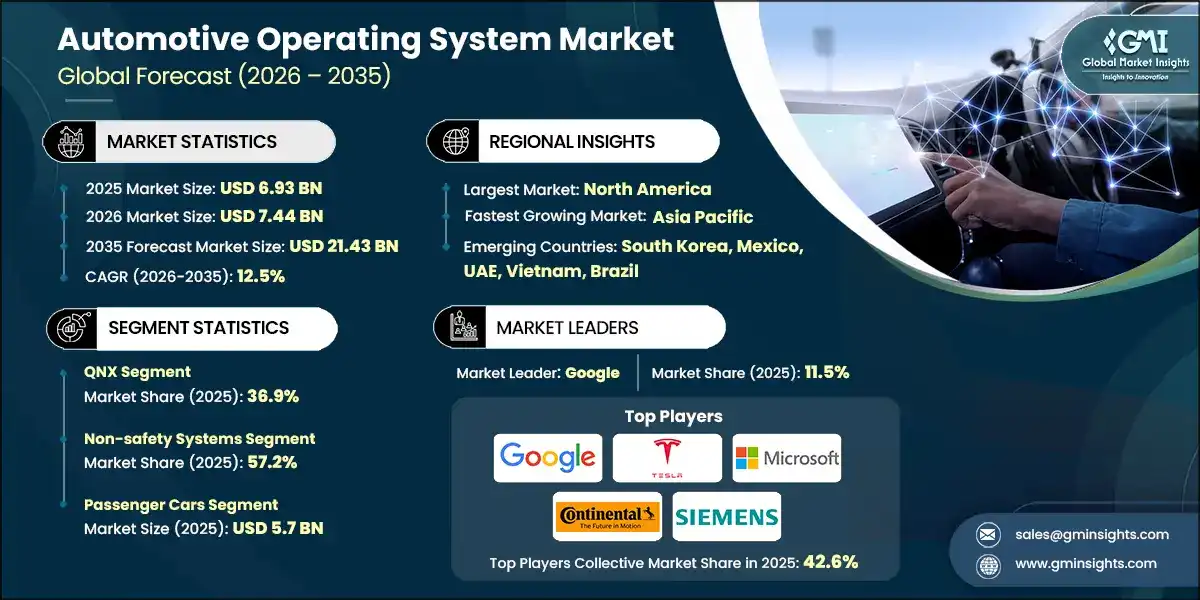
The global automotive operating system market size was valued at USD 6.93 billion in 2025. The market is expected to grow from USD 7.44 billion in 2026 to USD 21.43 billion in 2035 at a CAGR of 12.5%, according to latest report published by Global Market Insights Inc.
Automotive Operating System Market Key Takeaways
Market Size & Growth
- 2025 Market Size: USD 6.93 Billion
- 2026 Market Size: USD 7.44 Billion
- 2035 Forecast Market Size: USD 21.43 Billion
- CAGR (2026–2035): 12.5%
Regional Dominance
- Largest Market: North America
- Fastest Growing Region: Asia Pacific
Key Market Drivers
- Rapid Electrification of Vehicles.
- Growing Adoption of Software-Defined Vehicles (SDVs).
- Rising Integration of Advanced Driver Assistance Systems (ADAS).
- Increasing Demand for In-Vehicle Infotainment and Connectivity.
Challenges
- High Complexity of Software Integration and Validation.
- Concerns Related to Vehicle Cybersecurity and Data Privacy.
Opportunity
- Monetization of Software Features Through Subscription Models.
- Increasing Adoption of Vehicle-to-Everything (V2X) Communication.
- Expansion of Automotive OS Use in Commercial and Fleet Vehicles.
- Growth of Smart Mobility and Shared Transportation Platforms.
Key Players
- Market Leader: Google led with over 11.5% market share in 2025.
- Leading Players: Top 5 players in this market include Google, Tesla, Microsoft, Continental, Siemens, which collectively held a market share of 42.6% in 2025.
Get Market Insights & Growth Opportunities
The worldwide push for advancing the car features is the main reason that the automotive OS market is growing at a significant CAGR between 2026 and 2035. Government across many countries are implementing ADAS features and stepping up to make it a mandatory feature in a vehicle very soon.
For instance, in March 2025, the Ministry of Road Transport and Highways (MoRTH) issued a draft notification stating that all new vehicles designed to carry more than eight passengers will be mandated to include a form of Advanced Driver Assistance System (ADAS). This requirement will apply to a range of vehicles, including cars, SUVs, trucks, and buses.
Similarly, in July 2024, new rules regarding active safety features in vehicles, including speed limiters, came into effect across the European Union. The New Vehicle General Safety Regulation (GSR2), or Regulation (EU) 2019/2144, updates the minimum performance standards (type approval) for motor vehicles in the EU, requiring the addition of several advanced driver assistance systems (ADAS).
As the market completely depends on the number of vehicles sold every year, the need for a vehicle operating system will always be there simultaneously. For instance, in 2024, the car sale trend has seen a 2.5% increase compared to 2023, reaching 74.6 million units. In addition to this, the automotive HUD market is expected to reach USD 6.9 billion by 2034.
The car sales trend with the combination of automotive head-up displays will directly boost the demand for operating systems. Nowadays, infotainment systems, ADAS and digital transformation of traditional meters are increasingly adopted, as all these features require a display and an operating system, supporting the market in continuous growth.
To get key market trends
Automotive Operating System Market Trends
The automotive industry is being completely reshaped by the convergence of cutting-edge software platforms and operating systems. OEMs in the market are using the new technologies to provide their clients with more reliable, secure, and efficient vehicle software solutions.
For instance, in March 2025, Hyundai introduced its software brand Pleos, a proprietary vehicle OS designed to boost SDV performance and scalability based on E&E architecture. Pleos Connect next-generation infotainment system to launch in Q2 2026 and will be applied to more than 20 million vehicles by 2030.
Nowadays, OTA updates are no longer considered a luxury feature, they have become a standard requirement. Operating systems are now expected to make wireless delivery of both "SOTA" (Software) and "FOTA" (Firmware) updates seamless and secure. This trend fundamentally facilitates the process of bug fixing by OEMs that makes it easier for them to provide security patches and even grant access to new performance features or subscription-based services without going through a dealership.
In the past, infotainment and ADAS operated on different, isolated systems. Current regular operating systems use hypervisors to run these heterogeneous environments on a single SoC (System on Chip). This movement diminishes the hardware footprint and at the same time puts the OS in the position of enforcing strict "freedom from interference" between non-critical and safety-critical operations.
On top of that, OS is being designed to incorporate V2X (Vehicle-to-Everything) 5G communication. With this, the car will be able to "speak" with traffic lights, other cars, and the cloud infrastructure almost instantly. This development is crucial for the operation of the car at levels 3 and 4, as the operating system is responsible for analyzing the data from the surrounding environment and then making instantaneous safety decisions.
Automotive Operating System Market Analysis
Learn more about the key segments shaping this market
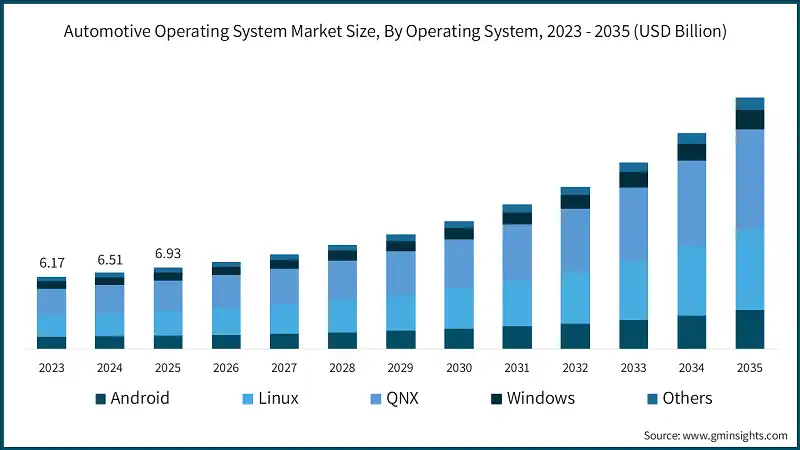
Based on operating system, the automotive operating system market is divided into Android, Linux, QNX, Windows and others. The QNX segment dominated the market with 36.9% share in 2025.
- QNX is dominating the automotive operating system market with availability in more than 275 million vehicles worldwide. As QNX is the first choice of automotive OEMs, it will continue to be a dominant one in the projected period between 2026 and 2035.
- Emerging features of Android attract more and more customers across the automotive industry. As trends suggest a positive growth trend, Android will impact the overall market in a positive way.
- For instance, in May 2025, Google unveiled the latest OS advancements for drivers, car manufacturers, and developers to boost the connected driving experience. Also, Google is to launch Gemini for vehicles very soon that will add further value to the overall automotive operating system market.
- On the other hand, Linux, Windows and other emerging OS are gaining momentum as OEMs partner with the providers based on their requirements. With continued adoption, advanced features will create opportunities for these operating systems in the automotive industry.
Learn more about the key segments shaping this market
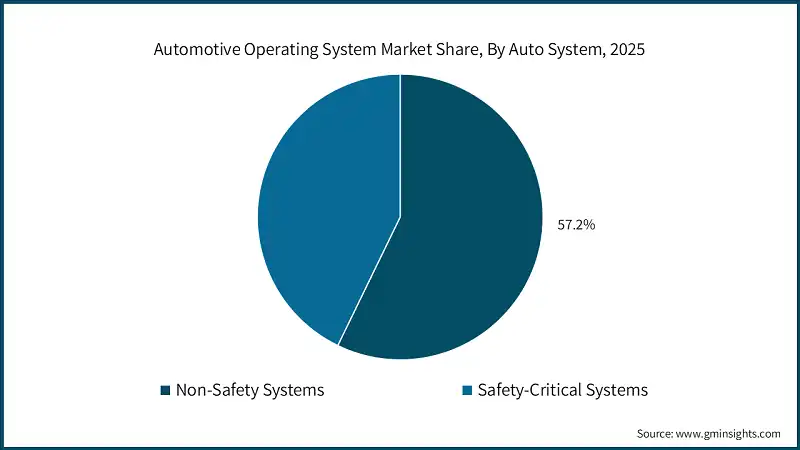
Based on auto system, the automotive operating system market is divided into non-safety systems and safety-critical systems. The non-safety systems segment accounts for 57.2% in 2025 and is expected to grow at the CAGR of 11.9% between 2026 and 2035.
- Infotainment and telematics are examples of non-safety systems, which are very common in today’s vehicles. The development of an infotainment operating system (OS) is not as strictly regulated as that of safety systems. This has enabled giants like Google (with Android Automotive) to swiftly penetrate the market by leveraging their mobile platforms.
- The governments of Europe (GSR), North America, and China are making it mandatory for manufacturers to install advanced safety features, such as Automatic Emergency Braking (AEB), Lane Keeping Assist (LKA), and Intelligent Speed Assistance (ISA).
- To be in compliance with these regulations, car makers will have to invest in powerful and certified safety operating systems like QNX or dedicated real-time operating systems (RTOS).
- As cars progress from Level 2 (Partial Automation) to Levels 3 and 4 (High Automation), the data processing requirements of the operating systems increase immensely. This has driven up the demand for high-priced OS licenses tremendously.
Based on vehicle, the automotive operating system market is divided into passenger cars and commercial vehicles. In 2025, the passenger cars segment led the automotive operating systems market, reaching a market value of USD 5.7 billion.
- The automotive operating system (OS) market is dominated by the passenger car segment, and it is also expected to reach the highest growth rate (CAGR) between 2026 and 2035. This is due to the transition from traditional mechanical systems to Software-Defined Vehicles (SDVs), which are passenger cars that are equipped with computing capabilities of high-end mobile devices.
- Passenger cars are produced and sold worldwide in large quantities as compared to commercial vehicles. Modern cars practically all need an OS for controlling engine, safety features, and cabin microclimates, so the broad consumer base makes this segment the major one.
- Passenger cars need to follow strict safety rules, like Euro NCAP and ISO 26262. Automakers are using advanced real-time operating systems (RTOS) like BlackBerry QNX to meet these standards, showing how important these systems are becoming in this market.
Looking for region specific data?
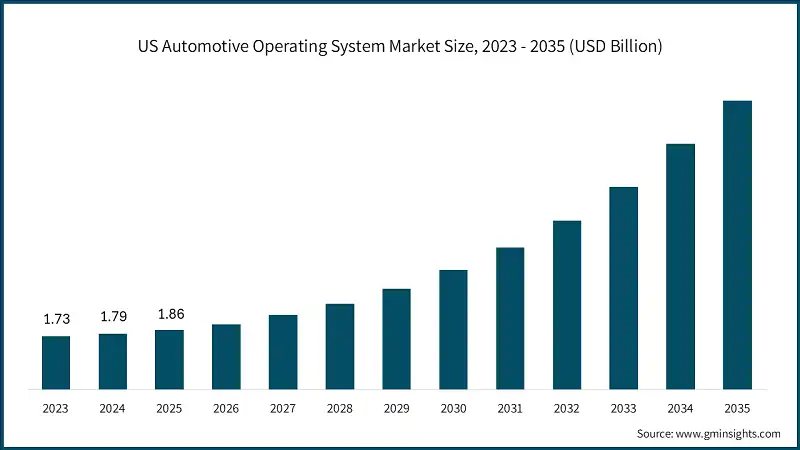
The US automotive operating system market reached USD 1.86 billion in 2025, growing from USD 1.79 billion in 2024.
- Automakers in the U.S. are moving quickly from hardware-based vehicles to ones that rely on software. These vehicles use centralized operating systems to control different functions and allow updates over the air. This change is driving the need for systems that are flexible and scalable enough to handle complex software for things like infotainment, ADAS, powertrain, and connectivity.
- The U.S. consumers now expect cars to have connected and digital cockpits. Automotive operating system are key to providing features like real-time navigation, telematics, voice control, smartphone integration, and personalized user interfaces. Better connectivity, including 5G and future V2X communication, makes it even more important for operating systems to communicate quickly and work seamlessly with external networks.
- At the same time, rules and safety standards are pushing automakers to use operating systems that meet strict safety requirements and provide secure environments for critical functions. For instance, in October 2025, Red Hat launched its in-vehicle operating system and announced that it had received the ISO 26262 ASIL-B safety certification from exida, a global functional safety certification body. This marked the first time an open-source Linux system achieved this certification, officially introducing Linux into the automotive safety field.
The North America region is estimated to reach USD 5.4 billion by 2035 and expected to grow at the CAGR of 10.3% between 2026 and 2035.
- The North America automotive operating system market is holding a dominant position with a share of 30.7% in 2025, which is mainly due to the growing acceptance of connected and autonomous vehicle technologies. This region, being a technology center for automotive innovations, is noticing a substantial rise in the need for operating systems that improve safety, infotainment, and driver assistance in cars.
- Luxury car segment in the region is ruled by major OEM like Mercedes Benz. Consequently, such OEMs are always experiencing a rise in the demand for the sophisticated operating system. For example, in 2024, Mercedes-Benz delivered 324,500 Passenger Cars (16.4% of global sales) to the United States.
The Europe automotive operating system market accounted for USD 1.8 billion in 2025 and is anticipated to grow at the CAGR of 11.1% between 2026 and 2035.
- The European Commission has introduced a plan requiring 90% of new cars sold by 2035 to be zero-emission. As electric vehicles (EVs) become more common in Europe, advanced operating systems that manage batteries, charging, and energy efficiency are becoming more important.
- At the same time, there is a strong focus on advanced driver assistance, self-driving technology, and connected services. This is driving the need for automotive operating systems that can handle real-time sensor data, vehicle-to-everything (V2X) communication, and AI-based decision-making.
- Europe’s car industry is also moving quickly toward software-defined vehicles, where software controls most functions instead of separate hardware components. Traditional distributed ECUs are being replaced by centralized systems that allow a single operating system to manage infotainment, driver assistance, energy systems, and diagnostics.
Germany's automotive operating system market is growing quickly in Europe, with a strong CAGR of 11.6% between 2026 and 2035.
- Germany is leading the way in legalizing and using Level 3 Autonomous Driving. Mercedes-Benz's DRIVE PILOT was the first system to get international approval. This progress is boosting the operating system (OS) market because Level 3 systems need advanced, safety-certified real-time operating systems (RTOS) like BlackBerry QNX to handle quick decisions between the car and the driver.
- German automobile manufacturers are progressively adopting a Zonal Architecture instead of trying to manage a lot of small, individual computers (ECUs). In this configuration, several high-capacity "Central Computers" take charge of the entire vehicle's OS.
- This transition is backed by Germany's robust supply chain, with players like Continental and Bosch embedding the "Middleware" which ensures flawless interaction of the various software components.
The Asia Pacific automotive operating system market is estimated to reach USD 7.6 billion by 2035, by growing at a CAGR of 15.1% during the analysis timeframe.
- The Asia Pacific market is expected to grow at the fastest CAGR of 15.1% between 2026 and 2035. This growth is because of the rising production of electric and premium vehicles, particularly in countries such as China, Japan, and South Korea.
- For instance, China is taking steps to reduce its dependence on Western operating systems such as QNX and Android. The China Automotive OS Open-Source Plan, which is headed by the CAAM, is striving to create a self-reliant software base.
- Meanwhile, by bringing together platforms such as Huawei's HarmonyOS (HOS) and iDVP, and Xiaomi's HyperOS, a unified "Phone-to-Car" ecosystem is being built that is difficult for Western OS providers to compete with in the local market.
China is estimated to grow with a CAGR of 15.9% in the projected period between 2026 and 2035, in the Asia Pacific automotive operating system market.
- In China, OEMs are continuously developing alternate technologies to reduce their reliance on Western software foundations like BlackBerry QNX or basic Android. For instance, in March 2025, Li Auto launched its self-developed automotive operating system, Li Auto Halo OS. This represents the world’s first open-source automotive operating system, demonstrating Li Auto’s significant technological breakthrough in the intelligent vehicle sector.
- Additionally, in May 2025, China's automotive operating system open-source plan was released, with the Xinchi chip taking the lead. The China Association of Automobile Manufacturers released the first microkernel open-source project in China's automotive operating system open-source plan.
- China’s lead in the technology sector will propel new operating systems to be launched in coming years. This will significantly improve China’s dominance in the Asia Pacific region.
Latin America automotive operating system market is estimated to reach USD 607.5 million in 2025 and is anticipated to show lucrative growth over the forecast period.
- LATAM has become a pioneer in the application of telematics. The demand for tracking and recovery systems that have already been included in operating systems is being driven by industries in Brazil and Mexico that are confronted with the problem of vehicle stealing and cargo insecurity.
- Considering the growing number of connected vehicles, the danger of theft through remote carjacking and the compromise of personal data is now a major concern. To counter this, the Car OS suppliers in the Latin American market are investing in hardening their security systems.
- The new generation of technology in the region emphasizes "Active Recovery" capabilities and real-time remote diagnostics that enable logistics companies to minimize insurance costs and risks.
Brazil is estimated to grow with a CAGR of 13.2% between 2026 and 2035, in the Latin America automotive operating systems market.
- The Brazil market is recognized as a vibrant and active one that is part of the country's larger automotive software ecosystem, the main reason being the quick digitalization of vehicles, alongside the growing use of advanced electronics. Brazilian vehicles are going to have a lot more connected features, these will range from infotainment and telematics to advanced safety systems.
- One of the most significant factors affecting this market is the modernization of the Brazilian automotive industry through initiatives like Rota 2030, which allocates funds for technology development and facilitates the adoption of high-performance software platforms by OEMs in new vehicles.
- Going for such types of operating systems not only keeps the production in Brazil competitive but also gets the vehicles ready for future developments like over-the-air (OTA) updates, improved security networks, and stronger integration of connected services.
The Middle East and Africa accounted for USD 452.7 million in 2025 and is anticipated to show lucrative growth over the forecast period.
- The market for automotive OS is expected to grow at a CAGR of 12.2% between 2026 and 2035 in the Middle East & Africa region. The increasing purchasing power will enable car buyers to opt for the luxury car segment, coming with the advanced features like infotainment systems, ADAS and more.
- The wealthier Gulf Cooperation Council (GCC) countries, particularly the UAE and Saudi Arabia, are investing in smart mobility solutions and building the digital ecosystems required to support connected cars and next-generation features such as advanced infotainment and telematics platforms.
- These factors combinedly support the growth of the automotive operating system market in the near future. With that, the market is expected to reach USD 1.4 billion by 2035.
UAE to experience substantial growth in the Middle East and Africa automotive operating system market in 2025.
- The automotive software market in the UAE is expected to grow significantly by 2035 as vehicles increasingly rely on digital platforms for safety, connectivity, and autonomous features.
- In November 2025, the Integrated Transport Centre (ITC), part of the Department of Municipalities and Transport, introduced the Autonomous Vehicles Integrated Testing, Operations, and Management System (AViTOMS).
- Consumers in the UAE prefer vehicles with features like easy smartphone integration, real-time navigation, and better connectivity. This trend is driving the adoption of Android-based and other modern automotive operating systems.
Automotive Operating System Market Share
The top 7 companies in the automotive operating systems industry are Google, Tesla, Microsoft, Continental AG, Siemens, Mercedes Benz and BMW, contributing 53.2% of the market in 2025.
- Google's Android Automotive OS is a system that helps automakers create connected infotainment systems. It includes features like navigation, voice services, and app ecosystems. Automakers can customize it and run it directly on vehicle hardware.
- Tesla's Tesla Operating System is a Linux-based platform that manages infotainment, vehicle controls, energy systems, and ADAS visualization. It supports over-the-air updates and integrates hardware and software across Tesla’s electric vehicles.
- Microsoft's Azure Connected Vehicle Platform is a cloud-based system that supports connected services, data management, OTA updates, and analytics. It helps automakers build software-defined vehicles without needing a built-in operating system.
- Continental offers automotive operating systems based on AUTOSAR and Android Automotive. These systems support cockpit, ADAS, and zonal controllers, helping automakers move toward centralized computing and software-defined vehicles.
- Siemens provides tools and platforms for developing, simulating, and validating vehicle operating systems. Their solutions include middleware, and digital twin technologies, helping automakers and suppliers create complex software systems.
- Mercedes-Benz's MB.OS is a custom operating system designed for software-defined vehicles. It integrates infotainment, ADAS, body, and powertrain systems, allowing centralized software management, OTA updates, and a unique digital experience.
- BMW's BMW Operating System is an in-house platform for digital cockpit and vehicle functions. Newer versions include Android Automotive for infotainment but keep BMW's own software design and user experience.
Automotive Operating System Market Companies
Major players operating in the automotive operating system industry are:
- Tesla
- Microsoft
- Continental
- Siemens
- Mercedes Benz
- BMW
- BlackBerry
- NVIDIA
- Apple
- Google focuses on in-car infotainment software with its automotive operating system. Android Automotive OS is mainly used for digital dashboards, navigation, voice commands, and app ecosystems, while automakers (OEMs) handle vehicle control, safety, and powertrain functions.
- Tesla stands out with its fully integrated software system that connects hardware, vehicle controls, and software updates. By owning its operating system, Tesla can quickly release over-the-air (OTA) updates, provide a smooth user experience, and manage all vehicle systems from one place.
- Microsoft’s strength lies in its cloud expertise rather than in-car software. Its Azure platform offers tools for managing data, OTA updates, analytics, and AI services. This makes Microsoft a key player in software-defined vehicles without needing to rely on embedded operating systems.
- Continental is strong in system integration and advanced technology. Its automotive platforms support domain and zonal architectures, helping automakers manage complex electronic control units (ECUs) while staying flexible with hardware and software suppliers.
- Siemens focuses on tools for designing and managing automotive software. It helps automakers and suppliers create, test, and manage vehicle operating systems using digital twins, AUTOSAR tools, and lifecycle management, instead of providing a runtime operating system.
- Mercedes-Benz gains an edge by keeping control of its vehicle software and reducing reliance on third-party operating systems. Its MB.OS system allows the company to stand out as a brand, centralize computing, and manage software for infotainment, advanced driver assistance systems (ADAS), and other vehicle functions.
- BMW uses a hybrid approach to its operating system. It combines in-house control of vehicle software with Android Automotive for infotainment. This strategy speeds up digital innovation while letting BMW maintain control over key vehicle functions, user experience, and long-term independence.
Automotive Operating System Market Report Attributes
| Key Takeaway | Details |
|---|---|
| Market Size & Growth | |
| Base Year | 2025 |
| Market Size in 2025 | USD 6.93 Billion |
| Market Size in 2026 | USD 7.44 Billion |
| Forecast Period 2026 - 2035 CAGR | 12.5% |
| Market Size in 2035 | USD 21.43 Billion |
| Key Market Trends | |
| Drivers | Impact |
| Rapid Electrification of Vehicles | Accelerates demand for automotive operating systems to manage battery control, power electronics, thermal management, and seamless integration of EV-specific software functions. |
| Growing Adoption of Software-Defined Vehicles (SDVs) | Shifts vehicle value toward software, increasing reliance on scalable, upgradable automotive operating systems, helping in continuous feature updates and lifecycle-based revenue models. |
| Rising Integration of Advanced Driver Assistance Systems (ADAS) | Drives need for real-time, safety-critical operating systems capable of handling sensor fusion, low-latency processing, and compliance with functional safety standards. |
| Increasing Demand for In-Vehicle Infotainment and Connectivity | Boosts adoption of feature-rich automotive OS platforms supporting multimedia, navigation, voice assistants, and seamless smartphone and cloud ecosystem integration. |
| Pitfalls & Challenges | Impact |
| High Complexity of Software Integration and Validation | Slows deployment of automotive operating systems due to extensive testing, cross-domain integration challenges, and strict automotive safety and reliability requirements. |
| Concerns Related to Vehicle Cybersecurity and Data Privacy | Increases compliance burden and development costs, forcing automotive OS providers to embed advanced security, encryption, and continuous threat-monitoring capabilities. |
| Opportunities: | Impact |
| Monetization of Software Features Through Subscription Models | Enables OEMs to generate recurring revenue by delivering paid software features, upgrades, and digital services through automotive operating systems. |
| Increasing Adoption of Vehicle-to-Everything (V2X) Communication | Creates demand for automotive OS platforms capable of managing real-time communication and secure data exchange with infrastructure and vehicles. |
| Expansion of Automotive OS Use in Commercial and Fleet Vehicles | Drives demand for centralized operating systems supporting telematics, predictive maintenance, fleet analytics, and remote vehicle management. |
| Growth of Smart Mobility and Shared Transportation Platforms | Expands use cases for automotive operating systems enabling fleet orchestration, remote diagnostics, software updates, and integration with mobility-as-a-service ecosystems. |
| Market Leaders (2025) | |
| Market Leaders | 11.5% market share |
| Top Players |
|
| Competitive Edge |
|
| Regional Insights | |
| Largest Market | North America |
| Fastest growing market | Asia Pacific |
| Emerging countries | South Korea, Mexico, UAE, Vietnam, Brazil |
| Future outlook |
|
What are the growth opportunities in this market?
Automotive Operating System Industry News
- In October 2025, Red Hat launched its in-vehicle operating system and announced it had earned the ISO 26262 ASIL-B safety certification from exida, an international safety certification body. This is the first open-source Linux system to achieve this certification, marking Linux's entry into the automotive safety field.
- In June 2025, VNC Automotive partnered with P3 to improve the SPARQ OS platform, which runs on Android Automotive OS, by adding seamless smartphone integration. This partnership allows automakers using the SPARQ OS platform to include Cobalt Link+, VNC Automotive’s solution that integrates smartphone features into connected vehicles, enhancing the in-car experience.
- In March 2025, Li Auto introduced its self-developed automotive operating system, Li Auto Halo OS. This is the world’s first open-source automotive operating system, showcasing Li Auto’s progress in smart vehicle technology.
- In March 2025, Hyundai Motor launched its new software brand, Pleos. The company plans to roll out its Pleos Connect infotainment system in vehicles starting in the second quarter of 2026 and expects it to be in over 20 million vehicles by 2030.
The automotive operating system market research report includes in-depth coverage of the industry with estimates & forecasts in terms of revenue ($ Mn/Bn) from 2022 to 2035, for the following segments:
Market, By Operating System
- Android
- Linux
- QNX
- Windows
- Others
Market, By Auto System
- Non-safety system
- Safety-critical system
Market, By Vehicle
- Passenger cars
- Hatchbacks
- Sedans
- SUVs
- Commercial vehicles
- LCV
- MCV
- HCV
Market, By Propulsion
- ICE
- EV
- Hybrid
Market, By Application
- Infotainment systems
- ADAS & safety systems
- Autonomous driving
- Communication systems
- Connected services
- Telematics
- Powertrain control
- Others
Market, By Sales Channel
- OEM
- Aftermarket
The above information is provided for the following regions and countries:
- North America
- US
- Canada
- Europe
- Germany
- UK
- France
- Italy
- Spain
- Russia
- Nordics
- Benelux
- Asia Pacific
- China
- India
- Japan
- South Korea
- ANZ
- Singapore
- Malaysia
- Indonesia
- Vietnam
- Thailand
- Latin America
- Brazil
- Mexico
- Argentina
- Colombia
- MEA
- South Africa
- Saudi Arabia
- UAE
Frequently Asked Question(FAQ) :
What was the market size of the automotive operating system in 2025?
The market size was valued at USD 6.93 billion in 2025, with a CAGR of 12.5% expected through 2035. The growth is driven by advancements in car features and the implementation of ADAS features by governments worldwide.
What is the projected value of the automotive operating system market by 2035?
The market is poised to reach USD 21.43 billion by 2035, fueled by the transition to Software-Defined Vehicles (SDVs), OTA updates, and V2X communication integration.
What is the expected size of the automotive operating system industry in 2026?
The market size is projected to reach USD 7.44 billion in 2026.
What was the market share of the QNX segment in 2025?
The QNX segment dominated the market with a 36.9% share in 2025, being the preferred choice for automotive OEMs and present in over 275 million vehicles globally.
What was the valuation of the non-safety systems segment in 2025?
The non-safety systems segment accounted for 57.2% of the market in 2025 and is expected to grow at a CAGR of 11.9% till 2035.
What is the growth outlook for the passenger cars segment from 2026 to 2035?
The passenger cars segment, valued at USD 5.7 billion in 2025, driven by the shift to Software-Defined Vehicles (SDVs).
Which region leads the automotive operating system sector?
The U.S. leads the market, with a valuation of USD 1.86 billion in 2025. Automakers in the region are transitioning to software-driven vehicles with centralized operating systems, enabling OTA updates and advanced functionalities.
What are the upcoming trends in the automotive operating system market?
Key trends include OTA-enabled SOTA and FOTA, hypervisor-based architectures to reduce hardware footprint, 5G V2X for real-time communication, and consolidation of safety-critical and non-critical functions on a single SoC.
Who are the key players in the automotive operating system industry?
Key players include Google, Tesla, Microsoft, Continental, Siemens, Mercedes Benz, BMW, BlackBerry, NVIDIA, and Apple.
Automotive Operating System Market Scope
Related Reports