Summary
Table of Content

Automotive Neural Processing Unit (NPU) Market
Get a free sample of this report
Form submitted successfully!
Error submitting form. Please try again.
Thank you!
Your inquiry has been received. Our team will reach out to you with the required details via email. To ensure that you don't miss their response, kindly remember to check your spam folder as well!
Request Sectional Data
Thank you!
Your inquiry has been received. Our team will reach out to you with the required details via email. To ensure that you don't miss their response, kindly remember to check your spam folder as well!
Form submitted successfully!
Error submitting form. Please try again.
Automotive Neural Processing Unit Market Size
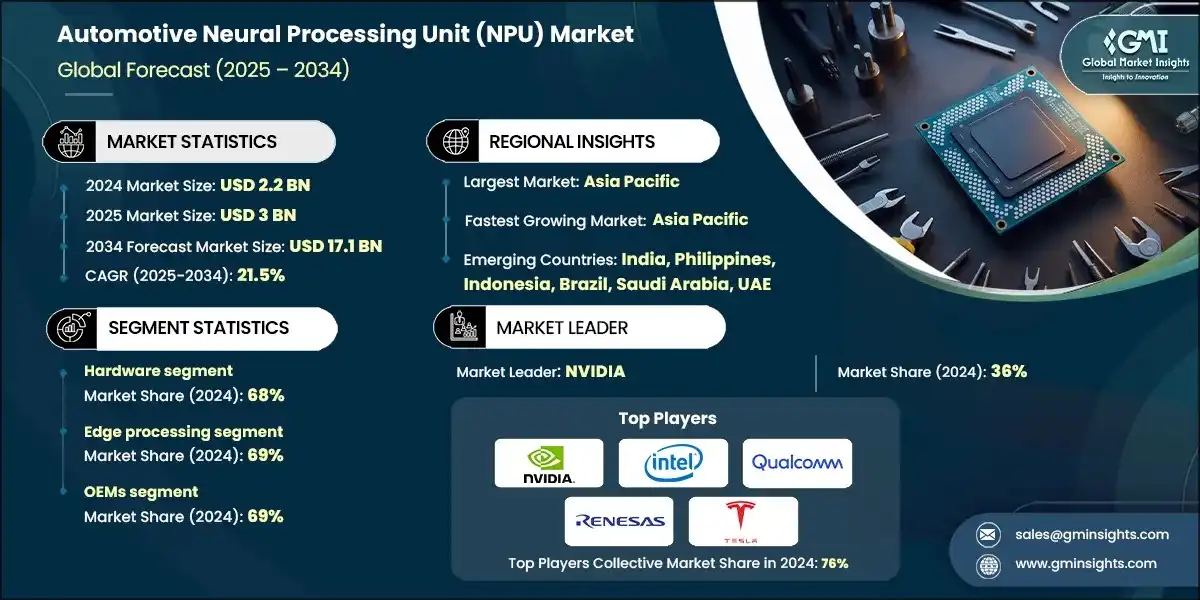
The global automotive neural processing unit market was estimated at USD 2.2 billion in 2024. The market is expected to grow from USD 3 billion in 2025 to USD 17.1 billion in 2034, at a CAGR of 21.5%, according to latest report published by Global Market Insights Inc.
To get key market trends
- The increased adoption of automotive neural processing units (NPUs) is transforming intelligent mobility, allowing vehicles to process dense sensor data in the field to perceive, make decisions, and take actions in real time. DPUs drive deep-learning applications in ADAS, autonomous driving and in-cabin intelligence to enhance safety, energy efficiency and comfort of drivers. OEMs and Tier-1s are currently deploying advanced compute architectures capable of supporting vehicle fusion, predictive analytics, and low-latency response in all driving cases.
- For example, in April 2024, Qualcomm Technologies launched its Snapdragon Ride Flex SoC that combines CPU, graphics, and NPU units on a platform to execute ADAS and digital cockpit functions. This modular integration enables car manufacturers to save up to 30% on system expenses and also increase the level of computation efficiency. Equally, the DRIVE Thor platform that NVIDIA is developing will probably be able to substitute several ECUs with one AI computed unit that provides more than 2,000 TOPS and is an indication that automotive NPUs are consolidating vehicle electronics.
- The electrification and connected mobility movement has contributed to an increase in the adoption of NPUs to predictive energy management, battery analytics, and vehicle-to-grid optimization. NPUs are used to compute real-time range estimation, real-time control of adaptive torque, and efficient route planning in electric vehicles (EVs) depending on the behavior of the driver and the surrounding environment. The system can be integrated with related cloud and edge systems to coordinate charging and over-the-air optimization and better sustainability indicators of OEMs and fleet operators.
- COVID-19 accelerated the use of AI-based digitalization in the automotive value chain. To maintain continuity in production, vehicle manufacturers progressively used simulation, remote diagnostics, and artificial intelligence off-line design testing. Remote retraining of models, monitoring driver behavior, and available health diagnostics of the vehicle are now possible with NPUs, forming the basis of self-healing and resilient automotive systems. As the automakers seek to lessen the reliance on centralized processing of the cloud, the trend is expected to grow as they focus on edge-driven AI compute.
- The NPU is being driven by increased adoption of ADAS and autonomous driving capabilities, including adaptive cruise control, lane-keeping assist, automatic braking, and parking assistance. The current cars are equipped with numerous cameras, radar, and LiDAR sensors, which need high-throughput artificial intelligence (AI). These systems can be used to implement vision and perception algorithms with millisecond latency using NPUs to provide real-time decision-making in safety-critical environments.
- The automotive neural processing unit market has the quickest growth rate in Asia-Pacific because of the fast implementation of AI-based automotive technologies, growing EV manufacturers, and governmental support of autonomous and smart mobility.
- Countries such as China, Japan, South Korea, and India spend a lot of money on manufacturing AI chips and smart vehicle infrastructure. The increasing partnerships of automakers and semiconductor firms, as well as the mass implementation of ADAS and connected car infrastructure are driving NPU integration.
Automotive Neural Processing Unit (NPU) Market Report Attributes
| Key Takeaway | Details |
|---|---|
| Market Size & Growth | |
| Base Year | 2024 |
| Market Size in 2024 | USD 2.2 Billion |
| Market Size in 2025 | USD 3 Billion |
| Forecast Period 2025 – 2034 CAGR | 21.5% |
| Market Size in 2034 | USD 17.1 Billion |
| Key Market Trends | |
| Drivers | Impact |
| Growing deployment of AI and deep learning in vehicles | Automakers increasingly integrate NPUs to process massive sensor data for ADAS and autonomous driving. On-board NPUs enable faster decision-making, real-time perception, and reduced cloud dependency, enhancing vehicle safety and responsiveness. |
| Rising demand for in-vehicle intelligence and personalization | Modern vehicles are evolving into AI-powered systems with real-time language processing, adaptive infotainment, and driver behavior analytics. NPUs support ultra-low latency AI processing for seamless in-cabin experiences and predictive interactions. |
| Expansion of EV and hybrid platforms | Electric and hybrid vehicles rely on NPUs for energy optimization, battery analytics, and sensor fusion. The electrification trend accelerates NPU integration to manage dynamic workloads and ensure power-efficient AI computing. |
| Emergence of edge AI in automotive systems | Edge NPUs allow localized AI processing for functions like object detection and driver monitoring, reducing latency and bandwidth costs. Automakers use this for real-time safety, ADAS reliability, and instant decision-making without cloud delays. |
| Pitfalls & Challenges | Impact |
| High initial implementation and maintenance costs | Automotive-grade NPUs require advanced silicon fabrication, AI model optimization, and safety validation. These raise production costs, limiting adoption among budget and mid-segment OEMs. |
| Concerns over data security and privacy | As NPUs process sensitive in-vehicle and environmental data, the risk of unauthorized access and AI model manipulation increases. Ensuring secure AI model training and encrypted data transfer is essential for trust and compliance. |
| Opportunities: | Impact |
| Advancement in autonomous and semi-autonomous driving | NPUs form the backbone of sensor fusion, environmental mapping, and decision-making in L3–L5 autonomous vehicles. The transition to self-driving cars is set to dramatically expand NPU demand. |
| Growing partnerships between semiconductor and automotive OEMs | Collaborations among chipmakers (Qualcomm, NXP, Nvidia) and automakers (Mercedes-Benz, Hyundai, and GM) are driving faster deployment of AI-driven ECUs and NPUs optimized for real-time processing. |
| Adoption of hybrid AI architectures | Hybrid processing models that combine edge NPUs and cloud AI enhance performance and learning capabilities, supporting dynamic over-the-air updates and adaptive intelligence. |
| Emergence of regional AI innovation hubs | Governments in China, Germany, and South Korea are investing in automotive AI and chip R&D, offering incentives to local manufacturers and boosting NPU production ecosystems. |
| Market Leaders (2024) | |
| Market Leaders |
36% market share |
| Top Players |
Collective Market Share in 2024 is 76% |
| Competitive Edge |
|
| Regional Insights | |
| Largest Market | Asia Pacific |
| Fastest growing market | Asia Pacific |
| Emerging countries | India, Philippines, Indonesia, Brazil, Saudi Arabia, UAE |
| Future outlook |
|
What are the growth opportunities in this market?
Automotive Neural Processing Unit Market Trends
- The automotive NPU market is evolving toward centralized compute architectures, where a single AI platform handles multiple vehicle domains ADAS, infotainment, and autonomy. Automakers are adopting software-defined vehicle (SDV) frameworks that rely on NPUs for sensor fusion and perception workloads. This shift enables over-the-air (OTA) updates and continuous software enhancements, transforming hardware sales into subscription-based AI feature revenues for OEMs and Tier-1 suppliers.
- For instance, in June 2024, NVIDIA expanded its partnership with Mercedes-Benz to deploy the DRIVE Orin platform across next-generation vehicles, enabling Level 3 automation and AI-enabled cockpit personalization. Similarly, Qualcomm’s Snapdragon Ride Flex SoC, introduced in April 2024, integrates CPU, GPU, and NPU cores to reduce hardware complexity by 30% and accelerate real-time sensor data processing for driver-assistance functions.
- The rising penetration of electric and autonomous vehicles is fueling demand for NPUs that can efficiently manage power-hungry AI workloads while maintaining thermal and energy efficiency. AI accelerators are now being used for battery analytics, range prediction, and intelligent energy routing in EVs, enabling more accurate vehicle diagnostics and lower energy consumption. This trend supports the broader push toward sustainable, intelligent mobility ecosystems.
- OEMs are shifting toward edge-based AI processing to minimize cloud dependency and latency in decision-making. NPUs embedded directly in the vehicle enable instant perception and response, critical for safety applications such as automatic emergency braking (AEB), pedestrian detection, and driver monitoring. For example, in 2025, Tesla’s Dojo supercomputer project and Mobileye’s EyeQ6 platform emphasized on-device inference to reduce real-time data transfer costs and improve autonomy reliability.
Automotive Neural Processing Unit Market Analysis
Learn more about the key segments shaping this market
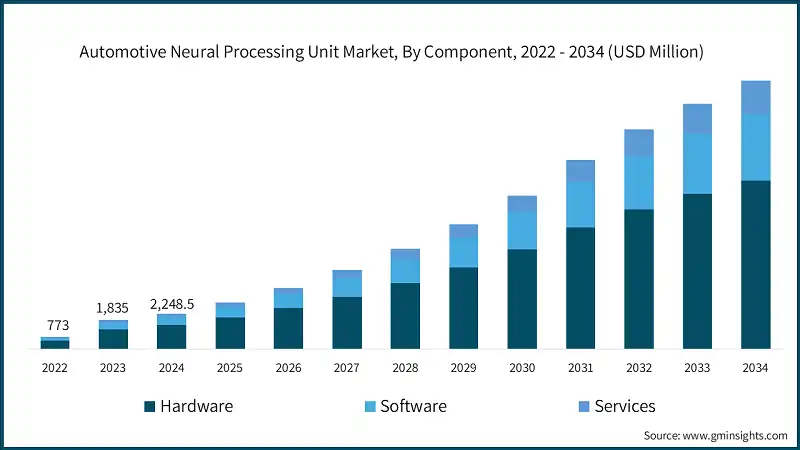
Based on component, the market is divided into hardware, software, and services. The hardware segment dominated the Automotive neural processing unit (NPU) market, accounting for around 68% in 2024 and is expected to grow at a CAGR of more than 20.5% through 2034.
- The hardware segment dominates the automotive neural processing unit (NPU) market because it forms the core computational infrastructure enabling AI-driven automotive functions. NPUs, integrated into advanced processors and SoCs, deliver high-speed parallel processing for applications like ADAS, autonomous driving, and in-vehicle infotainment.
- Automakers prioritize hardware innovation to achieve faster decision-making, lower latency, and energy-efficient AI inference directly at the vehicle edge. Leading chipmakers such as NVIDIA, Qualcomm, and NXP are investing heavily in specialized NPU architectures optimized for automotive workloads. Furthermore, the growing adoption of electric and connected vehicles requires powerful on-board hardware to handle massive sensor data streams and real-time analytics, solidifying the hardware segment’s dominance in the global market.
- In March 2025, NXP introduced the S32K5 microcontroller family, the automotive industry’s first 16 nm FinFET MCU with embedded MRAM and a dedicated NPU (eIQ Neutron). It targets software-defined vehicle (SDV) architectures, enabling zones of zone E/E systems with high compute performance, functional safety, and OTA update capability.
- The services segment will experience a CAGR of more than 25.1% owing to the rising demand for AI model optimization, over-the-air (OTA) updates, and software maintenance in vehicles. Automakers increasingly rely on continuous NPU calibration, cloud analytics, and post-deployment AI support to enhance autonomous driving performance and safety.
Learn more about the key segments shaping this market
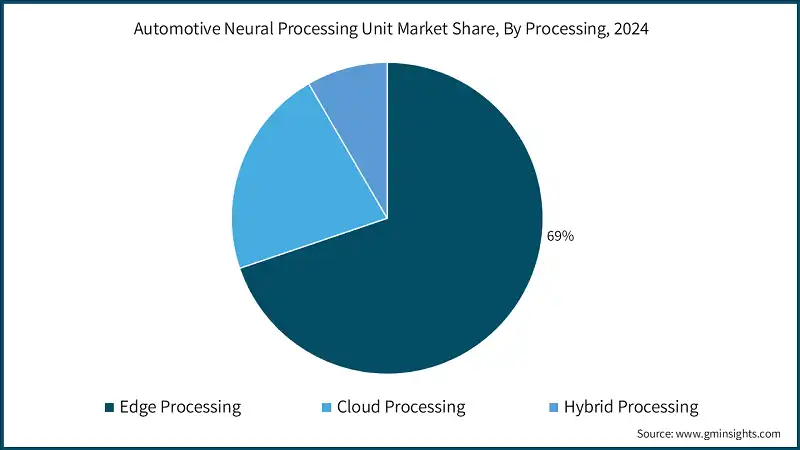
Based on processing, the automotive neural processing unit market is segmented into edge processing, cloud processing, and hybrid processing. The edge processing segment dominates the market accounting for around 69% share in 2024, and the segment is expected to grow at a CAGR of over 20.6% from 2025 to 2034.
- The edge processing segment holds the largest market share in the automotive neural processing unit (NPU) market due to its ability to process real-time data directly within the vehicle, minimizing latency and ensuring faster decision-making for safety-critical applications like ADAS, autonomous navigation, and driver monitoring. This on-device intelligence enables vehicles to function efficiently even in low-connectivity environments, improving reliability and responsiveness.
- Additionally, edge NPUs reduce dependence on cloud infrastructure, enhancing cybersecurity and lowering bandwidth costs. Automakers such as Tesla, BYD, and BMW are increasingly deploying edge-based NPUs like NVIDIA Orin and Qualcomm Snapdragon Ride to power high-performance perception and control systems. As vehicles evolve toward higher autonomy levels, edge computing remains central to achieving real-time AI performance and data privacy.
- For example, in February 2025, NXP Semiconductors announced its all-cash acquisition of Kinara, Inc. for USD 307 million to enhance its automotive and industrial edge AI offerings with high-performance NPUs and software, strengthening its intelligent-edge processing portfolio.
- The hybrid processing segment will expand at a CAGR of more than 24.8% due to the growing integration of edge and cloud intelligence in vehicles. Automakers are adopting hybrid NPUs to balance real-time decision-making with cloud-based model updates, enhancing autonomous driving accuracy, data optimization, and over-the-air performance improvements.
Based on sales channel, the market is segmented into OEMs, and aftermarket. OEMs segment dominates the market with around 69% share due to early integration of NPUs into advanced driver-assistance and autonomous platforms, enabling seamless hardware-software optimization and reducing reliance on aftermarket installations.
- The automotive neural processing unit market is primarily led by the OEMs segment, which accounts for a dominant share due to the growing integration of AI-driven systems at the manufacturing stage. Automakers are embedding NPUs directly into advanced driver-assistance systems (ADAS), autonomous driving platforms, and infotainment systems to improve real-time data processing, enhance safety, and support predictive vehicle behavior.
- Leading OEMs such as Tesla, BMW, and Toyota are partnering with NPU developers like NVIDIA, Qualcomm, and Mobileye to co-develop chip architectures optimized for automotive-grade reliability and efficiency. This built-in integration ensures superior performance, reduces installation costs, and supports faster time-to-market for AI-enabled vehicles, positioning OEMs as key enablers of next-generation intelligent mobility.
- For example, in October 2024, Qualcomm announced a multi-year collaboration with Alphabet Inc. (Google) to combine chips and software for automakers, while MercedesBenz Group confirmed use of Qualcomm’s Snapdragon Elite Cockpit chip in future vehicles.
- Aftermarket segment will grow at a CAGR of over 22.5% due to the rising demand for AI-powered retrofitting solutions, software upgrades, and performance optimization in existing vehicles. Fleet owners and mobility service providers are increasingly adopting NPUs to enhance ADAS, predictive maintenance, and driver monitoring functionalities.
Based on vehicle, the automotive neural processing unit market is divided into passenger vehicles, commercial vehicle, and electric vehicle (EVs). The passenger vehicle dominated market in 2024.
- The passenger vehicle segment holds the highest market share in the automotive neural processing unit (NPU) market due to the rapid integration of advanced driver assistance systems (ADAS), infotainment, and autonomous driving features. Leading automakers such as Tesla, BMW, and Mercedes-Benz are deploying NPUs to power real-time sensor fusion, object recognition, and AI-driven decision-making capabilities for safer, more personalized driving experiences.
- Additionally, rising consumer demand for intelligent, connected, and electric vehicles has accelerated the adoption of AI chips within passenger cars. NPUs enables efficient data processing at the edge, reducing latency and improving system performance. As vehicles become increasingly software-defined, OEMs are integrating NPUs to enhance performance, ensure driver safety, and comply with evolving autonomous and sustainability standards.
- For instance, in September 2024, Volvo Cars introduced its EX90 SUV equipped with NVIDIA Corporation Drive Orin AI chips, enabling high-performance safety and driver assistance features in a mainstream 7-seater passenger vehicle.
- The Electric Vehicle (EV) segment is expected to witness the fastest growth due to the increasing integration of NPUs for real-time energy optimization, battery management, and autonomous driving systems. Rising EV adoption, government incentives, and AI-driven vehicle intelligence are accelerating demand for efficient on-chip neural processing capabilities.
Looking for region specific data?
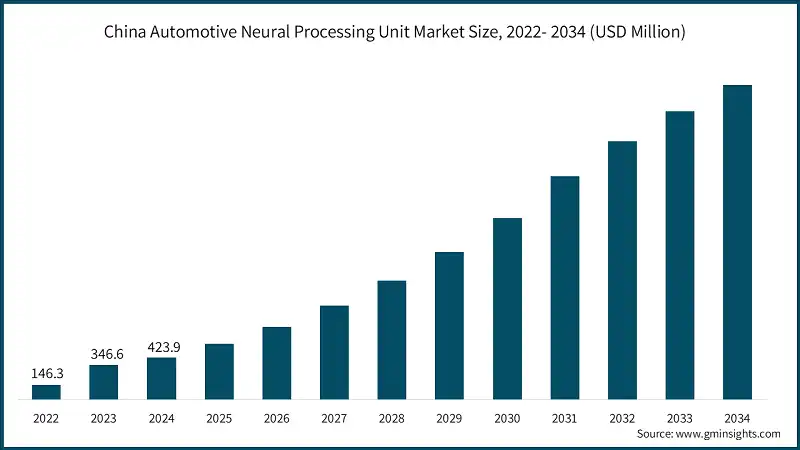
China dominated the automotive neural processing unit market in Asia Pacific with around 37% share and generated USD 423.9 million in revenue in 2024.
- The China market is witnessing strong growth due to the country’s rapid advancement in intelligent and autonomous vehicle technologies. The government’s strategic initiatives, such as the “Made in China 2025” plan and the Intelligent Connected Vehicle (ICV) Roadmap, are pushing OEMs and chipmakers to localize AI compute hardware. Domestic manufacturers like Horizon Robotics, Black Sesame Technologies, Huawei, and SemiDrive are developing automotive-grade NPUs optimized for real-time perception, sensor fusion, and driver-assistance workloads, reducing dependency on foreign suppliers.
- Additionally, China’s booming electric vehicle (EV) and smart mobility ecosystem is accelerating demand for on-board AI processors that enable autonomous driving, predictive maintenance, and energy optimization. The integration of NPUs in mid-tier and mass-market vehicles is expanding rapidly, supported by government subsidies, large-scale 5G connectivity, and the rise of software-defined vehicle platforms.
- For example, in April 2025, Horizon Robotics and DENSO announced a strategic partnership to co-develop high-performance assisted driving solutions for China.
- India is projected to grow at a strong CAGR for the automotive neural processing unit (NPU) Market due to rapid digitalization of the automotive ecosystem, expansion of ADAS and connected car technologies, and government-led initiatives promoting intelligent mobility. The "Make in India" and Automotive Mission Plan 2026 are encouraging domestic semiconductor design, fostering local NPU development and integration in electric and connected vehicles.
The automotive neural processing unit market in Germany is expected to experience significant and promising growth from 2025-2034.
- Europe accounts for over 29.6% of the market in 2024 and is the fastest-growing region with a CAGR of around 19.6% owing to stringent ADAS regulations, electric vehicle adoption, and AI-integrated automotive safety innovations.
- Germany is the leader in the automotive neural processing unit (NPU) market due to its advanced automotive R&D ecosystem, strong focus on vehicle automation, and widespread adoption of high-performance computing for real-time decision-making. German OEMs such as BMW, Mercedes-Benz, and Volkswagen are heavily investing in NPUs to power perception, navigation, and autonomous decision systems within next-generation vehicles.
- Additionally, Germany’s robust semiconductor infrastructure and partnerships with European microelectronics hubs such as Fraunhofer Institutes and Silicon Saxony—are accelerating innovation in AI hardware and neural network accelerators. Continuous investment in edge AI, 5G-enabled mobility, and in-vehicle computing platforms further cements Germany’s role as a pioneer in intelligent automotive systems and next-gen autonomous vehicle technologies.
- For instance, in March 2025, BOS Semiconductors announced a contract with a European OEM for its Eagle-N chiplet AI accelerator (250 TOPS) and Eagle-A SoC, with development work and vehicle system-validation efforts centered in Germany.
- The UK is becoming a major growing market for automotive neural processing units (NPUs) due to its strong focus on autonomous vehicle testing, government-backed AI innovation programs, and expanding EV manufacturing ecosystem. Leading firms like Arm, Jaguar Land Rover, and Wayve are investing in on-vehicle AI accelerators to enhance driving intelligence and safety.
The automotive neural processing unit market in US is expected to experience significant and promising growth from 2025-2034.
- North America accounts for over 19.4% of the market in 2024 and is expected to grow at a CAGR of around 20.7% owing to the high adoption of autonomous driving technologies, strong semiconductor R&D infrastructure, and major OEM investments in AI-based vehicle intelligence platforms.
- The U.S. is the leader in the automotive neural processing unit market due to its advanced automotive ecosystem, strong presence of semiconductor giants such as NVIDIA, Intel, and Qualcomm, and rapid development of AI-driven mobility solutions. American automakers and Tier-1 suppliers are increasingly integrating NPUs into ADAS, autonomous driving, and in-vehicle infotainment systems to enhance real-time decision-making and safety.
- Moreover, government support for autonomous vehicle testing, coupled with a robust startup ecosystem in automotive AI and edge computing, accelerates innovation and commercialization. Strategic partnerships between technology providers and OEMs such as NVIDIA’s DRIVE platform collaborations with Tesla and General Motors further strengthen the U.S. leadership in NPU development and adoption within next-generation smart vehicles.
- In March 2025, General Motors and NVIDIA announced a strategic collaboration aiming to use NVIDIA’s DRIVE AGX in-vehicle hardware for next-gen ADAS and AI driving experiences.
- Canada is becoming one of the fastest-growing markets in the North America automotive neural processing unit (NPU) market due to its growing investments in autonomous and electric vehicle R&D, strong government support for AI innovation, and collaborations between automakers and semiconductor firms.
The automotive neural processing unit market in Brazil is expected to experience significant and promising growth from 2025-2034.
- LAMEA holds around 1% of the automotive neural processing unit (NPU) market and is growing steadily at a CAGR of around 18.3%. The developments are fueled by rising EV adoption, smart mobility initiatives, and expanding automotive electronics manufacturing in Brazil, UAE, and South Africa.
- Brazil dominates the LAMEA automotive neural processing unit (NPU) market owing to its rapidly expanding automotive manufacturing base, growing EV ecosystem, and strong adoption of AI-driven vehicle technologies. The country’s focus on intelligent mobility, digital infrastructure, and advanced driver-assistance systems (ADAS) integration is driving the deployment of NPUs in connected and semi-autonomous vehicles. Increasing collaboration between local automakers and global semiconductor firms is also fostering domestic NPU adoption.
- Additionally, Brazil’s government incentives for smart mobility and R&D investments in automotive electronics are boosting innovation and localization. Companies such as Volkswagen Brazil and Stellantis are integrating AI-powered control units in next-generation vehicles to enhance performance and safety. This growing ecosystem positions Brazil as a strategic hub for automotive NPU development in Latin America.
- For example, in February 2024, Hyundai Motor Company announced an investment of over USD 1.1 billion in Brazil by 2032 focused on hybrid, electric and green hydrogen vehicles, signaling enhanced technology deployment in the region.
- The UAE automotive neural processing unit (NPU) market is rapidly expanding due to the nation’s aggressive digital transformation goals and adoption of next-generation mobility technologies. The government’s initiatives to localize AI chip design, enhance R&D capacity, and promote connected and autonomous vehicle ecosystems are key market enablers.
Automotive Neural Processing Unit Market Share
- The top 7 companies in the automotive neural processing unit (NPU) market are NVIDIA, Tesla, Qualcomm, Intel (Mobileye), Renesas, NXP, and AMD, contributed around 81% of the market in 2024.
- NVIDIA focuses on expanding its DRIVE Thor and Orin automotive platforms, integrating powerful NPUs for autonomous driving and AI cockpit systems. The company partners with major OEMs like Mercedes-Benz and BYD, emphasizing scalable AI computing, real-time sensor fusion, and full-stack software ecosystems for autonomous mobility.
- Tesla develops in-house NPUs through its Dojo and FSD chip architectures, optimizing AI performance for self-driving and fleet learning. Its strategy centers on vertical integration, real-world driving data utilization, and continuous over-the-air neural network updates to improve autopilot safety and real-time perception.
- leverages its Snapdragon Ride platform, integrating NPUs for ADAS, autonomous driving, and infotainment. The company’s strategy includes partnerships with BMW, GM, and Volvo, focusing on energy-efficient AI acceleration, modular architecture, and scalable hardware-software integration for connected and electric vehicles.
- Mobileye emphasizes EyeQ SoCs with embedded NPUs for advanced vision and perception. Its strategy targets mass-market scalability and safety validation through REM (Road Experience Management) data. Collaborations with Volkswagen and Geely enhance its footprint in semi-autonomous and ADAS systems globally.
- Renesas integrates NPUs into its R-Car SoC series, optimizing real-time AI inference for ADAS and infotainment. Its strategy involves combining low-power edge AI processing with strong OEM partnerships in Japan and Europe, targeting cost-effective, safety-compliant automotive AI solutions.
- NXP’s strategy focuses on automotive-grade edge AI processing with its S32K and S32G platforms featuring NPUs. The company emphasizes security, real-time processing, and interoperability for vehicle control, radar fusion, and digital cockpit applications, partnering with automakers to enhance safe and intelligent mobility.
- AMD leverages its adaptive AI architecture and Xilinx FPGA integration to deliver high-performance NPUs for autonomous and infotainment systems. Its strategy centers on customizable AI acceleration, automotive reliability, and deep partnerships with Tier-1 suppliers to expand presence in electric and connected vehicle domains.
Automotive Neural Processing Unit Market Companies
Major players operating in the automotive neural processing unit (NPU) market are:
- Amazon
- AMD
- Hailo
- IBM
- Intel (Mobileye)
- NVIDIA
- NXP
- Qualcomm
- Renesas
- Tesla
- The automotive neural processing unit market is rapidly evolving with the integration of AI, edge computing, and sensor fusion technologies to enable real-time decision-making in autonomous and semi-autonomous vehicles. These NPUs enhance perception, navigation, and driver-assistance capabilities through high-speed, low-latency computing.
- Manufacturers are increasingly focusing on developing software-defined, upgradable vehicle architectures supported by AI accelerators and NPUs. This approach allows continuous model training, OTA performance updates, and predictive maintenance insights, strengthening OEM control over in-vehicle intelligence and reducing dependence on external chip vendors.
- Strategic collaborations among semiconductor companies, automakers, and cloud providers are expanding ecosystem interoperability. Partnerships in AI-driven mobility, smart infrastructure, and safety validation frameworks are promoting sustainable, data-centric automotive solutions while ensuring cybersecurity, energy efficiency, and compliance with evolving global automotive standards.
Automotive Neural Processing Unit Industry News
- In July 2025, Tesla deployed its Grok AI assistant across Model S, 3, X, Y, and Cybertruck vehicles through over-the-air software updates. The deployment utilizes AMD Ryzen SoC hardware for local processing while leveraging xAI servers for advanced AI capabilities, demonstrating hybrid edge-cloud AI architectures in production vehicles.
- In March 2025, Infineon Technologies announced advances in Edge AI computing on its PSoC Edge platform, targeting automotive applications including mobility and AI communication systems. The announcement coincided with Infineon's participation in IAA Mobility 2025, demonstrating continued investment in automotive AI processing capabilities.
- In December 2024, STMicroelectronics launched the STM32N6 MCU series, featuring the company's first proprietary Neural-ART Accelerator NPU embedded in STM32 devices. The Neural-ART Accelerator provides up to 600x ML performance improvement versus typical high-end STM32 MCUs, with nearly 300 configurable MAC units achieving up to 600 GOPS. The launch includes automotive-adjacent applications such as in-vehicle driver warning systems and infotainment applications.
- In November 2024, NXP released updated training materials for its S32 eIQ Auto machine learning development kit, demonstrating continued investment in automotive AI software tools. The eIQ Auto SDK provides ASPICE-compliant runtime capabilities for production deployment on S32 platforms, addressing automotive software development requirements for NPU-enabled applications.
The automotive neural processing unit market research report includes in-depth coverage of the industry with estimates & forecasts in terms of revenue ($Bn), Shipment (Units) from 2021 to 2034, for the following segments:
Market, By Component
- Hardware
- NPU chips
- Accelerators
- Processors
- Software
- AI frameworks
- SDKs
- Drivers
- Services
- Integration
- Maintenance
- Consulting
Market, By Processing
- Edge Processing
- Cloud Processing
- Hybrid Processing
Market, By Vehicle
- Passenger vehicles
- Hatchbacks
- Sedans
- SUV
- MPVs
- Commercial vehicles
- Light commercial vehicles (LCV)
- Medium commercial vehicles (MCV)
- Heavy commercial vehicles (HCV)
- Electric Vehicles (EVs)
Market, By Application
- Advanced Driver Assistance Systems (ADAS)
- Autonomous Driving
- In-Vehicle Infotainment (IVI)
- Driver Monitoring Systems (DMS)
- Traffic Sign & Object Recognition
- Predictive Maintenance & Vehicle Diagnostics
- Others
Market, By Sales Channel
- OEMs
- Aftermarket
The above information is provided for the following regions and countries:
- North America
- US
- Canada
- Europe
- Germany
- UK
- France
- Italy
- Spain
- Russia
- Asia Pacific
- China
- India
- Japan
- Australia
- South Korea
- Philippines
- Indonesia
- LAMEA
- Brazil
- Mexico
- Argentina
- South Africa
- Saudi Arabia
- UAE
Frequently Asked Question(FAQ) :
What are the upcoming trends in the automotive neural processing unit (NPU) market?
Key trends include the rise of software-defined vehicles (SDVs), integration of AI chips for real-time perception, expansion of edge computing, and increased use of over-the-air (OTA) AI model optimization.
Who are the key players in the automotive neural processing unit market?
Major companies include NVIDIA, Tesla, Qualcomm, Intel (Mobileye), Renesas, NXP, and AMD, which collectively hold over 80% of the market share. These firms lead innovation in AI computing platforms, autonomous driving systems, and energy-efficient NPU architectures.
Which region leads the automotive neural processing unit market?
North America held over 19.4% share in 2024 and is projected to grow at a CAGR of 20.7% through 2034. Growth is fueled by strong semiconductor R&D, autonomous driving adoption, and OEM investments in AI-driven vehicle platforms.
What is the growth outlook for hybrid processing from 2025 to 2034?
The hybrid processing segment is expected to grow at a CAGR of over 24.8% till 2034, fueled by the integration of cloud and edge AI for continuous model updates and predictive intelligence.
What was the valuation of the edge processing segment in 2024?
The edge processing segment held about 69% market share in 2024, as on-vehicle NPUs provided low-latency data processing essential for ADAS and autonomous functions.
What is the projected value of the automotive neural processing unit (NPU) market by 2034?
The automotive neural processing unit (NPU) industry is expected to reach USD 17.1 billion by 2034, driven by advancements in edge AI, autonomous driving technologies, and software-defined vehicle architectures.
How much revenue did the hardware component segment generate in 2024?
The hardware segment accounted for around 68% share in 2024, generating the majority of industry revenue through high-performance AI chips and processors that enable real-time decision-making in vehicles.
What is the market size of the automotive neural processing unit industry in 2024?
The market size was valued at USD 2.2 billion in 2024, with a CAGR of 21.5% expected through 2034, driven by the rapid adoption of AI-enabled systems in connected and autonomous vehicles.
What is the current automotive neural processing unit (NPU) market size in 2025?
The market is projected to reach USD 3 billion in 2025, supported by growing integration of edge-based NPUs for ADAS, infotainment, and real-time driver monitoring.
Automotive Neural Processing Unit (NPU) Market Scope
Related Reports