Summary
Table of Content

Automotive Lighting Market
Get a free sample of this report
Form submitted successfully!
Error submitting form. Please try again.
Thank you!
Your inquiry has been received. Our team will reach out to you with the required details via email. To ensure that you don't miss their response, kindly remember to check your spam folder as well!
Request Sectional Data
Thank you!
Your inquiry has been received. Our team will reach out to you with the required details via email. To ensure that you don't miss their response, kindly remember to check your spam folder as well!
Form submitted successfully!
Error submitting form. Please try again.
Automotive Lighting Market Size
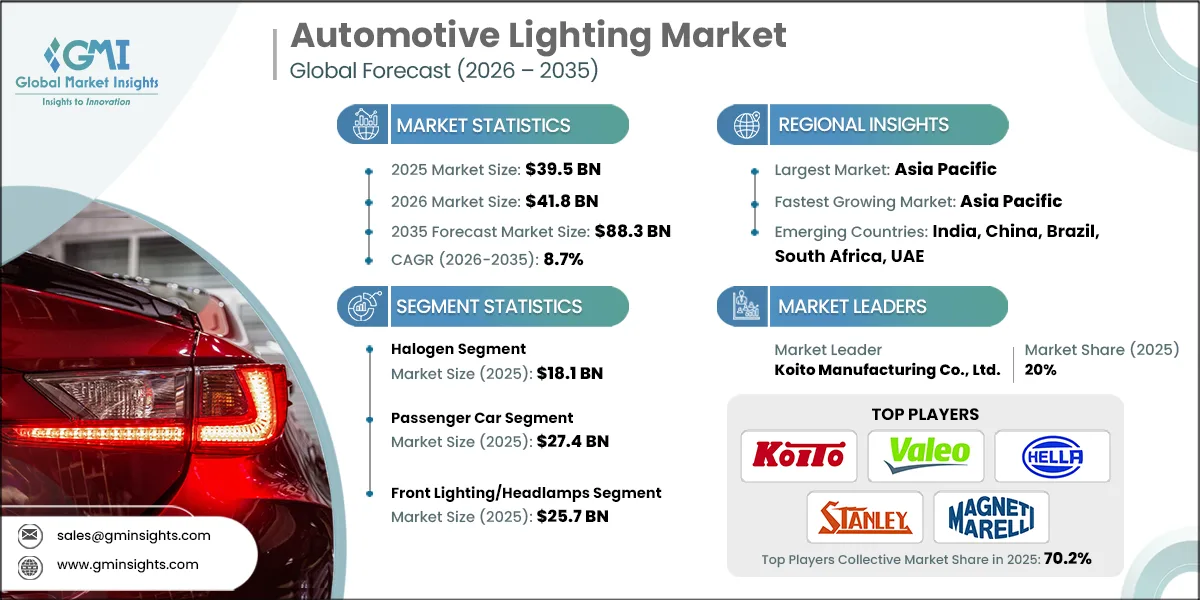
The global automotive lighting market was valued at USD 39.5 billion in 2025. The market is expected to grow from USD 41.8 billion in 2026 to USD 59.5 billion in 2031 and USD 88.3 billion in 2035, at a CAGR of 8.7% during the forecast period, according to the latest report published by Global Market Insights Inc.
Automotive Lighting Market Key Takeaways
Market Size & Growth
- 2025 Market Size: USD 39.5 Billion
- 2026 Market Size: USD 41.8 Billion
- 2035 Forecast Market Size: USD 88.3 Billion
- CAGR (2026–2035): 8.7%
Regional Dominance
- Largest Market: Asia Pacific
- Fastest Growing Region: Asia Pacific
Key Market Drivers
- Rising Demand for LED and Adaptive Lighting Systems.
- Stringent Vehicle Safety and Emission Regulations.
- Increasing Adoption of Electric and Autonomous Vehicles.
- Growing Consumer Preference for Stylish and Energy-Efficient Lighting.
- Expansion of Automotive Production in Emerging Markets.
Challenges
- High Initial Costs of Advanced Lighting Systems.
- Complexity in Integration with Vehicle Electronics.
Opportunity
- Adoption of Smart, Software-Defined Automotive Lighting Platforms.
- Growth of Modular and Scalable Lighting Architectures.
Key Players
- Market Leader: Koito Manufacturing Co., Ltd. led with over 20% market share in 2025.
- Leading Players: Top 5 players in this market include Koito Manufacturing Co. Ltd., Valeo SA, HELLA GmbH & Co. KGaA, Stanley Electric Co. Ltd., Magneti Marelli S.p.A., which collectively held a market share of 70.2% in 2025.
Get Market Insights & Growth Opportunities
The market is expanding, owing to rising demand for LED and adaptive lighting systems, stringent vehicle safety and emission regulations, increasing adoption of electric and autonomous vehicles, growing consumer preference for stylish and energy-efficient lighting, and expansion of automotive production in emerging markets A key important contributor of development in the automotive lighting industry is the increased move towards LED and adaptive lighting systems due to the regulatory requirements and safety regulations by bodies with the ultimate authority.
The Federal Motor Vehicle Safety Standard 108 in the United States and the UN-ECE lighting standards globally have regulatory requirements that are performance and beam pattern, as well as safety oriented and therefore auger well towards advanced LED systems with adaptive capabilities contributing to improved visibility and lessening the risk of glare. Those technologies are in line with the worldwide emissions and efficiency trends too as they are using less energy than the typical halogen lighting, contributing to extended energy-efficiency goals in vehicle fleets. To illustrate, in October 2025 regulatory changes as stipulated under UN ECE R148 were enforced in the EU that needed adaptive glare-free high beams on new vehicles accelerating adoption further.
The automotive lighting market is enjoying the swift shift in the industry toward electric and autonomous cars, which are inherently based on the intensive use of lighting solutions as components of the safety and energy-saving strategies. The consideration of electrification and automation goals into overall transportation policies by governments and policymakers globally serves as a catalyst in OEMs to implement lighting technologies that are energy-efficient, digitally supported, and sensor and communication system integration to enable autonomous processes to occur. Adaptive daytime running lights and intelligent signaling systems like the optimization of battery range and better awareness during automated driving modes can be given as an example. As an example, the IEA report shows that the sales of Electric cars reached over 17 million vehicles in 2024, increasing by over 25% over 2023 with the increment of 3.5 million vehicles sold in 2024 alone compared to 2020 total car sales of the entire world.
The automotive lighting industry includes designing, producing, and putting together light systems in cars such as headlights, back lights, fog lamps, daytime running lamps, and inside car lights. These systems make cars safer and easier to see while also looking good and helping save energy and meet rules. The current trends focus on LED lights, smart and adjustable lighting that work with driver help and self-driving technologies. This market caters to original equipment manufacturers after-market sellers as well as fleet managers motivated by changing safety rules, customer needs and tech improvements.
To get key market trends
Automotive Lighting Market Trends
- There has been a major shift towards the use of LED, OLED and laser lighting technologies in the automotive lighting industry as opposed to the traditional systems (halogen and HID). These technologies also provide superior brightness, less power usage and design flexibility. This development is consistent with the electrification of vehicles, as it aims to maximize energy usage and enhance night visibility and make vehicles differentiate at the premium level with distinct light signatures.
- The use of smart lighting systems that are able to dynamically adapt the beam patterns in accordance with traffic, speed, and environmental conditions is an emerging trend. The new technologies of Adaptive Front Lighting Systems (AFS) and matrix LEDs are also used in conjunction with onboard sensors and driver assistance systems to improve safety and limit glare. This combination is in addition to Advanced Driver-Assistance Systems (ADAS), autonomous driving models, which need intelligent lighting systems to communicate effectively with other systems in the vehicle.
- The automotive companies are offering lighting as a brand differentiating and design enhancer. Custom ambient lighting, dynamic turn signals, and signature daytime running lights, among others, increase the perceived vehicle quality and satisfy consumer demand to have personalized and immersive driving experience, especially in the high-end car segment.
- Due to the stricter rules imposed on emissions and energy efficiency all over the world, the automotive lighting industry is focusing on sustainable and energy efficient designs. Employing LEDs, OLEDs and lightweight materials will decrease power usage, especially in electric vehicles and aid in the overall optimization of energy. The industry is also progressing sustainability programs through the use of recyclable materials, simplification of production to reduce carbon footprints.
Automotive Lighting Market Analysis
Learn more about the key segments shaping this market
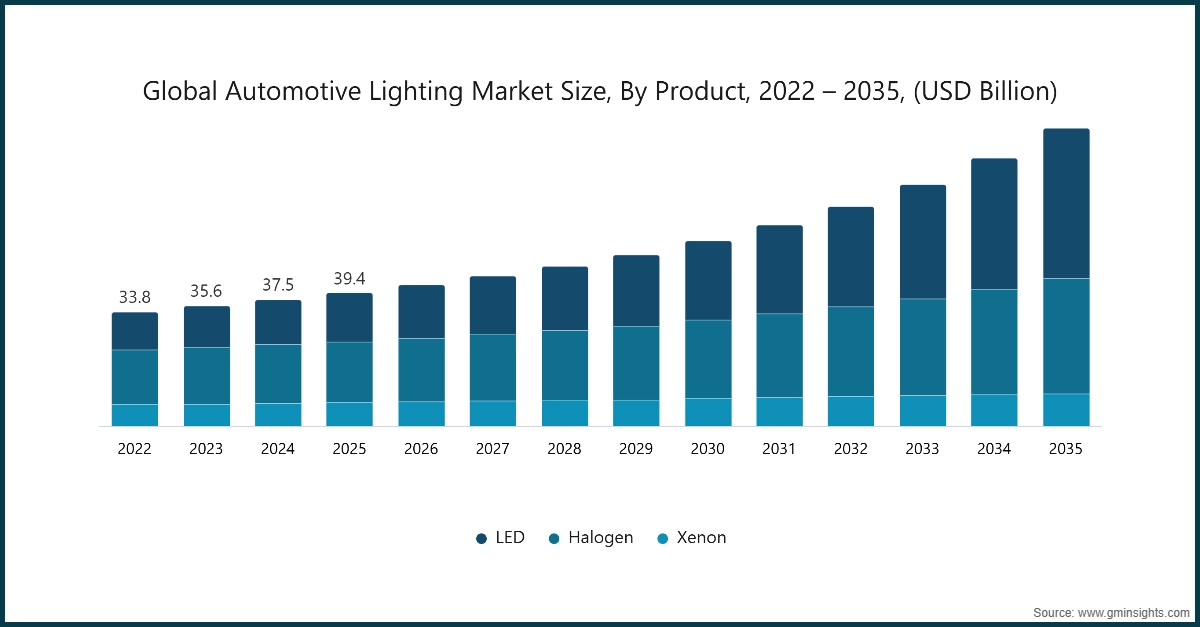
Based on the product, the market is divided into LED, halogen, and xenon.
- The halogen segment accounted for the automotive lighting market and was valued at USD 18.1 billion in 2025. Halogen lighting continues to drive demand in mainstream and entry‑level vehicle segments due to lower upfront costs, ease of manufacturing, and broad compatibility with existing electrical systems, encouraging OEM adoption where premium lighting is not yet essential.
- Halogen bulbs maintain strong aftermarket relevance, supported by robust global vehicle parc replacement cycles, simple retrofit fitment, and compatibility with legacy vehicles, sustaining stable market demand despite electrification trends.
- Manufacturers should optimize halogen production lines and partnerships for aftermarket supply, ensuring cost leadership and wide distribution channels to retain share in mass‑market and budget vehicle lighting.
- The LED segment was the fastest growing market during the forecast period, growing at a CAGR of 12.2% during the forecast period. LED lighting adoption is driven by energy efficiency, longer lifespan, and enhanced illumination performance compared with halogen alternatives, supporting EV range goals and improved nighttime visibility that aligns with global vehicle safety priorities.
- LED headlamp units are increasingly accepted under global lighting safety frameworks; for instance, in 2025 the EU’s updated UNECE lighting regulations mandate adaptive lighting compliance with LED sources, encouraging broader LED system deployments.
- Automakers should accelerate LED system development aligned with UNECE and FMVSS certification requirements, embedding adaptive features to capture growing regulatory and safety‑driven demand across premium and mainstream vehicle models.
Learn more about the key segments shaping this market
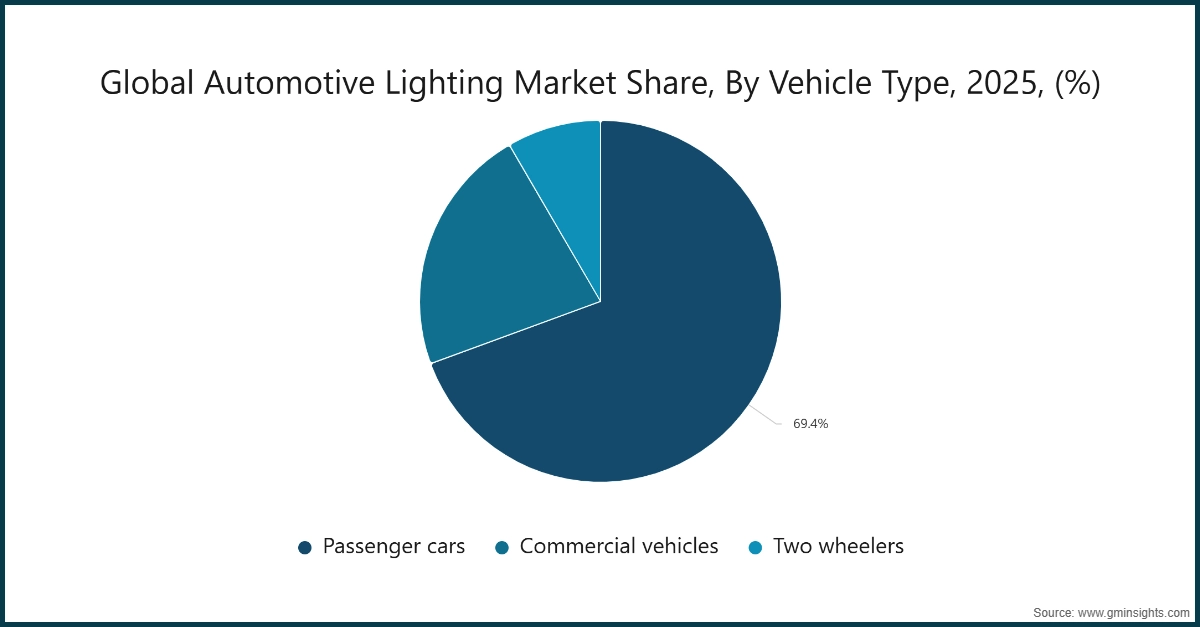
On the basis of vehicle type, the automotive lighting market is segmented into passenger cars, commercial vehicles, and two wheelers.
- The passenger car segment accounted for the largest market and was valued at USD 27.4 billion in 2025. Passenger cars lead market value due to consumer preference for adaptive, LED, and matrix lighting, enhancing aesthetics, safety, and brand differentiation, particularly in premium and mid-segment vehicles globally.
- Stringent vehicle safety and lighting regulations in North America, Europe, and Asia, including mandatory daytime running lights and adaptive headlamp standards, drive widespread adoption of advanced lighting in passenger cars.
- OEMs should integrate advanced LED and adaptive lighting features in passenger cars, balancing design appeal, regulatory compliance, and energy efficiency to strengthen brand positioning and market share.
- The commercial vehicles segment is anticipated to grow at a CAGR of 7.9% during the forecast period. Commercial vehicles increasingly require high-performance lighting systems to ensure driver safety during long-haul and urban operations, leading to demand for LED, halogen, and adaptive lighting systems optimized for durability and visibility.
- Growing commercial vehicle production in emerging markets, coupled with stricter road safety regulations, accelerates deployment of efficient and reliable lighting solutions to improve fleet safety, fuel efficiency, and operational compliance.
- Lighting manufacturers should develop durable, energy-efficient lighting solutions for commercial vehicles that meet regulatory safety standards, support long operational hours, and reduce maintenance costs for fleet operators.
Based on the application, the automotive lighting market is categorized into front lighting/headlamps, rear lighting, interior lighting, and side lighting.
- The front lighting/Headlamps segment accounted for the largest market and was valued at USD 25.7 billion in 2025. Front lighting drives market growth as headlamps are critical for night-time visibility, accident prevention, and regulatory adherence. Governments mandate adaptive, glare-free, and high-intensity lighting systems to enhance road safety globally.
- LED, matrix, and adaptive headlamps are increasingly integrated with ADAS and autonomous driving platforms, enabling intelligent beam control, vehicle-to-environment signaling, and superior illumination performance.
- Manufacturers should prioritize advanced adaptive LED headlamp systems with regulatory compliance and ADAS integration to strengthen safety credentials and differentiate offerings in passenger and commercial vehicles.
- The interior lighting segment was the fastest growing market during the forecast period, growing at a CAGR of 10.3% during the forecast period. Interior lighting adoption grows as ambient, customizable, and energy-efficient lighting improves cabin experience, enhances luxury appeal, and meets consumer expectations for modern, premium vehicle interiors.
- LED-based interior lighting reduces energy consumption and integrates with infotainment and connected vehicle systems, supporting EV efficiency goals while enabling flexible, dynamic lighting experiences.
- OEMs should develop modular, energy-efficient interior lighting systems with customizable ambient features, aligning with consumer preferences for premium, connected vehicle experiences and EV energy optimization.
Looking for region specific data?
North America Automotive Lighting Market
North America automotive lighting industry held a revenue share of 18.5% in 2025.
- In North America, automotive lighting growth is driven by increasing vehicle electrification, rising adoption of LED and smart adaptive lighting systems, and stringent safety mandates enforced under Federal and Motor Vehicle Safety Standards.
- Advanced front lighting and matrix LED systems are becoming standard in new vehicle models as OEMs seek energy efficiency and visibility improvements. Comfort and night‑time safety regulations also encourage innovation in intelligent lighting solutions across passenger and commercial segments.
- North America holds around one‑third of global automotive lighting demand, supported by strong automotive manufacturing and aftermarket ecosystems prioritizing smart and energy‑efficient lighting technologies.
- OEMs should localize LED and adaptive system production and integrate smart lighting with ADAS to meet North American safety and energy‑efficiency expectations.
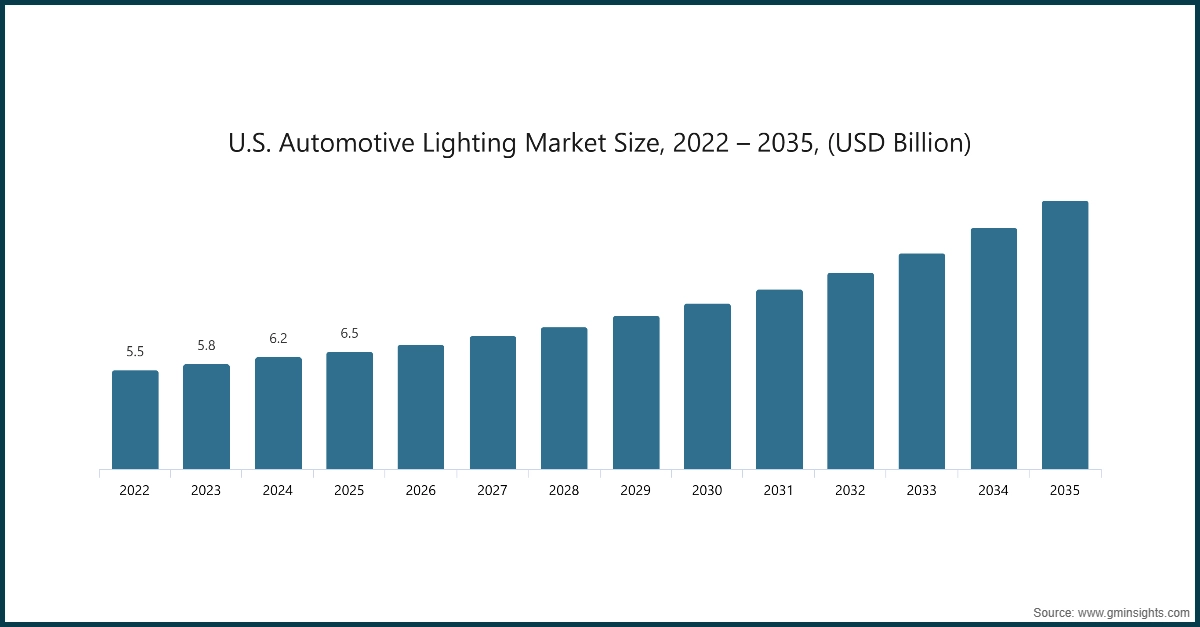
The U.S. automotive lighting market was valued at USD 5.5 billion and USD 5.8 billion in 2022 and 2023, respectively. The market size reached USD 6.5 billion in 2025, growing from USD 6.2 billion in 2024.
- The United States automotive lighting industry is shaped by regulatory frameworks like FMVSS 108, administered by the National Highway Traffic Safety Administration (NHTSA), which governs vehicle lighting performance and safety compliance.
- Recent allowance of adaptive driving beam (ADB) headlamps has opened pathways for intelligent lighting integration with collision avoidance and visibility optimization systems. For instance, in February 2022, the NHTSA amended FMVSS 108 to permit adaptive driving beam headlights, enabling safer dynamic illumination.
- Energy‑efficient LED and matrix lighting adoption is further catalyzed by consumer demand for advanced safety features and regulatory push for reduced nighttime accident rates. U.S. trends also reflect the growing share of electric vehicles, for which lighting efficiency directly impacts range and performance.
- U.S. manufacturers need to prioritize ADB‑compliant adaptive lighting modules and ensure self‑certification processes align with FMVSS 108 requirements to maximize U.S. market access.
Europe Automotive Lighting Market
Europe automotive lighting industry accounted for USD 8.5 billion in 2025 and is anticipated to show lucrative growth over the forecast period.
- Europe’s automotive lighting industry is propelled by stringent safety regulations, sustainability policies, and high consumer demand for premium lighting performance.
- The region benefits from harmonized UNECE standards that mandate advanced lighting functions, including adaptive glare‑free high beams and LED performance criteria for new vehicles.
- The EU’s regulatory environment encourages innovation while emphasizing energy efficiency and road safety, with widespread OEM implementation across passenger and commercial segments.
- European manufacturers should align development with UNECE adaptive lighting and E‑mark certification standards to secure broad European regulatory approval.
Germany dominated the Europe automotive lighting market, showcasing strong growth potential.
- Germany is a key automotive lighting hub within Europe, combining advanced OEM capabilities with regulatory emphasis on safety and innovation.
- Its automotive sector is investing in next‑generation lighting technologies such as micro‑LED, OLED, and adaptive beam systems integrated with vehicle sensors to enhance visibility and reduce glare.
- German government support for automotive competitiveness influences lighting tech adoption as part of broader vehicle industry strategies, though policy tensions around future emissions regulations persist.
- German manufacturers should focus on advanced adaptive lighting development and leverage Germany’s innovation ecosystem to differentiate high‑performance lighting solutions.
Asia Pacific Automotive Lighting Market
The Asia Pacific automotive lighting industry is the largest and fastest growing market and is anticipated to grow at the CAGR of 9.6% during the analysis timeframe.
- The Asia Pacific automotive lighting industry is the fastest‑growing globally, benefiting from massive vehicle production, electrification programs, and rising consumer expectations for energy‑efficient, intelligent lighting. China, Japan, and India lead production volumes and adopt LED and adaptive systems at scale.
- Regulatory support for safety and energy performance complements strong OEM ecosystems and export‑oriented manufacturing. Rapid urbanization and expanding middle classes boost demand for premium lighting in passenger and commercial vehicles.
- Additionally, integration with autonomous driving sensors and vehicle communication systems accelerates advanced lighting adoption across newer EV models.
- Asia Pacific manufacturers should scale manufacturing in China and India while embedding smart lighting tech to meet Asia Pacific’s rapid electrification and safety mandates.
China automotive lighting market is estimated to grow with a CAGR of 10.9% during the forecast period.
- China dominates the automotive lighting industry in Asia Pacific, driven by extensive vehicle production and strong electrification policies.
- Local regulations and standards for automotive lighting and reflective devices were updated with new GB standards effective July 1, 2025, covering LED and signal systems, ensuring compliance for vehicle installations.
- Government and industry bodies actively support scaling quality and safety standards, aligning with broader national mobility and energy goals.
- Manufacturers in China should invest in China‑specific GB certification compliance and optimize supply chains to align with local production and export demand.
Latin American Automotive Lighting Market
Brazil leads the Latin American automotive lighting industry, exhibiting remarkable growth during the analysis period.
- Brazil’s automotive lighting industry growth is tied to expanding vehicle production, rising urbanization, regulatory safety standards, and adoption of LED and adaptive lighting systems.
- Government agencies such as DENATRAN and INMETRO oversee lighting and vehicle safety standards, ensuring compliance through certification and testing, while Contran updates norms for traffic and safety features.
- These enforcement frameworks encourage automotive OEM integration of advanced lighting and reflective systems in new vehicles. The environment also supports gradual adoption of adaptive lighting technology amid growth in passenger vehicle segments.
- Manufacturers must strengthen product compliance with INMETRO and DENATRAN regulations and tailor lighting modules for Brazil’s mid‑market and fleet segments.
Middle East and Africa Automotive Lighting Market
South Africa automotive lighting industry to experience substantial growth in the Middle East and Africa market in 2025.
- South Africa’s automotive lighting industry is emerging within sub‑Saharan Africa, supported by incremental infrastructure improvements and growing vehicle ownership.
- Regulations focus on safety and visibility standards, with import and local assembly actors aligning to UNECE and global lighting norms where feasible. LED technology adoption is increasing, driven by demand for enhanced nighttime visibility and energy efficiency in commercial and passenger vehicles.
- Urbanization and consumer preference for modern lighting aesthetics further fuel adoption, while aftermarket sales gain traction as retrofit lighting upgrades expand.
- Manufacturers must establish partnerships with local distributors and support retrofitting LED upgrades to accelerate market penetration in South Africa.
Automotive Lighting Market Share
The global automotive lighting industry exhibits a moderately consolidated structure, characterized by major multinational lighting manufacturers alongside specialized regional suppliers. As of 2025, top players such as Koito Manufacturing Co., Ltd., Valeo SA, HELLA GmbH & Co. KGaA, Stanley Electric Co., Ltd., and Magneti Marelli S.p.A., collectively account for 71.2% of the total market share.
Emerging companies are expanding rapidly in Asia Pacific, Latin America, and African markets by providing cost-efficient, LED-based, and adaptive lighting solutions tailored to local OEM requirements. Regionally, North America and Europe dominate due to high vehicle production, stringent safety regulations, and widespread adoption of advanced lighting systems in passenger and commercial vehicles.
Automotive Lighting Market Companies
Prominent players operating in the automotive lighting industry are as mentioned below:
- Continenatl AG
- General Electric Company
- HELLA GmbH & Co. KGaA
- Hyundai Mobis Co., Ltd
- Ichikoh Industries, Ltd.
- Koito Manufacturing Co.
- Koninklijke Philips N.V.
- Lumax Industries
- Magnetti Marelli S.p.A
- Namyung Lighting
- OSRAM Gmbh
- Robert Bosch Gmbh
- Samsung Electronics Co., Ltd.
- Seoul Semiconductor
- Stanley Electric Co.Ltd
- Tungsram Group
- Valeo Visibility Systems
- Varroc Lighting Solutions
- Zizala Lichtsysteme Gmbh
- Zkw Lichtsysteme Gmbh
- Koito dominates the automotive lighting market with a 20% share, offering advanced LED, adaptive, and intelligent lighting solutions. The company collaborates with global OEMs to ensure regulatory compliance, energy efficiency, and superior illumination performance across passenger and commercial vehicles.
- Valeo holds 17.2% of the market, providing matrix LED, adaptive headlamps, and smart lighting systems. Its solutions focus on high efficiency, safety compliance, and integration with ADAS, supporting autonomous driving and premium vehicle differentiation.
- HELLA controls 15% of the market through innovative lighting technologies, including LED and adaptive systems. The company emphasizes reliability, smart integration with vehicle electronics, and compliance with global safety and emissions regulations.
- Stanley Electric has a 10% share, delivering high-performance LED and adaptive lighting platforms. Its solutions enhance vehicle visibility, efficiency, and compliance with safety standards, supporting both passenger and commercial vehicle segments.
- Magneti Marelli focuses on energy-efficient and stylish automotive lighting solutions, holding 8% of the market. Its offerings include LED and adaptive systems that balance design, safety, and regulatory adherence for global OEMs.
Automotive Lighting Market Report Attributes
| Key Takeaway | Details |
|---|---|
| Market Size & Growth | |
| Base Year | 2025 |
| Market Size in 2025 | USD 39.5 Billion |
| Market Size in 2026 | USD 41.8 Billion |
| Forecast Period 2026-2035 CAGR | 8.7% |
| Market Size in 2035 | USD 88.3 Billion |
| Key Market Trends | |
| Drivers | Impact |
| Rising Demand for LED and Adaptive Lighting Systems | Strengthens market growth as OEMs increasingly replace halogen and HID systems with LED and adaptive lighting to improve energy efficiency, vehicle safety, and design flexibility. |
| Stringent Vehicle Safety and Emission Regulations | Sustains long-term demand as governments enforce stricter vehicle safety standards, lighting performance norms, and energy-efficiency regulations. |
| Increasing Adoption of Electric and Autonomous Vehicles | Accelerates demand for advanced automotive lighting as EVs prioritize low-power components to extend driving range, while autonomous vehicles require intelligent lighting integrated with sensors and communication systems. |
| Growing Consumer Preference for Stylish and Energy-Efficient Lighting | Enhances market expansion as lighting becomes a key differentiator in vehicle design and brand identity. |
| Expansion of Automotive Production in Emerging Markets | Drives volume growth as rising vehicle manufacturing in Asia Pacific, Latin America, and parts of Africa increases demand for cost-effective yet compliant lighting systems. |
| Pitfalls & Challenges | Impact |
| High Initial Costs of Advanced Lighting Systems | Restrains adoption in price-sensitive vehicle segments, as adaptive LED, matrix, and laser lighting systems involve higher component costs, tooling investments, and validation expenses. |
| Complexity in Integration with Vehicle Electronics | Creates growth opportunities by enabling over-the-air updates, adaptive beam control, and AI-based lighting responses to driving conditions. |
| Opportunities: | Impact |
| Adoption of Smart, Software-Defined Automotive Lighting Platforms | Creates growth opportunities by enabling over-the-air updates, adaptive beam control, and AI-based lighting responses to driving conditions. |
| Growth of Modular and Scalable Lighting Architectures | Expands market potential as OEMs adopt modular lighting platforms that can be customized across multiple vehicle models and price segments. |
| Market Leaders (2025) | |
| Market Leader |
20% Market Share |
| Top Players |
Collective market share in 2025 is 70.2% |
| Competitive Edge |
|
| Regional Insights | |
| Largest Market | Asia Pacific |
| Fastest growing market | Asia Pacific |
| Emerging countries | India, China, Brazil, South Africa, UAE |
| Future outlook |
|
What are the growth opportunities in this market?
Automotive Lighting Industry News
- In April 2025, Marelli's unveiled the Pixel Rear Lamp, at Auto Shanghai 2025, is a high-resolution, tech-forward taillight using OLED-TFT technology to enable dynamic image display and V2X integration. It enhances safety by communicating vehicle status to road users, offers extensive personalization for lighting signatures, and provides a cost-effective, smooth, and detailed alternative to MiniLED/MicroLED solutions.
- In September 2025, Valeo and Ennostar unveiled a high-definition Mini LED exterior display at IAA Mobility 2025, designed to enhance V2X (Vehicle-to-Everything) communication and pedestrian safety. The technology integrates advanced lighting to create interactive, informative, and stylish, personalized surfaces on vehicle exteriors.
- In September 2025, OLEDWorks launched its second-generation Atala Digital OLED technology for the Audi A6 e-tron, enabling advanced, highly segmented active rear lighting signatures. These OLED engines offer enhanced, customizable, and animated light patterns, contributing to improved vehicle personalization and safety.
- In April 2025, Valeo together with Appotronics have announced a strategic partnership to offer a new generation of automotive front lighting solutions integrating exclusive Appotronics’ ALL-in-ONE full-color laser headlight system. Valeo will bring its unique expertise in lighting systems design and electronic control units design, along with unrivaled software capabilities, to integrate Appotronics recognized.
The automotive lighting market research report includes in-depth coverage of the industry with estimates & forecasts in terms of revenue (USD Million) from 2022 to 2035, for the following segments:
Market, By Product
- LED
- Halogen
- Xenon
Market, By Vehicle Type
- Passenger cars
- Commercial vehicles
- Two wheelers
Market, By Application
- Front lighting/Headlamps
- Rear lighting
- Interior lighting
- Side lighting
The above information is provided for the following regions and countries:
- North America
- U.S.
- Canada
- Europe
- Germany
- UK
- France
- Spain
- Italy
- Netherlands
- Asia Pacific
- China
- India
- Japan
- Australia
- South Korea
- Latin America
- Brazil
- Mexico
- Argentina
- Middle East and Africa
- Saudi Arabia
- South Africa
- UAE
Frequently Asked Question(FAQ) :
What was the market size of the automotive lighting in 2025?
The market size was valued at USD 39.5 billion in 2025, growing at a CAGR of 8.7% till 2035. The market is driven by the rising demand for LED and adaptive lighting systems, stringent safety regulations, and the growing adoption of electric and autonomous vehicles.
What is the projected value of the automotive lighting market by 2035?
The market is poised to reach USD 88.3 billion by 2035, fueled by advancements in lighting technologies and increasing vehicle electrification.
What is the expected size of the automotive lighting industry in 2026?
The market size is expected to reach USD 41.8 billion in 2026.
How much revenue did the halogen segment generate in 2025?
The halogen segment generated USD 18.1 billion in 2025, dominating the mainstream and entry-level vehicle segments due to its lower costs and compatibility with existing systems.
What was the valuation of the passenger car segment in 2025?
The passenger car segment was valued at USD 27.4 billion in 2025, led by consumer preference for adaptive, LED, and matrix lighting systems, particularly in premium and mid-segment vehicles.
What was the market size of the front lighting/headlamps segment in 2025?
The front lighting/headlamps segment accounted for USD 25.7 billion in 2025, as headlamps are critical for nighttime visibility, accident prevention, and regulatory compliance.
Which region led the automotive lighting sector in 2025?
North America held an 18.5% share of the market in 2025, propelled by increasing vehicle electrification, adoption of LED and adaptive lighting systems, and stringent safety mandates.
What are the upcoming trends in the automotive lighting market?
Key trends include the adoption of advanced LED, OLED, and laser lighting, smart adaptive systems, customized ambient lighting for brand differentiation, and sustainable, energy-efficient designs.
Who are the key players in the automotive lighting industry?
Key players include Continental AG, General Electric Company, HELLA GmbH & Co. KGaA, Hyundai Mobis Co., Ltd, Ichikoh Industries, Ltd., Koito Manufacturing Co., Koninklijke Philips N.V., Lumax Industries, Magnetti Marelli S.p.A, Namyung Lighting, OSRAM GmbH, and Robert Bosch GmbH.
Automotive Lighting Market Scope
Related Reports