Summary
Table of Content

Automotive Hydrogen Sensors Market
Get a free sample of this report
Form submitted successfully!
Error submitting form. Please try again.
Thank you!
Your inquiry has been received. Our team will reach out to you with the required details via email. To ensure that you don't miss their response, kindly remember to check your spam folder as well!
Request Sectional Data
Thank you!
Your inquiry has been received. Our team will reach out to you with the required details via email. To ensure that you don't miss their response, kindly remember to check your spam folder as well!
Form submitted successfully!
Error submitting form. Please try again.
Automotive Hydrogen Sensors Market Size
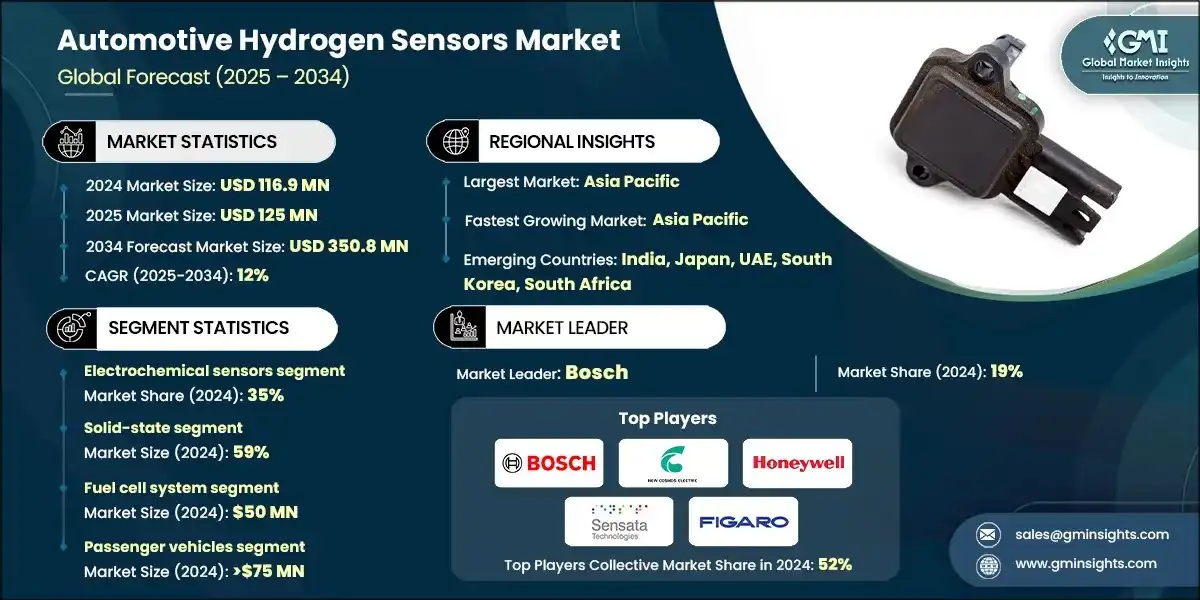
The global automotive hydrogen sensors market size was estimated at USD 116.9 million in 2024. The market is expected to grow from USD 125 million in 2025 to USD 350.8 million in 2034, at a CAGR of 12% according to latest report published by Global Market Insights Inc.
Automotive Hydrogen Sensors Market Key Takeaways
Market Size & Growth
- 2024 Market Size: USD 116.9 Million
- 2025 Market Size: USD 125 Million
- 2034 Forecast Market Size: USD 350.8 Million
- CAGR (2025–2034): 12%
Key Market Drivers
- Global push for green hydrogen and fuel cell electric vehicles.
- Expansion of hydrogen refueling infrastructure.
- Stringent safety standards and government mandates.
- Advancements in sensor technology.
Challenges
- High cost of advanced sensor technologies.
- Technical and performance challenges.
Opportunity
- Integration with IoT and predictive maintenance.
- Growth of hydrogen-powered commercial vehicles.
Key Players
- Market Leader: Bosch led with over 19% market share in 2024.
- Leading Players: Top 5 players in this market include Bosch, New Cosmos Electric, Honeywell, Sensata Technologies, Figaro Engineering, which collectively held a market share of 52% in 2024.
Get Market Insights & Growth Opportunities
The growth of the automotive hydrogen sensor market is rising rapidly primarily on account of the rapidly growing adoption of hydrogen fuel cell vehicles and safety regulations. Automotive hydrogen sensors are dedicated devices that detect hydrogen gas leaks, along with performance monitoring of fuel cell systems, and monitoring of safety for all types of vehicles. The market includes a wide variety of sensing technologies, including electrochemical sensors, metal oxide semiconductor sensors, catalytic combustion sensors, and thermal conductivity sensors, each providing specific advantages for specific automotive applications.
The rapid expansion of hydrogen refueling infrastructure will drive the demand for specialized automotive hydrogen sensors in hydrogen stations and in the hydrogen supply chain in general. Countries such as Germany, Japan, and South Korea are paving the way for increased hydrogen infrastructure development, coupled with government incentives to design and install thousands of new hydrogen stations by 2030.
Demand for hydrogen sensors is substantial in relation to the transition to zero-emission commercial vehicles: hydrogen powered fuel cell buses, trucks, and delivery vehicles. Major automotive OEMs are investing heavily into hydrogen powered commercial vehicle platforms, including Daimler, Volvo, and Hyundai, all launching fuel cell truck programs.
The COVID-19 pandemic initially disrupted the automotive hydrogen sensor market in 2020-2021 through severe supply chain bottlenecks, manufacturing shutdowns and a temporary pullback in investment from the automotive sector. This delayed vehicle construction and R&D team projects. The crisis also acted as a catalyst by speeding the government’s focus on green economic recovery and energy security, which has resulted in ongoing, and even increased, post-COVID stimulus packages for clean hydrogen and fuel cell technologies. After a brief delay, the market has rebounded quickly, with the long-term growth trajectory firmly intact, with the fundamental drives for decarbonization and hydrogen adoption strengthened in the wake of COVID-19.
The Asia-Pacific region is the unquestioned global leader and primary growth engine for the automotive hydrogen sensor market, fueled by aggressive national hydrogen strategies and distracted government support, such as in China, which has a hydrogen vehicle strategy that is underpinned by tax exemption policies and provincial strategies plans around deployment of 50,000 hydrogen fuel-cell vehicles by 2025, as part of China's overall carbon neutrality goal by 2060. This dominance is further flamed by leading fuel cell electric vehicle OEMs in Toyota and Hyundai leading the charge on commercial production of fuel cell vehicles, as well as massive government investments into a supporting network.
The Europe market is noted for a strict, regulatory-led approach to decarbonization, with the EU Green Deal and hydrogen strategy providing a robust roadmap for demand. This is driving considerable industrial activity, as evidenced by Vitesco Technologies being awarded a $25 million development program in April 2024 from a European automotive OEM to develop complete hydrogen sensor systems for commercial vehicles including the development of redundant sensor architectures and fail-safe operating modes. Growth is driven by massive German automotive manufacturing pivoting toward hydrogen for passenger cars, and especially commercial trucks and buses, to reach long-distance, zero-emission travel.
To get key market trends
Automotive Hydrogen Sensors Market Trends
The tightening operational requirements in the automotive sector around sensor durability and reliability is a key trend in the market. For instance, Hydrogen sensors must hold up in terms of reliability for 150,000+ miles for passenger vehicles and 500,000+ miles for commercial vehicles for their accuracy and response time specifications. This operational requirement is causing manufacturers to continue to innovate around material science to develop coating and self-diagnostics.
The ability to deploy a wireless hydrogen sensor network is another milestone in hydrogen vehicle fleet management. This trend is exemplified by the event in April 2024, Vitesco Technologies received a $25 million contract from a European automotive OEM to develop next-generation electrochemical hydrogen sensor systems for commercial vehicles. This can help operators detect leaks, improve or optimize fuel use, and improve operational safety. This is a priority for fleets around hydrogen mobility globally.
This trend highlights the broader trend of hydrogen technologies converging with IoT and predictive analytics. In terms of centralized data analysis, this will allow fleets to shift from reactive to predictive maintenance models and therefore minimize the impact of downtime and increase reliability of systems. As hydrogen fleets of vehicles continue to grow globally, especially in logistics and public transport, wireless, data-driven sensor networks have the potential to be a routine instrument in the hydrogen safety architecture that is contributing to sustainable, smart, safe, Lower-Cost operations that propel the adoption of hydrogen vehicle fleets.
The hydrogen sensor market for automotive applications is seeing a strong trend toward manufacturing cost reductions and the scalability of manufacturing processes relative to the mass-adoption of hydrogen vehicles. The existing sensor cost range of $50-200 needs to greatly reduce to a sensor cost range of $20-50 to support mass vehicle adoption. This sensor cost reduction trend is creating opportunities to innovate in manufacturing processes, material selections and design optimization.
Automation in processes such as pick-and-place assembly, automated testing and statistical process control are being used to improve quality consistency and reduce the labor and fixed costs associated with production. Standardization of interface to the sensor, mounting configurations, and communications protocols will contribute toward economies of scale and reduced customization costs. A trend towards platform sensor design will allow manufacturers to support multiple vehicle applications while keeping the sensor architecture common; allowing for lower costs associated with volume production.
Automotive Hydrogen Sensors Market Analysis
Learn more about the key segments shaping this market
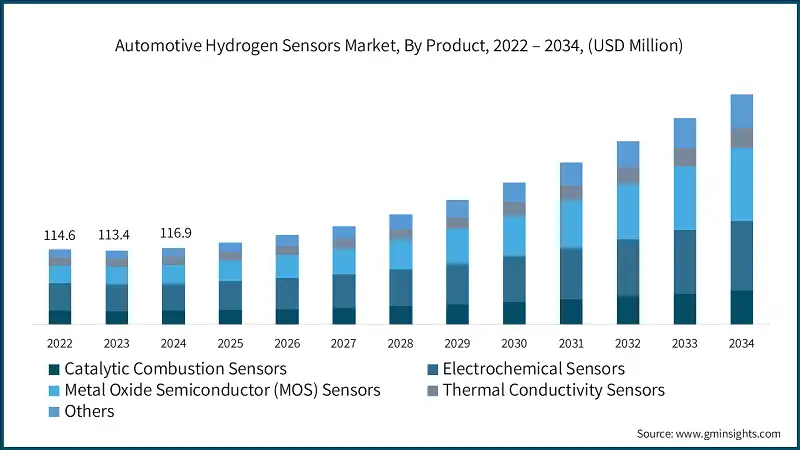
Based on product, the automotive hydrogen sensors market is divided into catalytic combustion sensors, electrochemical sensors, metal oxide semiconductor (MOS) sensors, thermal conductivity sensors, and others. Electrochemical sensors segment dominated the market accounting by around 35% in 2024 and is expected to grow at a CAGR of 10.2% from 2025 to 2034.
- Electrochemical sensors continue to dominate in the hydrogen sensor market, due to their levels of accuracy and selectivity, and response time characteristics, which are critical for safety sensitive automotive applications. Electrochemical sensors rely upon platinum electrodes in electrolytes that generate electrical signals that are proportional to hydrogen concentration. Electrochemical sensors may provide lower limit detection down to 1 ppm with response times of 10 seconds.
- In March 2024, Custom Sensors Solutions completed field trials for its wireless hydrogen sensor network based on its next generation of electrochemical sensing technology for monitoring fleets of vehicles. These electrochemical sensors provide high sensitivity and selectivity to accurately gauge hydrogen concentrations in real-time throughout an entire fleet of vehicles. The application of this technology as a wireless network permits fleet operators to monitor hydrogen levels continuously, aiding in greater accuracy with leak detection and improved safety for the fleet.
- Metal Oxide Semiconductor (MOS) sensors contribute 24% of the market share and exhibit the highest growth with a 15% CAGR, following the cost and durability advantages of MOS sensors. MOS sensors are made of heated metal oxide films that exhibit a change in electrical resistance when hydrogen gas is present. MOS sensors perform consistently in real-time, have longer lives and temperatures ranging from -20 to 70 C.
Learn more about the key segments shaping this market
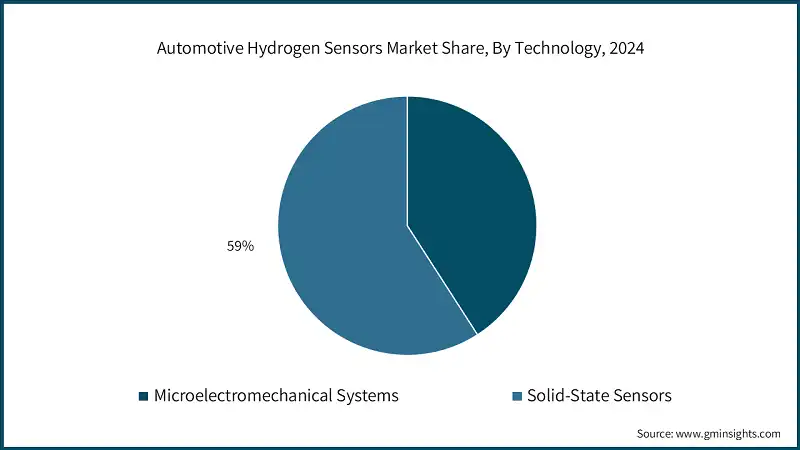
Based on Technology, the automotive hydrogen sensor market is categorized into microelectromechanical systems and solid-state. Solid-state segments dominate the market with 59% share in 2024, and the segment is expected to grow at a CAGR of 14% between 2025 and 2034.
- Solid-state sensors lead the technology segment with 59% of the market shares and 14% in strong CAGR growth indicative of automotive preferences for robust, maintenance-free sensing. Solid-state technology typically consists of MEMS-based sensors (Micro electrical-mechanical systems), thin film devices, and semiconductor detection systems with excellent durability and integration. Solid-state sensors utilize silicon micromachining techniques to produce miniaturized sensing elements with integrated signal processing and communication capabilities, often used for automotive.
- In February 2024, NGK Spark Plug's investment in producing hydrogen sensors highlights a rising emphasis on solid-state technologies in the hydrogen sensor industry. By utilizing its core competency in ceramic materials, NGK is introducing innovative solid-state sensor substrates intended to achieve increased durability, stability, and accuracy under extremely demanding operational conditions. These sensors forgo liquid electrolytes, thereby increasing reliability, and the ability for long-lasting service while exposed to extreme hydrogen conditions found in automotive and industrial environments.
- Microelectromechanical Systems (MEMS) contribute 41% market share with 9% CAGR, providing a lower cost solution for higher volume automotive applications. MEMS sensors exploit existing semiconductor processes to construct highly innovative miniaturized sensors with repeatable performance characteristics at a lower cost. Technology also allows for the incorporation of multiple sensor technologies in a single package, reducing installation complexity and costs to the overall sensor system.
Based on application, the automotive hydrogen sensor market is divided into onboard vehicle detection, fuel cell system monitoring, hydrogen refueling stations, exhaust gas analysis, post-crash detection, and others. Fuel cell system monitoring dominates the market and was valued at USD 50 million in 2024.
- Fuel cell system monitoring has the largest application, indicating the critical nature of hydrogen sensors and their role in improving fuel cell performance and increasing safety. New generation fuel cell systems require multiple sensor points along the hydrogen supply path, including inlet pressure monitoring, stack temperature management, and exhaust gas analysis. Typically, a hydrogen fuel cell vehicle will have 5-8 Sensors associated just to the fuel cell system monitoring, driving material amounts for sensor production associated with fuel cell vehicle production.
- In May 2024, TE Connectivity announced a strategic partnership with a leading fuel cell manufacturer to co-develop optimized sensor solutions for next-generation fuel cell stacks. The collaboration targets miniaturized sensors designed with superior chemical resistance and extended operational lifetimes, addressing the critical need for precision and reliability in hydrogen fuel cell monitoring.
- Onboard vehicle detection represents 25% market share with 10% CAGR, encompassing cabin air quality monitoring, garage detection systems, and general hydrogen leak detection throughout the vehicle. These applications require sensors with high sensitivity and fast response times to ensure passenger safety and prevent hydrogen accumulation in enclosed spaces.
- Regulatory requirements for hydrogen vehicle safety are driving increased adoption of comprehensive onboard detection systems, with some jurisdictions mandating multiple sensor locations throughout the vehicle structure.
Based on vehicles, the automotive hydrogen sensor market is divided into passenger and commercial vehicles. Passenger vehicles dominate the market and were valued at over USD 75 million in 2024.
- Passenger vehicle manufacturers are integrating hydrogen powertrains with smart sensing and monitoring systems to address contemporary safety and comfort expectations. Hydrogen fuel cell electric vehicles (FCEVs) offer much more than environmental benefits, as the new generation emphasizes an innovative smart sensor-based functionality, such as monitoring in the cabin, predictive maintenance, and real-time alerts to promote safety.
- In April 2025, Hyundai Motor introduced an all-new NEXO fuel cell electric vehicle (FCEV), highlighting how hydrogen powered passenger vehicles are evolving from zero emissions performance to include feature cutting-edge sensor technologies and safety systems. For example, the vehicle deploys a Rear Occupant Alert System equipped with radar-based sensors to identify micro-movements of occupants, particularly in left in the back seat.
- The commercial vehicle segment is rapidly becoming a major area of growth for hydrogen-based sensor deployment due to the acceleration toward zero-emission heavy-duty transport. Fleet operators are turning to hydrogen-powered trucks, buses, and delivery vehicles as the standards for reduced emissions become more stringent and reduce reliance on diesel. In turn, a need for highly reliable hydrogen sensors follows, which detect leaks, monitor fuel cell performance, and ensure operational safety at ambient road and temperature conditions.
Looking for region specific data?
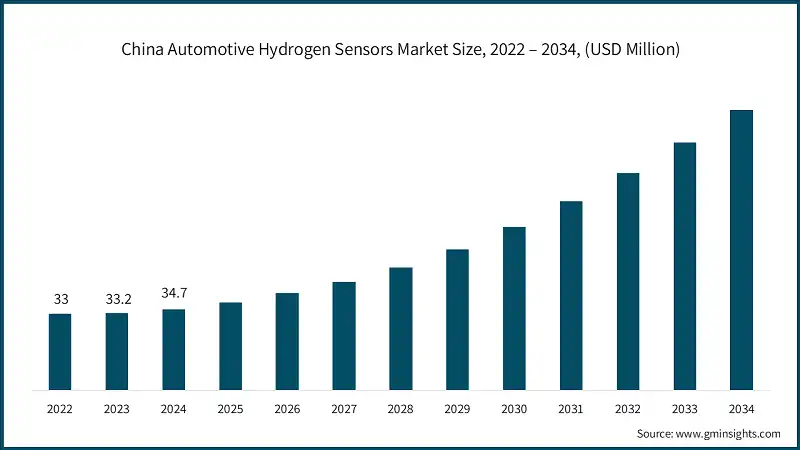
The China dominated Asia-Pacific automotive hydrogen sensors market with revenue of USD 34.7 million in 2024.
- Asia-Pacific dominates the market with 51.6% share in 2024 and the highest growth rate at 13% CAGR till 2034, driven by substantial government investments in hydrogen economy development and early commercial vehicle adoption. The growth within Asia-Pacific is developed by large government-funded investments in its hydrogen economy and proactive early vehicle commercialization.
- The growth in this region is led by China with a CAGR rate of 13.8%, largely supported by aggressive goals for hydrogen vehicle deployment and extensive development programs for readiness of infrastructure. In fact, the Chinese government plans to invest significantly in hydrogen technology and aims to have 1-billion fuel cell vehicles and 1,000 fuel cell refueling stations by 2030 while noting its own carbon neutrality by 2060.
- Japan has a strong position in hydrogen vehicles as well, with commercialization taking place early and is present on roadways. By April 2023, approximately 7,755 FCEVs were on the road and had approximately 181 hydrogen refueling stations (including stations under construction). In South Korea, the country’s Green New Deal, implemented within the country’s broader goal for hydrogen economy, calls for 200,000 hydrogen powered vehicle on roadways by 2025 and a KRW 13.1 trillion (USD 10 billion) investment by 2025, which will help support hydrogen vehicle supply and market readiness.
US automotive hydrogen sensors market will grow tremendously with CAGR of 10% between 2025 and 2034.
- North America comprises 15.2% of the market value with 10.4% CAGR. Growth is accelerating growth through feast investments in federal infrastructure programs and various state-level zero-emission vehicle mandates. The U.S. Infrastructure Investment and Jobs Act provide $8 billion in funding for hydrogen hubs which creates demand for hydrogen sensor systems across hydrogen vehicle production, distribution, and utilization market segments. California's Advanced Clean Cars II regulation mandates increasing percentages of zero-emission vehicle sales, driving hydrogen vehicle adoption and associated sensor demand.
- Canada is making great strides in establishing both the physical infrastructure and policy foundations for a hydrogen economy. As of May 2024, there are 13 operational low-carbon hydrogen production easy-to-source plants capable of producing more than 3000 metric tons per year. The industry also indicates that more than 80 low-carbon hydrogen initiatives have been announced with investment interests well over CAD 100 billion - suggesting aggressive growth ambitions.
- The focus of Canada’s plans is clearly less about existing high volumes of hydrogen vehicles and more emphasis on building the production, distribution and export infrastructure to be in-place for eventual vehicle uptake.
The automotive hydrogen sensors market in Germany will experience robust growth during 2025-2034.
- Europe represents 25% market share with 11% CAGR, supported by stringent emission regulations and comprehensive hydrogen strategy implementation. The European Union's Fit for 55 package outlines substantial emission reductions which will lead to increased uptake of hydrogen vehicles in commercial transportation sectors. Germany continues to lead development in Europe with the largest hydrogen refueling network in the world and considerable hydrogen vehicle initiatives in the industrial sectors.
- UK has committed to delivering up to 10 GW of low-carbon hydrogen production capacity by 2030, with at least half from electrolytic hydrogen. This scale-up across production, infrastructure and end-use applications creates a very significant opportunity for sensor manufacturers, as hydrogen sensors will be required across the value chain in production plants, transport pipelines, storage facilities and end-user fuel-cell or hydrogen-burn systems.
The automotive hydrogen sensors market in Brazil will experience significant growth between 2025 & 2034.
- Latin America holds a 5% share of the market in 2024. In Brazil, The Programa Nacional do Hidrogênio (PNH2) establishes Brazil's strategy to become a major global producer and exporter of low-carbon hydrogen by creating a legal and policy framework, and by leveraging its large percentage of renewable electricity to produce it.
- Key aspects include aiming to be the world's most competitive hydrogen producer by 2030, developing a national market, providing incentives, and fostering international cooperation. This policy push, with multiple hubs planned (e.g., in Ceará, Piauí and Rio de Janeiro), creates a significant demand pathway for sensors—detection, monitoring and safety systems—across production, storage and transport of hydrogen.
- In Argentina, The National Strategy for the Development of the Hydrogen Economy published in 2023 targets production of at least 5 million tons per year of low-emissions hydrogen by 2050, of which ~4 million t will be for export and ~1 million t for domestic decarbonization. With export-oriented hydrogen hubs planned around ports and transport corridors, the ecosystem will require extensive sensor deployment
The automotive hydrogen sensors market in UAE is expected to experience robust growth between 2025 & 2034.
- In 2024, the MEA market generated a revenue of USD 3.5 million, with expectations to grow at a compound annual growth rate (CAGR) of 13% from 2025 to 2034. The UAE has established its “National Hydrogen Strategy 2050” to position the country as a pre-eminent global low-carbon hydrogen producer, targeting aggregate production of around 1.4 million tons per annum (mtpa) of low-emission hydrogen by 2031, breakdowns of around 1 mtpa green hydrogen and 0.4 mtpa blue hydrogen.
- Domestic demand is forecasted to be in order of +/- 2.7 mtpa by 2031, with export potential of another +/- 0.6 mtpa. This growth trajectory creates significant requirements for hydrogen-value-chain sensor-systems, which cover from production to transport/storage hubs to at use safety/monitoring due to the scale of production and complexity of the associated infrastructure.
- Saudi Arabia has a hydrogen strategy as part of its larger Vision 2030 diversification plan, targeting hydrogen production of approximately 2.9 mtpa by 2030, and towards 4 mtpa by 2035 reported by the Oxford Business Group. The NEOM Green Hydrogen Company flagship project in the NEOM zone, expects to produce up to 600 tonnes per day of green hydrogen (≈ 0.6 mtpa) by 2026, converting it ne into ~1.2 mtpa green ammonia for export.
- As Saudi Arabia develops large-scale production, export logistics and pipelines and end use/demand, with that there is a sensor market in demand: more hydrogen-leak detection, more real-time monitoring of safety systems, and more infrastructure integrity sensors.
Automotive Hydrogen Sensors Market Share
The top 7 companies in the market are Bosch, Continental, Figaro Engineering, Honeywell, Nissha FIS, Sensata Technologies, and New Cosmos Electric. These companies hold around 60% of the market share in 2024.
- Bosch develop integrated hydrogen sensor systems that are designed for vehicle-level integration. The company recognizes the tremendous opportunity in developing systems, as their approach goes beyond hydrogen sensing to solutions that involve sensor fusion algorithms, fail-safe architectures, and integration with vehicle safety systems.
- Continental has developed hydrogen sensor systems based on its extensive automotive electronics capabilities. Its PowerCell subsidiary brings considerable knowledge and expertise in the field of fuel cell technology to develop hydrogen sensing solutions adapted to fuel cell vehicle applications. The company has joint ventures with some of the largest automotive suppliers that provide access to global markets as well as partnership opportunities in engineering for our technology
- Figaro Engineering is an expert in developing gas sensors based on semiconductor technologies. The company has expertise with both metal oxide and electrochemical technologies in that area. Figaro's automotive-qualified sensor products provide customers with a low-cost, high-value solution for mass quantity applications without sacrificing the reliability or durability needed for automotive components.
- Honeywell draws capabilities from their experience in aerospace and industrial sensors for hydrogen applications in automotive, providing designers with solutions capable of operating in not just automotive environments, but in extreme environments, which translates into reliability in the automotive market. Honeywell generates $3B annually through its sensing and IoT division, giving the company a potential advantage in the automotive market.
- New Cosmos Electric specializes in gas detection technology and has strengths in Asia, utilizing its electrochemical sensor expertise and relationships with Japanese and Korean automotive manufacturers to achieve a strong foothold in Asia. New Cosmos Electric does not solely focus on detecting atmospheric gases but is also focused on automotive systems by developing specific sensors for hydrogen refueling systems and fuel cell vehicles.
- Sensata Technologies leverages integrated sensor solutions while applying a system-level approach to the detection of hydrogen as a fuel. Sensata's automotive electronics expertise and manufacturing capability allow it to produce cost-effective hydrogen detection for the mass market. Additionally, Sensata has strong market positioning due to its global manufacturing capabilities and established relationships in the automotive space.
Automotive Hydrogen Sensors Market Companies
Major players operating in the automotive hydrogen sensors industry include:
- Amphenol Sensors
- Bosch
- Continental
- Figaro Engineering
- Honeywell
- Infineon Technologies
- New Cosmos Electric
- Nissha FIS
- Sensata Technologies
- Sensirion
- The automotive hydrogen sensor market is characterized by a moderate level of concentration. Although the levels of concentration can be assessed in various ways, the top five firms in the industry are considered to account for about 52% of the market share in 2024.
- The level of concentration in the market reflects the industry dynamics of the specialized nature of hydrogen sensing technology/sensors, as well as barriers to entry associated with expertise with specialized materials, automotive qualification, and investment in R&D, which can be significant.
- Amphenol Sensors intends to take its expertise in both automotive connectors and automotive sensors into the integrated hydrogen sensing space. Given Amphenol's emphasis and focus on integrated solutions and cost savings, Amphenol may be well positioned for automotive OEMs interested in traditional automotive sensor forms for an integrated suite of sensor technologies.
- Infineon Technologies utilizes its expertise in semiconductors to develop hydrogen sensor technology that utilizes MEMS along with integrated circuit technologies. The company's annual automotive semiconductor business, more than $5 billion, provides significant funding to support the sensor technology. Moreover, through partnerships with automotive-tier 1 suppliers, Infineon gains valuable market access for hydrogen sensors and opportunities to integrate hydrogen sensor technology.
- TE Connectivity brings together their knowledge of automotive connectors and sensor technology to create integrated solutions for hydrogen vehicle applications. The company's extensive global automotive business and established relationships with original equipment manufacturers (OEM) provide an access channel to the market along with integration potential.
- Vitesco Technologies focuses on automotive powertrain technologies that include sensors for alternative fuels systems. The company's experience in automotive electronics and powertrain integration presents a strong position for hydrogen vehicle sensor use.
Automotive Hydrogen Sensors Market Report Attributes
| Key Takeaway | Details |
|---|---|
| Market Size & Growth | |
| Base Year | 2024 |
| Market Size in 2024 | USD 116.9 Million |
| Market Size in 2025 | USD 125 Million |
| Forecast Period 2025 - 2034 CAGR | 12% |
| Market Size in 2034 | USD 350.8 Million |
| Key Market Trends | |
| Drivers | Impact |
| Global push for green hydrogen and fuel cell electric vehicles | Governments worldwide are implementing stringent emission regulations, which driving massive investment in hydrogen as a clean energy carrier |
| Expansion of hydrogen refueling infrastructure | For FCEVs to be viable, a widespread network of hydrogen refueling stations (HRS) is essential |
| Stringent safety standards and government mandates | Hydrogen is highly flammable and requires rigorous safety protocols. Organizations like the UNECE and national safety boards are mandating the use of hydrogen sensors |
| Advancements in sensor technology | Continuous R&D is leading to the development of more robust, sensitive, and cost-effective sensors, particularly in Solid-State and MOS technologies. |
| Pitfalls & Challenges | Impact |
| High cost of advanced sensor technologies | The high cost increases the overall bill of materials for FCEVs, posing a challenge to achieving price parity |
| Technical and performance challenges | Sensors must operate reliably in harsh automotive environments (temperature extremes, vibration, humidity). |
| Opportunities: | Impact |
| Integration with IoT and predictive maintenance | The rise of connected vehicles allows hydrogen sensors to become smart nodes on a network. |
| Growth of hydrogen-powered commercial vehicles | Hydrogen is particularly well-suited for long-haul trucks, buses, and fleet vehicles where battery weight and charging times are prohibitive. |
| Market Leaders (2024) | |
| Market Leaders |
19% market share |
| Top Players |
Collective market share in 2024 is 52% |
| Competitive Edge |
|
| Regional Insights | |
| Largest Market | Asia Pacific |
| Fastest Growing Market | Asia Pacific |
| Emerging Country | India, Japan, UAE, South Korea, South Africa |
| Future Outlook |
|
What are the growth opportunities in this market?
Automotive Hydrogen Sensors Industry News
- In May 2025, Honeywell announced that it has developed a new Hydrogen Leak Detector (HLD) solution, used to detect extremely small hydrogen leaks in hydrogen fuel systems in real time. HLD uses advanced Thermal Conductivity Detection (TCD) technology and is designed to detect very low levels of hydrogen extremely accurately, increasing safety in fuel-cell and hydrogen-storage applications.
- In March 2025, Metis Engineering launched a new family of CAN-based environmental sensors targeted at energy-storage and mobilization markets. The product line includes H Guard; a hydrogen detection sensor developed for real-time monitoring of leaks in electric or hydrogen-powered vehicles. The suite of sensors also includes Cell Guard for lithium-ion battery monitoring and Air Wise for air-quality monitoring, and they are intended to be modular sensors to enable a combination of products to be integrated into a vehicle control system for improved safety and system diagnostics.
- In September 2024, Toyota Motor Corporation and the BMW Group signed an agreement to expand existing cooperation in the hydrogen mobility sector with an emphasis on next-generation hydrogen fuel-cell systems and the development of associated infrastructure. The goal of the partnership is to accelerate the commercialization of hydrogen-powered vehicles by collaborating on engineering and design for research and development, optimizing manufacturing, and creating standard components. The partnership is expected to generate demand for automotive grade hydrogen sensors.
- In September 2023, Baker Hughes launched its new Druck hydrogen-rated pressure sensor line, developed to provide long-term stability and high durability under extreme operating conditions. The sensors are designed for use in hydrogen production, refueling, and storage systems, but also have strong applicability in fuel-cell electric vehicle (FCEV) platforms where robust and precise pressure monitoring is critical.
The automotive hydrogen sensors market research report includes in-depth coverage of the industry with estimates & forecasts in terms of revenue ($Mn) & Volume (Units) from 2021 to 2034, for the following segments:
Market By Product
- Catalytic combustion sensors
- Electrochemical sensors
- Metal Oxide Semiconductor (MOS) sensors
- Thermal conductivity sensors
- Others
Market By Technology
- Microelectromechanical Systems
- Solid-State Sensors
Market By Vehicle
- Passenger Vehicle
- Sedan
- Hatchback
- SUV
- Commercial Vehicle
- Light commercial vehicle
- Medium commercial vehicle
- Heavy commercial vehicle
Market By Application
- Onboard vehicle detection
- Fuel cell system monitoring
- Hydrogen refueling stations
- Exhaust gas analysis
- Post-crash detection
- Others
Market By End use
- OEM
- Aftermarket
The above information is provided for the following regions and countries:
- North America
- US
- Canada
- Europe
- UK
- Germany
- France
- Italy
- Spain
- Belgium
- Netherlands
- Sweden
- Russia
- Asia Pacific
- China
- India
- Japan
- Australia
- Singapore
- South Korea
- Vietnam
- Indonesia
- Latin America
- Brazil
- Mexico
- Argentina
- MEA
- South Africa
- Saudi Arabia
- UAE
Frequently Asked Question(FAQ) :
What is the market size of the automotive hydrogen sensors in 2024?
The market size was estimated at USD 116.9 million in 2024, with a CAGR of 12% expected through 2034. The growth is driven by the increasing adoption of hydrogen fuel cell vehicles and stringent safety regulations.
What is the projected value of the automotive hydrogen sensors market by 2034?
The market is poised to reach USD 350.8 million by 2034, fueled by advancements in sensing technologies, cost reductions, and the expansion of hydrogen vehicle fleets globally.
What is the expected size of the automotive hydrogen sensors industry in 2025?
The market size is projected to reach USD 125 million in 2025.
What was the market share of the electrochemical sensors segment in 2024?
The electrochemical sensors segment accounted for approximately 35% of the market in 2024 and is expected to witness over 10.2% CAGR till 2034.
What was the market share of the solid-state sensors segment in 2024?
The solid-state sensors segment dominated the market with a 59% share in 2024 and is projected to expand at a CAGR of 14% up to 2034.
What is the growth outlook for passenger vehicles in the market?
Passenger vehicles dominated the market, valued at over USD 75 million in 2024. Manufacturers are integrating hydrogen powertrains with advanced sensing systems to meet modern safety and comfort expectations.
Which region leads the automotive hydrogen sensors sector?
Asia-Pacific leads the market with a 51.6% share in 2024 and the highest growth rate of 13% CAGR through 2034. This growth is driven by significant government investments in hydrogen economy development.
What are the upcoming trends in the automotive hydrogen sensors market?
Trends include wireless sensor networks, IoT integration, predictive analytics, lower manufacturing costs, and advanced durable materials.
Who are the key players in the automotive hydrogen sensors industry?
Major players include Amphenol Sensors, Bosch, Continental, Figaro Engineering, Honeywell, Infineon Technologies, New Cosmos Electric, Nissha FIS, Sensata Technologies, and Sensirion.
Automotive Hydrogen Sensors Market Scope
Related Reports