Summary
Table of Content

Automotive Hydrogen Fuel Cell Stack Market
Get a free sample of this report
Form submitted successfully!
Error submitting form. Please try again.
Thank you!
Your inquiry has been received. Our team will reach out to you with the required details via email. To ensure that you don't miss their response, kindly remember to check your spam folder as well!
Request Sectional Data
Thank you!
Your inquiry has been received. Our team will reach out to you with the required details via email. To ensure that you don't miss their response, kindly remember to check your spam folder as well!
Form submitted successfully!
Error submitting form. Please try again.
Automotive Hydrogen Fuel Cell Stack Market Size
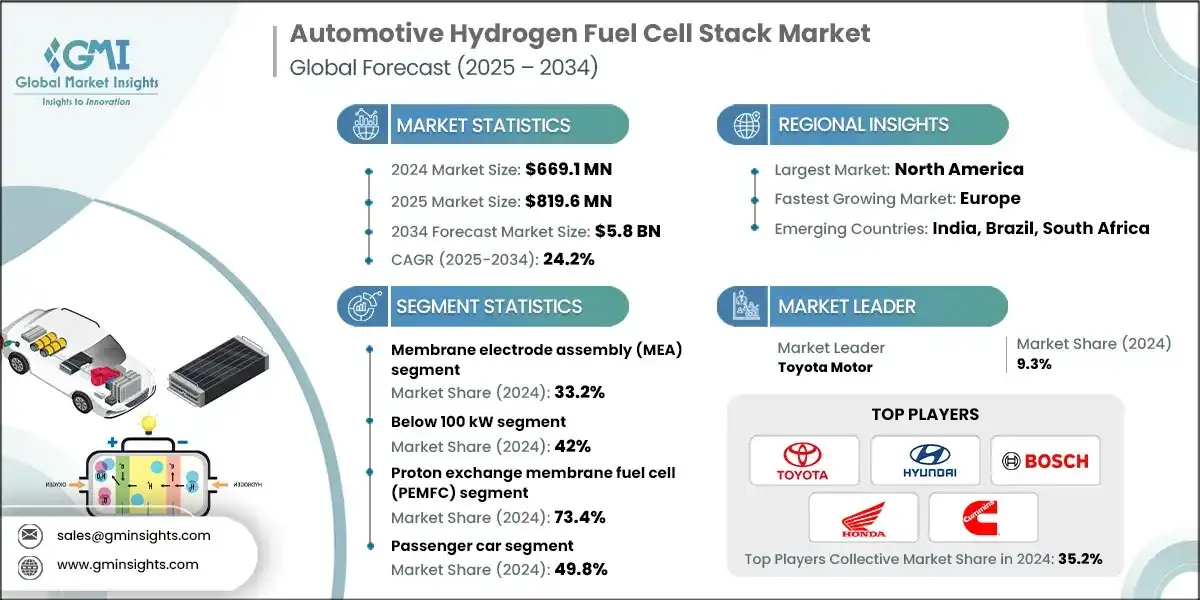
The global automotive hydrogen fuel cell stack market was estimated at USD 669.1 million in 2024. The market is expected to grow from USD 819.6 million in 2025 to USD 5.8 billion in 2034, at a CAGR of 24.2% according to the latest report published by Global Market Insights Inc.
Automotive Hydrogen Fuel Cell Stack Market Key Takeaways
Market Size & Growth
- 2024 Market Size: USD 669.1 Million
- 2025 Market Size: USD 819.6 Million
- 2034 Forecast Market Size: USD 5.8 Billion
- CAGR (2025–2034): 24.2%
Regional Dominance
- Largest Market: North America
- Fastest Growing Region: Europe
Key Market Drivers
- Government Incentives and Policies.
- Environmental Concerns.
- Technological Advancements.
- Energy Security and Diversification.
Challenges
- High Production Costs.
- Limited Refueling Infrastructure.
- Hydrogen Production Challenges.
- Consumer Awareness and Perception.
Opportunity
- Advancements in Fuel Cell Technology.
- Integration with Renewable Energy Sources.
- Expansion into Heavy-Duty Transport.
- Global Policy Support.
Key Players
- Market Leader: Toyota Motor led with over 9.3% market share in 2024.
- Leading Players: Top 5 players in this market include Toyota Motor, Hyundai Motor, Robert Bosch, Honda Motor, Cummins, which collectively held a market share of 35.2% in 2024.
Get Market Insights & Growth Opportunities
Growing awareness of climate change and air pollution is increasing the demand for zero-emission vehicles. Hydrogen fuel cell vehicles emit only water vapor as a byproduct of propulsion, making it a suitable alternative to traditional combustion engine vehicles, and is in line with efforts around the globe to reduce carbon footprints and improve air quality.
Continuous research and development are improving the efficiency, durability, and cost of fuel cells. Progress in materials science and engineering is yielding improved performance of hydrogen fuel cells, aiding in both adoption and applications across the economy, especially in comparison to battery electric vehicles.
Hydrogen can be produced using various domestic resources, which will reduce reliance on imported oil. This diversification improves energy security and leads to an improved transition to a more resilient energy system that can provide transportation and other needs with a stable and sustainable energy source.
Honda introduced the 2025 CR-V e:FCEV in February 2024, establishing the production plug-in hydrogen fuel cell electric vehicle in the United States. The CR-V e:FCEV has an electric motor that produces 174-horsepower and is powered by a 17.7 kWh battery that allows for 29 miles of electric range, in addition to a hydrogen fuel cell offering another 241 miles. The hydrogen tanks can be replenished in approximately 3-5 minutes, and the battery can be charged in about 2.5 hours using a Level 2 charger. The CR-V e:FCEV is available exclusively in California through a lease program with only 300 units produced per year.
Governments across the world are implementing policies such as subsidies, tax benefits, and grants, to encourage the development and adoption of hydrogen fuel cell vehicles. These policies are focused on lowering greenhouse gas emissions, reducing reliance on fossil fuels, and accelerating the transition to environmentally sustainable transportation systems.
The government of the U.S. is actively backing hydrogen fuel cell development via policy and investment. The Department of Energy awarded Plug Power a $1.66 billion loan guarantee to develop green hydrogen plants. This strategy is intended to increase clean hydrogen production, build infrastructure, and accelerate adoption of fuel cell vehicles (FCVs) in North America.
To get key market trends
Automotive Hydrogen Fuel Cell Stack Market Trends
Countries are increasingly producing hydrogen from renewable sources, like wind and solar. Green hydrogen can help support zero-emission vehicles and lessen the environmental footprint. This has led to advances in partnerships between governments and industry to increase production, allowing hydrogen fuel cell vehicles to be a viable sustainable vehicle option on a global scale when compared to traditional fossil-fuel vehicles.
Hydrogen fuel cells are being deployed for buses, trucks, and commercial vehicles because of their long-range and quick refueling capabilities. While heavy-duty applications highlight hydrogen’s advantage over batteries, it also generates more significant momentum for broader commercial applications for urban and intercity transport fleets worldwide.
The automotive industry, power generation, and academic institutions are collaborating on R&D efforts to develop fuel cell technology and accelerate its implementation. Their combined R&D approaches help to further improve the efficiency, durability, and energy storage of fuel cells, supporting hydrogen vehicles on the path to commercialization. The industry players leverage each other’s expertise and often share costs, as they have a collective interest in overcoming performance-related challenges.
In the U.S., hydrogen refueling infrastructure is advancing in select states, including California, Texas, and New York. Investment into infrastructure encourages broader acceptance of hydrogen vehicles, ensuring available hydrogen refueling on both urban roads and long-distance transport, while it reduces range anxiety.
European governments are implementing their hydrogen frameworks and advocating for its use through stringent emission requirements and mandated renewable energy procurement. For example, the RePowerEU strategy emphasizes hydrogen mobility solution adoption, while instilling the hydrogen ecosystem with refueling stations, incentives for vehicles purchases, and other research propel clean transport faster to implementation.
Countries in the Asia Pacific region are investing in advanced hydrogen fuel cell technology, such as lightweight stacks, compact systems, and improved storage. Innovations will enhance the performance, safety, and energy efficiency of hydrogen, which will support the region's ability to meet rising transport energy needs sustainably.
In August 2024, the global network of hydrogen refueling stations crossed the 1,000 milestone, with China leading the way with 390 stations, followed by South Korea (290), Europe (248), and Japan (160), as reported by H2stations.org. This station infrastructure expansion is being developed to support fuel-cell vehicle deployment around the globe.
Automotive Hydrogen Fuel Cell Stack Market Analysis
Learn more about the key segments shaping this market
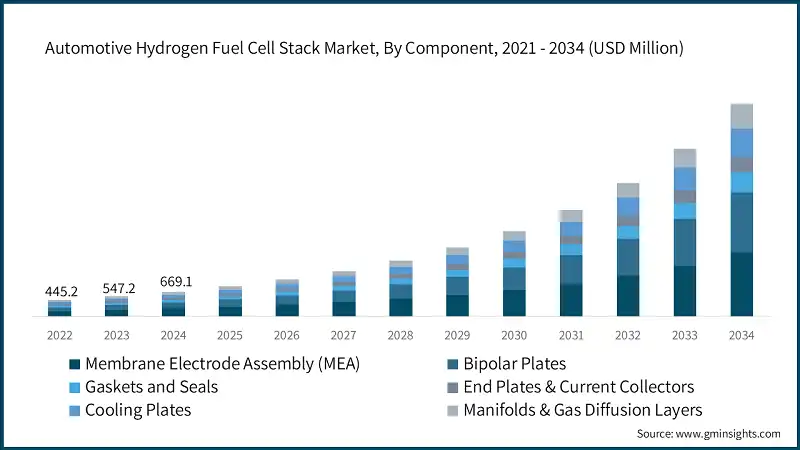
Based on component, the market is segmented as membrane electrode assembly (MEA), bipolar plates, gaskets and seals, end plates & current collectors, cooling plates and manifolds & gas diffusion layers. The membrane electrode assembly (MEA) represents the largest segment with 33.2% market share with USD 222.1 million in 2024.
- MEAs serve as the electrochemical heart of fuel cell stacks, where hydrogen and oxygen react to produce electricity. The 23% CAGR for MEA components reflects steady technological improvements in catalyst efficiency and membrane durability.
- Innovation in MEA technology improves efficiencies and durability of fuel cells while reducing the amount of platinum use. Increases in both membrane materials and catalyst layers provide the means for better efficiencies, lower cost, and longer longevity, allowing broader integration of hydrogen fuel cells in passenger vehicles and commercial fleets across the globe.
- Innovation in lightweight, corrosion resistant bipolar plates is ramping up. Use of engineered and new materials and manufacturing processes are being used for increasing conductivity and duration, while also decreasing weight and allowing for the mass production of fuel cell stacks, moving the system to improved efficiencies but also integration in automotive and heavy-duty applications.
- High performance gaskets and seals are being developed to suit the operating temperature and pressures within hydrogen fuel cell systems. Development of new polymer and composite materials, as well as their synthesis into improved seals to withstand these conditions, can enhance the durability of the systems, decrease potential leaks, and ultimately improve confidence in hydrogen fuel cell vehicles ultimately leading to improved adoption within urban and heavy-duty applications.
- In July 2024, Honda motor co. revealed new fuel cell technology with 60 percent efficiency of the system and improved cold-start in an automobile setup. The improvements in technology aim to improve customer experience while expanding market adoption.
Learn more about the key segments shaping this market
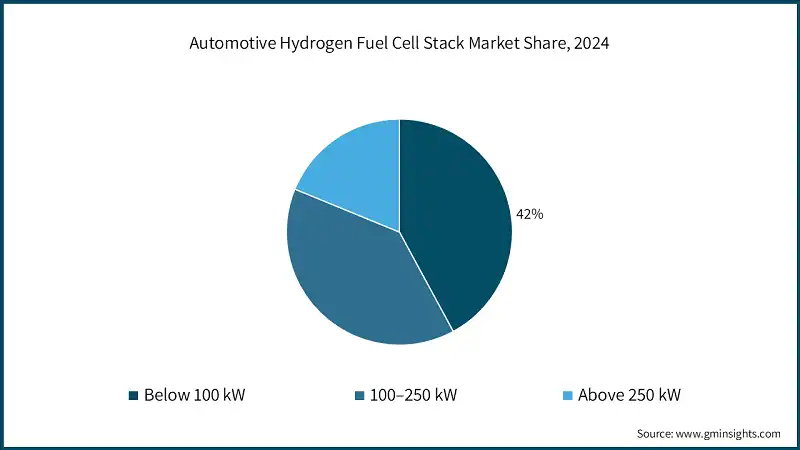
Based on power output, the automotive hydrogen fuel cell stack market is fragmented into Below 100 kW, 100-250 kW, above 250 kW. The Below 100 kW segment dominates the market with 42% market share, primarily serving passenger car applications where power requirements typically range from 60-90 kW.
- Fuel cells below 100 kW are increasingly utilized in passenger and light-duty commercial fleets, where size, fast startup, and cost efficiency are all important. These systems are being designed for urban mobility applications such as hydrogen sedans, work vans, and ride-sharing fleets.
- The 100-250 kW power segment is notably expanding for medium-duty trucks and public transport buses. Manufacturers produce modular hydrogen systems, which provide range, fast refueling, and emissions reduction as they transition from light-duty vehicles to heavy-duty transport fleets.
- Fuel cells above 250 kW are now emerging as the power solution of choice for heavy-duty trucks, long-haul vehicles, and transport for industrial use. Fuel cells can provide high energy density, durability, and replace diesel engines in heavy-duty logistics and the construction industries as they transition to cleaner energy solutions.
- In June 2024, Ballard Power Systems declared a technology licensing deal with an Asian car maker associated with fuel cell stack production and system assembly. The deal will involve transfer of technology, production processes as well as collaborative development initiatives.
Based on fuel cell technology, the automotive hydrogen fuel cell stack market is classified into proton exchange membrane fuel cell (PEMFC), solid oxide fuel cell (SOFC), alkaline fuel cell (AFC), and molten carbonated fuel cell (MCFC). The proton exchange membrane fuel cell (PEMFC) held a market share of 73.4% in 2024 and is anticipated to grow at a CAGR of 24% from 2025 to 2034.
- PEMFCs deliver high power output relative to their size and weight, making them suitable for vehicle integration where space and weight are critical. This compactness enables better fuel efficiency and design flexibility for sedans, SUVs, and trucks.
- PEMFC technology is the standard in automotive applications due to its high energy density, low operating temperature, and fast start-up. Performance enhancements in catalyst and membrane lifespan are facilitating the use of PEM cells in passenger cars, buses, and light trucks in markets around the world.
- SOFCs are developing in auxiliary power units and heavy-duty electric hybrid systems because of their high efficiency and fuel flexibility. Automotive developers are evaluating SOFC utilization for range extension and off-grid power generation, contributing to the increasing sustainability of commercial vehicle fleets.
- Automobile manufacturers are assessing AFC use for niche mobility applications based on the cell’s high efficiency, low weight, and low-cost materials. Further investigation focuses on electrolyte stability and reducing degradation as criteria for small vehicle power sources and auxiliary transport power sources.
- In May 2024, the worldwide fuel cell electric vehicle fleet expanded to 90,000 that represented a 14% annual development pace with the quickest development rates by business automobiles per the Hydrogen Council. Together, the deployment illustrates increasing acceptance of the market with the corresponding station infrastructure increasing to support it.
Based on vehicle, the automotive hydrogen fuel cell stack market is fragmented into passenger car, commercial vehicle and specialized vehicles. Passenger car held a market share of 49.8% in 2024 and is anticipated to grow at a CAGR of 19.7% from 2025 to 2034.
- Hydrogen passenger vehicles are advancing with improved efficiency of the fuel stacks, increased ranges, and lower cost. As vehicle manufacturers introduce hydrogen fuel cells into sedans and SUVs, they can create a complementary vehicle to battery electric vehicles as an option for those traveling longer distances. Further, compared to charging a battery electric vehicle, hydrogen fuel cell vehicles will enable faster refueling with zero tailpipe emissions.
- Hydrogen fuel cell-powered hatchbacks, sedans, and SUVs further expand the choices of original equipment manufacturers. Hatchbacks are cost-efficient, sedans are focused on efficiency, and SUVs provide power and range, all promoting consumer acceptance of hydrogen fuel cell technology across the segments of automobiles.
- Hydrogen fuel cell technology is changing the commercial vehicle landscape with longer driving ranges and fast refueling for logistics, delivery, and transit. Fleet electrification is advancing quickly, as OEMs are focusing on heavy-duty truck and bus alternatives available with zero tailpipe emissions.
- In April 2024, PowerCell Sweden was awarded a significant supply contract for fuel cell systems for use in European commercial vehicle applications. In addition to system development and manufacturing, the contract involves long-term supply commitments facilitating additional market expansion.
Looking for region specific data?
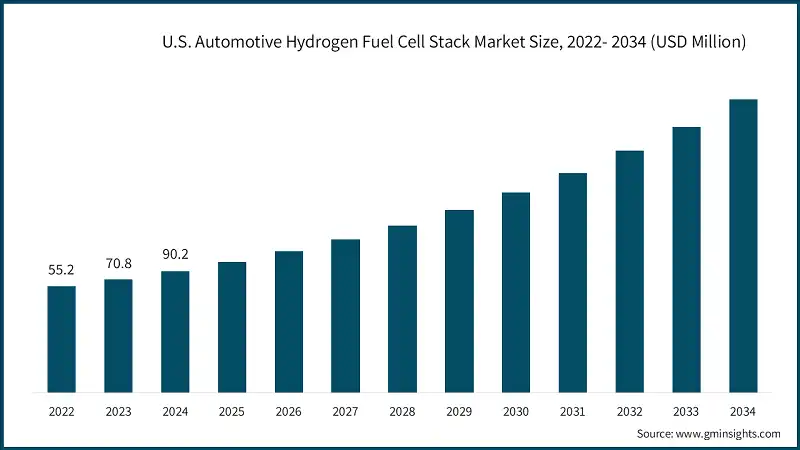
The U.S. automotive hydrogen fuel cell stack market holds a share of 86.4% in 2024 and experience significant and promising growth from 2025 to 2034.
- The hydrogen and fuel cell technologies office within the U.S. Department of Energy is funding the development of next-generation automotive fuel cell stacks focusing on increased power density, reduced platinum usage, and durability to support domestic manufacturing and integration into medium- and heavy-duty hydrogen auto-mobiles.
- OEMs like General Motors, Nikola, and Cummins, are developing large scale stack production for hydrogen-powered trucks and buses. These modular stacks provide between 150-300 kW power outputs helping to accelerate the adoption of zero-emission freight vehicle into U.S. logistics corridors.
- Efforts in the U.S. include encouraging on-shore production of Membrane Electrode Assemblies (MEAs), Bipolar Plates, and stack balance-of-plant components to signifiecantly reduce the reliance on oceane-brokered importation and to provide a scalable manufacturing capacity for automotive hydrogen fuel cell systems.
North America automotive hydrogen fuel cell stack market was valued at USD 104.4 million in 2024 and is estimated to grow at a CAGR of 28.1% from 2025 to 2034. The market in the region is driven by strong policy support and infrastructure development.
- The United States, Canada, and Mexico are harmonizing hydrogen vehicle specifications to develop interoperable fuel cell stack technologies and unlike supply chain supply. Original Engine Manufacturers (OEMs) are jointly working to create a unified stack platform that can be used for trucks and passenger vehicles in the North American market.
- With the introduction of hydrogen-powered public transit fleets and hydrogen logistics vehicles, demand for fuel cell stacks is increasing. Fuel cell stack manufacturers, including Ballard and Loop Energy, are expanding production facilities to accommodate the growing orders from regional bus and truck fleets.
- Various public-private initiatives, including Hydrogen Hubs, are also working to expand research, development and commercialization (R&D) in vehicle stack materials, testing and field verification. This work will continue to build early commercial pathways for durable and affordable North American stack technologies.
The automotive hydrogen fuel cell stack market in Europe is expected to grow at a CAGR of 24.8% to USD 1.16 billion by 2034, driven by stringent emissions regulations, comprehensive charging infrastructure, and strong consumer environmental consciousness.
- The Clean Hydrogen Partnership of the European Union invests in multinational R&D programs associated with lightweight and high-efficiency automotive stacks. The objective of these programs is to develop stack costs to less than €100/kW by 2030 using advanced materials design, digital testing, and coordinated manufacturing networks among large automakers within Europe.
- European manufacturers are employing recycling solutions for fuel cell stacks, recovering precious metals such as platinum and palladium. This and other sustainable practices such as decreasing emissions, increases circular sustainability goals of the fuel cell stack automotive hydrogen sector, and leads to the utilization of hydrogen stacks by the automotive sector to develop their respective contribution to the EU’s carbon neutral transport and green manufacturing goals.
- Europe continues to create a regional supply chain for fuel cell stack components, bringing together raw material producers, stack assemblers, and OEMs, creating a resiliency of localized production capacity, lowering transportation costs, and enacting a rapid deployment of hydrogen powered vehicles across several European nations.
The Germany automotive hydrogen fuel cell stack market holds 25.5% market share in 2024 and experience significant and promising growth from 2025 to 2034.
- Germany is very actively expanding domestic stack manufacturing through Bosch, Daimler Truck, and Cellcentric. These facilities will manufacture cutting-edge automotive fuel cell stacks for trucks and buses, supporting Europe’s decarbonization goals while reducing dependence on Asian suppliers, leading to domestic hydrogen components manufacturing vertically integrated vertically into fuel stack manufacturing.
- German research institutes are developing fuel cell stacks with improved membrane mechanical properties, water management, and catalyst durability (e.g. ZSW, Fraunhofer). Desired stack performance will meet lifetime performance targets of 25,000 hours and provide reliable performance for commercial hydrogen vehicles operating under demanding European transport operational conditions.
- German OEMs are utilizing new fuel stacks in prototype and early-series hydrogen vehicles. Each program will help validate stack performance with regards to efficiency, cold-start performance, and in-use emissions performance, while also accelerating overall hydrogen vehicle performance in readiness for large-scale production of hydrogen-powered passenger vehicles and hydrogen-powered HGVs throughout Germany’s automotive industry.
The automotive hydrogen fuel cell stack market in Asia Pacific held 56.3% share in 2024, growing at 22.8% CAGR to reach USD 2.9 billion by 2034.
- Countries in Asia Pacific, such as Japan, South Korea, and India, are expanding production of fuel cell stacks for use in vehicles. Meanwhile, governments are advocating for local manufacturing clusters and supporting OEMs (original equipment manufacturers) such as Toyota, Hyundai, and Tata Motors to facilitate supply in relation to growing demand for hydrogen passenger cars and commercial vehicles.
- Cross-border partnerships are also developing with Asian Pacific nations establishing joint venture arrangements in areas focused on membrane electrode assemblies and bipolar plates as part of a drive to lower production costs, localize supply considerations, and expedite the commercialization of automotive fuel cell stacks onto various vehicle platform applications throughout regional markets.
- Asia Pacific countries are developing demonstration fleets of buses, trucks and cars with next-generation fuel cell stacks, to test stack durability and re-fueling interoperability, and for evaluation of performance in tropical and urban settings, which can assist in improving regulatory alignment toward broader hydrogen mobility integration across the region.
The automotive hydrogen fuel cell stack market in China is estimated to hold market revenue of USD 166.9 million in 2024 and is expected to experience significant and promising growth from 2025 to 2034.
- China is quickly ramping up in-country manufacturing of automotive hydrogen fuel cell stacks, led by firms such as SinoHytec, Weichai Power and REFIRE, to meet the growing demand for hydrogen-powered buses, logistics vehicles and heavy-duty trucks throughout key provinces.
- The Chinese government’s roadmap for hydrogen development makes stack research and development a first priority for improved efficiency and reduced use of platinum. With state subsidies, many automakers and research database partners are developing a next generation of automotive fuel cell stacks designed to achieve long lifetimes and cost parity with battery electric powertrains by the early 2030s.
- Chinese OEMs such as SAIC, Great Wall Motors and FAW are integrating the new, domestically produced, fuel cell stacks into passenger vehicles and commercial fleets. Recently initiated pilot projects in Beijing and Shanghai have demonstrated that the stacks are performing in real-world applications of vehicles, and these pilot projects promote large scale deployment of hydrogen vehicles as an urban transport infrastructure within China.
The Latin American automotive hydrogen fuel cell stack market is projected to grow at a CAGR of 25.6% to USD 225.7 million by 2034. The market in the region is driven by regulatory incentives, growing green-hydrogen production, and regional manufacturing partnerships.
- Countries such as Brazil, Chile, and Colombia are utilizing hydrogen buses fitted with imported automotive fuel cell stacks from international suppliers such as Ballard and Toyota as part of pilot projects to test stack performance, efficacy, and compatibility with operating conditions typical of tropical ecosystems, thus supporting a transition towards sustainable solutions for urban mobility.
- Latin American firms are collaborating with international OEMs to develop localized production of automotive fuel cell stacks. Projects emphasize capacity building, sourcing from the region, and maintenance, in order to bolster local hydrogen technology ecosystems and provide lower reliance on stacked systems manufactured overseas.
- Demonstration programs in Chile and Argentina implement locally manufactured green hydrogen and imported automotive fuel cell stacks. These initiatives test hydrogen fuel cell stack and green hydrogen operational activity, compatibility, and stability against real transport applications, demonstrating the feasibility of a geographic region transitioning to a hydrogen-based mobility technology and becoming a sustainable hub for hydrogen technologies.
The MEA automotive hydrogen fuel cell stack market is projected to grow at a CAGR of 21.5% to USD 240.7 million by 2034. UAE leads regional market with 26.4% share of MEA value, driven by strong government initiatives under the Hydrogen Leadership Roadmap. Investments in stack assembly, vehicle trials, and infrastructure partnerships with Toyota and Al-Futtaim Motors are positioning the UAE as a regional hydrogen mobility hub.
- Testing of automotive fuel cell stacks for their thermal loads have begun in Saudi Arabia and the UAE in the desert conditions of the region. These tests tap into the thermal durability and cooling efficiency of hydrogen trucks and look at the long-term viability of the performance of innovative truck technology in extreme climates.
- Collaborative arrangements between energy companies in the Gulf and original equipment manufacturers are fostering local assembly of automotive fuel cell stacks. This has an impact to strengthen industry capacity, create blue-collar employment, and achieve national goals for economic diversification through hydrogen transportation initiatives.
- In South Africa and Namibia, hydrogen fuel cell stacks are being tested in diesel hybrid batteries for heavy duty off-road mining and haul trucks. These implementations show strong potential to zero-emission industrial transport and provide reasonable assurance of stack stability and scalability for off-road original equipment manufacturing in abusive operations.
Automotive Hydrogen Fuel Cell Stack Market Share
- The top 7 companies in the automotive hydrogen fuel cell stack industry are Toyota Motor, Hyundai Motor, Robert Bosch, Honda Motor, Cummins, Weichai Power, Symbio contributing around 39.5% of the market in 2024.
- Toyota stands as the global leader in hydrogen fuel cell stack development, fueled by a track record of more than 30 years of research and innovation. Furthermore, with its vertically integrated business model, from stack design and vehicle integration, to manufacturing, it maintains full cost control while delivering the highest stack performance. The Mirai's platform, combined with second-generation fuel cell modules, provides longer durability, improved efficiency, and supports hydrogen fuel cell applications in passenger vehicles, commercial vehicles, as well as stationary applications around the world.
- Hyundai retains strong global market share and distribution power with its new Hydrogen fuel cell stacks used in NEXO vehicles and other commercial vehicles, including a dedicated manufacturing facility. Using its expertise and multi-platform strategy, the company's ongoing partnerships support large-scale manufacturing. Hyundai’s priorities of cost reduction and stack durability continue to support broader deployments for both passenger and heavy-duty vehicles.
- Honda is also pursuing fuel cell advancement and has made first-mover advantages through ongoing R&D and strategic partnerships with global automakers. Honda offers a variety of high-performance fuel cell systems for both mobility and stationary applications. Through licensing ongoing development programs and joint-development programs, Honda continues to drive commercial diffusion with the expectation of encouraging a broader use of fuel cells as an emerging technology for sustainable hydrogen power options across the world.
- Robert Bosch is a major technology vendor for automotive fuel cell stacks based on its systems integration and manufacturing scale. The fuel cell stack solutions are designed to be cost-effective, scalable for manufacturing, and adaptable for OEMs. Partnerships across the fuel cell value chain position Bosch as a major enabler of hydrogen-powered mobility systems.
- Cummins focuses on fuel cell stack solutions for commercial vehicles based on its already established powertrain capabilities with heavy duty applications. Its hydrogen systems are designed to work with current drivetrains, improving vehicle range and performance. Partnerships and a service network help support fleet adoption, positioning Cummins as a leader in hydrogen transport for industrial and freight applications.
Automotive Hydrogen Fuel Cell Stack Market Companies
Major players operating in the automotive hydrogen fuel cell stack industry are:
- Ballard Power Systems
- Cummins
- EKPO Fuel Cell Technologies
- Honda Motor
- Hyundai Motor
- PowerCell Sweden
- Robert Bosch
- Symbio
- Toyota Motor
- Weichai Power
- Toyota's experience spans 30 years of research & development, vertical integration, and mass production in the fuel cell market. The Mirai platform and second-generation 60-80 kW stacks are intended to improve efficiency, durability, and cost for light-duty passenger cars, commercial vehicles, and marine applications. This is underpinned by hydrogen partnerships, infrastructure collaborations, and multiple technology license opportunities.
- Hyundai is enabling consumer adoption of fuel cell technology with the development of the NEXO passenger car and a commercial vehicle platform. Their dedicated fuel cell manufacturing facilities, partnerships with suppliers, and global manufacturing scale promote competitive stack production costs. The efforts include technological improvements, economies of scale, and optimized efficiencies for light-duty passenger cars, buses, trucks, and specialized commercial vehicles in North America, Europe, and Asia Pacific.
- Honda's focus is producing the highest efficiency and durable automotive fuel cell stacks for light-duty vehicles, specialty vehicles, and stationary power market applications. The decades of research and development have culminated several innovations, engineering solutions, and design practices. In recent years, the growth of partnerships has further emphasized hydrogen mobility, stationary fuel cells, energy development, and fuel cell technology applications.
- Bosch provides scalable and affordable automotive fuel cell stacks and components. Drawing on its system integration capabilities and worldwide manufacturing, Bosch supplies several OEMs (original equipment manufacturers). Bosch's approach combines its components portfolio, assembly capabilities, and its OEM partnership, therefore making it possible for stacks to be deployed broadly for use in passenger vehicles and commercial vehicles, in addition to pursuing the advancement of fuel cell technology around the globe.
- Cummins identifies itself as a fuel cell stack manufacturer for medium- and heavy-duty commercial vehicles using its expertise in heavy-duty powertrains. Existing connections with the current drivetrains, dedicated service networks, and partnerships with fleet partners all allow Cummins to pursue development in the marketplace. Cummins prioritizes durability, after-sales customer focus, in addition to expansion into global markets for zero-emission trucks and other industrial mobility applications.
- Ballard pursues automotive fuel cell stacks and systems, focusing on technology licensing, joint development, and strategic OEM partnerships. Ballard's expertise is in specialized R&D, in the manufacturing of the fuel stacks and systems, in addition to supporting the integration of fuel cell vehicles in the passenger and commercial mobility markets allowing collaboration to advance deployment of high-performance fuel cell technologies.
Automotive Hydrogen Fuel Cell Stack Market Report Attributes
| Key Takeaway | Details |
|---|---|
| Market Size & Growth | |
| Base Year | 2024 |
| Market Size in 2024 | USD 669.1 Million |
| Market Size in 2025 | USD 819.6 Million |
| Forecast Period 2025 – 2034 CAGR | 24.2% |
| Market Size in 2034 | USD 5.8 Billion |
| Key Market Trends | |
| Drivers | Impact |
| Government Incentives and Policies | Governments worldwide are implementing subsidies, tax incentives, and grants to promote hydrogen fuel cell vehicles. These policies accelerate adoption, reduce greenhouse gas emissions, and support the transition to sustainable transportation systems. |
| Environmental Concerns | Increasing awareness of climate change and air pollution drives demand for zero-emission vehicles. Hydrogen fuel cell vehicles produce only water vapor as a byproduct, making them an attractive alternative to traditional combustion engine vehicles. |
| Technological Advancements | Ongoing research and development lead to improvements in fuel cell efficiency, durability, and cost-effectiveness. Innovations in materials science and engineering enhance performance, making hydrogen fuel cell vehicles more competitive with battery electric vehicles. |
| Energy Security and Diversification | Hydrogen can be produced from various domestic resources, reducing dependence on imported oil. This diversification enhances energy security and supports the transition to a more resilient energy system, providing a stable and sustainable energy source for transportation. |
| Pitfalls & Challenges | Impact |
| High Production Costs | The manufacturing of hydrogen fuel cell systems involves expensive materials and complex processes, leading to high production costs. These costs can make hydrogen vehicles less affordable for consumers and limit widespread adoption. |
| Limited Refueling Infrastructure | The scarcity of hydrogen refueling stations, especially outside of specific regions, limits the practicality of hydrogen fuel cell vehicles for many consumers. This lack of infrastructure hampers widespread adoption and consumer confidence. |
| Hydrogen Production Challenges | Most hydrogen is currently produced from natural gas through a process that emits CO2. Developing cost-effective and scalable methods for producing green hydrogen is essential for the sustainability of hydrogen fuel cell vehicles |
| Consumer Awareness and Perception | Limited public knowledge about hydrogen fuel cell vehicles leads to misconceptions and hesitancy among potential consumers. Educational efforts are needed to increase awareness and acceptance, facilitating broader adoption. |
| Opportunities: | Impact |
| Advancements in Fuel Cell Technology | Innovations in materials science and engineering are leading to more efficient and durable fuel cells. These advancements can reduce costs and improve the performance of hydrogen fuel cell vehicles, enhancing their competitiveness in the market. |
| Integration with Renewable Energy Sources | Hydrogen can serve as a storage medium for excess renewable energy, facilitating the integration of variable renewable sources like wind and solar into the energy grid. This synergy supports a more sustainable energy system. |
| Expansion into Heavy-Duty Transport | Hydrogen fuel cell technology is well-suited for heavy-duty applications such as trucks, buses, and trains, where long range and quick refueling are essential. This market segment presents significant growth potential for hydrogen fuel cell vehicles. |
| Global Policy Support | International agreements and national policies are increasingly supporting the development and deployment of hydrogen technologies. This global policy momentum can accelerate the adoption of hydrogen fuel cell vehicles, driving growth in the sector. |
| Market Leaders (2024) | |
| Market Leaders |
9.3% Market Share |
| Top Players |
Collective Market Share in 2024 is 35.2% |
| Competitive Edge |
|
| Regional Insights | |
| Largest Market | North America |
| Fastest growing market | Europe |
| Emerging countries | India, Brazil, South Africa |
| Future outlook |
|
What are the growth opportunities in this market?
Automotive Hydrogen Fuel Cell Stack Industry News
- The Toyota Motor has announced to expand their fuel cell production capacity in Japan by 50 per cent in January 2025 to offer sustainable market solutions to the growing global demand of fuel cell system in the automotive and stationary markets. They have invested their capital in terms of capital expenditure to procure highly advanced material equipment, manufacturing queues and process efficiencies to eventually lower costs and to increase quality.
- In December 2024, The Hyundai Motor announced that they intend to establish a fuel cell production facility in the United States in their North American expansion strategy and establishment of a local supply chain. The fuel cell production plant will make fuel cell systems to passenger cars, commercial vehicles, and stationary power sets.
- In November 2024, The U.S. Department of Energy has launched funding of 52 projects totaling to 750 million dollars to streamline clean hydrogen production and fuel cell manufacturing capability in the U.S. According to the U.S. Department of Energy, the funding is targeted for developing technology, scale-up manufacturing capacity, and infrastructure deployment.
- In October 2024, Robert Bosch unveiled advanced fuel cell stack technology that has been improved for enhanced power density, reduced platinum loading, and extended durability for automotive applications. This is a new technology dedicated towards cost reduction and better performance to meet the mass market.
- Cummins also declared a strategic alliance with a major truck manufacturer in September 2024 to speed up the uptake of fuel cell systems in the heavy commercial trucks. They will involve their collaboration in joint development programs, and manufacturing and market deployment solutions.
The automotive hydrogen fuel cell stack market research report includes in-depth coverage of the industry with estimates & forecasts in terms of revenue ($Bn) and shipments (Units) from 2021 to 2034, for the following segments:
Market, By Component
- Membrane electrode assembly (MEA)
- Bipolar plates
- Gaskets and seals
- End plates & current collectors
- Cooling plates
- Manifolds & gas diffusion layers
Market, By Power output
- Below 100 kW
- 100-250 kW
- Above 250 kW
Market, By Fuel cell technology
- Proton exchange membrane fuel cell (PEMFC)
- Solid oxide fuel cell (SOFC)
- Alkaline fuel cell (AFC)
- Molten carbonate fuel cell (MCFC)
Market, By Vehicle
- Passenger Car
- Hatchback
- Sedan
- SUVs
- Commercial Vehicle
- LCV
- MCV
- HCV
- Specialized Vehicles
- Industrial vehicles
- Military vehicles
Market, By Sales channel
- OEM
- Aftermarket
The above information is provided for the following regions and countries:
- North America
- US
- Canada
- Europe
- Germany
- UK
- France
- Italy
- Spain
- Russia
- Nordics
- Netherlands
- Asia Pacific
- China
- India
- Japan
- Australia
- South Korea
- Southeast Asia
- Latin America
- Brazil
- Mexico
- Argentina
- MEA
- South Africa
- Saudi Arabia
- UAE
Frequently Asked Question(FAQ) :
What is the market size of the automotive hydrogen fuel cell stack in 2024?
The market size was USD 669.1 million in 2024, with a CAGR of 24.2% expected through 2034, driven by rising awareness of climate change and the demand for zero-emission vehicles.
What is the projected value of the automotive hydrogen fuel cell stack market by 2034?
The automotive hydrogen fuel cell stack market is expected to reach USD 5.8 billion by 2034, propelled by government incentives, technological advancements, and the expansion of hydrogen infrastructure.
What is the current automotive hydrogen fuel cell stack market size in 2025?
The market size is projected to reach USD 819.6 million in 2025.
How much revenue did the membrane electrode assembly (MEA) segment generate in 2024?
The membrane electrode assembly (MEA) segment generated USD 222.1 million in 2024, leading the market with a 33.2% share.
What was the valuation of the Below 100 kW power output segment in 2024?
The Below 100 kW power output segment held a 42% market share in 2024, primarily serving passenger car applications.
What is the growth outlook for the proton exchange membrane fuel cell (PEMFC) segment from 2025 to 2034?
The PEMFC segment is projected to grow at a 24% CAGR through 2034, led by its high energy density, compact size, and suitability for automotive applications.
Which region leads the automotive hydrogen fuel cell stack market?
North America led the market with USD 104.4 million in 2024, as strong policy support and infrastructure development.
What are the upcoming trends in the automotive hydrogen fuel cell stack market?
Key trends include advancements in fuel cell technology, integration with renewable energy sources, expansion into heavy-duty transport, and global policy support for hydrogen adoption.
Who are the key players in the automotive hydrogen fuel cell stack market?
Key players include Toyota Motor, Hyundai Motor, Robert Bosch, Honda Motor, Cummins, Ballard Power Systems, EKPO Fuel Cell Technologies, PowerCell Sweden, Symbio, and Weichai Power.
Automotive Hydrogen Fuel Cell Stack Market Scope
Related Reports