Summary
Table of Content

Automotive Driver Monitoring System Market
Get a free sample of this report
Form submitted successfully!
Error submitting form. Please try again.
Thank you!
Your inquiry has been received. Our team will reach out to you with the required details via email. To ensure that you don't miss their response, kindly remember to check your spam folder as well!
Request Sectional Data
Thank you!
Your inquiry has been received. Our team will reach out to you with the required details via email. To ensure that you don't miss their response, kindly remember to check your spam folder as well!
Form submitted successfully!
Error submitting form. Please try again.
Automotive Driver Monitoring System Market Size
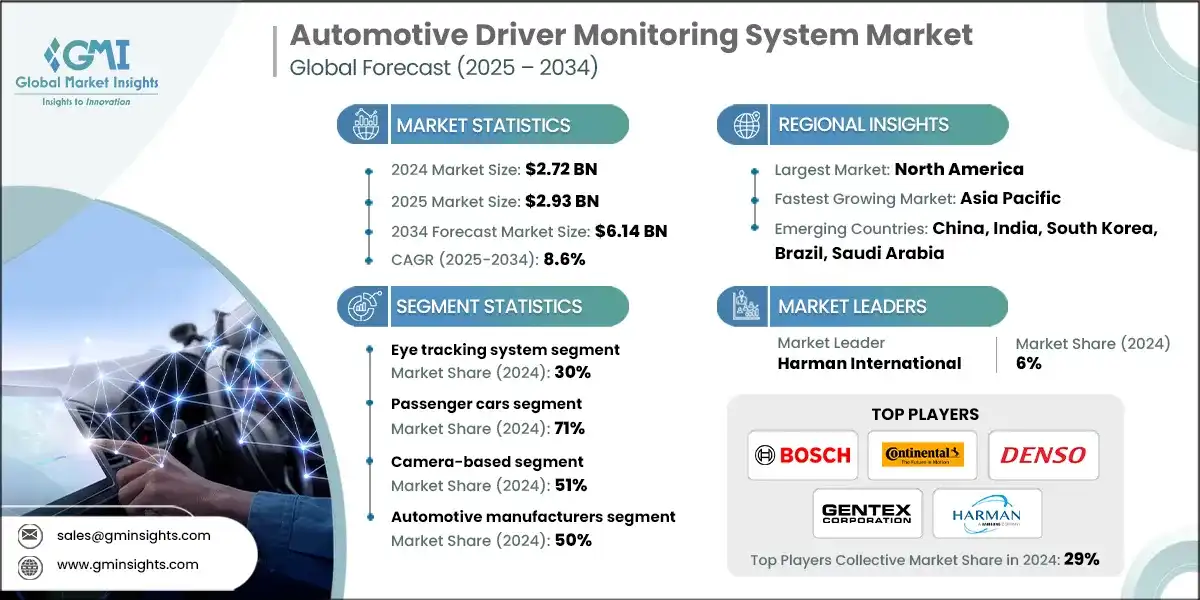
The global automotive driver monitoring system market size was estimated at USD 2.72 billion in 2024. The market is expected to grow from USD 2.93 billion in 2025 to USD 6.14 billion in 2034, at a CAGR of 8.6%, according to latest report published by Global Market Insights Inc.
Automotive Driver Monitoring System Market Key Takeaways
Market Size & Growth
- 2024 Market Size: USD 2.72 Billion
- 2025 Market Size: USD 2.93 Billion
- 2034 Forecast Market Size: USD 6.14 Billion
- CAGR (2025–2034): 8.6%
Regional Dominance
- Largest Market: North America
- Fastest Growing Region: Asia Pacific
Key Market Drivers
- Stringent government safety regulations.
- Rising demand for ADAS and semi-autonomous vehicles.
- Increasing incidents of distracted and drowsy driving.
- Growing consumer awareness of in-cabin safety features.
- Integration of AI and computer vision in automotive systems.
- Mandates for commercial fleet driver monitoring.
Challenges
- High cost of DMS hardware and software integration.
- Privacy and biometric data concerns among users.
Opportunity
- Mandatory DMS for Euro NCAP 2026 and GSR Phase II.
- Emergence of AI chipsets tailored for in-cabin monitoring.
- Integration with occupant monitoring and health analytics.
- Growing demand for DMS in commercial and shared mobility fleets.
Key Players
- Market Leader: Harman International led with over 6% market share in 2024.
- Leading Players: Top 5 players in this market include Bosch GmbH, Continental, Denso Corporation, Gentex Corporation, Harman International, which collectively held a market share of 29% in 2024.
Get Market Insights & Growth Opportunities
Driver Monitoring Systems (DMS) are vehicle-based technologies that assess drivers for attentiveness and their behavior. These systems collect information about eye position, head position, eyelid closing speed, and facial expressions to identify driver fatigue, distraction, or impairment. As road safety is rising global concern (often accelerated by the development of semi-autonomous driving technologies), DMS technology has emerged as a prominent added safety feature in passenger vehicles market.
Regulation from government authorities is one of the strongest drivers of DMS technologies. The European Union has established the General Safety Regulation (EU Regulation 2019/2144) requiring new vehicle types to have driver drowsiness and attention warning systems installed by July 2022 and in all newly registered vehicles starting from July 2024.
A higher level of regulation will be in place in 2026 when Advanced Driver Distraction Warning (ADDW) systems that monitor the driver gaze are put into effect in all passenger vehicles. This regulatory parameter has set a global benchmark, influencing other regions also to follow similar measures.
In the US, a federal mandate is still in process, yet the National Highway Traffic Safety Administration (NHTSA) has provided some guidance to adopt DMS deployment in vehicles with driver assist technologies. In addition, China has been incentivizing in-cabin monitoring systems for domestic and foreign vehicles sold in its country. These regional regulations combined with an increased interest in safer vehicle experiences are driving a significant demand across all major automotive markets.
Many key manufacturers have invested heavily in driver monitoring systems. For instance, Swedish company Smart Eye has provided its DMS software to over one million vehicles in 2022. Automotive OEMs like BMW, Audi, Porsche, Volvo and General Motors have started to integrate DMS from Smart Eye into different models. Most notably, in August 2024, Smart Eye received a SEK 700 million contract from several worldwide OEMs to provide DMS for their new vehicles which were set to be in production by 2026.
Technology is evolving rapidly in this sector. Research institutes are working on real-time gaze tracking and low-latency edge computing, as well as utilizing infrared sensors for night-time functionality. Driver Monitoring Dataset (DMD) is helping developers to create more accurate AI models to detect drowsiness, distraction, and gaze deviation with high levels of accuracy. This technology is resulting in systems being more reliable and effective under a variety of lighting levels and behavioral situations.
Recent news includes the introduction of Smart Eye’s AIS Focus system that has been designed for trucks and buses, to help vehicle manufacturers meet EU regulations. Driver monitoring systems (DMS) are now not just for luxury or passenger vehicles but are becoming more essential in commercial fleets where driver fatigue and distraction are a prominent safety concern.
To get key market trends
Automotive Driver Monitoring System Market Trends
The driver monitoring systems (DMS) industry is evolving from being optional safety add-ons to becoming a fundamental regulatory feature, particularly in rapid-growth markets, such as China. In the last couple of years, China has been at the forefront of DMS deployment within automobiles, primarily propelled by various developments in the country’s safety regulations.
The draft rules under the 2024 edition of China’s New Car Assessment Program (C-NCAP) have established a framework to measure safety score, which potentially incentivizes vehicle DMS deployments. Fatigue and driver attention monitoring systems are highlighted in the rules and have designated score points.
Automakers from around the world have also responded to these advancements. In late 2024, the US based electric vehicle giant Tesla updated the software of its Model Y to include a driver fatigue warning system based on its internal camera. Some Chinese brands, such as Li Auto, BYD, NIO, and Zeekr, have similarly incorporated monitoring systems on their premium and mid & top-range vehicles. This demonstrates that automakers are responding to regulations as well as providing systems to help improve driver behavior in their efforts to differentiate brand positioning.
Another remarkable trend is the integration of radar-based sensors with traditional cameras. While the cameras are effective in most cases, their performance can be interrupted by poor light or visual barriers. In response, manufacturers have begun to include ultra-wideband and millimeter-wave radar sensors in their system. They can also detect important indications such as heart rate and breathing are especially useful in scenarios such as the detection of the child or driver unconsciousness.
For instance, the acquisition of CAARESYS by HARMAN significantly strengthens Ready Care's competence, creating a robust solution and putting the company in a leading position for in-cabin radar sensing technology. With this development, Ready Care's offering included "contactless" measurement of vital signs of human’s heart rate, breathing rate, and inter beat intervals to monitor the overall state of a driver.
In 2024, the top ten automotive brands operating in China accounted for more than 60 percent of all DMS and occupant monitoring installations. Many leading OEMs have started adoption of these technologies to stay competitive in the marketplace. This rapid growth is also being experienced in the supply chain disruption, as both domestic and international component suppliers have begun ramping up production and R&D innovation to achieve increasing OEM demand in these areas.
Automotive Driver Monitoring System Market Analysis
Learn more about the key segments shaping this market
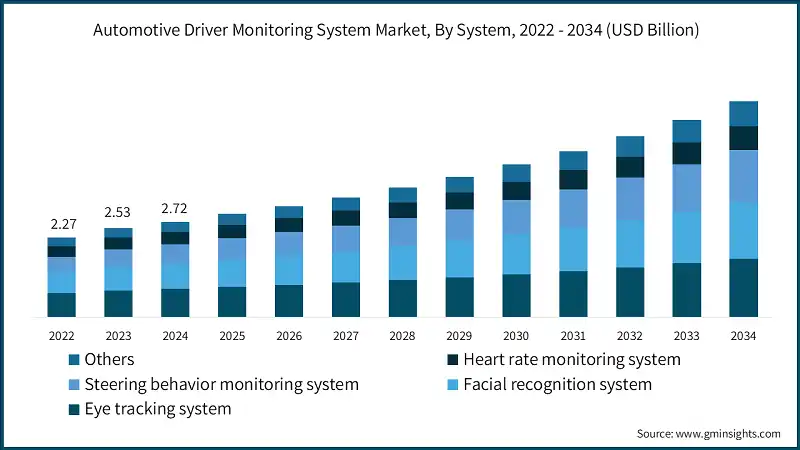
Based on system, the automotive driver monitoring system market is divided among eye tracking system, facial recognition system, steering behavior monitoring system, heart rate monitoring system, and others. The eye tracking system segment dominated the market, accounting for 30% in 2024 and is expected to grow at a CAGR of over 7.6% through 2025 to 2034.
- Eye tracking systems monitor significant elements, such as gaze direction, blink rate, eyelid closure, and pupil diameter, to assess a driver's attention and fatigue state. Eye tracking is an effective and practical means of characterizing physiological responses that can frequently precede cognitive distraction or drowsiness.
- Recent studies using simulators to capture gaze behavior have shown a considerable difference in fixation time and pupil area during instances of fatigue, allowing them to detect a high degree of accuracy even in darker conditions and under the condition of wearing glasses or obstructive eye wears.
- Facial recognition systems also offer measurements beyond the eyes, incorporating additional inputs of other facial expressions and head poses along with indications of yawning. These systems enable detailed monitoring by evaluating micro-movements in the facial structures and orientation, to indicate emotional states and measure physiological fatigue. Further, system identification can permit the identification of the driver to support personal in-vehicle features or functions and improved security. Facial recognition systems are gaining accuracy in recognizing subtle changes in the behaviors (e.g., hand gestures) and mood of the driver as artificial intelligence models develop over time.
- Steering behavior monitoring systems, once applicable purely for basic alerting systems, are entering into more advanced awareness/productivity monitor systems. This is developed to use the existing, in-vehicle hardware in a retiring manner to provide information on a driver’s state of alertness and level of vehicle control.
- Steering behavior monitoring systems are remarkably versatile because analyzing and monitoring driving behaviors related to steering input regarding grip strength, wheel angle variability, torque, micro-adjustments, etc. can provide valuable information about alertness and driver control. As many more vehicles are moving towards semi-autonomous modes, the ability to detect how actively a driver is engaged in a task using feedback from steering input is an important requirement.
- Physiological monitoring systems for heart rate and other indicators provide a direct interface with the driver's health and well-being. It can monitor heart rate variability and breathing rate either from contact sensors embedded in the steering wheel or through advanced radar-based sensor solutions located within the vehicle cabin. These systems may serve well to identify stress and anxiety conditions and also for more concerning potential events such as a heart attack. Nonetheless, the use of these sorts of systems is semi-limited due to the overall complexity of the hardware and maintaining stable signal signals while the vehicle is moving.
Learn more about the key segments shaping this market
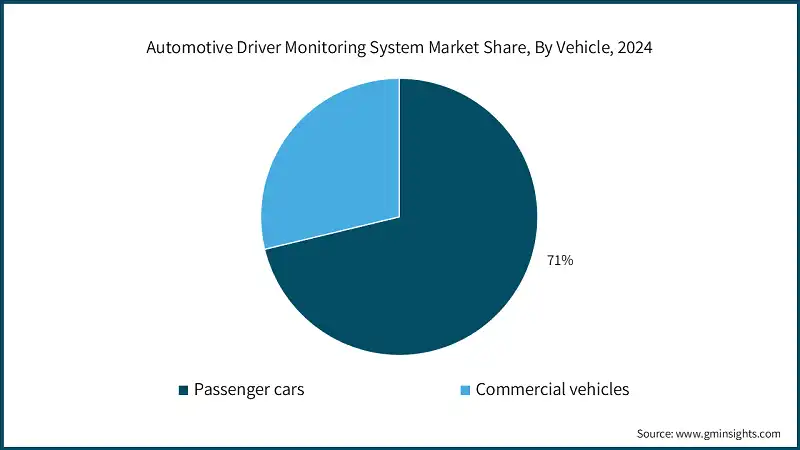
Based on vehicle, the automotive driver monitoring system market is segmented into passenger cars, and commercial vehicles. Passenger cars segment dominates the market with 71% share in 2024, and the segment is expected to grow at a CAGR of 9% from 2025 to 2034.
- Passenger cars have seen fast DMS integration due to strict safety rules, as well as with changed NCAP specifications. In January 2024, for example, the latest version of China's NCAP test process does DMS mandatory in vehicles with reference to the fatigue and monitoring of the driver of the vehicle to complete the security score. This regulatory standard has prompted OEMs to equip their passenger car models with DMS.
- Furthermore, the arrival and availability of Level 2 driver assistance systems have helped accelerate DMS adoption, considering that Level 2 driver assistance systems require the constant availability of the driver's attention as a precautionary method of safety mandates.
- Beyond regulatory changes, competition among automakers has also contributed to DMS use in passenger cars. Leading automakers use DMS to differentiate the model into three major categories to establish potential consumer interest such as safety, personalization, and comfort. As consumers become more friendly to the understanding of road safety and digital cockpit features, the market for intelligent in-cabin monitoring systems is equally increasing. As a result, many automakers are making DMS either standard or optional. Additionally, these systems have become standard or optional in the mid-to-high end models.
- Commercial vehicles have started to adopt DMS, but at a slower rate. This segment has major safety implications, especially for long-haul truck and bus driving related to fatigue and driver distraction. Commercial vehicles also operate in harsher environments (vibrations, dust, and inconsistent lighting), therefore, implementation is more difficult than it would be with passenger vehicles.
- For instance, BharatBenz, launched a Driver State Monitoring System in its heavy-commercial trucks to monitor system fatigue and reduce fatigue-related crashes. Similarly, the Swedish company Smart Eye announced they have recently signed contracts to equip European commercial fleets with AI-based monitoring systems for medium-duty trucks.
- In addition, Novus Hi-Tech launched a solution for mining truck DMS in India, to comply with requirements of the Directorate General of Mines Safety (DGMS) demonstrating regulations and safety issues.
- Fleet operators and insurance companies are gradually starting to change the brain and see DMS as a valuable feature to improve the driver's security and reduce insurance risk. The major challenges, including rigid internal cabin environments, increased costs and driver variation, provide some complications in widespread implementation.
Based on technology, the automotive driver monitoring system market is segmented among camera-based, sensor-based, and hybrid. The camera-based segment dominates the market with market share of 51% in 2024.
- The camera-based segment holds a dominant position in the market, owing to its advanced functionalities in real-time acquisition of high-quality, detailed visual data. Such systems of camera sensors, when enriched with AI-based platforms, perform a variety of complex functions, such as image recognition, real-time analysis, and post-processing decision making. A prominent example is found in the motor vehicle's field, especially with self-driving and autonomous vehicles, where cameras are important for autonomous navigation and security systems on board.
- The camera system allows vehicles to avoid barriers, recognize road signs and understand the condition of real-time roads, helps in the growth of self-driving vehicles. As vehicles can process visual data, they are capable of independent on-road decision-making, which provides for rapid and more accurate decisions than human-assisted vehicles. As a result, vehicles have better safety and operational capacity.
- The strength of camera-based technology lies in its high-resolution skills and the ability to work originally with artificial intelligence. In areas such as security and monitoring, camera-based systems can be equipped with AI, identify people, goods and movement patterns. This has improved monitoring accuracy in distinguishing between human and non-human movements.
- AI cameras detect signs of defective parts in a manufacturing production line, based on images captured earlier in the process. For example, a windshield that is damaged or has cracks or a car frame that is bent or not square will get flagged automatically, which assists manufacturers in improving quality and reducing defects.
- In addition to traditional camera-based systems, sensor technology is gaining traction including ultrasonic, LiDAR, and Radar for applications where poor visibility or environmental constraints of seeing the distance prevent a judgement by a camera. An autonomous vehicle use LiDAR sensors in conjunction cameras to record detailed 3D maps of their surrounding environments to assist during difficult conditions such as fog, rain, and darkness.
- A hybrid combination of both camera and sensor technology contributes to the continued advancement of the hybrid system. It combines camera images with sensor data, offering a reliable and flexible way to collect information.
Based on End Use, the automotive driver monitoring system market is segmented into automotive manufacturers, government, individuals, fleet operators, and others. The automotive manufacturers segment dominates the market with share of 50% in 2024.
- Automotive manufacturers dominate the market owing to the recent regulatory changes which have increased DMS adoption across automotive industry. For instance, the European Union's General Safety Regulation (GSR) now mandated that any new vehicle sold after 2022 is equipped with a driver attention monitoring system. Due to such legislation, manufacturers are now installing DMS systems in a variety of vehicles as standard feature. This is not only to comply with regulations but is also considered an excellent selling feature to provide safety to the vehicle and its occupants.
- Many automotive manufacturers are not only adopting DMS technology but are also leading the research and development of such technologies. Few OEMs have partnered with technology companies that specialize in Artificial Intelligence (AI) and in-cabin monitoring to develop advanced systems that detect fatigue, distracted, and impaired driving in real-time. In fact, several manufacturers have reported being uniquely qualified to build their systems by collecting massive datasets that included billions of kilometers of driving data and analysis, which they were able to test and improve the performance of DMS technology in a vehicle prior to public deployment. These partnerships provide assurance that the systems are both accurate and reliable while used under numerous driving scenarios.
- While governments might not be the first to use DMS, they have a most important influence on the market. Through regulations and safety standards, they essentially make it mandatory for manufacturers to deploy DMS. In addition, governmental vehicles like police cars, public transport, and emergency vehicles are slowly being equipped with DMS. The function of these DMS is to ensure driver accountability and improve road safety.
- Fleet operators are another important user group. Fleet operators typically utilize DMS for a variety of reasons, with the primary one being the mitigation of operational risks and improving safety outcomes. An increased number of logistics and transport related companies are deploying numerous DMS within fleets which are AI-driven and monitor the behavior of drivers. These systems reduce speeding, eliminate incidents of fatigue and reduce claims to insurance companies.
Looking for region specific data?
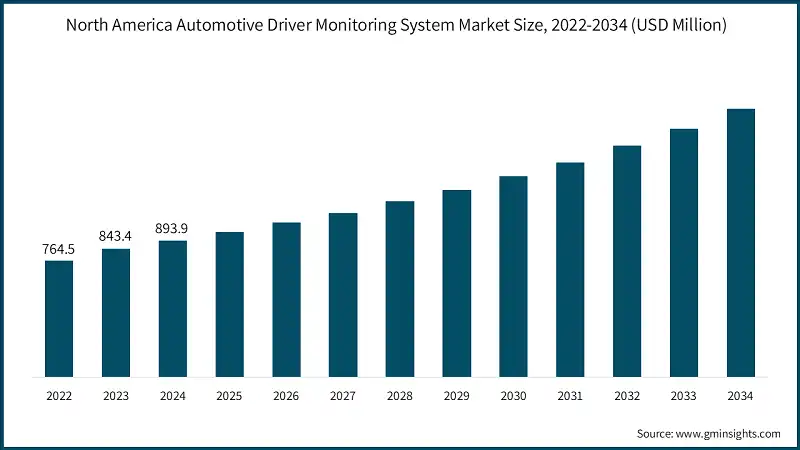
North America dominated the automotive driver monitoring system market with around 33% share and generated around USD 893.9 million revenue in 2024.
- The automotive driver monitoring system (DMS) industry is led by North America, owing to considerable regulatory support combined with manufacturers, OEMs and fleet operator's demand of advanced technology. Government entities in both the US and Canada have helped to promote DMS technology in vehicles through policy establishment, pilot projects and research.
- For example, in the US the National Highway Transportation Safety Administration (NHTSA) and its research advancing initiatives around driver attention and vehicle automation is creating a lucrative market for the driver monitoring system. The AV STEP (Automated Vehicle Safety, Transparency, and Evaluation Program) program is illustrative of this and is designed to enhance understanding of how automated or semi-automated driving systems preserve driver engagement, with safety and transparency.
- Although DMS is not mandated for all vehicle categories, the initiatives imply that the government is advocating for the adoption of DMS technologies which support drivers in various operational tasks.
- Transport Canada has acknowledged the value of driver monitoring system (DMS) as part of its advanced driver assistance technology. DMS is seen as an important approach in preventing distracted driving. Although it is not yet mandatory, the government has completed multiple studies and tests for driver monitoring systems, suggesting that regulations be made soon.
- In North America, manufacturers of motor vehicles respond by entering advanced driver monitoring solutions in their vehicles. Many US-based electric vehicle companies have announced a partnership with in-cabin AI solution suppliers to integrate eye tracking, body movement analysis and attention facilities in the upcoming model.
- Recent regulatory actions highlight the growing importance of DMS. For example, a major recall involving over two million vehicles required updates to attention monitoring systems. Similarly, regulatory bodies have studied hands-free driving systems, stressing the need for reliable DMS to keep drivers alert during automation.
US dominated the North America automotive driver monitoring system market with around 83% market share and generated USD 741.2 million revenue in 2024.
- The North American automotive driver monitoring system (DMS) market is largely driven by the US based industry players, regulatory interest and increasing consumer needs. One of the most notable examples is General Motors' Super Cruise system, which is a hands-free driving assistance technology with a Driver Monitoring System that uses infrared cameras to monitor driver focus. The system has been implemented on over twenty GM models and close to 750,000 miles of mapped roadways in the USA and Canada.
- US-based researchers have made important contributions to the research on DMS by conducting studies in practical driving scenarios. A study that used the National Advanced Driving Simulator examined production-grade DMS and found that they were able to detect drowsy driving in both low-light and nighttime driving scenarios.
- There is a growing population of US consumers who are aware of DMS, with estimates indicating that a considerable number of drivers are using driver monitoring systems by way of a series of hands-free or semi-automated systems. The rise of this technology has also been enforced by insurance company incentives and through fleet high-risk program activities. This indicates a gradual acceptance of driver assistance technologies to increase safety and alertness while driving.
- Besides GM, other US and global automakers are making further progress in developing advanced driver monitoring systems. GM's Ultra Cruise is expected to employ driver assistance, monitoring, and other advanced DMS technologies to observe driver engagement, especially in more complex and dynamic driving scenarios.
Europe automotive driver monitoring system accounted for USD 781.6 million in 2024 and is anticipated to show lucrative growth over the forecast period.
- The European market for automotive Driver Monitoring Systems is positioned for significant growth over the next few years because of regulations, improved safety awareness and development of technology. One of the primary reasons for this growth can be attributed to the European Union's General Safety Regulation (GSR), which requires all new vehicle types to have driver drowsiness and attention warning (DDAW) systems beginning in July 2022.
- The regulation also requires Advanced Driver Distraction Warning (ADDW), which requires all new vehicle types to have the system installed starting mid-2024 and will mandate all vehicles produced for sale in the EU to have the system by July 2026. As a result, DMS has moved from a premium optional feature to a mandated safety feature.
- At the same time, Euro NCAP, the primary car safety rating agency in Europe is adjusting their 5-star safety categories to account for these regulatory developments. To secure 5-star ratings, manufacturers must also prove they have effective distraction-detection systems in place, all of which should drive with interest in implementing advanced DMS technologies.
- Germany is the largest market in the region, driven by its advanced automotive manufacturing, as well as the early adoption of safety technology. The UK and France also remain important markets where strong regulations and active domestic automotive companies help drive demand for DMS technology.
- In the industry, major manufacturers are making commitments to DMS adoption. For example, Stellantis recently stated that it would have DMS provided on all its European vehicles by mid-2026. BMW will also install driver-facing camera systems and cockpit-based domain controllers across its model offerings. In the commercial vehicle area, Wrightbus in the UK has implemented advanced driver monitoring systems into its fleet so other bus and truck manufacturers can follow it.
- European universities and research institutions are also developing advanced machine learning models and lightweight neural networks for real-time fatigue and distraction detection as part of the DMS ecosystem to decrease latency, increase accuracy, and provide feedback in real-time in a vehicle embedded system. New methods of analyzing biometric data, such as tracking eye movements and detecting facial landmarks, are increasing the robustness of systems to different driving scenarios.
Asia Pacific automotive driver monitoring system accounted for USD 634.3 million in 2024 and is anticipated to show fastest growth over the forecast period.
- The automotive DMS market in Asia Pacific region will grow at the fastest growth rate within the forecast period due to stringent regulatory requirements, rapid vehicle electrification, rising road safety concerns and technological advancements. Governments have recognized that driver inattention and fatigue contribute significantly to traffic crashes and are now moving towards key safety standards that promote or require DMS technologies.
- China has taken the lead in regulatory advancement in this region. Proposed safety regulations for Level 2 driver assistance systems mandate disengagement protocols that depend on what the driver is doing, thus establishing a basis for requiring driver monitoring. It is anticipated that these regulations will be enforceable by 2027.
- Japan and South Korea have promoted advanced driver assistance systems and are also starting to integrate driver monitoring systems on a path for progress into commercial and passenger vehicles. India is more nascent in this phase but is actively working to promote the wider traction of safety systems within commercial fleets and public transportation through policy incentives and fleet safety programs.
- In 2024, the region generated almost a quarter of global DMS revenues, with China, Japan, and India leading the way. China's fast-growing electric vehicle (EV) market and increasing applications for smart cabins have fostered an acceleration of the proliferation of DMS technologies. Japan's DMS-related activity has been consistent growth, primarily driven by domestic manufacturers, such as Toyota and Nissan. India finds itself in the early stages of significant demand-side growth as autonomous vehicles, driver monitoring in buses, logistics, and ridesharing are emerging due to rapid urbanization and safety awareness.
- In 2025, a company from Taiwan (like Advantech) put out a real-time DMS solution targeting monitoring fatigue and distraction across the Asia Pacific markets. Japan has developed eye-tracking technologies in public transport, which monitor alertness for drivers and apply safety measures automatically if the company believes the driver is fatigued or unresponsive. In research institutions around the region, there has been significant movement on AI-based systems that can detect eye movement, yawning and other fatigue indicators using lightweight neural networks suitable for real time implementation in vehicles.
- There are several factors such as the rapid growth of vehicle ownership in the region, especially in the context of emerging economies, increasing the market base. With the development of electric and connected vehicles throughout China and key markets in Southeast Asia, it is increasingly easier to adopt DMS into digital cockpit architecture. An increasing number of crashes linked to driver fatigue and misuse of automated driver assistance systems have prompted consumers and regulators to make driver monitoring a critical layer of safety.
Latin America accounted for around USD 219.7 million in 2024 and is anticipated to show robust growth over the forecast period.
- The automotive driver monitoring system (DMS) market in Latin America is projected to see significant growth over the forecast period, driven by growing concerns for road safety, increased adoption of fleet safety technologies, and gradual shift in policy and regulatory environments. Latin America has some of the highest rates of fatalities due to road traffic in the world, and driver distraction, fatigue, and unsafe behavior are among the leading causes. The demand for DMS and related technologies is steadily rising as governments and commercial fleet operators have increased efforts on improving road safety.
- With respect to market shares, Brazil and Mexico represent the biggest markets in the region, in terms of both vehicle volume and technology adoption. Brazil is witnessing growing demand for safety solutions, particularly in relation to ride hailing, logistics, and taxis as the largest automotive market in Latin America, fleet operators are adopting smart in cabin systems with cameras and monitor driver behavior in real time. Similarly, Mexico's commercial transport sector is increasingly using telematics platforms that monitor driver behavior analytics, fatigue detection, and distractions.
- Although full-fledged DMS technologies are at a relatively early stage in the adoption cycle versus more developed markets, the region is experiencing strong momentum in implementing safety systems in the commercial and shared mobility market. An example of strong deployments was the implementation of an integrated monitoring system in ride-hailing handles in Brazil, combining panoramic interior cameras with automatic AI alerts for unsafe driving behavior. Fleet management companies in Mexico are enhancing their safety offerings by offering in-cab video and AI-based real-time alerts for driver drowsiness, mobile phone usage, and inattention.
- The confluence of technological changes, including image processing through AI, edge computing, and low-cost sensors, is enabling greater scalability of DMS systems. In addition, the growth in logistics, e-commerce, and shared mobility in the region strongly enables DMS application.
Middle East and Africa automotive driver monitoring system market accounted for USD 194.8 million in 2024 and is anticipated to show lucrative growth over the forecast period.
- The automotive DMS market in the Middle East and Africa (MEA) region is anticipated to experience rapid growth during the forecast period. Overall growth is mainly driven by growing concern about road safety, regulatory change, growth of fleet management technology, and increasing adoption of Advanced Driver Assistance Systems (ADAS). Many MEA countries are facing exceptionally high rates of road fatalities and are now seeking technology-based solutions to mitigate traffic crashes caused by driver fatigue, inattention, and other unsafe behaviors.
- The local governments of countries in the region, particularly Gulf Cooperation Council (GCC) countries, are increasing safety regulation or laws regarding road safety. For example, the United Arab Emirates (UAE) and Saudi Arabia are revising their transport safety regulations to require or incentivize the incorporation of ADAS features in their commercial fleets.
- Similarly, they are in the process of legislating the incorporation of technology that monitors the alertness of the driver, seatbelt usage, and inattentive driving to their governing framework. Regions with cities like Dubai, Abu Dhabi, and Riyadh, are establishing centralized or connected vehicle infrastructure programs to report on driver behavior to improve safety, and to help create an environment conducive to DMS adoption.
- This trend is also evident in country-specific developments. The UAE is leading in the deployment of integrated Advanced Driver Assistance Systems (ADAS) and driver management systems (DMS), driven primarily by risk-based monitoring solutions in logistics and construction fleets. The primary components of these systems are deep learning algorithms that automatically identify distractibility, fatigue, and risky behaviors in real-time. Fleet telematics and driver behavior monitoring are relatively more mature in South Africa than in many other countries.
- Academic and research institutions in the region are also part of this journey by creating prototypes that monitor drivers with IoT. These IoT-enabled devices monitor facial detection, and eye-tracking to detect drowsiness and notify the operator for safety. Furthermore, vendors are modifying their hardware-software solutions to address some of the regionally relevant issues, including extreme heat, dust and glare from the sun that can impact traditional vision-based systems.
Automotive Driver Monitoring System Market Share
- The top 7 companies in the automotive driver monitoring system industry are Aptiv, Bosch, Denso, Valeo, Continental, Gentex, Harman. These companies hold around 37% of the market share in 2024.
- Aptiv is a developer of advanced driver assistance systems (ADAS). Aptiv's ADAS products focus on improving the safety of both the driver and their passengers. For example, Aptiv's automotive driver monitoring systems incorporate sensors and algorithms to monitor the driver's attention, fatigue, and behavior to prevent accidents. These driver monitoring systems enable the car to monitor a driver's behavior, then can warn them when they are distracted or not paying attention.
- Bosch offers driver monitoring systems, which employ cameras and sensors to monitor the driver's behavior (e.g., eye movement, head location, etc.). Bosch aims to keep drivers alert and pay attention and actuates warnings when driver fatigue and distraction are detected. Joe states Bosch makes further progress towards autonomous driving and a supplier of ADAS and safety monitoring for the automobile sector.
- Denso is a leading supplier of automotive technology that designs and manufactures driver monitoring systems. Denso develops driver monitoring systems that monitor the state of a driver reducing risk on greater connected car safety. Denso systems monitor a driver’s eye movement, facial characteristics, and other behaviors parameters to assess signs of drowsiness or distraction. Denso creates APIs for driver monitoring system developers so they can add additional safety systems like ADAS.
- Valeo focuses on advanced automotive technologies, including driver monitoring systems. They provide products utilizing cameras and sensors to monitor the attention levels of drivers and detect potential dangers due to distraction or fatigue. These monitoring systems can issue warnings to drivers, and in some cases, initiate safety interventions to increase road safety. Valeo is also working on merging passenger vehicle capabilities with fully autonomous driving systems for a streamlined driving experience.
- Magna is currently developing driver monitoring systems that predominately emphasize detecting driver behavior and preventing collisions. They offer a camera-based monitoring system that provides driver monitoring via assessment of facial expressions, eye gaze, and head position to ascertain if the driver is paying attention to the road. Magna monitoring systems may issue alerts to the driver stating the need for attention or apply safety interventions, if the driver is in danger.
- Continental provides driver monitoring systems that are equipped with cameras and infrared sensors that use artificial intelligence to monitor the driver’s attention to the road by tracking visual behavior, eye movements and overall alertness. Continental considers these systems to be an important combatant against early signs of driver fatigue, distraction and impaired driving behaviors, and to provide warnings to keep driver’s safe from harm.
- Gentex specializes in formulating leading-edge Driver Assistance Systems, which includes driver monitoring technology. Their systems work by utilizing straightforward cameras and facial recognition software that look for signs that a driver is drowsy, distracted, or simply not paying attention to the road ahead. With technology designed to continuously assess a driver’s level of interest and alertness, Gentex aims to avoid any accidents and bolster vehicle safety. The same technology is being developed for smart mirror installations for more enhanced experience for what goes on in a car.
- Harman create driver monitoring systems that integrate facial recognition and behavioral analytics to assess the condition of drivers. Their solutions can detect drowsiness, distraction, and otherwise impaired ability. Harman’s solutions are delivered to the market in the context of a system that includes or interacts with voice recognition, audio and safety systems for a connected, safer, and more intuitive in-car experience.
Automotive Driver Monitoring System Market Companies
Major players operating in the automotive driver monitoring system industry are:
- Aptiv
- Bosch
- Continental
- Denso
- Gentex
- Harman
- Magna
- Tobii
- Valeo
- The automotive driver monitoring system (DMS) market is characterized by a moderately consolidated competitive landscape, led by a mix of global Tier-1 suppliers and emerging technology providers. Established players such as Bosch, Continental, Denso, Aptiv, and Valeo dominate the market, collectively accounting for a significant share of deployments.
- These companies leverage deep OEM relationships, broad ADAS portfolios, and strong manufacturing footprints to maintain their leadership in the DMS segment. Their systems typically integrate camera-based eye tracking, facial recognition, and behavioral analytics to detect drowsiness, distraction, and impaired driving in real time.
- Bosch, Continental, and Denso are especially prominent due to their ability to combine in-cabin monitoring with other ADAS components such as radar, LiDAR, and braking systems. These players are at the forefront of regulatory compliance, developing DMS solutions in response to safety mandates by the EU (Euro NCAP 2025) and U.S. NHTSA, which are pushing for mandatory driver monitoring in all new vehicles. Aptiv and Valeo continue to build competitive advantage through AI-powered sensor fusion and scalable software platforms, which can support both human-driven and semi-autonomous vehicles. Their focus is increasingly on delivering flexible DMS solutions that can evolve with the transition to Level 2+ and Level 3 autonomous driving.
- Mid-level players such as Magna and Gentex offer strong competition in niche areas of the market. Magna provides modular DMS solutions that are integrated into its broader cockpit systems, focusing on cost-effective scalability for mass-market vehicles. Gentex, on the other hand, differentiates through mirror-integrated systems that combine driver monitoring with other smart mirror functions. Their strength lies in the North American market, where smart mirror-based DMS is gaining traction among OEMs seeking minimal redesign requirements and high integration efficiency.
- Among emerging players, Harman is notable for expanding its capabilities from infotainment into driver monitoring. Backed by Samsung, Harman is investing in AI-based in-cabin sensing technologies that combine driver state monitoring with voice recognition, ambient intelligence, and user profiling. Their strategy is aligned with the rise of software-defined vehicles (SDVs) and connected cockpit ecosystems, where DMS is no longer a standalone safety feature but part of a holistic human-machine interface (HMI) experience.
- Overall, the DMS market is witnessing intense competition driven by safety regulations, rising consumer demand for in-cabin safety, and the international push toward autonomous mobility. Market leaders are investing heavily in camera technology, AI-driven analytics, and edge computing, while also exploring strategic partnerships with chipmakers and software providers. Meanwhile, mid-tier and emerging players are carving out space through innovative form factors, regional customization, and integration into broader digital cockpit systems.
Automotive Driver Monitoring System Market Report Attributes
| Key Takeaway | Details |
|---|---|
| Market Size & Growth | |
| Base Year | 2024 |
| Market Size in 2024 | USD 2.72 Billion |
| Market Size in 2025 | USD 2.93 Billion |
| Forecast Period 2025 - 2034 CAGR | 8.6% |
| Market Size in 2034 | USD 6.14 Billion |
| Key Market Trends | |
| Drivers | Impact |
| Stringent government safety regulations | Regulatory mandates are accelerating OEM adoption of DMS in both premium and mass-market vehicles. |
| Rising demand for ADAS and semi-autonomous vehicles | DMS acts as a core enabler for driver readiness in semi-autonomous driving levels. |
| Increasing incidents of distracted and drowsy driving | Rising road accidents are pushing insurers and governments to support DMS integration. |
| Growing consumer awareness of in-cabin safety features | Safety-conscious buyers now view DMS as a standard requirement, not just a premium feature. |
| Integration of AI and computer vision in automotive systems | Real-time driver state detection is now feasible due to powerful, low-latency AI algorithms. |
| Mandates for commercial fleet driver monitoring | Regulatory pressure and liability concerns are forcing fleet owners to adopt DMS solutions. |
| Pitfalls & Challenges | Impact |
| High cost of DMS hardware and software integration | Premium pricing limits adoption in entry-level vehicles and cost-sensitive markets. |
| Privacy and biometric data concerns among users | GDPR and data sensitivity issues hinder consumer trust and regulatory approval in some regions. |
| Opportunities: | Impact |
| Mandatory DMS for Euro NCAP 2026 and GSR Phase II | Regulatory mandates will drive explosive OEM demand across all vehicle classes. |
| Emergence of AI chipsets tailored for in-cabin monitoring | Dedicated edge AI chips reduce cost and boost real-time performance of DMS systems. |
| Integration with occupant monitoring and health analytics | Expanding DMS into wellness and health creates new revenue streams beyond safety compliance. |
| Growing demand for DMS in commercial and shared mobility fleets | Fleets require continuous driver monitoring for liability, safety, and insurance optimization. |
| Market Leaders (2024) | |
| Market Leaders |
6% market share |
| Top Players |
Collective market share in 2024 is 29% |
| Competitive Edge |
|
| Regional Insights | |
| Largest Market | North America |
| Fastest growing market | Asia Pacific |
| Emerging countries | China, India, South Korea, Brazil, Saudi Arabia |
| Future outlook |
|
What are the growth opportunities in this market?
Automotive Driver Monitoring System Industry News
- In January 2025, Gentex introduced its next-generation driver monitoring system (DMS) platform at CES that uses cameras incorporated into mirrors to monitor the cabin in two-dimensional and three-dimensional views. The system detects eye movement and head position, drowsiness with increased distractions, and even the level of cognition when in semi-autonomous driving mode.
- In January 2025, Valeo announced its collaboration with Amazon Web Services (AWS) to create cloud-native simulation environments to speed up the development of advanced driver assistance (ADAS) systems and driver monitoring systems (DMS), allowing for faster validation cycles and over-the-air features.
- In September 2024, Aptiv announced the availability of Gen 6 of its ADAS platform, integrating advanced AI/ML based perception with embedded radar behavior prediction and sensor fusion. The platform enables driver monitoring with in-cabin camera support and Smart Vehicle Architecture (SVA) to facilitate a seamless experience with in-vehicle infotainment and over-the-air updates.
- In February 2024, Harman expanded its partnership with Ferrari to include the use of its driver attention and biometric sensing system in future vehicle models. This technology is designed to support a personalized response to safety, adjusting real-time vehicle alerts based on driver distraction levels.
The automotive driver monitoring system market research report includes in-depth coverage of the industry with estimates & forecasts in terms of revenue ($ Bn) from 2021 to 2034, for the following segments:
Market, By System
- Eye tracking system
- Facial recognition system
- Steering behavior monitoring system
- Heart rate monitoring system
- Others
Market, By Vehicle
- Passenger cars
- Hatchback
- Sedan
- SUV
- Commercial vehicles
- Light commercial vehicles (LCV)
- Heavy commercial vehicles (HCV)
- Medium commercial vehicles (MCV)
Market, By Technology
- Camera-based
- Sensor-based
- Hybrid
Market, By End Use
- Automotive manufacturers
- OEMs (Original Equipment Manufacturers)
- Tier 1 suppliers
- Tier 2/3 component suppliers
- Aftermarket manufacturers
- Government
- Transportation & safety agencies
- Government vehicle fleets
- Individuals
- Fleet operators
- Transportation & logistics
- Mobility services
- Industry-specific fleets
- Commercial transportation
- Others
The above information is provided for the following regions and countries:
- North America
- US
- Canada
- Europe
- Germany
- UK
- France
- Italy
- Spain
- Nordics
- Russia
- Asia Pacific
- China
- India
- Japan
- Australia
- Indonesia
- Philippines
- Thailand
- South Korea
- Singapore
- Latin America
- Brazil
- Mexico
- Argentina
- Middle East and Africa
- Saudi Arabia
- South Africa
- UAE
Frequently Asked Question(FAQ) :
What is the market size of the automotive driver monitoring system in 2024?
The market size was USD 2.72 billion in 2024, with a CAGR of 8.6% expected through 2034. Increasing focus on road safety and advancements in semi-autonomous driving technologies are driving market growth.
What is the projected value of the automotive driver monitoring system market by 2034?
The market is poised to reach USD 6.14 billion by 2034, driven by regulatory mandates, integration of advanced technologies, and rising adoption in passenger vehicles.
What is the expected size of the automotive driver monitoring system market in 2025?
The market size is projected to reach USD 2.93 billion in 2025.
How much revenue did the eye tracking system segment generate in 2024?
The eye tracking system segment generated approximately 30% of the market share in 2024 and is expected to witness over 7.6% CAGR till 2034.
What was the market share of the passenger cars segment in 2024?
The passenger cars segment dominated the market with a 71% share in 2024 and is set to expand at a CAGR of 9% up to 2034.
What is the growth outlook for the camera-based segment from 2025 to 2034?
The camera-based segment, which held a 51% market share in 2024, due to its advanced functionalities, including real-time data acquisition and AI-based analysis.
Which region leads the automotive driver monitoring system sector?
North America leads the market with a 33% share, generating approximately USD 893.9 million in revenue in 2024. This growth is supported by regulatory initiatives and demand for advanced technologies from OEMs and fleet operators.
What are the upcoming trends in the automotive driver monitoring system market?
Trends include radar-camera integration, AI-driven driver analysis, contactless vital sign monitoring, and stricter safety regulations.
Who are the key players in the automotive driver monitoring system industry?
Key players include Aptiv, Bosch, Continental, Denso, Gentex, Harman, Magna, Tobii, and Valeo.
Automotive Driver Monitoring System Market Scope
Related Reports