Summary
Table of Content

Automotive Digital Twin Hardware Market
Get a free sample of this report
Form submitted successfully!
Error submitting form. Please try again.
Thank you!
Your inquiry has been received. Our team will reach out to you with the required details via email. To ensure that you don't miss their response, kindly remember to check your spam folder as well!
Request Sectional Data
Thank you!
Your inquiry has been received. Our team will reach out to you with the required details via email. To ensure that you don't miss their response, kindly remember to check your spam folder as well!
Form submitted successfully!
Error submitting form. Please try again.
Automotive Digital Twin Hardware Market Size
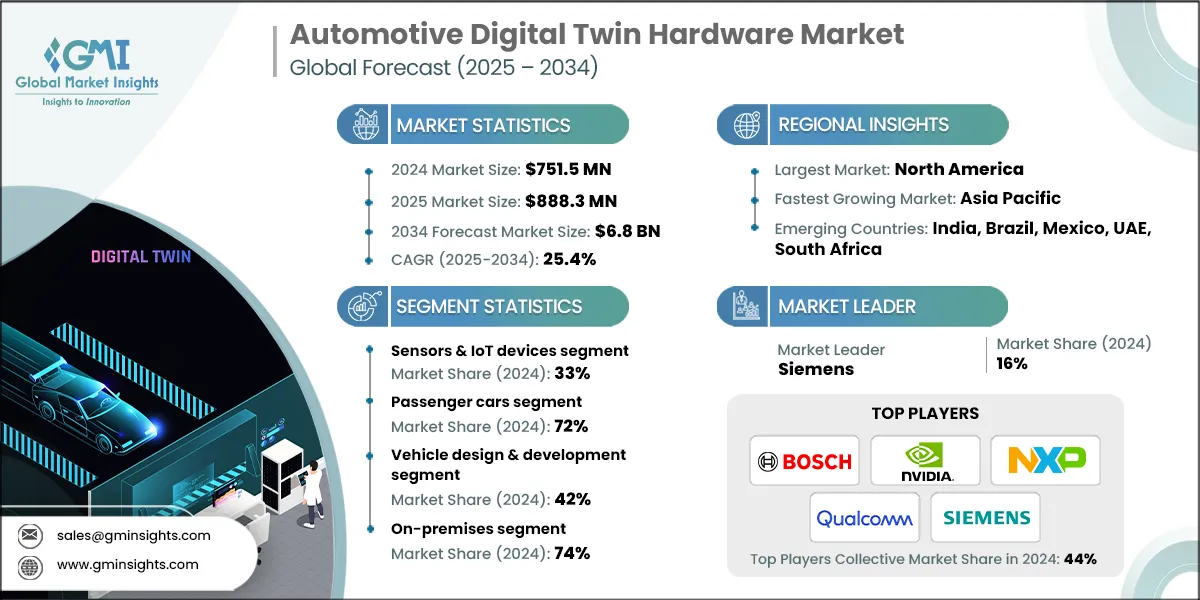
The global automotive digital twin hardware market was estimated at USD 751.5 million in 2024. The market is expected to grow from USD 888.3 million in 2025 to USD 6.8 billion in 2034, at a CAGR of 25.4% according to latest report published by Global Market Insights Inc.
Automotive Digital Twin Hardware Market Key Takeaways
Market Size & Growth
- 2024 Market Size: USD 751.5 Million
- 2025 Market Size: USD 888.3 Million
- 2034 Forecast Market Size: USD 6.8 Billion
- CAGR (2025–2034): 25.4%
Regional Dominance
- Largest Market: North America
- Fastest Growing Region: Asia Pacific
Key Market Drivers
- Integration of high-performance computing (HPC) and GPU hardware.
- Adoption of edge computing and IoT/IIoT devices.
- Advancements in AI and machine learning hardware.
- Expansion of autonomous and connected vehicle development.
- Industry 4.0 and smart manufacturing adoption.
Challenges
- High hardware and infrastructure costs.
- Data interoperability across heterogeneous systems.
Opportunity
- AI-accelerated simulation hardware.
- Integration of edge and cloud computing infrastructure.
- Expansion of digital twin hardware in EV and battery systems.
- Adoption of 5G and ultra-low latency networks.
Key Players
- Market Leader: Siemens led with over 16% market share in 2024.
- Leading Players: Top 5 players in this market include Bosch, NVIDIA, NXP Semiconductors, Qualcomm, Siemens, which collectively held a market share of 44% in 2024.
Get Market Insights & Growth Opportunities
Automotive OEMs and Tier-1 suppliers are increasingly adopting digital twin hardware systems, encompassing high-performance computing (HPC) units, GPUs, sensors, and edge servers. These systems simulate real-world car behaviors in virtual environments, enabling manufacturers to preview the impact of launching a new model on production schedules, optimize assembly line operations, and make better use of resources. Furthermore, digital twin hardware platforms support real-time workforce training, allowing engineers to virtually test and validate assembly processes with digital twins before implementing them on the factory floor.
For instance, in October 2024, Ola Electric, leveraging NVIDIA Omniverse and Krutrim AI, rolled out its Ola Digital Twin platform. This innovative solution harnesses GPU-accelerated computing hardware, enabling faster simulations of factory layouts, real-time robot calibrations, and autonomous equipment training. This showcases the pivotal role of advanced hardware in deploying digital twins within the automotive manufacturing sector.
The adoption of IoT/IIoT, AI, and Industry 4.0 technologies is driving demand for digital twin hardware. Modern cars, now software-defined systems, generate vast data through sensors and interconnected devices. Digital twin hardware processes this data in real-time, enabling predictive analytics and performance optimization.
In the Automotive Digital Twin Hardware Market, leading firms are turning to strategic alliances, mergers, and new product launches to solidify their market positions. For instance, in 2023, NVIDIA bolstered its collaboration with Siemens, merging industrial-grade GPUs and AI hardware with Siemens' simulation software. This integration aims to create scalable infrastructures for real-time digital twin operations, enhancing vehicle design, manufacturing, and validation processes.
Real-time monitoring and optimization of vehicle hardware systems, facilitated by digital twins, can be achieved both in real-time and through over-the-air (OTA) updates. For instance, consider a digital twin of an electric powertrain. By leveraging GPU hardware, simulations can be run to assess efficiency improvements under varying load conditions. Upon successful validation, immediate OTA software updates can enhance vehicle performance and energy efficiency, simultaneously presenting automakers with fresh monetization avenues.
North America, with its early embrace of edge computing, 5G infrastructure, and AI-driven automation, has emerged as a dominant player in the automotive digital twin hardware market. The region's rapid adoption of these technologies is further bolstered by the presence of tech giants like NVIDIA, Intel, and Microsoft. Additionally, supportive US government initiatives promoting smart manufacturing and industrial digitalization have accelerated the integration of these hardware solutions within the region's automotive sector.
China, Japan, and South Korea are automating large-scale production and adopting digital twin technologies, expanding their markets in the Asia Pacific. Major producers in the automotive and electronics sectors are investing in high-speed data processing hardware, sensor networks, and AI chipsets. These investments support real-time production monitoring and predictive maintenance, bolstering the region's influence in the global automotive digital twin hardware landscape.
To get key market trends
Automotive Digital Twin Hardware Market Trends
Industry 4.0 is pushing automotive manufacturers to adopt digital twin hardware, aiming for improved precision, automation, and predictive maintenance. As automotive production facilities increasingly deploy IoT sensors, edge computing units, and industrial controllers, there's a rising demand for high-performance computing hardware. This hardware is essential for efficiently processing and simulating real-time factory data.
Driven by the need for process optimization, reduced operational costs, and quicker time-to-market, investments in digital twin hardware infrastructure are surging. Automakers are turning to GPU-based simulation servers, AI accelerators, and edge nodes, facilitating real-time visualization and testing of vehicle designs, production workflows, and performance models.
AI-driven simulations, deep learning, and 3D modeling when paired with IoT and rapid data analytics are enhancing the scalability and affordability of digital twin hardware. These advancements facilitate virtual prototyping, multi-physics evaluations, and performance assessments, all while minimizing the need for extensive physical testing, leading to substantial reductions in development expenses.
Automotive manufacturers are leveraging hardware-enabled digital twins, integrating advanced visualization, robotics, and predictive analytics. This integration enhances asset management, production optimization, and lifecycle monitoring. As a result, manufacturers achieve better design customization, energy management, and equipment utilization, bolstering their competitive edge.
As 5G, AI, and blockchain weave into the fabric of connectivity, they're fueling the surge of IoT-driven automotive manufacturing. Car manufacturers are now melding Industrial IoT (IIoT) with digital twin technologies. This fusion allows them to craft intricate system architectures and tap into historical data, fine-tuning performance and preempting faults. The outcome Enhanced operational efficiency and fatter profit margins.
As Industry 4.0 initiatives gain momentum, the installation of industrial robots is surging, paving the way for increased deployment of digital twin hardware. The International Federation of Robotics (IFR) reported that in 2024, global installations of industrial robots reached approximately 541,000. With robotic systems becoming central to automotive production lines, the demand for real-time monitoring, optimization, and calibration via hardware-accelerated digital twin systems is poised for significant growth.
The rising focus on autonomous vehicles and electric mobility is driving demand for high-performance digital twin hardware. Automakers use AI-powered processors, GPUs, and simulation servers to replicate real-world scenarios, enabling safer, faster, and cost-effective vehicle validation.
Automotive Digital Twin Hardware Market Analysis
Learn more about the key segments shaping this market
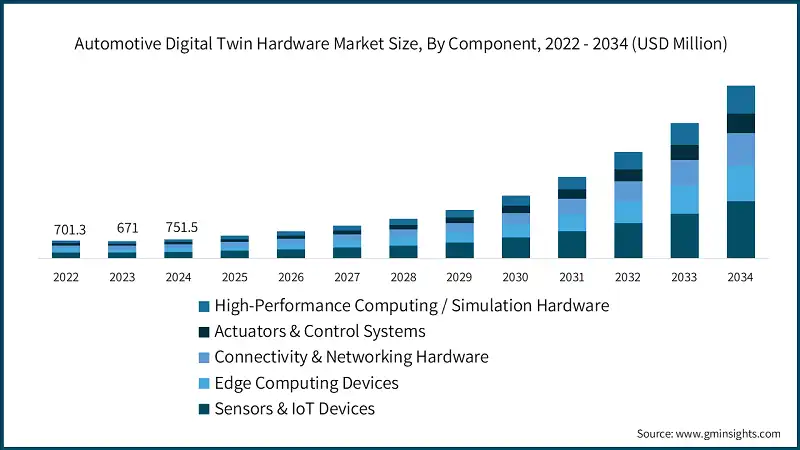
Based on component, the market is segmented into sensors & IoT devices, edge computing devices, connectivity & networking hardware, actuators & control systems, and high-performance computing / simulation hardware. The sensors & IoT devices segment dominates the market with 33% share in 2024 and is expected to grow at a CAGR of over 25.5% from 2025 to 2034.
- Sensors and IoT devices are integral to the automotive digital twin hardware market, capturing real-time data like temperature, vibration, and pressure for simulating physical assets. With growing vehicle autonomy, the adoption of MEMS sensors, LiDAR, radar, and cameras is rising to enhance predictive modeling and fault detection.
- For instance, in October 2024, Bosch launched its next-gen automotive MEMS sensor platform, enhancing digital twin applications and predictive maintenance. Its market leadership is fueled by rising IoT sensor adoption in manufacturing and vehicle operations.
- Edge computing devices enable real-time analysis by processing data on-site and synchronizing with cloud-based digital twins. The synergy of AI-driven processors, low-latency modules, and 5G enhances autonomous driving, ADAS testing, and production optimization.
- The growing reliance on digital twins is driving demand for networking devices like gateways, routers, and 5G modules to enable real-time synchronization between physical and virtual environments. V2X communication and TSN further emphasize the need for fast, secure, and low-latency connectivity infrastructure.
- Actuators and control systems, such as servo motors and smart valves, enable real-time interaction between physical machinery and virtual models in automotive digital twins. Their integration with AI-driven simulations helps optimize assembly lines, calibrate subsystems, and conduct virtual stress tests, driving demand as automation advances.
- High-performance computing (HPC) and simulation hardware are expected to grow significantly with a CAGR of 26.7% during forecast period, driven by advanced digital twin simulations in autonomous, electric, and connected vehicles. Companies like NVIDIA and Siemens are leading with integrated HPC platforms, enhancing vehicle validation, reducing costs, and accelerating product development.
Learn more about the key segments shaping this market
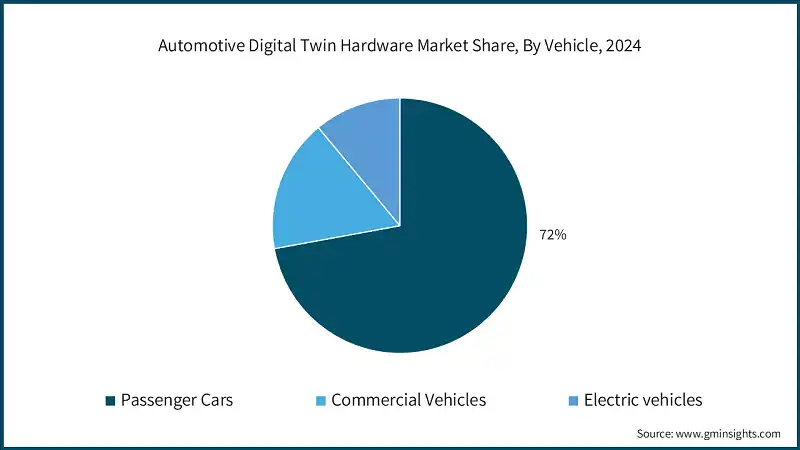
Based on vehicle, the automotive digital twin hardware market is divided into passenger cars, cars, commercial vehicles and electric vehicles. The passenger cars segment accounted for around 72% share in 2024 and is expected to grow at a CAGR of 25.7% from 2025 to 2034.
- In 2024, The passenger cars segment is expected to dominate the global market, driven by increasing system connectivity, ADAS advancements, and vehicle electrification. Automakers leverage GPUs, edge computers, and IoT sensors for real-time simulation, enhancing design accuracy and operational efficiency.
- The passenger cars segment is set to dominate with the shift to software-defined vehicles (SDVs), which require digital twin technology for OTA updates, virtual testing, and predictive maintenance. Companies like NVIDIA, Bosch, and Siemens are providing scalable solutions to support this transition.
- For instance, in October 2024, Ola Electric introduced the Ola Digital Twin, powered by NVIDIA Omniverse and Krutrim AI, to optimize equipment layout, train autonomous robots, and monitor vehicle prototypes in real-time.
- The commercial vehicles market is growing steadily with a CAGR of 24.5% from 2025 to 2034 due to fleet digitalization, predictive maintenance, and connected logistics. Advanced simulation hardware in trucks and buses enhances route planning, fuel efficiency, and system reliability.
- The electric vehicle (EV) market is set to grow significantly, driven by advancements in battery thermal management, multi-physics simulation, and car safety. Digital twin hardware helps optimize battery performance and powertrain efficiency, reducing development time and improving reliability.
Based on application, the market is segmented into vehicle design & development, manufacturing & production optimization, predictive maintenance, autonomous vehicle testing, supply chain & fleet management. The vehicle design & development segment is projected to dominate the automotive digital twin hardware market with 42% share in 2034.
- In 2024, the vehicle design and development segment will dominate the market, driven by demand for real-time simulations, virtual prototyping, and system-level validations enabled by high-performance GPUs, edge computing, and IoT sensors.
- The shift toward software-defined and electrified vehicles drives the demand for advanced digital twin hardware, enabling automakers to test powertrains, chassis, and autonomous systems in a controlled virtual environment.
- The adoption of manufacturing and production optimization is also high, with the power of digital twin hardware to monitor in real time, predictive maintenance, and throughput optimization on top of assembly lines. With the combination of IoT sensors, edge devices, and actuators with simulation platforms, manufacturers can simulate the situation in production, decrease downtimes, and enhance the efficiency of working.
- Predictive maintenance leverages high-performance computing and sensor-driven digital twins to foresee failures, optimize service schedules, and extend the lifespan of vehicles and equipment. By processing data in real-time, maintenance becomes proactive rather than reactive, leading to cost savings and heightened reliability.
- The autonomous vehicle testing market is growing rapidly, driven by the need for GPU-accelerated simulation hardware for ADAS and self-driving algorithms. Additionally, digital twin hardware adoption in supply chain and fleet management is optimizing logistics and boosting market growth.
- Major vendors like NVIDIA, Bosch, Siemens, and Qualcomm are creating modular digital twin platforms to streamline vehicle design, production, and testing for improved speed, accuracy, and cost efficiency.
Based on deployment mode, the automotive digital twin hardware market is divided into cloud, on-premises, and hybrid. The on-premises segment dominated around 74% market share in 2024.
- On-premises deployment dominates the automotive sector due to the need for stringent data privacy and security. OEMs and Tier-1 suppliers prioritize local infrastructure for autonomous vehicle validation, powertrain simulation, and ADAS testing.
- On-premises systems reduce latency for real-time vehicle digital twin applications by enabling high-fidelity simulations and edge computing. GPU-accelerated servers and AI processors on-site support virtual prototyping, predictive maintenance, and production optimization without relying on cloud connectivity.
- Cloud and hybrid deployment modes are growing due to scalability, remote accessibility, and cost savings. They enable global collaboration, fleet simulations, and multi-location operations while balancing performance and security.
- Siemens, NVIDIA, and Bosch provide modular digital twin platforms, enabling automakers to scale infrastructure. On-premises deployments dominate, while hybrid and cloud systems support AI-driven, collaborative operations.
Looking for region specific data?
North America dominated the automotive digital twin hardware market with a revenue share of 34% in 2024.
- The North American automotive sector is driving demand for digital twin hardware, driven by the adoption of connected, autonomous, and electrified vehicles. OEMs and Tier-1 suppliers are investing in GPUs, edge computing, and IoT sensors for real-time simulations and factory digitalization.
- Advancements in GPU-accelerated computing, AI-enabled processors, and low-latency edge hardware are driving regional growth, enabling modular solutions for vehicles and improving design, efficiency, and maintenance.
- For instance, in October 2024, NVIDIA and Bosch launched GPU-based digital twin platforms in North American manufacturing plants, enabling real-time simulations and reducing development time and costs.
- North America is becoming a key hub for digital twin hardware applications, driven by initiatives like the US Department of Energy's VTO, Industry 4.0 programs, and state-level smart manufacturing incentives.
- Technological innovations, robust partnerships between industry and government, and a rising embrace of connected, autonomous, and electric vehicles in both passenger and commercial sectors are propelling North America to the forefront of the automotive digital twin hardware market.
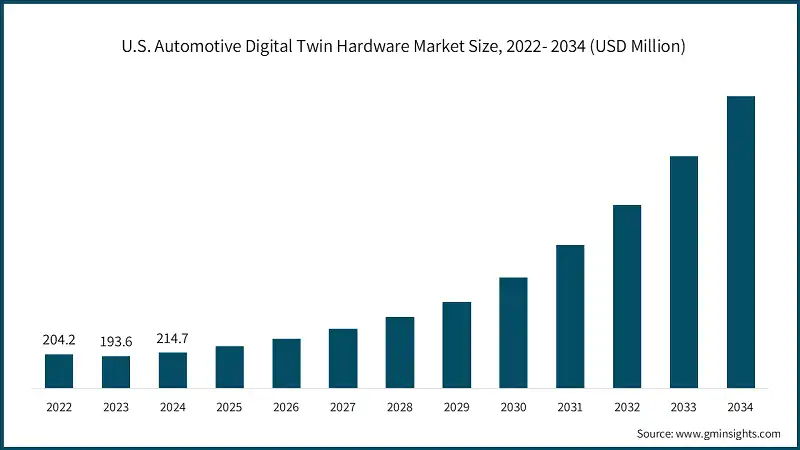
The U.S. market for automotive digital twin hardware is expected to experience significant and promising growth from 2025 to 2034.
- The US leads in connected, autonomous, and electric vehicles, with OEMs and tech providers using digital twin hardware to optimize production, validate systems, and enhance product reliability, driving adoption in the automotive sector.
- US automotive manufacturers and Tier-1 suppliers are investing in high-performance computing, edge devices, and AI-driven simulation hardware to enhance vehicle development and design accuracy, driving faster adoption of digital twin hardware solutions.
- Federal initiatives supporting Industry 4.0, smart manufacturing, and advanced mobility technologies are driving digital twin hardware deployment through policy incentives, R&D funding, and investments in domestic manufacturing.
- Robust ecosystems in cloud computing, IoT, and AI empower the US to seamlessly integrate digital twin hardware with advanced analytics and edge computing. This solid digital foundation not only reduces implementation costs and boosts scalability but also enables real-time simulations, driving consistent market growth.
- Rising demand for connected and personalized vehicles is driving automakers to adopt digital twin hardware, boosting the U.S. market.
Asia Pacific region dominated the automotive digital twin hardware market, which is anticipated to grow at a CAGR of 27.8% during the analysis timeframe.
- In 2024, the Asia Pacific region is set to grow the automotive digital twin hardware industry, driven by the rapid adoption of advanced vehicles and strong government support for smart manufacturing.
- Regional market growth is driven by increased R&D, local hardware production, and collaborations deploying GPUs, edge devices, and IoT sensors for real-time simulations.
- China, the region's largest and fastest-growing market, benefits from government incentives driving EV adoption, autonomous vehicle testing, and smart factory upgrades, while its growing automotive sector boosts demand for advanced digital twin hardware.
- For instance, in October 2024, NVIDIA and Bosch introduced GPU-accelerated digital twin platforms in Chinese manufacturing plants, enabling real-time simulations and predictive maintenance to enhance efficiency and reduce time-to-market.
- Japan, South Korea, and India are bolstering their regional digital twin hardware ecosystem by funding AI-driven simulations, launching pilot programs for smart factories, and offering incentives to weave IoT and edge computing into automotive production.
- Backed by strong policy initiatives, expanding infrastructure, and active partnerships between automakers and tech companies, the Asia Pacific region is leading the way in adopting, deploying, and advancing automotive digital twin hardware solutions.
The China is the fastest growing country in Asia Pacific automotive digital twin hardware market growing with a CAGR of 28.2% from 2025 to 2034.
- China market is growing rapidly, driven by advancements in connected, autonomous, and electric vehicles, as well as smart factory initiatives. Leading OEMs like BYD, SAIC, and NIO are investing in high-performance GPUs, edge computing, and IoT sensors to enhance virtual prototyping and production.
- Government initiatives like "Made in China 2025" and the Industrial Internet Development Action Plan are driving advancements in simulation hardware, AI computing, and digital twin integration to improve efficiency and real-time performance in vehicle and factory operations.
- Chinese automakers, tech providers, and software firms are collaborating to develop digital twin ecosystems, integrating cloud and hardware solutions to optimize vehicle design and manufacturing while strengthening domestic supply chains.
- The adoption of commercial EVs, autonomous fleets, and smart manufacturing is driving demand for GPU-accelerated simulation servers, sensors, and connectivity hardware, with pilot programs in cities like Shanghai showcasing the value of digital twin hardware.
- For instance, in July 2024, Siemens partnered with SAIC Motor to deploy its Xcelerator-based digital twin platform in China, enabling real-time simulations, predictive maintenance, and faster vehicle development.
Europe automotive digital twin hardware market accounted for USD 196.7 million in 2024 and is anticipated to register over 25.9% CAGR over the forecast period.
- The European market is driven by Industry 4.0 initiatives and the adoption of connected, electric, and autonomous vehicles, with OEMs like Volkswagen, BMW, and Daimler investing in advanced GPUs, edge computing, and IoT sensors for real-time simulations.
- The EU Green Deal and Horizon Europe are driving digital twin adoption by advancing AI simulations, HPC hardware, and factory automation, increasing demand across design, production, and testing stages.
- European automakers, technology providers, and software firms are collaborating to enhance digital twin hardware with modular architectures, GPU-accelerated simulations, and edge computing to optimize vehicle development and production workflows.
- Germany, France, and the Netherlands are driving Europe's digital twin innovation in the automotive sector, leveraging AI, cloud computing, and smart manufacturing to enhance efficiency and reduce costs.
- For instance, in March 2025, Siemens partnered with BMW to implement GPU-accelerated digital twin hardware in European production facilities, enabling real-time simulations and predictive maintenance.
Germany dominates the Europe automotive digital twin hardware market, showcasing strong growth potential, with a CAGR of 26.2% from 2025 to 2034.
- Germany, a key market for automotive digital twin hardware in Europe, leverages its strong automotive sector. Leading OEMs like BMW, Daimler, and Volkswagen invest in advanced technologies to enhance vehicle design, production, and testing.
- Germany's Industry 4.0 and smart factory initiatives are boosting demand for simulation hardware, connectivity solutions, and AI-driven edge devices, enabling vehicle digitalization and predictive maintenance.
- German automotive leaders Siemens, Bosch, and BMW are advancing digital twin hardware platforms by integrating GPU-accelerated simulations, real-time data processing, and modular architectures to enhance production efficiency and vehicle performance while reducing costs.
- In June 2024, Bosch and Daimler implemented a digital twin hardware solution at Daimler's Stuttgart and Sindelfingen plants. This integration optimized robotic assembly lines, enabled predictive maintenance, and reduced vehicle development cycles.
Brazil leads the Latin American automotive digital twin hardware market, exhibiting remarkable growth of 24.7% during the forecast period of 2025 to 2034.
- Brazil is emerging as a key market for automotive digital twin hardware in Latin America, driven by the adoption of connected, electric, and autonomous vehicles, along with government support for Industry 4.0 initiatives.
- Federal and state programs in Brazil are driving automakers to adopt advanced technologies like GPUs, edge computing, and IoT sensors, accelerating digital twin adoption in vehicle design and production.
- Brazilian OEMs and Tier-1 suppliers are partnering with global technology providers to deploy cost-effective digital twin platforms, focusing on system integration and workflow optimization in vehicle manufacturing.
- Brazil is set to become a regional hub for smart mobility solutions, driven by EV adoption, industrial partnerships, and investments in digital infrastructure.
- In August 2024, Embraer Automotive Technologies partnered with Siemens to implement GPU-accelerated digital twin hardware, enabling real-time testing, predictive maintenance, and advanced vehicle simulations in Brazil's automotive sector.
South Africa to experience substantial growth in the Middle East and Africa automotive digital twin hardware market in 2024.
- Driven by the rising adoption of connected, electric, and autonomous vehicles, South Africa is becoming a pivotal market for automotive digital twin hardware. The country's push to modernize its manufacturing sector, embracing smart factories and Industry 4.0 technologies, further fuels this trend.
- South Africa's automotive digitalization market is growing steadily, driven by government initiatives supporting advanced manufacturing and IoT-enabled infrastructure for real-time simulations.
- The government is implementing policies, including R&D funding, public-private partnerships, and collaborations with global technology providers, to drive automotive innovation, production efficiency, and predictive maintenance through digital twin hardware adoption.
- For instance, in March 2025, Siemens partnered with a leading South African OEM to implement GPU-accelerated digital twin hardware, enabling virtual testing, predictive maintenance, and system optimization in the automotive sector.
Automotive Digital Twin Hardware Market Share
- The top 7 companies in the automotive digital twin hardware industry are NXP Semiconductors, Bosch, Continental, NVIDIA, Qualcomm Technologies, Siemens, and General Electric contributed around 49% of the market in 2024.
- NXP Semiconductors is enhancing its presence in the automotive digital twin hardware market by offering advanced microcontrollers, connectivity solutions, and secure networks. Collaborating with OEMs and Tier-1 suppliers, it integrates IoT modules, edge computing, and AI to enable predictive maintenance and efficient vehicle design.
- Bosch leverages its expertise in sensors, automotive electronics, and IoT to deliver digital twin platforms for vehicle design, production, and testing. Its AI-driven solutions and global partnerships strengthen its position in smart manufacturing and vehicle lifecycle management.
- Continental integrates embedded electronics, connectivity modules, and edge computing to enhance digital twin applications, enabling real-time simulation, ADAS validation, and predictive diagnostics while improving development efficiency and product reliability.
- NVIDIA leads in GPU-accelerated computing for automotive digital twins, enabling AI-driven simulations, autonomous vehicle testing, and virtual prototyping. Its Omniverse and DRIVE platforms support OEMs and Tier-1 suppliers in enhancing performance and reducing time-to-market.
- Qualcomm integrate high-performance computing, AI acceleration, and 5G connectivity to deliver scalable automotive digital twin solutions. These platforms enable real-time simulations, OTA updates, and connected vehicle data analysis, driving advancements in ADAS, electric powertrains, and predictive maintenance.
- Siemens, through its Xcelerator and Teamcenter platforms, delivers digital twin solutions for vehicle design, simulation, and manufacturing. By integrating IoT, AI, and cloud connectivity, it enables predictive maintenance and production optimization, solidifying its leadership in EVs, autonomous vehicles, and factory digitalization.
- General Electric (GE) utilizes its Predix industrial IoT platform and digital twin hardware to optimize automotive production systems through real-time monitoring, predictive analytics, and performance optimization. Collaborations with OEMs and tech providers enable GE to enhance efficiency and support next-generation vehicle development.
Automotive Digital Twin Hardware Market Companies
Major players operating in the automotive digital twin hardware industry are:
- Bosch
- Continental
- General Electric
- IBM
- Molex
- NVIDIA
- NXP Semiconductors
- PTC
- Qualcomm
- Siemens
- NXP Semiconductors, Qualcomm, and Molex dominate the automotive digital twin hardware market by offering microcontrollers, connectivity solutions, and secure modules for real-time simulation and autonomous system testing.
- Bosch, Continental, and Siemens are driving the adoption of integrated digital twin hardware platforms by focusing on sensors, edge computing, GPU-accelerated simulation, and IoT-enabled factory solutions in vehicle manufacturing.
- NVIDIA, IBM, and PTC are advancing digital twin ecosystems with GPU-accelerated computing, AI analytics, and cloud integration, enabling virtual prototyping and real-time production optimization globally.
Automotive Digital Twin Hardware Market Report Attributes
| Key Takeaway | Details |
|---|---|
| Market Size & Growth | |
| Base Year | 2024 |
| Market Size in 2024 | USD 751.5 Million |
| Market Size in 2025 | USD 888.3 Million |
| Forecast Period 2025 - 2034 CAGR | 25.4% |
| Market Size in 2034 | USD 6.8 Billion |
| Key Market Trends | |
| Drivers | Impact |
| Integration of high-performance computing (HPC) and GPU hardware | Speeds up design validation and complex automotive system modeling through real-time simulation and accurate digital replicas. |
| Adoption of edge computing and IoT/IIoT devices | Supports real-time data collection for predictive maintenance and digital twin systems. |
| Advancements in AI and machine learning hardware | Enhance simulation intelligence and fault prediction for powertrains, ADAS, and autonomous driving. |
| Expansion of autonomous and connected vehicle development | Enables real-time virtual testing of sensors, ECUs, and control systems for safety and performance validation. |
| Industry 4.0 and smart manufacturing adoption | Leverages GPU servers and sensor-integrated hardware to optimize factory digital twins. |
| Pitfalls & Challenges | Impact |
| High hardware and infrastructure costs | High upfront costs limit the adoption of advanced GPUs, edge servers, and HPC systems by smaller automotive suppliers. |
| Data interoperability across heterogeneous systems | Integration challenges among CAD, PLM, IoT, and AI platforms hinder deployment and efficiency. |
| Opportunities: | Impact |
| AI-accelerated simulation hardware | Improves real-time processing and predictive accuracy for autonomous driving and vehicle optimization. |
| Integration of edge and cloud computing infrastructure | Creates scalable digital twin environments to improve decision-making and responsiveness. |
| Expansion of digital twin hardware in EV and battery systems | Improves EV range, safety, and charging efficiency with multi-physics modeling. |
| Adoption of 5G and ultra-low latency networks | Enables real-time synchronization between physical and digital systems. |
| Market Leaders (2024) | |
| Market Leaders |
16% Market Share |
| Top Players |
Collective market share in 2024 is 44% |
| Competitive Edge |
|
| Regional Insights | |
| Largest Market | North America |
| Fastest growing market | Asia Pacific |
| Emerging countries | India, Brazil, Mexico, UAE, South Africa |
| Future outlook |
|
What are the growth opportunities in this market?
Automotive Digital Twin Hardware Market News
- In October 2025, NVIDIA and BMW announced the deployment of GPU-accelerated digital twin hardware across BMW’s European manufacturing facilities, enabling real-time simulation of assembly lines, autonomous system validation, and predictive maintenance for passenger and commercial vehicles.
- In September 2025, Bosch and Volkswagen announced their partnership to develop a cutting-edge, IoT-enabled digital twin platform. This platform is designed to enhance EV powertrain production and facilitate virtual vehicle testing, with aspirations for a full-scale rollout by 2027.
- In February 2025, Siemens introduced enhancements to its Xcelerator digital twin hardware lineup. The upgrades include high-performance computing modules and AI-driven analytics, enabling real-time simulations for factories and vehicles. These advancements aim to boost efficiency in design, production, and predictive maintenance processes.
- In February 2025, NXP Semiconductors unveiled cutting-edge microcontrollers and secure connectivity solutions tailored for automotive digital twins. These innovations empower OEMs to conduct intricate simulations of ADAS, EV systems, and networks for autonomous vehicles, with a target for production integration by 2026.
The automotive digital twin hardware market research report includes in-depth coverage of the industry with estimates & forecasts in terms of revenue (USD Mn) and volume (units) from 2021 to 2034, for the following segments:
Market, By Component
- Sensors & IoT devices
- Edge computing devices
- Connectivity & networking hardware
- Actuators & control systems
- High-performance computing / simulation hardware
Market, By Vehicle
- Passenger cars
- Hatchbacks
- Sedans
- SUV
- Commercial vehicles
- Light commercial vehicles (LCV)
- Medium commercial vehicles (MCV)
- Heavy commercial vehicles (HCV)
- Electric vehicles (EVs)
Market, By Application
- Vehicle design & development
- Manufacturing & production optimization
- Predictive maintenance
- Autonomous vehicle testing
- Supply chain & fleet management
Market, By Deployment Mode
- Cloud
- On-premises
- Hybrid
The above information is provided for the following regions and countries:
- North America
- US
- Canada
- Europe
- UK
- Germany
- France
- Italy
- Spain
- Russia
- Nordics
- Asia Pacific
- China
- India
- Japan
- South Korea
- ANZ
- Southeast Asia
- Latin America
- Brazil
- Mexico
- Argentina
- MEA
- South Africa
- Saudi Arabia
- UAE
Frequently Asked Question(FAQ) :
What is the market size of the automotive digital twin hardware in 2024?
The market size was USD 751.5 million in 2024, with a CAGR of 25.4% expected through 2034 driven by faster design validation and real-time system simulation.
What is the projected value of the automotive digital twin hardware market by 2034?
The automotive digital twin hardware market is expected to reach USD 6.8 billion by 2034, propelled by integration of high-performance computing, GPU hardware, and adoption of Industry 4.0 technologies.
What is the current automotive digital twin hardware market size in 2025?
The market size is projected to reach USD 888.3 million in 2025.
How much revenue did the sensors & IoT devices segment generate in 2024?
Sensors & IoT devices dominated the market with 33% share in 2024, led by rising adoption of MEMS sensors, LiDAR, radar, and cameras for predictive modeling.
What was the market share of on-premises deployment in 2024?
On-premises deployment dominated with 74% market share in 2024, supported by stringent data privacy requirements, reduced latency for real-time applications, and GPU-accelerated servers for virtual prototyping.
Which region leads the automotive digital twin hardware market?
North America region held around 34% revenue share in 2024. Early adoption of edge computing, 5G infrastructure, AI-driven automation, and presence of tech giants fuel the region's dominance.
What are the upcoming trends in the automotive digital twin hardware market?
Key trends include AI-accelerated simulation hardware, integration of edge and cloud computing infrastructure, expansion in EV and battery systems, and adoption of 5G and ultra-low latency networks for real-time synchronization.
Who are the key players in the automotive digital twin hardware market?
Key players include Siemens, Bosch, Continental, NVIDIA, NXP Semiconductors, Qualcomm, General Electric, IBM, PTC, Molex, DSpace, Intel, Keysight Technologies, Altair Engineering, ETAS, Vector Informatik, National Instruments, Ansys, Threedy, Neural Concept, Applied Intuition, Cognata, Luminar Technologies, and Mobileye Global.
Automotive Digital Twin Hardware Market Scope
Related Reports