Summary
Table of Content

Automotive Differential Market
Get a free sample of this report
Form submitted successfully!
Error submitting form. Please try again.
Thank you!
Your inquiry has been received. Our team will reach out to you with the required details via email. To ensure that you don't miss their response, kindly remember to check your spam folder as well!
Request Sectional Data
Thank you!
Your inquiry has been received. Our team will reach out to you with the required details via email. To ensure that you don't miss their response, kindly remember to check your spam folder as well!
Form submitted successfully!
Error submitting form. Please try again.
Automotive Differential Market Size
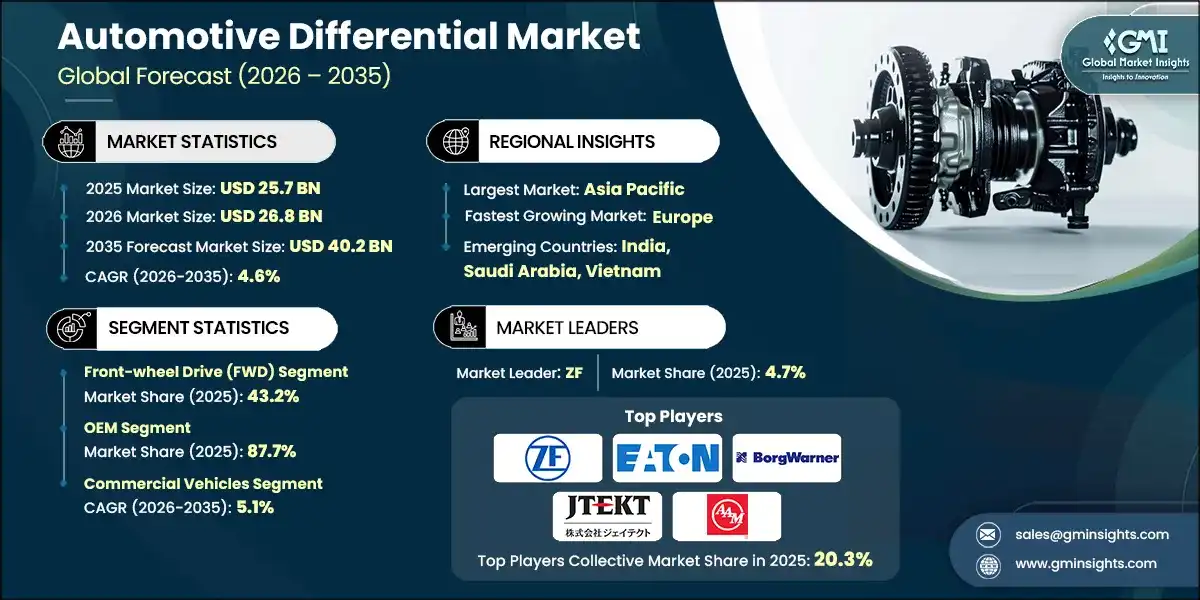
The global automotive differential market was valued at USD 25.7 billion in 2025. The market is expected to grow from USD 26.8 billion in 2026 to USD 40.2 billion in 2035 at a CAGR of 4.6%, according to latest report published by Global Market Insights Inc.
Automotive Differential Market Key Takeaways
Market Size & Growth
- 2025 Market Size: USD 25.7 Billion
- 2026 Market Size: USD 26.8 Billion
- 2035 Forecast Market Size: USD 40.2 Billion
- CAGR (2026–2035): 4.6%
Regional Dominance
- Largest Market: Asia Pacific
- Fastest Growing Region: Europe
Key Market Drivers
- Rising Global Vehicle Production.
- Growing Demand for SUVs and All-Wheel Drive Vehicles.
- Growth in Off-Road and Recreational Vehicle Segment.
- Increasing Penetration of Commercial Vehicles.
Challenges
- Weight and Packaging Constraints in Vehicles.
- Complexity in Design and Maintenance.
Opportunity
- Rising Adoption of Electric Differentials in EVs.
- Increasing Aftermarket Demand for Performance Differentials.
- Growth in Emerging Automotive Markets.
- Development of Lightweight and Compact Differential Solutions.
Key Players
- Market Leader: ZF led with over 4.7% market share in 2025.
- Leading Players: Top 5 players in this market include ZF, Eaton, BorgWarner, JTEKT, American Axle & Manufacturing, which collectively held a market share of 20.3% in 2025.
Get Market Insights & Growth Opportunities
Production of vehicles is increasing worldwide due to various reasons, such as increased disposable income of the middle class and expansion of the transportation & logistics industry. As the demand for vehicles will rise, it will support the automotive differential manufacturers to generate more revenue continuously in coming years.
As per OICA statistics, in 2024, over 67.7 million units were produced, in which China alone produced over 27.5 million units. The worldwide passenger car production is up about 4.9% as compared to 2022.
Additionally, in 2024, a survey found that the ratio between cars and ownership has increased to one car for every 5.5 individuals. This number is continuously increasing, resulting in an increased number of car production which will directly impact demand for automotive differential. Additionally, growing per capita income is the main reason for owning or affording at least one car.
Meanwhile, in recent years, the world has noticed a growth in the public transportation and logistics industries. This also has pushed the global production of commercial vehicles like buses, vans and trucks to support applications like public transport and goods transport.
Geographically, Asia Pacific is the biggest market for automotive differentials, as the majority of the global production was performed in this region. Countries like China, Japan, India and South Korea are continuously experiencing vehicle demand. Thus, global players and regional players are experiencing growth in vehicle sales.
For instance, in Q1 2025, Daimler Truck reported their trucks business experienced growth in the Asia Pacific region. The truck business has experienced around 16% growth as compared to Q1 2024.
To get key market trends
Automotive Differential Market Trends
Manufacturers are advancing automotive differentials based on vehicle-specific needs. Rising penetration of EVs as well as hybrid models, supports these manufacturers in producing these vehicle specific differentials that will help these players to continue to hold their market position. This change is pushing suppliers to redesign and integrate differential systems into vehicle platforms.
In July 2025, BorgWarner signed a deal with a major Chinese OEM to provide its electric cross differential (eXD) technology for electric vehicles in China. The eXD technology improves handling and traction by controlling how power is distributed between the wheels.
As a result, the automotive industry is now also focusing on electrified powertrains as electric and hybrid vehicles. These vehicles need different types of differential systems compared to traditional internal combustion engine (ICE) drivetrains. Electrically controlled differentials and e-differentials are becoming more important because they help distribute torque efficiently in electric vehicles.
Suppliers are focusing on technologies like electronic limited-slip differentials (eLSD) and torque-vectoring systems. These systems improve torque control, traction, and stability, especially in premium, performance, and all-wheel-drive (AWD) vehicles. As software and sensors become more connected to vehicle controls, electronic and smart differential systems are expected to grow in market share.
Environmental and regulatory rules focused on fuel efficiency and lower emissions are encouraging automakers and suppliers to create lighter and more efficient differential designs. Using materials like aluminum, composites, and optimized gear sets helps reduce weight and improve efficiency, supporting the trend toward lighter vehicles and lower energy use.
Automotive Differential Market Analysis
Learn more about the key segments shaping this market
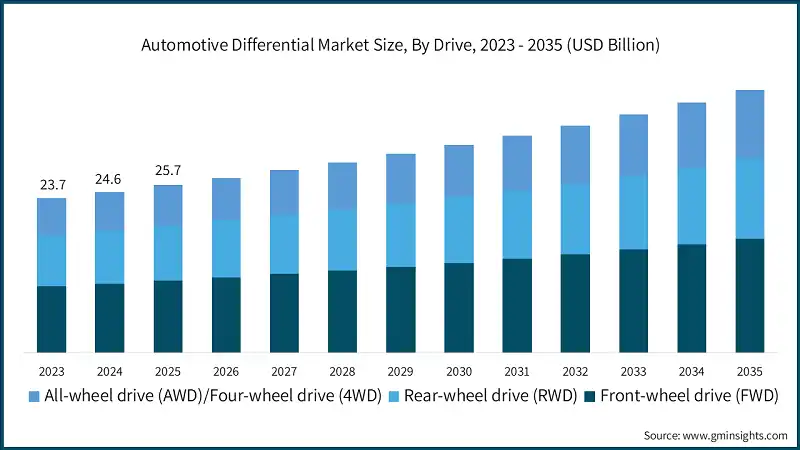
Based on drive, the market is divided into front-wheel drive (FWD), rear-wheel drive (RWD) and all-wheel drive (AWD)/four-wheel drive (4WD). The front-wheel drive (FWD) segment dominated the market with 43.2% share in 2025.
- In 2025, the front-wheel drive (FWD) segment led the automotive differential market with a value of USD 11.1 billion. FWD is popular because it is affordable. It combines the engine and differential into one unit, unlike rear-wheel drive (RWD) or all-wheel drive (AWD)/four-wheel drive (4WD) systems. This design lowers production costs, making FWD vehicles cheaper and more widely used worldwide.
- FWD vehicles are also more fuel-efficient. They are lighter than AWD or RWD vehicles because they use fewer parts in the drivetrain, which reduces energy loss. The combination of better fuel efficiency and lower weight makes FWD cars attractive to many consumers.
- However, the AWD/4WD segment is expected to grow the fastest, with a CAGR of 5.5% from 2026 to 2035 due to increasing demand for off-road and performance vehicles. Many automotive players are introducing differentials for AWD/4WD drives.
- For instance, in July 2025, JJE Technologies announced DL Combo, a fully integrated disconnect and locker differential system. By combining eDisconnect and eLocker functionalities into a single, compact unit, this innovation provides electrified all-wheel-drive (eAWD) vehicles with uncompromised off-road capability and low energy consumption.
Learn more about the key segments shaping this market
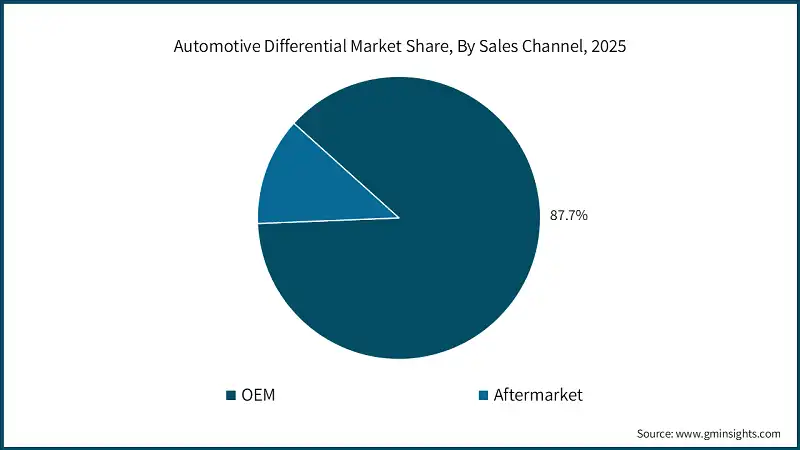
Based on sales channel, the automotive differential market is divided into OEM and aftermarket. The OEM segment accounts for 87.7% share in 2025 and is expected to reach USD 35.9 billion by 2035.
- The quality, adaptability, and performance of original equipment manufacturers (OEMs) make them the primary source of differentials for automakers. This trend suggests that the automotive industry would be more focused on the production of cars with integrated parts, as the fixed/non-recliner segment.
- One of the factors driving the growth of OEMs is the increasing application of advanced vehicle technologies. Modern systems such as limited-slip and electronic differentials require accurate adjustments during manufacturing. Automakers are benefiting from this, as OEMs are better at giving the advanced solutions that will ensure cars are efficient, safe, and high performing.
- At the same time, aftermarket players are benefiting from vehicle age and mileage. As the global vehicle fleet ages, demand for replacement differentials rises, especially in regions where older vehicles remain in use. Therefore, the aftermarket segment is expected to grow at the CAGR of 3.3% in the forecast period of 2026 to 2035.
Based on vehicle, the automotive differential market is divided into passenger cars and commercial vehicles. The commercial vehicles segment is expected to grow at the fastest CAGR of 5.1% between 2026 and 2035.
- The worldwide sales trend of commercial vehicles resulted in the market’s fastest growth within the segment. As the market is projected to grow at the fastest CAGR, there will be an increased demand for commercial vehicle differentials.
- Key players are introducing products specifically made for commercial vehicles. For instance, in December 2024, Dana Incorporated announced the new AdvanTEK 40 Pro axle system, designed to meet evolving commercial vehicle fleet requirements with increased efficiency and enhanced overall productivity.
- Also, passenger cars will continue to be a dominant segment by vehicle category in the automotive differential market. The segment is expected to reach USD 26.5 billion by 2035.
Looking for region specific data?
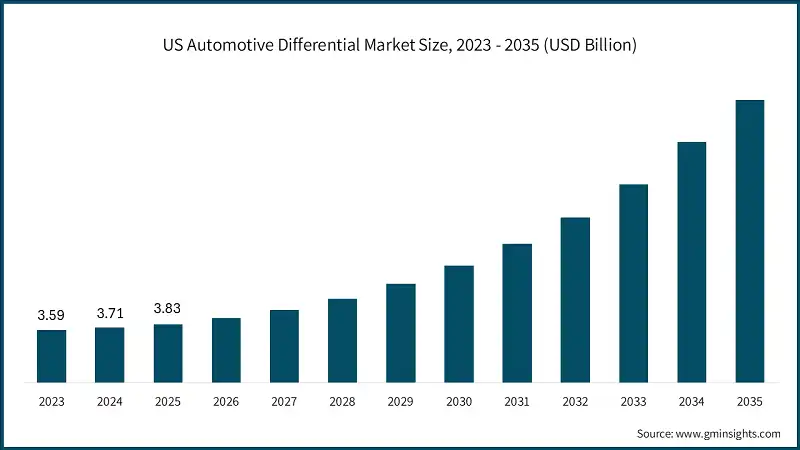
The US automotive differential market reached USD 3.83 billion in 2025, growing from USD 3.71 billion in 2024.
- In 2024, sales of new light vehicles in the US reached 16 million units, over 60% of which were manufactured locally. The new tariff imposed by the U.S. government encourages global automotive players to establish manufacturing facilities in the U.S.
- Establishing a manufacturing facility poses several types of cost burdens on OEMs, mainly those who produce components on their own. Thus, there are potential partnership opportunities for other players to supply these OEMs automotive components, including several types of differentials as per their specific needs.
- Also, many automotive OEMs are experiencing growth in terms of revenue in the U.S. OEMs such as Mercedes-Benz and Volkswagen have already stated the positive growth in the country.
- For instance, Volkswagen's release of fourth-quarter results for 2024 reveals 2 per cent growth in the U.S. market. Similarly, the same period result was also beneficial for Mercedes-Benz, experienced a good sales performance in the U.S. in the fourth quarter.
The North America region is estimated to reach USD 6.4 billion by 2035 by growing at the CAGR of 3.6% between 2026 and 2035.
- The market is benefiting in the region because of the expansion of commercial vehicle applications. According to the European Automobile Manufacturers' Association (ACEA), in 2024, North America led with a 1.7% increase in sales compared to 2023, reaching 4 million units and representing a 30% market share in commercial vehicle registrations.
- The region’s view on commercial vehicles is creating opportunities for automotive differential manufacturers to enter the market with a vast range of commercial vehicle differentials.
- As major OEMs like Volkswagen’s results for Q4 2024 revealed that the Volkswagen Group delivered 1.06 million vehicles, 6.4 per cent more than in the previous year.
- Moreover, in 2024, North America produced over 16 million vehicles, representing its over 17% market share in global production. This number will increase if automotive giants establish their vehicle production plants in the region.
The Europe automotive differential market accounted for USD 4.9 billion in 2025 and is anticipated to grow at the CAGR of 5.6% between 2026 and 2035.
- The region is home to many automotive OEMs like Daimler Trucks, Volkswagen Group, Stellantis and BMW Group. These players have significant dominance in the market, indicating the majority of the market share as OEM.
- In 2024, the region experienced a decline in terms of automotive production, which fell by 6.2% compared with last year. However, the dominance of these OEMs and continuous expansion strategies will create new growth opportunities for the differential market in terms of the revenue.
- On top of that, the region is shifting towards EV by introducing a plan of 90% EV sales share in total vehicles by 2035, encouraging automotive differential players to adopt EV-specific differential mechanisms to capture major market share.
Germany's automotive differential market is growing quickly in Europe, with a strong CAGR of 5.2% between 2026 and 2035.
- The market for automotive differentials in the country has now been supported by electric and advanced drivetrains. As electric and hybrid vehicles become more popular, driven by policies to cut emissions, manufacturers are adding features like electronically controlled differentials, torque vectoring systems, and advanced mechatronic solutions.
- Additionally, the market is steadily expanding, supported by its strong luxury and performance car industry. Brands like BMW, Mercedes-Benz, and Audi continue to need high-quality differential systems. The market is expected to grow at a CAGR of 5.2% between 2026 and 2035. This growth reflects global trends and strengthens Germany's lead in Europe's differential sub-assembly market.
- New automotive players are expanding their vehicle production facilities in Germany. For instance, in September 2025, Dreame Cars announced the selection of Brandenburg for establishing its new factory. The site will enable Dreame Cars to leverage this region's mature localized supply chain for key automotive components, significantly shorten the R&D lifecycle, and reduce logistics costs.
The Asia Pacific automotive differential market is estimated to reach USD 23.2 billion by 2035, by growing at a CAGR of 4.7% during the analysis timeframe.
- The region accounts for over 57% share within the automotive differential market, that reflects the region's dominance in the local vehicle production. As the region is the largest automotive manufacturing hub, with significant production volumes in countries such as China, Japan, India, and South Korea, this will continue to push the region’s dominance in the differential market.
- Additionally, increasing vehicle ownership and rising demand for passenger vehicles, especially SUVs and trucks, drive the need for differentials in the region. Another opportunity emerged as several countries are increasingly investing in autonomous driving research & development, promoting favorable government policies, and fostering collaborations between technology companies and automakers.
- Such factors collectively contribute to the APAC region's dominant position in the market.
China is estimated to grow with a CAGR of 4.3% in the projected period between 2026 and 2035, in the Asia Pacific automotive differential market.
- China has its strong dominance in the global automotive industry. There are currently more than 150 active brands in the Chinese automobile market. According to the China Association of Automobile Manufacturers (CAAM), in 2024, China produced 31.3 million vehicles (+3.7%), while the total new vehicle market increased by 4.5% to 31.44 million vehicles.
- Additionally, China’s EV strategy could give the differential market new revenue heights. Government policies supporting new energy vehicles, coupled with rising consumer preference for performance and safety features, are encouraging OEMs and suppliers to invest in innovative, cost-efficient differential technologies across both domestic and export-orientated segments.
- Differentials made for EVs will see a potential growth opportunity in coming years. The country’s priority for local production will support the players who are based in or have their presence in China.
Latin America automotive differential market is estimated to reach USD 857.6 million in 2025 and is anticipated to show lucrative growth over the forecast period.
- Demand for differentials in the region depends on vehicle production and sales in key markets like Brazil, Mexico, and Argentina. These countries have major automotive assembly operations and supply both local and export markets.
- While Latin America has a smaller share of the differential market compared to Asia-Pacific and North America, factors like urbanization, more light vehicle ownership, and investments in commercial and light-truck segments are keeping the demand steady. This includes demand for open, limited slip, and locking differentials.
- In addition to passenger cars and light commercial vehicles, industries like agriculture, mining, and off-road applications are driving the need for strong differential systems. This is especially true in rural and industrial areas of Brazil and Argentina.
- The aftermarket also supports demand, as older fleet vehicles require maintenance and replacement parts. Sales of differential gears and assemblies remain steady. The market is expected to grow steadily through the late 2020s, driven by both new vehicle production and replacement cycles in the aftermarket.
Brazil is estimated to grow with a CAGR of 3.6% between 2026 and 2035, in the Latin America automotive differential market.
- The market in Brazil is an important part of the country’s large automotive industry, which is one of the biggest in Latin America. This market is driven by the variety of vehicles in Brazil, including SUVs, pickup trucks, light commercial vehicles, and a large number of passenger cars.
- Durable differentials are popular with both original equipment manufacturers (OEMs) and the replacement parts market because they work well off-road and in tough conditions. Brazil’s strong automotive industry, with factories from major global OEMs and a developed supplier network, drives demand for drivetrain parts like open, limited slip, and locking differentials.
- Advanced traction systems and the gradual move to electric vehicles are expected to affect Brazil's differential market. Globally, high-tech differentials with electronic controls and torque-vectoring are common in premium and performance cars. In Brazil, their use depends on the country's progress in adopting electric vehicles and the growing demand for cars with better stability and control.
The Middle East and Africa accounted for USD 716.7 million in 2025 and is anticipated to show lucrative growth over the forecast period.
- Vehicle ownership, industrial growth, and more construction activities are increasing the demand for OEM drivetrain components and aftermarket replacements in the region. The MEA differential market is expected to grow at a compound annual growth rate of about 2.5% from 2026 to 2035, driven by the modernization of vehicle fleets and rising car sales.
- In the MEA region, demand depends on the types of vehicles and terrain needs. Countries like Saudi Arabia, the United Arab Emirates, South Africa, Egypt, and Nigeria are major contributors, each showing different growth patterns. In the Middle East, off-road and utility vehicles, which need strong differential systems to handle tough conditions, are especially popular due to desert and rural areas.
- In Africa, growing cities and the logistics industry are increasing the need for commercial vehicles with reliable drivetrain parts. The aftermarket for differential gears and related parts is also important, as older vehicles still in use require repairs and replacements.
UAE to experience substantial growth in the Middle East and Africa automotive differential market in 2025.
- The UAE's market is small but growing, supported by strong vehicle sales and the demand for rugged, high-performance vehicles that need reliable drivetrain systems.
- In the UAE, the types of vehicles commonly used, like SUVs, 4WDs, and luxury models, drive the demand for differentials. These vehicles require good traction, stability, and off-road capabilities. Many vehicles, especially those used for desert driving and off-road activities, come with locking or anti-slip differentials to handle sandy and rough terrains.
- This increases the need for differential parts in both the aftermarket and from original equipment manufacturers (OEMs). Additionally, wealthy consumers in the UAE, who are interested in the latest vehicle technologies, keep the demand for advanced drivetrain components high, especially in premium vehicles.
Automotive Differential Market Share
- The top 7 companies in the automotive differential industry are ZF, Eaton, BorgWarner, JTEKT, American Axle & Manufacturing, Dana and GKN Automotive, contributing 25.4% of the market in 2025.
- ZF Friedrichshafen makes automotive differential systems, including conventional, limited slip, and electronically controlled units. These systems are designed to work with different driveline setups. ZF's differentials are used in passenger and commercial vehicles.
- Eaton produces automotive differentials like mechanical locking and limited-slip types for light-duty, commercial, and off-highway vehicles. These differentials help manage wheel speed differences, improving traction, stability, and drivetrain efficiency under different loads and road conditions.
- BorgWarner makes differential systems for passenger vehicles and light trucks. Their products include limited-slip and electronically controlled systems that manage torque transfer between wheels.
- JTEKT manufactures differential assemblies and driveline components for passenger cars and commercial vehicles. Their differentials are designed to handle torque distribution and speed differences between wheels, improving stability and compatibility with axle and steering systems.
- American Axle & Manufacturing makes differentials as part of complete axle systems for light trucks, SUVs, and passenger vehicles. These differentials are built to efficiently transmit torque while handling load changes and durability requirements.
- Dana produces differential systems for passenger vehicles, commercial trucks, and off-highway vehicles. Company offers multiple differentials to meet industry’s specific requirement.
- GKN Automotive makes differential and all-wheel-drive systems for passenger cars and light vehicles. Company offers a wide range of open differentials, including 2-pinion, 4-pinion, and AWD variants.
Automotive Differential Market Companies
Major players operating in the automotive differential industry are:
- ZF
- Eaton
- BorgWarner
- JTEKT
- American Axle & Manufacturing
- Dana
- GKN Automotive
- Linamar
- Schaeffler
- Magna
- ZF stands out with its wide range of differential products, ability to work with advanced vehicle systems, strong partnerships with OEMs, and expertise in both traditional and electronic differentials for passenger and commercial vehicles.
- Eaton’s strengths include its expertise in designing locking and limited-slip differentials, a strong presence in commercial and off-highway markets, modular designs, and a focus on making products durable and adaptable to different traction needs.
- BorgWarner is known for its work on electronically controlled and limited-slip differentials, integration with vehicle stability and traction systems, and its focus on meeting the needs of hybrid and electric drivetrains.
- JTEKT’s competitive edge comes from combining differential systems with steering and driveline components, its expertise in managing torque, and providing reliable designs for a variety of global OEMs.
- American Axle excels in integrating full axle systems, producing differentials and driveline components at scale, specializing in light trucks and SUVs, and ensuring durability under different load conditions.
- Dana offers a wide range of differential technologies, designs for high torque capacity, and solutions for heavy-duty and off-highway applications, while integrating these with axle and driveline systems.
- GKN focuses on all-wheel-drive and differential solutions, torque vectoring, advanced AWD systems, and supports both traditional and electric vehicle platforms.
Automotive Differential Market Report Attributes
| Key Takeaway | Details |
|---|---|
| Market Size & Growth | |
| Base Year | 2025 |
| Market Size in 2025 | USD 25.7 Billion |
| Market Size in 2026 | USD 26.8 Billion |
| Forecast Period 2026 - 2035 CAGR | 4.6% |
| Market Size in 2035 | USD 40.2 Billion |
| Key Market Trends | |
| Drivers | Impact |
| Rising Global Vehicle Production | Boosts demand for automotive differentials across passenger and commercial segments, supporting consistent OEM sourcing and large-scale production efficiencies. |
| Growing Demand for SUVs and All-Wheel Drive Vehicles | Increase the need for advanced differential systems to manage torque distribution, traction control, and improved on-road and off-road performance. |
| Growth in Off-Road and Recreational Vehicle Segment | Drives demand for robust and locking differentials that enhance durability, traction, and reliability in extreme terrain conditions. |
| Increasing Penetration of Commercial Vehicles | Rising deployment of trucks and vans for logistics and construction increases demand for heavy-duty differentials designed for high load capacity and long service life. |
| Pitfalls & Challenges | Impact |
| Weight and Packaging Constraints in Vehicles | Vehicle lightweighting targets and limited underbody space restrict differential design flexibility, challenging manufacturers to balance performance, durability, and compact integration. |
| Complexity in Design and Maintenance | Advanced differentials involve intricate mechanical and electronic components, increasing development costs, maintenance complexity, and dependence on skilled servicing infrastructure. |
| Opportunities: | Impact |
| Rising Adoption of Electric Differentials in EVs | Creates opportunities for electric differentials that improve drivetrain efficiency and enable independent torque distribution without conventional mechanical layouts. |
| Increasing Aftermarket Demand for Performance Differentials | Rising vehicle modification trends and motorsport participation drive aftermarket demand for performance-focused differentials offering improved traction and enhanced driving dynamics. |
| Growth in Emerging Automotive Markets | Rapid urbanization, rising income levels, and expanding vehicle fleets in emerging economies generate strong demand for reliable and cost-efficient differential systems. |
| Development of Lightweight and Compact Differential Solutions | Advancements in materials and engineering enable lightweight, compact differentials that support fuel efficiency goals and easier integration into modern vehicle architectures. |
| Market Leaders (2025) | |
| Market Leaders |
4.7% market share |
| Top Players |
|
| Competitive Edge |
|
| Regional Insights | |
| Largest Market | Asia Pacific |
| Fastest growing market | Europe |
| Emerging countries | India, Saudi Arabia, Vietnam |
| Future outlook |
|
What are the growth opportunities in this market?
Automotive Differential Industry News
- In October 2025, BorgWarner signed contracts with Chery to supply advanced All-Wheel Drive (AWD) technologies. These include the torque-on-demand transfer case with mechanical lock (Mlock TOD) and the Gen VI Cross Wheel Drive (XWD) system. BorgWarner will also provide its Gen VI XWD system, which includes the Gen VI coupling and electronic limited-slip differential, for Chery’s SUVs.
- In October 2025, Toyota Alabama started producing three new differentials designed for Toyota’s trucks, the Tacoma and Tundra, and the Toyota Sequoia.
- In July 2025, JJE Technologies launched the DL Combo, the first fully integrated disconnect and locker differential system. This system combines eDisconnect and eLocker features into one compact unit, giving electrified all-wheel-drive (eAWD) vehicles better off-road performance and lower energy use.
- In April 2025, Eaton introduced the EV Truetrac differential, designed for electric vehicles (EVs). This new design addresses challenges like working with low-viscosity oil, reducing noise, and handling high and instant torque.
The automotive differential market research report includes in-depth coverage of the industry with estimates & forecasts in terms of revenue ($ Mn/Bn) and volume (Units) from 2022 to 2035, for the following segments:
Market, By Differential
- Mainline/Intercity
- Open differential
- Limited-slip differential (LSD)
- Electronic limited-slip differential (ELSD)
- Locking differential
- Manual Locking (Driver-activated)
- Automatic Locking (Sensing wheel slip)
- Torque differential
Market, By Component
- Differential Gears
- Differential Case/Housing
- Bearings & Seals
- Electronic Control Components
Market, By Vehicle
Passenger cars
- Hatchback
- Sedan
- SUV
- Commercial vehicles
- LCV
- MCV
- HCV
Market, By Drive
- Front-wheel drive (FWD)
- Rear-wheel drive (RWD)
- All-wheel drive (AWD)/Four-wheel drive (4WD)
Market, By Propulsion
- ICE
- EV
- Hybrid
Market, By Sales Channel
- OEM
- Aftermarket
The above information is provided for the following regions and countries:
- North America
- US
- Canada
- Europe
- Germany
- UK
- France
- Italy
- Spain
- Russia
- Nordics
- Benelux
- Asia Pacific
- China
- India
- Japan
- South Korea
- ANZ
- Singapore
- Malaysia
- Indonesia
- Vietnam
- Thailand
- Latin America
- Brazil
- Mexico
- Argentina
- Colombia
- MEA
- South Africa
- Saudi Arabia
- UAE
Frequently Asked Question(FAQ) :
What was the market size of the automotive differential in 2025?
The market size was USD 25.7 billion in 2025, with a CAGR of 4.6% expected through 2035. The growth is driven by increasing vehicle production, rising disposable income, and the expansion of the transportation and logistics industry.
What is the projected value of the automotive differential market by 2035?
The market is poised to reach USD 40.2 billion by 2035, supported by advancements in differential technologies and the growing adoption of electric and hybrid vehicles.
What is the expected size of the automotive differential industry in 2026?
The market size is projected to reach USD 26.8 billion in 2026.
How much revenue did the front-wheel drive (FWD) segment generate in 2025?
The FWD segment generated approximately USD 11.1 billion in 2025, due to its affordability and cost-effective design.
What was the valuation of the OEM segment in 2025?
The OEM segment accounted for 87.7% of the market share in 2025, valued at USD 22.5 billion, and is expected to reach USD 35.9 billion by 2035.
What is the growth outlook for the commercial vehicles segment from 2026 to 2035?
The commercial vehicles segment is projected to grow at a CAGR of 5.1% till 2035, led by increasing global sales of commercial vehicles.
Which region leads the automotive differential sector?
The U.S. leads the market, with the market valued at USD 3.83 billion in 2025.
What are the upcoming trends in the automotive differential market?
Key trends include eLSDs, torque-vectoring and e-differentials for EVs and hybrids, along with lightweight aluminum and composite materials to improve efficiency and reduce emissions.
Who are the key players in the automotive differential industry?
Key players include ZF, Eaton, BorgWarner, JTEKT, American Axle & Manufacturing, Dana, GKN Automotive, Linamar, Schaeffler, and Magna.
Automotive Differential Market Scope
Related Reports