Summary
Table of Content

Automotive Computer Vision AI Market
Get a free sample of this report
Form submitted successfully!
Error submitting form. Please try again.
Thank you!
Your inquiry has been received. Our team will reach out to you with the required details via email. To ensure that you don't miss their response, kindly remember to check your spam folder as well!
Request Sectional Data
Thank you!
Your inquiry has been received. Our team will reach out to you with the required details via email. To ensure that you don't miss their response, kindly remember to check your spam folder as well!
Form submitted successfully!
Error submitting form. Please try again.
Automotive Computer Vision AI Market Size
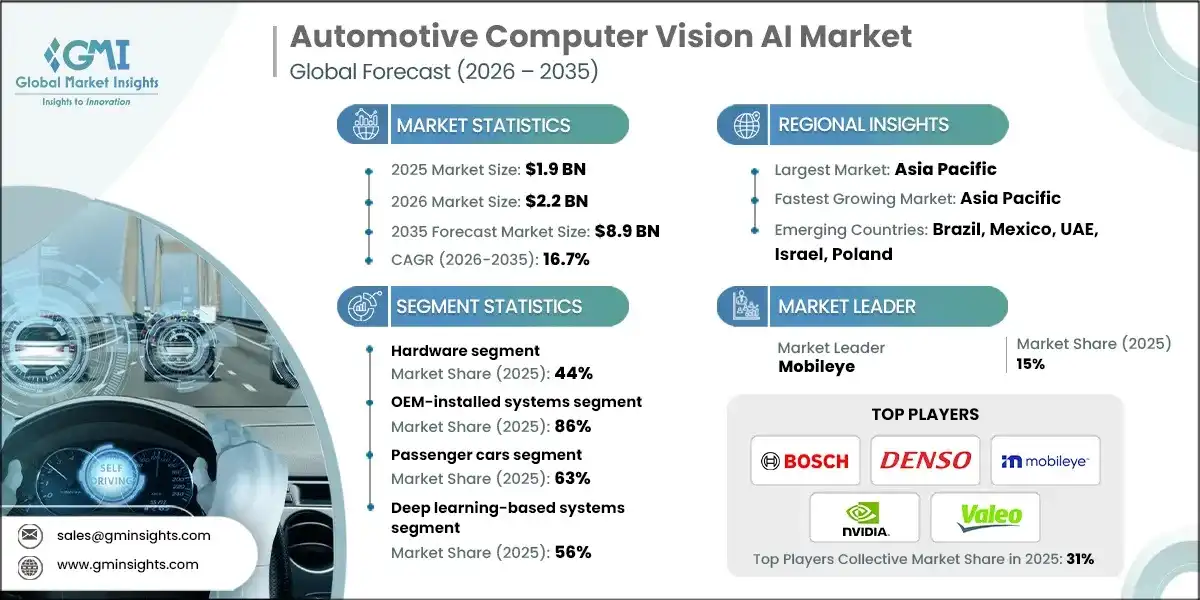
The global automotive computer vision AI market size was estimated at USD 1.9 billion in 2025. The market is expected to grow from USD 2.2 billion in 2026 to USD 8.9 billion in 2035, at a CAGR of 16.7% according to latest report published by Global Market Insights Inc.
Automotive Computer Vision AI Market Key Takeaways
Market Size & Growth
- 2025 Market Size: USD 1.9 Billion
- 2026 Market Size: USD 2.2 Billion
- 2035 Forecast Market Size: USD 8.9 Billion
- CAGR (2026–2035): 16.7%
Regional Dominance
- Largest Market: Asia Pacific
- Fastest Growing Region: Asia Pacific
Key Market Drivers
- Increasing adoption of advanced driver assistance systems (ADAS) in vehicles.
- Rising demand for autonomous and semi-autonomous vehicles.
- Stringent safety and emission regulations encouraging AI-based vision systems.
- Technological advancements in AI, machine learning, and sensor fusion.
- Growing investment by OEMs and Tier-1 suppliers in smart vehicle technologies.
Challenges
- High development and integration costs.
- Complexity in sensor fusion and real-time data processing.
Opportunity
- Growth of autonomous and semi-autonomous vehicles.
- Rising demand for in-cabin monitoring and safety features.
Key Players
- Market Leader: Mobileye led with over 15% market share in 2025.
- Leading Players: Top 5 players in this market include Bosch, Denso, Mobileye, NVIDIA, Valeo, which collectively held a market share of 31% in 2025.
Get Market Insights & Growth Opportunities
The automotive industry's rapid digital transformation is driving the shift toward intelligent, connected, and autonomous vehicles. Computer vision AI, combined with advanced sensor technologies, enables vehicles to perceive and respond to their environment with exceptional accuracy, revolutionizing safety systems and driver assistance capabilities.
Technologies once limited to luxury vehicles are now entering mainstream and entry-level segments. The International energy agency notes a 40% cost reduction in ADAS features over five years, driven by economies of scale, semiconductor advancements, and algorithm optimization. This has made advanced computer vision systems more accessible, accelerating market penetration.
The automotive computer vision AI market has evolved significantly since the early 2010s. From 2010 to 2017, it focused on single-function applications like lane departure warnings and forward collision alerts, relying on traditional image processing techniques. This phase established foundational architecture but faced computational and algorithmic limitations.
The second phase (2018-2023) witnessed the deep learning revolution transforming automotive computer vision capabilities. Convolutional neural networks (CNNs) and later transformer-based architecture enabled dramatic improvements in object detection, classification, and semantic segmentation accuracy.
Stanford University research highlights that modern deep learning-based computer vision systems achieve over 95% object detection accuracy in challenging scenarios, compared to 60-70% by traditional methods. This advancement has driven the large-scale adoption of Level 2+ automation systems and established the technology as critical for higher automation levels.
Between 2024 and 2035, system integration, advanced sensor fusion, and edge AI are driving advancements in computer vision systems. These systems now integrate data from cameras, LiDAR, radar, and ultrasonic sensors to create detailed environmental models. The shift to edge computing enables real-time decision-making while addressing latency, reliability, and privacy concerns.
Over the past five years, global investments in automotive computer vision AI have exceeded $180 billion, driven by venture capital and corporate funding. Companies like Waymo, Cruise, Aurora, and Argo AI have raised billions, while traditional automotive suppliers are heavily investing in R&D for computer vision advancements.
To get key market trends
Automotive Computer Vision AI Market Trends
The automotive computer vision AI industry is transitioning from modular perception pipelines to end-to-end deep learning systems. Developers like Waymo, Tesla, and Comma.ai now use neural networks that directly map sensor inputs to driving decisions, eliminating the need for handcrafted intermediate steps.
Deep learning research indicates that end-to-end models outperform human-engineered pipelines in feature representation, particularly in complex scenarios. According to the Journal of Machine Learning Research, these systems deliver 15-25% better performance in handling pedestrians, unusual objects, and complex intersections compared to modular approaches.
Research institutions like Stanford University and MIT are advancing vision-language models (VLMs) by integrating them with traditional computer vision systems. This enables vehicles to interpret visual scenes and respond to natural language commands, recognizing complex scenarios like "construction zone ahead" or "school bus loading children" without extensive programming.
Vision-language integration addresses a key challenge in autonomous driving by bridging the gap between visual cues and driving intentions. Research at Carnegie Mellon University shows VLM-equipped systems improve performance by 40-50% in tasks like yielding to emergency vehicles and interpreting complex road scenarios.
The automotive computer vision AI sector increasingly relies on synthetic data generation and simulation-based development to meet the high data demands for training perception systems. Collecting and annotating real-world driving data is costly, time-intensive, and inadequate for capturing rare but critical scenarios like sudden pedestrian movements or vehicle component failures.
Global privacy regulations, such as GDPR in Europe and CCPA in California, are pushing the automotive computer vision AI market toward privacy-preserving architectures. These frameworks aim to protect personal data while enabling continuous learning, addressing concerns over traditional methods that centralize raw camera footage, particularly in in-cabin monitoring systems.
Automotive Computer Vision AI Market Analysis
Learn more about the key segments shaping this market
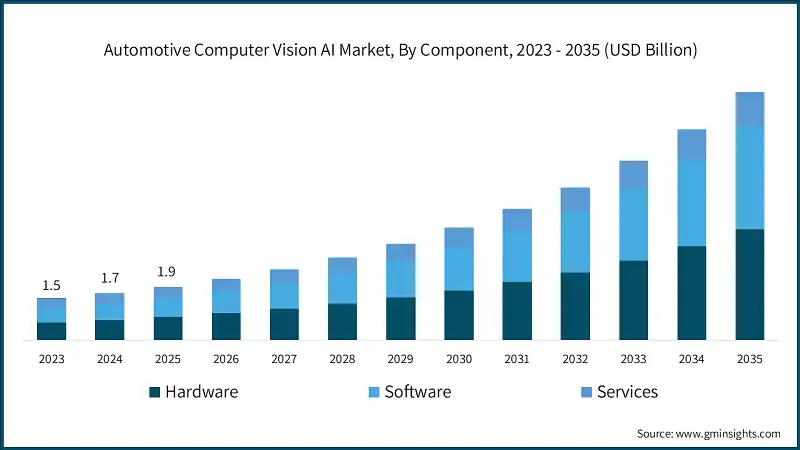
Based on component, automotive computer vision AI market is segmented into hardware, software and services. The hardware segment dominates the market with 44% share in 2025, and the segment is expected to grow at a CAGR of 16.9% from 2026 to 2035.
- The hardware segment comprises of cameras, imaging sensors, AI processors, memory system, power management electronics, and sensor integration components.
- Hardware forms the foundation for computer vision AI, holding a significant market share due to the complexity of automotive perception systems and the high costs of automotive-grade electronics meeting strict reliability and durability standards.
- Modern automotive computer vision systems use wide-angle cameras (120-180 degrees) for surround-view and parking, medium-angle cameras (50-60 degrees) for forward-facing ADAS, and narrow-angle cameras (25-35 degrees) for long-range object detection.
- Advanced ADAS systems, as per Bosch, Continental, and Aptiv, integrate 4-8 cameras with resolutions ranging from 1.2 megapixels (1280x960) to 8 megapixels (3840x2160), producing 40-80 megapixels of image data per frame.
- The software segment is expected to hold a 35% share by 2025, with an 18.9% CAGR, reaching USD 3.7 billion by 2035. Software advancements are emerging as the primary differentiator in automotive computer vision AI systems, with algorithm improvements surpassing hardware gains. The shift to software-defined vehicle architectures further enables continuous feature updates via over-the-air technology.
- The software segment includes perception algorithms (object detection, tracking, classification, semantic segmentation), fusion algorithms, localization and mapping software, prediction and planning algorithms, and system middleware.
- Over-the-air (OTA) update capabilities are transforming the software business model from one-time sales to continuous revenue streams through features-on-demand, subscription services, and hardware capability unlocking.
- The services segment is expected to reach USD 1.2 billion by 2035, with a 21% share in 2025 and an 11.4% CAGR. This represents the slowest growth rate among components, highlighting its maturity compared to the hardware and software segments.
- The services segment encompasses system integration, calibration and validation, maintenance and support, software updates and management, and consulting and training services.
- Despite slower growth, services remain a significant revenue stream, as vehicles require regular maintenance and updates throughout their 10–15-year lifespan.
- System integration services play a crucial role in automotive computer vision AI by combining cameras, AI processors, and software into validated and safety-certified systems, requiring specialized expertise.
Learn more about the key segments shaping this market
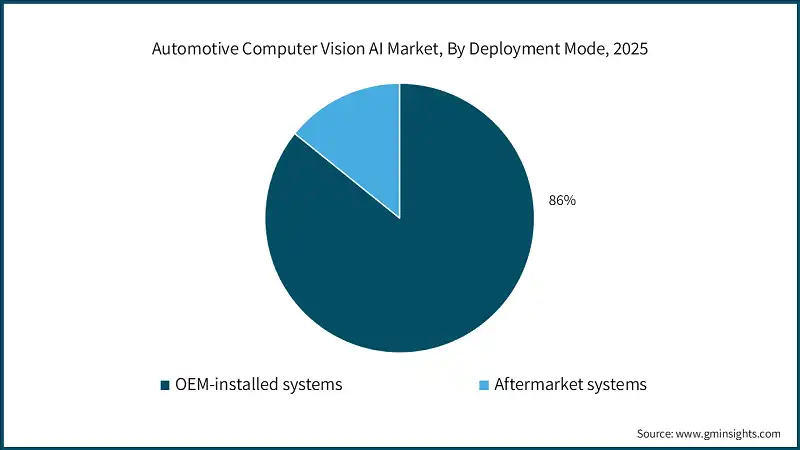
Based on deployment mode, automotive computer vision AI market is divided into OEM-installed systems and aftermarket systems. The OEM-installed systems segment dominates with 86% market share in 2025 and is growing at the fastest rate of 17% CAGR till 2035.
- The dominance of the OEM-installed systems segment stems from regulatory mandates, technical integration complexity, consumer preference for factory-integrated features with warranties, and cost advantages through economies of scale over aftermarket options.
- OEMs integrate computer vision AI systems during vehicle manufacturing, ranging from basic driver assistance in entry-level models to advanced automation in premium vehicles.
- The OEM-installed segment is experiencing rapid standardization of previous premium features across broader vehicle populations.
- Technologies like automatic emergency braking, lane keeping assistance, and driver monitoring systems are becoming standard in mainstream vehicles due to regulatory mandates, safety rating requirements (Euro NCAP, IIHS, CNCAP), and competitive pressures.
- Premium OEM-installed systems are pushing capability boundaries with comprehensive sensor suites and advanced automation features.
- OEM-installed systems capitalize on vertical integration and data feedback loops, offering advantages over aftermarket systems. They connect to vehicle CAN bus networks, enabling rapid access to state data and actuator control.
- Aftermarket systems are expected to hold a 14% market share by 2025, reaching USD 1 billion by 2035 at a CAGR of 14.9%. Although slower than OEM systems, they present notable market opportunities.
- Aftermarket computer vision AI systems enhance older vehicles, upgrade existing systems, support commercial fleets with specialized features, and replace failed or damaged OEM systems.
- The segment is particularly strong in commercial vehicle applications where return-on-investment calculations favor retrofitting existing fleets rather than replacing vehicles prematurely.
- The aftermarket segment faces challenges including installation complexity, regulatory constraints on after-market safety system modifications, and consumer uncertainty about product effectiveness and compatibility.
Based on vehicles, the automotive computer vision AI market is segmented into passenger cars, commercial vehicles, electric vehicles and autonomous vehicles. The passenger cars segment dominates with 63% market share in 2025 with 16.9% CAGR during 2026 to 2035.
- The passenger cars segment dominates the automotive computer vision AI market, driven by global production of approximately 75 million units annually and increasing adoption of ADAS features alongside rising demand for safety and convenience technologies.
- Computer vision AI systems in passenger cars support applications ranging from basic parking assistance and lane keeping to advanced Level 2+ automation, including highway driving, traffic jam assistance, and automated parking.
- The passenger cars segment is experiencing rapid technology cascading from luxury to mainstream markets, driven by declining system costs and regulatory mandates.
- Key applications driving the passenger vehicle segment include adaptive cruise control with stop-and-go capability, lane centering assistance, automated emergency braking, traffic sign recognition, and parking assistance systems.
- In 2025, the commercial vehicles segment holds an 18% market share and is projected to reach USD 1.5 billion by 2035, driven by a 16.8% CAGR and increasing automation in logistics and transportation.
- Commercial vehicles, including delivery vans, trucks, and buses, are ideal for computer vision AI deployment due to their structured operating environments, high utilization rates, and potential for reducing operational costs.
- The U.S. Department of Transportation reports that autonomous commercial vehicles could lower logistics costs by 30-45% through driver cost savings, optimized fuel efficiency, and 24/7 operational capability.
- Long-haul trucking is the most valuable application in commercial vehicles. Companies such as Aurora, TuSimple, Kodiak Robotics, and Plus are developing Level 4 autonomous truck systems for highway freight transport.
- Electric vehicles are expected to account for 13% of the market by 2025 and reach USD 1.2 billion by 2035, growing at a CAGR of 17.7%. This growth highlights the integration of electrification and vehicle intelligence in next-generation mobility.
- Electric vehicles are ideal for advanced computer vision AI deployment due to higher electrical power availability, flexible software-defined architecture, and their positioning as premium, technology-forward products. Manufacturers also use advanced features to differentiate in the competitive EV market.
- Global electric vehicle sales exceeded 14 million units in 2024, representing 18% of total vehicle sales, according to the International Energy Agency [IEA.ORG]. Projections indicate the EV market share could reach 35-40% by 2030 and over 60% by 2035 under current policy scenarios.
- Dedicated autonomous vehicles are specifically designed for driverless operation and are primarily used in robotaxi services, autonomous deliveries, and specialized applications like airport shuttles and campus transport.
- Autonomous vehicles, while growing slower than other segments, feature the highest technological intensity. Level 4 automation systems typically exceed $100,000 per vehicle.
- The autonomous vehicle segment is transitioning from development and testing phases toward commercial deployment and scaling.
- Waymo operates over 700 autonomous vehicles providing robotaxi services in Phoenix, San Francisco, and Los Angeles, completing over 100,000 paid rides weekly according to company reports.
Based on technology, the automotive computer vision AI market is divided between machine vision-based systems, deep learning-based systems and sensor fusion-based systems. Deep learning-based systems dominate with 56% market share in 2025, and with a CAGR of 16.7% during forecast period.
- Deep learning systems dominate the technology segmentation, aligning with overall market growth and solidifying their role in automotive computer vision AI.
- Deep learning uses neural network architectures to automatically learn hierarchical feature representations from data. This approach improves accuracy and robustness across various scenarios.
- The segment's growth is driven by continuous algorithmic improvements, increasing availability of training data, and hardware acceleration enabling real-time inference for complex models.
- The deep learning segment faces challenges such as the need for millions of annotated images for training, over 200 TOPS processing capability for advanced models, and interpretability issues due to the "black box" nature of neural networks.
- Deep learning capabilities are advancing rapidly, with annual benchmark performance improvements surpassing hardware efficiency gains. This progress reinforces its critical role in automotive computer vision.
- Machine vision-based systems are expected to hold a 10% market share in 2025 and grow to USD 761.7 million by 2035 at a 15.3% CAGR. This reflects the segment's maturity and its gradual replacement by deep learning methods in many applications.
- Machine vision refers to traditional computer vision techniques using handcrafted features, classical image processing algorithms, and rule-based decision logic rather than learned neural network representations.
- Despite slower growth, machine vision remains important for specific applications where interpretability, deterministic behavior, and computational efficiency are paramount.
- Machine vision is crucial in automotive applications, including parking assistance (surround-view stitching), lane detection (high-contrast marking identification), traffic sign detection (template matching), and driver monitoring.
- The segment is losing market share as deep learning-based methods outperform in tasks like pedestrian detection in cluttered environments, object classification under varying lighting, and semantic scene understanding.
- By 2025, sensor fusion-based systems will capture a 34% market share, projected to surge to USD 3.1 billion by 2035, marking a robust 17.1% CAGR during forecast period, the most rapid growth rate across technology segments.
- Sensor fusion uses algorithms to integrate data from various sensors, including cameras, LiDAR, radar, and ultrasonic devices. This process enhances environmental representation by leveraging each sensor's strengths and mitigating their weaknesses.
- This approach is becoming dominant for advanced ADAS and autonomous driving applications where safety requirements demand robust performance across all environmental conditions.
- The sensor fusion segment benefits from its alignment with automotive industry's conservative approach to safety, where redundancy and diverse sensing modalities provide robustness against single-point failures.
Looking for region specific data?
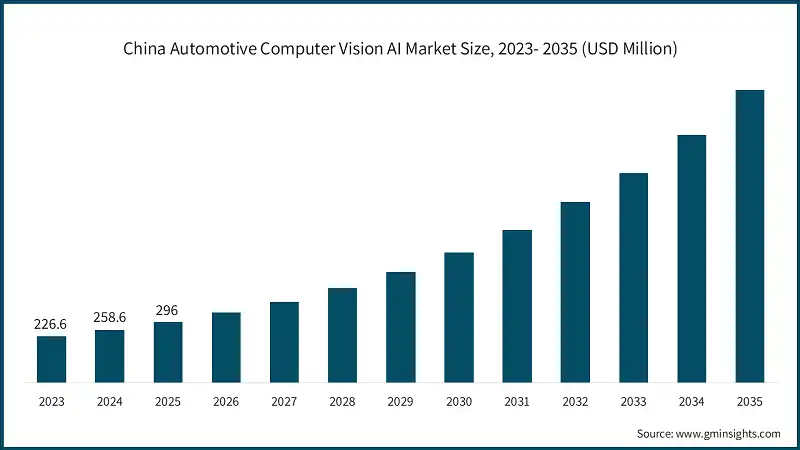
The China automotive computer vision AI market is expected to experience significant and promising growth with a CAGR of 17.2% from 2026 to 2035.
- China is expected to dominate the Asia Pacific market, holding 38% of the regional share in 2025. The market is projected to reach USD 1.4 billion by 2035, growing at a CAGR of 17.2%.
- China's market leadership reflects multiple factors making it the global epicenter for automotive computer vision AI innovation and deployment.
- China's national industrial policy prioritizes intelligent connected vehicles as a strategic industry. The Ministry of Industry and Information Technology aims for over 50% of new vehicle sales to feature Level 2+ automation by 2025 and significant commercial adoption of Level 3/4 automation by 2030.
- Governments allocate over $10 billion annually to R&D, support autonomous vehicle testing in 30+ cities, deploy smart infrastructure for V2X communication, and provide subsidies for advanced vehicle purchases.
- China's automotive industry is advancing rapidly, with domestic manufacturers such as BYD, NIO, XPeng, Li Auto, Geely, and Great Wall Motors introducing ADAS and automation features that compete with or outperform global rivals.
- Chinese EV manufacturers use advanced driver assistance systems (ADAS) as key differentiators by offering them as standard features. This approach is supported by China's mature AI and sensor supply chains, which reduce component costs compared to Western suppliers.
- China's autonomous vehicle development is progressing rapidly with support from technology companies including Baidu, Alibaba, Tencent, and specialized autonomous vehicle developers.
- Chinese autonomous vehicle developers capitalize on extensive datasets for AI training, government support for pilot programs, and advanced 5G infrastructure enabling V2X communication.
Asia Pacific dominated the automotive computer vision AI market with a market share of 41%, which is anticipated to grow at a CAGR of 17.7% during the analysis timeframe.
- The Asia Pacific region leads global automotive production with over 50 million vehicles annually, driven by supportive government policies, rapid electric vehicle adoption, and significant technological investments. It also houses the largest consumer markets, including China, India, Japan, and Southeast Asian nations.
- China's strong computer vision AI supply chain, featuring leading AI chip designers (Horizon Robotics, Black Sesame Technologies), camera and sensor manufacturers, and algorithm developers, gives it a significant competitive advantage globally.
- Manufacturers in China leverage the country's vast domestic market, collecting real-world data from millions of vehicles to swiftly refine and enhance their algorithms.
- Japan maintains technological leadership in the rest of Asia Pacific market, with domestic manufacturers Toyota, Honda, Nissan, and Subaru deploying advanced ADAS systems globally.
- Japan's automotive supplier ecosystem including Denso, Panasonic, and Hitachi provides advanced components and systems supporting both domestic and international OEMs.
- South Korea represents another high-growth market within rest of Asia Pacific, with domestic manufacturers Hyundai and Kia rapidly advancing their ADAS and autonomous vehicle capabilities.
- South Korea's government is advancing autonomous vehicle development by enabling testing in designated zones through regulatory sandbox programs, investing in 5G and V2X infrastructure, and allocating substantial R&D funding.
- India is the fastest-growing emerging market in rest of Asia Pacific, with annual automotive production nearing 6 million vehicles. This growth is driven by strong economic performance and an expanding middle class.
- India's market, traditionally centered on cost-sensitive vehicles, is witnessing accelerated ADAS adoption due to regulations mandating automatic emergency braking (initiated in 2023) and driver airbags.
- Southeast Asia, including Thailand, Indonesia, Vietnam, Malaysia, and the Philippines, offers significant growth potential with over 4 million vehicles produced annually and rapidly advancing economies.
- Japanese, Korean, and Chinese manufacturers are integrating advanced ADAS technologies into their vehicles, initially targeting premium segments before expanding to mainstream models.
US dominated the North America automotive computer vision AI market with a CAGR of 15.6% during the analysis timeframe.
- The U.S. boasts a diverse automotive landscape, spanning from budget-friendly mainstream vehicles to high-end luxury and performance models. Consumers increasingly favor larger vehicles, such as SUVs and pickups, valuing both spaciousness and power.
- These preferences come with budgets that accommodate advanced automotive systems. The country's extensive highway infrastructure is well-suited for automation technologies.
- By 2025, Tesla will strengthen its leadership in the U.S. automotive computer vision AI market by equipping its global fleet of over 5 million vehicles with vision-based ADAS and autonomous driving features.
- General Motors, Ford, and Stellantis (headquartered in the Netherlands but with major U.S. operations) are heavily investing in ADAS and autonomous vehicle technologies to compete with Tesla and global rivals.
- The U.S. automotive computer vision AI market features key players like NVIDIA with its DRIVE Orin and upcoming Thor platforms, Qualcomm's Snapdragon Ride, and startups offering solutions in perception, prediction, simulation, and validation.
- The U.S. regulatory framework supports innovation by allowing technological experimentation while ensuring minimum safety standards. States like California, Arizona, Nevada, Texas, and Florida further enable extensive autonomous vehicle testing and deployment.
- The National Highway Traffic Safety Administration has introduced voluntary guidelines requiring the reporting of automated vehicle crashes. This approach ensures regulatory oversight without imposing restrictive rules that could hinder innovation.
North America automotive computer vision AI market accounted for USD 385.2 million in 2025 and is anticipated to show growth of 15.7% CAGR over the forecast period.
- North America, the third-largest regional market by current value, plays a key role in automotive computer vision AI development.
- It hosts leading technology firms, autonomous vehicle testing programs, automotive manufacturers' technical centers, and a strong venture capital ecosystem driving innovation.
- In North America, companies like Google (Waymo), Amazon (Zoox), Tesla, NVIDIA, and Intel/Mobileye are fostering synergies between the automotive and technology sectors.
- By 2035, the U.S. is set to command 81% of the North American market, expanding its value to an impressive USD 1.3 billion, with a robust CAGR of 15.6%.
- Canada's market is expected to grow at a 16.4% CAGR, reaching USD 332.5 million by 2035, up from 19% of the regional market in 2025. This growth reflects its smaller base and faster technology adoption compared to the U.S.
- Canada's automotive market records approximately 1.8 million annual vehicle sales and reflects high consumer adoption of safety technologies and ADAS features.
- Canadian consumers face challenging winter driving conditions where advanced safety features provide value, driving above-average ADAS adoption rates.
- Transport Canada states that the government is introducing automatic emergency braking mandates and developing regulatory frameworks for automated vehicles to enhance safety.
- Canada's automotive manufacturing sector, including plants from General Motors, Ford, Stellantis, Honda, and Toyota, produces over 2 million vehicles annually, primarily serving North American markets.
- Canada is advancing technology development, particularly in autonomous vehicle testing, with programs in cities like Toronto, Ottawa, and Waterloo, supported by provincial governments and research institutions.
Germany dominates the Europe automotive computer vision AI market, showcasing strong growth potential, with a CAGR of 16.8% from 2026 to 2035.
- Germany stands out as Europe's top automotive producer, hosting premium brands like Mercedes-Benz, BMW, Audi, and Porsche, all of which are at the forefront of global advancements in ADAS and automation technologies.
- German manufacturers position technological sophistication as core brand attributes, offering cutting-edge computer vision AI systems in their vehicles and investing substantially in autonomous driving development.
- Mercedes-Benz launched Drive Pilot, the world’s first internationally certified Level 3 conditional automation system, initially in Germany and later approved in select U.S. states.
- Germany's automotive supply chain including Bosch, Continental, ZF Friedrichshafen, and numerous specialized technology companies provides advanced components and systems globally.
- Germany faces challenges such as slower EV adoption compared to China (despite recent acceleration), higher manufacturing costs than Asian competitors, and complex regulations balancing innovation with consumer protection.
- However, German manufacturers' premium positioning, technical capabilities, and substantial R&D investments sustain competitive leadership in automotive computer vision AI.
- The country promotes innovation through collaboration among the government, industry, and research institutions, focusing on publicly funded research, regulatory development, and infrastructure deployment.
Europe automotive computer vision AI market accounted for USD 593.1 million in 2025 and is anticipated to show growth of 16.5% CAGR over the forecast period.
- Europe's strong market position stems from stringent safety and environmental regulations, advanced automotive technologies, and early adoption of intelligent transportation systems by consumers.
- Leading European manufacturers, including Volkswagen Group, BMW, Mercedes-Benz, Stellantis, and Renault, are investing over $120 billion in electric and autonomous vehicle development, focusing on ADAS and autonomous technologies, through 2030.
- Germany holds the largest share of the European automotive computer vision AI market and is expected to sustain strong growth, driven by the increasing adoption of advanced driver assistance systems and autonomous vehicle technologies.
- The United Kingdom remains a prominent luxury automotive market despite Brexit challenges. Leading manufacturers like Jaguar Land Rover, Bentley, Rolls-Royce, Aston Martin, and McLaren are incorporating advanced ADAS technologies into their premium vehicles.
- The UK Department for Transport has introduced regulatory frameworks, including new legislation, to enable autonomous vehicles on public roads, contingent on meeting safety validation requirements.
- Italy's automotive industry, including Ferrari, Maserati, Lamborghini (Volkswagen Group), and Iveco, emphasizes performance and luxury segments, where advanced ADAS features are now standard.
- Spain produces over 2 million vehicles annually, primarily for European markets, with major international brands like Volkswagen, Renault, and Ford operating manufacturing facilities in the country.
- Nordic countries, including Sweden, Norway, Denmark, and Finland, exhibit high adoption rates of advanced vehicle technologies due to affluent populations, environmental awareness promoting EV adoption, and the need for safety technologies in challenging weather conditions.
- The Netherlands and Belgium are emerging as significant markets for advanced ADAS technologies, driven by high income levels, strong safety awareness, and supportive regulations
Brazil leads the Latin American automotive computer vision AI market, exhibiting remarkable growth of 15.7% during the forecast period of 2026 to 2035.
- Brazil, Latin America's largest economy and automotive market, leads the region in automotive computer vision AI, with approximately 2.5 million vehicles sold annually driving technology adoption.
- Brazil's automotive market, once centered on cost-sensitive vehicles with basic features, is now witnessing rising demand for safety technologies and ADAS features in premium and upper-mainstream segments.
- According to the Brazilian automotive industry association, vehicles with automatic emergency braking and other advanced safety features represented approximately 15% of sales in 2024, up from under 5% in 2020, indicating rapid growth though from a low base.
- Brazil faces significant market challenges, including high import tariffs on advanced automotive technologies, economic instability impacting consumer purchasing power, and weaker regulatory mandates for advanced safety features compared to developed markets.
- The country's large market size and the presence of global manufacturers like Volkswagen, General Motors, Ford, Fiat (Stellantis), Toyota, Honda, and Hyundai support technology deployment as these companies globally standardize ADAS features.
- Brazil's automotive computer vision AI market is increasingly influenced by regional manufacturing and adaptation of vehicles specifically for Latin American markets by manufacturers.
UAE to experience substantial growth in the Middle East and Africa automotive computer vision AI market in 2025.
- The UAE's market leadership is driven by high per-capita income, annual automotive sales of approximately 350,000 favoring premium and luxury vehicles, and government efforts to establish the country as a technology and innovation hub.
- UAE consumers show strong preference for premium vehicles from brands like Mercedes-Benz, BMW, Audi, Lexus, and Land Rover, where advanced ADAS features are standard. Approximately 40-45% of new vehicles sold in the UAE include these systems, among the highest adoption rates in the MEA region.
- The UAE government is advancing autonomous vehicle technologies, with Dubai's Autonomous Transportation Strategy targeting 25% of trips via autonomous means by 2030.
- The government has established regulatory frameworks enabling autonomous vehicle testing, with trials including autonomous taxis, buses, and delivery vehicles in designated zones.
- Automotive computer vision systems in the UAE must withstand extreme environmental conditions, including temperatures above 50°C, intense sunlight, sand, dust, and poor visibility during sandstorms.
Automotive Computer Vision AI Market Share
The top 7 companies in the automotive computer vision AI industry are Bosch, Continental, Mobileye, Magna International, Denso, Valeo and NVIDIA contributed around 36% of the market in 2025.
- Bosch's automotive computer vision AI portfolio includes mono, stereo, and multi-camera systems with resolutions from 1.2MP to 8MP, supporting applications like parking assistance and long-range object detection. Its multi-camera systems integrate 4-12 cameras with central processing units running proprietary perception algorithms for enhanced environmental awareness.
- Continental's automotive computer vision AI portfolio includes mono and stereo camera systems, surround-view cameras, infrared driver monitoring cameras, and integrated sensor platforms combining cameras with radar and/or LiDAR.
- Mobileye holds a market-leading position in automotive computer vision AI, driven by its pioneering role and a comprehensive technology stack that includes silicon, algorithms, and mapping.
- Magna, a leading diversified automotive supplier, generates over $40 billion in annual revenue. The company focuses on ADAS and driver assistance systems as a strategic growth area within its extensive product portfolio.
- DENSO offers a robust automotive computer vision AI portfolio, including cameras, image processing units, and integrated sensor systems, along with advanced ADAS solutions. It supplies components for Toyota Safety Sense, Honda Sensing, and other Japanese OEM ADAS brands with strong domestic and global market penetration.
- Valeo, a French automotive supplier, focuses on innovation with expertise in ADAS sensors and systems. The company generates nearly €20 billion annually, with 40% of its revenue coming from its Comfort & Driving Assistance Systems division.
- NVIDIA, with a 3.1% market share, plays a crucial role in AI computing for automotive computer vision. In 2024, its automotive division generated over $1 billion in quarterly revenue, driven by the DRIVE platform, which integrates hardware, software, and cloud services.
Automotive Computer Vision AI Market Companies
Major players operating in the automotive computer vision AI industry are:
- Aptiv
- Continental
- Denso
- Intel
- Magna
- Mobileye
- NVIDIA
- Qualcomm Technologies
- Robert Bosch
- Valeo
- Aptiv, Continental, Denso, Intel, Magna, Mobileye, NVIDIA, Qualcomm Technologies, Robert Bosch, and Valeo dominate the automotive computer vision AI market with expertise in AI-driven perception, sensor fusion, and high-performance computing. Their solutions seamlessly integrate with ADAS and autonomous driving platforms, ensuring precise object detection and real-time decision-making.
- These companies are advancing automotive computer vision AI through deep learning-based perception, multi-sensor fusion, edge AI processing, and scalable architectures. By integrating vision AI with vehicle ECUs and automation stacks, they enhance safety, reliability, and intelligence while leveraging OEM partnerships and global expertise.
- The market is expanding due to the growing adoption of ADAS and autonomous vehicles, stricter safety regulations, and rising demand for connected mobility solutions. Key players are driving automotive computer vision AI deployment, enabling safer and software-defined vehicles.
Automotive Computer Vision AI Market Report Attributes
| Key Takeaway | Details |
|---|---|
| Market Size & Growth | |
| Base Year | 2025 |
| Market Size in 2025 | USD 1.9 Billion |
| Market Size in 2026 | USD 2.2 Billion |
| Forecast Period 2026-2035 CAGR | 16.7% |
| Market Size in 2035 | USD 8.9 Billion |
| Key Market Trends | |
| Drivers | Impact |
| Increasing adoption of advanced driver assistance systems (ADAS) in vehicles | Boosts demand for computer vision AI to enable features like collision avoidance, lane keeping, and adaptive cruise control. |
| Rising demand for autonomous and semi-autonomous vehicles | Drives integration of AI vision systems for perception, decision-making, and safe vehicle operation. |
| Stringent safety and emission regulations encouraging AI-based vision systems | Encourages OEMs to implement AI-enabled monitoring to enhance safety compliance and reduce accident risks. |
| Technological advancements in AI, machine learning, and sensor fusion | Improves accuracy, reliability, and real-time performance of automotive vision systems across vehicle platforms. |
| Growing investment by OEMs and Tier-1 suppliers in smart vehicle technologies | Growing investment by OEMs and Tier-1 suppliers in smart vehicle technologies |
| Pitfalls & Challenges | Impact |
| High development and integration costs | Increases R&D and production expenses, potentially slowing adoption among cost-sensitive OEMs. |
| Complexity in sensor fusion and real-time data processing | Raises engineering challenges and development time, affecting system reliability and deployment speed. |
| Opportunities: | Impact |
| Growth of autonomous and semi-autonomous vehicles | Expands demand for computer vision AI to enable reliable perception and decision-making for self-driving systems. |
| Rising demand for in-cabin monitoring and safety features | Creates opportunities for AI-based driver monitoring and passenger safety applications. |
| Market Leaders (2025) | |
| Market Leaders |
15% Market Share |
| Top Players |
|
| Competitive Edge |
|
| Regional Insights | |
| Largest Market | Asia Pacific |
| Fastest growing market | Asia Pacific |
| Emerging countries | Brazil, Mexico, UAE, Israel, Poland |
| Future outlook |
|
What are the growth opportunities in this market?
Automotive Computer Vision AI Industry News
- In December 2025, Qualcomm expanded its Snapdragon Ride Vision platform, introducing new 8MP cameras and bolstering AI processing capabilities. The tech giant forged partnerships with automotive manufacturers across Europe and Asia, eyeing deployments for the 2027 model year.
- In November 2025, General Motors revived its Cruise autonomous vehicle program, focusing on next-generation designs and enhanced safety validation before resuming public road operations.
- In September 2025, Tesla rolled out a wide release of its Full Self-Driving (FSD) Beta v12. This version marks a significant shift from the previous modular approach to a comprehensive end-to-end neural network architecture, underscoring a pivotal redesign aimed at integrating vision, language, and action models.
- In August 2025, Mobileye announced the production of its EyeQ Ultra processor with a Chinese EV manufacturer. The processor delivers 176 TOPS performance, enabling Level 4 urban autonomous driving.
The automotive computer vision AI market research report includes in-depth coverage of the industry with estimates & forecasts in terms of revenue (USD Bn) from 2022 to 2035, for the following segments:
Market, By Component
- Hardware
- Cameras (mono, stereo, surround, infrared)
- Sensors (LiDAR, radar, ultrasonic)
- Processors & Edge AI chips
- Software
- AI & machine learning algorithms
- Computer vision platforms
- Image processing & object detection software
- Services
- System integration
- Consulting & customization
- Deployment & installation
- Maintenance & support
Market, By Vehicle
- Passenger Cars
- Hatchback
- SUV
- Sedan
- Commercial vehicles
- Light commercial vehicles (LCV)
- Medium commercial vehicles (MCV)
- Heavy commercial vehicles (HCV)
- Electric vehicles (EVs)
- Autonomous vehicles
Market, By Technology
- Machine vision-based system
- Deep learning-based system
- Sensor fusion-based system
Market, By Deployment Mode
- OEM-installed
- Aftermarket
Market, By Application
- Advanced driver assistance systems (ADAS)
- Forward collision warning (FCW)
- Automatic emergency braking (AEB)
- Lane departure warning (LDW)
- Lane keeping assist (LKA)
- Adaptive cruise control (ACC)
- Traffic sign recognition (TSR)
- Blind spot detection (BSD)
- Parking assist and surround view monitoring
- Autonomous driving
- Object and pedestrian detection
- Road edge and lane boundary detection
- Free space detection
- Environmental mapping
- Path planning support
- Incabin monitoring
- Driver monitoring system (DMS)
- Occupant monitoring system (OMS)
- Gesture recognition
- Seatbelt and child presence detection
- Others
The above information is provided for the following regions and countries:
- North America
- US
- Canada
- Europe
- Germany
- UK
- France
- Italy
- Spain
- Russia
- Netherlands
- Sweden
- Denmark
- Poland
- Asia Pacific
- China
- India
- Japan
- Australia
- South Korea
- Singapore
- Thailand
- Indonesia
- Vietnam
- Latin America
- Brazil
- Mexico
- Argentina
- Colombia
- MEA
- South Africa
- Saudi Arabia
- UAE
- Israel
Frequently Asked Question(FAQ) :
What is the market size of the automotive computer vision AI in 2025?
The market size was USD 1.9 billion in 2025, with a CAGR of 16.7% expected through 2035. The rapid digital transformation of the automotive industry, driven by intelligent, connected, and autonomous vehicles, is fueling market growth.
What is the projected value of the automotive computer vision AI market by 2035?
The market is poised to reach USD 8.9 billion by 2035, driven by advancements in deep learning systems, vision-language models, and privacy-preserving architectures.
What is the expected size of the automotive computer vision AI industry in 2026?
The market size is projected to reach USD 2.2 billion in 2026.
What was the market share of the hardware segment in 2025?
The hardware segment held a 44% market share in 2025 and is expected to grow at a CAGR of 16.9% from 2026 to 2035.
What was the market share of OEM-installed systems in 2025?
OEM-installed systems dominated the market with an 86% share in 2025 and is set to expand at a CAGR of 17% through 2035.
What was the market share of the passenger cars segment in 2025?
The passenger cars segment accounted for 63% of the market in 2025 and is anticipated to observe around 16.9% CAGR till 2035.
Which region leads the automotive computer vision AI sector in the Asia Pacific?
China leads the Asia Pacific market, holding 38% of the regional share in 2025. The market is projected to reach USD 1.4 billion by 2035, growing at a CAGR of 17.2%.
What are the upcoming trends in the automotive computer vision AI market?
Shift to end-to-end deep learning, use of vision-language models, synthetic data generation, and privacy-preserving architectures for GDPR/CCPA compliance.
Who are the key players in the automotive computer vision AI industry?
Key players include Aptiv, Continental, Denso, Intel, Magna, Mobileye, NVIDIA, Qualcomm Technologies, Robert Bosch, and Valeo.
Automotive Computer Vision AI Market Scope
Related Reports