Summary
Table of Content

Automotive Communication Technology Market
Get a free sample of this report
Form submitted successfully!
Error submitting form. Please try again.
Thank you!
Your inquiry has been received. Our team will reach out to you with the required details via email. To ensure that you don't miss their response, kindly remember to check your spam folder as well!
Request Sectional Data
Thank you!
Your inquiry has been received. Our team will reach out to you with the required details via email. To ensure that you don't miss their response, kindly remember to check your spam folder as well!
Form submitted successfully!
Error submitting form. Please try again.
Automotive Communication Technology Market Size
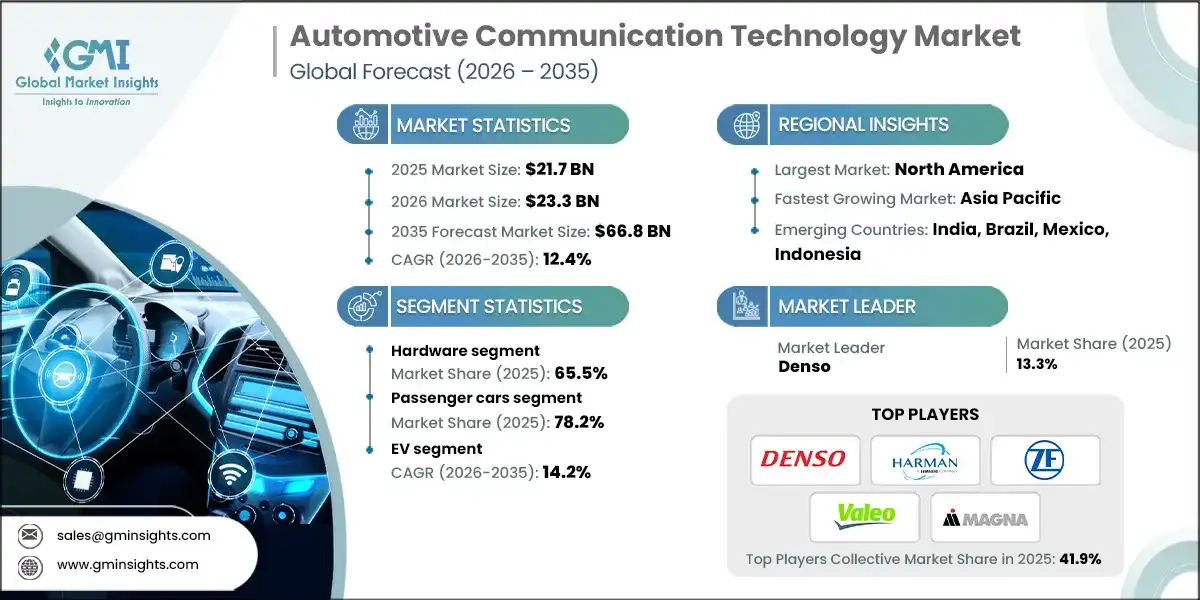
The global automotive communication technology market size was valued at USD 21.7 billion in 2025. The market is expected to grow from USD 23.3 billion in 2026 to USD 66.8 billion in 2035 at a CAGR of 12.4%, according to latest report published by Global Market Insights Inc.
To get key market trends
Communication technologies are evolving as vehicles become more connected and data-driven. Automakers and suppliers are adopting technologies that let vehicles communicate with each other, infrastructure, and cloud services. This includes hardware like telematics control units (TCUs) and software platforms for connected services.
One major change is the move to next-generation connectivity solutions. For example, LG Innotek recently introduced a new digital key solution. This shows how automotive components are now designed to securely connect vehicles with devices like smartphones.
Vehicle-to-Everything (V2X) communication is becoming more common. In June 2025, Verizon Business launched a V2X connected-driving platform, which is already being used by automakers and state transportation departments. This platform allows vehicles to communicate with other road users and infrastructure, showing practical use beyond testing.
The industry is also meeting the need for better data handling with advanced connectivity platforms. MediaTek recently launched intelligent cockpit and connectivity chips for vehicles. This shows that semiconductor companies are investing in automotive communication technology to improve in-car experiences and handle large amounts of data.
Regulations and industry cooperation are also important. As connected mobility grows worldwide, companies and standards organizations are working to align communication protocols and testing methods across regions. This helps automakers sell vehicles in different markets and ensures consistent safety and performance.
Automotive Communication Technology Market Report Attributes
| Key Takeaway | Details |
|---|---|
| Market Size & Growth | |
| Base Year | 2025 |
| Market Size in 2025 | USD 21.7 Billion |
| Market Size in 2026 | USD 23.3 Billion |
| Forecast Period 2026 - 2035 CAGR | 12.4% |
| Market Size in 2035 | USD 66.8 Billion |
| Key Market Trends | |
| Drivers | Impact |
| Rising Vehicle Electrification and Software-Defined Vehicles | Electrification and software-defined architectures increase reliance on high-speed, scalable communication networks to manage power systems, software updates, and vehicle-wide data flows. |
| Growing Integration of Advanced Driver Assistance Systems (ADAS) | ADAS deployment drives demand for low-latency, high-bandwidth communication technologies to support real-time sensor fusion, decision-making, and safety-critical vehicle functions. |
| Increasing Demand for In-Vehicle Infotainment and Connectivity | Rising consumer expectations for seamless infotainment, navigation, and connected services accelerate adoption of in-vehicle communication and data exchange technologies. |
| Shift Toward Autonomous and Semi-Autonomous Vehicles | Autonomous driving requires reliable, high-speed communication architectures to enable continuous data exchange between sensors, controllers, and centralized vehicle computing units. |
| Pitfalls & Challenges | Impact |
| Complexity of Network Integration and Interoperability | Integrating multiple communication protocols across legacy and next-generation architectures increases system complexity, development timelines, validation efforts, and overall engineering costs. |
| Cybersecurity and Data Privacy Concerns | Expanding vehicle connectivity increases exposure to cyber threats, driving higher security investments and slowing adoption of advanced automotive communication technologies. |
| Opportunities: | Impact |
| Growth of Vehicle-to-Everything (V2X) Communication | V2X communication enables advanced safety, traffic optimization, and smart infrastructure interaction, creating strong demand for next-generation automotive networking solutions. |
| Increasing Adoption of 5G-Enabled Automotive Networks | 5G provides ultra-low latency and high bandwidth, enabling real-time connectivity, enhanced vehicle services, and scalable support for autonomous mobility applications. |
| Expansion of Electric and Autonomous Commercial Vehicles | Commercial electric and autonomous fleets require advanced communication systems for fleet monitoring, diagnostics, predictive maintenance, and data-driven operational efficiency. |
| Integration of AI-Driven In-Vehicle Data Processing | AI-driven vehicle intelligence increases demand for high-bandwidth, low-latency communication networks supporting real-time analytics, adaptive controls, and continuous learning systems. |
| Market Leaders (2025) | |
| Market Leaders |
13.3% market share |
| Top Players |
|
| Competitive Edge |
|
| Regional Insights | |
| Largest Market | North America |
| Fastest growing market | Asia Pacific |
| Emerging countries | India, Brazil, Mexico, Indonesia |
| Future outlook |
|
What are the growth opportunities in this market?
Automotive Communication Technology Market Trends
Car makers and technology companies are switching from older, slower networks to faster connections in vehicles. They are using Ethernet-based systems and zonal designs to manage the increasing number of cameras, sensors, and controllers in modern cars. These changes improve data flow and prepare vehicles for advanced safety and driver assistance systems.
More vehicles now have connected and telematics features. Fleet operators and car makers use these technologies to get real-time data, plan maintenance, and improve how fleets work. This helps reduce downtime and cut operating costs.
Vehicle-to-Everything (V2X) communication systems are becoming more common as cities and governments invest in smarter transport systems. These systems let cars connect with roads, other vehicles, and traffic systems, making travel safer and improving traffic flow. Companies like Continental, Qualcomm, and NXP are leading in this field.
In October 2025, Volkswagen announced that it had produced over two million cars with Car2X technology in Europe. These cars use local swarm intelligence to communicate with each other and with nearby traffic systems in real time, helping to reduce road accidents.
Automotive OEMs and suppliers are focusing on making connectivity across platforms secure and easy. The Car Connectivity Consortium highlights the need for standardized and secure connections in future vehicles. For example, in October 2025, NTT and Toyota Motor Corporation started a joint project on mobility and AI/telecommunications to work toward a future with no traffic accidents.
Automotive Communication Technology Market Analysis
Learn more about the key segments shaping this market
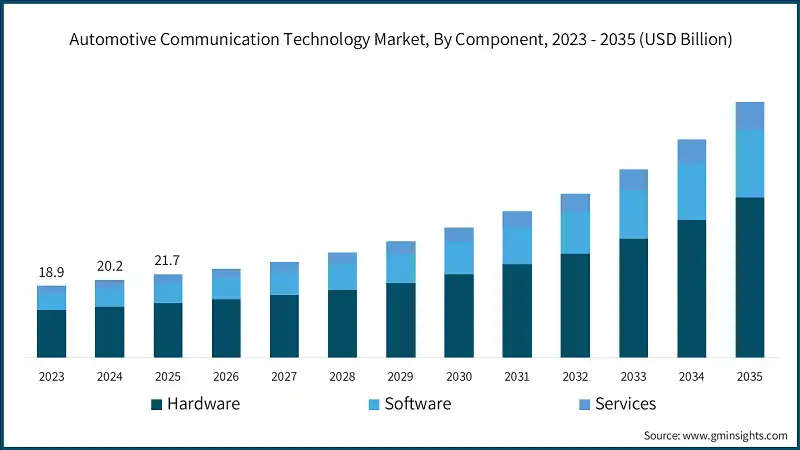
Based on component, the automotive communication technology market is divided into hardware, software and services. The hardware segment dominated the market with 65.5% share in 2025.
- Hardware is very important for vehicle communication. Thus, the analysis found the hardware segment as a dominant one. In 2025, the hardware segment is valued at USD 14.2 billion. Every vehicle, whether basic or advanced, needs physical parts like wiring harnesses, transceivers, ECUs, sensors, gateways, and connectors during manufacturing. These parts cannot be replaced by software.
- Vehicles now have more electronic features like ADAS, infotainment, and powertrain control, which has increased the need for communication hardware. More features mean more chips, cables, and network controllers are required.
- Automakers are investing in high-speed communication hardware such as CAN, LIN, FlexRay, and automotive Ethernet to ensure real-time data transfer and meet safety standards.
- While hardware is still important, the software segment is expected to grow the fastest, with a CAGR of 13.5% from 2026 to 2035, due to changes in vehicle design. The move to software-defined vehicles is a major reason for this growth.
Learn more about the key segments shaping this market
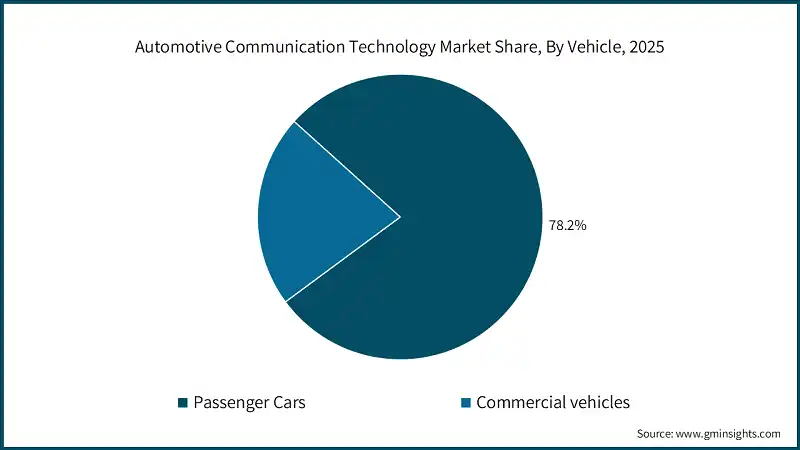
Based on vehicle, the automotive communication technology market is divided into passenger cars and commercial vehicles. The passenger cars segment accounts for 78.2% in 2025 and is expected to reach USD 49.5 billion by 2035.
- Passenger cars are the leading segment in the automotive communication technology market because they are produced in large numbers and adopt new technologies quickly. As the biggest contributors to global vehicle sales, passenger cars allow automakers to widely use technologies like V2X, telematics, and in-vehicle networking.
- These technologies, often included as standard or mid-range features, improve safety, driver assistance, and infotainment, making them common in everyday cars.
- For example, in October 2025, Volkswagen announced that over two million of its cars in Europe had Car2X technology. This shows how passenger cars are leading in adopting communication systems.
- On the other hand, the commercial vehicle segment is expected to grow the fastest, with a CAGR of 14.3% from 2026 to 2035. Fleet operators are using communication technologies to improve efficiency and increase vehicle uptime through real-time monitoring and predictive maintenance.
Based on propulsion, the automotive communication technology market is divided into ICE, EV and hybrid. The EV segment is expected to grow at the fastest CAGR of 14.2% between 2026 and 2035.
- Worldwide penetration of electric vehicles is expected to be the fastest-growing segment in the market. It is expected that the segment will grow at the CAGR of 14.2% between 2026 and 2035. According to the IEA, electric car sales reached 17 million units worldwide in 2024, rising by more than 25%.
- As EVs need more advanced communication systems than ICE vehicles, the segment will require a continuous need for communication technologies. EVs depend on data exchange for battery management, power electronics, charging systems, and energy optimization that has increased the use of high-speed technologies like Automotive Ethernet.
- These trends increase the need for faster, more reliable, and real-time communication in EVs compared to ICE vehicles. As a result, the EV automotive communication technology market is expected to reach USD 16.5 billion by 2035 and grow at the fastest rate during the forecast period.
- The Internal Combustion Engine (ICE) segment remains the largest part of the automotive communication technology market because most vehicles worldwide still use ICE powertrains. These vehicles rely on communication technologies like CAN, LIN, and FlexRay for functions such as powertrain control, body electronics, safety systems, and diagnostics.
Looking for region specific data?
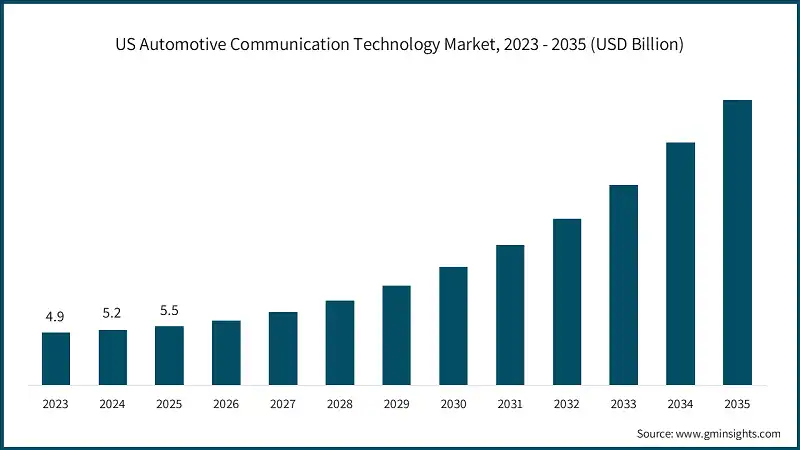
The US automotive communication technology market reached USD 5.5 billion in 2025, growing from USD 5.2 billion in 2024.
- In the U.S. market, a major trend is the increasing use of vehicle-to-everything (V2X) communication. This technology allows vehicles to share information with infrastructure, other vehicles, and networks. The push for V2X is driven by the need to improve safety and traffic flow.
- Autonomous vehicle OEMs like Tesla have sold approximately 634,000 units in the U.S. in 2024. This number is increasing because of the ADAS and better communication technologies equipped in the Tesla cars.
- Moreover, pilot programs and smart city projects, which connect vehicles with infrastructure, are helping this trend grow. Automakers and technology companies are working on V2X systems while also using older in-vehicle protocols like CAN, LIN, and newer Ethernet systems.
The North America automotive communication technology market is estimated to reach USD 17.6 billion by 2035 and expected to grow at the CAGR of 11% between 2026 and 2035.
- The National Highway Traffic Safety Administration (NHTSA) has strengthened its authority under the National Traffic and Motor Vehicle Safety Act by issuing the Third Amended Standing General Order (SGO) 2021-01. This order, which takes effect on June 16, 2025, replaces the 2023 amended order and helps NHTSA monitor safety risks, especially those related to advanced vehicle technologies.
- This action shows NHTSA's focus on addressing new safety challenges as vehicles become more automated, software-based, and reliant on communication systems. It supports NHTSA's goal to reduce traffic accidents, injuries, and deaths through better oversight and data-driven safety efforts.
- The General Order highlights the need for reliable communication systems in vehicles. These systems must log data, report incidents, and ensure transparency. Automakers and technology companies are required to make sure their in-vehicle communication systems can accurately record, store, and share safety information.
The Europe automotive communication technology market accounted for USD 5.9 billion in 2025 and is anticipated to grow at the CAGR of 12.3% between 2026 and 2035.
- Europe's market is influenced by the high number of connected vehicles in the region. Statista reports that Europe makes up about 30% of the global connected car fleet, showing its advanced use of telecommunication technologies in vehicles.
- Connected cars can connect in-car systems with external networks. This allows constant data sharing for navigation, safety alerts, diagnostics, and entertainment. This high level of connectivity increases the need for reliable in-car communication systems and external communication tools.
- A major trend in Europe is the growth of vehicle-to-everything (V2X) communication. This technology lets vehicles communicate with other vehicles, roadside infrastructure, and traffic management systems.
- The European Union supports this with programs like Cooperative Intelligent Transport Systems (C-ITS) and Horizon Europe, which focus on AI-based traffic management and V2X technology. These efforts aim to make driving safer, reduce traffic jams, and improve awareness by creating standardized communication systems across member countries.
Germany's automotive communication technology market is growing quickly in Europe, with a strong CAGR of 13.1% between 2026 and 2035.
- In Germany, companies such as Volkswagen, BMW, and Mercedes-Benz are using LTE-V2X and 5G NR-V2X modules to enable vehicle-to-vehicle (V2V) and vehicle-to-infrastructure (V2I) communication. These efforts are supported by government programs for smart mobility and strong 5G networks.
- For instance, recently Mercedes-Benz Group signed a deal with US patent platform Avanci to license 5G technology for use in connected vehicles. Mercedes-Benz plans to start selling vehicles equipped with 5G technology in Germany immediately.
- German automakers and suppliers are also improving in-vehicle networks and connected car systems. They are working on telematics, gateway modules, and zonal communication systems to handle fast data transfers.
- This is part of a shift toward software-defined vehicles, where connectivity supports safety, navigation, over-the-air updates, entertainment, and predictive maintenance.
- At the same time, security and regulations are becoming more important. As connected and autonomous features grow, the industry and regulators are focusing on cybersecurity for V2X communication and in-vehicle networks.
The Asia Pacific automotive communication technology market is estimated to grow at the fastest CAGR of 14.5% during the analysis timeframe.
- The region in 2025 is valued at USD 5.6 billion, which is also expected to grow the fastest between 2026 and 2035. This growth is supported by the rollout of 5G networks and government policies.
- Automakers in countries like China, Japan, South Korea, and India are adding telematics and V2X systems to new vehicles. These systems allow vehicles to share data with infrastructure in real time, making roads safer and improving traffic.
- People in these countries now expect vehicles to have more connected features. This has increased demand for digital dashboards with navigation, media streaming, voice assistants, and over-the-air (OTA) updates. This trend is especially strong in tech-focused markets like China and Southeast Asia.
- Automakers are working with telecom and cloud companies to offer subscription-based connected services. Embedded connectivity systems are becoming more popular than tethered ones because they provide continuous services and advanced features.
China is estimated to grow with a CAGR of 15% in the projected period between 2026 and 2035, in the Asia Pacific automotive communication technology market.
- In 2024, over 27.5 million passenger cars were sold in China, making it the largest market in the Asia-Pacific region. These strong numbers are creating continuous opportunities for players in the automotive communication technology. Additionally, in 2024–2025, many new passenger cars in China are being equipped with 5G connectivity and V2X modules, supported by both domestic and international OEMs that have moved these technologies into mass production.
- China has the largest 5G network in the world, which supports fast and low-delay communication needed for connected vehicles. The growth of smart city projects and intelligent transportation pilot zones is speeding up the use of vehicle-to-infrastructure messaging in real-world scenarios.
- Moreover, in China, autonomous taxi (robotaxi) development has become a key driver and real-world use case for advanced connected vehicle communication systems. Cities like Wuhan have seen large-scale deployment of fully autonomous taxis such as Baidu’s Apollo Go operating without drivers on public roads, which demonstrates China’s push toward commercial use of self-driving services and requires robust low-latency, high-reliability connectivity between vehicles and infrastructure.
Latin America automotive communication technology market is estimated to reach USD 2 billion in 2025 and is anticipated to show lucrative growth over the forecast period.
- Governments across the countries, such as Brazil, Mexico, Argentina, Chile, and Colombia, are focusing more on connected vehicle policies. They are adding V2X and connected mobility technologies to their national transportation plans. This is part of a larger effort to include communication systems in transportation and smart city projects.
- Connected vehicle systems are becoming more common as telematics, infotainment, and connectivity platforms grow. This change is happening because people want advanced in-car features like navigation, remote diagnostics, emergency call systems, and real-time communication with cloud services.
- Countries like Brazil and Mexico are leading this trend due to the rise in smartphone use and the expansion of 4G and 5G networks. Pilot projects and investments in smart city initiatives are also helping to increase the use of this technology.
Brazil is estimated to grow with a CAGR of 10.3% between 2026 and 2035, in the Latin America automotive communication technology market.
- Brazil's National IoT Plan focuses on building connected vehicle infrastructure as part of its larger IoT and digital transformation goals. It connects automotive communication development to national digital strategies, encouraging teamwork between public and private sectors. This also signals Original Equipment Manufacturers (OEMs) and technology providers that connected mobility technologies are a priority for future infrastructure.
- The Ministry of Transport has introduced guidelines for sharing data between agencies. This step helps improve infrastructure planning and monitoring while setting the stage for regulating connected vehicle communication systems.
- Brazil is also creating rules for future mobility technologies, such as autonomous vehicles and cybersecurity. These efforts indirectly affect how automotive communication technologies are managed.
The Middle East and Africa accounted for USD 1.7 billion in 2025 and is anticipated to show lucrative growth over the forecast period.
- The region shows the second fastest CAGR of 13.2% between 2026 and 2035. This growth is attributed to the regulatory pushes for using advanced features in vehicles. For instance, Saudi Arabia now requires telematics for commercial fleets to improve safety and compliance.
- Similarly, the UAE is introducing telematics in taxis and buses as part of its Smart Mobility plan. These rules make telematics adoption a necessity, not just a choice, boosting in-vehicle connectivity and data systems.
- Countries like the UAE, Saudi Arabia, and South Africa are moving towards advanced real-time communication technologies, supported by the rollout of 5G networks.
- Automakers and suppliers are adding better communication systems to offer services like remote diagnostics, predictive maintenance, and infotainment.
UAE to experience substantial growth in the Middle East and Africa automotive communication technology market in 2025.
- The UAE is driving the demand for better automotive communication by focusing on electric, autonomous, and connected vehicles. These vehicles need advanced communication systems and high-performance connectors.
- In November 2025, WeRide, a global leader in autonomous driving technology, and Uber Technologies announced the launch of Level 4 fully driverless robotaxi commercial operations in Abu Dhabi.
- This marks the first driverless deployment in the Middle East, as well as the first city outside the United States to host fully driverless operations on the Uber platform. The launch was supported by the world’s first city-level fully driverless robotaxi permit outside the U.S.
- Such development is the indication of how the UAE is going to be a potential opportunity hub for players in the market.
Automotive Communication Technology Market Share
- The top 7 companies in the automotive communication technology industry are Denso, Harman International, ZF Friedrichshafen, Valeo, Magna, Mitsubishi Electric and Aptiv, contributing 50.1% of the market in 2025.
- Denso makes communication and networking modules for vehicles. These modules help with data exchange, telematics connectivity, and infotainment system integration. They use protocols like CAN, LIN, and Ethernet, which are important for connected vehicles and ADAS communication.
- Harman provides communication solutions for vehicles, including infotainment platforms, telematics control units, in-car voice systems, and connected display controllers. Their products combine audio, navigation, and data connectivity to meet the needs of modern vehicles.
- ZF produces electronic control units and systems that focus on communication within vehicles. These systems support ADAS and sensor networking, allowing data to move between safety, chassis, and driver assistance modules as part of the vehicle's communication system.
- Valeo designs advanced sensors and communication components for vehicles. These products work with vehicle networks to improve ADAS, connectivity, and infotainment, making vehicles safer and better at sharing data.
- Magna creates modules and electronic solutions that improve connectivity inside vehicles. Their products connect control units, infotainment systems, and telematics systems, ensuring smooth data sharing across different parts of the vehicle.
- Mitsubishi Electric develops electronic components and communication units for vehicles. These products connect to vehicle networks and infotainment systems, helping with data transfer and connectivity in modern vehicles.
- Aptiv offers communication products for vehicles, such as USB and wireless charging modules, along with electronics that connect user devices to infotainment and telematics systems. Their products enable data sharing and connected features in vehicles.
Automotive Communication Technology Market Companies
Major players operating in the automotive communication technology industry are:
- Denso
- Harman International
- ZF Friedrichshafen
- Valeo
- Magna
- Mitsubishi Electric
- Aptiv
- Yazaki
- Autoliv
- Lear
- Denso’s strength comes from its long experience in making embedded telematics and vehicle network modules for the global market. It has a strong engineering team and works closely with automotive electronic systems to ensure smooth communication and control across different parts of a vehicle.
- Harman is known for its reliable infotainment and telematics platforms. Its technology is deeply connected with vehicle systems and is already used in millions of vehicles worldwide.
- ZF combines its skills in mechanics and electronics to focus on safety systems, ADAS electronics, and vehicle network components. These components help sensors and control units communicate efficiently.
- Valeo specializes in V2X systems, which allow vehicles to share data in real time with infrastructure. It also offers a wide range of connectivity components for safety and telematics applications.
- Magna uses its expertise in automotive systems to provide modular communication and electronic subsystems. These systems connect vehicle networks with control units and telematics platforms for various car manufacturers.
- Mitsubishi Electric has a long history of making electronic control units and communication modules for vehicles. These modules help share data within vehicle networks and work well with infotainment and telematics systems.
- Aptiv focuses on smart connectivity platforms and vehicle electronics. Its technology connects infotainment, telematics, and data networks with both in-vehicle and external communication systems.
Automotive Communication Technology Industry News
- In October 2025, NTT and Toyota Motor started working together on mobility and AI/telecommunications to create a future with zero traffic accidents.
- In August 2025, LG Innotek launched its 'Next-generation Digital Key Solution', a key product in its automotive connectivity business. This business also includes 5G communication modules and automotive AP modules.
- In June 2025, Verizon Business introduced the Edge Transportation Exchange, a vehicle-to-everything (V2X) platform for connected vehicles. This platform helps vehicles share important data in near real-time with other vehicles, pedestrians, and connected infrastructure like traffic signals. Several customers have already signed up for this solution.
- In October 2024, KD strengthened its role in automotive communication networks by partnering with industry leaders. The company is promoting the use of fiber optics in cars by working with camera suppliers, wiring manufacturers, testing experts, and automotive testing solution providers.
The automotive communication technology market research report includes in-depth coverage of the industry with estimates & forecasts in terms of revenue ($ Mn/Bn) from 2022 to 2035, for the following segments:
Market, By Component
- Hardware
- Transceivers
- Connectors & Cables
- Gateways & Domain Controllers
- Software
- Services
Market, By Bus Module
- Local Interconnect Network (LIN)
- Controller Area Network (CAN)
- FlexRay
- Media Oriented Systems Transport (MOST)
- Ethernet
Market, By Connectivity
- In-vehicle/Internal communication technology
- External communication technology
Market, By Vehicle
- Passenger cars
- Hatchback
- SUV
- Sedan
- Commercial vehicles
- LCV
- MCV
- HCV
Market, By Vehicle Class
- Economy
- Mid-range
- Luxury
Market, By Propulsion
- ICE
- EV
- Hybrid
Market, By Application
- Powertrain & Chassis
- Body Control & Comfort
- Infotainment & Telematics
- Safety & ADAS
- Others
Market, By Sales Channel
- OEMs
- Aftermarket
The above information is provided for the following regions and countries:
- North America
- US
- Canada
- Europe
- Germany
- UK
- France
- Italy
- Spain
- Russia
- Nordics
- Benelux
- Asia Pacific
- China
- India
- Japan
- South Korea
- ANZ
- Singapore
- Malaysia
- Indonesia
- Vietnam
- Thailand
- Latin America
- Brazil
- Mexico
- Argentina
- Colombia
- MEA
- South Africa
- Saudi Arabia
- UAE
Frequently Asked Question(FAQ) :
What was the valuation of the passenger cars segment in 2025?
The passenger cars segment accounted for 78.2% of the market in 2025 and is expected to reach USD 49.5 billion by 2035.
What is the growth outlook for the EV segment from 2026 to 2035?
The EV segment is set to expand at a CAGR of 14.2% till 2035, led by increasing electrification and demand for advanced communication technologies in electric vehicles.
Who are the key players in the automotive communication technology industry?
Key players include Denso, Harman International, ZF Friedrichshafen, Valeo, Magna, Mitsubishi Electric, Aptiv, Yazaki, Autoliv, and Lear.
What are the upcoming trends in the automotive communication technology market?
Shift to Ethernet-based systems, zonal architectures, V2X communication, real-time telematics, and AI- and cloud-based connectivity platforms.
What was the size of the U.S. automotive communication technology sector in 2025?
The U.S. market reached USD 5.5 billion in 2025, with a major trend being the growing adoption of vehicle-to-everything (V2X) communication to enhance safety and traffic flow.
How much revenue did the hardware segment generate in 2025?
The hardware segment generated approximately USD 14.2 billion in 2025, dominating the market with a 65.5% share due to its critical role in vehicle communication systems.
What was the market size of the automotive communication technology in 2025?
The market size was valued at USD 21.7 billion in 2025, with a CAGR of 12.4% expected through 2035. The growth is driven by advancements in connected vehicle technologies and increasing adoption of communication systems like V2X.
What is the expected size of the automotive communication technology industry in 2026?
The market size is projected to reach USD 23.3 billion in 2026.
What is the projected value of the automotive communication technology market by 2035?
The market is poised to reach USD 66.8 billion by 2035, fueled by the adoption of Ethernet-based systems, zonal architectures, and the rise of connected and autonomous vehicles.
Automotive Communication Technology Market Scope
Related Reports