Summary
Table of Content

Automotive Airbags Market
Get a free sample of this report
Form submitted successfully!
Error submitting form. Please try again.
Thank you!
Your inquiry has been received. Our team will reach out to you with the required details via email. To ensure that you don't miss their response, kindly remember to check your spam folder as well!
Request Sectional Data
Thank you!
Your inquiry has been received. Our team will reach out to you with the required details via email. To ensure that you don't miss their response, kindly remember to check your spam folder as well!
Form submitted successfully!
Error submitting form. Please try again.
Automotive Airbags Market Size
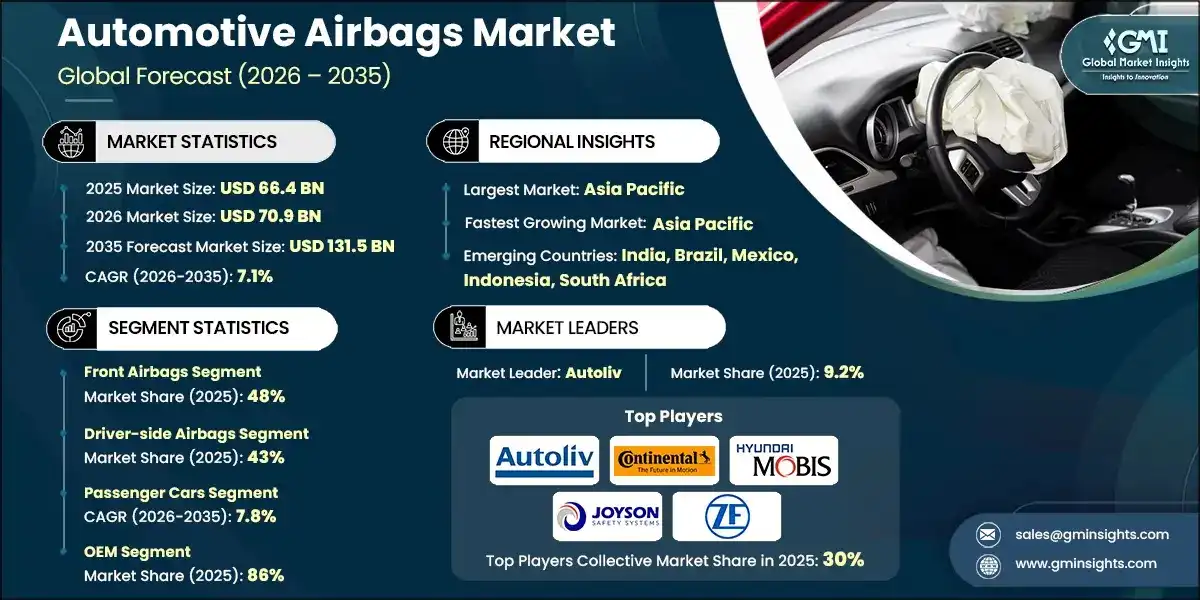
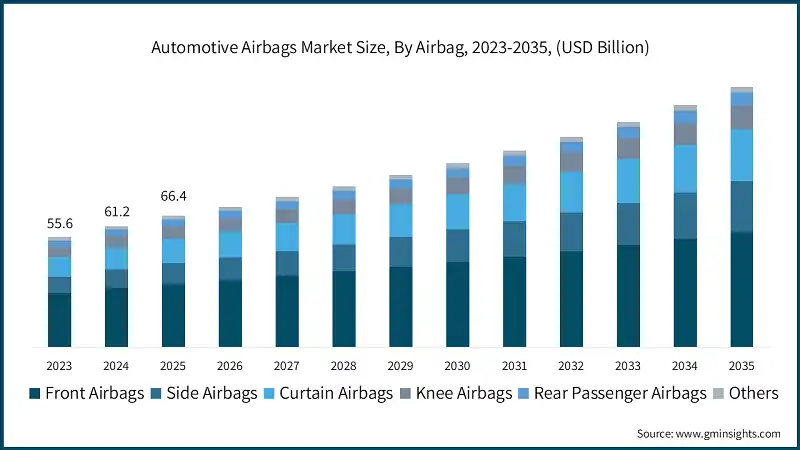
The global automotive airbags market size was valued at USD 66.4 billion in 2025. The market is expected to grow from USD 70.9 billion in 2026 to USD 131.5 billion in 2035 at a CAGR of 7.1%, according to latest report published by Global Market Insights Inc.
Automotive Airbags Market Key Takeaways
Market Size & Growth
- 2025 Market Size: USD 66.4 Billion
- 2026 Market Size: USD 70.9 Billion
- 2035 Forecast Market Size: USD 131.5 Billion
- CAGR (2026–2035): 7.1%
Key Market Drivers
- Stringent vehicle safety regulations.
- Rising consumer awareness of occupant safety.
- Growth in global vehicle production.
- Increasing crash test and NCAP standards.
Challenges
- High product liability and recall risks.
- Pricing pressure from automotive OEMs.
Opportunity
- Expansion in emerging automotive markets.
- Growth of electric and autonomous vehicles.
- Development of pedestrian protection airbags.
- Increasing aftermarket replacement demand.
Key Players
- Market Leader: Autoliv led with over 9.2% market share in 2025.
- Leading Players: Top 5 players in this market include Autoliv, Continental, Hyundai Mobis, Joyson Safety Systems, ZF Friedrichshafen, which collectively held a market share of 30% in 2025.
Get Market Insights & Growth Opportunities
Government bodies and safety organizations throughout the world require that all passenger and commercial vehicles include airbags as standard equipment. As time has gone on, government and safety organizations have placed more emphasis on requiring multiple types of airbags in each vehicle, including side airbags and curtain airbags; therefore, automotive manufacturers (OEMs) are required to include more sophisticated airbag systems in their designs resulting in greater penetration and unit volume demand for airbags on a worldwide basis.
For instance, In 2025, India’s new Bharat NCAP safety rating system influenced automakers to offer six airbags as standard on several entry-level models, boosting airbag adoption beyond basic frontal units to meet higher voluntary safety benchmarks.
With customers becoming aware of the importance of road safety, dangers associated with driving, and vehicle safety ratings, they have become increasingly attracted to purchasing vehicles that have increased protection features. Therefore, most vehicle purchasers now consider the National Highway Traffic Safety Administration's (NHTSA) New Car Assessment Program (NCAP) rating as a major factor when deciding which vehicle to purchase, resulting in increased demand for multiple and advanced airbag systems by automotive manufacturers (OEMs).
The steady expansion of global vehicle production, particularly in Asia-Pacific and emerging markets, directly supports airbag market growth. The increased production volume of passenger cars, SUVs, and electric vehicles will create demand for additional airbag installations, thus increasing the size of the market for airbag manufacturers.
Stricter crash testing protocols and evolving NCAP evaluation criteria require improved occupant protection in frontal, side, and rollover collisions. Therefore, OEMs will need to develop their ability to integrate additional airbag types into their designs; for instance, increasing the number of airbags in a vehicle will allow for a higher level of protection, and therefore, a higher safety rating.
To get key market trends
Automotive Airbags Market Trends
To achieve more optimal safety outcomes, while reducing risk of injury to vehicle occupants, automobile manufacturers are increasingly beginning to implement smart air bags that alter deployment forces relative to occupant seat position, crash severity, and/or seatbelt function. This additional complexity adds value to the total airbag system and provides additional means for comparing technology used by airbag supply companies.
Passenger car manufacturers are integrating additional air bags to the center-rear and rear seats to provide protection from an occupant-to-occupant collision when a side impact accident occurs. This growing trend indicates a heightened emphasis on total cabin safety and rear seat occupant protection with an increase in prioritizing the premium segment (luxury) of their products.
Today`s airbag suppliers are creating new materials to decrease the weight of airbag assemblies; designers are also creating additional concave and/or light inflators to create more compact assemblies. This trend is a direct consequence of existing fuel economy goals and the need for electric vehicles to be able to achieve maximum range. It also allows the manufacturer the flexibility to design an airbag into the new style of vehicle interiors available today without compromising safety and performance.
Commercial vehicle operators are more frequently installing air bags into their fleet of vehicles, most often to protect the driver because of increasing National Highway Traffic Safety Administration safety regulations, but also with fleet operators concentrating on driver safety and developing means to expand the number of airbag types needed to operate their fleets. The installation of driver air bags into most of the heavy duty and medium duty vehicles is creating new growth opportunities for airbag suppliers beyond what was found in light duty passenger and compact passenger vehicles in the past.
Automotive Airbags Market Analysis
Learn more about the key segments shaping this market
Based on airbags, the automotive airbags market is divided into front airbags, side airbags, curtain airbags, knee airbags, rear passenger airbags and others. Front airbags dominated the market, accounting for 48% in 2025 and are expected to grow at a CAGR of 6.2% through 2026 to 2035.
- Front airbags is designed to keep the driver and passenger safe by protecting them from injury. They are designed to deploy from the dashboard and steering wheel, thereby assisting in absorbing the impact force on the passenger's body, which keeps the body from hitting the hard surface of the car's interior.
- During side-impact crashes, side airbags are designed to protect the passenger's upper and lower body. The side airbags deploy from inside the seat or outside the door, and their primary function is to protect the passenger's torso and pelvis region, minimizing the severity of chest and abdomen injuries that might occur due to a vehicle or other object hitting the passenger's body zone.
- Curtain airbags are large-bore airbags that deploy from the roof rail of the car, and are located along the side windows of the vehicle during type of crash. Curtain airbags provide head protection for the passenger, preventing any contact with either the window or door frame, and external objects. This is especially important during rollovers because it assists in minimizing the risk of emissions from the car.
- Knee airbags are deployed beneath the dash to protect the lower legs of the front-seat passengers. Knee airbags are built to assist in providing leg protection during an impact and also to help maintain the passenger's proper position during an accident, thus enabling the full performance of the seatbelt and airbag.
Learn more about the key segments shaping this market
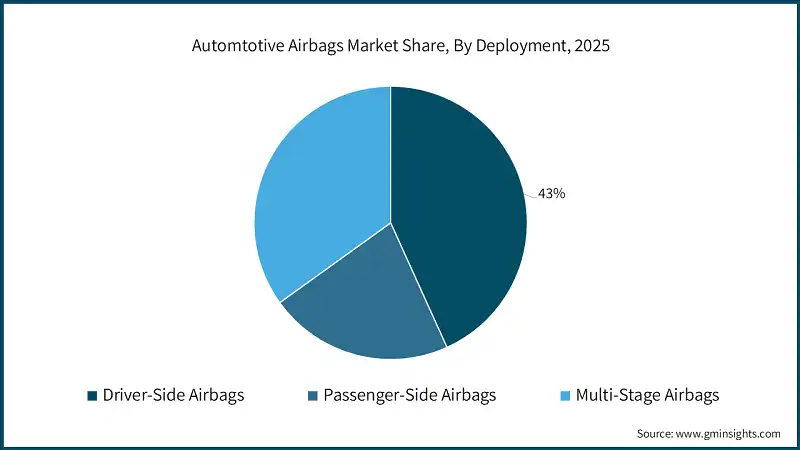
Based on deployment, the automotive airbags market is segmented into driver-side airbags, passenger-side airbags and multi-stage airbags. Driver-side airbags segment dominates the market with 43% share in 2025, and the segment is expected to grow at a CAGR of 7.3% from 2026 to 2035.
- The driver-side airbag remains a core safety feature, with ongoing enhancements in sensor integration and deployment accuracy. OEMs are focusing on improved inflation timing and force control to reduce injury risk, while ensuring compliance with increasingly stringent safety regulations across global automotive markets.
- Passenger-side airbags are being developed with both advanced occupant detection systems as well as suppression systems to adjust for a passenger’s size and seating position. The result is improved safety of children/small occupants, while still allowing OEMs to comply with regulatory requirements and increase their crash test rating.
- Multi-stage airbags are also becoming more prevalent, which can deploy at variable deployment levels based upon crash severity and occupant condition. These systems provide improved protection to occupants while decreasing the risk of injury related to airbag deployment, they are being utilized more extensively in premium, electric and safety-oriented vehicles.
Based on vehicle, the automotive airbags market is segmented into passenger cars and commercial vehicles. The passenger cars segment dominates the market with 75% share in 2025, and the segment is expected to grow at a CAGR of 7.8% from 2026 to 2035.
- Passenger Cars are adopting a more sophisticated driver airbag, integrating steering wheel sensors with Advanced Driver Assistance Systems (ADAS) to better support the timing and force of airbag deployment for both enhanced protection and lower risk of injury for both driver and the passenger, particularly with the introduction of compact and electric vehicles with a rapidly evolving design of the passenger compartment.
- Multi-Stage Adaptive Driver Airbags are becoming increasingly popular across all passenger car segments as a means by which to achieve higher New Car Assessment Program (NCAP) ratings from safety organizations. This has resulted in many Original Equipment Manufacturers (OEMs) designing Driver Airbags that incorporate improved precision inflation control.
- The use of Driver Airbags in Commercial Vehicles has become more standard due in large part to the enforcement of more stringent Safety Regulations by Regional Authorities and Fleet Safety Programs undertaken by Large Fleets.
- Many Truck and Bus manufacturers are now using the integration of the Driver Airbag with the Seatbelt Pretensioners and Steering Systems as an added protection for drivers in the event of a Frontal Collision and to assist Truck and Bus Manufacturers in meeting the new requirements of occupational safety and compliance.
Based on sales channel, the automotive airbags market is segmented into OEM and aftermarket. The OEM segment is expected to dominate the market with a share of 86% in 2025.
- The increasing integration of integrated smart airbag systems (including multi-phase, or “multi-stage,” airbag technology) with various types of occupant sensing, crash prediction algorithms and a capability for adaptive deployment based on both crash severity and occupant size by OEMs in passenger car and light truck markets for both passenger and commercial vehicles will improve the level of safety and occupant injury risk across the automotive safety rating spectrum.
- OEMs are now utilizing airbag systems that are controlled by software, and those airbag systems are equipped with capabilities that allow OEMs to download complex software programs to change the configuration of airbag deployment parameters during the vehicle’s lifecycle. These ongoing improvements will lead to greater utilization of new vehicle safety systems, ongoing and greater utilization of advanced safety solutions (ADAS), and ongoing improvement in long-term vehicle safety performance and the positioning of premium vehicles.
- The continued use of aftermarket products for retrofitting older or previously low-safety rated passenger and commercial vehicles will mean consumers and fleet operators can have access to safer products and thus increase the number of vehicles in lower-cost and aging vehicle segments that can be fitted with airbags.
- Aftermarket airbags are incorporating newer technology, which include side-curtain inflation technologies, pedestrian protection inflator systems, and other advanced technological innovations, within days of being introduced by OEMs. These types of airbag systems offer consumers and fleet operators a lower-cost option for safety enhancement that is flexible, customizable and immediately available for both individual and commercial vehicle owners and operators.
Looking for region specific data?
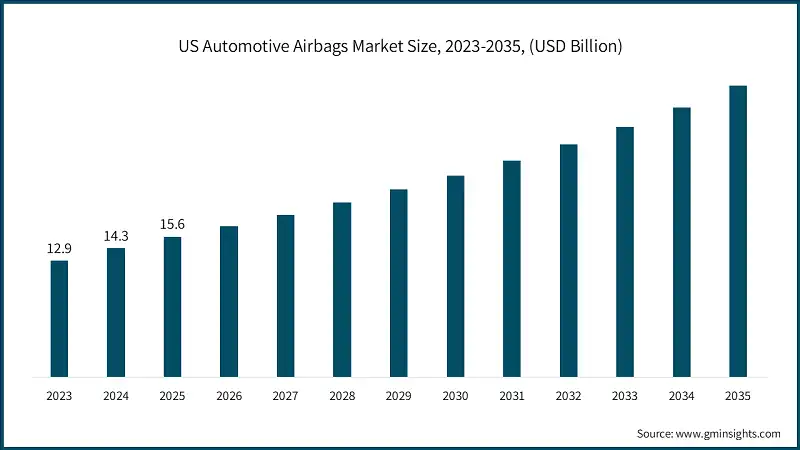
The US automotive airbags market reached USD 15.6 billion in 2025, growing from USD 14.3 billion in 2024.
- The introduction of enhanced frontal, side and knee airbags has rapidly increased in the United States. The National Highway Traffic Safety Administration (NHTSA) and the Insurance Institute for Highway Safety (IIHS) both have very strict testing protocols that are causing Original Equipment Manufacturers (OEMs) to integrate multi-stage smart airbags.
- These airbag systems are being developed to increase safety standards and create new innovations throughout both passenger and commercial vehicle segments.
- The integration of airbag systems and Advanced Driver Assistance Systems (ADAS) such as automatic emergency braking and occupant sensing is becoming a norm. With OEM integration, the ability to predict crashes and the timing of airbag deployment leads to the optimization of protection outcomes and increases the number of airbag safety ratings for mid and high-end vehicles operated within the United States.
- Commercial fleets in the United States are also upgrading their current airbag systems due to strict occupational and liability safety standards. This has led to the development of advanced driver and passenger airbag systems which utilize durable sensor and control modules designed specifically for use in trucks, vans, and buses.
North America dominated the automotive airbags market with a market size of USD 18.8 billion in 2025.
- As Canada and Mexico move in alignment with the United States' national safety standards, regional adoption has created a situation where manufacturers and suppliers are able to share platforms while scaling smart/adaptive airbag technology across North American (NA) vehicle lines resulting in increased airbag content per vehicle.
- The growing need for customers to purchase aftermarket retrofit airbags for used and imported vehicles has also led to increased demand for retrofit airbags in the aftermarket distribution segment. This is true for rural areas and light commercial fleets as OEM retrofit airbag solutions are economical upgrades for providing increased safety.
- Manufacturers are also blending airbag technologies with telematics and connectivity. This allows for the transmission of data after airbag deployment as well as the ability to perform over-the-air (OTA) diagnostic tests, providing manufacturers and fleet operators with improved safety insight and increased readiness for service amongst both passenger and commercial vehicle fleets.
Europe automotive airbags market accounted for a share of 19.4% and generated revenue of USD 12.9 billion in 2025.
- The advancement of airbags, such as lateral airbags and center airbag systems is driven by rigorous Euro NCAP testing protocols resulting in automotive makers expanding their occupant protection systems, as well as pedestrian protection systems.
- Increasing urbanization is driving the demand for City EV's as well as Compact Vehicles therefore creating a need for optimized Curtain and Pedestrian Airbags to support the dense Traffic Safety requirements found within Cities across Europe.
- OEM's throughout Europe are introducing the use of Common Airbag Platforms to provide greater Scale of Content and Cost savings, thereby creating the opportunity for wider adoption of Mid to Premium Level Safety Solutions.
Germany dominates the automotive airbags market, showcasing strong growth potential, with a CAGR of 4.6% from 2026 to 2035.
- German OEMs are at the forefront of developing advanced occupant sensing and multi-staged airbag systems. Their multi-stage airbags incorporate advanced technologies into their ADAS and driver monitoring systems, increasing occupant safety and improving integration into today’s vehicle designs.
- Recently, there has been a new class of airbags designed exclusively for Electric Vehicles with unique interior layouts, thereby maximizing deployment strategies and providing head and torso protection while enclosed by the safety structures of the battery fore front of the vehicle.
- In response to the heightened expectations of the Euro NCAP testing protocol and competitive safety positioning within the marketplace, German vehicle manufacturers are offering multi-tiered airbag packages consisting of Front Side, and Knee/Center Airbags as Tiered Options in accordance with current automobile safety legislation both in Europe and around the world.
The Asia Pacific automotive airbags market is anticipated to grow at the highest CAGR of 7.7% from 2026 to 2035 and generated revenue of USD 29.3 billion in 2025.
- While advanced airbags are widely accepted in developed APAC markets (Japan, Korea, Australia), rapidly expanding markets in India and Southeast Asia are accelerating their adoption of advanced airbags due to increasing governmental pressure through regulatory compliance.
- Regional manufacturers of airbags are investing in new manufacturing techniques and advanced technology to satisfy the increased demands of Original Equipment Manufacturers (OEM) and aftermarket safety equipment companies throughout the APAC markets.
- OEMs in the APAC region are integrating airbag systems with telematics and occupant sensing technology, to provide improved capabilities in predicting crashes and responding to an accident after one has occurred.
China automotive airbags market is estimated to grow with a CAGR of 8.1% from 2026 to 2035.
- The introduction of new C-NCAP (Chinese-New Car Assessment Program) regulatory guidelines by the Chinese government has led to new market requirements for the implementation of up to six airbags in new vehicles manufactured for the Chinese market: thus, accelerating the market share growth of side, curtain and knee airbags across all segments of passenger vehicles.
- Companies in the region are developing innovative cost-effective smart airbag systems based on regional crash characteristics and urban transportation patterns; this allows for rapid adoption of smart airbags by markets in the region.
- Rapid growth in the demand for electric vehicles (EVs) in the Chinese market is driving the development of specialized airbag systems for the EV cabin area; these systems are being developed with the latest technology (advanced sensors, electronic control modules, etc.) and therefore allowing for greater amounts of airbag content per vehicle sold in this rapidly expanding market.
Latin America automotive airbags market shows lucrative growth over the forecast period.
- The process to converge the Safety Norms of LATAM countries (Mexico, Chile, Argentina) to align with Global Safety Norms is accelerating the adoption of airbag systems in passenger and light-duty vehicles.
- OEMs are starting to employ streamlined airbag systems made to cater to the Regional Buying Power, while at the same time balancing their ability to remain compliant with safety standards yet affordable.
- The increasing number of commercial fleets in the LATAM region are now utilizing Advanced Driver Airbag System technology to assist in meeting their Corporate Safety Protocol and help mitigate any liability associated with Crashes.
Brazil automotive airbags market is estimated to grow with a CAGR of 3.8% from 2026 to 2035 and reach USD 1.6 billion in 2035.
- New State-level regulations in Brazil for automotive safety will raise minimum airbag requirements. This will compel Original Equipment Manufacturers (OEM) to offer dual-airbags and multi-stage airbag systems in entry-level vehicles.
- The older vehicle fleets contribute to aftermarket airbag demand as vehicle owners look to upgrade safety features to comply with regulations and for their insurance benefits. This demand will continue to spur growth in the aftermarket section.
- OEMs in Brazil are choosing to utilize modular airbag platforms supplied by Global Suppliers, thereby providing an opportunity for OEMs to reduce costs on airbag technologies while at the same time creating safer solutions that are appropriate for multiple passenger vehicle segments.
The Middle East and Africa automotive airbags market accounted for USD 1.9 billion in 2025 and is anticipated to show lucrative growth over the forecast period.
- The growing adoption of airbags by imported and used vehicles is primarily due to increased focus on safety between imported and used vehicle markets, thus creating demand for airbag retrofit solutions in the aftermarket of these vehicles, plus provides greater opportunities for dealer established systems.
- Increased regulation of airbag systems is resulting in legislation enacted by MEA governments increasing the stringency and requirements for the safety of Passengers; OEMs are thus increasing the baseline criteria of airbags in their model range for that region.
- Cost-effective airbag systems are creating opportunities for OEMs to develop airbag systems in various commercial Categories (i.e.: Taxis, Buses and Delivery Fleets) for vehicles, to meet cost limitations.
UAE market is expected to experience substantial growth in the Middle East and Africa automotive airbags market, with a CAGR of 2.6% from 2026 to 2035.
- The increasing demand by consumers for superior safety is causing OEMs to standardize multi-airbag systems on all luxury and mid-range new vehicles.
- The UAE Traffic Safety Initiative and Implementation is expected to drive further adoption of airbags for Fleet and Commercial Vehicles.
- The development and use of connected safety technology (airbags connected to telematics and emergency response systems) provide the opportunity to significantly reduce time between crash notification and potential help, thus improving post-crash response.
Automotive Airbags Market Share
- The top 7 companies in the automotive airbags industry are Autoliv, ZF Friedrichshafen, Daicel, Joyson Safety Systems, Continental, Hyundai Mobis, and Toyota Boshoku contributing 32% of the market in 2025.
- Autoliv, a leading provider of automotive safety equipment, specializes in air bags, seat belts, and steering wheels. Autoliv is the main provider for most of the top OEMs around the world by developing advanced air bag technologies such as multi-stage deployment, & smart sensing technology. Autoliv is continuously investing in research & development and providing innovation in safety products to stay ahead of the changing global regulatory environment and crash test requirements.
- ZF TRW Automotive is also a leading provider of air bag control units, inflators and complete restraint systems. ZF uses adaptive air bag technology in conjunction with integrated safety electronics to provide a scalable product to all OEM globally. To improve the safety of passengers, ZF also has significant expertise in engineering and the use of restraint systems as part of an integration with ADAS platforms.
- Daicel manufactures automotive air bag inflators (and other materials related to air bags) that are essential to safe air bag deployment. Daicel has a significant presence in Asia, Europe and North America and has a focus on lightweight, highly engineered Inflatables, however it also offers a variety of inflators for OEM with different safety standards and high-volume production schedules across all segments of vehicles.
- Joyson Safety Systems was formed through several strategic acquisitions including the acquisition of Takata assets. Joyson is a significant global supplier to OEMs of air bags, seat belts, & electronics used in safety products. Joyson focuses on innovation in smart air bag technology and advanced sensor integration. Joyson serves a broad range of OEM's and will continue to grow through a diverse range of safety product lines manufactured throughout the world.
- Continental, the automotive Safety Division of Continental AG, has developed Airbags, Restraint Systems and Crash Sensors that are incorporated into Vehicle Safety Electronics. In addition to using their expertise in Electrification and ADAS, Continental has developed algorithms for the deployment of airbags as well as ensuring the reliability of these systems. Due to its global presence and partnerships with OEMs, Continental provides advanced solutions in occupant protection to a wide variety of Vehicle Classes.
- Hyundai Mobis manufactures airbag modules and integrated safety systems designed primarily for Hyundai and Kia brands, while at the same time continuing to expand their customer base globally. This company emphasizes Adaptive Airbag technology, Optimized (Sensor) Airbag technology and adapting both technologies to fit different cabin layouts including EV platforms. Mobis has developed capabilities to combine Airbags with Electronic Control Units that include advanced control systems to support the enhancement of passenger and driver protection and to meet regulatory requirements.
- Toyota Boshoku Company, as a Tier 1 supplier, produces, manufactures and globally distributes Airbag Systems, Seat Components and other Interior Automotives products. The company works closely with Toyota Motor Corporation globally in providing reliable and cost-effective Airbag Integration for both Passenger and Commercial vehicles. The Safety Solutions from this company complement the Vehicle Dynamics and Interior design of vehicles while meeting the highest Quality and Performance Standards.
Automotive Airbags Market Companies
Major players operating in the automotive airbags industry are:
- Autoliv
- Continental
- Daicel
- Hyundai Mobis
- Joyson Safety Systems
- Nippon Seiki
- Toyoda Gosei
- Toyota Boshoku
- ZF Friedrichshafen (TRW Automotive)
- Autoliv is a world leader in the field of automotive safety systems, developing a range of products, including air bags, seat belts and steering wheels, for all the major original equipment manufacturers (OEMs) throughout the world. Continental provides integrated (or standalone) safety system solutions to the automotive industry, including the manufacture of air bags, restraints and crash sensors. With a strong electronic technology competency base, Continental can offer its customers integrated solutions for air bag deployment accuracy and occupant crash protection. Continental is well positioned within the global supply chain as it serves all segments of vehicle OEMs and focuses on creating new safety innovations while ensuring reliable products are manufactured in accordance with international crash test standards.
- Daicel is a global supplier that specializes in developing automotive air bag inflators, propellants and deployment systems; Daicel focuses on lightweight, high-performance air bag inflators. Daicel serves OEMs worldwide and is committed to providing efficient, safe and compliant products that meet the regional safety standards for vehicles. Hyundai Mobis produces air bags and modules, and integrated safety systems primarily for Hyundai and Kia, while ensuring that these products are available to customers worldwide. In addition, Hyundai Mobis provides adaptive air bag technologies and occupant sensing capabilities for both internal combustion engines (ICE) and electric vehicles (EVs) and will continue to expand into connected vehicle markets.
Automotive Airbags Market Report Attributes
| Key Takeaway | Details |
|---|---|
| Market Size & Growth | |
| Base Year | 2025 |
| Market Size in 2025 | USD 66.4 Billion |
| Market Size in 2026 | USD 70.9 Billion |
| Forecast Period 2026-2035 CAGR | 7.1% |
| Market Size in 2035 | USD 131.5 Billion |
| Key Market Trends | |
| Drivers | Impact |
| Stringent vehicle safety regulations | Increases mandatory airbag installation, directly boosting unit demand per vehicle. |
| Rising consumer awareness of occupant safety | Accelerates OEM adoption of advanced and multi-airbag systems. |
| Growth in global vehicle production | Expands the overall addressable market for airbag suppliers. |
| Increasing crash test and NCAP standards | Drives integration of additional airbags to achieve higher safety ratings. |
| Pitfalls & Challenges | Impact |
| High product liability and recall risks | Increases compliance costs and exposes manufacturers to financial and reputational losses. |
| Pricing pressure from automotive OEMs | Compresses margins despite rising technology and development costs. |
| Opportunities: | Impact |
| Expansion in emerging automotive markets | Unlocks volume growth driven by regulatory alignment with global safety norms. |
| Growth of electric and autonomous vehicles | Enables new airbag designs tailored to flexible cabin layouts. |
| Development of pedestrian protection airbags | Opens high-margin opportunities in premium and urban vehicles. |
| Increasing aftermarket replacement demand | Generates recurring revenue from aging vehicle fleets. |
| Market Leaders (2025) | |
| Market Leaders |
9.2% market share |
| Top Players |
|
| Competitive Edge |
|
| Regional Insights | |
| Largest Market | Asia Pacific |
| Fastest Growing Market | Asia Pacific |
| Emerging Country | India, Brazil, Mexico, Indonesia, South Africa |
| Future Outlook |
|
What are the growth opportunities in this market?
Automotive Airbags Industry News
- In January 2025, Autoliv responded by expanding capacity at its Utah facility by adding a second production line. This expansion aligns with growing need for far-side crash protection systems and the trend toward center airbags being used as standard equipment in a number of 2025 model year platforms. Additionally, this expansion bolsters Autoliv's position as a leader in innovative solutions and technology related to occupant safety.
- In December 2024, by employing machine learning algorithms, Hyundai Mobis has developed a next-generation, multi-stage, airbag system that utilizes pre-crash sensor data and occupant classification as well as crash severity to determine the optimal intensity of deployment. Testing conducted by the company has confirmed a 40% improvement in the accuracy of deployment compared to older generations of products, thereby enhancing occupant protection. Furthermore, this system will provide the groundwork for the future direction of Hyundai Mobis' adaptive airbag technology.
- In November 2024, Continental signed a multi-year supply agreement with one of the major European OEMs to provide them with an integrated smart airbag system. The smart airbag system combines occupant monitoring sensors, deployment algorithms, and electronic control units, which represents Continental’s strategy to leverage their breadth of automotive electronics for enhanced safety in the launch of an innovative new electric vehicle platform set to launch in 2026.
- In October 2024, ZF Friedrichshafen is forming a technology partnership with an autonomous vehicle developer to create airbags capable of accommodating non-traditional seating arrangements. The goal of this collaboration is to assist in addressing safety issues associated with new and emerging seating configurations (forward-facing seats, rear-facing seats, face-to-face seating) in the cabins of autonomous vehicles and to establish ZF as a leader in promoting advanced occupant protection technologies for all types of transportation vehicles.
The automotive airbags market research report includes in-depth coverage of the industry with estimates & forecasts in terms of revenue ($ Mn/Bn) and shipments (units) from 2022 to 2035, for the following segments:
Market, By Airbag
- Front airbags
- Side airbags
- Curtain airbags
- Knee airbags
- Rear passenger airbags
- Others (e.g., pedestrian protection airbags)
Market, By Deployment
- Driver-side airbags
- Passenger-side airbags
- Multi-stage airbags
Market, By Vehicle
- Passenger Cars
- Hatchback
- Sedan
- SUV
- Commercial vehicle
- LCV (Light commercial vehicle)
- MCV (Medium commercial vehicle)
- HCV (Heavy commercial vehicle)
Market, By Fabric
- Nylon fabric
- Polyester fabric
Market, By Sales channel
- OEM
- Aftermarket
The above information is provided for the following regions and countries:
- North America
- US
- Canada
- Europe
- Germany
- UK
- France
- Italy
- Spain
- Russia
- Nordics
- Poland
- Romania
- Asia Pacific
- China
- India
- Japan
- South Korea
- ANZ
- Vietnam
- Indonesia
- Latin America
- Brazil
- Mexico
- Argentina
- MEA
- South Africa
- Saudi Arabia
- UAE
Frequently Asked Question(FAQ) :
What was the market size of the automotive airbags in 2025?
The market size was valued at USD 66.4 billion in 2025, with a CAGR of 7.1% expected through 2035. The growth is driven by government mandates for airbag installations and advancements in airbag technologies.
What is the projected value of the automotive airbags market by 2035?
The market is poised to reach USD 131.5 billion by 2035, fueled by increasing adoption of advanced airbag systems and rising emphasis on vehicle safety standards.
What is the expected size of the automotive airbags industry in 2026?
The market size is projected to reach USD 70.9 billion in 2026.
What was the market share of front airbags in 2025?
Front airbags dominated the market with a 48% share in 2025 and is expected to grow at a CAGR of 6.2% till 2035.
What was the market share of the driver-side airbags segment in 2025?
The driver-side airbags segment held a 43% market share in 2025 and is set to expand at a CAGR of 7.3% through 2035.
What was the market share of the passenger cars segment in 2025?
The passenger cars segment dominated the market with a 75% share in 2025 and is anticipated to observe around 7.8% CAGR up to 2035.
What was the valuation of the U.S. automotive airbags sector in 2025?
The U.S. market was valued at USD 15.6 billion in 2025, led by the adoption of advanced frontal, side, and knee airbags and stringent safety testing protocols by NHTSA and IIHS.
What are the upcoming trends in the automotive airbags market?
Smart adjustable airbags, expanded rear/center-seat coverage, lightweight designs for efficiency, and wider use in commercial vehicles.
Who are the key players in the automotive airbags industry?
Key players include Autoliv, Continental, Daicel, Hyundai Mobis, Joyson Safety Systems, Nippon Seiki, Toyoda Gosei, Toyota Boshoku, and ZF Friedrichshafen (TRW Automotive).
Automotive Airbags Market Scope
Related Reports