Summary
Table of Content

Automotive 3D Printing Market
Get a free sample of this report
Form submitted successfully!
Error submitting form. Please try again.
Thank you!
Your inquiry has been received. Our team will reach out to you with the required details via email. To ensure that you don't miss their response, kindly remember to check your spam folder as well!
Request Sectional Data
Thank you!
Your inquiry has been received. Our team will reach out to you with the required details via email. To ensure that you don't miss their response, kindly remember to check your spam folder as well!
Form submitted successfully!
Error submitting form. Please try again.
Automotive 3D Printing Market Size
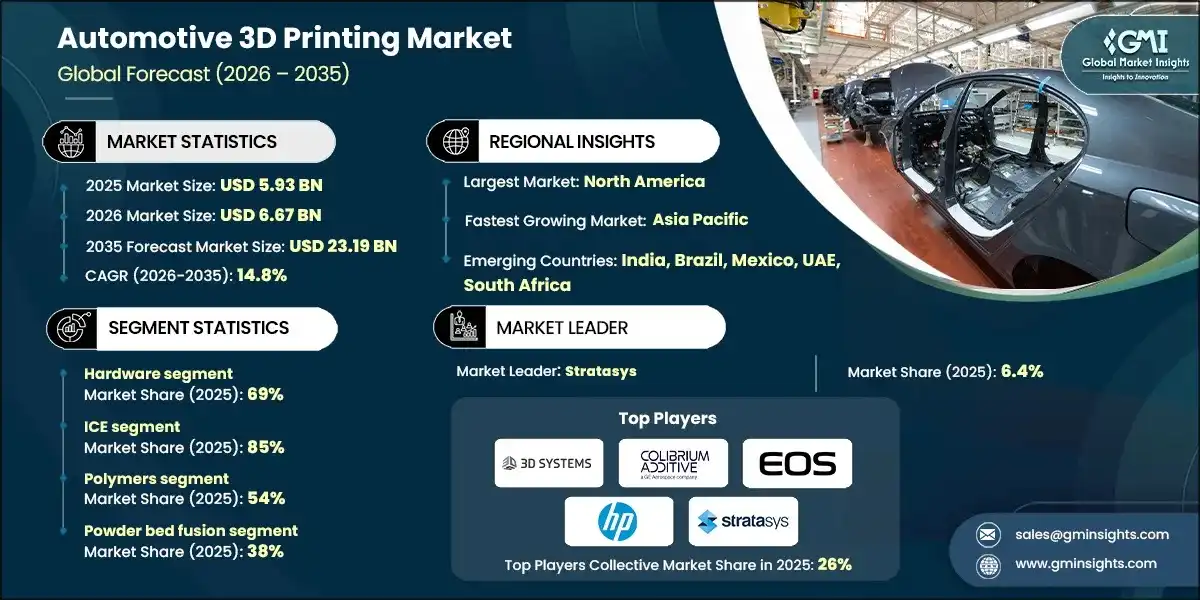
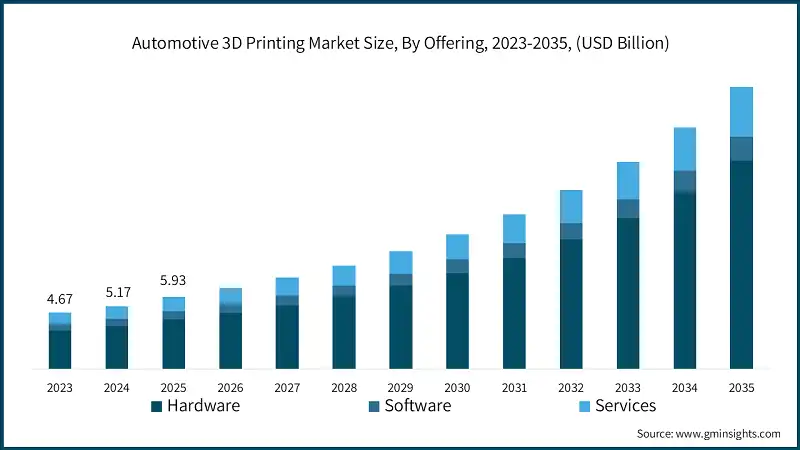
The global automotive 3D printing market size was valued at USD 5.93 billion in 2025. The market is expected to grow from USD 6.67 billion in 2026 to USD 23.19 billion in 2035, at a CAGR of 14.8%, according to latest report published by Global Market Insights Inc.
Automotive 3D Printing Market Key Takeaways
Market Size & Growth
- 2025 Market Size: USD 5.93 Billion
- 2026 Market Size: USD 6.67 Billion
- 2035 Forecast Market Size: USD 23.19 Billion
- CAGR (2026–2035): 14.8%
Regional Dominance
- Largest Market: North America
- Fastest Growing Region: Asia Pacific
Key Market Drivers
- Rapid prototyping / faster time-to-market.
- Lightweight components demand.
- Technological advances.
- Supply-chain resilience & flexibility.
Challenges
- Material limitations & standardization issues.
- High costs & scalability challenges.
Opportunity
- On-demand spare parts & aftermarket replacements.
- Expands aftermarket services, reduces storage costs, and improves parts availability..
- EV & next-gen powertrain components.
- Sustainable / material-efficient production.
Key Players
- Market Leader: Stratasys led with over 6.4% market share in 2025.
- Leading Players: Top 5 players in this market include 3D Systems, Colibrium Additive/ GE Additive, EOS, HP, Stratasys, which collectively held a market share of 26% in 2025.
Get Market Insights & Growth Opportunities
By using 3D printing as part to accelerate development timeframes, manufacturers are better positioned to test their designs faster and repeat the process of testing/iterating quicker, which ultimately results in fewer defects being found before starting mass production. Therefore, these capabilities are critical for the introduction of new models or EV platforms, thereby affording manufacturers a competitive edge, quicker time to market, and an improved ability to respond to consumer demand and regulatory requirements.
In August 2024, Ford Motor Company began using 3D printing, by using a "Form 4" machine by Formlabs and a Fuse One 3D printer to produce rapid prototypes of parts for its new Electric Explorer, charging port covers, dashboard and rear-view assemblies. This process allowed Ford to take their designs from the drawing board to being validated in just a few hours.
The increase in the number of lightweight vehicles and particularly electric vehicles (EVs) has led to the increased adoption of 3D printing due, in large part, to the ability of additive manufacturing to provide manufactured products that are optimized to be the least heavy (and thus lighter than other products), for example, battery enclosures, structural supports, and heat-exchange components. When they can, manufacturers should weigh the benefits of having lighter components, because lighter components give manufacturers the opportunity to increase the level of performance, the level of energy efficiency, and the level of EV range.
In 2025, Honda is using metal additive manufacturing, or LPBF (Laser Powder Bed Fusion), to create engine pieces and lightweight components for racing wheelchairs, automotive and motorsport applications.
3D printing also provides manufacturers with a process to create better, more durable products, because the ongoing advancements in the type of materials that are available, as well as the robotics and design software that are available, enables greater levels of accuracy, durability, and automation. Thus, manufacturers may be able to utilize additive manufacturing technologies to produce more complex, functional parts. Many of the improvements made to design software and integration will not only minimize the number of defects, but they will also maximize the efficiency of the production process and provide precision manufacturing for both prototype and series production in automotive applications.
3D printing has decreased the need for a centralized production model and long supply chains, as 3D printing allows for on-demand manufacturing by enabling manufacturers to quickly respond to shifts in demand, potential supply chain interruptions, and after-market demand for replacement parts. Therefore, flexible additive manufacturing enables companies to financially support low-volume production, bespoke parts, and spare parts production, thus providing resilience, flexibility, and efficiency throughout the automotive supply chain.
To get key market trends
Automotive 3D Printing Market Trends
OEM and suppliers are increasingly using 3D printing in-house to reduce reliance on outside suppliers. This is boosting speed of the iterative design phase for prototypes by lowering the time of transition from design to producing parts and improving flexibility within the supply chain. Using an in-house facility enables faster testing of designs and quicker decisions to be made, which is beneficial for manufacturers of specialty vehicles and electric vehicles (EVs) who want to develop new products but only need to produce them at low volumes and/or prototype them.
More manufacturers are beginning to print with multiple material types, including polymers, metals, and composites, due to the advanced capabilities of 3D printers. They can print components that have tailored mechanical performance properties, such as lightweight structures or the ability to bend, and/or bio-based or recyclable materials, which help manufacturers to meet their sustainability goals, while also allowing manufacturers to produce high-performance components for EVs and traditional/legacy vehicles.
Rather than just using 3D printing to create prototypes, EV manufacturers are increasingly using 3D printing as a way of manufacturing parts. The complexity of parts, such as battery housing, internal cooling channels, and lightweight brackets, makes 3D printing an important technology for manufacturers of EVs, who will benefit from being able to optimize their designs, save weight, and produce more efficiently due to the integration of additive manufacturing into the assembly process of these vehicles.
In March 2025, Divergent Technologies deliver their Czinger 21C hypercar with hundreds of structural pieces produced using 3D printing; thus, 3D printing is not just a prototyping tool, but a source of manufacturing real, functional, load-bearing parts that can be fitted to street-legal vehicles.
Automakers leverage 3D printing to deliver personalized, low-volume, or niche components. On-demand production allows digital spare-part libraries, reducing inventory and logistics costs. Custom interiors, trims, and accessories are produced efficiently, meeting consumer demand for bespoke vehicles while enhancing flexibility and responsiveness in aftermarket and specialty vehicle applications.
For instance, OEMs and suppliers of parts are looking to AM for producing the following types of parts including low volume/specialty (for example, parts for electric vehicles or luxury cars), such as Premier Form producing parts for electric vehicles and luxury vehicles on demand rather than a large, traditional mass production system.
Automotive 3D Printing Market Analysis
Learn more about the key segments shaping this market
Based on offering, the automotive 3D printing market is divided into hardware, software and services. The hardware segment dominated the market, accounting for 69% in 2025 and is expected to grow at a CAGR of over 15% through 2026 to 2035.
- Hardware dominates the automotive 3D printing market as this category gathers powder bed fusion systems, material extrusion platforms, vat photopolymerization, binder jetting lines and other production-class equipment.
- For instance, Ford’s Cologne facility features twelve high-tech printers, the largest handling builds up to 2.4 m x 1.2 m x 1 m with part weights around 15 kg. BMW’s dedicated campus centralizes dozens of polymer and metal systems (and supports production like Cadillac’s CELESTIQ at GM’s AIC), reflecting how clustered capacity streamlines scale-up and training.
- Software holds 11.4% of the market in 2025 with its connective tissue topology optimization, process simulation, print preparation, nesting, monitoring, and MES integrations.
- BMW’s use of Synera (formerly Elise, backed by BMW iVentures) to design and calculate bionic structures shows how software unlocks lighter parts that still meet structural targets.
- Services contract production, design for AM, PPAP workflows, material development, training, and maintenance. Stratasys Direct, for instance, supports Toyota, Honda, GM, and BMW with prototypes, jigs, fixtures, and qualified end-use parts. Material collaborations of BMW with Cubicure and BASF Forward AM on PA 12 C show how services extend into sustainable material engineering for production.
Learn more about the key segments shaping this market
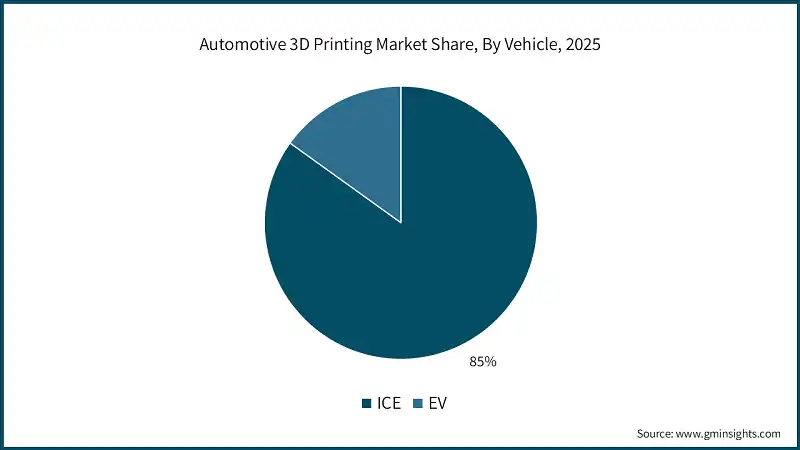
Based on vehicle, the automotive 3D printing market is segmented into ICE and EV. ICE segment dominates the market with 85% share in 2025, and the segment is expected to grow at a CAGR of 15.4% from 2026 to 2035.
- The ICE sector's rapid increase relates directly to the evolution towards traditional automotive uses of this technology. The use of rapid prototyping in the production of CFRP roofs on BMW M Models allows the introduction of additive technology to high-end ICE production.
- For instance, Ford's creation, via 3D Printing technology of whose metal part created through 3D printing at Ford's Research and Innovation Centre in 2019, is an example of the usage of 3D printing within a complex integrated ICE powertrain, in the form of an aluminum intake manifold, for the F-150 engine, and demonstrates the depth of capabilities and possibilities afforded to manufacturers of ICE vehicles by such technologies.
- The introduction of the Cadillac CELESTIQ by General Motors demonstrates the specific application of 3D printing technologies for Electric Vehicle platforms. Using additive manufacturing, General Motors has introduced more than 130 parts for the Cadillac, including the first-ever 3D printed metal safety component.
- EV segment is rapidly increasing and expected to increase due to its unique manufacturing designs and its combined aggressive targets set forth.
- Volkswagen has created a 3D-Printed, Plastic Battery Pack Housing utilizing Selective Laser Sintering. This structure is significantly lighter than traditional aluminum housing designs, due to its 60% reduction in weight when compared to conventional aluminum designs.
Based on material, the automotive 3D printing market is segmented into metals, polymers, ceramics and composites. The polymers segment dominates the market with 54% share in 2025, and the segment is expected to grow at a CAGR of 13.8% from 2026 to 2035.
- The polymer segment includes many types of materials, from commodity thermoplastics to high-performance engineering polymers. Arkema's portfolio of automotive 3D printing materials illustrates the variety of polymers available. Rilsan bio-based polyamide (PA11) allows for faster production and greater design freedom, with potential applications from harness protectors to door-opening mechanisms.
- In 2025, the metals segment is projected to grow at the fastest growth rate of 16.8% CAGR projected through 2035. Functional parts and tooling applications are seeing rapid adoption of metal additive manufacturing.
- Composite materials, and carbon-fiber-reinforced polymer composites in particular, play an increasingly important role in developing lightweight automotive components. For instance, General Motors achieved a 32% weight reduction by using 3D-printed nylon polymers that were reinforced with carbon fibers to replace steel in overhead conveyor risers.
- The integration of waste CFRP (carbon-fiber-reinforced polymer) materials into large-scale 3D printing creates the gripper arms of robots is demonstrated by an example from BMW.
Based on technology, the automotive 3D printing market is segmented into material extrusion, vat photopolymerization, powder bed fusion, material jetting, binder jetting, direct energy deposition and sheet lamination. The powder bed fusion segment is expected to dominate the market with a share of 38% in 2025.
- The powder bed fusion (PBF) is led by its ability to manufacture intricate metal and polymer components and provide outstanding mechanical properties and dimensional accuracy. Over the past thirty years, EOS has been utilizing its Direct Metal Laser Sintering (DMLS) process, which is a type of laser powder bed fusion technology, for the mass manufacture of automobiles.
- DMLS provides superior design capabilities, design freedom, the production of complex, lightweight geometric shapes, and saves time by eliminating the need for post-processing of assemblies.
- Material extrusion is used to manufacture prototypes, tooling, and production tooling and includes two major processes, fused deposition modeling (FDM) and fused filament fabrication (FFF).
- For instance, BMW has demonstrated the potential of large volume production tooling using the material extrusion process (for example, BMW's bionic robot grippers). Through its recycling program, BMW converts waste powder and used parts into new filament for FFF and granulates for Fused Granulate Fabrication (FGF) with an annual processing total of around 12 tons.
- Vat photopolymerization technology has high resolution and surface finish. For instance, Ford owns one of the first SLA machines, the SLA 3, which they purchased in 1986, indicating the long-term use of this technology in the automotive industry.
Looking for region specific data?
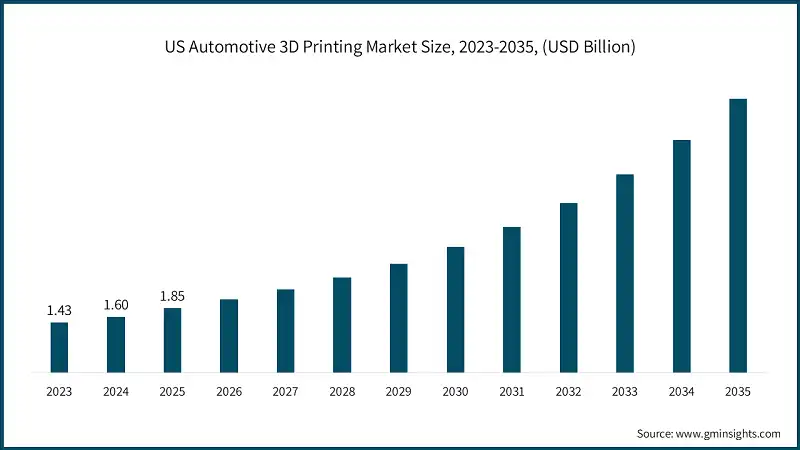
The US automotive 3D printing market reached USD 1.85 billion in 2025, growing from USD 1.60 billion in 2024.
- The use of 3D printing technology for the manufacturing of EV battery housings, brackets and thermal management components has increased among US vehicle manufacturers. As EV investments continue to rise, vehicle manufacturers utilize additive manufacturing processes to quicken models with early development processes and enable them to design complex shapes when manufacturing their products. This accelerates and enhances innovation in many ways and makes the US automotive industry's competitiveness against foreign manufacturers more robust.
- Digital inventories are developing for low-volume or discontinued parts so dealerships and aftermarket suppliers can manufacture parts on demand. By reducing the cost of storing inactive inventories, providing faster service and extending vehicle lifetimes to meet the needs of its aging fleet, this will help improve overall consumer satisfaction through increased customer service.
- The growing trend among performance vehicle manufacturers and automotive customization retailers to leverage 3D printing technology for the manufacture of unique, bespoke interior trim, aerodynamic enhancements, and specialty part components is significantly strengthening both premium and performance car segments as it enables faster design iterations and maximized degrees of customization.
North America dominated the automotive 3D printing market with a market size of USD 2.25 billion in 2025.
- North American OEMs and Tier-1 suppliers are rapidly incorporating metal 3D printing technology into their drive systems, structural support systems, and high-temperature resistant electric vehicle parts.
- These technologies provide improved reliability and sufficient levels of throughput due to their multiple lasers, allowing additive manufacturing to progress towards production-level applications.
- Automotive Manufacturers are increasingly combining traditional machining with metal additive manufacturing processes. Hybrid machining processes allow vehicle manufacturers to optimally combine the speed that they obtain from additive manufacturing, with better precision obtained through traditional machining.
- Hybrid machining processes also reduce material waste, allow for the creation of complex shapes, and allow vehicle manufacturers to utilize greater flexibility in tooling, which increases the overall resiliency of the Supply Chain.
Europe automotive 3D printing market accounted for a share of 28.4% and generated revenue of USD 1.68 billion in 2025 and is anticipated to show lucrative growth over the forecast period.
- The European automotive industry is focusing on biodegradable materials, recycled resins, and emissions-reduced metal powders as it builds new models; because of this, European Union legislation has now mandated that all automotive manufacturers pursue greener alternative additive materials throughout both vehicle and prototype production processes.
- The European automakers that manufacture luxury or specialty vehicles utilize 3D printing platforms to create custom interiors, lightweight structures, and "limited editions" of unique or high-end vehicles. This allows for new business models that provide customers with more personalization and allow product designers exclusive access to an expanding range of design choices.
- Additive manufacturing hubs are being established across Europe to enable on-demand production, increased efficiency of production and reduced emissions associated with transportation between factories. Therefore, the opportunity for improved manufacturer-to-market relationships will greatly affect every aspect of the supply chain and ultimately increase the ability to satisfy customer demand.
Germany dominates the automotive 3D printing market, showcasing strong growth potential, with a CAGR of 12.8% from 2026 to 2035.
- German automotive original equipment manufacturers (OEMs) are utilizing 3D printing of tooling such as jigs, fixtures, and assembly line components to speed up production times and increase accuracy.
- German automotive OEMs are making adoption of metal additive manufacturing of high-performance powertrains (both combustion engines and electric drives). The ability to print precision metal components in 3D printing precision components such as optimized cooling systems, light housing structures, and structurally efficient (strong yet lightweight) components support both premium automotive applications as well as current development efforts towards the next generation of electric vehicles (EVs).
- German automotive manufacturers have also established strong certification processes for automotive parts created by 3D printing. By ensuring that all parts manufactured through 3D printing meet strict standards (i.e., establishing material quality over time, repeatability from part to part, and conformance to stringent safety requirements) this will facilitate a more rapid transition from prototype performance to approved production parts.
The Asia Pacific automotive 3D printing market is anticipated to grow at the highest CAGR of 16.4% from 2026 to 2035 with a revenue of USD 1.48 billion in 2025.
- China's large-scale electric vehicle manufacturing is sustaining the acceleration of additive manufacturing (AM) for applications such as battery enclosures, structural support parts, and thermal management components. The high levels of production encourage manufacturers to invest in a greater number of automated/additive manufacturing systems that utilize high-speed AM technologies.
- Additive manufacturing is a central theme of China's future vision for factories that are both "intelligent" and able to accommodate robots and artificial intelligence (AI) to control quality. The combination of these technologies with AM creates opportunities for an increased number of automotive manufacturing plants adopting AM at an accelerated pace.
- As the Chinese manufacturers continue to develop domestic suppliers of metal powders, high-strength polymer materials, and low-cost composite materials, they are reducing the reliance on imported materials and allowing a more competitive price point in relation to automotive AM applications.
China automotive 3D printing market is estimated to grow with a CAGR of 16.8% from 2026 to 2035.
- Japanese and South Korean automotive original equipment manufacturers (OEMs) have begun to incorporate AM technologies into their operations to create precision components, lightweight support brackets, and advanced tooling.
- Emerging automotive production centers such as Thailand, Malaysia and Vietnam use 3D printing technology to produce tools, fixtures, and replacement parts. New and improved capabilities in flexible AM systems enable companies to create locally sourced supply chains to meet fluctuating consumer demands for products in their geographic regions.
- Manufacturers operating in the Asia-Pacific (APAC) region are using additive manufacturing to minimize tooling costs, reduce time-to-market for prototypes and satisfy localized low-volume production needs. These capabilities show a distinct competitive advantage for many automotive manufacturers operating within the dynamic, price-sensitive automotive market segment.
Latin America Automotive 3D printing market shows lucrative growth over the forecast period.
- The manufacturers in Mexico, Argentina, and Chile have begun to utilize additive manufacturing techniques to alleviate the shortage of replacement parts for automobiles, as well as to reduce their dependence on imported parts, they are also able to use locally manufactured automobile parts to support the production of locally manufactured vehicles, thus providing additional flexibility.
- Many technical institutes and universities in Latin America are establishing additive manufacturing training programs to provide workers with skills to use this technology and to enable additional industrial utilization of it.
- Local automotive plants deploy AM for jigs, fixtures, and prototype components, enhancing flexibility in low-volume and mixed-model production lines.
Brazil automotive 3D printing market is estimated to grow with a CAGR of 7.4% from 2026 to 2035 and reach USD 64 million in 2035.
- Brazil is relying on additive manufacturing increasingly to produce replacement components for an increasing number of outdated commercial vehicles, agricultural vehicles, and passenger vehicles. The on-demand production of parts allows for greater availability, as well as substantially shorter lead times.
- With local manufacturing plants incorporating additive manufacturing into the tooling and fixture processes, Brazil is using it to minimize the impact of supply chain delays, and produce locally manufactured vehicles, allowing for quicker assembly times and better control of production costs.
- In Brazil, the motorsport and enthusiast markets are using additive manufacturing to make custom aerodynamic components, lightweight structures, and to provide rapid prototyping capabilities. As a result, Brazil is accelerating the acceptance of additive manufacturing in the performance-oriented segments of the automotive industry.
The Middle East and Africa automotive 3D printing market accounted for USD 328.7 million in 2025 and is anticipated to show lucrative growth over the forecast period.
- The Middle East and North Africa (MENA) markets utilize additive manufacturing (AM) to create custom parts for off-road vehicles, components for industrial fleets, and applications for maintenance, enabling localized production at lower costs.
- Saudi Arabia and South Africa are promoting the adoption of additive manufacturing as part of their industrial diversification programs, providing support for the automotive supply chain.
- Automotive service centers are using 3D printing to produce fixtures and repair tools and replace parts which enhances productivity and reduces reliance on imports.
UAE automotive 3D printing market is expected to experience substantial growth in the Middle East and Africa market, with a CAGR of 10.3% from 2026 to 2035.
- UAE has implemented national innovation strategies to accelerate the adoption of automotive 3D printing, enabling the production of high-tech and rapid prototypes and the creation of digital manufacturing ecosystems.
- The UAE's luxury automotive sector is using additive manufacturing to create custom interiors, performance-enhancing parts and limited-edition items to support the development of personalization-focused business models.
- Dedicated additive manufacturing hubs located in Dubai and Abu Dhabi provide industrial-grade capabilities, empowering regional auto manufacturers and service centres to access advanced mterials and printing technologies locally.
Automotive 3D Printing Market Share
- The top 7 companies in the automotive 3D printing industry are Stratasys, HP, EOS, 3D Systems, Colibrium Additive/ GE Additive, Desktop Metal and Nikon SLM Solutions contributing 31% of the market in 2025.
- Stratasys is the market leader at 6.4% with breadth across FDM, PolyJet, P3 DLP, SLA, SLS, SAF, and MJF, plus end-to-end services via Stratasys Direct. The unit supports Toyota, Honda, GM, and BMW with prototypes, tooling, and PPAP-qualified runs. The portfolio includes ULTEM 9085, carbon-reinforced thermoplastics (Nylon 12CF, ABS-CF10), LOCTITE 3D 3955 FST, PA12, polypropylene, and PA11 to serve production support and end-use needs. Recent focus areas include scaling SAF for high-volume runs and formalizing PPAP workflows for automotive-grade quality.
- 3D Systems brings a long legacy in SLA and an expanded footprint in SLS and direct metal printing. Automotive programs use 3D Systems’ platforms for prototyping, production-grade photopolymers, and metal parts qualified for durability and thermal conditions expected under the hood. Its Figure 4 technology has focused on speed, accuracy, and production stability.
- EOS remains a reference in metal AM with DMLS systems, materials (aluminum, cobalt chrome, copper, nickel alloys, stainless, titanium, tool steel), and process controls are engineered for serial reliability. The company’s automotive thrust centers on stable throughput, multi-laser productivity, and end-to-end quality assurance for complex metal components.
- HP metal jet and polymer portfolio have found strong traction in automotive through the Volkswagen-GKN ecosystem. The program targets up to 100,000 functional parts annually and leverages Siemens software to double part density per build. The company is aligning materials and process controls for structural components in serial production.
- GE Additive benefits from the proximity to GM’s own industrialization efforts. GM’s AIC supports CELESTIQ and performance programs, illustrating how close OEMs now keep AM capabilities to vehicle development. Strategic focus areas include safety-class components, precise lattice control, and quality documentation aligned to automotive standards.
- Nikon SLM Solutions work intersects with OEM research on multi-material concepts and productivity optimization. BMW’s research lineage includes SLM 280 2.0 in multi-material studies, underscoring the cutting edge of PBF-LB/M.
- Desktop Metal’s binder jetting portfolio is trained on high-throughput metal parts. The company’s single-pass jetting approach aims at cost-effective serial runs with a growing library of automotive-grade alloys. The Studio System extends capability to engineering teams for fast-turn metal prototypes without a full production cell.
Automotive 3D Printing Market Companies
Major players operating in the automotive 3D printing industry are:
- 3D Systems
- Colibrium Additive/ GE Additive
- Desktop Metal
- EOS
- GE Additive
- HP
- Materialise
- Nikon SLM Solutions
- SLM Solutions
- Stratasys
- Stratasys is a pioneer of the 3D Printing market due to its broad Technology Portfolio including Fused Deposition Modelling (FDM), PolyJet, SAF & SLA technologies which allows for Advanced Prototyping, Tooling & End-use components for Automotive Part Production. This includes 300K+ Contract Projects and advanced automotive quality materials and Volumetric workflows including Production Part Approval Process (PPAP) type production to support OEM Aircraft Manufacturing. 3D Systems are supported by a strong Technical Expertise for Stereolithography (SLA), Selective Laser Sintering (SLS) and Direct Metal Printing (DMP) applications.
- EOS has an extensive Materials Portfolio including Metal-Sintering Technology (STF) that allows its Systems to produce Aluminum, Nickel, Tool Steel, etc.) with high productivity and repeatable processes. EOS emphasis is on Process-Reliability, Production Rate improvement and Development of Materials Innovations to make available High-quality automotive parts. HP has teamed up with GKN Powder Metallurgy and Siemens on High-Speed Laser Systems to optimize Workflows based on producing Lightweight Structures (metal).
- Materialise has supported OEMs through Design for AM, Production Qualification, Workflow Development, and Moving automotive clients from Prototype to Validated Serial Manufacturer. Nikon SLM Solutions manufactures Selective Laser Melting (SLM) systems achieving Precision and Complexity in Layered Metal Manufacturing for automotive applications. Their multi-laser technology allows for increased productivity & Increased number of possibilities to achieve the desired geometries.
Automotive 3D Printing Market Report Attributes
| Key Takeaway | Details |
|---|---|
| Market Size & Growth | |
| Base Year | 2025 |
| Market Size in 2025 | USD 5.93 Billion |
| Market Size in 2026 | USD 6.67 Billion |
| Forecast Period 2026-2035 CAGR | 14.8% |
| Market Size in 2035 | USD 23.19 Billion |
| Key Market Trends | |
| Drivers | Impact |
| Rapid prototyping / faster time-to-market | Reduce product development cycles, enabling quicker launches and improved competitiveness. |
| Lightweight components demand | Supports EV adoption and fuel efficiency, driving higher 3D printing adoption for optimized parts. |
| Technological advances | Enhance production accuracy, material versatility, and scalability, accelerating industry adoption. |
| Supply-chain resilience & flexibility | Minimize inventory and logistics costs, enabling agile manufacturing and on-demand production. |
| Pitfalls & Challenges | Impact |
| Material limitations & standardization issues | Restricts use for safety-critical components and slows regulatory approval. |
| High costs & scalability challenges | Limits mass-production adoption and makes implementation expensive for small and mid-sized manufacturers. |
| Opportunities: | Impact |
| On-demand spare parts & aftermarket replacements | Expands aftermarket services, reduces storage costs, and improves parts availability. |
| Expands aftermarket services, reduces storage costs, and improves parts availability. | Expands aftermarket services, reduces storage costs, and improves parts availability. |
| EV & next-gen powertrain components | Drives adoption of 3D printing for complex, lightweight, and high-performance components. |
| Sustainable / material-efficient production | Enhances eco-friendly manufacturing and aligns with regulatory and consumer sustainability trends. |
| Market Leaders (2025) | |
| Market Leaders |
6.4% market share |
| Top Players |
Collective market share in 2024 is Collective market share in 2025 is 26% |
| Competitive Edge |
|
| Regional Insights | |
| Largest Market | North America |
| Fastest growing market | Asia Pacific |
| Emerging countries | India, Brazil, Mexico, UAE, South Africa |
| Future outlook |
|
What are the growth opportunities in this market?
Automotive 3D Printing Industry News
- In Jul 2025, BMW expands circular AM initiatives, recycling up to 12 tons of powder annually into filament and granulates for auxiliary devices and pre-development projects; recycled PA 12 C is distributed from the Additive Manufacturing Campus to plants worldwide.
- In April 2025, GM highlights 3D-printed precision in the Cadillac CELESTIQ with 130+ printed parts including the largest production metal print in GM’s lineup and the first printed metal safety component, which won a 2024 Award of Distinction.
- In February 2025, Ford reported roughly 1,000 complex metal and polymer parts supporting Red Bull F1 powertrains, with advanced 3D scanning, X-ray, and CT quality check methods migrating to consumer programs.
- In December 2024, BMW’s Landshut foundry receives a fully automated, high-volume sand core 3D printing line from Laempe Mössner Sinto, integrating six high-speed printers with automated handling and QA for the new six-cylinder engine generation.
- In November 2024, Carbon and Ford showcase on-demand production of end-use automotive parts, with Ford qualifying DLS and EPX 82 for multiple components including HVAC lever arms and EPB brackets.
The automotive 3D printing market research report includes in-depth coverage of the industry with estimates & forecasts in terms of revenue ($ Mn/Bn) from 2022 to 2035, for the following segments:
Market, By Offering
- Hardware
- Software
- Services
Market, By Vehicle
- ICE
- Passenger cars
- Commercial vehicles
- EV
- Passenger cars
- Commercial vehicles
Market, By Material
- Metals
- Aluminum alloys
- Stainless steel
- Titanium alloys
- Cobalt chrome
- Others
- Polymers
- Ceramics
- Composites
Market, By Technology
- Material extrusion
- Vat photopolymerization
- Powder bed fusion
- Material jetting
- Binder jetting
- Direct energy deposition
- Sheet lamination
Market, By Application
- Rapid prototyping & design validation
- Tooling, jigs & fixtures
- Production parts/end-use manufacturing
- Spare parts & aftermarket
The above information is provided for the following regions and countries:
- North America
- US
- Canada
- Europe
- Germany
- UK
- France
- Italy
- Spain
- Russia
- Nordics
- Poland
- Romania
- Asia Pacific
- China
- India
- Japan
- South Korea
- ANZ
- Vietnam
- Indonesia
- Latin America
- Brazil
- Mexico
- Argentina
- MEA
- South Africa
- Saudi Arabia
- UAE
Frequently Asked Question(FAQ) :
What was the market size of the automotive 3D printing in 2025?
The market size was valued at USD 5.93 billion in 2025, with a CAGR of 14.8% expected through 2035. The adoption of 3D printing for faster prototyping, reduced defects, and enhanced production efficiency is driving market growth.
What is the projected value of the automotive 3D printing market by 2035?
The market is poised to reach USD 23.19 billion by 2035, driven by advancements in additive manufacturing, increased EV production, and the demand for lightweight and sustainable components.
What is the expected size of the automotive 3D printing industry in 2026?
The market size is projected to reach USD 6.67 billion in 2026.
What was the market share of the hardware segment in 2025?
The hardware segment dominated the market with a 69% share in 2025 and is expected to grow at a CAGR of over 15% from 2026 to 2035.
What was the market share of the ICE segment in 2025?
The ICE segment held an 85% market share in 2025 and is set to expand at a CAGR of 15.4% till 2035.
What was the market share of the polymers segment in 2025?
The polymers segment accounted for 54% of the market in 2025 and is anticipated to showcase around 13.8% CAGR till 2035.
What was the valuation of the US automotive 3D printing sector?
The US market was valued at USD 1.85 billion in 2025. The increasing use of 3D printing for EV components, such as battery housings and thermal management parts, is driving growth in the region.
What are the upcoming trends in the automotive 3D printing market?
Trends include diverse materials, sustainable bio-based options, 3D-printed EV parts, on-demand component production, and integration of additive manufacturing into assembly.
Who are the key players in the automotive 3D printing industry?
Key players include 3D Systems, Colibrium Additive/GE Additive, Desktop Metal, EOS, GE Additive, HP, Materialise, Nikon SLM Solutions, SLM Solutions, and Stratasys.
Automotive 3D Printing Market Scope
Related Reports