Summary
Table of Content

Automatic Ice Maker Market
Get a free sample of this report
Form submitted successfully!
Error submitting form. Please try again.
Thank you!
Your inquiry has been received. Our team will reach out to you with the required details via email. To ensure that you don't miss their response, kindly remember to check your spam folder as well!
Request Sectional Data
Thank you!
Your inquiry has been received. Our team will reach out to you with the required details via email. To ensure that you don't miss their response, kindly remember to check your spam folder as well!
Form submitted successfully!
Error submitting form. Please try again.
Automatic Ice Maker Market Size
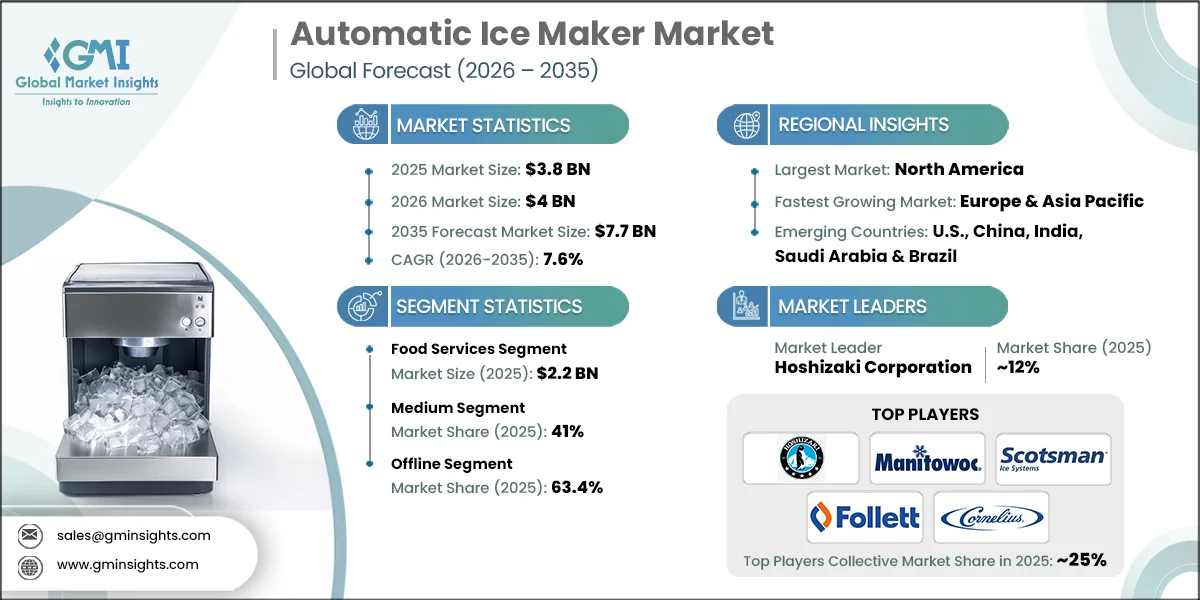
The global automatic ice maker market size was estimated at USD 3.8 billion in 2025. The market is expected to grow from USD 4 billion in 2026 to USD 7.7 billion in 2035, at a CAGR of 7.6% according to latest report published by Global Market Insights Inc.
Automatic Ice Maker Market Key Takeaways
Market Size & Growth
- 2025 Market Size: USD 3.8 Billion
- 2026 Market Size: USD 4 Billion
- 2035 Forecast Market Size: USD 7.7 Billion
- CAGR (2026–2035): 7.6%
Regional Dominance
- Largest Market: North America
- Fastest Growing Region: Europe & Asia Pacific
Key Market Drivers
- Expansion of hospitality and foodservice industry.
- Rising consumer preference for convenience.
- Growth of quick-service restaurants and home entertainment trends.
Challenges
- High energy consumption.
- Supply chain interruptions and supplier product shortages.
Opportunity
- New market adoption in emerging market.
- Eco-friendly refrigerants and energy.
Key Players
- Market Leader: Hoshizaki Corporation led with over market share of ~12% in 2025.
- Leading Players: Top 5 players in this market include Hoshizaki Corporation, Manitowoc Ice, Scotsman Ice Systems, Follett corporation, Cornelius, Inc., which collectively held a market share of 25% in 2025.
Get Market Insights & Growth Opportunities
- The demand for automatic ice makers is increasing rapidly. This growth is mainly due to the increasing demand for commercial ice machines from restaurants, bars, catering companies, hotels, etc. These types of businesses require large amounts of melted ice on a regular basis making it necessary for them to always have access to automatic ice makers. In 2023, there were approximately 963 million international tourist arrivals globally according to the United Nations World Tourism Organization (UNWTO), indicating that global tourism has rebounded strongly since the pandemic began. The combination of increased tourism and more high-end (i.e., luxury) hotels and upscale fine-dining restaurants had led to an explosion in demand for automated ice machines for use in these high-end beverage applications that require premium-grade specialty ice cubes.
- Convenience has become an important growth factor due to changing trends in how people live. The increasing need for convenience is being driven by the increase in urbanization and a more rapid lifestyle. Due to time restrictions placed upon consumers by their lifestyles, consumers have turned increasingly towards appliances that allow them to save on time taken to complete household chores. Automatic ice makers offer easy-to-use, quick-to-prepare solutions for households and the removal of the traditional labor-intensive ice making process, which generally takes a lot of time and effort to prepare. Other technological advances such as smart connectivity, smaller designs, and higher rated energy efficient models, have increased the attractiveness of ice makers. In fact, according to the U.S. Department of Energy, energy efficient appliances (including ice makers) can lower energy costs by 20% or more, which reflects the sustainability and cost savings consumers are seeking. As a result of these various factors, automatic ice makers are quickly becoming more widespread in residential environments, where convenience and environmental consciousness are driving factors in consumer purchasing decisions.
- The rapid expansion of the quick service restaurant (QSR) segment and the current trend of home entertainment all contribute to this market development story. Quick Service Restaurants and Fast Food Chains have greatly benefited from the use of efficient ice-making equipment to provide quality beverage service and fast service times. As temperatures rise in many parts of the world, particularly in hot weather states, demand for cold beverages is increasing. In 2023, the National Restaurant Association reported that the Quick Service Restaurant segment accounted for greater than USD 350 billion in revenue. This statistic illustrates the QSR segment's dependence on efficient equipment to produce quality beverages, as well as the rise of consumers investing in machines that create the unique type of ice required for use in Specialty Cocktails and Premium Beverages, due to the increased popularity of Home Bar and Entertainment Areas.
To get key market trends
Automatic Ice Maker Market Trends
- The market for automatic ice makers is evolving rapidly, as a new generation of smart and connected ice makers are becoming one of the innovations driving the evolution of this sector. These technologically advanced appliances feature many Internet of Things (IoT) capabilities, and are designed for users to easily monitor and control their ice-making processes using dedicated mobile apps or through integrated smart home systems. These systems provide users with many additional features, including the ability to control their devices remotely, to receive real-time alerts regarding their ice levels, and to access predictive maintenance alerts that will enable users to address potential problems before they arise. All of these enhancements improve a user’s experience and simplify the use of automatic ice makers. The increasing popularity of smart kitchen solutions combined with home automation technology coincides with this trend, resulting in ice makers being regarded as more than just appliances they are now a key component of a complete connected and integrated living experience for the tech-savvy consumer.
- The ice maker industry is evolving with new technology and design trends. More consumers are demanding ice makers made with compact, modular designs that take advantage of the growing popularity of smaller living spaces. As people adapt to smaller living areas because of urbanization, they are looking for ice makers that offer maximum functionality and minimal space requirements.
- Therefore, manufacturers are designing new and innovative ice makers that are sleek and compact, fitting perfectly into the overall design of modern kitchens or commercial settings. Consumers in urban areas want the convenience of a compact ice maker without sacrificing efficiency. Similarly, small businesses will benefit from the introduction of modular ice makers. Businesses will be able to select and tailor an ice maker to match their needs and only purchase the correct-sized equipment, avoiding the cost and wasted space of larger machines. The current market trend is to provide flexible solutions for both residential and commercial customers while addressing the space constraints created by urbanization and changing consumer preferences.
Automatic Ice Maker Market Analysis

Learn more about the key segments shaping this market
Based on application, the market is categorized into healthcare industry, food services, retail and others. The food services accounted for revenue of around USD 2.2 billion in 2025 and is anticipated to grow at a CAGR of 7.1% from 2026 to 2035.
- The global expansion of restaurants, cafés, bars, and hotels has significantly increased the demand for high-capacity ice-making solutions to support beverage preparation and food preservation. Rising consumer preference for cold drinks, cocktails, and premium dining experiences has made ice an essential component in foodservice operations.
- Additionally, the surge in quick-service restaurants (QSRs) and fast-food chains, driven by changing lifestyles and urbanization, requires efficient ice makers to ensure speed and quality of service. The hospitality industry’s continuous growth, fueled by tourism and luxury dining trends, further amplifies this demand.
Based on price of automatic ice maker market consists of low, medium and high. The medium priced emerged as leader and held 41% of the total market share in 2025 and is anticipated to grow at a CAGR of 7.3% from 2026 to 2035.
- Medium-priced ice makers offer reliable performance, durability, and essential functionalities without the premium cost associated with high-end models, making them highly attractive to both residential and commercial buyers. Foodservice businesses, small restaurants, cafés, and households prefer these models because they provide sufficient capacity and efficiency at a reasonable price point.
- Additionally, this segment often includes energy-efficient and compact designs, which appeal to cost-conscious consumers seeking modern appliances without compromising on quality. The growing middle-class population, rising disposable incomes, and increasing demand for value-for-money products in emerging markets further support the popularity of medium-priced ice makers.

Learn more about the key segments shaping this market
Based on distribution channel of automatic ice maker market consists of online and offline. The offline distribution channel emerged as leader and held 63.4% of the total market share in 2025 and is anticipated to grow at a CAGR of 7.7% from 2026 to 2035.
- Offline channels, including specialty appliance stores, large retail chains, and authorized dealers, provide customers with the advantage of physically inspecting products before purchase, which is particularly important for high-value appliances like ice makers. These channels offer personalized assistance, installation services, and after-sales support, which enhances customer confidence and satisfaction. Commercial buyers such as restaurants, hotels, and healthcare facilities often prefer offline purchases to ensure proper guidance on capacity, technical specifications, and maintenance requirements.
- Additionally, offline stores frequently showcase a wide range of models, enabling buyers to compare features and quality in real time. In regions where trust in online transactions is still developing, offline channels remain the preferred choice. Furthermore, strong relationships between manufacturers and distributors, along with promotional offers and financing options available in physical stores, continue to drive sales through this channel.
Looking for region specific data?
North America Automatic Ice Maker Market
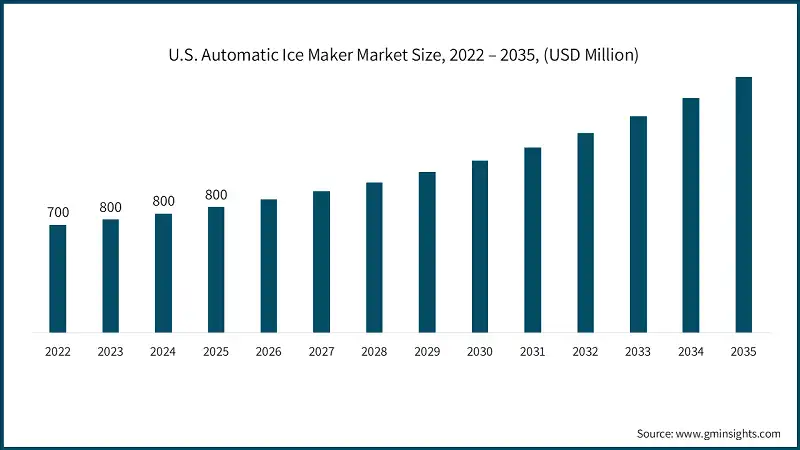
The U.S. dominates an overall North America market and valued at USD 800 million in 2025 and is estimated to grow at a CAGR of 7.5% from 2026 to 2035.
- The increasing adoption of advanced refrigeration and kitchen appliances in both residential and commercial sectors is driving demand, as consumers seek convenience and efficiency in food and beverage preparation. The hospitality industry, including hotels, restaurants, and bars, continues to expand, creating a strong need for reliable ice-making solutions to meet high-volume requirements.
- Additionally, the surge in quick-service restaurants and the growing trend of home entertaining have further boosted the popularity of automatic ice makers. Technological advancements, such as energy-efficient models, smart connectivity features, and compact designs, are appealing to eco-conscious and tech-savvy consumers. Rising disposable incomes and urbanization have also contributed to higher spending on premium appliances.
Europe Automatic Ice Maker Market
In the European market, Germany is expected to experience significant and promising growth from 2026 to 2035.
- The country has a strong hospitality and foodservice industry, which is expanding due to rising tourism and increasing numbers of hotels, restaurants, and catering services. This growth creates a substantial demand for efficient ice-making solutions to support beverage and food preservation needs.
- Additionally, Germany’s high standard of living and growing preference for premium kitchen appliances among consumers are driving adoption in residential settings. The trend toward energy-efficient and sustainable appliances aligns with Germany’s strict environmental regulations and consumer awareness about eco-friendly products, encouraging manufacturers to introduce advanced, low-energy ice makers.
Asia Pacific Automatic Ice Maker Market
In the Asia Pacific market, the China held 34.4% market share in 2025 and is anticipated to grow at a CAGR of 8.2% from 2026 to 2035.
- Rapid urbanization and rising disposable incomes are fueling demand for modern kitchen and refrigeration appliances among households, as consumers increasingly prioritize convenience and lifestyle upgrades. The booming foodservice industry, driven by the expansion of restaurants, cafés, bars, and hotels, is creating substantial demand for high-capacity ice makers to meet beverage and food preservation needs.
- Additionally, China’s thriving e-commerce sector and well-developed distribution networks make these appliances more accessible to a broad consumer base. Technological advancements, such as energy-efficient models and smart connectivity features, align with the country’s push toward sustainability and smart home integration, further accelerating adoption. The growing popularity of Western dining habits and cold beverages, coupled with the rise of quick-service restaurants and home entertaining trends, also supports market growth.
Middle East and Africa Automatic Ice Maker Market
In the Middle East and Africa market, Saudi Arabia held 20.4% market share in 2025 promising growth from 2026 to 2035.
- The country’s rapidly expanding hospitality and tourism sector, fueled by initiatives under Vision 2030, is creating strong demand for advanced refrigeration and ice-making solutions in hotels, resorts, and restaurants. Rising disposable incomes and a growing preference for luxury lifestyles are encouraging consumers to invest in premium home appliances, including automatic ice makers.
- Additionally, the hot climate and year-round high temperatures significantly increase the need for ice in both residential and commercial settings, making these appliances essential for food preservation and beverage cooling. The surge in quick-service restaurants, cafés, and entertainment venues further amplifies demand. Saudi Arabia’s robust infrastructure development and increasing penetration of modern retail and e-commerce platforms ensure easy availability and accessibility of these products.
Automatic Ice Maker Market Share
- In 2025, the prominent manufacturers in market are Hoshizaki Corporation, Manitowoc Ice, Scotsman Ice Systems, Follett corporation, Cornelius, Inc. collectively held the market share of ~25%.
- Scotsman Ice Systems is a pioneering manufacturer in the ice-making industry, known for producing a diverse range of ice types, including cubes, flakes, nugget, and gourmet ice. The company has consistently focused on developing high-quality, reliable, and energy-efficient ice solutions, which have contributed to its expansive market presence. Scotsman Ice Systems’ commitment to innovation and excellence has positioned it as a leader in industry. Similarly, Follett Ice has gained recognition as a prominent manufacturer of ice and water dispensing equipment, particularly for its chewable nugget ice machines. The company’s products are designed to meet the specific needs of the healthcare and foodservice sectors, with a strong emphasis on hygiene and specialized solutions. Follett Ice’s ability to address the unique requirements of various market segments has earned it a positive reputation and a strong position in the marketplace.
- Cornelius Inc. is a globally recognized supplier of beverage dispensing and cooling equipment, with ice makers serving as a fundamental component of their comprehensive foodservice solutions. The company provides robust and reliable ice machine systems that seamlessly integrate with its other beverage dispensing offerings, catering to a wide range of customer needs. Cornelius Inc.’s commitment to delivering high-quality, dependable products has enabled it to secure a meaningful share of the market. By offering fully integrated solutions that enhance operational efficiency and customer satisfaction, the company continues to strengthen its position as a leader in the foodservice equipment industry.
Automatic Ice Maker Market Companies
Major players operating in the automatic ice maker industry include:
- Brema Ice Makers
- Cornelius, Inc.
- Follett Ice
- Hoshizaki Corporation
- Howe Corporation
- Icematic
- Ice-o-Matic
- KOLD-DRAFT
- Manitowoc Ice
- Marvel Refrigeration
- Marx Ice
- Newair
- Polar Ice
- Scotsman Ice Systems
- U-Line Corporation
Hoshizaki is recognized as a global leader in the design, manufacturing, and marketing of an extensive range of foodservice equipment, with a particular emphasis on state-of-the-art ice machines. The company has established a strong foothold in the market by leveraging advanced technological innovations and consistently delivering high-quality products. Hoshizaki's significant global presence and commitment to excellence have enabled it to maintain a substantial market share, both within national boundaries and on the international stage. The company’s dedication to innovation and customer satisfaction continues to reinforce its leadership position in the foodservice equipment market.
Manitowoc Ice has emerged as a key player in the commercial ice machine market, offering a wide range of products that are highly regarded for their reliability, energy efficiency, and advanced diagnostic capabilities. The company’s extensive product portfolio is one of the largest in the ice machine market, catering to diverse commercial sectors with dependable and long-lasting ice solutions. Manitowoc Ice’s reputation for delivering high-performance products has solidified its standing in the market, making it a preferred choice for businesses seeking efficient and durable ice-making equipment. The company’s focus on innovation and customer-centric solutions continues to drive its growth and market presence.
Automatic Ice Maker Market Report Attributes
| Key Takeaway | Details |
|---|---|
| Market Size & Growth | |
| Base Year | 2025 |
| Market Size in 2025 | USD 3.8 Billion |
| Market Size in 2026 | USD 4 Billion |
| Forecast Period 2026 - 2035 CAGR | 7.6% |
| Market Size in 2035 | USD 7.7 Billion |
| Key Market Trends | |
| Drivers | Impact |
| Expansion of hospitality and foodservice industry | Drives significant demand for high-capacity ice makers as hotels, restaurants, and bars require consistent ice supply for beverages and food preservation. |
| Rising consumer preference for convenience | Accelerates adoption of automatic ice makers in residential settings due to time-saving and hassle-free operation. |
| Growth of quick-service restaurants and home entertainment trends | Increases demand for efficient ice-making systems to support fast beverage service in QSRs and cafés. |
| Pitfalls & Challenges | Impact |
| High energy consumption | Raises operational costs for commercial users and limits adoption among energy-conscious consumers. |
| Supply chain interruptions and supplier product shortages | Leads to delayed deliveries and increased production costs, impacting market growth. |
| Opportunities: | Impact |
| New market adoption in emerging market | Expanding urbanization and rising disposable incomes in Asia, Africa, and Latin America create untapped demand. |
| Eco-friendly refrigerants and energy | Growing sustainability regulations and consumer awareness drive demand for green, energy-efficient ice makers. |
| Market Leaders (2025) | |
| Market Leaders |
Market share of ~12% |
| Top Players |
|
| Competitive Edge |
|
| Regional Insights | |
| Largest Market | North America |
| Fastest growing market | Europe & Asia Pacific |
| Emerging countries | U.S., China, India, Saudi Arabia & Brazil |
| Future outlook |
|
What are the growth opportunities in this market?
Automatic Ice Maker Industry News
- In February 2025, Hoshizaki unveiled its IM CUBE series, featuring the Cube, FlexiCube, UltraCube, and EliteCube models. These machines boast variable-speed DC pumps for enhanced ice clarity, energy and water efficiency, integrated UV sanitation for heightened hygiene, and built-in drain pumps for easier maintenance.
- In November 2025, Hoshizaki transitioned 66 of its ice maker models to eco-friendly refrigerants like R-600a and R-290. This shift slashed their global warming potential by over 99% compared to older HFC-based systems, underscoring Hoshizaki's commitment to sustainability and regulatory adherence.
- In June 2024, GE Appliances rolled out the Opal 2.0 Ultra Nugget Ice Maker. This model boasts a scale-reducing water filter, a reusable air filter, a sleek touch display, and a newly designed steel scoop. With modern color choices and user-friendly maintenance features, the unit promises both aesthetic appeal and enhanced usability.
- In 2024, Scotsman launched the UC2024 undercounter ice maker. This ENERGY STAR-certified unit, at just 24 inches wide, churns out 230 pounds of medium cube ice daily. Using the low-GWP R-290 refrigerant, it also sports a removable air filter and a front-breathing design, ensuring hassle-free installation and upkeep.
The automatic ice maker market research report includes in-depth coverage of the industry, with estimates & forecast in terms of revenue (USD Billion) and volume (Thousand Units) from 2022 to 2035, for the following segments:
Market, By Product Type
- Ice cubes
- Ice flakes
- Ice nuggets
- Ice ball/sphere
Market, By Capacity
- <20 lbs/day
- 20-50 lbs/day
- 50 lbs/day
Market, By Price
- Low
- Medium
- High
Market, By Application
- Residential
- Commercial
- Restaurants
- Craft cocktail bars/speakeasies
- Luxury hotels/resorts
- Whisky bars/lounges
Market, By End-use
- Healthcare industry
- Food services
- Retail
- Others
Market, By Distribution Channel
- Online
- E-commerce website
- Company website
- Offline
- Specialty retail
- Department stores
- Appliance retailers
The above information is provided for the following regions and countries:
- North America
- U.S.
- Canada
- Europe
- Germany
- UK
- France
- Italy
- Spain
- Asia Pacific
- China
- Japan
- India
- South Korea
- Australia
- Indonesia
- Malaysia
- Latin America
- Brazil
- Mexico
- Argentina
- MEA
- Saudi Arabia
- UAE
- South Africa
Frequently Asked Question(FAQ) :
What is the market size of the automatic ice maker market in 2025?
The global market for automatic ice was valued at USD 3.8 billion in 2025, supported by rising demand from hospitality, foodservice, and residential applications.
What is the projected value of the automatic ice maker market by 2035?
The market is expected to reach USD 7.7 billion by 2035, growing at a CAGR of 7.6% from 2026 to 2035, driven by expanding tourism, quick-service restaurants, and smart kitchen adoption.
What will be the market value of automatic ice makers in 2026?
The market is projected to reach USD 4 billion in 2026, marking the beginning of strong growth momentum during the forecast period.
Which application segment generated the highest revenue in 2025?
The food services segment led the market, generating approximately USD 2.2 billion in revenue in 2025 due to strong demand from restaurants, cafés, bars, and hotels.
What was the market share of the medium-priced segment in 2025?
The medium-priced segment dominated the market with a 41% share in 2025, supported by its balance of affordability, performance, and energy efficiency.
Which distribution channel leads the automatic ice maker market?
Offline distribution channels accounted for 63.4% of the market share in 2025, driven by customer preference for in-store product evaluation, installation services, and after-sales support.
Which region leads the automatic ice maker market?
North America is the largest regional market, with the U.S. valued at USD 800 million in 2025, supported by strong hospitality demand and high adoption of advanced kitchen appliances.
Who are the key players in the automatic ice maker market?
Major players include Hoshizaki Corporation, Manitowoc Ice, Scotsman Ice Systems, Follett Corporation, Cornelius, Inc., Ice-O-Matic, Brema Ice Makers, and U-Line Corporation.
Automatic Ice Maker Market Scope
Related Reports