Summary
Table of Content

Automated Cell Counter Market
Get a free sample of this report
Form submitted successfully!
Error submitting form. Please try again.
Thank you!
Your inquiry has been received. Our team will reach out to you with the required details via email. To ensure that you don't miss their response, kindly remember to check your spam folder as well!
Request Sectional Data
Thank you!
Your inquiry has been received. Our team will reach out to you with the required details via email. To ensure that you don't miss their response, kindly remember to check your spam folder as well!
Form submitted successfully!
Error submitting form. Please try again.
Automated Cell Counter Market Size
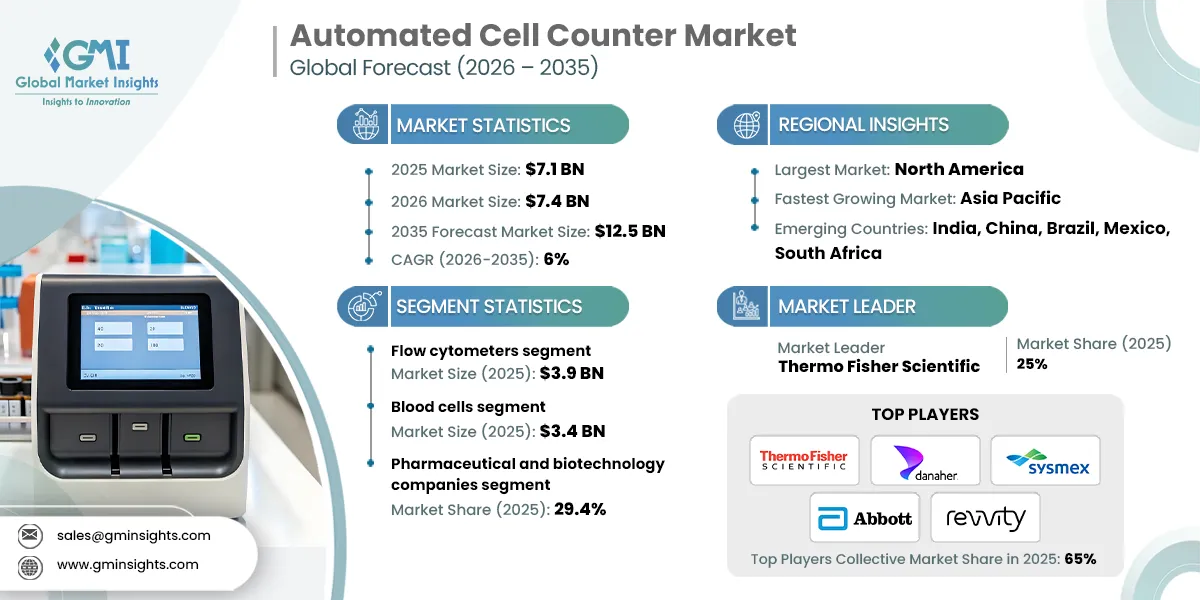
The global automated cell counter market was valued at USD 7.1 billion in 2025 and is projected to grow from USD 7.4 billion in 2026 to USD 12.5 billion by 2035, expanding at a CAGR of 6%, according to the latest report published by Global Market Insights Inc. This steady growth is driven by the increasing prevalence of chronic and infectious diseases, increasing research and development expenditure worldwide and technological advancements in automated cell counter industry.
Automated Cell Counter Market Key Takeaways
Market Size & Growth
- 2025 Market Size: USD 7.1 Billion
- 2026 Market Size: USD 7.4 Billion
- 2035 Forecast Market Size: USD 12.5 Billion
- CAGR (2026–2035): 6%
Regional Dominance
- Largest Market: North America
- Fastest Growing Region: Asia Pacific
Key Market Drivers
- Increasing prevalence of chronic and infectious diseases.
- Increasing research and development expenditure worldwide.
- Technological advancements in automated cell counter industry.
- Expansion of stem cell and regenerative medicine.
Challenges
- High cost of automated cell counter devices.
- Lack of skilled workforce.
Opportunity
- Expansion in cell therapy manufacturing.
Key Players
- Market Leader: Thermo Fisher Scientific led with over 25% market share in 2025.
- Leading Players: Top 5 players in this market include Thermo Fisher Scientific, Danaher, Sysmex Corporation, Abbott Laboratories, Revvity (Nexcelom Bioscience), which collectively held a market share of 65% in 2025.
Get Market Insights & Growth Opportunities
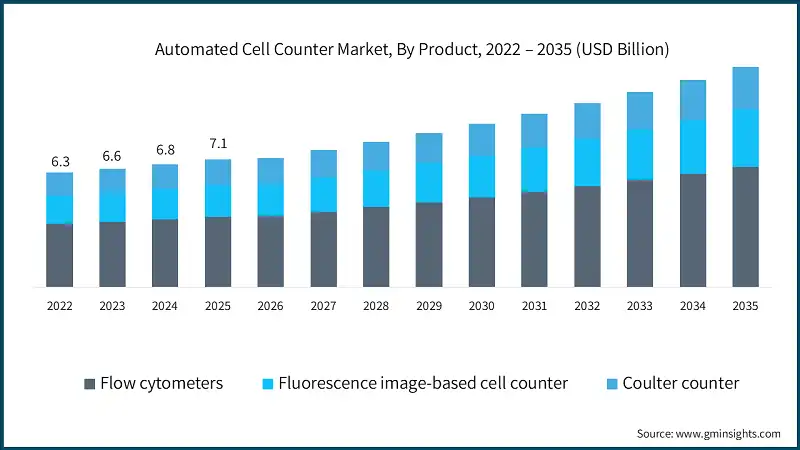
The market increased from USD 6.3 billion in 2022 to USD 6.8 billion in 2024. Increasing prevalence of chronic and infectious diseases is a major driver for the automated cell counter market. Infectious diseases such as tuberculosis and HIV demand accurate and frequent cell analysis for diagnosis, treatment monitoring, and research. For instance, according to WHO, total of 1.23 million people died from tuberculosis in 2024, including 150,000 among people with HIV. Globally, TB remains the leading cause of death from a single infectious agent and ranks among the top 10 causes of death.
Such alarming statistics highlight the growing need for advanced diagnostic tools. Automated cell counters enable rapid and precise quantification of immune cells like CD4 and CD8 in HIV patients and facilitate cell viability checks in TB drug development. Similarly, chronic conditions such as cancer and diabetes require continuous blood cell monitoring, further boosting demand for automated solutions that reduce human error and improve throughput. As healthcare systems worldwide focus on early detection, personalized medicine, and large-scale screening programs, the reliance on automated cell counting technologies will intensify. In conclusion, the rising burden of chronic and infectious diseases creates a sustained demand for accurate, high-throughput cell analysis, making automated cell counters as an essential component in modern diagnostics and research.
Additionally, increasing research and development expenditure worldwide is a driver for the automated cell counter market. Global health-related research and development spending, measured as a percentage of Gross Domestic Expenditure on Research and Development (GERD), reflects strong investment trends across regions. For example, the Americas allocate 15.7% of GERD to health research, followed by the Eastern Mediterranean at 14.8% and South-East Asia at 12.3%, according to WHO data.
These rising investments fuel advancements in drug discovery, cell-based therapies, and precision medicine all of which require accurate and high-throughput cell analysis. Automated cell counters play a important role in these processes by ensuring reproducibility, reducing manual errors, and accelerating workflows in research laboratories and biopharmaceutical manufacturing. As governments and private organizations continue to prioritize healthcare innovation, the demand for cell counting technologies will grow, particularly in areas like stem cell research, immunology, and vaccine development.
An automated cell counter is a laboratory instrument that rapidly and accurately quantifies cells in a sample (like blood or cell cultures) and often assesses their viability (live vs. dead), reducing human error by using technology like electrical impedance or advanced image analysis instead of manual microscopy. These devices provide quick cell counts, size, and concentration data for research, diagnostics (like blood tests), and cell therapy, offering objective, reliable results with easy data export.
To get key market trends
Automated Cell Counter Market Trends
- Technological innovations in automated cell counter devices are a key factor fueling the growth of the market. Modern laboratories and biopharmaceutical companies demand faster, more accurate, and reproducible cell counting solutions to support high-throughput workflows. Innovations in automation reduce manual errors, improve efficiency, and enable real-time data integration, making these systems indispensable for applications in drug discovery, clinical diagnostics, and cell therapy manufacturing. As research complexity grows, the need for advanced technologies that handle diverse cell types and provide detailed analytics continues to rise, fueling adoption globally.
- Recent advancements include AI-powered image analysis, cloud-based connectivity, and integration with flow cytometry and microfluidics. AI algorithms now allow counters to distinguish between live and dead cells with exceptional accuracy, while cloud platforms enable remote monitoring and data sharing across research networks.
- Additionally, next-generation counters offer multi-parameter analysis, combining cell size, morphology, and viability in a single run. Portable and handheld models are also gaining traction, particularly in point-of-care settings and resource-limited regions, expanding the market beyond traditional laboratory environments.
- For instance, Beckman Coulter’s Multisizer 4e Coulter Counter demonstrates advanced innovation with a particle sizing range of 0.2-1600 μm. Its 10 μm aperture enables analysis of micro-particles as small as 200 nm, while an enhanced noise reduction system ensures superior accuracy. These features make it ideal for applications in sub-cellular research and nanoparticle studies, showcasing how technological progress is driving versatility and precision in automated cell counters.
- As a result, technological advancements are transforming automated cell counters from basic counting tools into better analytical platforms. These innovations improve accuracy, speed and enable integration with digital ecosystems, supporting personalized medicine, large-scale bioprocessing, and global research collaboration.
Automated Cell Counter Market Analysis
Learn more about the key segments shaping this market
Based on product type, the market is segmented into flow cytometers, fluorescence image-based cell counter and coulter counter The flow cytometers segment was valued at USD 3.9 billion in 2025 and held a significant market share of 55%.
- A flow cytometer is an advanced analytical instrument that measures and analyzes physical and chemical characteristics of cells or particles as they flow in a fluid stream through a laser beam. It can rapidly process thousands of cells per second, providing detailed information on cell size, granularity, and fluorescence markers. This high-speed, multi-parameter capability makes flow cytometry an important technology in modern cell analysis.
- Flow cytometry dominate the automated cell counter market because they offer better precision and throughput compared to other methods. They help researchers and clinicians to perform complex analyses such as immunophenotyping, cell viability testing, and biomarker detection all essential for cancer research, infectious disease monitoring, and personalized medicine.
- Additionally, their ability to handle large sample volumes and deliver real-time, high-resolution data drives adoption in pharmaceutical research and development, clinical diagnostics, and academic research.
- For instance, BD Biosciences offers the FACSCanto II Flow Cytometer, a widely used system in clinical and research settings. It provides multi-color fluorescence detection and automated sample handling, making it ideal for immunology and oncology applications.
- As demand for precision medicine, immunotherapy, and high-throughput screening continues to rise, flow cytometry remains the preferred choice for laboratories worldwide. Ongoing advancements in automation, AI integration, and compact designs are expected to further support its strong presence.
Based on application, the automated cell counter market is segmented into blood cells, cell lines, microbial cells and other applications. The blood cells segment was valued at USD 3.4 billion in 2025.
- Blood cells are the fundamental components of blood, including red blood cells (RBCs), white blood cells (WBCs), and platelets. Accurate measurement and analysis of blood cells are essential for diagnosing and monitoring various health conditions, making them a primary focus in clinical and research applications.
- Blood cell analysis is one of the most frequent and essential diagnostic procedures worldwide. Automated cell counters enable rapid and precise quantification of blood cells, reducing manual errors and improving efficiency in hospitals, diagnostic labs, and research facilities.
- Additionally, blood cell analysis, such as a complete blood count (CBC), is widely used in managing chronic diseases, including cancers like leukemia, autoimmune and inflammatory conditions such as rheumatoid arthritis and lupus, and organ-related diseases like chronic kidney disease. According to WHO, in 2022 alone, there were an estimated 20 million new cancer cases and 9.7 million deaths, while 53.5 million people were alive within five years following a cancer diagnosis. These figures underscore the critical need for routine blood cell monitoring in cancer care and other chronic conditions, highlighting the indispensable role of automated cell counters in diagnostics and treatment planning.
- As a result, increasing burden of chronic and infectious diseases, combined with the need for fast, accurate, and high throughput testing particularly in blood cell analysis ensures continued demand for advanced cell counting technologies.
Learn more about the key segments shaping this market
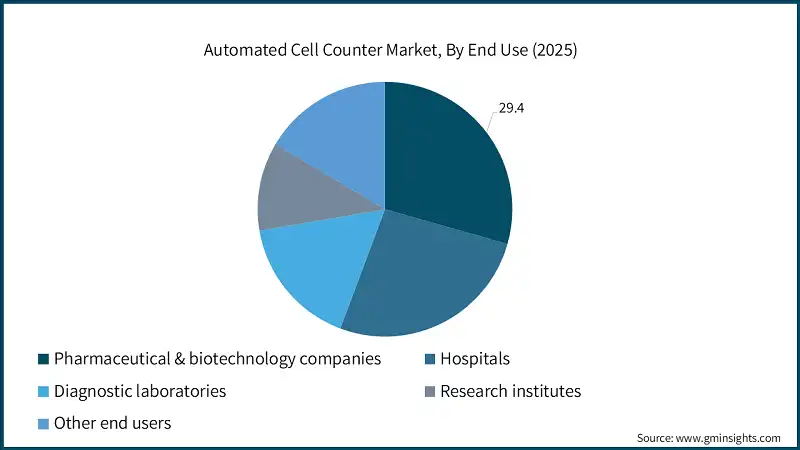
Based on end use, the automated cell counter market is segmented into pharmaceutical and biotechnology companies, hospitals, diagnostic laboratories, research institutes and other end users. The pharmaceutical and biotechnology companies segment held a significant market share of 29.4% in 2024.
- Pharmaceutical and biotechnology companies rely heavily on advanced cell analysis for drug discovery, biologics production, and quality control processes. Automated cell counters are important in ensuring accuracy and efficiency in high-throughput workflows, which are critical for developing monoclonal antibodies, vaccines, and cell-based therapies.
- The surge in biologics and personalized medicine has amplified the need for precise cell counting technologies. Automated systems enable these companies to maintain stringent regulatory compliance while accelerating research and development timelines. Their ability to process large volumes of samples with minimal error supports faster drug development and commercialization.
- Pharma and biotech firms are at the forefront of adopting cutting-edge technologies, including AI-driven image analysis, flow cytometry integration, and cloud-based data management platforms. These innovations enhance cell characterization and enable complex applications such as immunology, oncology, and regenerative medicine research.
- As global investment in biopharmaceuticals continues to rise, this segment will maintain its dominance in the market.
Looking for region specific data?
North America Automated Cell Counter Market
The North America region accounted for 38% of the market in 2024. The market in North America is experiencing robust expansion, driven by the region’s advanced healthcare infrastructure and technological advancements.
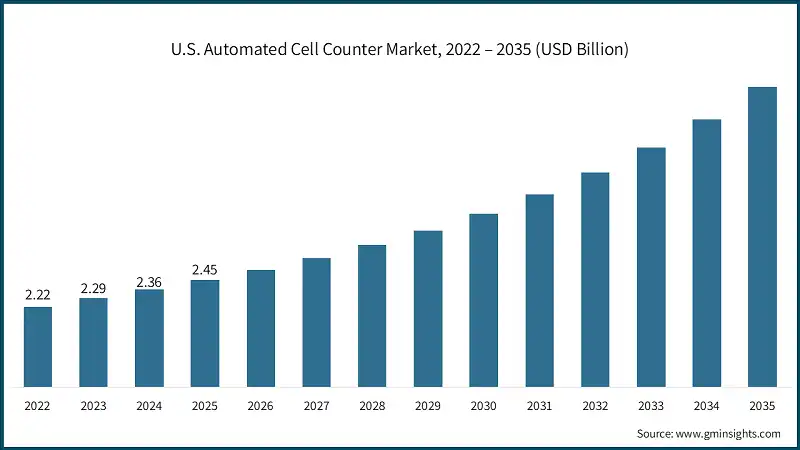
- The U.S. automated cell counter market was valued at USD 2.22 billion and USD 2.29 billion in 2022 and 2023, respectively. In 2025 the market size increased to USD 2.45 billion from USD 2.36 billion in 2024. This growth is primarily attributed to the increasing prevalence of chronic and infectious diseases.
- According to CDC, In the U.S. in 2022, 1,851,238 new cancer cases were reported, and in 2023, 613,349 people died of cancer. These figures highlight the growing need for accurate and timely diagnostics. Blood cell analysis, including complete blood counts (CBC), is a critical component in cancer detection and monitoring. Automated cell counters enable rapid, high-throughput testing, ensuring precision and efficiency in managing large patient volumes.
- The growing prevalence of conditions such as cancer, diabetes, and autoimmune diseases has significantly increased the need for precise cell counting technologies across U.S. Automated cell counters help hospitals and diagnostic labs deliver reliable results quickly, supporting early detection and personalized treatment plans. As healthcare providers prioritize efficiency and accuracy, the adoption of automated systems continues to accelerate, stimulating market growth.
- The U.S. leads in both usage and development of automated cell counter technologies due to its advanced healthcare infrastructure, high diagnostic testing volumes, and continuous investment in laboratory automation. Hospitals and diagnostic centers collaborate with leading manufacturers to integrate solutions such as AI-powered image-based counters and flow cytometry systems, ensuring better patient care and operational efficiency.
Europe Automated Cell Counter Market
Europe market accounted for USD 1.9 billion in 2025 and is anticipated to show lucrative growth over the forecast period.
- Europe is witnessing a steady increase in research and development expenditure, particularly in healthcare and life sciences. Governments and private organizations are allocating significant budgets to support innovation in diagnostics, drug discovery, and cell-based therapies. This increase in funding creates a strong foundation for adopting advanced laboratory technologies, including automated cell counters, which are essential for high-throughput and accurate cell analysis in research settings.
- For instance, According to EFPIA, the European pharmaceutical industry invested approximately €50 billion in healthcare-related research and development in 2023, marking a steady increase from €47 billion in 2022. . This spending supports innovation in drug discovery, diagnostics, and advanced therapies, including cell-based research.
- Higher research and development spending accelerates the development of new treatments and personalized medicine approaches, both of which require precise cell counting and characterization. Automated cell counters enable researchers to process large sample volumes efficiently, maintain reproducibility, and integrate data seamlessly into analytical workflows. As European countries focus on cutting-edge research in oncology, immunology, and regenerative medicine, the demand for automated cell counting solutions continues to rise, driving market growth.
Germany's automated cell counter market is projected to experience steady growth between 2026 and 2035.
- Germany’s market is experiencing steady growth due to the increasing research and development expenditure.
- Germany is one of Europe’s largest investors in pharmaceutical and healthcare research. According to EFPIA, the country allocated €8,540 million to pharmaceutical industry research and development in 2021, making it the top contributor in Europe.
- This significant investment reflects Germany’s commitment to advancing diagnostics, drug discovery, and cell-based therapies. Such funding creates a strong foundation for adopting advanced laboratory technologies, including automated cell counters, which are essential for high-throughput and accurate cell analysis in research and clinical settings.
Asia Pacific Automated Cell Counter Market
The Asia Pacific region is projected to show a lucrative growth of about 6.9% during the forecast period.
- The automated cell counter market in Asia Pacific is expanding steadily, driven by rising prevalence of chronic and infectious diseases.
- Automated cell counters offer speed, accuracy, and scalability, making them indispensable for managing large patient volumes and supporting public health initiatives.
- For instance, According to WHO, the South-East Asia (SEA) Region, which accounts for nearly one-fourth of the world’s population, bears more than 45% of the global annual TB incidence. In 2022 alone, over 4.8 million people fell ill with tuberculosis, and more than 600,000 died (excluding HIV+TB mortality), representing more than half of global TB deaths. Such alarming figures highlight the urgent need for advanced diagnostic solutions, including automated cell counters, which play a critical role in monitoring blood cells and immune responses in TB and other infectious diseases.
- The increasing burden of diseases like tuberculosis, HIV, and cancer drives demand for rapid, accurate, and high-throughput testing in hospitals, diagnostic laboratories, and research institutions across Asia-Pacific.
China automated cell counter market is poised to witness lucrative growth between 2026 - 2035.
- The market in China is expanding rapidly, driven by the increasing prevalence of chronic diseases such as cancer.
- Automated cell counters offer speed, accuracy, and scalability, making them indispensable for managing large patient volumes and supporting oncology diagnostics and research.
- For instance, according to global cancer observatory data, China reported 4,824,703 new cancer cases in 2022, with 2,574,176 deaths and 10,968,974 prevalent cases within five years of diagnosis. These figures highlight the urgent need for advanced diagnostic solutions, including automated cell counters, which play a critical role in blood cell analysis, immune profiling, and monitoring treatment response in cancer care.
- The increasing burden of diseases like cancer, diabetes, and other chronic conditions drives demand for rapid, accurate, and high throughput testing in hospitals, diagnostic laboratories, and research institutions across China.
Latin America Automated Cell Counter Market
Brazil is experiencing significant growth in the market.
- The growth of the market in the country is highly attributed to technological advancements and the introduction of innovative automated cell counter devices, along with the increasing prevalence of chronic and infectious disease in Brazil.
- Modern laboratories and healthcare facilities in Brazil are increasingly adopting automated systems that deliver faster, more accurate, and reproducible cell analysis compared to manual methods.
- As a result, technological advancements are accelerating the growth of Brazil’s automated cell counter market by improving speed, accuracy, and efficiency. With increasing adoption of AI-driven and cloud-enabled systems, Brazil is strengthening its diagnostic capabilities and supporting personalized medicine, ensuring continued market expansion.
Middle East and Africa Automated Cell Counter Market
- Saudi Arabia is steadily increasing its research and development expenditure, particularly in healthcare and life sciences. The government and private sector are investing heavily in modernizing healthcare infrastructure and supporting innovation in diagnostics, drug discovery, and cell-based therapies.
- These initiatives create a strong foundation for adopting advanced laboratory technologies, including automated cell counters, which are essential for high-throughput and accurate cell analysis in clinical and research settings.
- Higher research and development spending accelerates the development of personalized medicine, oncology research, and regenerative therapies all of which require precise cell counting and characterization.
Automated Cell Counter Market Share
- Leading companies in the automated cell counters market are actively strengthening their global footprint through strategic initiatives. These include acquisitions, partnerships, and technology-driven collaborations aimed at securing long-term growth in this rapidly evolving segment. Top 5 players Thermo Fisher Scientific, Danaher, Sysmex Corporation, Abbott Laboratories, and Revvity (Nexcelom Bioscience) collectively hold a market share of approximately 65% in the global automated cell counter market.
- Their product portfolios now feature next-generation cell counting technologies, including high-throughput systems, AI-powered image analysis, and integrated multi-parameter solutions. By incorporating advanced automation and connectivity features, these players are enabling real-time data monitoring, remote diagnostics, and streamlined workflows for laboratories and healthcare facilities.
- Close collaboration with clinical laboratories, research institutions, and regulatory authorities remains central to their strategy, ensuring compliance with stringent quality standards and data integrity norms. At the same time, efforts to expand access in emerging markets and support growing demand from biopharma and academic research sectors are making automated cell counting more widely available.
- Through continuous innovation, these companies are redefining cell analysis workflows, enhancing accuracy, reducing manual errors, and accelerating turnaround times. Their commitment to precision, scalability, and evidence-based practices is shaping modern laboratory protocols and supporting sustainable healthcare and research ecosystems worldwide.
Automated Cell Counter Market Companies
Few of the prominent players operating in the automated cell counter industry include:
- Thermo Fisher Scientific
- PerkinElmer
- Bio-Rad Laboratories
- Abbott Laboratories
- Sysmex Corporation
- NanoEnTek
- F. Hoffmann-La Roche Ltd
- Danaher
- Agilent Technologies
- Merck KGaA
- ChemoMetec A/S
- Logos Biosystems
- Nexcelom Bioscience (Revvity)
- DeNovix
- Curiosis
- Revvity (Nexcelom Bioscience)
Revvity, through Nexcelom Bioscience, specializes in fluorescence image-based cell counters designed for research and cell therapy applications. The company emphasizes innovation in multi-parameter analysis and high-throughput capabilities, enabling advanced workflows in biopharma and regenerative medicine. Its focus on precision and user-friendly design makes Revvity a preferred choice for cutting-edge cell analysis.
Abbott Laboratories is a major contributor to automated cell counting through its hematology platforms based on the Coulter principle. The company focuses on delivering robust, high-throughput solutions for clinical laboratories, ensuring accuracy and reliability in routine diagnostics. Abbott’s strong presence in healthcare and commitment to operational excellence position it as a trusted provider in the automated cell counter market.
Merck KGaA is a recognized player in the automated cell counting market, focusing on delivering innovative solutions that enhance accuracy and efficiency in cell analysis workflows. The company emphasizes portability and user-friendly designs, supporting research and biopharmaceutical applications where flexibility and reliability are critical. Through continuous investment in advanced technologies and global support infrastructure, Merck strengthens its position as a trusted partner for modern laboratory operations.
Automated Cell Counter Market Report Attributes
| Key Takeaway | Details |
|---|---|
| Market Size & Growth | |
| Base Year | 2025 |
| Market Size in 2025 | USD 7.1 Billion |
| Market Size in 2026 | USD 7.4 Billion |
| Forecast Period 2026 - 2035 CAGR | 6% |
| Market Size in 2035 | USD 12.5 Billion |
| Key Market Trends | |
| Drivers | Impact |
| Increasing prevalence of chronic and infectious diseases | Drives demand for accurate cell analysis in diagnostics and research, boosting adoption of automated cell counters. |
| Increasing research and development expenditure worldwide | Expands investment in advanced cell analysis technologies, accelerating innovation and market growth. |
| Technological advancements in automated cell counter industry | Enhances accuracy, throughput, and multi-parameter capabilities, making automated solutions more attractive than manual methods. |
| Expansion of stem cell and regenerative medicine | Drives strong demand for automated cell counters to ensure accurate cell quantification for therapy development. |
| Pitfalls & Challenges | Impact |
| High cost of automated cell counter devices | Limits adoption among small laboratories and research institutions, slowing market penetration in cost-sensitive regions. |
| Lack of skilled workforce | Creates operational inefficiencies and increases dependency on training programs, hindering optimal utilization of advanced systems. |
| Opportunities: | Impact |
| Expansion in cell therapy manufacturing | Creates significant demand for high-accuracy, high-throughput automated cell counters to support quality control and scalability in advanced therapies. |
| Market Leaders (2025) | |
| Market Leaders |
25% Market Share |
| Top Players |
|
| Competitive Edge |
|
| Regional Insights | |
| Largest Market | North America |
| Fastest Growing Market | Asia Pacific |
| Emerging Countries | India, China, Brazil, Mexico, South Africa |
| Future outlook |
|
What are the growth opportunities in this market?
Automated Cell Counter Market News:
- In May 2021, PerkinElmer announced that it had entered into an agreement to acquire Nexcelom Bioscience in a cash transaction. Nexcelom was recognized as a global leader in automated cell counting instruments, image cytometry workstations, assays, and a wide range of cell reagents and consumables. The company also provided fit-for-purpose cell counting method development aligned with ISO standards, supporting advancements in cell and gene therapy, immuno-oncology, virology, and vaccine development. This acquisition strengthened PerkinElmer’s preclinical portfolio and enhanced its quality assurance and quality control capabilities in biologics manufacturing and cell-based research.
The automated cell counter market research report includes an in-depth coverage of the industry with estimates and forecast in terms of revenue in USD Million and from 2021 - 2034 for the following segments:
Market, By Product Type
- Flow cytometer
- Fluorescence image-based cell counter
- Coulter counter
Market, By Application
- Blood cells
- Cell lines
- Microbial cells
- Other applications
Market, By End Use
- Pharmaceutical & biotechnology companies
- Hospitals
- Diagnostic laboratories
- Research institutes
- Other end use
The above information is provided for the following regions and countries:
- North America
- U.S.
- Canada
- Europe
- Germany
- UK
- France
- Italy
- Spain
- Netherlands
- Asia Pacific
- China
- India
- Japan
- Australia
- South Korea
- Latin America
- Brazil
- Mexico
- Argentina
- Middle East and Africa
- Saudi Arabia
- South Africa
- UAE
Frequently Asked Question(FAQ) :
What was the market size of the automated cell counter market in 2025?
The market size was USD 7.1 billion in 2025, with a CAGR of 6% projected through 2035, driven by the increasing prevalence of chronic and infectious diseases, rising R&D expenditures, and technological advancements.
What is the projected value of the automated cell counter market by 2035?
The market is expected to reach USD 12.5 billion by 2035, fueled by innovations in automation, AI-powered image analysis, and cloud-based connectivity.
What is the projected size of the automated cell counter market in 2026?
The market is expected to grow to USD 7.4 billion in 2026.
How much revenue did the flow cytometers segment generate?
The flow cytometers segment generated USD 3.9 billion in 2025, holding a significant 55% market share.
What was the market share of pharmaceutical and biotechnology companies in 2024?
The pharmaceutical and biotechnology companies segment accounted for 29.4% of the market in 2024.
Which region leads the automated cell counter market?
North America led the market with a 38% share in 2024, driven by advanced healthcare infrastructure and technological innovations.
What are the upcoming trends in the automated cell counter industry?
Key trends include AI-driven image analysis, cloud-based connectivity, integration with flow cytometry and microfluidics, and the growing need for advanced technologies to handle diverse cell types and provide detailed analytics.
Who are the key players in the automated cell counter market?
Key players include Thermo Fisher Scientific, PerkinElmer, Bio-Rad Laboratories, Abbott Laboratories, Sysmex Corporation, NanoEnTek, F. Hoffmann-La Roche Ltd, and Danaher.
Automated Cell Counter Market Scope
Related Reports