Summary
Table of Content

Auto Collision Estimating Software Market
Get a free sample of this report
Form submitted successfully!
Error submitting form. Please try again.
Thank you!
Your inquiry has been received. Our team will reach out to you with the required details via email. To ensure that you don't miss their response, kindly remember to check your spam folder as well!
Request Sectional Data
Thank you!
Your inquiry has been received. Our team will reach out to you with the required details via email. To ensure that you don't miss their response, kindly remember to check your spam folder as well!
Form submitted successfully!
Error submitting form. Please try again.
Auto Collision Estimating Software Market Size
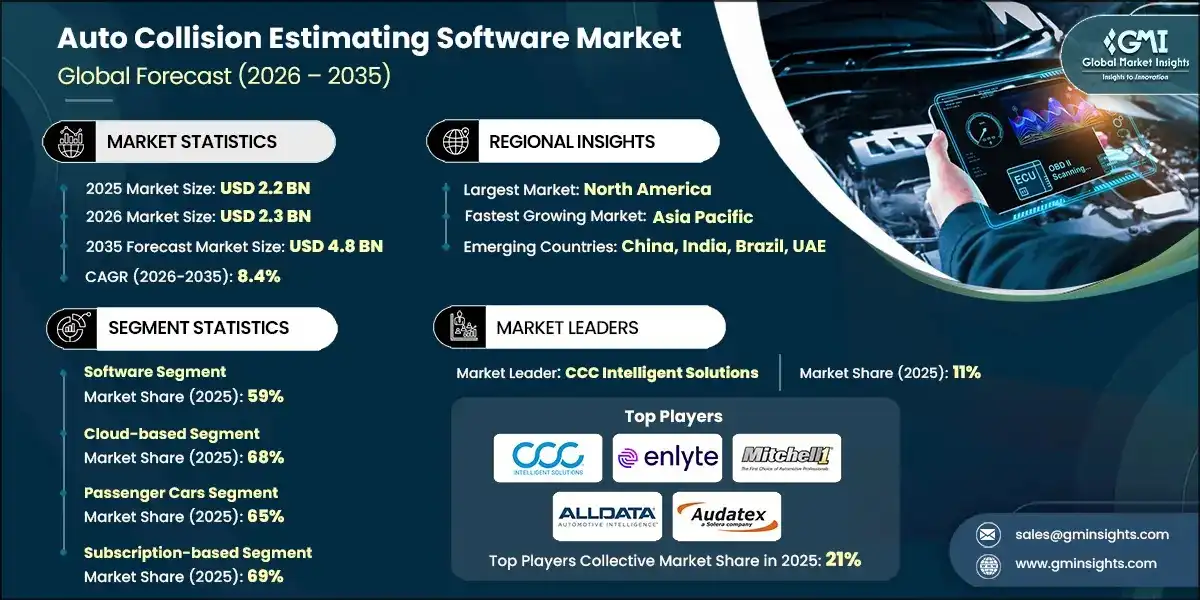
The global auto collision estimating software market size was estimated at USD 2.2 billion in 2025. The market is expected to grow from USD 2.3 billion in 2026 to USD 4.8 billion in 2035, at a CAGR of 8.4% according to latest report published by Global Market Insights Inc.
To get key market trends
In 2023, over 6.1 million police-reported motor vehicle crashes occurred in the United States, driving global demand for collision estimation solutions. Auto collision estimating software aids repair shops, insurers, and fleet managers by streamlining damage assessments, cost estimations, and claims processing. It utilizes AI, machine learning, and cloud computing for accurate repair estimates, parts pricing, and labor calculations.
In 2023, the U.S. reported 6,138,359 motor vehicle traffic crashes, a 3.5% rise from 2022. While fatality rates declined, increasing vehicle miles drove up repair-demanding crashes, sustaining the need for efficient estimation tools.
The automotive sector is increasingly adopting cloud solutions for improved data management and operational efficiency. Cloud backends support telematics, ADAS, real-time communications, and over-the-air updates. Collision estimating software also benefits from cloud deployment, offering scalability, real-time updates, and seamless insurance system integration. The cloud segment is expected to dominate the forecast period due to lower costs and better accessibility.
AI is revolutionizing automotive services, including predictive maintenance, quality control, and process optimization. In collision estimating, AI-powered tools identify damage, classify repairs, and generate estimates. Machine learning improves accuracy by analyzing repair data and pricing trends. Regulatory frameworks, like those from NAIC, guide AI adoption with transparency and consumer protection requirements.
North America, with its high vehicle ownership rates and established insurance infrastructure, has emerged as a dominant player in the global market. The region's early adoption of digital claims processing further solidifies its leading position.
Asia Pacific is projected to grow at a CAGR of 10.4% from 2026 to 2035. Rapid motorization in China, India, and Southeast Asia is driving the vehicle repair market. Increased insurance penetration and digital tool adoption in emerging economies are boosting software demand.
Key emerging markets include China, India, Brazil, and the UAE. China's automotive market is rapidly digitalizing repair services. India's growing middle class and vehicle ownership drive software opportunities. Brazil leads Latin America with insurance sector modernization. The UAE excels in the Middle East with advanced insurance infrastructure and tech readiness.
Auto Collision Estimating Software Market Report Attributes
| Key Takeaway | Details |
|---|---|
| Market Size & Growth | |
| Base Year | 2025 |
| Market Size in 2025 | USD 2.2 Billion |
| Market Size in 2026 | USD 2.3 Billion |
| Forecast Period 2026-2035 CAGR | 8.4% |
| Market Size in 2035 | USD 4.8 Billion |
| Key Market Trends | |
| Drivers | Impact |
| Rising vehicle accidents and repair needs | Drives higher demand for software that can provide accurate and quick repair estimates, reducing downtime for vehicles. |
| Adoption of digital tools in repair shops | Improves operational efficiency and minimizes human errors, streamlining the repair process. |
| Insurance reliance on automated claims | Speeds up claims processing and improves customer satisfaction. |
| AI and cloud-based software advancements | Provides precise, real-time estimates and scalable solutions accessible from anywhere |
| Regulations for standardized repair estimates | Promotes compliance and consistency in repair assessments across the industry. |
| Pitfalls & Challenges | Impact |
| High initial software costs for small repair shops | Limits adoption among small and independent repair shops, slowing overall market growth |
| Integration challenges with existing systems | Causes operational inefficiencies and delays, reducing the effectiveness of software deployment. |
| Opportunities: | Impact |
| Growth in emerging markets | Expand market potential by targeting regions with rising vehicle ownership and repair needs. |
| AI and machine learning integration | Enhances estimate accuracy and efficiency, reducing repair time and costs. |
| Cloud-based scalable solutions | Enables remote access and flexibility, supporting shops of all sizes and locations. |
| Partnerships with insurance companies | Streamlines claims processing and improves collaboration between repair shops and insurers. |
| Market Leaders (2025) | |
| Market Leaders |
11% Market Share |
| Top Players |
|
| Competitive Edge |
|
| Regional Insights | |
| Largest Market | North America |
| Fastest growing market | Asia Pacific |
| Emerging countries | China, India, Brazil, UAE |
| Future outlook |
|
What are the growth opportunities in this market?
Auto Collision Estimating Software Market Trends
The insurance industry is shifting to digital and hybrid claims processing, replacing traditional in-person appraisals. Digital claim settlements, as defined by the National Association of Insurance Commissioners, rely solely on digital data without on-site inspections or appraisals by insurers or adjusters.
NAIC survey data reveals 88% of 193 auto insurers are using, planning to use, or exploring AI and machine learning models. These technologies support accident image analysis, repair and settlement estimation, and fraud detection across the insurance value chain.
The automotive sector is increasingly adopting cloud solutions for enhanced data management, operational efficiency, and scalability. Cloud backends are critical for telematics and ADAS, enabling real-time communication and SOTA updates. This shift also benefits collision estimating software, where cloud deployment offers clear advantages over on-premises systems.
Cloud-based estimating software automates updates for parts pricing, labor rates, and repair procedures. It enables multi-location repair chains to standardize practices and monitor performance. Cloud APIs simplifies integration with insurance systems, streamlining estimate submissions and approvals. The World Bank highlights digital transformation as vital for powering essential services.
AI and machine learning are transforming collision damage assessments by replacing manual inspections with automated image analysis. In the automotive sector, AI supports predictive maintenance, quality control, process optimization, and human-robot collaboration. For collision estimation, AI-powered image recognition identifies damage, classifies repairs, and generates cost estimates from photos or videos.
Machine learning algorithms improve estimation accuracy by analyzing repair data, pricing trends, and labor patterns. Neural networks identify damage types like dents or cracks and link them to repair procedures. Natural language processing extracts repair details from technician notes and OEM bulletins.
Auto Collision Estimating Software Market Analysis
Learn more about the key segments shaping this market
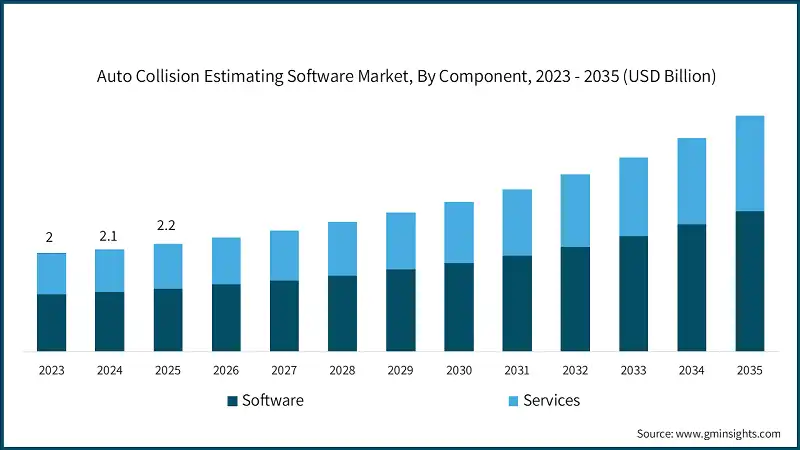
Based on component, the auto collision estimating software market is segmented into software and services representing the core estimation platform and associated implementation, training, and support offerings. The software segment dominates the market with 59% share in 2025, and the segment is expected to grow at a CAGR of 8.6% from 2026 to 2035.
- The software segment dominated the market and is expected to grow steadily. Its revenue includes license fees, cloud subscription charges, and pay-per-estimate usage fees.
- The software component includes the core estimation engine, parts pricing databases, labor time standards, repair procedure libraries, and user interface.
- Advanced features like AI-driven damage recognition, automated parts identification, and integration APIs enhance functionality. These advancements, particularly AI and machine learning, drive premium pricing and segment growth.
- Subscription-based software pricing dominates the market, offering vendors steady cash flows and customers continuous updates and features. This shift aligns with industry trends and the preference for operational over capital expenses.
- In 2025, services made up 41% of the market, totaling USD 917.1 million. The services segment is set to expand at a CAGR of 8.1% from 2026 to 2035.
- Services include software implementation and configuration, user training and certification, technical support and troubleshooting, database customization for regional parts pricing and labor rates, integration services for connecting with insurance and parts supplier systems, and ongoing consulting for workflow optimization.
- The services component is crucial for large organizations with multi-location repair chains. It ensures standardized configurations, corporate system integration, and comprehensive training for estimators and technicians.
- The increasing complexity of ADAS calibration and electric vehicles drives the need for training services. The Bureau of Labor Statistics highlights that automotive technicians now require updated skills to work with cameras and sensors.
- The services segment includes ongoing database maintenance and updates. Vendors continuously update parts pricing, labor rates, and repair procedures to ensure estimation accuracy.
Learn more about the key segments shaping this market
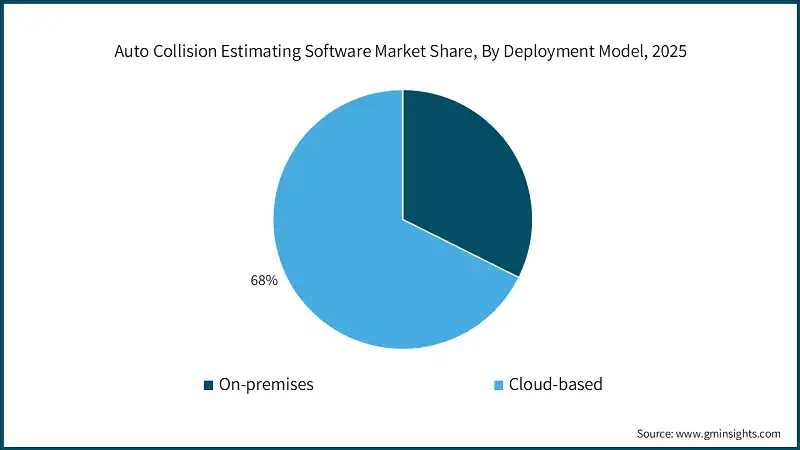
Based on deployment model, the auto collision estimating software market is divided into on-premises and cloud-based. The cloud-based segment dominates with 68% market share in 2025 and is growing at the rate of 7.9% CAGR till 2035.
- The cloud deployment model leads the market with key benefits such as reduced upfront costs through subscription pricing, automatic updates, multi-location access, simplified IT infrastructure, and integration with cloud-based systems.
- The automotive sector's shift to cloud infrastructure drives the adoption of cloud backends. These are crucial for telematics and ADAS, enabling real-time communication and software-over-the-air updates.
- Insurance companies prefer cloud deployment for claims processing, enabling real-time estimates, automated workflows, and centralized analytics.
- Cloud solutions provide small and medium-sized repair shops with cost-effective access to advanced estimation tools. The subscription model eliminates large upfront fees and reduces IT management efforts.
- Cloud platforms also facilitate compliance with insurance company requirements for electronic estimate submission and standardized formatting.
- On-premises solutions, holding a 32.1% market share, are set to outpace their counterparts with a projected CAGR of 9.4%. This growth will see revenues leap from USD 716.7 million in 2025 to an impressive USD 1.7 billion by 2035.
- On-premises deployment benefits large dealership groups with existing IT infrastructure, repair facilities in areas with poor internet, and organizations with strict data security policies. It also appeals to enterprises avoiding subscription costs through perpetual licensing.
- On-premises solutions provide full data control, customization flexibility, and independence from internet connectivity. Automotive dealership networks often integrate estimating software with other systems, requiring deep customization enabled by on-premises deployment.
- The higher CAGR for on-premises solutions reflects growing adoption in emerging markets where internet infrastructure may be less reliable and in specialized applications requiring extensive customization.
- Organizations now select deployment models based on size and technical expertise. The market favors hybrid models, combining cloud-based core functions with on-premises data and customizations for flexibility.
Based on vehicle, the market is segmented into passenger cars, commercial vehicles and electric vehicles reflecting the diverse repair requirements and market dynamics across vehicle categories. The passenger cars segment dominates with 65% market share in 2025.
- Passenger vehicles represent most of the global vehicle fleet and consequently generate the highest collision repair volumes.
- In 2023, the United States reported 6,138,359 police-recorded motor vehicle crashes, with passenger vehicles involved in most cases. The aging vehicle fleet (12-14 years) in mature markets drives consistent collision repair demand.
- Passenger car estimating software must accommodate wide vehicle diversity, from economy compact cars to luxury sedans and SUVs, each with different parts pricing, repair complexity, and technology content.
- Standardized repair procedures and widespread parts availability simplify estimations for common vehicle models in the passenger car segment. Yet, the growing adoption of ADAS features in these vehicles introduces added complexity.
- The national highway traffic safety administration (NHTSA) has expanded its New Car Assessment Program to include ADAS technologies. This has increased ADAS adoption in new passenger vehicles, driving demand for sensor calibration and advanced diagnostics in repairs.
- The commercial vehicle segment holds a 25% market share and is projected to grow at a CAGR of 8.4% from 2026 to 2035. It includes light commercial vehicles, medium-duty trucks, and heavy-duty trucks used for freight and commercial services.
- Commercial vehicle repairs are costly due to larger parts, specialized components, and downtime impacts. Fleet management companies are key customers for estimating software.
- Estimating the commercial vehicle segment is challenging due to specialized body configurations, distinct pricing for commercial-grade components, and fleet-specific repair workflows.
- Electric vehicles (EVs) hold a 10.0% market share. With a projected CAGR of 9.7%, the EV segment is the fastest-growing category, driven by global adoption and specialized software repair needs.
- The U.S. Department of Energy emphasizes high-voltage system safety in EV repair and maintenance. Accurate estimating software is vital for specialized EV collision repairs.
- Estimating software for EVs must incorporate EV-specific parts databases, high-voltage system diagnostic procedures, battery health assessment protocols, and manufacturer-specific repair authorization requirements.
- EV market share is projected to reach 30-40% of new vehicle sales in major markets by 2030, driving demand for EV-specific estimation capabilities. Manufacturers limit battery and high-voltage system repairs to certified facilities, requiring software to track certifications and route estimates effectively.
Based on pricing model, the auto collision estimating software market is divided into subscription-based, license-based, pay-per-estimate / usage-based approaches, each offering different value propositions and customer alignment. The subscription-based dominates with 69% market share in 2025, and with a CAGR of 8.6% during forecast period.
- Subscription pricing has become the preferred model for both software vendors and customers due to its alignment with cloud deployment, predictable recurring revenue, and continuous delivery.
- Subscription models charge monthly or annual fees based on user count, estimate volume, or feature tier. This makes advanced estimation tools affordable for small and medium-sized repair shops by eliminating large upfront costs.
- Subscribers receive software updates, database refreshes, technical support, and new features. The recurring revenue model ensures predictable cash flow, supporting R&D and customer success efforts.
- The software industry's shift to subscription pricing reflects customer preferences for operational expenses over capital expenditures. Insurance firms and fleet operators favor subscriptions for budget predictability and scalability.
- License-based pricing involves upfront payment for perpetual software usage rights, with optional annual maintenance fees for updates and support.
- License-based models appeal to large organizations with established IT infrastructure and preference for asset ownership rather than ongoing subscriptions.
- Automotive dealership groups and large repair chains prefer perpetual licenses to avoid subscription commitments and maintain vendor-independent software access. This option suits organizations with stable user counts and minimal need for frequent updates.
- The license-based model faces challenges as customers prefer subscription models for continuous updates and cloud access. Vendors also favor recurring revenue over one-time license sales.
- Usage-based pricing, also known as pay-per-estimate, accounted for 10.9% of the market share. This segment is forecasted to expand at a CAGR of 8.2% from 2026 to 2035.
- Usage-based pricing charges customers based on the number of estimates generated, aligning costs directly with business activity and value received.
- Pay-per-estimate models suit repair shops with seasonal or variable volumes. This approach eliminates fixed fees during slow periods while ensuring access to full software features when needed.
- Insurance companies use usage-based pricing to access additional estimation resources during peak claim periods, such as after major weather events. This approach eliminates the need for maintaining excess fixed capacity.
Looking for region specific data?
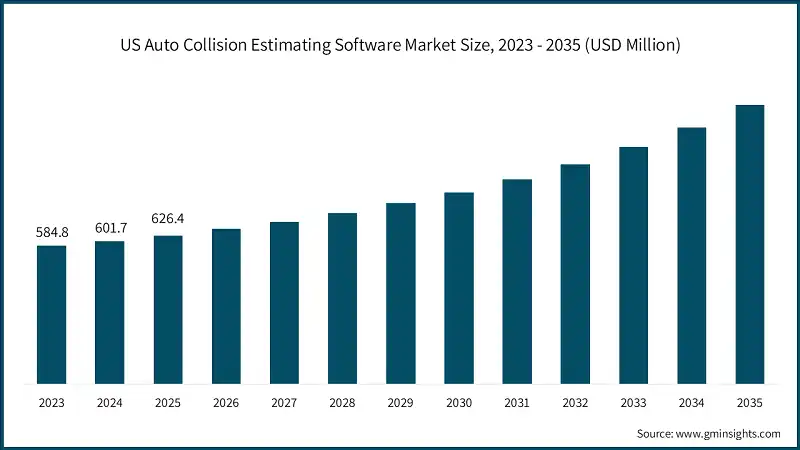
The US auto collision estimating software market is expected to experience significant and promising growth of 6.8% between 2026 to 2035.
- The US dominates the North American market, driven by a strong automotive repair ecosystem, high vehicle ownership, and widespread digital adoption in insurance and repair networks.
- Auto body shops, insurers, fleet operators, and car rental companies are adopting collision estimating software to improve accuracy, reduce claim times, and streamline repairs.
- The adoption of advanced estimating platforms is growing nationwide. This growth is driven by insurance mandates, compliance requirements, and the rising repair complexity from ADAS, EVs, and connected vehicles.
- Cloud-based, AI-powered collision estimating solutions are gaining traction. They offer image-based damage assessments, real-time pricing, and claims management integration to improve transparency and efficiency.
- Strong R&D and collaborations among insurers, software providers, OEMs, and repair networks in the US are driving innovations in automated damage detection, predictive repair costing, and digital claims processing.
North America dominated the auto collision estimating software market with a share of 35%, which is anticipated to grow at a CAGR of 6.9% during the analysis timeframe.
- North America benefits from high vehicle ownership rates, mature insurance infrastructure, and early adoption of digital claims processing technologies.
- In 2025, the U.S. is expected to account for 81% of North America's market revenue. The 6,138,359 police-reported motor vehicle crashes in 2023 highlight strong demand for estimation software.
- The U.S. automotive body repair industry generated USD 45.9 billion in revenue across 34,618 establishments in 2022, providing a large addressable market for software vendors.
- The U.S. market leads due to its advanced insurance industry, widespread collision and comprehensive coverage, early adoption of AI and cloud technologies, and strong regulatory support for digital transformation.
- In Canada, most provinces mandate universal insurance coverage. Additionally, software solutions must cater to both English and French speakers. Notably, collision patterns in the country are influenced by its climate, leading to a spike in accidents during winter months.
- Canadian insurers follow similar digital transformation trends as U.S. counterparts, adopting AI-powered estimation and remote claims processing.
- The North American software market faces maturity challenges due to high penetration, limiting greenfield growth. Future growth relies on cloud migration, feature expansion (AI, ADAS, EV), and vendor market share shifts.
China is fastest growing country in Asia Pacific auto collision estimating software market growing with a CAGR of 10% from 2026 to 2035.
- China's burgeoning automotive repair and insurance sector, coupled with surging vehicle ownership and a spike in collision incidents, is propelling the growth of the nation's auto collision estimating software market.
- Advanced collision estimating solutions are gaining traction across repair networks, thanks to supportive government regulations, insurance reforms, and digitalization initiatives. These measures aim to enhance claim accuracy, transparency, and overall efficiency.
- China's advanced IT infrastructure, cloud computing, AI, and big data analytics enable real-time damage assessments and seamless claims management, boosting software adoption.
- Key players like Yixin, Autohome, and Ping A Good Doctor use AI-powered platforms to optimize repair workflows and reduce costs while improving service reliability.
- China is rapidly becoming a key market for auto collision estimating software in Asia-Pacific, driven by supportive policies, technological advancements, and rising demand for efficient digital claims processing.
Asia Pacific is the fastest growing auto collision estimating software market, which is anticipated to grow at a CAGR of 10.4% during the analysis timeframe. Rapid motorization, growing insurance penetration, and increasing digitalization drive accelerated market growth.
- China, the largest market in the Asia Pacific, is expected to reach USD 197 million by 2025, contributing 38% of regional revenue. The country's automotive market is rapidly digitalizing repair services.
- Government initiatives promoting a digital economy and modernizing insurance drive the adoption of estimation software. Chinese insurers use AI-powered claims processing and mobile tools to cater to the growing vehicle population.
- Key markets encompass India, Japan, South Korea, Australia, and various Southeast Asian nations.
- In India, a burgeoning middle class and increasing vehicle ownership signal significant growth potential, even as insurance penetration lags that of more developed markets.
- Japan and South Korea represent mature markets with high technology adoption and sophisticated insurance systems.
- Australia follows North American market patterns with high insurance penetration and digital claims adoption.
- The Asia Pacific market is experiencing rapid vehicle population growth in emerging economies and rising insurance penetration. Mobile-first technology adoption and diverse regulatory environments further characterize the region.
- The region's robust growth stems from an expanding market, with more vehicle owners and insurance customers, and a swift embrace of technology, notably the digitalization of repair and insurance processes.
Germany dominates the Europe auto collision estimating software market, showcasing strong growth potential, with a CAGR of 8.1% from 2026 to 2035.
- In Germany, auto collision estimating software is gaining traction among automotive repair shops, insurers, and fleet operators. This shift aims to boost estimate accuracy, expedite claims processing, and refine repair workflows.
- Regulatory compliance, digitalization efforts, and stringent vehicle safety standards are driving the swift adoption of advanced estimating solutions in the automotive and insurance sectors.
- In Germany, repair centers and insurers use AI-driven damage assessments, cloud-based cost databases, and claims management systems to boost efficiency and reduce turnaround times.
- Germany's software providers and tech firms are developing modular collision estimating platforms. These solutions integrate with repair shops, insurers, and fleet tools, strengthening Germany's role in Europe's digital automotive repair market.
- Collaborations among OEMs, insurers, and software developers in Germany are driving advancements in predictive repair costing, automated damage detection, and digital claims processing. These efforts are boosting the adoption of collision estimating software.
Europe auto collision estimating software market accounted for USD 634.4 million in 2025 and is anticipated to show growth of 7.8% CAGR over the forecast period.
- Europe's market strength reflects diverse country-level insurance systems, strong data privacy regulations, and high vehicle safety standards.
- Germany, the largest market in Europe, leads in adopting auto collision estimating software due to its strong automotive industry and advanced insurance sector.
- German insurers and repair shops require software supporting complex vehicle technologies, including advanced ADAS and premium vehicle brands with specialized repair requirements.
- Key markets include United Kingdom, France, Italy, and Spain, each with distinct insurance regulatory frameworks and market structures.
- Insurers are reshaping their adoption of estimation technologies, guided by the European insurance and occupational pensions authority's supervisory insights on digital transformation and AI utilization.
- Strict GDPR regulations in Europe influence cloud deployment and data storage. Diverse markets require multilingual software, while insurance systems vary from private to state controlled. High vehicle safety standards drive ADAS adoption.
- The European Union's focus on digital transformation and AI governance creates both opportunities and compliance requirements for software vendors.
Brazil leads the Latin American auto collision estimating software market, exhibiting remarkable growth of 10.1% between 2026 and 2035.
- Brazil's large population, growing middle class, and expanding automotive market create opportunities for estimation software adoption.
- Brazilian insurers are modernizing claims processing systems and adopting digital tools to improve efficiency and reduce fraud.
- Brazil's auto collision estimating software market is steadily growing, driven by rising vehicle ownership, collision incidents, and the expansion of automotive repair and insurance industries.
- Repair shops and insurance networks across the country are adopting advanced collision estimating platforms. These include AI-powered damage assessments, cloud-based cost databases, and integrated claims management systems.
- In Brazil, software developers, insurers, and repair networks are collaborating to improve real-time estimate accuracy and streamline claims workflows. They are also implementing predictive repair costing and automated damage detection.
- Brazil's automotive, insurance, and fleet management sectors are adopting collision estimating software to boost efficiency and reliability, driven by advancements in cloud computing, IoT diagnostics, and digital claims platforms.
UAE to experience substantial growth in the Middle East and Africa auto collision estimating software market in 2025.
- UAE's high per capita income, mandatory insurance requirements, and technology-forward business environment drive estimation software adoption.
- UAE insurers and repair shops adopt international best practices and advanced technologies, creating demand for sophisticated estimation tools.
- The UAE's auto collision estimating software market is growing due to rising vehicle ownership, an expanding automotive repair sector, and the insurance industry's move to digital claims processing.
- Supportive regulations, insurance modernization, and standardized repair protocols are driving the adoption of advanced estimating solutions nationwide.
- In alignment with the UAE's Smart Government and digital transformation strategies, repair shops and insurers are adopting AI-powered tools and cloud-based platforms. These advancements enhance estimate accuracy, expedite claims, and improve operational efficiency.
- The UAE is emerging as a regional leader in digital automotive repair technologies by investing in IoT diagnostics, cloud platforms, and data-driven repair solutions to enhance efficiency and service reliability.
- In the GCC, the adoption of auto collision estimating software is surging, driven by supportive regulations, modern insurance practices, and a growing embrace of digital infrastructure.
Auto Collision Estimating Software Market Share
- The top 7 companies in the auto collision estimating software industry are CCC Intelligent Solutions, Enlyte, Mitchell Repair Information, Alldata, RepairShopr, Web-Est, and Audatex contributed around 22% of the market in 2025.
- CCC Intelligent Solutions leads the market as the largest single vendor. Its dominance is driven by a robust platform for repair facilities and insurers, a vast parts pricing database, strong insurance carrier relationships, and innovations in AI-powered damage assessments and cloud workflows.
- Enlyte, formerly Mitchell International, offers software solutions for insurance claims management, collision repair estimation, and network management. Its clients include property and casualty insurers, collision repair facilities, and automotive dealerships.
- Mitchell Repair Information provides repair information, estimating software, and workflow management tools for collision repair professionals. Its databases include repair procedures, parts pricing, and labor times, serving repair shops, dealerships, and fleet operators.
- Alldata, a subsidiary of AutoZone, provides diagnostic software and repair information for automotive service professionals. It focuses on mechanical repairs while offering collision estimation tools integrated with repair procedure databases.
- RepairShopr offers web-based collision estimation and shop management software for independent repair facilities. It emphasizes user-friendly interfaces, affordable pricing, and integration with popular shop management systems.
- Web-Est provides collision estimation software tailored to regional markets and customer segments. It offers cloud-based and on-premises deployment, customizable databases, and integration with insurance and parts supplier systems.
- Audatex, a subsidiary of Solera Holdings Inc., is a leading provider of automotive claims and estimation software. It offers cloud-based platforms, AI-driven damage assessments, and integration with insurance claims systems, with a strong presence in Europe and the Asia Pacific.
Auto Collision Estimating Software Market Companies
Major players operating in the auto collision estimating software industry are:
- Alldata
- Audatex Solutions
- CCC Intelligent Solutions
- Constellation R.O. Writer
- Enlyte
- Mitchell Repair Information
- RepairShopr
- Scott Systems
- Smart Estimator App
- Web-Est
- The auto collision estimating software market has seen rapid adoption as repair shops, insurers, and fleet operators prioritize efficiency, cost reduction, and accuracy. Leading providers integrate AI-driven damage assessment, real-time repair cost estimation, and automated claims processing to streamline workflows.
- Market leaders invest in cloud-based platforms that allow seamless data sharing between insurers, repair facilities, and OEMs. Solutions leveraging AI and machine learning enhance the accuracy of damage assessments, reducing the time required for claims approvals and vehicle repairs.
- Strategic partnerships between software providers and insurance companies drive growth by integrating estimating solutions with claims management systems. These collaborations help insurers accelerate claims processing, reduce fraud risks, and enhance customer satisfaction.
- The increasing use of mobile apps and remote inspection tools has transformed the auto estimating process, enabling vehicle owners to submit damage assessments through AI-powered photo analysis. This shift improves efficiency while reducing reliance on in-person inspections.
Auto Collision Estimating Software Industry News
- In January 2025, CCC Intelligent Solutions expanded its AI-powered damage assessment capabilities. The update includes advanced computer vision algorithms with 95% accuracy in identifying vehicle damage from smartphone photos.
- In December 2024, Enlyte Group launched a digital claims settlement platform integrating estimation, parts procurement, and repair scheduling. The AI-powered platform automates estimate generation from photos and provides real-time parts availability from multiple suppliers.
- In November 2024, DataTouch launched P-Pages AI, an AI-driven tool designed to streamline repair planning for collision repair shops. The software converts PDF estimates from external appraisers into a standardized digital format, identifying overlooked “not included” repair operations based on CEG P-Pages.
- In November 2024, Repairify integrated its ADAS Think platform with CCC ONE, CCC Intelligent Solutions’ estimating and repair management software. This integration streamlined ADAS identification and recalibration requirements, allowing repair shops to access ADAS insights directly within CCC ONE.
- In September 2024, Mitchell Repair Information Company updated its EV repair procedures for over 50 models. The database now includes high-voltage safety protocols, battery damage assessment, and manufacturer-specific repair requirements.
- In July 2024, Alldata integrated with AutoZone's parts distribution network. This enables repair shops to access real-time parts availability, compare prices, and place orders directly through the estimation platform.
The auto collision estimating software market research report includes in-depth coverage of the industry with estimates & forecasts in terms of revenue (USD Bn) from 2022 to 2035, for the following segments:
Market, By Component
- Software
- Cloud?based estimating platforms
- On?premise estimating systems
- Mobile estimating applications
- AI?driven image?based estimating tools
- Services
- Implementation & integration
- Training & support
- Consulting
- Maintenance & upgrades
Market, By Deployment Model
- On-premises
- Cloud-based
Market, By Vehicle
- Passenger vehicles
- Hatchback
- Sedan
- SUVs
- Commercial vehicles
- Light commercial vehicles (LCVs)
- Medium commercial vehicles (MCVs)
- Heavy commercial vehicles (HCVs)
- Electric vehicles
Market, By Pricing Model
- Subscription-based
- License-based
- Pay-per-estimate / usage-based
Market, By End Use
- Independent auto repair shops
- Dealerships
- Fleet management companies
- Insurance companies
- Others
The above information is provided for the following regions and countries:
- North America
- US
- Canada
- Europe
- Germany
- UK
- France
- Italy
- Spain
- Russia
- Nordics
- Benelux
- Asia Pacific
- China
- India
- Japan
- Australia
- South Korea
- Singapore
- Thailand
- Indonesia
- Vietnam
- Latin America
- Brazil
- Mexico
- Argentina
- Colombia
- MEA
- South Africa
- Saudi Arabia
- UAE
Frequently Asked Question(FAQ) :
What is the projected value of the auto collision estimating software market by 2035?
The market is poised to reach USD 4.8 billion by 2035, fueled by the adoption of AI-powered solutions, cloud-based platforms, and the growing need for efficient claims processing.
How much revenue did the software segment generate in 2025?
The software segment generated approximately 59% of the market revenue in 2025 and is expected to grow at a CAGR of 8.6% from 2026 to 2035.
What is the expected size of the auto collision estimating software industry in 2026?
The market size is projected to reach USD 2.3 billion in 2026
What is the market size of the auto collision estimating software in 2025?
The market size was USD 2.2 billion in 2025, with a CAGR of 8.4% expected through 2035. The market growth is driven by increasing vehicle crashes, digital transformation in insurance, and advancements in AI and cloud computing.
What was the valuation of the cloud-based deployment segment in 2025?
The cloud-based deployment segment accounted for 68% of the market share in 2025, led by its scalability, automated updates, and seamless integration with insurance systems.
What is the growth outlook for the subscription-based segment from 2026 to 2035?
The subscription-based segment is set to expand at a CAGR of 8.6% till 2035, maintaining its dominance with a 69% market share in 2025.
Which region leads the auto collision estimating software sector?
The United States leads the North American market, with significant growth of 6.8% expected through 2035. This growth is supported by a robust automotive repair ecosystem, high vehicle ownership, and widespread digital adoption in insurance and repair networks.
What are the upcoming trends in the auto collision estimating software market?
AI/ML-based damage assessment, cloud-driven operations, digital claims processing, and telematics- and ADAS-enabled real-time updates.
Who are the key players in the auto collision estimating software industry?
Key players include Alldata, Audatex Solutions, CCC Intelligent Solutions, Constellation R.O. Writer, Enlyte, Mitchell Repair Information, RepairShopr, Scott Systems, Smart Estimator App, and Web-Est.
Auto Collision Estimating Software Market Scope
Related Reports