Summary
Table of Content

Asia Pacific Wet Wipes Market
Get a free sample of this report
Form submitted successfully!
Error submitting form. Please try again.
Thank you!
Your inquiry has been received. Our team will reach out to you with the required details via email. To ensure that you don't miss their response, kindly remember to check your spam folder as well!
Request Sectional Data
Thank you!
Your inquiry has been received. Our team will reach out to you with the required details via email. To ensure that you don't miss their response, kindly remember to check your spam folder as well!
Form submitted successfully!
Error submitting form. Please try again.
Asia Pacific Wet Wipes Market Size
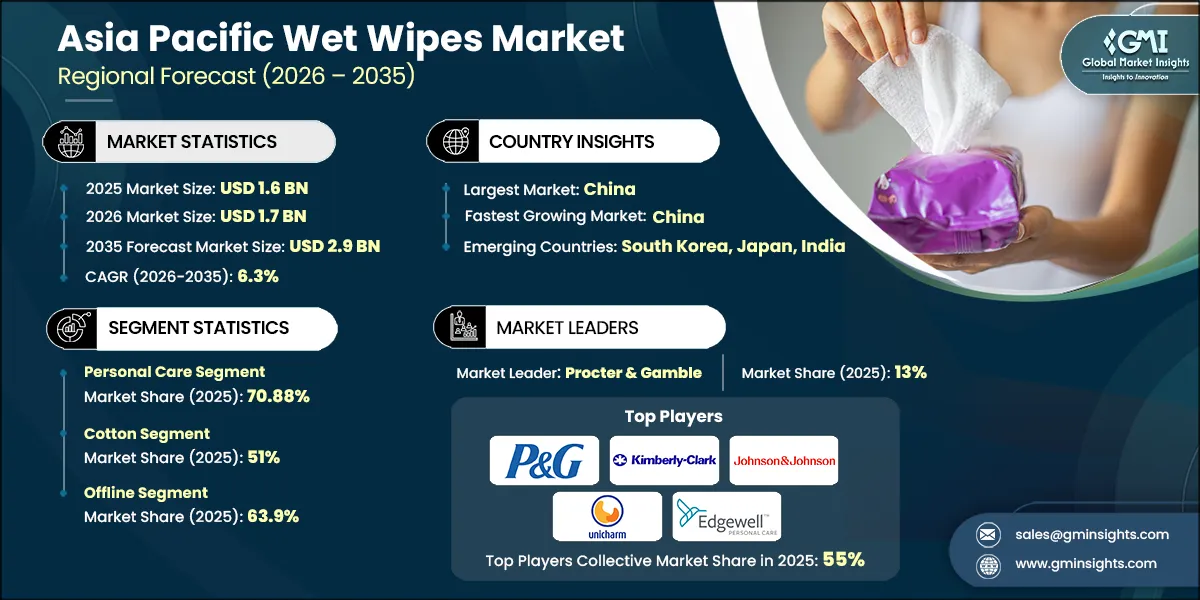
The Asia Pacific wet wipes market was estimated at USD 1.6 billion in 2025. The market is expected to grow from USD 1.7 billion in 2026 to USD 2.9 billion in 2035, at a CAGR of 6.3% according to latest report published by Global Market Insights Inc.
Asia Pacific Wet Wipes Market Key Takeaways
Market Size & Growth
- 2025 Market Size: USD 1.6 Billion
- 2026 Market Size: USD 1.7 Billion
- 2035 Forecast Market Size: USD 2.9 Billion
- CAGR (2026–2035): 6.3%
Regional Dominance
- Largest Market: China
- Fastest Growing Country: China
Key Market Drivers
- Urbanization & rising hygiene awareness.
- Growth of baby & personal care wipes.
- Eco friendly non woven innovation.
Challenges
- Environmental waste & disposal issues.
- Price sensitivity in developing markets.
Opportunity
- Ecommerce & subscription growth.
- Travel‑friendly & multi‑functional wipes.
Key Players
- Market Leader: Procter & Gamble led with over 13% market share in 2025.
- Leading Players: Top 5 players in this market include Procter & Gamble, Kimberly-Clark Corporation, Johnson & Johnson, Unicharm Corporation, Edgewell, which collectively held a market share of 55% in 2025.
Get Market Insights & Growth Opportunities
The accelerated transformation in the regional capacity, innovation with biodegradable substrates, and products for different skin types and hygiene needs across fast-growing economies reinforce the Asia Pacific wet wipes market. Global and regional players like Kimberly-Clark, P&G, Unicharm, Reckitt, Johnson & Johnson, The Honest Co., Himalaya, and WipesPlus are pushing their portfolios further with localized variants, premium baby wipes, cosmetic cleansing wipes, disinfectant surface wipes, and eco-friendly household wipes. This regional push is led by high urbanization trends and rising purchasing power, coupled with surging post-pandemic hygiene awareness.
In fact, there is a growing inclination toward gentle, skin-safe formulation due to increasing consumer preference for skin-friendly formulae and mounting environmental concerns-a shift from conventional polymer-based nonwovens to plant-based biodegradable fibers represented by viscose, lyocell, and bamboo pulp. While non-woven fabrics continue to dominate at about ~79.5% of the global market, Asia-Pacific manufacturers are increasingly resorting to biodegradable non-wovens as part of their strategic play to remain compliant with impending regulatory changes and evolving retailer sustainability scorecards. After all, APAC's large consumer base, especially in India, China, and Southeast Asia, increasingly favors products that combine dermatological safety with natural ingredients and low environmental impact.
The demand acceleration is prominent in baby wipes, intimate wipes, and household/disinfectant wipes, owing to changes in lifestyle trends among young families, an increase in women participating in the workforce, and an interest in portable sanitization solutions. The "prevention first" culture in the region, which strengthened during the pandemic, is pushing the usage of travel, school, office, and general-purpose wipes. Moreover, the APAC region, especially the Indian market, is anticipated to register the highest CAGR through 2030, due to an increase in disposable income, development of modern retail, and widespread e-commerce penetration, Clinically proven, pH balanced, and fragrance-free wipes are currently gaining momentum among consumers, while disinfectant product offerings are driven by institutional, hospitality, and healthcare industry solutions.
Innovations are unfolding in terms of moisture-retain containers, travel-friendly compact packs, resealable compact "flip-open" packages, as well as giant household containers, and intelligent retailing approaches, including e-commerce subscriptions, and "value" multi-pack offerings. Asia Pacific's swift growth is additionally facilitated through local manufacturing, automation, and "greener" substrate technologies. Private label brands, together with local brands, are increasingly competing side by side with multinational brands through affordable but excellent quality biodegradable products that suit the tropics, as well as sensitive skin types.
The strong brand trust, convenience, and versatility, baby wipes and household disinfectant wipes continue to be regional mainstays that lead in generating revenue. In a nutshell, the Asia Pacific market is poised for continued momentum as sustainable material adoption, regulatory alignment, and demographic growth redefine product performance and purchasing behavior.
To get key market trends
Asia Pacific Wet Wipes Market Trends
Growth in the Asia Pacific wet wipes industry is at an unprecedented cycle, as recent regional market assessments have estimated, with exponential middle-class populations, increasing disposable incomes, rapid urbanization, and improved hygiene awareness across developing economies. The socioeconomic uplift has been high in India, China, Indonesia, Vietnam, and the Philippines, with millions getting into higher-income brackets. This is accelerating the demand for premium, skin friendly, biodegradable, and specialized Asia Pacific wet wipes. Higher hygiene standards being adopted by households and busier lifestyles increase consumer interest in products that offer convenience, dermatologist-tested safety, and multifunctional benefits. The high level of penetration of smartphones, digital payments, and e-commerce has normalized online purchasing of Asia Pacific wet wipes, making it easy for both urban and rural consumers to buy baby wipes, facial wipes, disinfectant wipes, and household cleaning wipes.
Technology advances in product development: The Asia Pacific region is witnessing the evolution of the wet wipes segment from basic cleansing wipes to high-performance, technology-enhanced products. The industry is now using biotech active ingredients, natural key ingredients, hydrating ingredients like hyaluronic acid, squalene, niacinamide, and probiotics to address a myriad of skin requirements in the tropics. To retain product efficacy and combat irritation, industry leaders have moved towards utilizing nano-encapsulation delivery systems, pH-stable emulsions, and advanced non-woven materials that have improved touch, absorbency, and disposability. Now, these products can be used by consumers who want comfort even in hot and humid climates, especially by people with sensitive skin, babies, or athletes.
- The rise of e-commerce and subscription-based ecosystems: Asia Pacific's thriving digital economy is continuously impacting the behavior of consumers. E-commerce currently represents a considerable percentage of the total purchases of wet wipes, driven by the popularity of mobile commerce and efficient logistics systems. Consumers are showing a preference for direct-to-consumer e-commerce sites, which focus on offering consumers privacy, ease of shopping, and an extended product range. Manufacturers are launching membership programs for baby wet wipes, facial wet wipes, personal care wet wipes, and disinfectant wipes, which are assisted by AI-enabled usage monitoring, reminders, and recommendations.
- Sustainable design and circular innovation: Sustainability has become a new source of differentiation for the wipes industry. As consumers have increased awareness about the environment, especially Gen Z and Millennial consumers, manufacturers are now racing to introduce “plastic-free,” “compostable,” or “tree-free” bamboo-based wipes. Waterless concentrated wipes, dry towels that are compressed into packages, canister refills, or biodegradable packages are now displacing traditional plastic packages to produce wipes.
- Focus on professional-grade hygiene and home wellnes: There is a great increase in the demand for professional levels of hygiene and home-care standards in the Asia Pacific region. Antibacterial and antiviral wipes for home and office use – disinfectants.
- In parallel, home wellness culture is rising. Smart hygiene tools—such as UV sterilizers, travel-friendly sanitizing gadgets, and surface cleanliness sensors—are increasingly used alongside wipes, enabling consumers to manage hygiene with greater precision and effectiveness, mirroring professional standards.
Asia Pacific Wet Wipes Market Analysis
 Learn more about the key segments shaping this market
Learn more about the key segments shaping this market
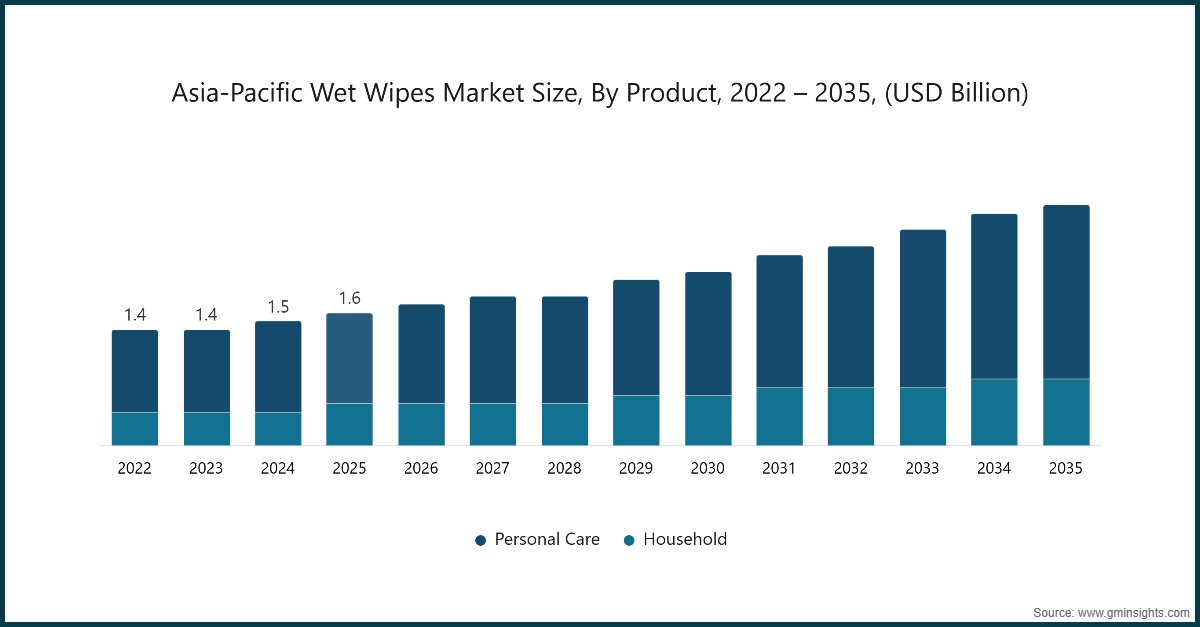
Based on the product type, the market is divided into personal care wipes and household wipes. The personal care segment held the largest share, accounting for 70.88% of the Asia Pacific market share in 2025
- Personal care wet wipes dominate the market share because they are tied to consumers’ daily hygiene routine. Face wipes are a common personal care wet wipe and are preferred because they are a convenient way of removing make up, or cleansing the skin quickly, thus appealing to most beauty consumers.
- Body wipes are also a type of personal care wet wipe that provide on-the-go freshness for consumers, and especially appeal to travelers, individuals after exercise, or assisted care individuals.
- Intimate wipes are a newer product segment, and interest in augments from more consumers focus on personal hygiene and demand products that are gentle, and pH balanced. Baby wipes are a significant and dominant product segment in the marketplace. They serve important functions in the necessary changing of diapers, as well as the general cleaning of infant’s sensitive skin.
- Household wipes have a moderately growing segment; created specifically for disinfecting and quick clean-ups. The household wet wipes segment includes consumer easy-to-use surface disinfecting wipes, glass wipes, kitchen wipes, and floor wipes. These products help consumers keep their home living environment sanitized.
Learn more about the key segments shaping this market
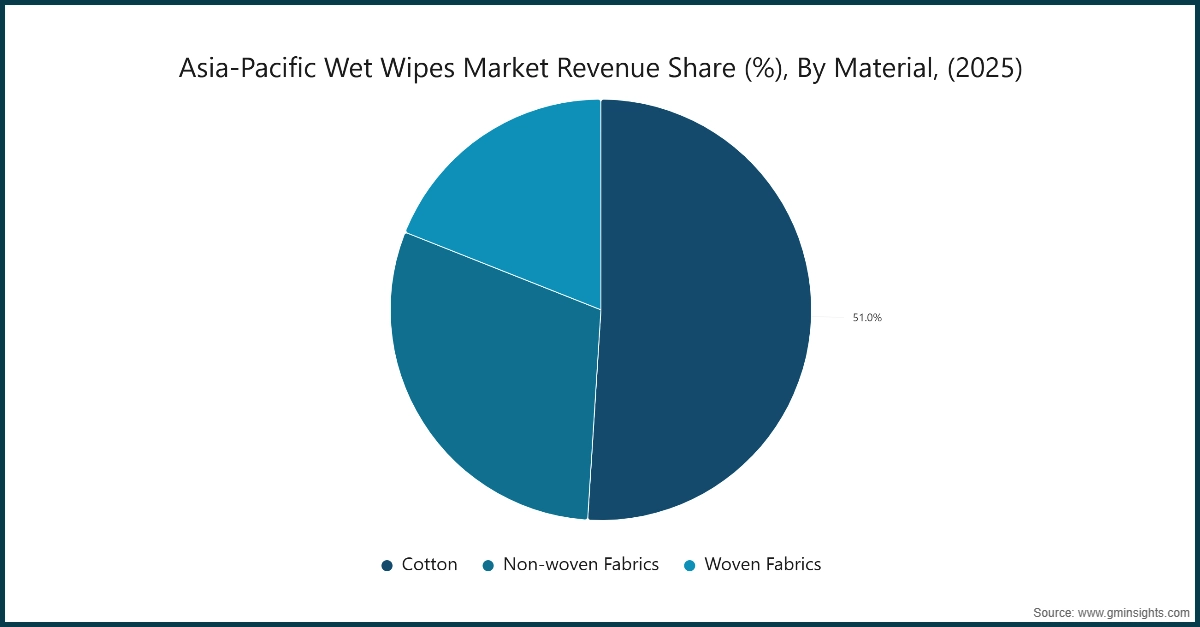
Based on material, the Asia Pacific wet wipes market is segmented into cotton, non-woven fabrics, and woven fabrics. In 2025, the cotton segment held the major market share of 51%, generating the revenue in 2025
- Non-woven fabric is the primary material of most disposable wipes in the market. They can be produced by methods like spunlace or airlaid using fibers of polyester, polypropylene, and viscose. Many wipes are produced using non-woven fabric, as it provides the best combination of good price, strength and absorbency, and is a material used in mass-market products.
- Cotton is primarily a premium material used in wipes that are for buyers looking for a natural, soft, biodegradable wipe and it is predominantly used in baby care and facial wipes, where patients are sensitive to product softness. Woven fabrics represent a very small, niche use.
- Woven fabrics tend to make durable wipes that can be reused, and they are often used for industrial grade wipes, and not considered a use for single use consumer wet wipes.
- A major trend is the industry-wide transition to sustainability and plastic-free products. There is very high consumer and regulatory push to switch from non-woven synthetic non-woven materials to a plant-based, biodegradable, and compostable material like bamboo, cotton, and viscose.
Based on the distribution channel, the market is segmented into online and offline. In 2025, the offline segment held the major market share of 63.9%, reflecting a continued reliance on supermarkets, pharmacies, and specialty beauty stores for immediate availability.
- Offline channels are still the most widely used distribution source for wet wipes. Supermarkets and hypermarkets are the most significant channel for wet wipes; consumers buy wipes when they are doing grocery shopping.
- Individual stores including drugstores and other convenience stores can be a smaller yet important channel for wet wipes when consumers impulse purchase them or buy a smaller travel size pack. Dollar stores provide another significant channel for wet wipes in the low-price segment and for private-label wet wipes.
- Online channels are the channel that is growing fastest for wet wipes due to the convenience and wider range of products. E-commerce marketplaces such as Amazon are the largest source for international and domestic distribution and allow consumers to obtain products that are within their price preference and provide easy access to consumer reviews on products. Company websites for wet wipes allow brands, especially niche and premium brands, to interface directly with consumers and provide subscription services.
- The brand and distribution channel-defining trend is the substantial acceleration of e-commerce and direct-to-consumer (DTC) channels. Online is taking a substantial share of the market driven by the benefits of being able to purchase in bulk, auto-replenishments, and the opportunity to access more niche/specialty brands.
 Looking for region specific data?
Looking for region specific data?
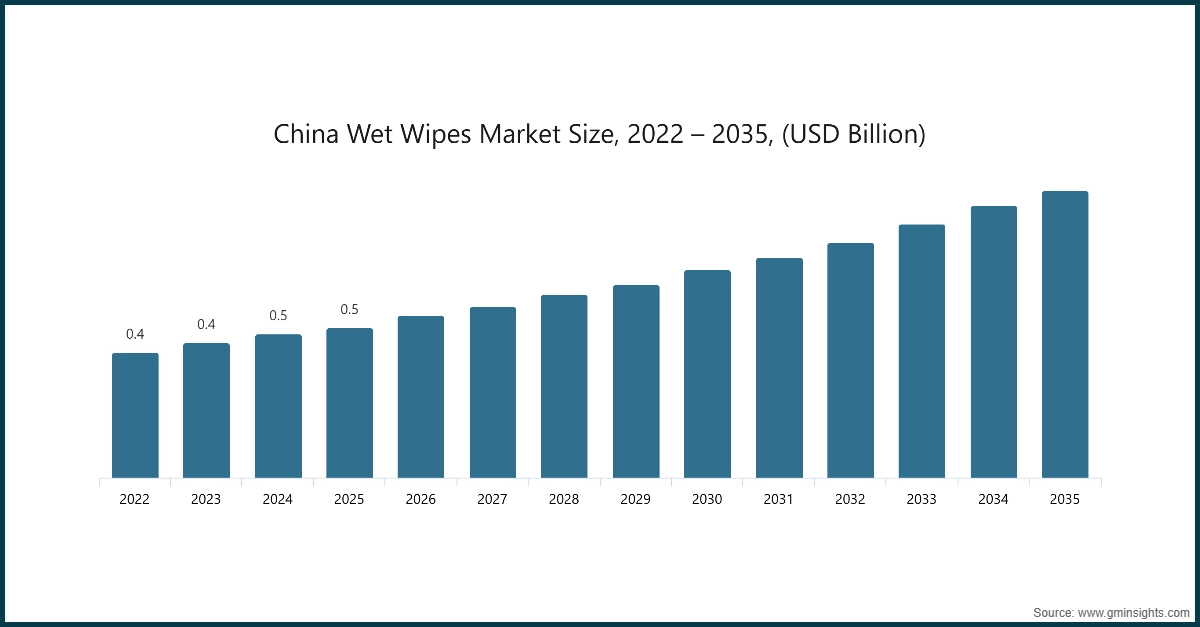
Asia Pacific remains the fastest-growing regional market. It has an accelerated market share with a high projected growth rate of 6.3% through 2035. The wet wipes market is experiencing rapid growth, driven by rising hygiene awareness, urbanization, and expanding middle-class populations. Countries like China, India, Japan, and South Korea are key contributors, with increasing demand for baby wipes, personal care wipes, and disinfectant wipes. The region benefits from a large consumer base and growing retail and e commerce infrastructure. Local and international brands compete aggressively, with innovation focused on affordability, skin safety, and eco-friendly materials.
- China is a dominant force, holding over 32% of the regional share, while India is emerging as a high-growth corridor due to massive public-sector hygiene literacy campaigns.
- Rising urbanization in India, Vietnam, and Indonesia is shifting habits from traditional cloth-based care to high-tech, pH-balanced commercial cleansers.
- In Japan and South Korea, an emerging middle-class, and a progressive focus on health in the area, which combines to create an unyielding drive for Asia Pacific wet wipes.
Asia Pacific wet wipes Market Share
Procter & Gamble is leading with a 13% market share. Procter & Gamble, Kimberly-Clark Corporation, Johnson & Johnson, Unicharm Corporation, and Edgewell collectively hold around 55%, indicating a moderately fragmented market concentration with a strong tier of dominant global players. These prominent players are proactively involved in strategic endeavors, such as mergers & acquisitions, facility expansions, and collaborations, to expand their product portfolios, extend their reach to a broad customer base, and strengthen their market position.
P&G's Always brand unveiled an array of new "Skin-Safe" digital engagement platforms and nonwoven wipes industry is undergoing significant environmental transformation, driven by ambitious sustainability goals. The sector's commitment to achieve net-zero emissions by 2040 encompasses comprehensive initiatives to reduce packaging plastic usage and enhance product recyclability. These environmental measures directly address growing concerns about the ecological impact of disposable wipes and align with increasing regulatory requirements for single-use products. Companies are implementing innovative solutions and sustainable practices throughout their manufacturing processes to meet these environmental targets while maintaining product quality and performance.
Asia Pacific Wet Wipes Market Companies
Major players operating in the Asia Pacific wet wipes industry are:
- Cora
- Cottons
- Johnson & Johnson
- Kimberly-Clark Corporation
- L. Organic
- Lil-Lets
- Lola
- Natracare
- Organyc
- Playtex
- Procter & Gamble
- Unilever
- The Honest Company
- Unicharm Corporation
- Veeda
Lil-Lets Group Ltd. expanded its range of sustainable hygiene platforms with the introduction of its Reusable Tampon Applicator, a connected eco-friendly multi-use device designed to eliminate single-use plastic waste. Engineered for optimal productivity and precise comfort, this medical-grade system offered a smoother application experience compared to older manual cardboard or plastic designs.
Asia Pacific Wet Wipes Market Report Attributes
| Key Takeaway | Details |
|---|---|
| Market Size & Growth | |
| Base Year | 2025 |
| Market Size in 2025 | USD 1.6 Billion |
| Market Size in 2026 | USD 1.7 Billion |
| Forecast Period 2026-2035 CAGR | 6.3% |
| Market Size in 2035 | USD 2.9 Billion |
| Key Market Trends | |
| Drivers | Impact |
| Urbanization & rising hygiene awareness | APAC’s expanding middle class fuels strong uptake of baby, facial, hand/body, and household disinfectant wipes |
| Growth of baby & personal care wipes | Baby wipes remain the largest and fastest growing application category; intimate wipes lead growth within personal care |
| Eco friendly non woven innovation | Shift toward biodegradable plant-based wipes as retailers and consumers demand sustainability |
| Pitfalls & Challenges | Impact |
| Environmental waste & disposal issues | Growing concerns about non- biodegradable wipes’ contribution to pollution and landfill burden pressure brands to adopt greener substrates. |
| Price sensitivity in developing markets | Biodegradable wipes cost 20–30% more, limiting penetration in cost conscious segments across India, Indonesia, Philippines. |
| Opportunities: | Impact |
| Ecommerce & subscription growth | Digital penetration allows regional and niche brands to scale quickly, offering value bundles and recurring delivery models |
| Travel‑friendly & multi‑functional wipes | Baby skincare and disinfectant multi‑use wipes meet the needs of mobile young households and commuters. |
| Market Leaders (2025) | |
| Market Leader |
13% market share |
| Top Players |
The collectively hold market share around 55% |
| Competitive Edge |
|
| Regional Insights | |
| Largest Market | China |
| Fastest growing market | China |
| Emerging countries | South Korea, Japan, India |
| Future outlook |
|
What are the growth opportunities in this market?
Asia Pacific Wet Wipes Market News
- In 2025, Procter & Gamble and Kimberly-Clark expanded their R&D investments to accelerate the launch of new biodegradable and eco-friendly wet wipes, responding to rising sustainability pressure across global markets. This included innovations in plant-based substrates and improved skin-friendly lotion formulations, aimed at reducing environmental impact while expanding premium product portfolios.
- In 2025, Johnson & Johnson introduced new sensitive-skin wet wipes targeting consumers with allergies and dermatological sensitivities. These products were part of its wider move into specialized wet wipe categories, as the company responded to the increasing prevalence of skin conditions and demand for dermatologist-tested solutions worldwide.
- In 2025, Johnson & Johnson introduced new sensitive skin wet wipes targeting consumers with allergies and dermatological sensitivities. These products were part of its wider move into specialized wet wipe categories, as the company responded to the increasing prevalence of skin conditions and demand for dermatologist-tested solutions worldwide.
- In late 2025, P&G, Kimberly Clark, and Essity collectively boosted the production of biodegradable wipes, driven by a nearly 30% surge in eco-friendly product launches. These developments align with stricter environmental regulations and growing consumer insistence on compostable, plastic-free alternatives in both personal care and household wipes.
The Asia Pacific wet wipes market research report includes in-depth coverage of the industry with estimates & forecasts in terms of revenue (USD Billion) from 2022 to 2035, for the following segments:
Market, By Product Type
- Personal care wet wipes
- Face wipes
- Body wipes
- Intimate wipes
- Baby wipes
- Others
- Household wet wipes
Market, By Material
- Cotton
- Non-woven fabrics
- Woven fabrics
Market, By Price Range
- Low
- Medium
- High
Market, By Packaging Size
- Upto 50 wipes
- 50-100 wipes
- More than 100 wipes
Market, By End User
- Individual
- Commercial
Market, By Distribution Channel
- Online
- E-commerce
- Company websites
- Offline
- Mega retail stores
- Specialty stores
- Others
The above information is provided for the following countries:
- China
- India
- Japan
- Australia
- South Korea
Frequently Asked Question(FAQ) :
What is the market size of the Asia Pacific wet wipes in 2025?
The market size was USD 1.6 billion in 2025, with a CAGR of 6.3% expected through 2035 driven by rising hygiene awareness, urbanization, and expanding middle-class populations across the region.
What is the projected value of the Asia Pacific wet wipes market by 2035?
The Asia Pacific wet wipes market is expected to reach USD 2.9 billion by 2035, propelled by sustainable material adoption, e-commerce growth, and demographic expansion in emerging economies.
What is the current Asia Pacific wet wipes market size in 2026?
The market size is projected to reach USD 1.7 billion in 2026.
How much market share did the personal care wipes segment hold in 2025?
Personal care wipes held 70.88% market share in 2025, dominating due to daily hygiene routines including baby wipes, face wipes, body wipes, and intimate wipes.
What was the market share of the cotton material segment in 2025?
Cotton material held 51% market share in 2025, preferred for premium baby care and facial wipes due to its natural, soft, and biodegradable properties.
Which country leads the Asia Pacific wet wipes market?
China dominates the regional market, holding over 32% share in 2025, while India emerges as a high-growth corridor driven by hygiene literacy campaigns and rising disposable income.
What are the upcoming trends in the Asia Pacific wet wipes market?
Key trends include shift to biodegradable plant-based substrates, e-commerce and subscription model growth, integration of biotech active ingredients, professional-grade disinfectant wipes, and sustainable plastic-free packaging innovations.
Who are the key players in the Asia Pacific wet wipes market?
Key players include Procter & Gamble, Kimberly-Clark Corporation, Johnson & Johnson, Unicharm Corporation, Edgewell, Cora, Cottons, L. Organic, Lil-Lets, Lola, Natracare, Organyc, Playtex, Unilever, The Honest Company, and Veeda.
Asia Pacific Wet Wipes Market Scope
Related Reports