Summary
Table of Content

Asia Pacific Two Wheeler Market
Get a free sample of this report
Form submitted successfully!
Error submitting form. Please try again.
Thank you!
Your inquiry has been received. Our team will reach out to you with the required details via email. To ensure that you don't miss their response, kindly remember to check your spam folder as well!
Request Sectional Data
Thank you!
Your inquiry has been received. Our team will reach out to you with the required details via email. To ensure that you don't miss their response, kindly remember to check your spam folder as well!
Form submitted successfully!
Error submitting form. Please try again.
Asia Pacific Two Wheeler Market Size
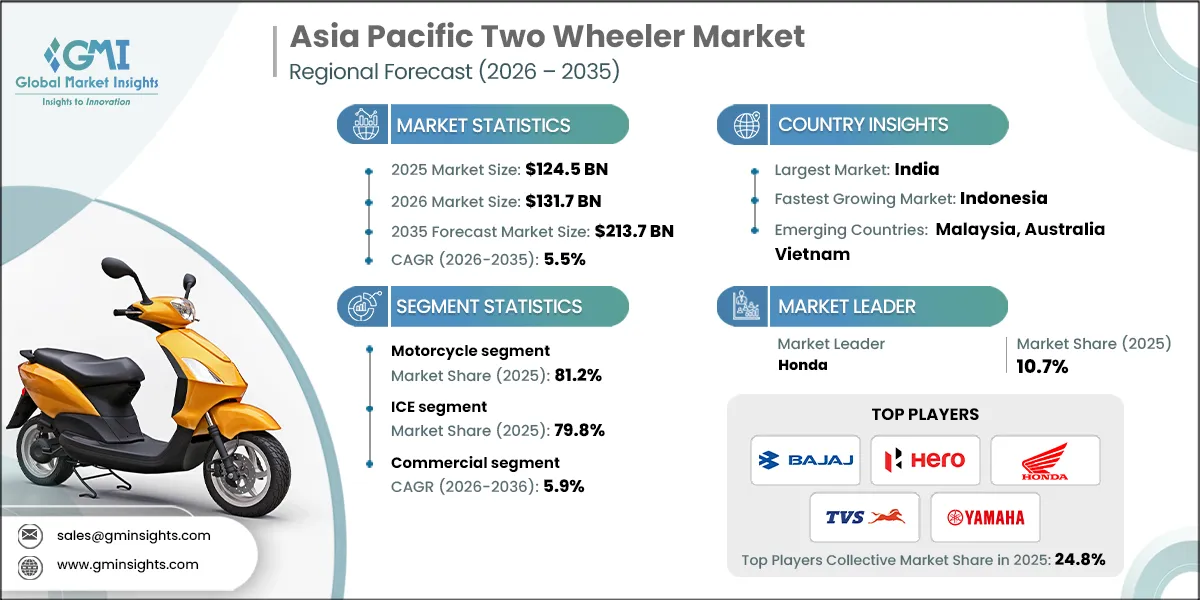
The Asia Pacific two wheeler market was valued at USD 124.5 billion in 2025. The market is expected to grow from USD 131.7 billion in 2026 to USD 213.7 billion in 2035 at a CAGR of 5.5%, according to latest report published by Global Market Insights Inc.
Asia Pacific Two Wheeler Market Key Takeaways
Market Size & Growth
- 2025 Market Size: USD 124.5 Billion
- 2026 Market Size: USD 131.7 Billion
- 2035 Forecast Market Size: USD 213.7 Billion
- CAGR (2026–2035): 5.5%
Regional Dominance
- Largest Market: India
- Fastest Growing Country: Indonesia
Key Market Drivers
- Rising Middle-Class Population.
- Traffic Congestion in Mega Cities.
- Fuel Efficiency Advantages.
- Expanding E-commerce and Delivery Services.
Challenges
- Safety Concerns and Accident Rates.
- Volatility in Fuel Prices.
Opportunity
- Rapid Adoption of Electric Two Wheelers.
- Development of Battery Swapping Infrastructure.
- Growth of Shared Mobility Services.
- Expansion of Charging Infrastructure.
Key Players
- Market Leader: Honda led with over 10.7% market share in 2025.
- Leading Players: Top 5 players in this market include Bajaj Auto, Hero, Honda, TVS, Yamaha, which collectively held a market share of 24.8% in 2025.
Get Market Insights & Growth Opportunities
Two-wheelers represent a significant share of total vehicles sold each year. Countries where roads are congested and have less per capita income, as compared to other countries with per capita income, are the major participants in the two-wheeler sales growth.
Also, countries with high per capita income have shown interest in premium bikes. For instance, in 2025, BMW Motorrad sold 5,841 motorcycles in 2025 in India. Between January and October 2025, over 28 million two-wheelers were sold in China and India, which is more than half of the 55 million two-wheelers sold globally. This revenue stream is expected to grow continuously.
The region has been seen as a major adopter of EV two-wheelers. According to the International Council on Clean Transportation, electric two-wheeler sales were more concentrated in 2025, with 95% of global e2Ws sold in China, India, and Vietnam.
Such major adoption by people of these countries indicates investing in electric two-wheelers would present a profitable ROI. The market in the projected period will be mainly driven by these electric motorcycles, electric scooters, and electric mopeds.
There are a lot of supporting factors, like the expanding EV charging infrastructure, good after-sales services, consumer pledges for sustainability, and government support & incentives. All of these factors will encourage two-wheeler market players to shift their focus to sustainable two-wheelers such as e2Ws, as well as consumers who were previously preventing themselves from buying an EV two-wheeler.
Geographically, India dominates with the largest share, followed by China, which holds over 20% of the market share in the total two-wheelers sold globally between January and October 2025 sales statistics. In India, EV two-wheeler demand is less compared to China, as China’s dominance in EVs accounts for over 70% of total EV two-wheelers sold globally in the same period of the year 2025. South Korea and Malaysia have been following this trend since the inception and market entry of EV two-wheelers. Overall, there seem to be positive growth opportunities in the Asia Pacific region.
To get key market trends
Asia Pacific Two Wheeler Market Trends
The world is shifting towards emission-free or zero-emission vehicles that have given opportunities to two-wheeler manufacturers to produce and launch electric two-wheelers. Recently many key players have introduced new electric bikes and scooters. For instance, in November 2025, Yamaha Motor announced the launch of two new electric scooter models in India. The models are the AEROX E electric sport scooter developed in-house by Yamaha and the EC-06 electric scooter created in collaboration with River Mobility.
Many players are also introducing their first series of electric two-wheelers, like Honda, which recently announced its first electric motorcycle, the Honda WN7. It is powered by a compact and lightweight water-cooled motor with an integrated inverter. The motor provides a maximum output of 50 kW, similar to a 600 cc ICE motorcycle, and a maximum torque of 100 Nm, comparable to a 1000 cc ICE motorcycle.
All around, these players are trying to give the same level of experience of an ICE motorcycle to an electric bike rider by providing higher output in kW, which could be equivalent to a powerful ICE bike engine.
In May 2025, Honda Motorcycle & Scooter India announced that it will build a fourth production line at its fourth plant in Ahmedabad, Gujarat. It is planned to begin operation in 2027, the new line will have an annual production capacity of 650,000 units, bringing the total capacity of the fourth plant to 2.61 million units, making it Honda’s largest assembly plant for Honda motorcycles in the world.
As a suppliers’ side trend, geographic expansion has emerged as the key strategy. In the second half of 2025, QJMOTOR launched and steadily advanced the relocation of its core production system, with part of its manufacturing capacity moving from the original Chengdong site to the Eastern New District of Wenling. As the new plant is progressively put into operation, QJMOTOR is entering a new manufacturing phase characterized by scale, automation, and digitalization.
Asia Pacific Two Wheeler Market Analysis
Learn more about the key segments shaping this market
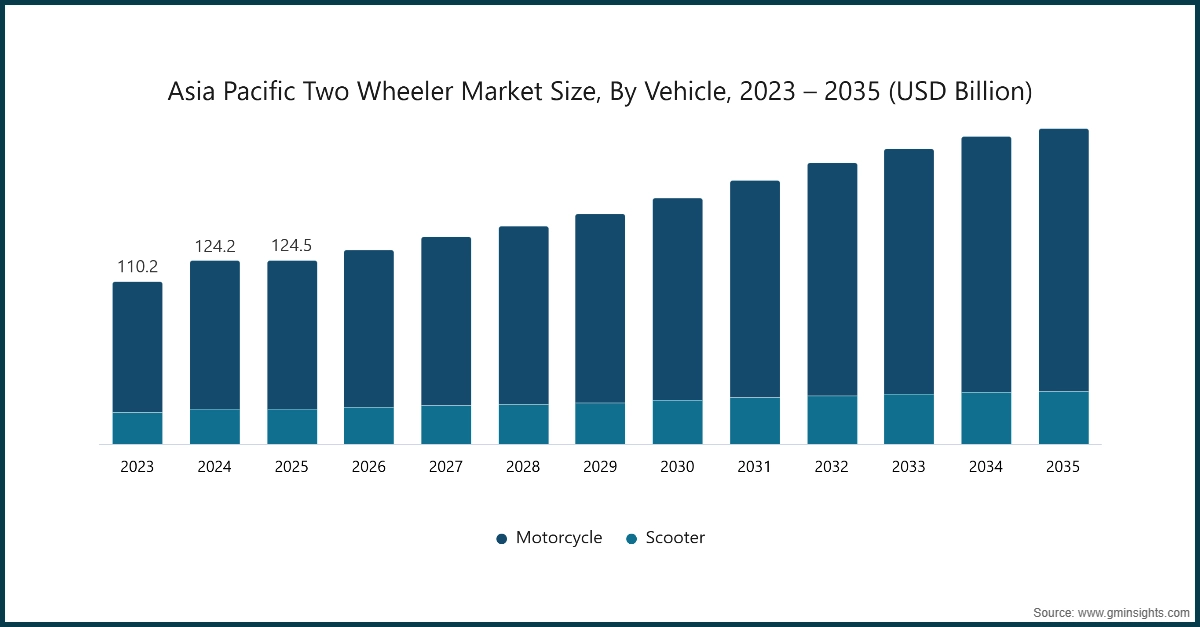
Based on vehicle, the two wheeler market is divided into motorcycle and scooter. The motorcycle segment dominated the market with market share of around 81.2% and generating revenue of around USD 101.1 billion in 2025.
- Motorcycles are the most widely used and preferred two-wheeler option as compared to scooters. As it comes in different types, such as cruiser motorcycles, sport motorcycles, touring motorcycles, standard/naked motorcycles, adventure/dual-sport motorcycles and off-road/dirt motorcycles. From daily commuters to young enthusiasts, choose motorcycles.
- In FY25, Honda shared its Asian market results, including India, Indonesia, Thailand and Vietnam, which account for 85% of global unit sales (17.17 million units). Honda is envisioning further growth in regional demand for motorcycles, mainly in the regions including Southwest Asia, whose largest market is India, as well as Indonesia and the Philippines.
- On the other hand, the scooter segment is picking up speed because it offers some characteristics that have made its entry pathway into the two-wheeler market. Scooters are designed for every age group and give a gearless option that became available across the region. Honda’s ACTIVA is its best-selling scooter model used for commuting and city riding, as well as the Dio, a scooter targeting young people.
- Furthermore, the market will see a rise in electric motorcycles and electric scooters that will boost their shares. As countries across the region support the electrification of the two-wheelers, manufacturers will get profitable business opportunities.
Learn more about the key segments shaping this market
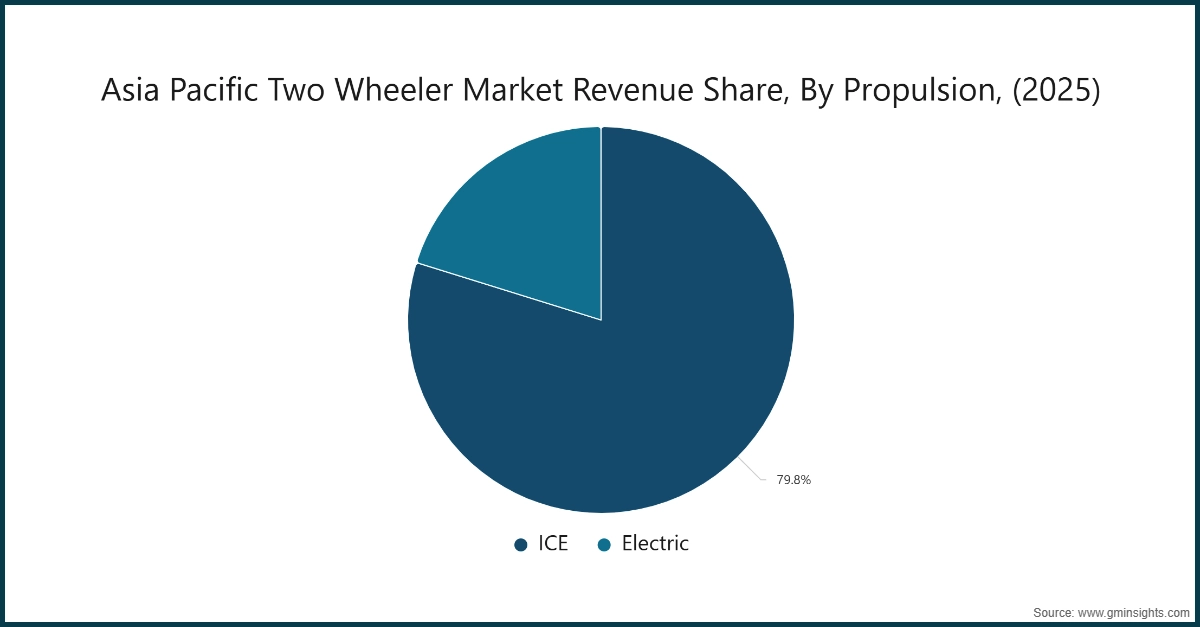
Based on propulsion, the Asia Pacific two wheeler market is divided into ICE and electric. The ICE segment accounts for 79.8% in 2025 and is expected to reach USD 158.6 billion by 2035.
- ICE-based two-wheelers are dominant and expected to continue in the coming years. Before the inception or market entry of electric two-wheelers, ICE motorcycles and scooters were the only option. Also, as the electric segment came into the market, less availability of charging infrastructures limited its wide adoption as compared to the wide availability of petrol pumps.
- Nowadays, electric two-wheelers are attracting more consumers as they give lower ownership costs by cutting fuel prices. For example, EV charging at home costs approximately USD 0.11 per mile, compared to around USD 0.18 - USD 0.23 per mile to fuel an internal combustion engine (ICE) vehicle.
- In support of the electric segment’s fastest growth CAGR of 8.1% between 2026 and 2035, ICE is losing its market share. As ICE vehicles are costly and inefficient. They waste up to 70% of fuel energy as heat and idling, leading to higher operating costs, more downtime, and greater exposure to fuel price volatility. The electric segment is estimated to grow faster in coming years.
Based on end use, the Asia Pacific two wheeler market s divided into personal and commercial. The commercial segment is expected to grow at the fastest CAGR of 5.9% between 2026 and 2035.
- The commercial two-wheeler segment is expected to grow faster than the personal segment between 2026 and 2035, largely driven by the rapid expansion of last-mile delivery and shared mobility services. Businesses involved in e-commerce, food delivery, quick-commerce, and local logistics increasingly favor two-wheelers because they are more affordable to operate, easier to navigate through congested cities, and allow riders to complete more deliveries than four-wheelers.
- A good example of this trend is Bijliride, an EV rental and mobility startup that launched its electric two-wheeler rental service in Delhi in January 2025. The location was selected based on heavy commuter movement, strong public transport connectivity, and a high demand for short-distance travel.
- Despite the faster growth of the commercial segment, personal two-wheelers continue to dominate the market in terms of overall share. This is mainly because a large number of consumers already own personal two-wheelers and regularly replace them.
- In many developing countries, where public transportation options are limited and cars remain expensive, personal two-wheelers play a crucial role in daily life. They are often the primary mode of transport for commuting to work or school and managing everyday activities, which helps keep demand steady and higher than that of the commercial segment.
Looking for region specific data?
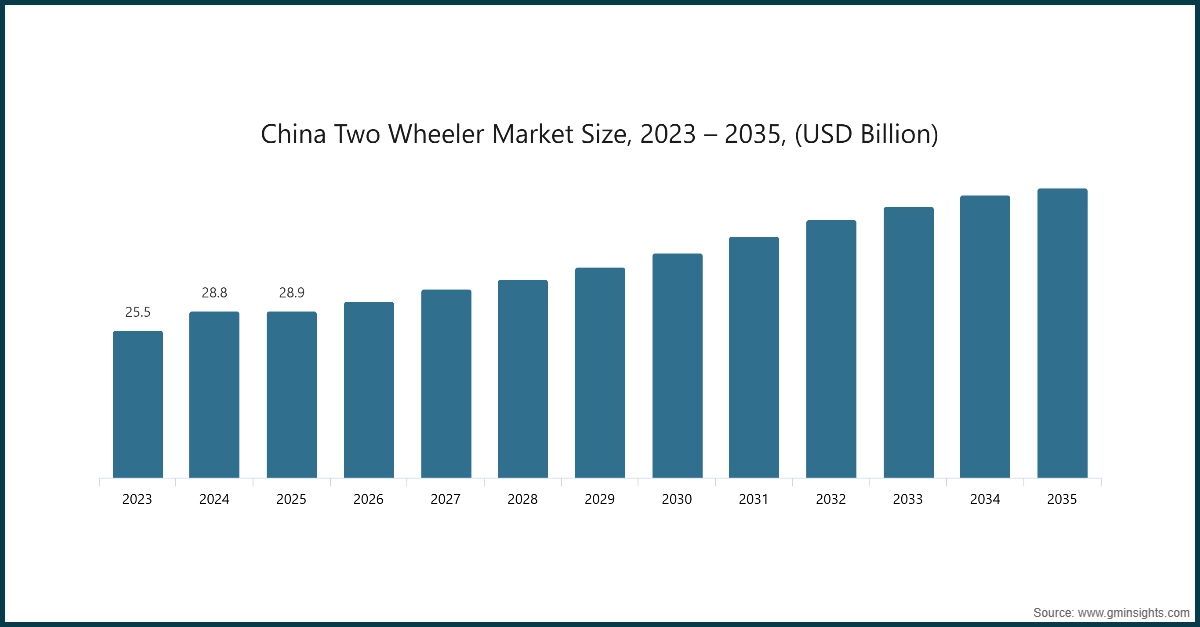
The China two wheeler market reached USD 28.9 billion in 2025, growing from USD 28.8 billion in 2024.
- China is the second largest country in the Asia Pacific two-wheeler market. The region’s dominance is because of its population, government policies for EVs and availability of local automakers.
- Chinese cities are extremely dense, and many local governments have restricted or banned private car usage in central urban areas through licence plate quotas, congestion controls, and parking limits. Two-wheelers, especially electric scooters, require less road space, are easier to park, and are often exempt from these restrictions. This has made two-wheelers the most practical option for short-distance urban mobility.
- EV penetration has already crossed 50% in the country that encourages local electric two-wheeler manufacturers to invest in the electric segment despite choosing ICE-based motorcycle or scooter production.
- ICE’s dominance in the country might be low as compared to other countries in the region, there are many two-wheeler manufacturers who have released their significant position in China. Honda’s latest sales reports that Honda holds 18-20% market share in China and operates only with the ICE segment. As Honda is also shifting towards electrification of vehicles. Its brand loyalty will continue to support keeping its dominance in the country.
India has dominated the market by holding its largest share of around 34.3% in 2025. Congested roads in urban areas and less road availability in rural areas support the two wheeler market's growth.
- In India, many people depend on two-wheelers for travel. Public transport does not reach many semi-urban and rural areas. In cities, heavy traffic makes two-wheelers a faster and easier option. As more people start working and need to travel daily, the demand for two-wheelers remains strong.
- TVS Motor Company recorded monthly sales of 519,508 units in November 2025, with a growth of 30% as against 401,250 units in November 2024. Similarly, Hero MotoCorp sales surged 40% in December 2025. Such an increase in sales represents the country's view on two wheelers as the first vehicle choice.
- Loans with low down payments, longer repayment times, and digital options have made it easier to buy two-wheelers. This has helped more people, especially those looking for basic and mid-range models, to make purchases.
- The rise of e-commerce, food delivery, and gig jobs has increased the need for two-wheelers. Companies use them for deliveries because they are cheap to run and easy to handle in traffic. This has created a fast-growing demand for two-wheelers in the business market.
The two wheeler market in Japan is valued at USD 2.5 billion in 2025 and is expected to grow at a CAGR of around 4.3% from 2026 to 2035.
- Japan's aging population is increasing the demand for lightweight scooters and small motorcycles. Older riders prefer vehicles that are easy to handle, fuel-efficient, and reliable. This trend keeps the market stable even though the overall population is shrinking.
- In Japan's big cities, space is limited, parking is expensive, and traffic rules are strict. Two-wheelers are a better option than cars for short and medium distances because they are faster, easier to park, and cheaper to own. Urban commuters now use motorcycles and scooters more for daily travel instead of just for leisure.
- Japanese manufacturers are focusing on making vehicles with better quality, safety features, smart technology, and fuel efficiency. People trust these brands, which leads to repeat purchases and upgrades, helping the market grow even though it is already well-developed.
- The growth of food delivery, postal services, and local logistics is increasing the use of two-wheelers for business. Companies prefer two-wheelers for last-mile deliveries because they are reliable, save fuel, and can easily move through crowded areas. This creates a steady need for new vehicles and fleet replacements.
South Korea's two wheeler market is growing at a low CAGR of around 1.9% between 2026 and 2035 and is estimated to reach USD 2.3 billion in 2035.
- South Korea has a very efficient and affordable public transportation system, including subways, buses, and trains. Most urban commuters prefer public transport because it is reliable, safe, and convenient. This reduces the need for personal two-wheelers, which limits market growth. For example, Greater Seoul has built one of the world's most extensive and seamlessly integrated public transit systems, with 23 metro lines.
- Also, the country has strict rules for motorcycles and scooters, such as mandatory training and higher insurance costs. These rules make owning a two-wheeler more expensive and time-consuming, discouraging new buyers and slowing market growth compared to countries with easier rules.
- South Korea has a high number of cars and people prefer them for their status, comfort, and safety. With affordable car loans and strong local car brands, many people choose cars over two-wheelers, especially for family use, which lowers the demand for two-wheelers.
- Cold winters and heavy rainfall in South Korea make it hard to use two-wheelers all year. This weather reduces demand and makes daily commuting by two-wheeler less practical.
- Therefore, market for two wheelers is continuously experiencing decline due to evolving urban mobility patterns and stronger alternatives to personal transport.
Indonesia is expected to grow at the fastest CAGR of around 7.8% between 2026 and 2035, driven by the high dependence on two-wheelers for daily mobility.
- Indonesia has a large population and crowded cities, but public transport is limited in many areas. Two-wheelers are the most practical option for daily travel, school, and small businesses. This creates steady demand, unlike in places where two-wheelers are mainly for fun.
- Two-wheelers are cheaper than cars. Easy financing, low down payments, and long repayment plans make them affordable for middle and lower-income groups. This helps more people, especially first-time buyers, own vehicles.
- Recently, Honda launched two electric two-wheelers in Indonesia. The CUV e: uses two swappable Honda Mobile Power Pack e: batteries, while the ICON e: has a fixed battery.
- Indonesia has a strong two-wheeler manufacturing industry. Big companies like Honda, Yamaha, and Suzuki produce locally. This keeps prices low and ensures enough supply, helping the market grow faster than in countries with higher costs or import dependence.
Malaysia is experiencing growth in the two wheeler sector, as the country is expected to grow at a strong CAGR of 6.8% between 2026 and 2035.
- The registration numbers of two-wheelers reached 13.6 million by the end of 2023, which demonstrates their extensive presence throughout both urban and semi-urban regions of the country. The market started to recover in 2025 after production and sales suffered their most severe downturn between 2023 and early 2024. The economic conditions improved and this development led to increased motorcycle sales, which grew during the first nine months of 2025.
- Changes in the market are also affecting demand. The used motorcycle market is growing fast and is expected to grow quicker than the overall economy. Many cost-conscious buyers prefer used motorcycles due to higher living costs.
- Electric two-wheelers are also growing quickly, with triple-digit growth rates. Urban traffic, rising middle-class incomes, and the need for delivery and logistics services continue to make two-wheelers important in Malaysia's transport and lifestyle.
Asia Pacific Two Wheeler Market Share
- The top 7 companies in the Asia Pacific two wheeler market are Bajaj Auto, Hero, Honda, Loncin Motor, Royal Enfield, TVS and Yamaha contributing 27.9% of the market in 2025.
- Bajaj Auto manufactures motorcycles and scooters across commuter, sports, and premium segments. Its two-wheelers are designed for daily mobility and performance use, covering varied engine capacities and usage requirements in domestic and international markets.
- Hero manufactures motorcycles and scooters primarily focused on everyday commuting. Its two-wheelers emphasize fuel efficiency, practical design, and ease of use, offering multiple engine options suited for urban and rural transportation needs.
- Honda produces a range of motorcycles and scooters designed for commuting and leisure riding. Its two-wheelers include automatic and manual transmission models, addressing different riding preferences, engine capacities, and operating conditions across markets.
- Loncin Motor manufactures motorcycles and scooters for personal transportation and utility use. Its two-wheeler portfolio includes varied engine displacements and configurations, catering to standard commuting, light touring, and commercial mobility applications.
- Royal Enfield manufactures mid-capacity motorcycles designed for road and touring use. Its two-wheelers feature classic styling and single- and twin-cylinder engines, intended for long-distance riding, urban travel, and recreational motorcycling.
- TVS manufactures motorcycles and scooters across commuter, performance, and electric segments. Its two-wheelers are developed for daily transport and sport riding, offering multiple engine sizes, transmission options, and usage-specific designs.
- Yamaha produces motorcycles and scooters focused on commuting and performance riding. Its two-wheelers include automatic and manual models, designed to balance engine performance, handling characteristics, and everyday usability across diverse riding conditions.
Asia Pacific Two Wheeler Market Companies
Major players operating in the market are:
- Bajaj Auto
- Hero
- Honda
- Kawasaki
- Loncin Motor
- Royal Enfield
- Suzuki
- TVS
- Yadea
- Yamaha
- Bajaj Auto benefits from strong capabilities in commuter and performance motorcycles, efficient manufacturing processes, and a wide export footprint that supports cost control and market diversification across regions.
- Hero leverages large-scale production, an extensive distribution network, and deep penetration in commuter segments, enabling consistent volume sales across urban, rural, and semi-urban two-wheeler markets.
- Honda’s competitive edge comes from advanced engine engineering, high product reliability, and a diversified scooter and motorcycle portfolio supported by standardized global manufacturing and quality practices.
- Loncin Motor gains advantage through vertically integrated operations, in-house engine manufacturing, and cost-efficient production, supporting both branded motorcycles and powertrain supply to global partners.
- Royal Enfield stands out through focused expertise in mid-capacity motorcycles, strong brand-led differentiation, and a dedicated touring-oriented product ecosystem built around long-distance riding needs.
- TVS combines in-house research and engineering, motorsports-derived expertise, and a balanced product mix across commuter, performance, and electric segments to address varied two-wheeler demand.
- Yamaha’s edge lies in performance-focused engineering, refined ride dynamics, global design inputs, and consistent emphasis on handling and engine tuning across motorcycle and scooter offerings.
Asia Pacific Two Wheeler Market Report Attributes
| Key Takeaway | Details |
|---|---|
| Market Size & Growth | |
| Base Year | 2025 |
| Market Size in 2025 | USD 124.5 Billion |
| Market Size in 2026 | USD 131.7 Billion |
| Forecast Period 2026-2035 CAGR | 5.5% |
| Market Size in 2035 | USD 213.7 Billion |
| Key Market Trends | |
| Drivers | Impact |
| Rising Middle-Class Population | Expanding middle-class income levels increase affordability of two wheelers, driving higher ownership rates and sustained demand for personal and family mobility solutions. |
| Traffic Congestion in Mega Cities | Severe urban traffic congestion encourages consumers to prefer two wheelers for faster commuting, easier parking, and improved daily travel efficiency. |
| Fuel Efficiency Advantages | High fuel efficiency of two wheelers lowers commuting costs, making them an economical transportation choice amid rising living expenses across Asia Pacific cities. |
| Expanding E-commerce and Delivery Services | Growth of e-commerce and last-mile delivery services boosts demand for two wheelers as cost-effective, agile vehicles for logistics and courier operations. |
| Pitfalls & Challenges | Impact |
| Safety Concerns and Accident Rates | High accident rates and safety concerns deter potential buyers, prompting stricter regulations and increasing costs related to safety compliance and insurance. |
| Volatility in Fuel Prices | Fluctuating fuel prices create uncertainty in ownership costs, influencing purchasing decisions and potentially slowing demand for conventional two wheelers. |
| Opportunities: | Impact |
| Rapid Adoption of Electric Two Wheelers | Increasing adoption of electric two wheelers offers manufacturers growth opportunities through eco-friendly mobility solutions supported by government incentives and emission reduction goals. |
| Development of Battery Swapping Infrastructure | Battery swapping infrastructure reduces charging time anxiety, accelerating electric two-wheeler adoption and improving convenience for commercial and high-usage consumers. |
| Growth of Shared Mobility Services | Expansion of shared mobility platforms increases fleet demand for durable two wheelers, opening new revenue streams for manufacturers and service providers. |
| Expansion of Charging Infrastructure | Widening charging infrastructure enhances electric two-wheeler practicality, supporting mass adoption and long-term transition toward sustainable urban transportation systems. |
| Market Leaders (2025) | |
| Market Leader |
10.7% market share |
| Top Players |
Collective market share in 2025 is 24.8% |
| Competitive Edge |
|
| Regional Insights | |
| Largest Market | India |
| Fastest growing market | Indonesia |
| Emerging countries | Malaysia, Australia, Vietnam |
| Future outlook |
|
What are the growth opportunities in this market?
Asia Pacific Two Wheeler Industry News
- In November 2025, Honda launched its first electric motorcycle, the Honda WN7. It is powered by a compact and lightweight water-cooled motor with an integrated inverter. The motor provides a maximum output of 50 kW, similar to a 600 cc ICE motorcycle, and a maximum torque of 100 Nm, comparable to a 1000 cc ICE motorcycle.
- In November 2025, Yamaha introduced the Jog E electric scooter in Japan. This scooter uses Honda’s swappable batteries. Yamaha is focusing on urban electrification in Japan with this launch.
- In November 2025, TVS Motor launched four new Norton motorcycles in the UK, India, and Europe. These include the Manx and Manx R supersport models, along with the Atlas and Atlas GT. The launch happened at EICMA, an international motorcycle exhibition in Milan, Italy.
- In November 2025, Yamaha Motor launched two new electric scooters in India. These are the AEROX E, developed by Yamaha, and the EC-06, made in partnership with River Mobility Private Limited.
- In July 2025, Hero launched its EVooter line with the Vida VX2. This aims to make EV ownership more affordable for Indian customers. Hero also introduced a ‘Pay-per-Kilometre’ model, which reduces costs to ₹0.96 per km. This is a ‘Battery as a Service’ option.
The Asia Pacific two wheeler market research report includes in-depth coverage of the industry with estimates & forecasts in terms of revenue ($ Mn/Bn) and volume (Units) from 2022 to 2035, for the following segments:
Market, By Vehicle
- Motorcycle
- Cruiser motorcycles
- Sport motorcycles
- Touring motorcycles
- Standard/naked motorcycles
- Adventure/dual-sport motorcycles
- Off-road/dirt motorcycles
- Scooter
- Maxi scooters
- Moped-style scooters
Market, By Propulsion
- ICE
- Electric
Market, By Displacement
- Under 250cc
- 250cc–500cc
- 500cc–1000cc
- Above 1000cc
Market, By Distribution Channel
- Offline
- Online
Market, By End Use
- Personal Use
- Commercial
The above information is provided for the following regions and countries:
- China
- India
- Japan
- Australia
- South Korea
- Singapore
- Vietnam
- Thailand
- Philippines
- Malaysia
- Indonesia
- Rest of Asia Pacific
Frequently Asked Question(FAQ) :
What is the two-wheeler market size in 2025?
The two-wheeler market is valued at USD 124.5 billion in 2025. Rising middle-class income levels, urban traffic congestion, and the growth of e-commerce and delivery services are driving market expansion.
What is the market size of the two-wheeler industry in 2026?
The market size for the two-wheeler industry is projected to reach USD 131.7 billion in 2026, reflecting steady growth driven by affordability, fuel efficiency, and increasing demand for personal mobility solutions.
What is the projected value of the two-wheeler market by 2035?
The two-wheeler market is expected to reach USD 213.7 billion by 2035, growing at a CAGR of 5.5%. This growth is fueled by the adoption of electric two-wheelers, expansion of charging infrastructure, and the rise of shared mobility services.
How much revenue did the motorcycle segment generate in 2025?
The motorcycle segment dominated the market in 2025, accounting for approximately 81.2% of the market share and generating revenue of around USD 101.1 billion. Its dominance is attributed to its widespread use for personal and commercial purposes.
What was the valuation of the ICE segment in 2025?
The ICE (Internal Combustion Engine) segment accounted for 79.8% of the market in 2025 and is projected to reach USD 158.6 billion by 2035. Its continued dominance is supported by its affordability and established infrastructure.
What is the growth outlook for the commercial segment from 2026 to 2035?
The commercial segment is expected to grow at the fastest CAGR of 5.9% between 2026 and 2035. This growth is driven by the increasing use of two-wheelers in delivery services, logistics, and shared mobility platforms.
Which region leads the two-wheeler market?
China led the two-wheeler market in 2025, with a valuation of USD 28.9 billion, up from USD 28.8 billion in 2024. Its leadership is driven by high population density, urbanization, and the growing adoption of electric two-wheelers.
What are the upcoming trends in the two-wheeler industry?
Key trends include the rapid adoption of electric two-wheelers, development of battery swapping infrastructure, expansion of charging networks, and the growth of shared mobility services.
Who are the key players in the two-wheeler market?
Key players include Honda, Bajaj Auto, Hero, TVS, Yamaha, Kawasaki, Loncin Motor, Royal Enfield, and Suzuki. These companies are focusing on innovation in electric mobility, fuel efficiency, and expanding their presence in emerging markets.
Asia Pacific Two Wheeler Market Scope
Related Reports