Summary
Table of Content

Asia Pacific Stationary Flow Battery Storage Market
Get a free sample of this report
Form submitted successfully!
Error submitting form. Please try again.
Thank you!
Your inquiry has been received. Our team will reach out to you with the required details via email. To ensure that you don't miss their response, kindly remember to check your spam folder as well!
Request Sectional Data
Thank you!
Your inquiry has been received. Our team will reach out to you with the required details via email. To ensure that you don't miss their response, kindly remember to check your spam folder as well!
Form submitted successfully!
Error submitting form. Please try again.
Asia Pacific Stationary Flow Battery Storage Market Size
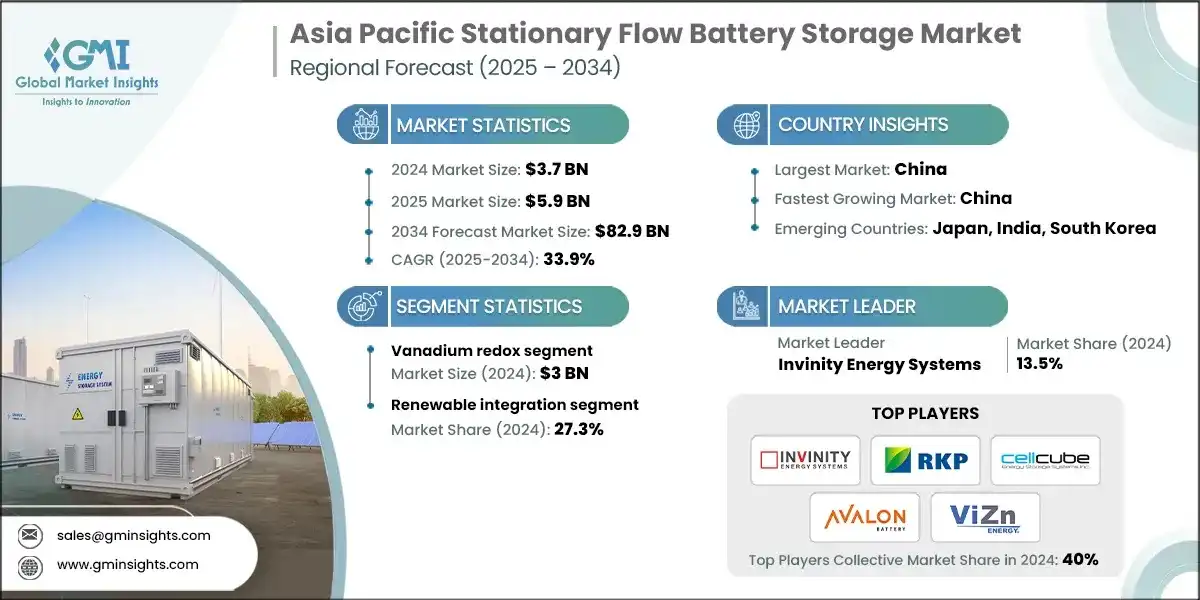
Asia Pacific stationary flow battery storage market was valued at USD 3.7 billion in 2024. The market is expected to grow from USD 5.9 billion in 2025 to USD 82.9 billion by 2034, at a CAGR of 33.9%, according to Global Market Insights Inc.
Asia Pacific Stationary Flow Battery Storage Market Key Takeaways
Market Size & Growth
- 2024 Market Size: USD 3.7 Billion
- 2025 Market Size: USD 5.9 Billion
- 2034 Forecast Market Size: USD 82.9 Billion
- CAGR (2025–2034): 33.9%
Key Market Drivers
- Growth in the renewable energy sector.
- Favorable regulatory framework.
Challenges
- Safety concerns.
Opportunity
- Grid-scale renewable integration.
- EV charging infrastructure support.
Key Players
- Market Leader: Invinity Energy Systems led with over 13.5% market share in 2024.
- Leading Players: Top 5 players in this market include Invinity Energy Systems, Rongke Power, CellCube Energy Storage Systems, Avalon Battery, ViZn Energy Systems, which collectively held a market share of 40% in 2024.
Get Market Insights & Growth Opportunities
- Asia Pacific’s surge in solar and wind installations has created a pressing need for long-duration energy storage. Flow batteries, with their ability to store excess energy and release it during peak demand, are ideal for stabilizing intermittent renewable sources. Countries like China and India are deploying flow batteries in solar parks and wind farms to ensure grid reliability. This integration is a key growth driver, as governments push for cleaner energy and reduced carbon emissions, making flow batteries central to the region’s energy transition strategies.
- For instance, in July 2025, China Huaneng Group completed construction of a 200 MW/1 GWh vanadium redox flow battery system in Xinjiang, paired with a 1 GW solar farm. The project addresses renewable intermittency and supports grid stability in a region rich in solar and wind resources. With five hours of continuous discharge, it exemplifies how flow batteries enable large-scale renewable integration while reducing CO2 emissions by over 1.6 million tonnes annually.
- Governments across Asia Pacific are investing in smart grid infrastructure to improve energy distribution and reliability. Flow batteries support grid modernization by offering frequency regulation, load shifting, and peak shaving capabilities. Their long discharge durations and scalability make them suitable for utility-scale applications. As nations upgrade aging grid systems and incorporate decentralized energy sources, flow batteries are increasingly adopted to enhance grid resilience and reduce blackout risks, especially in densely populated and industrialized regions.
- Supportive policies and financial incentives are accelerating flow battery adoption. China’s National Development and Reform Commission mandates energy storage integration in new renewable projects, while India’s National Energy Storage Mission promotes long-duration storage technologies. These initiatives reduce upfront costs and encourage private sector participation. Subsidies, tax benefits, and pilot programs across Asia Pacific are fostering a favorable environment for flow battery deployment, making policy support a critical growth enabler.
- Flow batteries are gaining traction in industrial and commercial sectors due to their reliability and long cycle life. Data centers, manufacturing units, and commercial buildings require uninterrupted power, and flow batteries offer extended discharge without degradation. Their ability to manage high energy loads efficiently makes them ideal for backup power and cost optimization. As businesses seek energy independence and operational continuity, flow batteries are becoming a preferred solution.
- Innovations in vanadium redox, zinc-bromine, and iron flow battery chemistries are improving efficiency, scalability, and cost-effectiveness. These advancements are reducing manufacturing costs and enhancing performance, making flow batteries more competitive with lithium-ion alternatives. Research institutions and startups in Asia Pacific are developing new electrolyte formulations and modular designs, which are expanding the applicability of flow batteries across diverse sectors and driving market growth.
- Asia Pacific countries are aligning with global climate commitments, aiming to reduce carbon emissions and transition to clean energy. Flow batteries play a vital role in decarbonizing power grids by enabling renewable integration and reducing reliance on fossil fuels. Their ability to store green energy and support demand response programs aligns with national climate action plans, making them a strategic asset in achieving sustainability targets.
- Utility companies in Asia Pacific are increasingly adopting flow batteries for large-scale energy storage. These projects support grid stability, renewable integration, and energy arbitrage. Flow batteries’ scalability and long-duration capabilities make them suitable for utility applications. Collaborations between utilities and technology providers are leading to pilot projects and commercial deployments, especially in China, India, and Japan, where energy demand is rising rapidly.
- For reference, in September 2024, Energy Storage Industries Asia Pacific received USD 42.5 million in public and private funding to build a 3.2 GWh iron flow battery manufacturing plant in Queensland. The facility will support utility-scale deployments across Australia, with initial systems already installed at Stanwell Corporation’s Clean Energy Hub.
To get key market trends
Asia Pacific Stationary Flow Battery Storage Market Trends
- As production scales up, the cost of flow battery systems is gradually declining. Domestic manufacturing in China and India is reducing dependency on imports and lowering system costs. Vertical integration strategies, such as Largo’s vanadium supply chain, are improving cost efficiency. These developments are making flow batteries more accessible and attractive for large-scale and commercial users, driving broader market adoption.
- Flow batteries are being deployed in remote and off-grid areas across Asia Pacific, including islands, mining zones, and rural communities. Their ability to provide stable power without degradation makes them ideal for microgrids. Governments and NGOs are supporting these initiatives to enhance energy access and reduce diesel dependency. The growing focus on rural electrification and sustainable development is expanding the market for flow batteries in off-grid applications.
- Energy companies and tech firms are investing heavily in flow battery technologies. Partnerships between domestic manufacturers and international players are accelerating technology transfer and deployment. Companies like VRB Energy and Redflow are expanding operations in Asia Pacific through joint ventures and pilot projects. These collaborations are fostering innovation, improving system reliability, and scaling up production, contributing significantly to market growth.
- For illustration, in October 2025, Sharp Corporation signed an MoU with ESI Asia Pacific to co-develop zinc-air flow battery technology in Queensland. The partnership includes a proof-of-concept with the University of Queensland and aims to create scalable, low-cost, long-duration energy storage solutions for the Indo-Pacific.
- Unlike lithium-ion batteries, flow batteries rely on more abundant and recyclable materials like vanadium and zinc. This reduces vulnerability to supply chain disruptions and geopolitical risks. Asia Pacific countries are investing in domestic resource extraction and refining to secure raw material supply. The strategic advantage of stable supply chains is encouraging governments and industries to favor flow battery technologies over alternatives.
- For example, in July 2025, Allegro Energy in Australia introduced microemulsion flow batteries using water-based electrolytes. These systems avoid reliance on lithium and toxic materials, offering a safer and more sustainable alternative for data centers and industrial applications.
- Flow batteries offer superior safety and longer cycle life compared to conventional batteries. Their non-flammable electrolytes and low degradation rates make them suitable for critical infrastructure and high-risk environments. These attributes are driving adoption in sectors where safety and reliability are paramount, such as healthcare, telecom, and defense. The reduced maintenance and replacement costs further enhance their appeal.
- For instance, in March 2025, Sumitomo Electric’s redox flow battery was selected for Japan’s Nagasu Energy Storage Facility due to its non-flammable electrolyte and long lifespan. The system meets fire safety regulations without requiring hazardous material permits, making it ideal for grid-scale deployment.
Asia Pacific Stationary Flow Battery Storage Market Analysis
Learn more about the key segments shaping this market
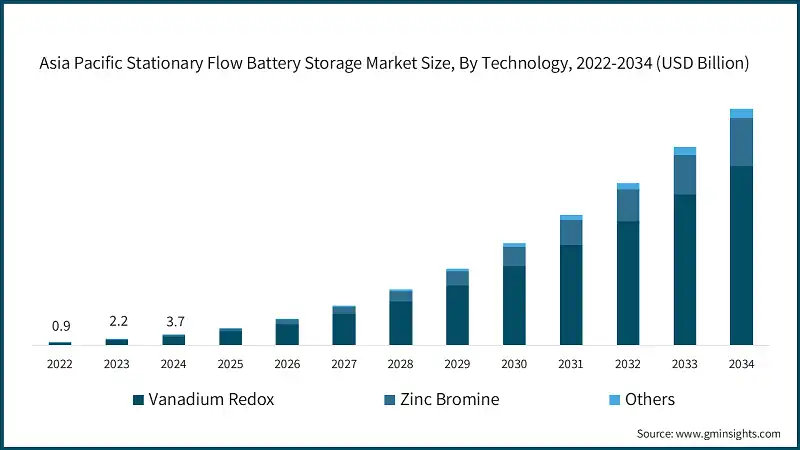
- Based on technology, the industry is segmented into vanadium redox, zinc bromine, and others. The vanadium redox segment dominated the Asia Pacific stationary flow battery storage market accounting for USD 3 billion in 2024 and is expected to grow at a CAGR of 33% through 2034.
- VRFBs are favored for utility-scale applications like renewable integration and grid balancing. China dominates vanadium production, enabling cost-effective domestic manufacturing and vertical integration strategies. Innovations in stack design and electrolyte management are improving energy density and reducing costs, making VRFBs the backbone of long-duration storage in the region.
- Zinc bromine flow batteries are gaining traction for commercial and industrial applications due to their compact design, high energy density, and tolerance to temperature fluctuations. These systems are ideal for off-grid and backup power scenarios in Asia Pacific’s tropical and remote regions. Companies including Redflow are expanding deployments in Australia and Southeast Asia, supported by government incentives and pilot programs.
- Iron-based and hybrid flow batteries are emerging as cost-effective alternatives, driven by abundant raw materials and simplified system designs. Iron flow batteries offer environmental benefits and reduced toxicity, making them suitable for urban and residential deployments. Hybrid systems, combining flow batteries with other technologies like lithium-ion or supercapacitors, are being piloted for EV charging and grid services.
- Advancements in stack architecture and membrane materials are enhancing flow battery efficiency and reducing manufacturing complexity. Research centers in China, Japan, and Australia are developing high-performance ion-selective membranes and optimized flow channels to improve electrolyte distribution. These innovations increase power density and reduce internal resistance, enabling more compact and efficient systems.
- Artificial intelligence is being integrated into flow battery systems to enable predictive maintenance, performance optimization, and real-time diagnostics. AI algorithms analyze operational data to forecast failures, optimize charge-discharge cycles, and reduce downtime. In Asia Pacific, smart grid initiatives and digital infrastructure are supporting the deployment of AI-enhanced energy storage systems.
- Technology growth is being fueled by strategic partnerships between battery manufacturers and raw material suppliers. In Asia Pacific, companies are securing vanadium and zinc supply chains through joint ventures and long-term contracts. Vertical integration reduces price volatility and ensures consistent quality, while collaborative R&D accelerates innovation. These alliances are enabling large-scale deployments and reducing barriers to entry for new technologies.
Learn more about the key segments shaping this market
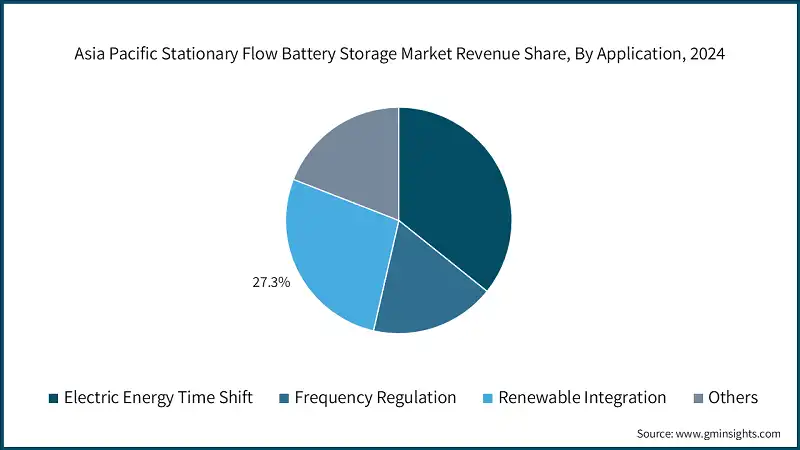
- Based on application, the industry is segmented into electric energy time shift, frequency regulation, renewable integration, and others. The renewable integration segment dominated the 27.3% share of Asia Pacific stationary flow battery storage market in 2024 and is expected to grow at a CAGR of 33.4% through 2034.
- Asia Pacific’s aggressive expansion of solar and wind capacity is driving demand for stationary flow batteries to manage intermittency. Flow batteries store surplus energy during peak generation and release it during low production periods, ensuring grid stability. Countries like China, India, and Japan are deploying flow batteries in renewable parks to support decarbonization goals. Their long-duration discharge and scalability make them ideal for integrating variable renewables into the grid, especially in regions with high renewable penetration.
- Flow batteries are particularly suited for this due to their ability to deliver consistent output over extended durations. In Asia Pacific, utilities and commercial users are leveraging this capability to reduce peak tariffs, optimize energy costs, and enhance grid efficiency. Time-shifting also supports load balancing and reduces the need for peaker plants, making it a strategic tool for energy management.
- Flow batteries are increasingly used for frequency regulation, voltage support, and other ancillary grid services. Their fast response time and stable output help maintain grid frequency within acceptable limits, especially as renewable energy introduces variability. In Japan and South Korea, flow batteries are being integrated into smart grid systems to provide real-time frequency control. These services are essential for modernizing grid infrastructure and ensuring reliability in densely populated urban centers.
- Industrial and commercial facilities in Asia Pacific are adopting flow batteries for peak shaving—reducing energy consumption during high-tariff periods. This application helps lower operational costs and reduce strain on the grid. Flow batteries’ long discharge duration and minimal degradation make them ideal for sustained load management. In Australia and Southeast Asia, pilot projects are demonstrating how flow batteries can optimize energy use in manufacturing plants, data centers, and commercial buildings.
- Flow batteries are being deployed for backup power in critical infrastructure such as hospitals, telecom towers, and government facilities. Their safety profile, long cycle life, and ability to deliver uninterrupted power make them suitable for resilience applications. In disaster-prone regions of Asia Pacific, flow batteries are part of microgrid systems that ensure energy continuity during grid outages. This use case is gaining traction as climate risks and energy security concerns rise.
- In regions with high renewable generation, curtailment—wasting excess energy due to grid limitations—is a growing issue. Flow batteries help absorb surplus energy and release it when needed, reducing curtailment and maximizing renewable utilization. China’s National Energy Administration has emphasized storage deployment to address curtailment in solar-rich provinces. Flow batteries’ ability to store large volumes of energy for hours makes them a preferred solution for this challenge.
Looking for region specific data?
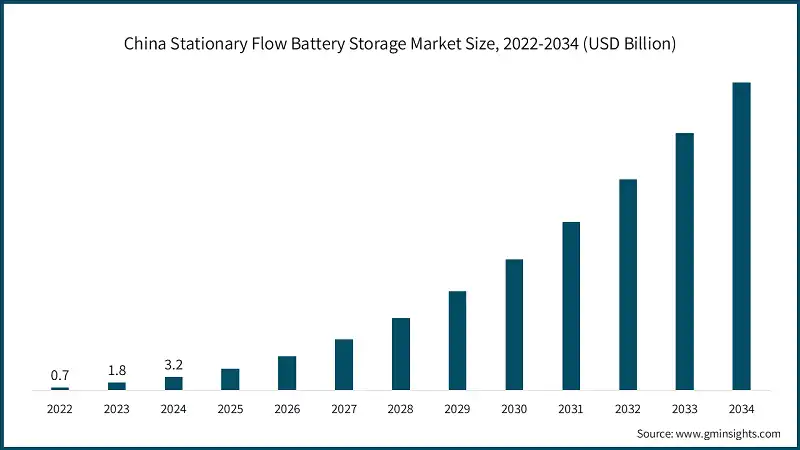
- China stationary flow battery storage market is set to reach USD 75.7 billion by 2034, due to its vast vanadium reserves, strong domestic manufacturing, and aggressive policy support. For instance, the National Development and Reform Commission mandates energy storage integration in new renewable projects, targeting 30 GW of new capacity by 2025. Local governments, like Sichuan Province, are promoting vanadium battery clusters. China’s solar PV capacity surpassed 530 GW in 2023, necessitating large-scale storage to manage surplus generation. These factors make China a hub for flow battery innovation, deployment, and cost reduction.
- Australia’s competitive electricity market and abundant renewable resources are driving flow battery adoption. The country is investing in iron flow battery manufacturing, with Energy Storage Industries Asia Pacific building a 3.2 GWh plant in Queensland. Merchant storage projects are gaining traction, offering grid services like energy arbitrage and frequency regulation. Government support for long-duration storage and microgrid resilience in remote areas further boosts demand. Australia’s emphasis on decarbonization and energy independence positions it as a key player in flow battery innovation.
- India’s rapid renewable energy expansion—targeting 500 GW by 2030—is creating demand for long-duration storage solutions. Flow batteries are being considered for solar parks, industrial zones, and rural microgrids. The government’s National Energy Storage Mission promotes advanced storage technologies, including flow batteries, to enhance grid stability and reduce curtailment. India’s diverse climate and grid challenges make flow batteries attractive for both utility-scale and distributed applications. Domestic manufacturing and pilot projects are emerging, supported by favorable policies and international partnerships.
- Japan prioritizes energy security and safety in its post-Fukushima energy strategy. Flow batteries, with non-flammable electrolytes and long cycle life, are ideal for urban and disaster-resilient infrastructure. Sumitomo Electric is leading deployments of vanadium redox systems for grid services and community microgrids. Government incentives support smart grid integration and backup power solutions. Japan’s aging grid and high renewable penetration make flow batteries essential for frequency regulation and peak shaving, especially in densely populated areas.
- South Korea’s advanced digital infrastructure and smart grid initiatives are driving flow battery adoption. The country is investing in AI-integrated energy storage systems for predictive maintenance and grid optimization. Flow batteries are being tested for EV charging stations, industrial backup, and renewable integration. Government R&D programs and partnerships with global tech firms are accelerating innovation in stack design and hybrid chemistries. South Korea’s focus on clean energy and technology leadership makes it a strategic market for next-gen flow battery solutions.
- Asia Pacific is the fastest-growing region for RFBs, driven by massive renewable investments and manufacturing scale. China leads in vanadium production and flow battery deployment, with projects like Dalian Rongke’s 100 MW system. Japan and South Korea are investing in R&D and commercial rollouts. Australia is piloting RFBs in solar microgrids and mining operations. Government incentives, grid modernization, and industrial demand are fueling growth.
- Asia Pacific countries are increasingly collaborating on energy storage research, manufacturing, and deployment. Cross-border partnerships—such as Sharp’s MoU with ESI Asia Pacific—are fostering technology transfer and regional supply chain development. Shared challenges like typhoon resilience, island grid stability, and renewable intermittency are driving joint pilot projects. Regional forums like APEC and ASEAN are promoting harmonized standards and funding mechanisms for flow battery deployment. This collaborative environment is accelerating market growth across borders.
Asia Pacific Stationary Flow Battery Storage Market Share
- The top 5 companies in the Asia Pacific Stationary flow battery storage industry are Rongke Power, Avalon Battery, CellCube Energy Storage Systems, Invinity Energy Systems, and ViZn Energy Systems contributing around 40% of the market in 2024.
- ViZn Energy Systems develops advanced energy storage solutions designed for utility, commercial, industrial, and microgrid applications. Their systems are built with non-toxic, recyclable materials and engineered for durability, offering both high-power and long-duration capabilities. With a robust 20-year design life and minimal performance degradation over full charge cycles, ViZn’s batteries are optimized for extreme operating conditions. The technology supports multiple revenue-generating applications, enhancing return on investment. ViZn’s emphasis on safety, reliability, and environmental sustainability positions the company as a significant contributor to the long-duration energy storage landscape in the Asia Pacific region and beyond.
- Invinity Energy Systems is a key player in the Asia Pacific stationary flow battery market, offering vanadium-based energy storage solutions optimized for long-duration applications. Its modular and utility-grade systems are well-suited for the region’s growing demand for renewable integration, grid stability, and commercial energy resilience. The company’s Endurium product line supports deployments exceeding 500 MWh and offers over 30 years of asset life with zero degradation—ideal for Asia Pacific’s climate and infrastructure needs. With strategic partnerships and expanding presence in markets like China, Australia, and Southeast Asia, Invinity is helping drive the region’s transition to reliable, 24/7 clean energy.
Asia Pacific Stationary Flow Battery Storage Market Companies
Major players operating in the Asia Pacific stationary flow battery storage industry are:
- Avalon Battery
- CellCube Energy Storage Systems
- Elestor
- ESS
- Everflow
- Invinity Energy Systems
- Largo
- Primus Power
- Rongke Power
- Sumitomo Electric
- ViZn Energy Systems
- Voltstorage
- VRB Energy
- Rongke Power is a major force in the Asia Pacific stationary flow battery market, specializing in vanadium redox flow battery (VRFB) technology. Headquartered in Dalian, China, the company has surpassed 3.5 GWh of global installations by mid-2025, with a strong concentration in Asia. Its landmark 100 MW / 400 MWh project in Northwest China exemplifies its leadership in utility-scale energy storage for grid stability and renewable integration. With over 500 patents and a vertically integrated supply chain, Rongke Power ensures safety, scalability, and cost efficiency. Its water-based, non-flammable electrolyte systems are well-suited for the region’s diverse energy needs.
- Everflow, a subsidiary of the SCHMID Group, is actively contributing to the growth of stationary flow battery storage across Asia Pacific. Specializing in vanadium-based systems, Everflow has deployed scalable energy storage solutions tailored for telecom, commercial, and utility sectors in the region. Its product range includes modular containers and multi-MWh installations, designed for integration into decentralized energy networks. The company’s water-based electrolyte technology ensures deep discharge capability, unlimited cycling, and zero fire risk—ideal for Asia Pacific’s diverse climate and infrastructure needs. Backed by SCHMID’s global manufacturing expertise, Everflow is enabling safe, recyclable, and long-duration storage for EV charging hubs and neighborhood grids.
- CellCube Energy Storage Systems, operating under Enerox GmbH, is expanding its footprint in the Asia Pacific stationary flow battery market with vanadium-based solutions tailored for long-duration energy storage. With over 130 global deployments, CellCube’s systems are designed for commercial, industrial, and utility-scale use, offering up to 24 hours of energy delivery and over 20,000 cycles without degradation. Its modular architecture and real-time monitoring capabilities make it ideal for renewable integration and grid stability across diverse climates in Asia Pacific. As the region scales up clean energy infrastructure, CellCube’s safe, recyclable, and turnkey storage solutions are well-positioned to support sustainable growth.
Asia Pacific Stationary Flow Battery Storage Market Report Attributes
| Key Takeaway | Details |
|---|---|
| Market Size & Growth | |
| Base Year | 2024 |
| Market Size in 2024 | USD 3.7 Billion |
| Market Size in 2025 | USD 5.9 Billion |
| Forecast Period 2025 - 2034 CAGR | 33.9% |
| Market Size in 2034 | USD 82.9 Billion |
| Key Market Trends | |
| Drivers | Impact |
| Growth in the renewable energy sector | Asia Pacific stationary flow battery market is growing rapidly due to the expansion of solar and wind energy. These batteries offer long-duration, scalable storage ideal for managing renewable intermittency |
| Favorable regulatory framework | Favorable regulatory frameworks across the region, including energy storage mandates and pilot programs, are accelerating flow battery adoption. Supportive policies promote safety, performance, and integration with renewable energy systems |
| Pitfalls & Challenges | Impact |
| Safety concerns | Safety concerns remain a key restraint for the Asia Pacific stationary flow battery market. Issues such as electrolyte leakage, material handling risks, and limited public awareness can hinder widespread adoption and investor confidence |
| Opportunities: | Impact |
| Grid-scale renewable integration | Grid-scale renewable integration presents a major opportunity for flow batteries in Asia Pacific. Their long-duration storage capabilities help stabilize solar and wind output, ensuring reliable power supply and reducing curtailment |
| EV charging infrastructure support | The expansion of EV charging infrastructure across Asia Pacific creates demand for energy storage solutions. Flow batteries can support load management and peak shaving at charging stations, enhancing grid efficiency and reducing operational costs. |
| Market Leaders (2024) | |
| Market Leaders |
13.5% market share |
| Top Players |
Collective market share in 2024 is 40% |
| Competitive Edge |
|
| Regional Insights | |
| Largest Market | China |
| Fastest Growing Market | China |
| Emerging Country | Japan, India, South Korea |
| Future Outlook |
|
What are the growth opportunities in this market?
Asia Pacific Stationary Flow Battery Storage Industry News
- In February 2025, Largo Clean Energy Corp. and Stryten Critical E-Storage formed Storion Energy, a joint venture focused on advancing vanadium flow battery technology for long-duration energy storage. While headquartered in North America, Storion’s vertically integrated model—combining Largo’s vanadium supply from Brazil with Stryten’s electrolyte production—positions it to support growing demand in the Asia Pacific market.
- In October 2024, VRB Energy initiated construction of a major manufacturing facility aimed at producing up to 3 GWh of vanadium flow battery capacity annually. This industrial base, located in China, marks a significant step in scaling up long-duration energy storage solutions across the Asia Pacific region. Designed to support grid-scale applications, VRB Energy’s systems are tailored for renewable integration, peak load management, and energy resilience.
- In October 2024, CellCube Inc. secured USD 19 million in funding from the U.S. Department of Defense Innovation Unit to develop a megawatt-scale vanadium flow battery system. While the project is U.S.-based, its technological advancements and scalable design have strong relevance for Asia Pacific’s growing energy storage needs. The system’s long-duration capability and reliability make it ideal for stabilizing grids powered by intermittent renewables like solar and wind.
- In September 2024, ESS Inc. partnered with Energy Storage Industries (ESI) to establish a manufacturing facility in Maryborough, Queensland, Australia, focused on producing iron flow battery systems for long-duration energy storage. The site aims to deliver 1.6 GWh of annual capacity by 2026, scaling up to 3.2 GWh by 2029. This initiative supports Australia’s growing need for grid-scale renewable integration and energy resilience.
This Asia Pacific stationary flow battery storage market research report includes in-depth coverage of the industry with estimates & forecast in terms of volume (MW) & revenue (USD Million) from 2021 to 2034, for the following segments:
Market, By Technology
- Vanadium Redox
- Zinc Bromine
- Others
Market, By Application
- Electric Energy Time Shift
- Frequency Regulation
- Renewable Integration
- Others
The above information has been provided for the following countries:
- China
- Australia
- India
- Japan
- South Korea
Frequently Asked Question(FAQ) :
What is the market size of the Asia Pacific stationary flow battery storage in 2024?
The market size was USD 3.7 billion in 2024, with a CAGR of 33.9% expected through 2034 driven by rapid expansion of solar and wind energy installations across the region.
What is the projected value of the Asia Pacific stationary flow battery storage market by 2034?
The Asia Pacific stationary flow battery storage market is expected to reach USD 82.9 billion by 2034, propelled by renewable energy integration, smart grid modernization, and supportive government policies.
What is the current Asia Pacific stationary flow battery storage market size in 2025?
The market size is projected to reach USD 5.9 billion in 2025.
How much revenue did the vanadium redox segment generate in 2024?
Vanadium redox flow batteries generated USD 3 billion in 2024 and are expected to grow at a CAGR of 33% through 2034.
What was the valuation of the renewable integration application segment in 2024?
The renewable integration segment held 27.3% market share in 2024 and is expected to grow at a CAGR of 33.4% through 2034.
Which country leads the Asia Pacific stationary flow battery storage market?
China's market is set to reach USD 75.7 billion by 2034, supported by vast vanadium reserves, strong domestic manufacturing, and aggressive policy support including energy storage mandates.
What are the upcoming trends in the Asia Pacific stationary flow battery storage market?
Key trends include declining system costs through scaled production, AI integration for predictive maintenance, deployment in off-grid and remote areas, waste-to-energy solutions, and strategic partnerships for technology transfer and supply chain development.
Who are the key players in the Asia Pacific stationary flow battery storage market?
Key players include Invinity Energy Systems, Rongke Power, CellCube Energy Storage Systems, Avalon Battery, ViZn Energy Systems, Elestor, ESS, Everflow, Largo, Primus Power, Sumitomo Electric, Voltstorage, and VRB Energy.
Asia Pacific Stationary Flow Battery Storage Market Scope
Related Reports