Summary
Table of Content

Asia Pacific Over the Counter (OTC) Drugs Market
Get a free sample of this report
Form submitted successfully!
Error submitting form. Please try again.
Thank you!
Your inquiry has been received. Our team will reach out to you with the required details via email. To ensure that you don't miss their response, kindly remember to check your spam folder as well!
Request Sectional Data
Thank you!
Your inquiry has been received. Our team will reach out to you with the required details via email. To ensure that you don't miss their response, kindly remember to check your spam folder as well!
Form submitted successfully!
Error submitting form. Please try again.
Asia Pacific Over the Counter Drugs Market Size
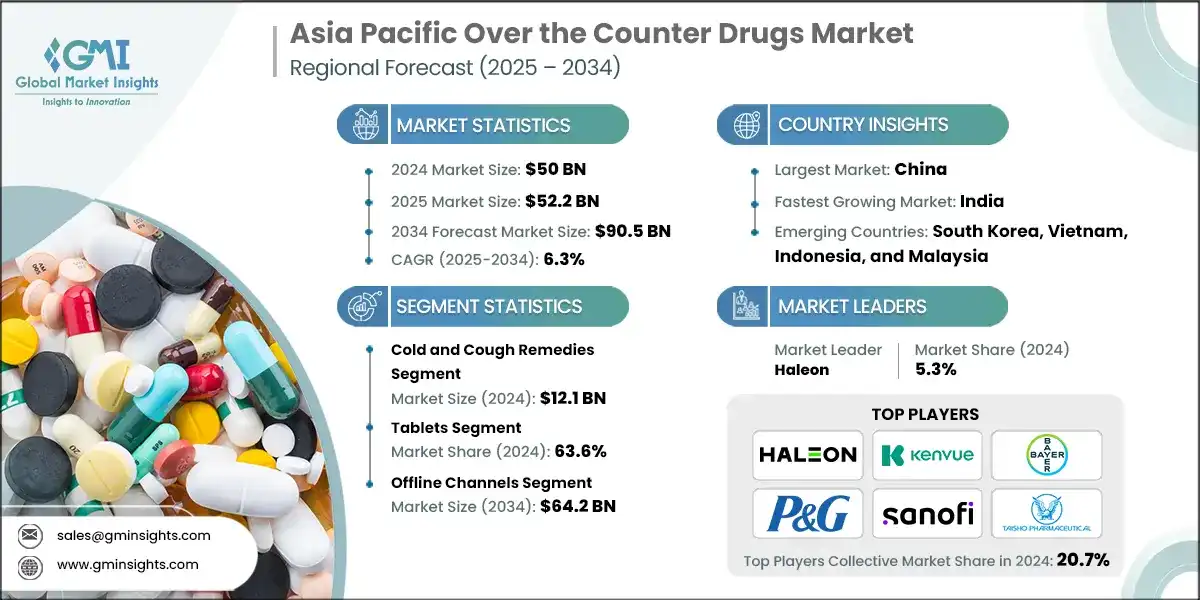
The Asia Pacific over the counter drugs market was estimated at USD 50 billion in 2024. The market is expected to grow from USD 52.2 billion in 2025 to USD 90.5 billion in 2034, growing at a CAGR of 6.3% from 2025 to 2034, according to the latest report published by Global Market Insights Inc. The growing aging population in the region is a key factor driving the demand for OTC drugs, as the geriatric population is more susceptible to chronic illnesses such as joint pain, respiratory ailments, and digestive issues, among others.
To get key market trends
For instance, Japan leads the world with over 29% of its population aged 65 and above. China, too, had more than 310 million people aged 60 and above in 2024, according to the State Council Information Office. This highlights a large population susceptible to chronic conditions requiring long-term treatment, thereby contributing to the adoption of OTC medications in the region.
Over the counter (OTC) drugs are medications that can be directly purchased from pharmacies without the need for a doctor’s prescription. These drugs are used for managing various conditions such as pain relief, allergy management, digestive health, dermatological issues, and dietary requirements. The Asia Pacific OTC drugs market is characterized by the presence of several global and domestic pharmaceutical players. Top 6 players such as Haleon, Kenvue, Bayer, Procter & Gamble Company, Sanofi, and Taisho Pharmaceuticals account for around 19 – 22% of market share. These players maintain a competitive edge owing to their strong visibility, brand recognition, robust distribution network, and diversified product portfolios. Further, these players are focusing on expanding their reach across the region through different marketing strategies, partnerships, and collaborations with retail pharmacies and increasing R&D expenditures to launch innovative formulations.
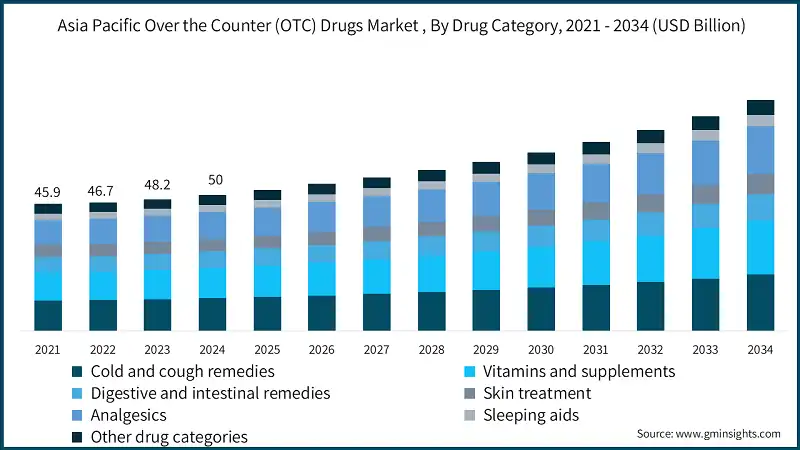
The Asia Pacific OTC drugs market witnessed stable growth from USD 45.9 billion in 2021 to USD 48.2 billion in 2023. A key trend during this period was the growing awareness of preventive healthcare, immunity building, and increased adoption of self-medication. This has drastically driven the demand for vitamins, pain relief medicines, cold and cough remedies, and digestive care medications, eliminating the need for hospital or clinic visits.
OTC drugs are non-prescription medications that can be purchased directly without a physician's prescription. These drugs are regulated by health authorities to ensure safety and efficacy. They are available as tablets, ointments, solutions, sprays, and other dosage forms that can be conveniently self-administered by patients, thus eliminating the need for a doctor’s prescription.
Asia Pacific Over the Counter (OTC) Drugs Market Report Attributes
| Key Takeaway | Details |
|---|---|
| Market Size & Growth | |
| Base Year | 2024 |
| Market Size in 2024 | USD 50 Billion |
| Market Size in 2025 | USD 52.2 Billion |
| Forecast Period 2025 - 2034 CAGR | 6.3% |
| Market Size in 2034 | USD 90.5 Billion |
| Key Market Trends | |
| Drivers | Impact |
| Growing geriatric population | The increasing elderly population fuels strong demand for OTC medications for chronic and preventive care. |
| Rising cultural inclination towards self-care and preventive health | Consumer preference for preventive care encourages higher OTC usage across vitamins, supplements, and immunity boosters. |
| Expansion of e-commerce and online pharmacies | E-commerce platforms improve accessibility, convenience, and product variety, accelerating OTC drug sales in the APAC region. |
| Pitfalls & Challenges | Impact |
| Risk of misuse and overconsumption | Unsupervised OTC use raises risks of misuse, prompting regulatory tightening and potential restrictions on sales. |
| Potential for adverse drug reactions | Side effects from improper or excessive consumption damage consumer trust, limiting sustained market penetration. |
| Opportunities: | Impact |
| Rapid growth of herbal and natural OTC products | Rising demand for herbal formulations will boost market growth, as consumers demand herbal and natural products. |
| Expanding women's health and specialty segments | Rising focus on reproductive and hormonal care drives demand for targeted OTC solutions and niche markets. |
| Market Leaders (2024) | |
| Market Leaders |
5.3% market share |
| Top Players |
Collective Market Share is 20.7% |
| Competitive Edge |
|
| Regional Insights | |
| Largest Market | China |
| Fastest Growing Market | India |
| Emerging Countries | South Korea, Vietnam, Indonesia, and Malaysia |
| Future outlook |
|
What are the growth opportunities in this market?
Asia Pacific Over the Counter Drugs Market Trends
- A key trend shaping the growth of the Asia Pacific OTC drugs industry is the increasing number of OTC drug approvals combined with the growing regulatory shift supporting these approvals.
- For instance, as per the China National Medical Products Administration (NMPA), as of September 2022, 5,041 OTC drugs, including 1,111 chemical drugs, 3,921 traditional Chinese medicines, and 9 biological products, were approved. This increasing number of OTC drug approvals accelerates their adoption, thereby boosting market growth.
- Another trend driving the growth of this market is the increasing reclassification of prescription drugs into OTC drug categories. For example, among the OTC drugs approved in 2022 by the China National Medical Products Administration (NMPA), 805 were earlier prescription drugs and were granted OTC status via Rx-to-OTC switch; additionally, among these 805 drugs, 192 have both prescription and OTC statuses.
- This shift from prescription to over-the-counter status is broadening consumer access, reducing financial burdens, and minimizing the pressure on healthcare systems by significantly expanding the range of medications available over the counter.
- Moreover, it also encourages pharmaceutical companies to invest in R&D to develop new delivery formulations such as gummies, softgels, and dissolvable strips, among others. These innovations foster the adoption of OTC drugs due to increased patient comfort and adherence to the treatment.
- Further, a well-established network of retail pharmacy chains such as Apollo Pharmacy, Watsons, and Guardian in countries like India, Singapore, and Hong Kong has improved access to OTC products.
- Moreover, beyond disease management, OTC drugs are increasingly adopted for wellness, energy, skin health, and fitness trends. Vitamins and supplements involved in boosting energy levels, dermatological care, and weight management are gaining traction among young and urban consumers. This growing shift towards holistic wellness and lifestyle further enhances the growth of the OTC drugs market in the region.
Asia Pacific Over the Counter Drugs Market Analysis
Learn more about the key segments shaping this market
Based on the drug category, the Asia Pacific over the counter drugs market is segmented into cold and cough remedies, vitamins and supplements, digestive and intestinal remedies, skin treatment, analgesics, sleeping aids, and other drug categories. The cold and cough remedies segment dominated the market and was valued at USD 12.1 billion in 2024, driven by the rising incidence rate of respiratory infections, such as cold, cough, flu, and other viral infections caused by pollutants or seasonal outbreaks.
- As per the Journal of The Association of Physicians of India, cough is the second common symptom seen by general practitioners, and its prevalence ranges from 5–10% in India. This growing concern ensures that the cold and cough remedies remain a necessity, thereby reinforcing their dominant share in the market.
- Additionally, the availability of OTC cold and cough remedies in a wide array of formulations such as syrups, lozenges, sprays, and tablets makes them suitable for various age groups. This versatility, therefore, drives regular purchases and adoption across diverse populations.
- The vitamins and supplements segment, on the other hand, is expected to witness high growth at a CAGR of 6.9% during the forecast period.
- Rapid urbanization and changing dietary habits have led to nutritional deficiencies, prompting consumers to supplement their nutrition. Thus, the widespread availability of OTC vitamins and supplements fulfils the growing demand of consumers and positions it as the fastest-growing segment in the Asia Pacific OTC drugs market.
Learn more about the key segments shaping this market
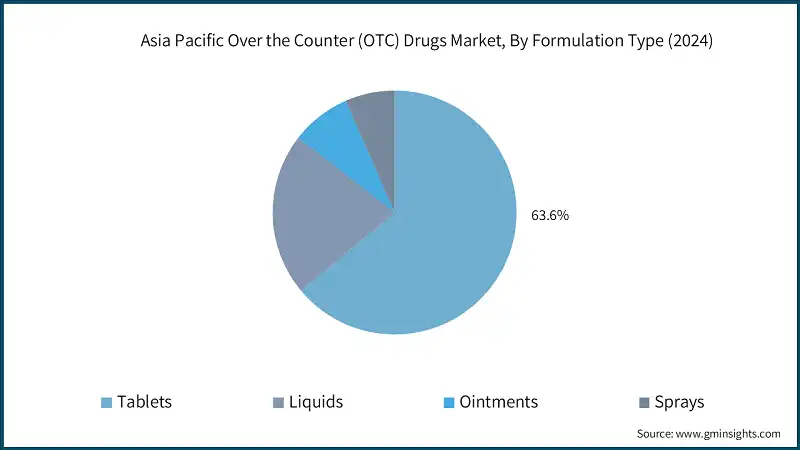
Based on the formulation type, the Asia Pacific OTC drugs market is classified into tablets, liquids, ointments, and sprays. In 2024, the tablets segment dominated the market with 63.6% of market share and is anticipated to grow at a 6.6% CAGR over the analysis period.
- The growth of the tablets segment is primarily due to its widespread consumer acceptance and convenience of use. Tablets are the most preferred formulation type across all age groups as they are easy to store and consume.
- Additionally, their longer shelf life compared to liquid and other formulations further reinforces their dominant position.
- Moreover, the availability of a wide range of OTC drugs such as pain relievers, antihistamines, vitamins, and supplements, as well as digestive health products in tablet form, further drives the growth of this segment.
- On the other hand, the liquids segment is anticipated to witness growth at a 6.1% CAGR during the forecast period, driven by their growing adoption among children and the elderly population with swallowing issues.
- Additionally, the growth of this segment can be attributed to the fast onset of action that liquids provide, as the active ingredients are already dissolved, leading to quick absorption in the body.
Based on the distribution channel, the Asia Pacific OTC drugs market is segmented into online channels and offline channels. The offline channels segment dominated the market in 2024 and is expected to reach USD 64.2 billion by 2034. The offline channels segment is sub-segmented into hospital pharmacies, retail pharmacies, and other offline channels. On the other hand, the online channels segment accounted for USD 13.6 billion in 2024, driven by the growing penetration of e-commerce in key markets such as China, India, Indonesia, and South Korea. Additionally, the COVID-19 pandemic has significantly accelerated the shift towards online purchase of healthcare products, including OTC drugs.
- The hospital pharmacies and retail pharmacies are the primary point of purchase for OTC drugs in Asia Pacific countries due to the trust consumers place in these channels.
- In countries such as China, India, and Japan, pharmacists often provide consultation for minor ailments such as cough, cold, fever, and digestive issues. Thus, this health advice from pharmacists further reinforces consumer reliance on offline channels.
- Additionally, the availability of various formulations and novel drugs further increases the accessibility of OTC drugs in offline channels.
Looking for region specific data?
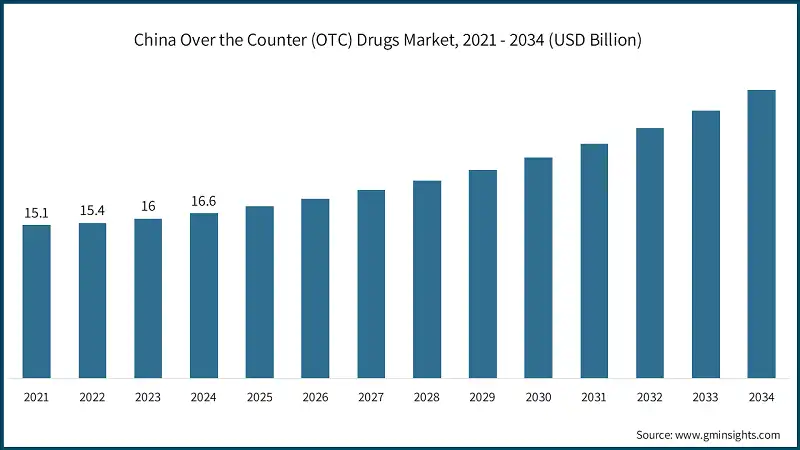
China Over the Counter Drugs Market China market was valued at USD 15.1 billion and USD 15.4 billion in 2021 and 2022, respectively. The market size reached USD 16.6 billion in 2024, growing from USD 16 billion in 2023. India market is anticipated to grow at a significant CAGR over the analysis period. Japan OTC drugs market is expanding rapidly in the overall Asia Pacific OTC drugs market with 6.4% CAGR during the forecast period. Indonesia is emerging as a high-growth market for OTC drugs within the Asia Pacific region, driven by a mix of demographic and economic factors. The Asia Pacific OTC drugs industry is characterized by intense competition, with participation from multinational global companies, regional players, and emerging brands. Top 6 players such as Haleon, Kenvue, Bayer, Procter & Gamble Company, Sanofi, and Taisho Pharmaceuticals account for ~20.7% of market share. These players focus on various strategies such as business expansion, mergers and acquisitions, collaborations, and novel product launches to consolidate their market presence. Many companies are also increasing investments in research and development to create safer, more effective OTC products with fewer side effects. Efforts to expand access in underserved regions and improve affordability further underscore the market’s shift toward global inclusivity, preventive care, and personalized wellness. Few of the prominent players operating in the Asia Pacific OTC drugs industry include: Haleon holds a leading position in the Asia Pacific OTC drugs market with a share of 5.3%, leveraging its strong portfolio of trusted brands across pain relief, respiratory health, digestive care, and vitamins and minerals. In 2024, the company reinforced its leadership by expanding its presence in high-growth regions such as Asia-Pacific and Latin America, while maintaining strong positions in North America and Europe. Kenvue holds a growing position in the Asia Pacific OTC drugs market, driven by its portfolio of iconic brands such as Tylenol, Motrin, and Zyrtec. The company also introduced next-generation OTC formulations, such as Tylenol+ with added immune support, and expanded its product line to include natural alternatives. Bayer is one of the leading players in the Asia Pacific OTC drugs market, driven by trusted brands and a commitment to advancing self-care. With a portfolio that includes widely recognized names such as Aspirin, Claritin, and Canesten, Bayer has positioned itself as a leader in key therapeutic areas, such as pain relief, allergy management, dermatology, digestive health, and cardiovascular support.India OTC Drugs Market
Japan Over the Counter Drugs Market
Asia Pacific Over the Counter Drugs Market Share
Asia Pacific Over the Counter Drugs Market Companies
Asia Pacific Over the Counter Drugs Industry News:
The Asia Pacific over the counter drugs market research report includes an in-depth coverage of the industry with estimates and forecast in terms of revenue in USD Million and from 2021 - 2034 for the following segments:
Market, By Drug Category
- Cold and cough remedies
- Vitamins and supplements
- Digestive and intestinal remedies
- Skin treatment
- Analgesics
- Sleeping aids
- Other drug categories
Market, By Formulation Type
- Tablets
- Liquids
- Ointments
- Sprays
Market, By Distribution Channel
- Online channels
- Offline channels
- Hospital pharmacies
- Retail pharmacies
- Other offline channels
The above information is provided for the following countries:
- China
- Japan
- India
- Australia
- South Korea
- Indonesia
- Vietnam
- Malaysia
- Thailand
- Rest of Asia Pacific
Frequently Asked Question(FAQ) :
What was the market size of the China OTC drugs market?
The China OTC drugs market was valued at USD 16.6 billion in 2024, growing from USD 16 billion in 2023.
Who are the key players in the Asia Pacific OTC drugs market?
Key players include Abbott Laboratories, Alinamin Pharmaceutical, Alkem Laboratories, Bayer, Cipla, Dr. Reddy’s Laboratories, Glenmark Pharmaceuticals, Haleon, Himalaya Wellness Company, Kenvue, Perrigo Company, and Piramal Pharma.
What was the valuation of the online channels segment in 2024?
The online channels segment was valued at USD 13.6 billion in 2024, driven by the growing penetration of e-commerce in countries like China, India, Indonesia, and South Korea, along with the accelerated shift to online healthcare product purchases during the COVID-19 pandemic.
Which distribution channel dominated the Asia Pacific OTC drugs market in 2024?
The offline channels segment dominated the market in 2024 and is projected to reach USD 64.2 billion by 2034. This segment includes hospital pharmacies, retail pharmacies, and other offline channels.
What is the projected size of the Asia Pacific OTC drugs market in 2025?
The market is expected to reach USD 52.2 billion in 2025.
How much revenue did the cold and cough remedies segment generate?
The cold and cough remedies segment generated USD 12.1 billion in 2024, driven by the increasing incidence of respiratory infections caused by pollutants and seasonal outbreaks.
What was the market share of the tablets segment in 2024?
The tablets segment held 63.6% of the market share in 2024 and is anticipated to grow at a CAGR of 6.6% during the forecast period.
What is the market size of the Asia Pacific OTC drugs in 2024?
The market size was USD 50 billion in 2024, driven by the growing aging population and increasing prevalence of chronic illnesses such as joint pain, respiratory ailments, and digestive issues.
What is the projected value of the Asia Pacific OTC drugs market by 2034?
The market is expected to reach USD 90.5 billion by 2034, growing at a CAGR of 6.3% from 2025 to 2034, supported by rising OTC drug approvals and regulatory shifts favoring these approvals.
Asia Pacific Over the Counter (OTC) Drugs Market Scope
Related Reports