Summary
Table of Content

Asia Pacific Motorcycles and Scooters Market
Get a free sample of this report
Form submitted successfully!
Error submitting form. Please try again.
Thank you!
Your inquiry has been received. Our team will reach out to you with the required details via email. To ensure that you don't miss their response, kindly remember to check your spam folder as well!
Request Sectional Data
Thank you!
Your inquiry has been received. Our team will reach out to you with the required details via email. To ensure that you don't miss their response, kindly remember to check your spam folder as well!
Form submitted successfully!
Error submitting form. Please try again.
Asia Pacific Motorcycles and Scooters Market Size
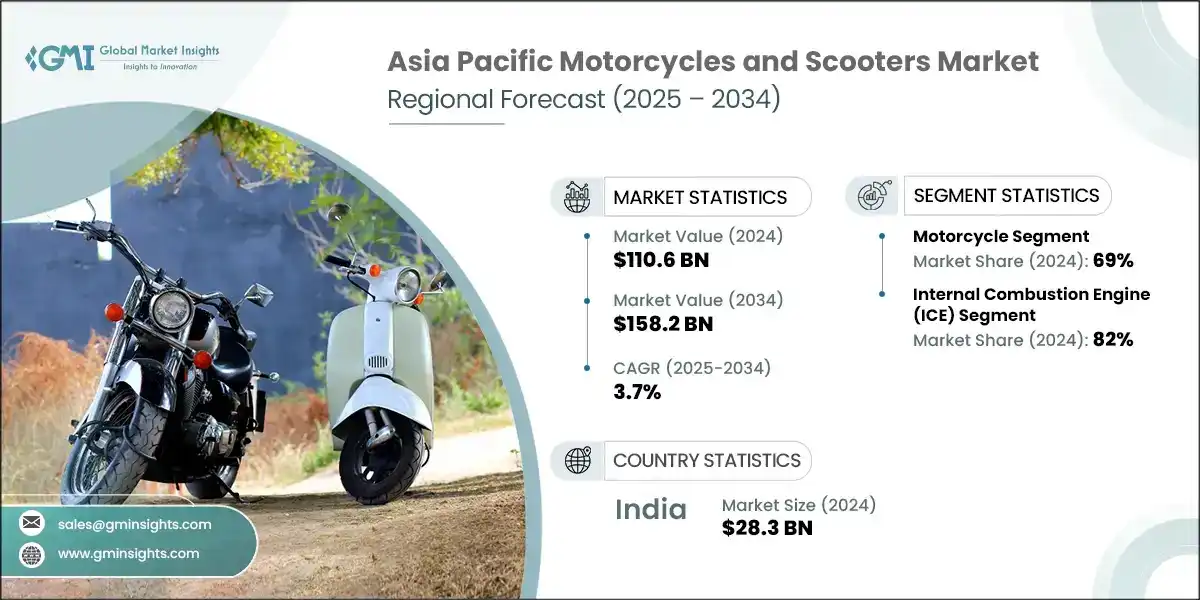
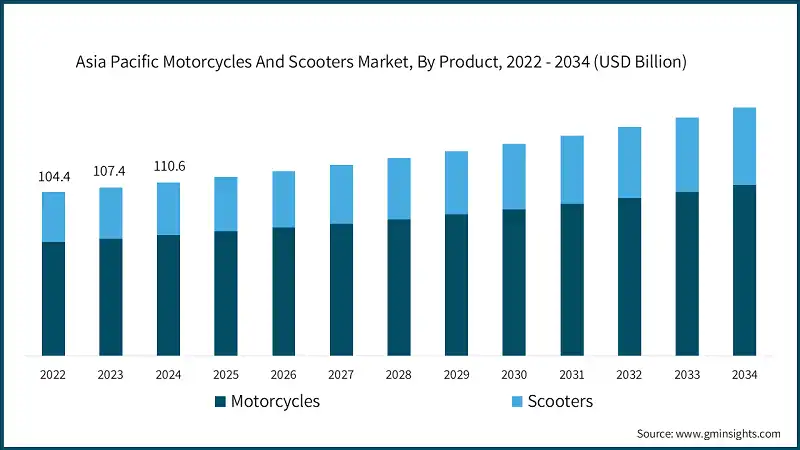
A comprehensive report by Global Market Insights Inc. projects the Asia Pacific motorcycles and scooters market size was estimated at USD 110.6 billion in 2024. The market is expected to grow from USD 114.1 billion in 2025 to USD 158.2 billion in 2034, at a CAGR of 3.7%.
Asia Pacific Motorcycles and Scooters Market Key Takeaways
Market Size & Growth
- 2024 Market Size: USD 110.6 Billion
- 2034 Forecast Market Size: USD 158.2 Billion
- CAGR (2025–2034): 3.7%
Key Market Drivers
- Urban congestion and rising fuel prices.
- Government incentives for electric two-wheelers.
- Shift toward sustainable and green mobility.
- Growing demand for smart, connected mobility.
- Rising popularity of leisure and adventure motorcycling.
- Expansion of two-wheeler sharing platforms and delivery services.
Challenges
- Rider safety concerns in high-traffic zones.
- High initial cost of electric two-wheelers.
Opportunity
- Expansion of electric two-wheeler segment.
- Integration of IoT and smart connectivity.
- Growth of micromobility and shared mobility platforms.
- Tourism and recreational riding trends.
Key Players
- Market Leader: Honda Motor led with over 13% market share in 2024.
- Leading Players: Top 5 players in this market include Honda Motor, BMW Motorrad, Hero MotoCorp, Yamaha Motor, TVS Motor, which collectively held a market share of 65% in 2024.
Get Market Insights & Growth Opportunities
- The Asia-Pacific motorcycles and scooters market is experiencing robust growth driven by surging urbanization, rising middle-class populations, and the increasing need for affordable, fuel-efficient personal mobility solutions. Motorcycles and scooters are integral to daily transportation in many regional economies, with demand further fueled by congested urban environments, improving road infrastructure, and the growing popularity of two-wheelers for both commuting and leisure. The transition toward electric scooters and motorcycles is accelerating, supported by environmental concerns, government incentives, and advancing battery technologies.
- Regulatory policies and modernization initiatives across Asia-Pacific are shaping the market’s future. For instance, in March 2025, India introduced updated Bharat Stage (BS) emission norms for two-wheelers, pushing manufacturers toward cleaner, low-emission engines and electric drivetrains.
- Similarly, China’s continued subsidies for electric two-wheelers and stricter licensing regulations for high-performance motorcycles are influencing product portfolios and consumer choices. Leading manufacturers are also focusing on integrating smart connectivity, safety features, and advanced telematics to appeal to tech-savvy riders.
- The COVID-19 pandemic had a mixed impact on the motorcycles and scooters market. While initial lockdowns in 2020 caused production delays and sales slowdowns, the sector rebounded strongly from 2021 as consumers sought cost-effective, personal, and socially distanced transport options over shared mobility services. E-commerce and digital showrooms emerged as essential sales channels, with brands investing heavily in online retail platforms and doorstep delivery services to adapt to shifting buyer preferences.
- Value-added offerings, including extended warranties, low-interest financing, maintenance subscriptions, and branded riding gear, are becoming major competitive differentiators. In mid-2025, Honda launched a region-wide subscription model in Southeast Asia, bundling vehicle leasing, periodic servicing, and roadside assistance into a single monthly fee reflecting a broader industry trend toward creating comprehensive ownership solutions that build brand loyalty.
- India and China dominate the Asia-Pacific motorcycles and scooters market in both production and consumption, thanks to their large populations, thriving domestic manufacturing bases, and supportive policy frameworks. Meanwhile, Southeast Asian countries such as Indonesia, Vietnam, and Thailand are emerging as high-growth markets, propelled by rapid urban expansion and increasing per capita incomes.
To get key market trends
Asia Pacific Motorcycles and Scooters Market Trends
- The Asia-Pacific motorcycles and scooters industry is undergoing significant transformation driven by electrification, digital integration, and evolving urban mobility preferences. Consumers in countries such as India, China, and Indonesia are increasingly adopting electric scooters and motorcycles for daily commuting and short-distance travel. Manufacturers are responding with lightweight, battery-powered models featuring lithium-ion technology, regenerative braking, and smartphone connectivity, reshaping expectations around efficiency, sustainability, and smart riding features.
- For instances, in February 2024, Hero Electric launched its latest range of connected electric scooters across India, featuring real-time diagnostics, GPS tracking, and app-based ride customization. This launch highlights Hero’s commitment to expanding its electric portfolio and enhancing rider engagement through digital services.
- Digital sales channels and direct-to-consumer platforms are rapidly expanding in the Asia-Pacific region, especially in Tier-2 and Tier-3 cities across India, Vietnam, and Thailand. OEMs are investing heavily in virtual showrooms, online bookings, remote test rides, and instant financing approvals to improve accessibility and convenience for younger, tech-savvy customers.
- For instance, in May 2024, Yamaha introduced its ‘Yamaha Connect’ mobile platform in Indonesia and Vietnam, offering online reservations, doorstep test rides, integrated service scheduling, and flexible financing options tailored for urban millennials and Gen Z consumers.
- As urban congestion worsens and last-mile delivery grows, demand for lightweight scooters and motorcycles with electric powertrains is surging. Countries like Singapore, Malaysia, and the Philippines are witnessing increased government incentives to support electric vehicle adoption, further accelerating market growth.
- In March 2024, TVS Motor Company partnered with several logistics firms across Southeast Asia to deploy electric scooter fleets optimized for urban delivery, featuring telematics-based fleet management and battery-swapping technology. This collaboration targets sustainable urban logistics and highlights growing B2B opportunities in the region.
- Customization and personalization are becoming key aftermarket trends in Asia-Pacific, with riders seeking tailored accessories, smart helmet integration, performance upgrades, and connected dashboard features. Online marketplaces and certified dealer programs are enhancing consumer access to these products, especially in urban hubs like Mumbai, Jakarta, and Ho Chi Minh City.
Asia Pacific Motorcycles and Scooters Market Analysis
Learn more about the key segments shaping this market
Based on product, the Asia Pacific motorcycles and scooters market is divided into motorcycles and scooters. The motorcycle segment dominated the market, accounting for around 69% in 2024 and is expected to grow at a CAGR of over 3.5% through 2025 to 2034.
- Motorcycles dominate the Asia Pacific motorcycles and scooters market, driven by strong demand across key countries such as India, China, Indonesia, and Thailand. These vehicles are preferred for their higher engine capacity, better performance, and suitability for long-distance commuting compared to scooters.
- Motorcycles appeal to a wide consumer base including daily commuters, delivery fleets, and motorcycle enthusiasts seeking both practicality and style. For instance, in January 2025, Hero MotoCorp launched the XPulse 300 electric variant in India, featuring advanced battery technology and connectivity features, targeting young urban riders and adventure enthusiasts.
- OEMs in the motorcycle segment are continuously innovating with advanced technologies such as fuel injection systems, ABS, digital instrument clusters, and connectivity features to enhance rider safety and convenience. Additionally, there is a rising focus on electric motorcycles as governments push for greener transportation and consumers become more eco-conscious. For example, in early 2025, several Asia Pacific manufacturers introduced new electric motorcycle models with extended range and fast charging capabilities, targeting urban riders and delivery services.
- The scooter segment, while smaller, is growing steadily due to its affordability, ease of use, and compact design, making it especially popular among female riders and first-time buyers in densely populated cities. Brands like Honda and TVS have expanded their scooter portfolios with stylish, fuel-efficient, and electric variants to capture this expanding market. Scooters remain the preferred choice for short-distance travel, last-mile connectivity, and light cargo transport in the region.
Learn more about the key segments shaping this market
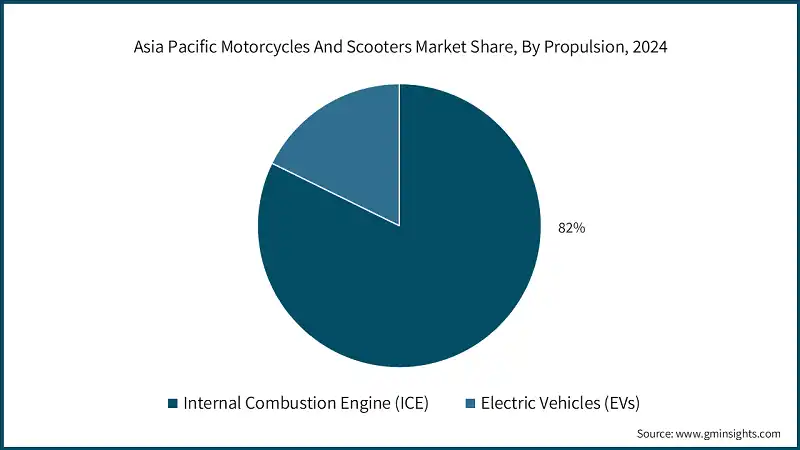
Based on propulsion, the Asia Pacific motorcycles and scooters market is segmented into internal combustion engine (ICE) and electric vehicles (EVs). The internal combustion engine (ICE) segment dominates the market with 82% share in 2024, and the segment is expected to grow at a CAGR of over 4% from 2025 to 2034.
- The widespread availability of affordable ICE motorcycles and scooters, coupled with established fuel infrastructure, continues to drive strong demand across countries such as India, Indonesia, and Vietnam. ICE vehicles are favored for their longer range, lower upfront cost, and quick refueling convenience, making them the preferred choice for daily commuters, delivery services, and rural consumers.
- However, the electric vehicle segment is rapidly gaining traction due to increasing environmental regulations, government incentives, and growing consumer awareness about sustainability. Several manufacturers have introduced new electric two-wheelers with improved battery life and performance to capture this emerging market. For instance, in October 2024, Hero MotoCorp launched an upgraded version of its electric scooter, the Vida V1, featuring fast charging and smartphone connectivity, targeting urban riders in India. Similarly, VinFast expanded its electric motorcycle lineup in early 2025, increasing exports to ASEAN countries and emphasizing affordable green mobility.
- Despite the growth of EVs, the ICE segment’s dominance remains firm, supported by robust dealer networks, wide service availability, and the preference for traditional fuel-powered vehicles in semi-urban and rural regions. OEMs continue to innovate within the ICE space, integrating fuel-efficient engines, ABS, and digital displays to enhance rider experience and comply with stricter emission norms.
Based on engine displacement, the market is segmented into Under 250cc, 250cc–500cc, 500cc–1000cc and above 1000cc. The 500cc–1000cc segment is expected to dominate the market.
- This segment appeals to riders seeking a balance of power, performance, and versatility suitable for both urban commuting and occasional touring. The growing middle-class population and increasing disposable incomes across countries such as India, China, and Thailand are driving demand for motorcycles in this displacement range, which offers superior acceleration and highway capability compared to smaller bikes.
- Manufacturers are responding with a range of models that combine advanced engine technologies, rider comfort, and premium styling to capture this lucrative segment. For example, in January 2025, Kawasaki launched its Ninja 650 in Southeast Asia, offering a sporty design and reliable performance that caters to both new and experienced riders. Similarly, Royal Enfield expanded its Himalayan lineup with the 650cc Interceptor variant in 2024, attracting adventure touring enthusiasts.
- While the under 250cc segment remains popular for budget-conscious urban commuters, and the above 1000cc segment appeals to niche luxury and performance markets, the 500cc–1000cc category is positioned for significant growth due to its versatility and wider market acceptance. OEMs are also increasingly introducing mid-range motorcycles with ABS, ride modes, and connectivity features to enhance safety and rider engagement in this displacement category.
Based on distribution channel, the market is segmented into offline and online sales. The offline segment is expected to dominate the market.
- Traditional dealership networks remain the primary point of purchase for most consumers, especially in emerging markets like India, Indonesia, and Vietnam, where customers prefer physical inspection, test rides, and personalized after-sales service. Established brick-and-mortar showrooms offer extensive model selections, financing options, and maintenance support, which build strong customer trust and loyalty.
- The online sales channel is gradually gaining traction, driven by increasing internet penetration, digital payment adoption, and changing consumer behavior, particularly among younger, tech-savvy buyers in urban areas. Leading OEMs and e-commerce platforms have begun offering online booking, home delivery, and virtual showrooms to enhance convenience and capture evolving customer preferences.
- For instance, in 2024, TVS Motor Company launched an online platform in India allowing customers to configure and book motorcycles with doorstep delivery. Similarly, Honda expanded its digital sales initiatives in Southeast Asia, integrating augmented reality tools to help buyers explore products remotely.
Based on end-use, the market is segmented into personal users and commercial users. The personal segment is expected to dominate the market.
- The rising need for affordable and convenient personal mobility in densely populated urban and semi-urban areas is driving strong demand among individual consumers. Motorcycles and scooters serve as the preferred choice for daily commuting, offering fuel efficiency, ease of navigation through traffic, and lower ownership costs compared to cars. Increasing disposable incomes, urbanization, and shifting lifestyles toward personal independence further bolster the preference for personal vehicles.
- The personal segment also benefits from a diverse consumer base, including students, working professionals, and small business owners who use two-wheelers for everyday travel. For instance, countries like India, Indonesia, and Vietnam have witnessed steady growth in personal motorcycle ownership due to expanding middle-class populations and improved road infrastructure. Manufacturers cater to this segment by offering a wide range of models tailored to different age groups, genders, and riding preferences, including stylish scooters for young women and powerful motorcycles for enthusiasts.
- While the commercial user segment, encompassing delivery services, logistics, and fleet operators, is growing especially with the rise of e-commerce and last-mile delivery in the region it remains secondary to personal usage in terms of volume. However, OEMs are increasingly launching specialized motorcycles and scooters designed for commercial applications, featuring higher load capacities, durability, and low maintenance costs. For instance, in 2024, Bajaj Auto introduced the RE Compact cargo scooter in India, targeting small-scale commercial users and delivery fleets.
Looking for region specific data?
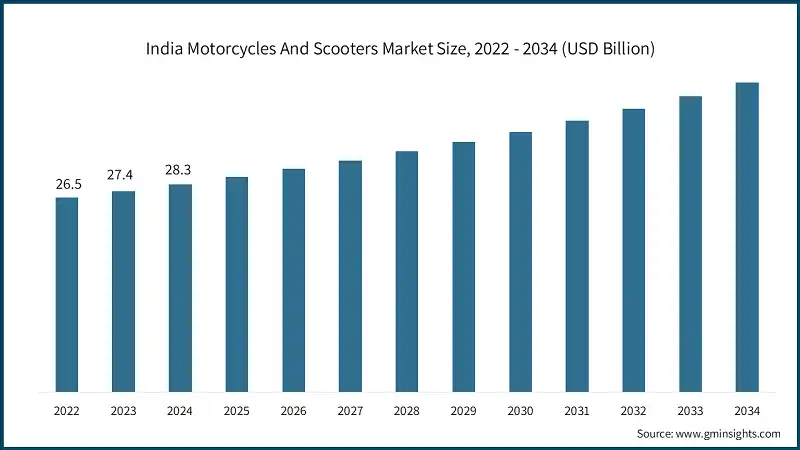
India contributes to Asia Pacific motorcycles and scooters market with around 25% market share and generated around USD 28.3 billion revenue in 2024.
- India is the largest market in the Asia Pacific region for motorcycles and scooters, driven by a vast population, increasing urbanization, and the growing demand for affordable and efficient personal mobility solutions. The country’s extensive two-wheeler culture, supported by favorable road infrastructure and a price-sensitive consumer base, has made motorcycles and scooters the most preferred mode of transport for millions across urban and rural areas.
- India’s domestic market is dominated by major manufacturers such as Hero MotoCorp, Bajaj Auto, and TVS Motor Company, which have established strong brand loyalty through affordable, fuel-efficient models and extensive dealer and service networks. The market is characterized by a wide range of engine displacement segments, catering to diverse consumer needs from daily commuting to recreational riding.
- For instance, according to the Society of Indian Automobile Manufacturers (SIAM) in 2024, India registered over 17 million two-wheeler sales, maintaining its position as the world’s largest two-wheeler market and contributing more than 35% to the Asia Pacific motorcycles and scooters market. This volume underscores India’s critical role in driving regional demand and shaping industry trends.
- Government initiatives such as the FAME II scheme and growing investments in electric vehicle infrastructure are accelerating the adoption of electric motorcycles and scooters, positioning India as a future leader in sustainable two-wheeler mobility. The country also hosts numerous motorcycle expos, racing events, and riding clubs that foster strong community engagement and stimulate demand across various segments.
The motorcycles and scooters market in China is expected to experience significant and promising growth from 2025 to 2034.
- The scooters and motorcycles market in China is expected to experience significant and promising growth, driven by rising urbanization, increasing disposable incomes, and government support for green mobility solutions. Despite historically being dominated by electric two-wheelers due to stringent emission norms and urban congestion, the market is now witnessing renewed interest in both electric and conventional motorcycles.
- China’s domestic market is home to leading manufacturers such as Yadea, Niu Technologies, and Loncin, which are innovating rapidly with advanced battery technologies, smart connectivity features, and stylish designs to attract a broad consumer base. The growing middle class and young urban professionals are increasingly opting for electric scooters and motorcycles as practical, eco-friendly alternatives for daily commuting.
- For instance, in 2024, the China Association of Automobile Manufacturers (CAAM) reported a 20% year-on-year increase in electric two-wheeler sales, underscoring the rapid adoption of clean energy vehicles. This growth is supported by expanding charging infrastructure and government subsidies, which continue to lower barriers for consumers.
The motorcycles and scooters market in Japan is expected to experience significant and promising growth from 2025 to 2034.
- The motorcycles & scooters market in Japan is expected to experience significant and promising growth, supported by rising demand for premium, technologically advanced two-wheelers and a renewed interest in personal mobility. Japan’s mature market is characterized by consumers who value high performance, safety features, and innovative designs, driving demand for both traditional and electric motorcycles.
- Key domestic manufacturers such as Honda, Yamaha, Suzuki, and Kawasaki continue to lead the market by integrating cutting-edge technologies like advanced rider-assistance systems, lightweight materials, and connectivity solutions into their product lines. These innovations cater to urban commuters as well as enthusiasts seeking sporty and touring motorcycles.
- For instance, in 2024, the Japan Automobile Manufacturers Association (JAMA) reported a steady increase in motorcycle sales, highlighting growing consumer interest in electric scooters and hybrid motorcycles. Government incentives promoting clean energy vehicles and improvements in charging infrastructure are further boosting the adoption of electric two-wheelers.
Asia Pacific Motorcycles and Scooters Market Share
- The top 7 companies in the Asia Pacific motorcycles and scooters industry are Honda Motor, Hero MotoCorp, Yamaha Motor, TVS Motor, Bajaj Auto, Yadea Group and Suzuki Motor contributing around 75% of the market in 2024.
- Honda Motor is a global leader in motorcycles and scooters, renowned for its innovation, reliability, and extensive market presence across Asia-Pacific, Europe, and Latin America. Honda continues to expand its electric and hybrid two-wheeler portfolio while maintaining strong production and R&D capabilities worldwide.
- For instance, in March 2025, Honda launched its new hybrid scooter model, the PCX Hybrid, in Japan and Southeast Asia, featuring seamless fuel-electric powertrain integration and smartphone connectivity aimed at eco-conscious urban commuters.
- Hero MotoCorp is India’s largest two-wheeler manufacturer and a dominant player in the Asia Pacific motorcycles & scooters market. Known for affordable, fuel-efficient motorcycles and scooters, Hero has a vast distribution network and is accelerating its push into electric mobility.
- For instance, in January 2025, Hero MotoCorp introduced the Vida V2 electric scooter in India and select Southeast Asian markets, equipped with fast charging, GPS tracking, and app-based performance monitoring targeted at young urban riders.
- Yamaha Motor is a major Japanese manufacturer with a diverse portfolio including motorcycles, scooters, and off-road vehicles. Yamaha is investing heavily in electric mobility and smart vehicle technologies to meet the growing demand for sustainable transport solutions.
- For instance, in February 2025, Yamaha launched the E-Vino 2.0 electric scooter in Taiwan and Japan, featuring swappable batteries and integrated ride analytics for urban commuters and younger riders.
- TVS Motor is a prominent Indian manufacturer known for its motorcycles, scooters, and mopeds, with a growing focus on electric vehicles. TVS boasts a strong presence in domestic and international markets, emphasizing innovation and affordable mobility.
- For instance, in December 2024, TVS launched the iQube Electric scooter in India and expanded its availability to select Southeast Asian countries, offering fast charging, connected features, and enhanced range for daily urban use.
- Bajaj Auto is a leading Indian two-wheeler manufacturer with a significant presence in motorcycles and three-wheelers across Asia, Africa, and Latin America. Bajaj focuses on performance, durability, and increasingly on electric and hybrid vehicle development.
- For instance, in February 2025, Bajaj Auto launched the Chetak Electric scooter in India with improved battery technology and app-based controls, aimed at urban commuters seeking sustainable alternatives.
- Yadea Group is a Chinese leader in electric two-wheelers, dominating the electric scooter and motorcycle market in China and expanding aggressively across global markets. Yadea is known for innovative battery management systems and smart connectivity. For instance, in March 2025, Yadea launched the G5 electric motorcycle in Southeast Asia and Europe, featuring a high-capacity battery, fast charging, and integrated GPS and anti-theft systems targeted at urban riders.
- Suzuki Motor is a well-established Japanese manufacturer offering motorcycles and scooters with a focus on performance, reliability, and innovation. Suzuki continues to enhance its electric vehicle offerings while maintaining strong sales in conventional two-wheelers. For instance, in April 2025, Suzuki introduced the Burgman Street electric scooter in India and Japan, featuring a lightweight design, extended battery range, and smartphone integration for city commuters.
Asia Pacific Motorcycles and Scooters Market Companies
Major players operating in the Asia Pacific motorcycles and scooters industry are:
- Bajaj Auto
- Hero MotoCorp
- Honda Motor
- Kawasaki
- KTM AG
- Royal Enfield
- Suzuki Motor
- TVS Motor
- Yadea Group
- Yamaha Motor
- Hero MotoCorp, Yamaha Motor, and TVS Motor have aggressively gained market share in the Asia Pacific motorcycles and scooters market through strategic investments in electric mobility, product diversification, and regional expansion.
- Hero MotoCorp, as India’s largest two-wheeler manufacturer, leverages its extensive dealer network and affordable electric scooter portfolio to capture urban and rural segments, with models like the Vida V2 targeting young, eco-conscious riders across South Asia. The company’s continued focus on low-cost EVs and digital sales platforms supports rapid adoption in emerging markets.
- Yamaha Motor has adopted a multi-market approach centered on Asia Pacific, with strong manufacturing hubs in Thailand, Vietnam, and India enabling agile responses to local demand.
- Yamaha blends traditional performance motorcycles with smart electric scooters like the E-Vino 2.0, targeting younger urban consumers and expanding into entry-level power sports vehicles. Its investments in connectivity and battery technology solidify its position as a leader in both conventional and electric two-wheelers.
- TVS Motor has strengthened its market position by accelerating its electric vehicle strategy, notably with the iQube electric scooter, while expanding export operations across Southeast Asia. Combining affordable pricing, connected vehicle features, and enhanced battery performance, TVS targets urban commuters and last-mile delivery sectors. Its growing R&D investment and digital sales initiatives complement a robust portfolio of ICE motorcycles and scooters, ensuring broad market coverage.
Asia Pacific Motorcycles and Scooters Market Report Attributes
| Key Takeaway | Details |
|---|---|
| Market Size & Growth | |
| Base Year | 2024 |
| Market Size in 2024 | USD 110.6 Billion |
| Forecast Period 2025 - 2034 CAGR | 3.7% |
| Market Size in 2034 | USD 158.2 Billion |
| Key Market Trends | |
| Drivers | Impact |
| Urban congestion and rising fuel prices | Encourages adoption of compact, fuel-efficient, and low-emission two-wheelers for daily commuting. |
| Government incentives for electric two-wheelers | Supports market penetration of e-scooters and e-motorcycles through subsidies, tax benefits, and reduced registration costs. |
| Shift toward sustainable and green mobility | Accelerates integration of intelligent software, sensors, and over-the-air update capabilities. |
| Growing demand for smart, connected mobility | Drives integration of Bluetooth connectivity, navigation, ride analytics, and smartphone-based diagnostics in two-wheelers. |
| Rising popularity of leisure and adventure motorcycling | Expands demand for high-performance, touring, and off-road motorcycles with advanced comfort and safety features. |
| Expansion of two-wheeler sharing platforms and delivery services | Boosts fleet sales and accelerate demand for lightweight, durable, and connected scooters for last-mile delivery and mobility-as-a-service (MaaS). |
| Pitfalls & Challenges | Impact |
| Rider safety concerns in high-traffic zones | Could limit adoption among new or inexperienced users, particularly for scooters used in dense city environments. |
| High initial cost of electric two-wheelers | May deter price-sensitive consumers, particularly in southern and eastern Asia Pacific markets. |
| Opportunities: | Impact |
| Expansion of electric two-wheeler segment | Opens new markets and boosts OEM innovation in lightweight EV design, powertrain efficiency, and urban mobility solutions. |
| Integration of IoT and smart connectivity | Real-time diagnostics, remote updates, and app-based controls elevate the rider experience, setting the brand apart. |
| Growth of micromobility and shared mobility platforms | Last-mile and urban transit solutions are driving a surge in demand for scooters and low-speed motorcycles. |
| Tourism and recreational riding trends | Boosts the demand for touring, adventure, and performance motorcycles along Asia Pacifics picturesque routes and travel hotspots. |
| Market Leaders (2024) | |
| Market Leaders |
13% market share |
| Top Players |
Collective market share in 2024 is 65% |
| Competitive Edge |
|
| Regional Insights | |
| Largest Market | India |
| Fastest Growing Market | Vietnam, Indonesia |
| Emerging Country | Philippines |
| Future Outlook |
|
What are the growth opportunities in this market?
Asia Pacific Motorcycles and Scooters Industry News
- In July 2025, TVS Motor launched the updated iQube electric scooter in India and select Southeast Asian markets, featuring enhanced battery capacity, faster charging, and integrated smartphone connectivity tailored for urban commuters.
- In May 2025, Yamaha Motor announced the rollout of its E-Vino 3.0 electric scooter in Japan and Taiwan, incorporating swappable batteries and AI-powered ride analytics aimed at younger riders and city dwellers.
- In April 2025, Hero MotoCorp expanded its Vida electric scooter lineup to include the Vida V2 Pro in India and Vietnam, focusing on increased range and app-based vehicle diagnostics, strengthening its position in the Asia Pacific EV segment.
- In March 2025, Suzuki Motor unveiled the Burgman Street electric scooter at the Tokyo Motor Show, highlighting a lightweight design and extended battery life targeted at urban professionals in Japan and Southeast Asia.
- In February 2025, Bajaj Auto announced a strategic partnership with Indian e-commerce platforms to deploy Chetak Electric scooters for last-mile delivery services across metropolitan cities in India, supporting sustainable urban logistics.
- In January 2025, Yadea Group expanded its electric scooter presence into Australia and New Zealand with the launch of the G5 model, featuring cloud-based IoT connectivity and fast charging infrastructure.
- In December 2024, Honda Motor strengthened its electric two-wheeler portfolio in Southeast Asia by introducing the PCX Electric scooter, equipped with smartphone integration and regenerative braking, aimed at eco-conscious urban commuters.
The Asia Pacific motorcycles and scooters Market research report includes in-depth coverage of the industry with estimates & forecasts in terms of revenue ($ Mn) and shipment (Units) from 2021 to 2034, for the following segments:
Market, By Product
- Motorcycles
- Cruiser motorcycles
- Sport motorcycles
- Touring motorcycles
- Standard/naked motorcycles
- Adventure/dual-sport motorcycles
- Off-road/dirt motorcycles
- Scooters
- Traditional gasoline scooters
- Electric scooters
- Maxi scooters
- Moped-style scooters
Market, By Propulsion
- Internal combustion engine (ICE)
- Electric vehicles (EVs)
Market, By Engine Displacement
- Under 250cc
- 250cc–500cc
- 500cc–1000cc
- Above 1000cc
Market, By Distribution Channel
- Offline
- Online
Market, By End Use
- Personal
- Commercial
The above information is provided for the following regions and countries:
- China
- India
- Japan
- South Korea
- ANZ
- Vietnam
- Indonesia
- Thailand
- Philippines
- Singapore
- Rest of Asia Pacific
Frequently Asked Question(FAQ) :
What is the market size of the Asia Pacific motorcycles and scooters in 2024?
The market size was estimated at USD 110.6 billion in 2024, growing at a CAGR of 3.7% through 2034. The market growth is driven by urbanization, a growing middle class, and demand for affordable, fuel-efficient mobility solutions.
What is the projected value of the Asia Pacific motorcycles and scooters market by 2034?
The market is poised to reach USD 158.2 billion by 2034, supported by the transition to electric vehicles and advancements in battery technology.
What was the market share of the motorcycle segment in 2024?
The motorcycle segment dominated the market with a 69% share in 2024 and is expected to grow at a CAGR of over 3.5% from 2025 to 2034.
What was the valuation of the internal combustion engine (ICE) segment in 2024?
The ICE segment accounted for 82% of the market share in 2024 and is projected to grow at a CAGR of over 4% from 2025 to 2034.
What is the contribution of India to the Asia Pacific motorcycles and scooters sector?
India contributed approximately 25% of the market share, generating around USD 28.3 billion in revenue in 2024.
What are the key trends in the Asia Pacific motorcycles and scooters market?
Trends include electric two-wheelers, digital integration, direct sales, EV incentives, and rising demand for customization.
Who are the major players in the Asia Pacific motorcycles and scooters industry?
Major players include Bajaj Auto, Hero MotoCorp, Honda Motor, Kawasaki, KTM AG, Royal Enfield, Suzuki Motor, TVS Motor, Yadea Group, and Yamaha Motor.
Asia Pacific Motorcycles and Scooters Market Scope
Related Reports