Summary
Table of Content

Asia Pacific Kitchenware Market
Get a free sample of this report
Form submitted successfully!
Error submitting form. Please try again.
Thank you!
Your inquiry has been received. Our team will reach out to you with the required details via email. To ensure that you don't miss their response, kindly remember to check your spam folder as well!
Request Sectional Data
Thank you!
Your inquiry has been received. Our team will reach out to you with the required details via email. To ensure that you don't miss their response, kindly remember to check your spam folder as well!
Form submitted successfully!
Error submitting form. Please try again.
Asia Pacific Kitchenware Market Size
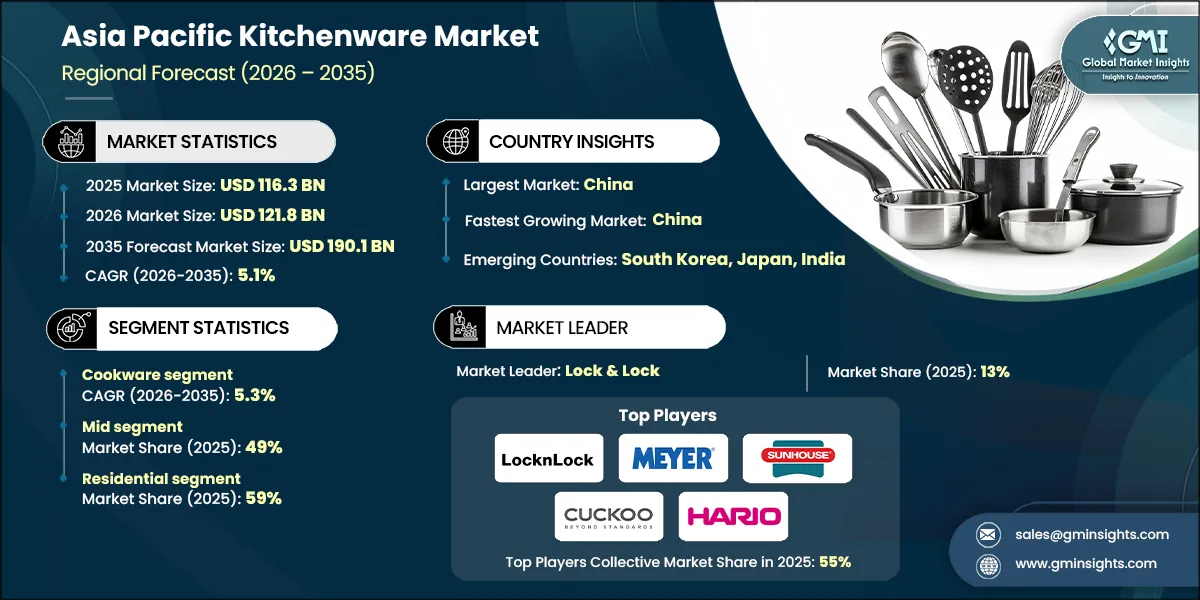
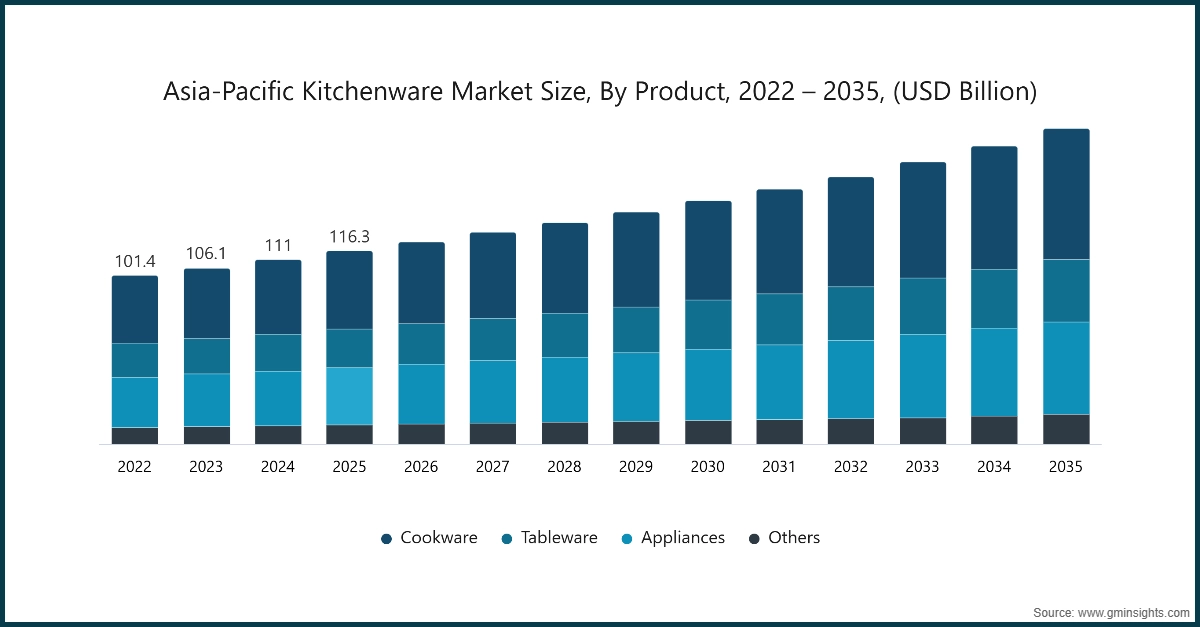
The Asia Pacific kitchenware market was estimated at USD 116.3 billion in 2025. The market is expected to grow from USD 121.8 billion in 2026 to USD 190.1 billion in 2035, at a CAGR of 5.1% according to latest report published by Global Market Insights Inc.
Asia Pacific Kitchenware Market Key Takeaways
Market Size & Growth
- 2025 Market Size: USD 116.3 Billion
- 2026 Market Size: USD 121.8 Billion
- 2035 Forecast Market Size: USD 190.1 Billion
- CAGR (2026–2035): 5.1%
Regional Dominance
- Largest Market: China
- Fastest Growing Country: China
Key Market Drivers
- Urbanization & rising disposable income.
- Growth of home cooking & health focused lifestyles.
- Increased adoption of non stick, induction compatible, ceramic-coated, and stainless-steel cookware.
Challenges
- Raw material price volatility.
- Price sensitivity in developing markets.
Opportunity
- E‑commerce & omnichannel retail expansion.
- Online platforms enable rapid penetration of branded and private‑label kitchenware across Tier‑2 and Tier‑3 cities.
Key Players
- Market Leader: Lock & Lock led with over 13% market share in 2025.
- Leading Players: Top 5 players in this market include Lock & Lock, Meyer Thailand, Sunhouse Group, Cuckoo Electronics, HARIO, which collectively held a market share of 55% in 2025.
Get Market Insights & Growth Opportunities
The rapid change in regional manufacturing capacity, innovation in sustainable materials, and diversification of products to suit modern cooking practices and needs are further strengthening the Asia Pacific kitchenware market. Major global and regional brands such as Tefal, Meyer, Tramontina, Hawkins, Prestige, Supor, Cello, LocknLock, and other private labels are diversifying their product lines with non-stick cookware, stainless steel utensils, ceramic-coated cookware, bakeware, food storage products, and eco-friendly kitchen tools. This regional market is primarily fueled by the fast pace of urbanization, increasing disposable incomes, and a growing trend towards home-cooked meals and healthy eating in rapidly growing economies.
At the same time, there is a clear trend towards safe, durable, and eco-friendly kitchenware, which is a result of increased consumer awareness about food safety and sustainability. The growing demand for PFOA-free non-stick coatings, food-grade stainless steel, silicone, glass, and bamboo-based kitchen tools indicates a shift away from conventional low-cost plastics and poor-quality metal alloys. Although traditional materials like stainless steel and aluminum still hold a major market share, Asia Pacific kitchenware manufacturers are gradually integrating recyclable, biodegradable, and long-lasting materials to meet the growing food safety regulations and sustainability requirements set by governments and organized retailers.
The growing reach of digital food content, home chefs, and healthy diets has further fueled the demand for specialized cookware such as induction-compatible cookware, multi-functional pans, air-fryer accessories, and microwave-safe storage containers. In addition, the “home-first” consumption pattern that gained momentum during the pandemic is also contributing to the sustained demand for kitchenware used in home meal preparation, baking, and food storage.
The Asia Pacific market, especially in India and Southeast Asia, is expected to grow with a strong CAGR over the forecast period of 2035. The growing disposable income, development of modern retail formats, and increasing penetration of e-commerce platforms are driving the market in the Asia Pacific region. Online platforms, company websites, and omnichannel retailing are playing an important role in improving the accessibility and visibility of products. Consumers are increasingly showing interest in ergonomic designs, heat-efficient cookware, easy-to-clean materials, and stylish kitchenware, while premiumization is observed in urban households looking for durable and design-driven kitchenware solutions.
Innovation in the market is taking place in terms of product design, material science, and packaging, such as stackable cookware, modular storage solutions, space-saving kitchen utensils, and heat-resistant handles. Companies are also adopting automation, local sourcing, and eco-friendly manufacturing practices to enhance cost-effectiveness and minimize their ecological footprint. The private label and local brands are increasing competition for MNCs by offering affordable and quality kitchenware products that are specifically designed to meet the tropical cooking requirements and usage patterns of the Asia Pacific region.
Due to their inherent brand value, versatility, and replacement requirements, cookware and food storage products are the key revenue-generating segments in the Asia Pacific market. In conclusion, the Asia Pacific kitchenware market is expected to continue its growth trajectory due to innovations in material science, regulatory harmonization, changing cooking habits, and the growing population.
To get key market trends
Asia Pacific Kitchenware Market Trends
The Asia Pacific kitchenware industry is on a high momentum growth phase, driven by robust macroeconomic factors such as the presence of growing middle-class populations, increasing disposable incomes, rapid urbanization, and shifting lifestyle trends in emerging markets. Countries like India, China, Indonesia, Vietnam, and the Philippines are experiencing a major socioeconomic boost, with millions of households upgrading to higher income segments. This trend is fueling the demand for high-quality, long-lasting, ergonomic, and health-oriented kitchenware products that cater to contemporary cooking and food preparation requirements.
The increasing awareness about food safety, the rising number of hours devoted to home cooking, and the growing number of dual-income households are fueling consumer demand for convenient, versatile, and easy-to-clean kitchenware products such as non-stick cookware, induction-compatible utensils, modular storage systems, and space-saving accessories. The increasing penetration of smartphones, online payment systems, and e-commerce platforms has made online kitchenware shopping the new norm in both urban and semi-urban areas, allowing consumers to easily compare product designs, materials, and prices.
- Technology Upgrades in Product Development: The Asia Pacific market is undergoing a shift in the kitchenware category from traditional cooking ware to technology-upgraded, performance-oriented products. There is an increasing trend among companies to develop advanced non-stick coatings, heat-efficient bases, multi-layer stainless steel, and ceramic/hybrid materials to enhance durability, cooking performance, and energy efficiency. Material upgrades have also shifted focus to PFOA-free non-stick coatings, food-grade metals, silicone, glass, and bamboo-based utensils, which are safe and suitable for frequent cooking in tropical countries. Upgrades are also being made to handle ergonomics, heat-resistant handles, balanced weight, and scratch-resistant surfaces to improve user comfort and product durability. These upgrades are of immense interest to home chefs, health-conscious consumers, and heavy-use households, where performance and safety are key drivers of purchase decisions.
- Emergence of E-Commerce Economy: The rapidly growing digital economy in the Asia Pacific region is also changing the way consumers make purchases in the kitchenware industry. E-commerce is increasingly contributing to the total sales of kitchenware, driven by the growth of mobile commerce, efficient last-mile delivery, and comprehensive product discovery through digital content platforms.
- Consumers are increasingly opting for Direct-to-Consumer (DTC): Brand websites and popular online portals that provide a broader range of products, clear pricing, detailed material descriptions, and consumer reviews. Brands are also launching subscription and replenishment services for consumable kitchen products like storage bags, cleaning tools, bakeware liners, and replacement lids. AI-driven recommendations, cooking habits analysis, and personalized product bundles further increase consumer engagement and brand loyalty on digital platforms.
- Sustainable Design and Circular Innovation: Sustainability has become a major differentiator in the Asia Pacific kitchenware market, particularly for Gen Z and Millennial consumers. Brands are increasingly focusing on sustainable materials, recyclable metals, long-life products, and plastic-reduced packaging solutions. Bamboo cutlery, glass storage containers, silicone kitchen tools, and modular cookware sets for extended use are becoming popular.
Asia Pacific Kitchenware Market Analysis
Learn more about the key segments shaping this market
Based on product, the kitchenware market is categorized into cookware, tableware, appliances, and others. The cookware segment has dominated the market with a market of USD 47.2 billion and is expected to grow at a CAGR of 5.3% from 2026 to 2035.
- The market for cookware products is shifting towards sustainability due to a change in consumer preference. Cookware manufacturer GreenPan introduced new cookware products in 2024 that are PFAS free and are manufactured with recycled aluminum.
- The trend of smart technology in kitchenware appliances has forced manufacturers to adopt technology and integrate AI and IoT technology into their products. Many companies are now innovating various kitchen appliances to integrate AI and IoT technology for example, in February 2024 Breville launched smart oven air fryer with AI enabled precise cooking control technology.
- Ergonomic and multifunctional tableware are trending due to their usability and compact designs. In January 2025 Kitchenware brand Joseph Joesph launched a new range of space-saving and ergonomics which are designed for modern kitchen solutions.
Learn more about the key segments shaping this market
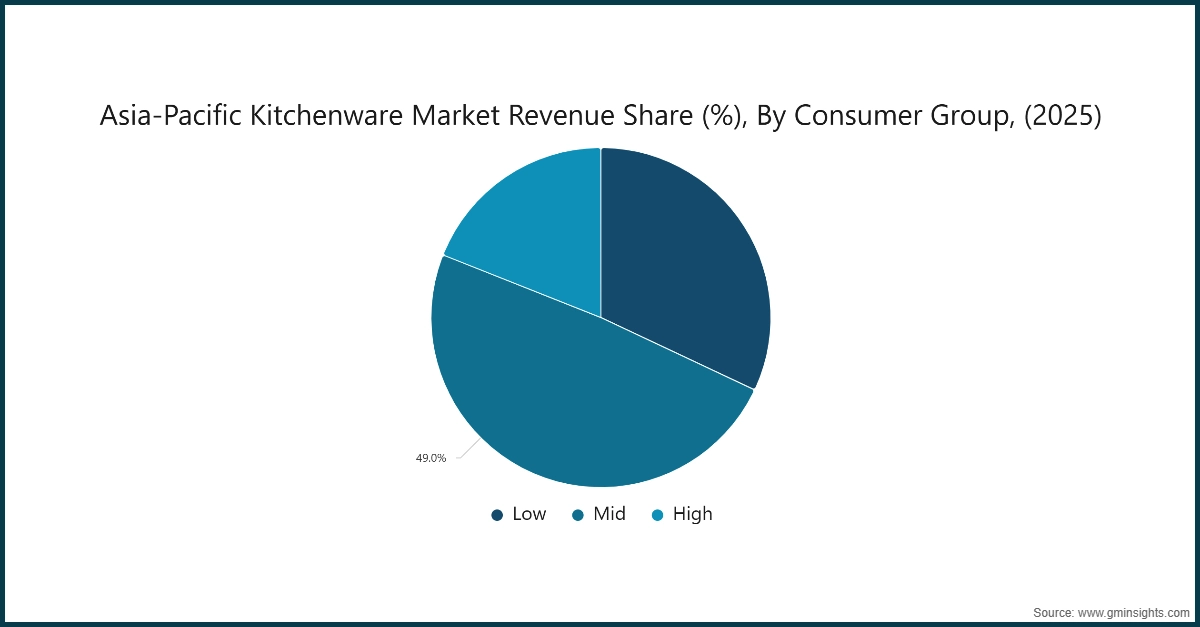
Based on price, the kitchenware market is categorized into low, mid, and high price. The mid segment has a dominant market share of 49% and is expected to grow through 2026 to 2035.
- Consumers preferred mid-priced kitchenware due to their value for money and durable offerings. These products also feature better materials and designs compared to low priced options without premium pricing of high-end brands.
- The low-priced kitchenware products are popular in emerging markets that cater to price sensitive consumers. The cheap and mass production of low-priced kitchenware has led to their high market share compared to high-priced kitchenware.
- The consumers’ need for premium and luxury kitchenware is contributing to the market share of high-priced kitchenware products. Brand conscious consumers and the luxury hospitality sector have also contributed to the high-priced kitchenware industry.
Based on end-use, the kitchenware market is categorized into residential and commercial segments. The residential segment has a higher market share of around 59% in 2025.
- The integration of technology into kitchenware has transformed the cooking experience for consumers. Smart appliances with app enabled cooking has allowed consumers to cook efficiently and easily. Also, the rise of social media food influencers has started a trend of home cooking which has led to an increase in the kitchenware market.
- The commercial kitchenware segment, which includes hotels, restaurants, cafes, etc., is growing due to a rise in demand for durable, high performance and automated kitchen solutions.
- With the rise of quick service restaurants and fine dining restaurants businesses are adopting durable stainless-steel cookware and high-speed oven appliances that enhance their efficiency. These factors are leading to growth in the commercial segment of the market.
Asia Pacific Kitchenware Market
Looking for region specific data?
Asia Pacific remains the fastest growing regional market for kitchenware, supported by rapid urbanization, rising disposable incomes, and structurally strong demographic fundamentals. The region commands a significant market share globally and is projected to grow at a robust CAGR of approximately 5.1% through 2035.
Key markets such as China, India, Japan, and South Korea are major contributors to regional growth, with increasing demand for cookware, bakeware, food storage solutions, and modular kitchen tools. The region benefits from a vast consumer base, strong manufacturing ecosystems, and the rapid expansion of modern retail formats and e commerce platforms, which collectively enhance product accessibility and affordability. Both domestic and international brands compete intensely, with innovation centered on material safety, durability, sustainability, and value for money offerings tailored to diverse cooking styles and climatic conditions.
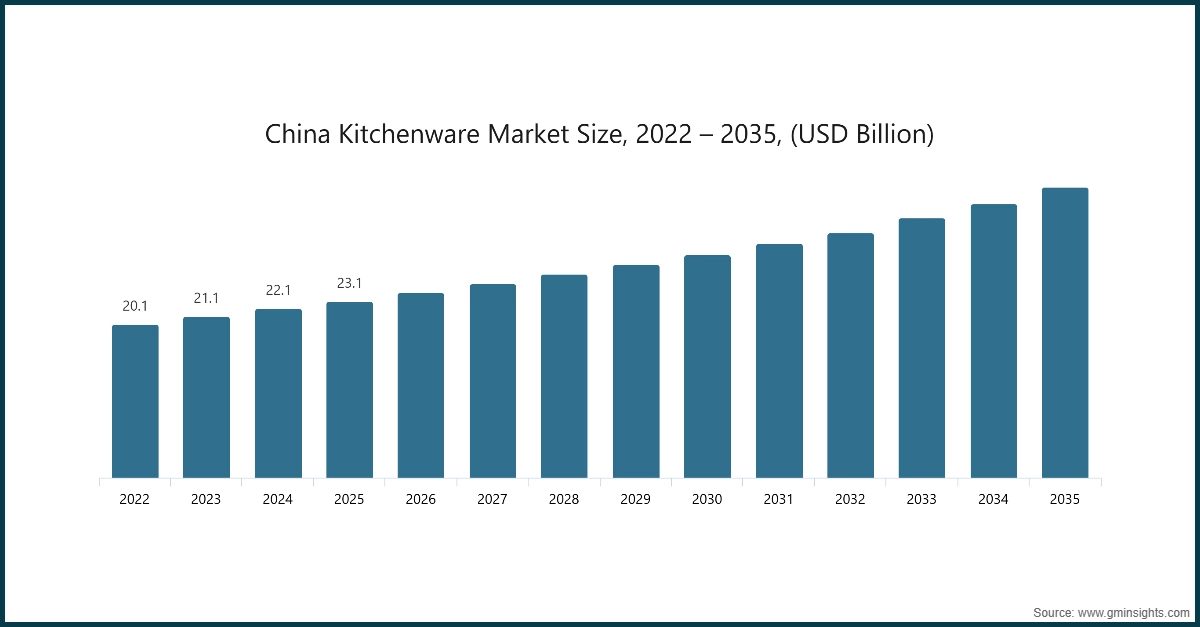
- China remains the dominant force, accounting for over 30% of the Asia Pacific kitchenware market, driven by large scale urbanization, well established manufacturing infrastructure, and strong demand for premium and mid range cookware among urban households.
- India is emerging as a high growth corridor, supported by rapid income growth, expansion of modern kitchens, and increasing exposure to global cooking trends. Government led initiatives promoting hygiene, food safety, and organized retail development are accelerating the shift from traditional cooking tools to branded, standardized, and induction compatible kitchenware.
- Rising urbanization in India, Vietnam, and Indonesia is reshaping household cooking habits, driving a transition from conventional utensils and low quality cookware to non stick, stainless steel, ceramic coated, and energy efficient kitchen solutions suited for frequent use and compact living spaces.
- In Japan and South Korea, high consumer spending power and a strong emphasis on precision cooking, health-oriented meal preparation, and aesthetic design continue to fuel demand for premium, technologically advanced kitchenware. Consumers in these markets demonstrate a strong preference for high performance materials, space efficient designs, and long-term durability, reinforcing steady value growth despite market maturity.
Asia Pacific Kitchenware Market Share
Lock & Lock is leading with a 13% market share. Meyer Thailand, Cuckoo Electronics, Lock & Lock, Sunhouse Group, HARIO collectively hold around 55%, indicating a moderately fragmented market concentration with a strong tier of dominant global players. Leading companies are actively engaged in strategic initiatives, including capacity expansions, mergers & acquisitions, product portfolio diversification, and regional partnerships, to strengthen their market positioning. These strategies focus on expanding reach across emerging Asian economies, enhancing localized manufacturing capabilities, and addressing evolving consumer demand for durable, safe, and sustainable kitchenware solutions.
Market leaders are increasingly investing in material innovation, coating technologies, and energy‑efficient cookware designs, while aligning operations with long‑term sustainability goals. Industry efforts to reduce environmental impact include lower‑plastic packaging, recyclable materials, long‑life cookware designs, and cleaner manufacturing processes, supporting regional regulatory trends and retailer sustainability benchmarks. These initiatives directly address growing consumer scrutiny around food safety, product longevity, and environmental responsibility.
In 2023 KitchenAid launched a cordless collection of blenders, food choppers, etc. Also, in 2024 they launched an AI enabled stand mixers to customize speed and timing depending on use case. These developments highlight the kitchenware industry’s evolution towards innovating advanced technology to meet ever expanding consumer needs. This has positioned the company in the market.
Asia Pacific Kitchenware Market Companies
Major players operating in the Asia Pacific kitchenware industry are:
- Breville Group
- Cuckoo Electronics
- HARIO
- Lock & Lock
- Meyer Thailand
- Myrex Thailand
- Noda Horo
- Pearl Metal
- PT Kedaung Indah Can
- Satien Stainless Steel
- Sunhouse Group
- Tiger Corporation
- Wahei Freiz
- Yoshikawa
- Zojirushi
Groupe SEB and Meyer Corporation increased investments in advanced non‑stick and ceramic‑coating technologies, aiming to expand premium cookware offerings while meeting stricter food‑safety and sustainability standards across Asia Pacific.
Asia Pacific Kitchenware Market Report Attributes
| Key Takeaway | Details |
|---|---|
| Market Size & Growth | |
| Base Year | 2025 |
| Market Size in 2025 | USD 116.3 Billion |
| Market Size in 2026 | USD 121.8 Billion |
| Forecast Period 2026-2035 CAGR | 5.1% |
| Market Size in 2035 | USD 190.1 Billion |
| Key Market Trends | |
| Drivers | Impact |
| Urbanization & rising disposable income | Expansion of middle class households across APAC fuels demand for cookware, bakeware, food storage, and kitchen tools |
| Growth of home cooking & health focused lifestyles | Increased adoption of non stick, induction compatible, ceramic-coated, and stainless-steel cookware |
| Increased adoption of non stick, induction compatible, ceramic-coated, and stainless-steel cookware | Increased adoption of non stick, induction compatible, ceramic coated, and stainless steel cookware |
| Pitfalls & Challenges | Impact |
| Raw material price volatility | Fluctuations in steel, aluminum, and coating inputs impact margins for manufacturers |
| Price sensitivity in developing markets | Premium cookware and eco-friendly materials remain less accessible in price conscious markets such as India, Indonesia, and Vietnam |
| Opportunities: | Impact |
| E‑commerce & omnichannel retail expansion | Online platforms enable rapid penetration of branded and private‑label kitchenware across Tier‑2 and Tier‑3 cities |
| Online platforms enable rapid penetration of branded and private‑label kitchenware across Tier‑2 and Tier‑3 cities | Online platforms enable rapid penetration of branded and private‑label kitchenware across Tier‑2 and Tier‑3 cities |
| Market Leaders (2025) | |
| Market Leader |
13% market share |
| Top Players |
Consolidate share of 55% |
| Competitive Edge |
|
| Regional Insights | |
| Largest Market | China |
| Fastest growing market | China |
| Emerging countries | South Korea, Japan, India |
| Future outlook |
|
What are the growth opportunities in this market?
Asia Pacific Kitchenware Industry News
- In February 2025, CFS Brands, a foodservice equipment manufacturer has acquired Mercer Culinary, a New York based commercial kitchenware provider. This acquisition will expand CFS Brands product portfolio in the market.
- In February 2025, Our Place, a cookware company, partnered with celebrity interior designer Brigette Romanek to release a new cookware line featuring luxurious designs of their existing cookware products. This partnership placed them in the premium category of the market and expanded their portfolio.
- In April 2024, Groupe SEB acquired Sofilac to enhance their position in the premium kitchenware industry. Sofilac now has access to reach of Groupe SEB to expand globally.
- In June 2023, Meyer Corporation, a cookware manufacturer, acquired Great Jones, a premium cooking item brand. This acquisition will enable Meyer's operational and product expertise access to Great Jones home cooks audience.
- In 2024 Joseph launched BPA-free food containers which are made from recycled materials to expand in the sustainable kitchenware line. This has made them one of the top companies in the sustainable market and it has strengthened their sustainability commitment to appeal environmentally conscious consumers.
The Asia Pacific kitchenware market research report includes in-depth coverage of the industry with estimates & forecasts in terms of revenue (USD Billion) and volume (Million Units) from 2022 to 2035, for the following segments:
Market, By Product
- Cookware
- Pan
- Fry pan
- Sauté pan
- Saucepan
- Roasting pan
- Others
- Pots
- Brazier
- Sauce Pot
- Dutch oven/ cocotte pots
- Fryer pot
- Others
- Bakeware
- Bread and loaf pan
- Sheet pan
- Cake pans
- Muffin pans
- Others
- Tableware
- Cooking tools & utensils
- Knifes
- Cutlery
- Scrapper
- Skimmer
- Tongs
- Others
- Appliances
- Large kitchen appliances
- Refrigerator
- Mixer & grinders
- Dishwasher
- Dough kneader
- Others (grills, griddles etc)
- Small kitchen appliances
- Cookers
- Coffee makers
- Blenders
- Food processors
- Juicer
- Ice dispenser
- Toaster
- Others (microwave, oven, air fryers, etc)
- Large kitchen appliances
- Others
Market, By Price Range
- Low
- Mid
- High
Market, By End Use
- Residential
- Commercial
- Hotels
- Restaurants
- Others
Market, By Distribution Channel
- Online
- E-commerce websites
- Brand-owned websites
- Offline
- Supermarkets/hypermarkets
- Specialty stores
- Department stores
The above information is provided for the following countries:
- China
- India
- Japan
- Australia
- South Korea
Frequently Asked Question(FAQ) :
What was the market size of the Asia Pacific kitchenware in 2025?
The market size was USD 116.3 billion in 2025, growing at a CAGR of 5.1% till 2035. The market is driven by rapid urbanization, rising disposable incomes, and a growing preference for home-cooked meals and healthy eating.
What is the projected value of the Asia Pacific kitchenware market by 2035?
The market is poised to reach USD 190.1 billion by 2035, fueled by innovations in sustainable materials, product diversification, and increasing e-commerce penetration.
What is the expected size of the Asia Pacific kitchenware industry in 2026?
The market size is expected to reach USD 121.8 billion in 2026.
How much revenue did the cookware segment generate in 2025?
The cookware segment generated USD 47.2 billion in 2025 and is expected to grow at a CAGR of 5.3% from 2026 to 2035.
What was the market share of the mid-tier segment in 2025?
The mid-tier segment held a dominant market share of 49% in 2025, led by its value-for-money offerings and durable designs.
What was the market share of the residential segment in 2025?
The residential segment accounted for approximately 59% of the market share in 2025, supported by the integration of technology into kitchenware and the rise of home cooking trends.
Which country leads the Asia Pacific kitchenware sector?
China leads the market, contributing over 30% of the regional revenue in 2025, supported by large-scale urbanization, a strong manufacturing base, and high demand for premium and mid-range cookware.
What are the emerging trends in the Asia Pacific kitchenware market?
Technology-driven product innovation, growth of e-commerce and D2C channels, sustainable and eco-friendly designs, and rising demand for ergonomic, health-focused kitchenware.
Who are the key players in the Asia Pacific kitchenware industry?
Major players include Breville Group, Cuckoo Electronics, HARIO, Lock & Lock, Meyer Thailand, Myrex Thailand, Noda Horo, Pearl Metal, Sunhouse Group, Tiger Corporation, Wahei Freiz, Yoshikawa, and Zojirushi.
Asia Pacific Kitchenware Market Scope
Related Reports