Summary
Table of Content

Asia Pacific Bike Pedal Market
Get a free sample of this report
Form submitted successfully!
Error submitting form. Please try again.
Thank you!
Your inquiry has been received. Our team will reach out to you with the required details via email. To ensure that you don't miss their response, kindly remember to check your spam folder as well!
Request Sectional Data
Thank you!
Your inquiry has been received. Our team will reach out to you with the required details via email. To ensure that you don't miss their response, kindly remember to check your spam folder as well!
Form submitted successfully!
Error submitting form. Please try again.
Asia Pacific Bike Pedal Market Size
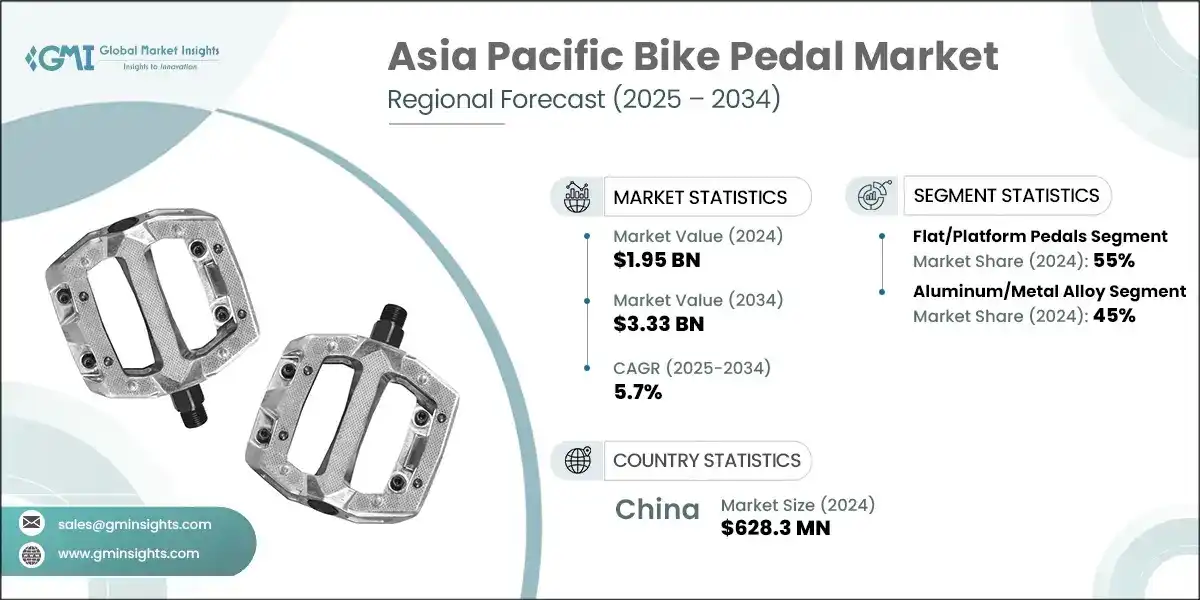
The Asia Pacific bike pedal market size was estimated at USD 1.95 billion in 2024. The market is expected to grow from USD 2.02 billion in 2025 to USD 3.33 billion in 2034, at a CAGR of 5.7%.
Asia Pacific Bike Pedal Market Key Takeaways
Market Size & Growth
- 2024 Market Size: USD 1.95 Billion
- 2034 Forecast Market Size: USD 3.33 Billion
- CAGR (2025–2034): 5.7%
Regional Dominance
- Largest Market: China
- Fastest Growing Country: India
Key Market Drivers
- The rise in urban cycling culture.
- E-bike integration and hybrid pedals.
- Fitness and adventure cycling trend.
- Government support for green mobility.
Challenges
- High cost of advanced pedals.
- Lack of standardization across bike types.
Opportunity
- Rising demand for smart pedals with sensor integration.
- Expansion of bike-sharing programs in urban areas.
Key Players
- Market Leader: Shimano led with over 9% market share in 2024.
- Leading Players: Top 5 players in this market include Exustar, Look Cycle, Shimano, VP Components, Wahoo, which collectively held a market share of 14% in 2024.
Get Market Insights & Growth Opportunities
- The growing concern regarding public health, personal fitness as well as environmental sustainability is leading to a worldwide adoption of riding bicycles. People living in metropolitan areas prefer bicycles as a cleaner and more active way of commuting.
- The COVID-19 pandemic marked a significant turning point in the adoption of bicycles as a mode of transport, integrating them into the commuting practices of individuals who had previously relied on public transport. Sustaining this trend, governments are expanding bike lanes and relevant infrastructure. Other metropolitan centers, including, but not limited to, Delhi, Seoul, and Tokyo, are forking out larger budgets for bike-friendly lanes and infrastructure.
- In March 2025, Chief Minister of Delhi, Rekha Gupta set aside INR 12,952 crore for transport infrastructure which includes funding for roads, cycling lanes, and upgrades to make the areas more pedestrian-friendly. This is an increase of 38% from the previous year’s transport budget, showing improved urban mobility by adding cycle tracks in and around the city as well as in the Delhi and NCR regions.
- The implementation of hybrid assists systems in e-bikes facilitated their widespread acceptance after 2020. Their adoption had previously been limited by concern regarding e-bike systems costing too much, lack of awareness, and an absence of hybrid pedal systems. The utilization of smart sensors and other energy-efficient materials is gaining traction.
- The growth in fitness popularity together with the rise in adventure tourism, especially post-2021, has created a demand for high-performance pedals. Mountain biking and endurance riding now have specialized pedals which are more bike specific and are preferred by cyclists. The underlying factors significantly contributing this trend are the rising disposable incomes and the increased concern for fitness in the youth in Asia.
- In May 2025, the government of Kerala, India, sanctioned funding of INR 75 lakh (around USD 90,000) to host the international cross-country mountain biking competition, MTB Kerala 2025, which is set to be held at an elevation of 3000ft. The project seeks to draw both national and international cyclists and put the state of Kerala at the forefront of the adventure tourism industry which is heavily based on fitness and outdoor activities.
- The governments around the Asia Pacific region since 2021 have enhanced policies aimed at emission reduction, coupled with the promotion of cycling. Local manufacturing incentives, eco-transport campaigns, as well as subsidies have all seen increases. The manufacturing of bicycle pedals is now shifting towards the use of local and recyclable materials.
- China is rapidly developing as one of the key growth markets for high-performance bike pedals. Development of mountain biking parks, cycling tourism and bike-sharing ecosystems is spurring the need for more advanced and durable pedal systems. Furthermore, China’s growing middle class is increasingly interested in the premium and performance cycling gear, which is in line with the country’s accepted standard of higher disposable income.
To get key market trends
Asia Pacific Bike Pedal Market Trends
- The transition from traditional flat pedals to performance and clipless systems gained traction around 2015, marking a shift from leisurely to fitness-oriented cycling. By the 2020s, the rise of endurance riding and a culture of competitive cycling were already fostering a significant need for specialized, high-efficiency pedals. Anticipating the need for professional cycling experiences, performance and clipless pedals are likely to become standard fittings on mid- to high-range bicycles across Asia.
- In March 2024, the announcement by Shimano concerning a Singapore plant upgrade greatly investing into mid-range components for sports and mountain bikes stems from the increased fitness-oriented cycling demand in the Asia-Pacific region.
- Pedal technology until 2018 was purely mechanical, but that changed with the introduction of the first e-bikes featuring hybrid-assist and sensor technology. After 2020, this trend accelerated with the introduction of more intelligent, effort-reducing pedal technologies incorporating torque sensors and connectivity solutions. As the market shifts toward more customizable pedal-assist features.
- The bike pedals until 2017 adhered to a uniform design with minimal customization for users. This changed with the widespread adoption of performance-capture riders and recreational cyclists who demanded better ergonomic comfort and modular options for interchangeable parts. Now and into the future, the projected advancement of bike pedals foresees entirely customizable systems based on personal requirements and riding styles.
- In March 2025, for mountain bikes and e-bikes, Flat bike has launched the award-winning removable “pop-off” pedals which can be detached using latching mechanisms without the aid of tools. With MTB recognized standards, these pedals are durable while also providing the rider with easy customization for transportation and storage.
- Bike pedals were manufactured using plastic and steel up until the mid-2010’s, indicating no concern for the environment. Business and consumer shifts towards eco-friendly initiatives, as well as enhanced sustainability policies, led to the adoption of recycled composites and light aluminum alloys after 2022. Manufacturers will face even tougher eco-design regulations and will need to turn to biologically based, recyclable other low-impact materials to meet next-generation product design expectations.
Asia Pacific Bike Pedal Market Analysis
Learn more about the key segments shaping this market
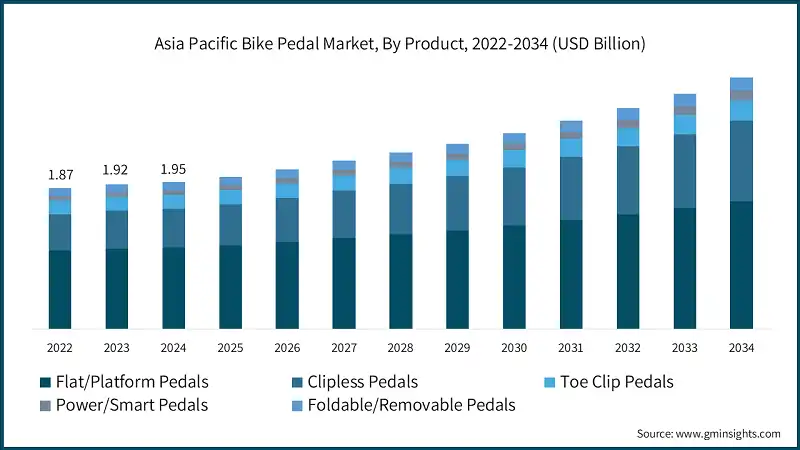
Based on product, the Asia Pacific bike pedal market is divided into flat/platform pedals, clipless pedals, toe clip pedals, power/smart pedals and foldable/removable pedals. The flat/platform pedals segment dominated the market accounting for around 55% in 2024 and is expected to grow at a CAGR of over 4% through 2034.
- The bike pedal market in Asia Pacific region is largely dominated by flat and platform pedals owing to their low cost and the predominance of casual and commuter bicycles in the region. These pedals do not require special shoes which is helpful to novices and urban residents. The simple design and low maintenance of these pedals attract thrifty consumers from developing countries such as India, Vietnam and Indonesia.
- Clipless pedals grow at 7% CAGR, due to the enthusiasts seeking speed, power transfer, and control for long rides. These pedals facilitate foot engagement, prevent energy loss during climbs, and improve stability on rugged terrain. Their precise cleat systems, coupled with lightweight materials, make them ideal for enduring competitions, demanding technical trails.
- In May 2025, the recently launched 3ax clipless pedals include a novel feature: a maximum of 2° of lateral tilt, which allows for more natural foot movement and reduces knee strain by 17% on average, while offering a performance boost of up to 5.5%.
- The adoption of power/smart pedals is increasing because of the need for performance and fitness analytics. These pedals are equipped with real-time cadence, power output, and balance metrics, which are crucial for competitive and serious recreational cyclists.
Learn more about the key segments shaping this market
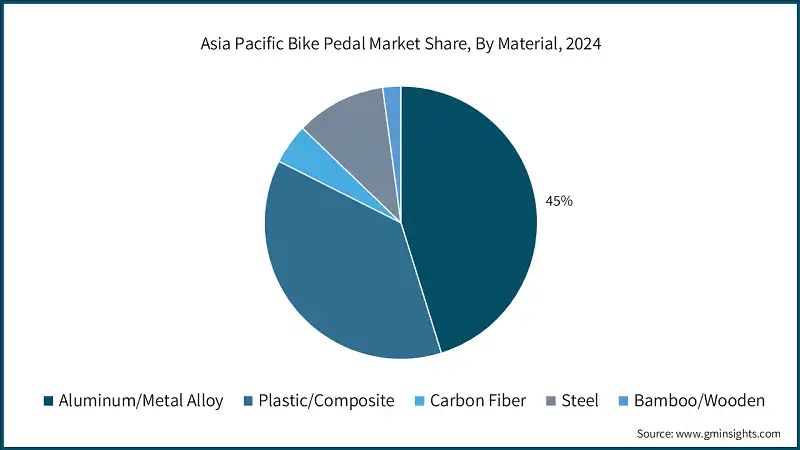
Based on material, the Asia Pacific bike pedal market is segmented into aluminum/metal alloy, plastic/composite, carbon fiber, steel and bamboo/wooden. The aluminum/metal alloy segment dominates the market with 45% share in 2024, and the segment is expected to grow at a CAGR of 5% from 2025 to 2034.
- The aluminum/ metal alloy segment continues to dominate the Asia Pacific bike pedal market because of its durability, lightweight characteristics and cost efficiency. Compared to urban and off-road cyclists’ plastic alternatives, these materials are much more durable and boast a greater degree of strength and wear resistance.
- In July 2025, VP Components exhibited the VP-F57 folding pedal, which is constructed using the Zedler Advanced Plus XXL standard of mechanical testing from extruded recycled aluminum and PA6 Boron steel ball bearings. The pedal is an aluminum alloy which is favored in the performance and leisure cycling markets in the Asia-Pacific region due to the region's emerging preference for low-carbon aluminum.
- Plastic/composite grows at 7% CAGR, the growing use of plastic and composite materials for pedals stems from corrosion resistance, low weight and ease of manufacturing. These advantages have made the entry of plastic pedals in mid-range bicycles easy. The durability of these materials is quite sufficient for urban and recreational cycling and stylized pedals are ergonomically pleasing as well as aesthetically appealing, which simplifies mass production.
- Steel pedals are famous for their enduring durability and remarkable load-bearing ability for utility and heavy-duty bikes used in the industrial and rural areas. Although steel weighs more than other materials, it is preferential for budget-conscious cyclists who need solid and long-lasting support.
Based on bike, the Asia Pacific bike pedal market is segmented into road bikes, mountain bikes, electric bikes, hybrid/city bikes, folding bikes, kids’ bikes and touring & trekking bikes. The mountain bikes segment is expected to dominate as the growing popularity of outdoor recreation and eco-friendly transport fuels demand across diverse terrains, age groups, and skill levels.
- Mountain bikes dominate the segment due to their emphasis on weight reduction and terrain adaptability, further supported by the introduction of advanced technologies such as smart suspensions, hydraulic disc brakes, and lightweight frames
- In April 2025, UCI’s decision to reduce the XCO World series world cup from five to three riders sparked outrage from 120 professional mountain bikers including Tom Pidcock, Pauline Ferrand-Prévot, Puck Pieterse and Nino Schurter, claiming the decision hampers the exposure smaller teams and developing riders receive. They demand the five-rider podium be restored ahead of the 2025 season set to start in Brazil.
- The Asia Pacific bike pedal market from electric bikes grow at 7% CAGR increasing owing to the improvement of traffic jams, growth in the use of bikes for riding to work, and government policies promoting electric mobility. They are gaining popularity among professionals and for use in the delivery sector in Shanghai, Tokyo and Delhi, which has increased the demand for e-bike pedals.
- The usage of touring and trekking bicycles in the Asia-Pacific Region is an emerging development which is followed by cycle tourism. Trekking is an inherently demanding, multi-day endurance activity and those proprietary bikes must be able to endure the harsh abuse of long trips while also bearing hefty weights
Based on end use, the Asia Pacific bike pedal market is segmented into OEMs and aftermarket. The OEMs segment is expected to dominate as demand for advanced, lightweight and high-performance bikes increases across consumer, professional and rental segments, OEMs must deliver scalable, quality-assured, and customizable components.
- The OEMs segment is expected to dominate the Asia Pacific bike pedal market. OEMs supply customized and branded pedals specifically designed for particular bike types which, in turn, guarantees performance and quality control. Also, the rising acceptance of e-bikes and premium bicycles in metropolitan areas and among the health-conscious population drives the need for factory-fitted pedal systems.
- In March 2025, prominent OEMs like Shimano and SRAM continue to increase investment in and partnerships for in-region production relationships that allow them to serve manufacturers directly reaffirming the role of factory-installed components for Asia- Pacific builds.
- The aftermarket is seeing a 6% CAGR. Riders are more likely to upgrade their pedals with smart or ergonomic design pedals that can be tailored to specific terrain and can also do it easier with DIY installation guides and online retail stores, and they are also benefiting from affordability without compromising access. This trend is extending across the Asia Pacific belt.
Looking for region specific data?
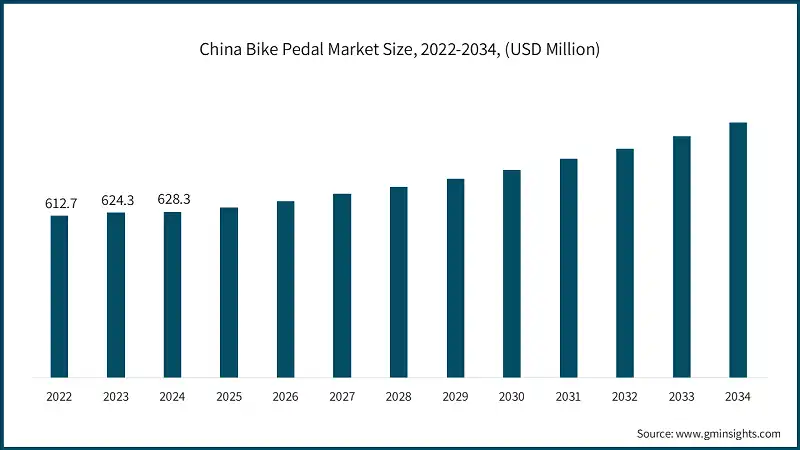
China accounted for over 32% share in Asia Pacific bike pedal market, generating revenue of USD 628.3 million in 2024.
- China leads in the market due to China’s position as the largest manufacturer of bicycles, coupled with its domestic market and export potential. The unparalleled infrastructure in the country, coupled with the culture surrounding bicycles, as well as governmental policies promoting ecological forms of transportation, stimulate innovation and demand in the Asia Pacific bike pedal market.
- In May 2025, the China Cycle 2025 actively demonstrated China being the hub for bicycles and e-bikes as the exports exceed 60% of global trade volumes. During the fair, over 1580 exhibitors showcased some of the country’s leading and most innovative high-tech components such as pedals.
- Japan’s cycling culture has a promotion of eco-friendly modes of transport, encouragement of active commuting, and municipal efforts toward improving mobility within regions, it is anticipated that Japan will experience a steady increase in the demand for bike pedals. Japan is also expected to experience a robust CAGR of around 5% through 2034.
The bike pedal market in India is expected to experience significant and promising growth from 2025 to 2034.
- India is expected to dominate the market due to the large and expanding middle-class segment of India, alongside the use of bicycles for commuting and fitness and the government's promotion of environmentally friendly modes of transport, are key drivers of pedal demand. The strong domestic production of standard and performance bicycle components, increasing urbanization is spurring interest.
- In June 2025, India’s bicycle manufacturing hub Ludhiana was noted as in sharp competition from the rest of the world, particularly China, even though it leads in the production of domestic components like pedals. Ludhiana today accounts for 75% of bicycle production in India and 92% of bicycle parts manufacturing, indicating tremendous local potential.
- Thailand has a competitive advantage in the Asia Pacific bike pedal market owing to its emerging capabilities in bicycle manufacturing and existing export infrastructure. Thailand has emerged as a and supported by investment in production technology. Furthermore, the rising preferences for cycling as a fitness and transportation activity are developing additional demand in the country.
The bike pedal market in Indonesia is expected to experience significant and promising growth from 2025 to 2034.
- The bike pedal industry in Indonesia is expected to increase considerably, reaching an estimated CAGR of nearly 7% by 2034. This surge is driven by the growing urban traffic gridlock, the adoption of environmentally friendly modes of transport, and the rising popularity of cycling for both commuting and leisure.
- In April 2025, Jakarta integrated an additional 3.8 km of protected bike lanes in 2025, adding to the already over 314 km of pedestrian and cycling infrastructure being implemented throughout the city.
- Taiwan holds a good position in the Asia Pacific bike pedal market owing to its robust manufacturing base and bicycle part industrial park. The country hosts well-known pedal manufacturers such as Wellgo, VP Components and HT Components. With their advanced technology, trained workforce and considerable capacity for international trade, it's no wonder the country is and continues to be, a major OEM market.
- The widespread adoption of shared bicycles and eco-friendly transport systems in Metro Manila and Cebu is quickly transforming the Philippines into a potential producer of bike pedals. A rising middle class is not only leisure-cycling but also fueling standard and advanced pedal-type demand.
The Asia Pacific bike pedal market in Vietnam is expected to experience significant and promising growth from 2025 to 2034.
- The Vietnam bicycle pedal market is expected to thrive significantly, with an anticipated CAGR of nearly 9% between 2024 and 2034. Contributing to this growth are rising levels of urban congestion, the adoption of greener modes of transport, and the health consciousness of now younger people.
- In May 2025, the first-ever GIZ, WRI, and Health Bridge partnered Vietnam technical guideline for bicycle infrastructure design in urban areas focuses on infrastructure accessibility in Vietnam. The guideline seeks to foster greater safety and accessibility as well as improved convenience in cycling infrastructure, which would promote its use on a daily basis for all age groups and abilities.
- The South Korean smart mobility infrastructure, strong consumer focus on health and fitness, and recreational cycling are steadily elevating the South Korean’s position in the bike pedal market. In addition, South Korea’s significant adoption and leadership in the use of smart cycling technologies and e-bikes and health-oriented travel, creates a market for technologically enhanced pedals, along with the mid-range options.
Asia Pacific Bike Pedal Market Share
- The top 7 companies in the Asia Pacific bike pedal industry are Shimano, VP Components, Wellgo Pedals, Exustar, Wahoo, Xpedo and Look Cycle contributing around 14% of the market in 2024.
- Shimano is recognized as one of the world’s leading manufacturers of bicycle components, specifically in the areas of drivetrain, brake, and pedal systems. Shimano also OEMs and services in the aftermarket for road and MTB as well as e-bikes. Shimano maintained a reputation for innovation, brand loyalty, and market share in the cycling industry.
- VP Components is located in Taiwan and concentrates on manufacturing bicycle pedals, headsets, and bottom brackets. As a major OEM supplier, they maintained a reputation for affordable price performance components. The company offers a full range of clipless and flat pedals for both recreational and competitive cyclists.
- Taiwan based Wellgo is one of the leading pedal manufacturers in the world. The company produces clipless and platform pedals for road, mountain, and BMX bikes. Wellgo is one of the industry leaders in aftermarket sales as well as aftermarket services and is known for their affordable pricing.
- Exustar is a manufacturer based in Taiwan that concentrates on pedals and cycling shoes as well as other accessories. They target recreational and competitive cyclists in the road and MTB segments. Exustar uses performance materials and ergonomic design to optimize comfort and efficiency for the riders.
- MKS (Mikashima Industrial Co.) continues to cater to the niche high-quality pedal market with its durable, traditionally crafted platform and toe clip pedals. The brand is gaining traction among urban commuters, vintage bike enthusiasts, and tourers in Japan and select APAC cities, driven by demand for reliability and handcrafted components.
- Wahoo is a performance-focused cycling technology company known for its smart training products and Speedplay pedals. It specializes in connected fitness, offering power meter pedals, trainers, and sensors tailored for elite cyclists, with a growing presence in the Asia Pacific market driven by demand for smart and data-driven cycling gear.
- Look Cycle is a pioneering French brand renowned for inventing the clipless pedal and carbon frame technologies. It dominates the high-end road cycling segment with innovative clipless pedals, aerodynamic designs, and professional race partnerships, making it a key player in the premium pedal market across Europe and expanding markets in Asia.
Asia Pacific Bike Pedal Market Companies
Major players operating in the Asia Pacific bike pedal industry are:
- Crank brothers
- Exustar
- HT Components
- MKS (Mikashima)
- RockBros
- Shimano
- TIME Bicycles
- VP Components
- Wahoo
- Wellgo Pedals
- Xpedo
- Particularly notable for its EZY quick-release platform pedals which are of great rigidity and easy to use, MKS is favored among folder-bike users. On the other hand, RockBros is gaining popularity for its cost- competitive aluminum nylon-platform or adapter models which provide exceptional grip. Shimano continues to dominate the premium market with its XTR and SPD-SL clipless systems used broadly by both professional and casual riders.
- During Taipei Cycle 2025, VP Components showcased their new eco-friendly folding and traction-pin pedals crafted from recycled aluminum, and so, showcased their eco-conscious, modular and durable design; Wellgo is still known for their economical quick-release and commuter platform pedals despite their inconsistent reliability reputation; and Xpedo introduced their tool-free quick-release cadence adapters for easy Bluetooth cadence tracking across multiple bikes.
- While Crank brothers continues to enjoy popularity owing to the float and mud-shedding features of their models Candy and Stamp, Exustar has diversified its lower-cost, city commuting oriented clipless SPD systems and Look Cycle is strengthening its foothold in the gravel and road bike segments with precision-engineered, competitively rated, lightweight carbon hybrid pedal systems.
Asia Pacific Bike Pedal Market Report Attributes
| Key Takeaway | Details |
|---|---|
| Market Size & Growth | |
| Base Year | 2024 |
| Market Size in 2024 | USD 1.95 Billion |
| Forecast Period 2025 - 2034 CAGR | 5.7% |
| Market Size in 2034 | USD 3.33 Billion |
| Key Market Trends | |
| Drivers | Impact |
| The rise in urban cycling culture | Boosts demand for durable and ergonomic pedals suited for daily commuting. |
| E-bike integration and hybrid pedals | Drives innovation in smart, dual-mode pedal systems for assisted riding |
| Fitness and adventure cycling trend | Accelerates the market for high-performance, terrain-specific pedal designs. |
| Government support for green mobility | Encourages adoption of eco-friendly and locally manufactured pedal components. |
| Pitfalls & Challenges | Impact |
| High cost of advanced pedals | Restricts adoption among price-sensitive consumers, limiting market penetration. |
| Lack of standardization across bike types | Creates compatibility issues, reducing aftermarket and upgrade potential. |
| Opportunities: | Impact |
| Rising demand for smart pedals with sensor integration | Enables growth in the premium segment by attracting tech-savvy cyclists. |
| Expansion of bike-sharing programs in urban areas | Drives bulk demand for sturdy, low-maintenance pedals from fleet operators. |
| Market Leaders (2024) | |
| Market Leaders |
9% market share |
| Top Players |
Collective market share in 2024 is 14% |
| Competitive Edge |
|
| Regional Insights | |
| Largest Market | China |
| Fastest Growing Market | India |
| Emerging Countries | Thailand, Vietnam, India, Indonesia, Philippines |
| Future outlook |
|
What are the growth opportunities in this market?
Asia Pacific Bike Pedal Industry News
- In May 2025, the government of Kerala, India, sanctioned funding of INR 75 lakh (around USD 90,000) to host the international cross-country mountain biking competition, MTB Kerala 2025, which is set to be held at an elevation of 3000ft. The project seeks to draw both national and international cyclists and put the state of Kerala at the forefront of the adventure tourism industry which is heavily based on fitness and outdoor activities.
- In March 2024, the announcement by Shimano concerning a Singapore plant upgrade greatly investing into mid-range components for sports and mountain bikes stems from the increased fitness-oriented cycling demand in the Asia-Pacific region.
- In July 2025, in China, new government policies have enacted a trade-in subsidy program which resulted in the purchase of over 8.47 million new e-bikes in the first half of 2025. This not only boosted e-bike sales by over 643% year over year but also resulted in growth that doubled on a month-over-month basis in key provinces such as Jiangsu, Hebei, and Zhejiang.
- In June 2025, Ludhiana, a city in India’s Punjab state known as the country’s bicycle manufacturing center, was described as being under significant threat from intense competition around the world, particularly from China, despite being a leader in the nation’s production of home-based components like pedals. Today, Ludhiana produces 75% of all bicycles in India and 92% of the country’s bicycle parts manufacturing, and there is significant potential for local production.
The Asia Pacific bike pedal market research report includes in-depth coverage of the industry with estimates & forecasts in terms of revenue (USD Million) and shipments (Units) from 2021 to 2034, for the following segments:
Market, By Product
- Flat/platform pedals
- Clipless pedals
- Toe clip pedals
- Power/smart pedals
- Foldable/removable pedals
Market, By Material
- Aluminum/metal alloy
- Plastic/composite
- Carbon fiber
- Steel
- Bamboo/wooden
Market, By Bikes
- Road bikes
- Mountain bikes
- Electric bikes
- Hybrid/city bikes
- Folding bikes
- Kids bikes
- Touring & trekking bikes
Market, By End use
- OEM
- Aftermarket
Market, By Distribution channel
- Offline
- Online
The above information is provided for the following regions and countries:
- China
- India
- Japan
- South Korea
- Indonesia
- Vietnam
- Thailand
- Malaysia
- Philippines
- Australia
- Taiwan
- Rest of APAC
Frequently Asked Question(FAQ) :
What is the market size of the Asia Pacific bike pedal in 2024?
The market size was USD 1.95 billion in 2024, with a CAGR of 5.7% expected through 2034. The growing focus on public health, fitness, and environmental sustainability is driving market growth.
What is the projected value of the Asia Pacific bike pedal market by 2034?
The market is poised to reach USD 3.33 billion by 2034, driven by increasing adoption of bicycles for commuting, fitness, and recreational purposes.
What was the market share of the flat/platform pedals segment in 2024?
The flat/platform pedals segment accounted for approximately 55% of the market share in 2024 and is set to expand at a CAGR of over 4% through 2034.
What was the valuation of the aluminum/metal alloy segment in 2024?
The aluminum/metal alloy segment held a 45% market share in 2024 and is expected to witness over 5% CAGR till 2034.
What is the growth outlook for the plastic/composite pedals segment?
The plastic/composite pedals segment is expected to grow at a CAGR of 7% up to 2034, led by their corrosion resistance, lightweight properties, and ease of manufacturing.
Which country leads the Asia Pacific bike pedal sector?
China leads the market with over 32% share, generating USD 628.3 million in revenue in 2024.
What are the upcoming trends in the Asia Pacific bike pedal market?
Trends include a shift to clipless pedals, tech advancements (torque sensors, connectivity), customization, eco-friendly materials, and innovative designs like pop-off pedals.
Who are the key players in the Asia Pacific bike pedal industry?
Key players include Crank Brothers, Exustar, HT Components, MKS (Mikashima), RockBros, Shimano, TIME Bicycles, VP Components, Wahoo, Wellgo Pedals, and Xpedo.
Asia Pacific Bike Pedal Market Scope
Related Reports