Summary
Table of Content

ASEAN Medical and Wellness Tourism Market
Get a free sample of this report
Form submitted successfully!
Error submitting form. Please try again.
Thank you!
Your inquiry has been received. Our team will reach out to you with the required details via email. To ensure that you don't miss their response, kindly remember to check your spam folder as well!
Request Sectional Data
Thank you!
Your inquiry has been received. Our team will reach out to you with the required details via email. To ensure that you don't miss their response, kindly remember to check your spam folder as well!
Form submitted successfully!
Error submitting form. Please try again.
ASEAN Medical and Wellness Tourism Market Size
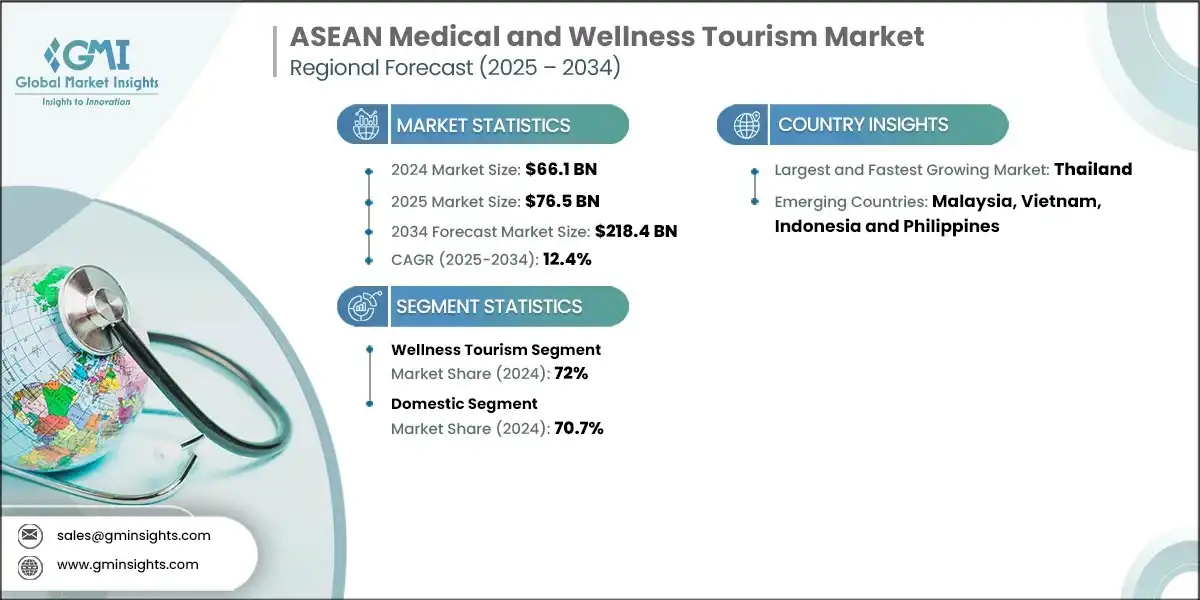
The ASEAN medical and wellness tourism market was estimated at USD 66.1 billion in 2024. The market is expected to grow from USD 76.5 billion in 2025 to USD 218.4 billion in 2034, growing at a CAGR of 12.4% from 2025 to 2034, according to the latest report published by Global Market Insights Inc. This high growth is attributed to several factors, including supportive government policies to ease medical travel, low cost of medical treatment in ASEAN countries, favourable government initiatives to promote wellness tourism, coupled with growing compliance towards international standards for surgical procedures.
ASEAN Medical and Wellness Tourism Market Key Takeaways
Market Size & Growth
- 2024 Market Size: USD 66.1 Billion
- 2025 Market Size: USD 76.5 Billion
- 2034 Forecast Market Size: USD 218.4 Billion
- CAGR (2025–2034): 12.4%
Key Market Drivers
- Low cost of medical treatment in developing countries.
- Growing compliance towards international standards for surgical procedures.
- Various government policies to ease medical travel.
- Growing interest of people in health and wellness.
- Rising government initiatives to promote wellness tourism.
- Growing preference for eco-friendly and sustainable wellness practices.
Challenges
- High cost of wellness programs.
- Long wait time for certain medical procedures.
- Issue with patient follow-up and post-surgery complications.
- Limited awareness and education for wellness tourism.
Opportunity
- Development of health special economic zones.
- Digital healthcare and telemedicine.
Get Market Insights & Growth Opportunities
The ASEAN countries witness substantial growth in the number of visiting medical and wellness tourists can be attributed to their proximity to major countries such as China, Japan, South Korea, and Australia. Patients from these countries can opt for a short wellness trip or plan for a quality medical treatment. Some of the major players operating in this industry include Bumrungrad International Hospital, Raffles Medical Group, Marriott International, KPJ Healthcare Berhad, St. Luke's Medical Center and Radisson Hotel Group among other participants.
Patients from across the world choose Southeast Asian countries like Thailand, Malaysia, and Singapore for medical procedures because they offer significant cost savings compared to Western countries. For example, when patients from the U.S. travel to regional countries such as Malaysia and Thailand, they can save up to 80% on their treatment costs, depending on the procedure. In addition, apart from affordable treatment, these countries also focus on providing high-quality healthcare services, as many regional hospitals maintain and promote their Joint Commission International (JCI) accreditation to attract consumers.
Additionally, traveling to a destination country with a combination of medical treatment and wellness experiences is a key factor boosting the market growth. For example, when visiting Indonesia and Thailand, travelers can access wellness retreats that offer spa treatments, yoga, and alternative therapies alongside their medical procedures. Similarly, patients traveling to the Philippines for medical reasons opt for packages covering wellness activities, including different therapies at beach resorts.
Further, supportive and favorable government policies, improved overall infrastructure, and partnerships with different industry participants fuel the medical and wellness tourist footfall in these countries. For instance, Malaysia's Healthcare Travel Industry Blueprint 2021-2025 aims to make the country Asia's Cardiology Hub. Similarly, Singapore attracts wealthy international patients by offering advanced medical services, especially in cancer treatment and heart care.
In medical and wellness tourism, the patient travels abroad for various medical treatments and wellness services such as spa and holistic therapy. This approach allows people to receive quality healthcare at lower costs while recovering in a relaxing environment that combines medical care with vacation-like experiences.
To get key market trends
ASEAN Medical and Wellness Tourism Market Trends
Increasing footfall of medical and wellness tourists, integration of wellness tourism into medical packages, growth of digital health platforms and telemedicine services, and increasing preference for health- and wellness-related services are among the key trends shaping the industry growth.
- People worldwide are increasingly focusing on preventive healthcare and well-being, seeking services that go beyond traditional medical treatments. Wellness tourism in Southeast Asia continues to grow as travelers embrace spa therapies, fitness programs, yoga retreats, and holistic treatments.
- Additionally, the number of tourists visiting ASEAN countries for different medical procedures and wellness therapies is witnessing substantial growth. For instance, as per the data released by the Malaysia Healthcare Travel Council, the number of tourists increased from 0.56 million in 2021 to over 1 million in 2023. This significant rise is projected to fuel the industry's growth in Malaysia over the analysis period.
- Digital platforms have made it easier for people to connect with wellness services online, book environmentally friendly wellness packages, and keep track of their health through mobile applications. In Thailand, Malaysia, and Singapore, patients now benefit from telemedicine services that provide convenient post-treatment follow-ups and wellness coaching, helping reduce unnecessary travel.
- Further, the market continues to expand as more people seek preventive medical services, such as health check-ups, weight management programs, and mental health treatments. This shift toward a more comprehensive approach to health is evident in the growing number of wellness-focused travel packages available throughout ASEAN countries.
ASEAN Medical and Wellness Tourism Market Analysis
Learn more about the key segments shaping this market
The growing awareness levels and availability of affordable and high-quality treatment, coupled with a focus on early diagnosis and timely therapeutic intervention, are anticipated to spur the industry’s growth.
Based on category, the ASEAN medical and wellness tourism market is segmented into medical tourism and wellness tourism. The wellness tourism segment accounted for a majority share of 72% in 2024. The growing trend towards opting for wellness activities and therapies while traveling to a country for medical reasons or during a work trip is contributing to segmental growth. The segment is expected to exceed USD 162 billion by 2034, growing at a CAGR of 12.7% during the forecast period.
- The region's rich cultural heritage embraces traditional healing practices such as Balinese spa treatments, Thai massage, and various other herbal remedies, which is driving the industry growth. People from across the world are increasingly focusing on mental well-being and stress relief, leading more travelers to choose yoga retreats, meditation sessions, and spa vacations as escapes from their fast-paced lifestyles.
- People now actively seek wellness destinations that match their sustainable values, preferring eco-friendly resorts, natural therapies, and holistic health treatments. For example, Thailand's wellness resort, Chiva-Som in Hua Hin, highlights this shift through its use of solar energy, organic farming, and other practices, appealing to environmentally conscious visitors.
- Additionally, the growing number of tourists visiting these countries continues to support market growth. Wellness tourism naturally encourages longer stays and repeat visits, as people make these experiences a regular part of their travel plans.
- Further, the medical tourism segment was valued at USD 18.5 billion in 2024 and is anticipated to witness robust growth throughout the analysis period. Factors such as the availability of affordable treatment and supportive government policies centered towards ease of medical travel for cross-border patients are contributing to industry growth.
Learn more about the key segments shaping this market
Based on travel type, the ASEAN medical and wellness tourism market is segmented into wellness tourism and medical tourism. The wellness and medical categories are further bifurcated into domestic and international. The wellness tourism by domestic travel type category accounted for the majority market share of 70.7% in 2024 owing to high preference for wellness activities such as yoga, meditation, especially post complex medical procedures for an overall healing experience.
- Regional countries are witnessing high growth in wellness activities from the local travelers. For instance, domestic travelers in the Philippines are visiting the beach resorts, lush rainforests, and hot springs to experience the natural beauty while also enjoying the wide range of services provided by wellness facilities, such as the traditional hilot massage and herbal medicines, at such locations.
- Additionally, Thailand is witnessing a significant growth in its wellness tourism owing to the rise in the number of tourists in the country's tropical islands, cultural centers, and urban markets for Thai massage, yoga retreats, etc. For example, the wellness tourism spending in the country doubled from 2022 to 2023, highlighting the potential and future growth.
- Further, the international wellness tourism category was valued at around USD 14 billion in 2024 and is projected to record healthy growth over the analysis period. The growing trend towards opting for a combination package including both medical treatment and wellness tourism, especially among foreign travelers, is a key factor propelling the market growth. For example, as per the data reported by Indonesia's Ministry of Tourism, the country records more than 10 million visitors annually, including a significant percentage for wellness-related practices.
Looking for region specific data?
Thailand dominated the ASEAN medical and wellness tourism market with the leading market share of 47.7% in 2024.
- Thailand welcomes visitors with its rich cultural heritage, modern healthcare facilities, and stunning natural landscapes, making it a preferred choice for wellness tourism worldwide.
- In addition, the country's hospitals continue to build trust among international patients by delivering exceptional service quality and forming strong partnerships with global healthcare providers.
- Patients choose Thailand primarily for its affordable medical procedures without compromising on quality. For example, a patient can undergo a total knee replacement for under USD 10,000 in Thailand, while the same procedure costs around USD 50,000 in the U.S.
- Further, the Thai government actively supports medical tourism through initiatives like Thailand 4.0 and continuous investments in healthcare infrastructure, making the country increasingly attractive to international patients seeking medical care.
- Moreover, expansion of medical facilities, enhanced payment methods, and improved overall infrastructure are other variables supporting the market growth.
Malaysia medical and wellness tourism market accounted for around USD 10.6 billion in 2024.
- Malaysia's medical tourism market continues to grow due to its excellent medical services, affordable pricing, strong government backing, and effective marketing initiatives. Patients can access a wide range of treatments, from heart care and cancer treatment to orthopedic procedures, fertility services, and cosmetic surgery.
- The country's healthcare system stands out with its modern medical facilities, hospitals that meet international standards, and skilled medical professionals trained at institutions worldwide.
- The consistently growing tourist footfall in the country is a key parameter supporting the growth momentum.
- Further, the country offers visitors a thriving wellness tourism experience that showcases the country's natural beauty, rich cultural heritage, and timely healing practices. Visitors seeking wellness treatments opt for spas, retreats, and traditional Malay medical practices in their treatments.
The Vietnam medical and wellness tourism market is anticipated to witness notable growth over the analysis timeframe.
- Vietnam's medical and wellness tourism market continues to grow as the country welcomes international patients with affordable healthcare services and steadily improving standards, particularly in dental care, cosmetic surgery, and traditional medicine.
- Vietnam's deep-rooted knowledge of herbal medicine and acupuncture offers visitors authentic wellness experiences.
- The government is working actively to develop and promote Ho Chi Minh City as a welcoming medical tourism hub, while private companies invest in modern hospitals and wellness centers.
- Moreover, the visitors can recover and rejuvenate amid Vietnam's beautiful landscapes and rich culture, with improved and convenient international connectivity from countries across the world.
ASEAN Medical and Wellness Tourism Market Share
Leading healthcare providers and hospitality players such as Bumrungrad International Hospital, Raffles Medical Group, Marriott International, KPJ Healthcare Berhad, St. Luke's Medical Center, and Radisson Hotel Group, among others, have a notable presence in the industry. These players maintain their key position by combining a strong service portfolio, quality treatments at affordable costs, enhanced payment channels, and partnerships with insurance providers.
Hospitality companies, such as Hilton Worldwide Holdings Inc., Four Seasons Hotels, Marriott International, and Radisson Hotel Group, maintain a strong industry presence with extensive service portfolios related to medical and wellness tourism, focusing on holistic and traditional treatments, appealing to patients seeking alternative healing, and expanding the market reach.
Expansion of activities by healthcare providers is a key business strategy for regional healthcare providers. For example, in September 2024, IHH Healthcare acquired Island Hospital to further improve its presence in Malaysia. Such developments enable the providers to further improve their industry presence.
ASEAN Medical and Wellness Tourism Market Companies
Few of the prominent players operating in the ASEAN medical and wellness tourism industry include:
- Key players
- Bumrungrad International Hospital
- COMO Hotels and Resorts
- Four Seasons Hotels
- Hilton Worldwide Holdings Inc.
- IHH Healthcare
- InterContinental Group
- KPJ Healthcare Berhad
- Mahkota Medical Centre
- Makati Medical Center
- Marriott International
- National Heart Institute (Institut Jantung Negara)
- Penang Adventist Hospital
- Radisson Hotel Group
- Raffles Medical Group
- Rosewood Hotel Group
- SingHealth Group
- St. Luke's Medical Center
- Sunway Group
- Emerging players
- AEK Udon International Hospital
- Gojek
- Grab Holdings Ltd.
- Kamalaya
- Keemala
- RAKxa
- Yanhee International Hospital
Bumrungrad International Hospital enhances patient care through medical innovation and preventive healthcare, using advanced technologies that align with international standards. The hospital's VitalLife Scientific Wellness Center creates a comprehensive medical tourism experience by blending wellness treatments with modern medical procedures. Through active participation in ASEAN forums, Bumrungrad helps strengthen regional healthcare cooperation and supports Thailand's position as a healthcare innovation center.
KPJ Healthcare is transforming healthcare delivery through a five-year plan that expands its hospital network using a hub-and-spoke model while improving patient experience through unified digital health records. By collaborating with tourism organizations, KPJ makes medical tourism more accessible to international patients.
Marriott International brings wellness experiences closer to travelers through luxury retreats across Asia-Pacific, including destinations in Bali and Thailand, as part of its Luxury Wellbeing Series. Visitors can experience personalized programs that integrate sleep therapy, nutrition guidance, and traditional healing practices like Ayurveda and meditation. These wellness offerings reflect Marriott's understanding of travelers seeking meaningful health and wellness experiences.
ASEAN Medical and Wellness Tourism Market Report Attributes
| Key Takeaway | Details |
|---|---|
| Market Size & Growth | |
| Base Year | 2024 |
| Market Size in 2024 | USD 66.1 Billion |
| Market Size in 2025 | USD 76.5 Billion |
| Forecast Period 2025 - 2034 CAGR | 12.4% |
| Market Size in 2034 | USD 218.4 Billion |
| Key Market Trends | |
| Drivers | Impact |
| Low cost of medical treatment in developing countries | Continues to attract international patients, especially from high-income nations seeking affordable care. |
| Growing compliance towards international standards for surgical procedures | Enhances trust and credibility among regional providers, boosting inbound medical tourism. |
| Various government policies to ease medical travel | Ease of visa facilitation and strategic healthcare investments are improving patient mobility. |
| Growing interest of people in health and wellness | Rising lifestyle-related stress and awareness fueling demand for holistic wellness experiences. |
| Rising government initiatives to promote wellness tourism | National strategies and funding are expanding wellness infrastructure and global outreach. |
| Growing preference for eco-friendly and sustainable wellness practices | Tourists increasingly choose destinations offering nature-integrated and low-impact wellness options. |
| Pitfalls & Challenges | Impact |
| High cost of wellness programs | Limits access for middle-income travelers, especially in luxury wellness segments. |
| Long wait time for certain medical procedures | Hampers the growth and discourages time-sensitive patients, especially in public healthcare systems. |
| Issue with patient follow-up and post-surgery complications | Affects reputation and repeat visits due to lack of continuity in care. |
| Limited awareness and education for wellness tourism | Slows growth in emerging ASEAN markets where wellness tourism is in nascent stage. |
| Opportunities: | Impact |
| Development of health special economic zones | Will attract global healthcare providers and boost regional competitiveness in medical tourism. |
| Digital healthcare and telemedicine | Expected to expand access, reduce costs, and support pre- and post-treatment engagement across borders. |
| Regional Insights | |
| Largest and Fastest growing Market | Thailand |
| Emerging countries | Malaysia, Vietnam, Indonesia and Philippines |
| Future outlook |
|
What are the growth opportunities in this market?
ASEAN Medical and Wellness Tourism Industry News:
- In April 2025, Raffles Medical Group, a Singapore based healthcare provider signed a collaboration agreement with Renji Hospital, one of the renowned public hospitals in Shanghai, China. This partnership will allow the patients from Raffles to tap the expertise of Renji specialists, while Renji gains exposure to Raffles’ clientele across Asia.
- In June 2024, Malaysia’s Sunway Medical Centre adopted the use of artificial intelligence (AI) in radiology reporting to enhance medical imaging workflow. This approach could enable the company to secure a distinct competitive advantage over its industry peers.
- In March 2024, Bumrungrad International Hospital earned its second Global Healthcare Accreditation (GHA) accreditation, landing in the category of Excellence, scoring 100% across all criteria measuring the quality of care delivered to medical tourists. The GHA certification will significantly benefit Bumrungrad International Hospital by strengthening its reputation as a leading medical tourism destination.
The ASEAN medical and wellness tourism market research report includes an in-depth coverage of the industry with estimates and forecast in terms of revenue in USD Million from 2021 - 2034 for the following segments:
Market, By Category
- Wellness tourism, by service
- Lodging
- Transport
- Wellness activities
- Other services
- Medical tourism, application
- Cardiovascular surgery
- Cosmetic surgery
- Breast augmentation
- Hair transplant
- Other cosmetic surgeries
- Orthopedic surgery
- Oncology treatment
- Fertility treatment
- Bariatric surgery
- Other applications
Market, By Travel Type
- Wellness tourism
- Domestic
- International
- Medical tourism
- Domestic
- International
The above information is provided for the following countries:
- Thailand
- Malaysia
- Vietnam
- Indonesia
- Philippines
- Singapore
- Cambodia
- Laos
- Brunei
Frequently Asked Question(FAQ) :
What is the market size of the ASEAN medical and wellness tourism in 2024?
The market size was USD 66.1 billion in 2024, with a CAGR of 12.4% expected from 2025 to 2034, driven by supportive government policies, affordable medical treatments, and adherence to international surgical standards.
What is the projected value of the ASEAN medical and wellness tourism market by 2034?
The market is expected to reach USD 218.4 billion by 2034, fueled by the integration of wellness services into medical packages and the rise of digital health platforms and telemedicine.
What is the projected size of the ASEAN medical and wellness tourism market in 2025?
The market is expected to reach USD 76.5 billion in 2025.
What was the market share of the wellness tourism segment in 2024?
The wellness tourism segment accounted for 72% of the market in 2024, driven by the growing preference for wellness activities during medical or business trips.
What is the projected value of the wellness tourism segment by 2034?
The wellness tourism segment is expected to exceed USD 162 billion by 2034, growing at a CAGR of 12.7% during the forecast period.
Which travel type category dominated the ASEAN medical and wellness tourism market in 2024?
The domestic wellness tourism category led the market with a 70.7% share in 2024, driven by demand for activities like yoga and meditation, especially post-medical procedures.
Which country leads the ASEAN medical and wellness tourism industry?
Thailand dominated the market with a 47.7% share in 2024, attributed to its advanced healthcare infrastructure and wellness offerings.
What are the upcoming trends in the ASEAN medical and wellness tourism market?
Key trends include the increasing footfall of medical and wellness tourists, integration of wellness services into medical packages, growth of digital health platforms, and rising preference for health and wellness services.
Who are the key players in the ASEAN medical and wellness tourism industry?
Key players include Bumrungrad International Hospital, COMO Hotels and Resorts, Four Seasons Hotels, Hilton Worldwide Holdings Inc., IHH Healthcare, InterContinental Group, KPJ Healthcare Berhad, Mahkota Medical Centre, Makati Medical Center, and Marriott International.
ASEAN Medical and Wellness Tourism Market Scope
Related Reports