Summary
Table of Content

Arc Welding Equipment Market
Get a free sample of this report
Form submitted successfully!
Error submitting form. Please try again.
Thank you!
Your inquiry has been received. Our team will reach out to you with the required details via email. To ensure that you don't miss their response, kindly remember to check your spam folder as well!
Request Sectional Data
Thank you!
Your inquiry has been received. Our team will reach out to you with the required details via email. To ensure that you don't miss their response, kindly remember to check your spam folder as well!
Form submitted successfully!
Error submitting form. Please try again.
Arc Welding Equipment Market Size
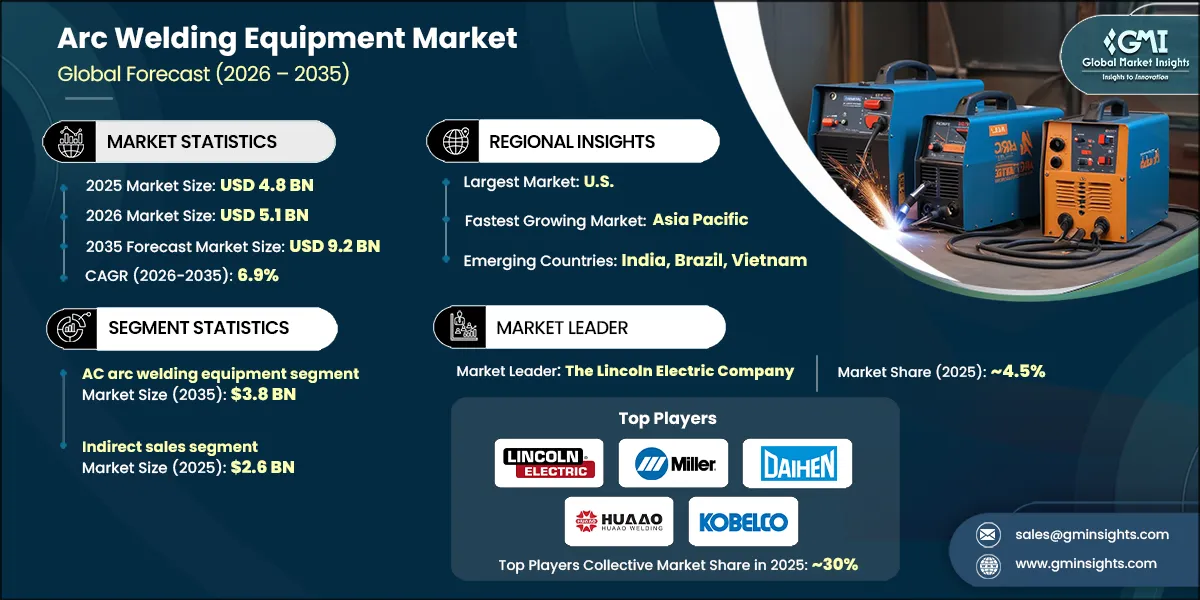
The global arc welding equipment market was estimated at USD 4.8 billion in 2025. The market is expected to grow from USD 5.1 billion in 2026 to USD 9.2 billion in 2035 at a CAGR of 6.9% according to latest report published by Global Market Insights Inc.
To get key market trends
Regulations governing workplace practices and design of arc welding equipment greatly influence the demand for required systems and ancillary safety equipment in many industries. The Occupational Safety and Health Administration (OSHA) has established a number of regulations (1910.254, 1926.351, 1910.252, and 1915.56) which require employers to have their arc welding equipment comply with mandatory technical standards in general industry, construction, and maritime. The regulations set forth many requirements, such as voltage limits (maximum AC manual welding voltage of 80V; maximum DC manual welding voltage of 100V), require insulated electrode holders and electrodes, require that arc welding machines be grounded when used, and a ventilating system must provide a minimum airflow of 2000 CFM per welder when working in enclosed spaces. According to the UK’s Health and Safety Executive (HSE), the International Agency for Research on Cancer (IARC) classifies all welding fumes as Group 1 carcinogenic substances that can lead to lung cancer and potentially kidney cancer. When welded, the concentration of respirable manganese is often greater than the workplace exposure limit of 0.05 mg/m³; those without effective controls can suffer neurological effects similar to those of Parkinson’s disease.
Arc Welding Equipment Market Report Attributes
| Key Takeaway | Details |
|---|---|
| Market Size & Growth | |
| Base Year | 2025 |
| Market Size in 2025 | USD 4.8 Billion |
| Market Size in 2026 | USD 5.1 Billion |
| Forecast Period 2026 - 2035 CAGR | 6.9% |
| Market Size in 2035 | USD 9.2 Billion |
| Key Market Trends | |
| Drivers | Impact |
| Stringent Safety Regulations | Global compliance requirements are accelerating adoption of advanced, automated welding systems, boosting demand for high-tech equipment across industrial sectors. |
| Sustained Steel Production and Infrastructure Build-out | Rising steel output and infrastructure investments worldwide are expanding fabrication activities, directly driving higher consumption of arc welding machines and consumables. |
| Health Risk Awareness Encouraging Safer Technologies | Growing emphasis on occupational health is pushing manufacturers toward fume-control and ergonomic solutions, creating a premium segment for safety-focused welding equipment globally. |
| Pitfalls & Challenges | Impact |
| High Capital and Integration Costs | Significant upfront investment requirements are limiting adoption among SMEs, slowing global penetration of advanced welding technologies. |
| Technical Skills Shortage and Compliance Burden | Lack of skilled operators and complex regulatory demands are creating operational bottlenecks, restraining market growth and delaying technology upgrades worldwide. |
| Opportunities: | Impact |
| Expansion of Renewable Energy and Green Infrastructure Projects | Global investments in renewable energy, such as wind farms, solar plants, and green hydrogen facilities are projected to surge as governments push for decarbonization. These projects require extensive steel fabrication and structural welding, creating a significant demand for arc welding equipment. |
| Development of AI-Driven and IoT-Enabled Welding Solutions | The integration of artificial intelligence and IoT into welding systems enables predictive maintenance, real-time quality monitoring, and remote diagnostics, features highly valued in large-scale manufacturing and construction. By leveraging these technologies, companies can reduce downtime, improve weld consistency, and optimize resource utilization. |
| Market Leaders (2025) | |
| Market Leaders |
Market share of ~4.5% |
| Top Players |
|
| Competitive Edge |
|
| Regional Insights | |
| Largest Market | U.S. |
| Fastest growing region | Asia Pacific |
| Emerging countries | India, Brazil, Vietnam |
| Future outlook |
|
What are the growth opportunities in this market?
Welding is recognized as a known carcinogen (group 1) by CCOHS and has increased the need for adequate ventilation systems, local exhaust systems, and respiratory protection. The OSHA standard requiring eye protection helmets with insulating properties against heat and electricity, fire resistance, and protection of the face, neck, and ears, along with specific filter plate shade numbers for each electrode size in shielded metal arc welding (SMAW) (shade number 10 for electrodes of 1/16 to 5/32 inches) increases the demand for ventilation, local exhaust systems maintaining a minimum of 100 linear feet per minute velocity at the welding area, and use of airline respirators. Together, these comprehensive safety requirements will create a continuing requirement for the development of new equipment that incorporates safety features, integrated fume extraction systems, superior PPE (welding helmets and respiratory protection), and lower emissions than current consumables. Estimates indicate that the new equipment will generate approximately a 25% increase in the compound annual growth rate (CAGR).
The arc welding equipment market has continued to experience an extremely high rate of growth since the 1980s and will likely continue such high growth through the early part of the next decade. The expected stabilization of global steel production at 1.75 billion tons in 2025, with a subsequent increase of 1.3% in 2026, supports the continued strength of these industries that are highly dependent on steel. Based on projections made by the World Steel Association's Short Range Outlook report (October 2025), the continuing growth of the steel industry will keep on expanding the need for welding consumables and welding equipment. During this period, Indian Steel consumption was expected to rise by approximately 9% over 2025-2026 as a result of their growing infrastructure and manufacturing sectors; whereas, The three developing countries of Vietnam, Egypt and Saudi Arabia are expected to be at the forefront of continued growth in developing markets. The US is projected to hold the largest single market share for AWE in 2025 at approximately 38.2% of total global AWE sales. The primary drivers of continued growth in AWE sales in the US are anticipated to be ongoing and expansive investments in modernizing the country's infrastructure, expansion of defense manufacturing, expansion of the energy sector, including construction of oil and natural gas pipelines and installation of renewable energy generation facilities. Within North America, the automotive industry, particularly electric vehicles (EVs), is anticipated to stimulate demand for specialized welding equipment including battery assembly welds, hairpin joins in electric motors, and lightweight aluminum fabrication of vehicle body panels that require precision in heat control. Additionally, as the construction industry begins to rebound following pandemic-related disruptions, the demand for structural steel fabrication equipment to make and erect buildings, bridges, stadiums, as well as heavy civil engineering activities including industrial facilities has become vital to the continued growth of AWE sales.
Arc Welding Equipment Market Trends
All types of arc welding equipment (power sources, wire feeders, welding guns, torches, electrodes, and additional accessories) are used in a variety of manual, semi-automatic and fully-automated welding processes. Customers in this market are found in all end-use industries such as automotive, construction, shipbuilding, oil & gas, power generation, aerospace, and general fabrication. Types of arc welding equipment include both AC (alternating current) and DC (direct current). Inverter-based arc welding systems are being more widely adopted because they consume less energy and provide more control of the welding arc than do transformer-based systems.
- Due to a skilled workforce shortage and the need for consistent quality in welding processes, there is a growing interest in robotic welding equipment among companies operating in the industrial sector. The American Welding Society (AWS) estimates that by 2028, the U.S. will be short approximately 330,000 welders, resulting in increased investment in automation solutions for the industry. Lincoln Electric recently exhibited its new Cooper Adapt collaborative welding system and advanced robotic welding cells with a laser-guided assembly process at FABTECH 2025; Fronius has created a model specifically designed for smaller businesses called the CWC-S Cobot Welding Cell that does not require prior programming expertise to operate. The Millier Electric Company has released the Copilot Builder collaborative robotic welding system, which provides an easy and flexible way to create modular welding systems that can be reconfigured based on the needs of the user. ESAB announced in September 2025 that it had acquired EWM GmbH for about $318 million as part of its larger strategy to expand into advanced automation and heavy industrial machinery. Additionally, the availability of 7-axis cobot arms (demonstrated by Kassow Robots and integrated into companies including Spartan Robotics) allows for greater flexibility in welding complex shapes, especially in tight spaces.
- In the era of Industry 4.0, arc welding has been altered with the integration of Internet of Things (IoT) technology through the incorporation of wireless data for real-time analysis, cloud-based production monitoring, and predictive maintenance. Many welding machines come equipped with built-in sensors that relay information about welding parameters (e.g., current, voltage, wire feed speed, gas flow) to central management systems for immediate feedback on the quality of welds and optimizations of weld processes. For example, Ford's Dunton plant in the UK utilizes 5G-connected sensors in its laser welding of EV battery components to produce as much as 500,000 data points per minute, and AI-based predictive maintenance systems are processing that data in milliseconds. Lincoln Electric provides IoT-based monitoring solutions that allow customers to view arc-on time records, wire deposition rates, overall equipment effectiveness (OEE), and automated alerts when weld parameters fall outside of specifications. Fronius offers its WeldCube Premium software, which tracks and documents each weld's welding parameters and is fully integrated with its enterprise resource planning (ERP) and manufacturing execution systems (MES). Cellular (4G/5G) and eSIM technology provides means for securely connecting and scaling distributed welding operations with over-the-air (OTA) activation.
- The demand for more energy-efficient welding products and for reduced- emissions welding consumables is primarily influenced by corporate sustainability commitments and environmental regulation implementation. The ESAB Rustler EM 280 PRO will be available in 2025 and will utilize power factor correction (PFC) technology to provide full output at 30 amps compared to a 50-amp requirement with older technology – thus providing an energy efficiency rating of 82% in energy saver mode. In addition, Miller Electric introduced FabCOR Element XP metal core wire which can reduce emissions by up to 25% over other metal core wires, as well as Bernard Clean Air E MIG guns capturing up to 95% of weld fumes generated at the welding point. The U.S. Environmental Protection Agency's National Emission Standards for Hazardous Air Pollutants (NESHAP) for Metal Fabrication and Finishing (40 CFR Part 63 Subpart XXXXXX) outline the implementation of management practices to minimize the emission of cadmium, chromium, lead, manganese and nickel compounds during welding. Facilities that burn 2,000 pounds or more of MFHAP welding rods each year are subject to follow three different levels of compliance with specific visible emissions monitoring procedures and/or the possible installation of fume capture systems. In addition, Fronius shared LCA data during public events, demonstrating the environmental benefits of using better resource efficiency in filler metals, shielding gases, and energy to minimize a customer's impact on the environment.
Arc Welding Equipment Market Analysis
Learn more about the key segments shaping this market
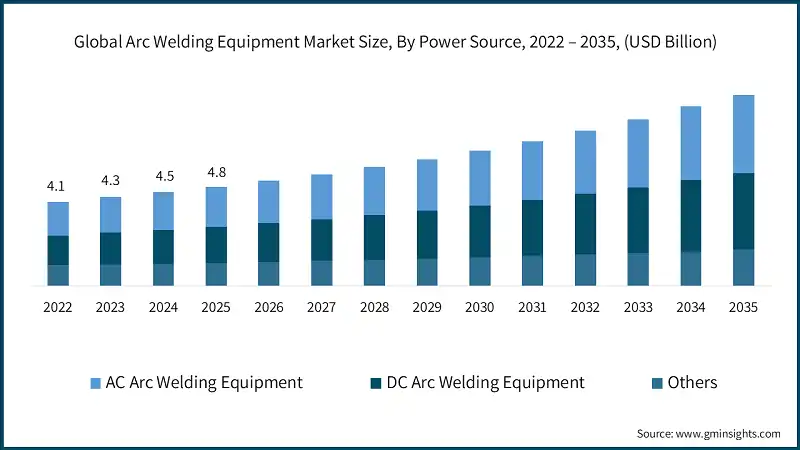
Based on power source, the market is segmented into AC arc welding equipment, DC arc welding equipment, and others. The AC arc welding equipment was valued at USD 1.9 billion in 2025 and is projected to reach USD 3.8 billion by 2035.
- AC Arc Welding Equipment held 40.3% of the total market in 2025 and is expected to have a compound annual growth rate (CAGR) of 7% through 2035 due to the characteristics of the product and competitive pricing. AC welding equipment does well in projects that incorporate magnetic arc deflection, including projects that use Gas Tungsten Arc Welding (GTAW) or Tungsten Inert Gas welding (TIG) when using aluminum because the alternating current (AC) removes the oxide during the electrode negative half cycle of welding, while the heat is produced during the electrode positive half cycle of welding. OSHA sets the maximum open-circuit voltage threshold of the AC manual arc welding and cutting to a maximum of 80 volts and to a maximum of 100 volts for AC automatic arc welding and cutting. This further defines how manufacturers have developed and designed their equipment to meet OSHA's safety requirements.
- The Welding Journal from the American Welding Society indicates that aluminum must be welded using certain equipment configurations, including the use of AC/DC. TIG (TIG) capability to weld materials that include aluminum, steel, and stainless steel. Products, such as the Miller Multimatic 220 AC/DC Multiprocess, show advancement in the welding equipment. The Multimatic 220 AC/DC Multiprocess automatically switches the welding gas when the polarity is switched between AC and DC and when a user switches between MIG and TIG. It is also offered with a wireless foot pedal option, which eliminates the difficulty of management of cables.
- Due to the initial purchase price being much cheaper than sophisticated DC inverter systems, the AC equipment segment has become very popular with small manufacturers, repair facilities, and schools who cannot afford sophisticated DC inverters. Continued growth of this segment from small manufacturers, service shops and schools along with other factors such as the continued growth of the automotive, aerospace and marine industries as well as the increased technological capability of industrial-grade AC power supplies (better arc stability and operation via inverter-based AC systems) have contributed to this 7 % CAGR forecast for the AC equipment segment.
Learn more about the key segments shaping this market
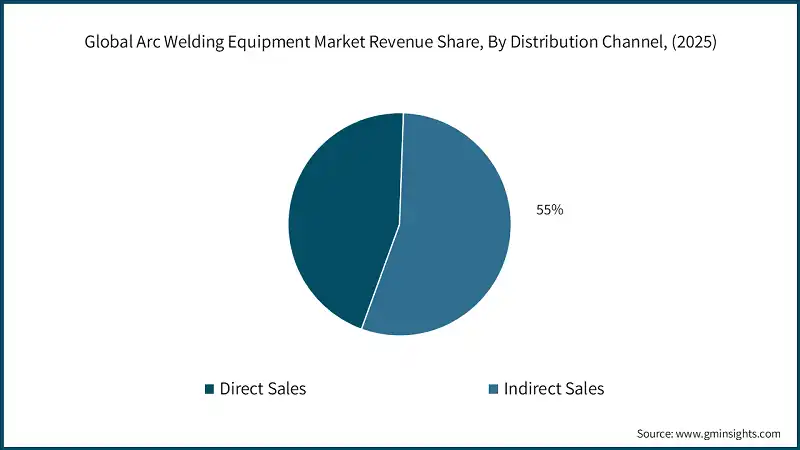
Based on distribution channel, the arc welding equipment market is segmented into direct sales and indirect sales. The indirect sales segment was worth USD 2.6 billion in 2025 with a market share of around 55%.
- By 2025, distributors, dealers, and industrial supply retailers via indirect sales accounted for a 55% market share and are projected to have maintained a growth rate of 6.6%. These indirect sales channels have created an ideal mechanism to cover the market for standard products, consumables, small and medium-sized customers, aftermarket parts, and geographic markets devoid of direct access or coverage by a manufacturer’s own direct sales force, as well as having the potential to develop additional capabilities through other indirect sales business models. In addition to broadening the geographic market reach to small fabricators, maintenance facilities, installers and individual welders in secondary and tertiary markets that manufacturers have not found to be economically viable for direct sales force coverage, the indirect business model offers many strategic advantages. Advantages include: Inventory availability allowing for immediate delivery of product (equipment and consumables) to support replacement and emergency purchases where the cost of production downtime exceeds the premium pricing for rapid availability. Product breadth offered by multiple suppliers providing the user opportunities to compare products based on specifications and pricing, while allowing distributors to provide application support across multiple competing brands. Local technical support provided by distributor personnel that are knowledgeable about their specific region's particular industry, application and customer base; providing users assistance that may include basic training on how to use or operate welding equipment, troubleshooting support and warranty coordination. The indirect sales channel holds a dominant market share of transactions involving manual welding equipment priced at less than $15,000 (e.g., equipment consumables, electrodes, welding wire, shielding gases; replacement parts; welding personal protective equipment such as helmets, gloves, jackets; and ancillary equipment such as welding tables, clamps, and positioning devices).
- Leading distributors of welding supplies tend to have large networks of retail locations that serve their regions. For example, Airgas, an Air Liquide company, has hundreds of retail locations throughout North America, offering many different brands of welding equipment, as well as selling industrial gases and welding supplies. Other regional distributors, such as Vern Lewis Welding Supply, also provide similar offerings, but with more personal connections with their customers due to being based closer to home. Finally, companies like Grainger Industrial Supply and MSC Industrial Direct are "generalist suppliers," and stock thousands of types of industrial supplies in their catalogs to be sold to the millions of maintenance departments and manufacturing companies purchasing diverse products. The American Welding Society has partnered with ESAB to sponsor the 2025 "Blue Collar Tour" of the Western Welding Academy, which provides equipment to student participants of the tour and has plans to donate welding helmets to each of the high schools in their footprint in an effort to promote students to consider careers in the skilled trades.
Looking for region specific data?
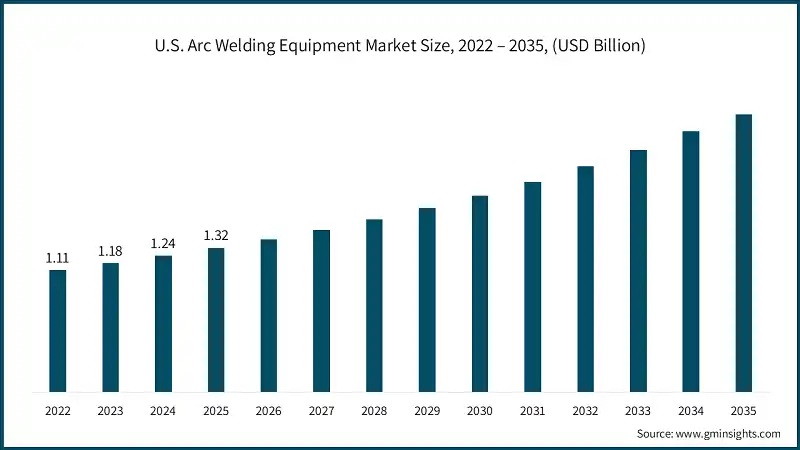
The U.S. arc welding equipment market was valued at around USD 1.32 billion in 2025 and is anticipated to register a CAGR of 6.9% between 2026 and 2035.
- North America dominated the market with 38.2% share in 2025 and projects 7.1% CAGR through 2035, driven by the U.S.’s position as the single largest national market supported by extensive manufacturing infrastructure, stringent regulatory environment mandating equipment upgrades, and robust demand across automotive, aerospace, defense, construction, oil and gas, and power generation sectors.
- The regulatory landscape significantly influences North American equipment demand: OSHA's comprehensive standards (1910.254 for general industry, 1926.351 for construction, 1910.252 for general welding requirements, 1915.56 for maritime applications) establish mandatory technical specifications for electrode holders, cables, connectors, grounding, open circuit voltages, and operational procedures.
- EPA's National Emission Standards for Hazardous Air Pollutants (NESHAP) under 40 CFR Part 63 Subpart XXXXXX require facilities using ≥2,000 lbs/year of MFHAP welding rod to implement emissions management practices including fume capture systems, visible emissions monitoring, and potential site-specific management plans, driving sustained investment in compliant equipment and fume extraction systems.
- The United States' defense and aerospace sectors represent particularly demanding customers requiring advanced welding equipment with stringent quality certifications, comprehensive traceability, and often clearances for sensitive applications; Lincoln Electric's partnership with the U.S. Navy's Maritime Industrial Base Program and General Dynamics Electric Boat for additive manufacturing in submarine production exemplifies the defense sector's technology adoption.
- The American Welding Society's September 2025 announcement that the U.S. Department of Labor approved its Welding Automation Specialist National Guideline Standard (NGS) establishes a nationally recognized apprenticeship framework for training professionals in automated welding, addressing the skills shortage while potentially accelerating automation adoption through availability of qualified operators.
- Canada contributes meaningfully to the North American market through its manufacturing sector, oil sands operations requiring extensive pipeline welding and facility construction, and progressive occupational health regulations; the Canadian Centre for Occupational Health and Safety emphasizes requirements for adequate ventilation, local exhaust systems, and selection of lower fume-generating processes.
The Asia Pacific arc welding equipment market was valued at around USD 1.4 billion in 2025 and is anticipated to register a CAGR of 7.8% between 2026 and 2035.
- Asia Pacific held 28.3% market share in 2025, propelled by rapid industrialization in India and Vietnam, sustained manufacturing activity in China despite economic headwinds, technological leadership and quality emphasis in Japan and South Korea, and infrastructure investment across the region. India emerges as the growth leader with forecasted 9% steel consumption increase over 2025-2026 driven by continued expansion across infrastructure and manufacturing sectors, directly translating into welding equipment demand for structural fabrication, pipeline construction, automotive production, and shipbuilding. Vietnam's identification as a growth leader among developing markets reflects its role in manufacturing supply chain diversification as companies establish production capacity for electronics, automotive components, consumer goods, and other fabrication-intensive industries previously concentrated in China.
- China remains the largest national market in Asia Pacific despite slowing growth, with massive shipbuilding industry, automotive production, construction activity, and machinery manufacturing creating sustained equipment demand; the Chinese manufacturer Jinan Huaao Electric Welding Machine represents domestic equipment suppliers competing with global brands on price while improving quality and capabilities. Japan and South Korea contribute high-value segments: Japanese manufacturers including Panasonic Welding Systems, Daihen Corporation, OTC Daihen, Kobe Steel (Kobelco), and Denyo emphasize quality, reliability, and technological innovation serving domestic manufacturing sectors and export markets; South Korea's shipbuilding industry (a global leader) demands advanced welding equipment and automation for hull construction and assembly.
- The Asia Pacific's 7.8% CAGR reflects several powerful drivers: infrastructure investment in developing economies requiring extensive steel fabrication; automotive production growth particularly in electric vehicle manufacturing with specialized joining requirements; shipbuilding activity concentrated in China, South Korea, and Japan; electronics manufacturing requiring precision joining; and gradual adoption of automation technologies as labor costs rise and quality requirements tighten. Fronius's Tech Day Series 2025 held across Indian locations (June-November 2025) providing hands-on experience with MIG/MAG through advanced CMT and LaserHybrid systems, robotic systems, automation systems, and manual welding innovations demonstrates major manufacturers' commitment to regional market development through technical training and technology showcase events.
Europe Arc welding equipment market was valued at around USD 1 billion in 2025 and is anticipated to register a CAGR of 6.2% between 2026 and 2035.
- Europe accounted for 21.2% market share in 2025 with 6.2% CAGR, characterized by mature industrial economies, emphasis on energy efficiency and environmental compliance, strong automotive and machinery manufacturing sectors, and technology leadership in automation and digitalization.
- Germany, the United Kingdom, and France represent primary markets, with Germany's position as Europe's manufacturing powerhouse supporting demand across automotive (particularly premium brands emphasizing quality and automation), machinery and equipment manufacturing, and renewable energy sectors including wind turbine fabrication. The UK Health and Safety Executive's classification of all welding fumes as Group 1 carcinogens and emphasis on manganese exposure limits (0.05mg/m³ 8hr TWA frequently exceeded without controls) reflects Europe's strict occupational health standards driving fume extraction equipment adoption and low-emission consumables demand.
- European equipment manufacturers including Fronius International (Austria), EWM GmbH (Germany being acquired by ESAB), and Kemppi (Finland) contribute innovation particularly in digitalization, with Fronius's WeldCube welding data management systems and Pathfinder offline programming software exemplifying European technology leadership.
- The European market emphasizes sustainability: Fronius's presentation of Life Cycle Analysis insights helping customers minimize carbon footprints and ESAB's focus on energy efficiency with 82% efficient power sources meeting EU Ecodesign Directives align with European environmental priorities. The Schweissen & Schneiden trade fair in Essen, Germany (September 15-19, 2025), where Fronius launched its manual next-level MIG/MAG welding system and showcased automation solutions, represents a premier European industry event demonstrating market vibrancy. Europe's moderately lower 6.2% CAGR compared to North America and Asia Pacific reflects market maturity, economic uncertainties, and modest manufacturing output growth, though technology replacement demand, automation adoption in response to high labor costs, and environmental compliance requirements sustain steady market expansion.
Arc Welding Equipment Market Share
- The top 5 companies in the arc welding equipment industry, such as The Lincoln Electric Company, Miller Electric Mfg. (part of ITW Welding), Daihen, Jinan Huaao Electric Welding Machine, and Kobe Steel (Kobelco) hold a market share of 30%.
- With an estimated global market share of approximately 4.5%, Lincoln Electric is one of the leading manufacturers of welding equipment and has the largest product portfolio in the industry, which includes manual welding equipment (stick, MIG, and TIG), engine-driven field welders, robotic and automated welding systems, cutting systems, consumables (welding wire and electrodes), and aftermarket products and services. Lincoln's competitive advantages stem from its solid brand recognition and reputation for quality and service established over a history of more than 130 years; a strong distribution network consisting of direct sales via this website (40 locations worldwide) and through thousands of distributors/dealers globally; the Company's position as the technology leader in the industry with innovations such as the collaborative welding system known as Cooper Adapt; the ArcAdjust Real-Time Adjustment Control Solution; the Flex Lase Handheld Laser Welding Systems; the additive manufacturing/3D printing capability; and the infrastructure created to support customers with services like the Welding Technology and Training Center (WTTC), which contains 155 welding/cutting booths and VR Training Labs; strategic alliances such as the recent collaboration announced on September 22, 2020, between the U.S. Navy's Maritime Industrial Base program and General Dynamics Electric Boat to further develop 3D metal printing for the production of nuclear submarines.
- As a subsidiary of Colfax Corporation, ESAB Corporation (the operating name following corporate restructuring) is the second-largest global player with approximately 4–5% of the market share. Its strong position within this market is driven further by consumables and cutting equipment that complement ESAB's welding power source and automation business lines. The announcement made by ESAB in September 2025 regarding the acquisition of EWM GmbH (headquartered in Germany) for approximately $318 million enhances ESAB's position in terms of heavy industrial equipment and advanced automation capability; this transaction is expected to be completed in the second half of 2025. This acquisition demonstrates ESAB's growth strategy of combining organic product development with selective acquisitions to expand their technology capabilities as well as their market access. As part of ESAB's competitive strategy, energy efficiency and compliance with environmental regulations are emphasized through products like the Rustler EM 280 PRO, which has achieved an energy-use rating of 82% energy efficiency using Power Factor Correction technology that is compliant with EU Ecodesign Directives. Other competitive technology strategies include: portable and mobile welding systems, exemplified by the Renegade VOLT ES 200i, which is a battery-powered MIG/TIG welding machine that is the only battery-powered model on the market with swappable batteries and can produce up to 200 amps; multi-process welding machines, such as the Rebel EMP 215ic, which allow users to perform MIG, Flux-Cored, TIG, and Stick welding processes, and incorporate sMIG (Smart MIG) technology that improves arc stability; industrial automation solutions for welding, such as the Warrior Edge 500DX/RobustFeed Edge DX, which enable professional welders to work more quickly by providing advanced welding modes (Speed, Pulse, Thin, Root) that result in higher travel speeds and improved puddle control.
- Fronius International has about 3-4% of the global market share and uses digitalization, software integration, and advanced technological processes to differentiate itself from competitors, rather than through large-scale production or a wide range of products offered by some of its competitors. The company’s primary niche differentiating Fronius includes: WeldCube Premium - software that provides full traceability of weld data and seamlessly integrates with MES/ERP systems; Pathfinder - software that allows for offline programming of robots, achieving up to a 90% reduction in time needed compared with teaching robots via their controllers; Cold Metal Transfer (CMT) Technology - the company has 20 years of experience developing precision methods for removing spatter when joining metals, as well as developing new additive (3D printing) applications for such materials; CWC-S Cobots/Cells designed specifically for small and medium-sized enterprises. This equipment is designed so anyone can learn to use it in a matter of hours without prior programming knowledge; and Full automation solutions utilizing intelligent sensors (SeamTracking, TouchSense, WireSense), HMI-T21 RS control systems (providing real-time visual feedback on process performance), and ArcView 2 cameras to monitor the weld pool during production.
Arc Welding Equipment Market Companies
Major players operating in the arc welding equipment industry are:
- Ador Welding
- Amada Miyachi America
- Arcon Welding Equipment
- CLOOS Welding Equipment
- Daihen
- Denyo
- ESAB
- Fronius International
- Illinois Tool Works (ITW Welding)
- Jinan Huaao Electric Welding Machine
- Kobe Steel (Kobelco)
- Miller Electric Mfg. (part of ITW Welding)
- OTC Daihen
- Panasonic Welding Systems
- The Lincoln Electric Company
Illinois Tool Works (ITW) Welding Segment, operating primarily through Miller Electric Manufacturing and Hobart Filler Metals brands alongside Bernard and Tregaskiss (consumables and accessories), generated approximately $447 million revenue in Q4 2024 representing 11.65% of ITW's total revenue. This translates to estimated annual welding segment revenue of ~$1.8 billion, though global arc welding equipment market share likely approximates 3-4% considering Miller's primary strength in North America with more modest international presence. Miller Electric's competitive positioning centers on: innovation leadership in safety and ease-of-use with products like ClearLight 4x Lens Technology offering up to 4x clarity of 1/1/1/1 ANSI-certified lenses allowing welders to keep helmets down between tasks; collaborative robotics through the Copilot Builder system with modular, reconfigurable design and the February 2025 strategic partnership with Novarc Technologies developing AI-powered adaptive welding solutions; laser welding adoption via OptX handheld laser welders (1kW and 2kW models) boosting productivity up to 10 times versus traditional welding while minimizing distortion and spatter; future-proof equipment exemplified by the Millermatic 211 PRO with USB-enabled software updates ensuring equipment currency throughout service life; and comprehensive ecosystem including equipment, consumables (Hobart filler metals), guns/torches (Bernard, Tregaskiss), fume extraction (FILTAIR systems), and PPE.
Arc Welding Equipment Industry News
- In September 2025, ESAB Corporation announced agreement to acquire EWM GmbH (Germany) for approximately $318 million. The transaction, expected to close in the second half of 2025, strengthens ESAB's heavy industrial welding equipment and advanced automation capabilities, bringing German engineering expertise and comprehensive product portfolio to complement ESAB's existing offerings. The strategic acquisition reflects industry consolidation trends and ESAB's commitment to expanding automation technology capabilities.
- In September 2025, Lincoln Electric showcased innovation at FABTECH 2025 in Chicago (September 8-11), unveiling the Cooper Adapt collaborative welding system featuring multi-zone workspace, extended reach via track-mounted cobot arm, and lower investment versus traditional robotic cells. The company also introduced the AlumaFab Aluminum Welding System (developed with MK Products), LT-10D Submerged Arc Welding Tractor, Flextec Power Sources, ArcAdjust Real-Time Adjustment Control Solution, and CQI-15 Compliant Robotic Welding Cell emphasizing quality control and automation standards. Live demonstrations featured collaborative welding, full automation line builds, and laser welding and cutting solutions.
- In September 2025, Lincoln Electric launched the Flex Lase Handheld Laser Welding System, a powerful 2kW solution designed for high-precision welds at significantly faster travel speeds, addressing growing demand for laser joining technologies in fabrication shops and automotive applications.
- In September 2025, Lincoln Electric partnered with the U.S. Navy's Maritime Industrial Base Program and General Dynamics Electric Boat to advance additive manufacturing for submarine production, installing four SculptPrint 1500 additive manufacturing cells to accelerate integration of 3D metal printing into construction of nuclear-powered submarines. The partnership demonstrates defense sector adoption of advanced manufacturing technologies.
- In August 2025, The American Welding Society (AWS) received approval from the U.S. Department of Labor for its Welding Automation Specialist National Guideline Standard (NGS), establishing a nationally recognized apprenticeship framework for training skilled professionals in automated welding. This workforce development initiative addresses the critical skills shortage constraining further automation adoption, with AWS projecting a welder shortfall of approximately 330,000 positions by 2028.
The arc welding equipment market research report includes in-depth coverage of the industry, with estimates & forecasts in terms of revenue (USD Billion) and volume (Thousand Units) from 2022 to 2035, for the following segments:
Market, By Welding Technology
- Shielded metal arc welding (SMAW)
- Gas metal arc welding (GMAW/MIG)
- Flux-cored arc welding (FCAW)
- Gas tungsten arc welding (GTAW)
- Submerged arc welding (SAW)
- Others (plasma arc welding (PAW), etc.)
Market, By Power Source
- AC arc welding equipment
- DC arc welding equipment
- Others
Market, By End Use Industry
- Automotive & transportation
- Heavy industry & fabrication
- Construction & infrastructure
- Shipbuilding & marine
- Aerospace & defense
- Energy and power
- Oil and gas
- Others
Market, By Distribution Channel
- Direct sales
- Indirect sales
The above information is provided for the following regions and countries:
- North America
- U.S.
- Canada
- Europe
- Germany
- U.K.
- France
- Italy
- Spain
- Asia Pacific
- China
- Japan
- India
- South Korea
- Australia
- Latin America
- Brazil
- Mexico
- Argentina
- MEA
- UAE
- Saudi Arabia
- South Africa
Frequently Asked Question(FAQ) :
What was the valuation of indirect sales segment in 2025?
Indirect sales held 55% market share and generated USD 2.6 billion in 2025.
What is the current arc welding equipment market size in 2026?
The market size is projected to reach USD 5.1 billion in 2026.
How much revenue is the AC arc welding equipment segment expected to generate by 2035?
AC arc welding equipment generated USD 1.9 billion in 2025 and is projected to reach USD 3.8 billion by 2035.
What is the projected value of the arc welding equipment market by 2035?
The arc welding equipment market is expected to reach USD 9.2 billion by 2035, propelled by industrial automation, infrastructure development, and sustainability initiatives.
What is the market size of the arc welding equipment in 2025?
The market size was USD 4.8 billion in 2025, with a CAGR of 6.9% expected through 2035 driven by stringent workplace safety regulations and evolving equipment design standards.
What is the growth outlook for the Asia Pacific arc welding equipment market from 2026 to 2035?
Asia Pacific is projected to grow at a 7.8% CAGR through 2035, driven by rapid industrialization in India and Vietnam, and sustained manufacturing activity across the region.
Which region leads the arc welding equipment market?
The U.S. held 38.2% share with USD 1.32 billion in 2025. Extensive manufacturing infrastructure and stringent regulatory environment fuel the region's dominance.
What are the upcoming trends in the arc welding equipment market?
Key trends include adoption of robotic welding systems, IoT-enabled real-time monitoring, AI-driven predictive maintenance, and increasing demand for energy-efficient and low-emission welding solutions.
Arc Welding Equipment Market Scope
Related Reports