Summary
Table of Content

Apparel Market
Get a free sample of this report
Form submitted successfully!
Error submitting form. Please try again.
Thank you!
Your inquiry has been received. Our team will reach out to you with the required details via email. To ensure that you don't miss their response, kindly remember to check your spam folder as well!
Request Sectional Data
Thank you!
Your inquiry has been received. Our team will reach out to you with the required details via email. To ensure that you don't miss their response, kindly remember to check your spam folder as well!
Form submitted successfully!
Error submitting form. Please try again.
Apparel Market Size
Factors such as an increase in demand for casual wear, athleisure apparel, changing social media trends, higher disposable incomes, and the fast growth of e-commerce platforms are contributing to the rapid growth of the global apparel market. In 2023 the World Bank reported that internet penetration worldwide was 66%, resulting in a large volume of sales through fashion retailers offering affordable, trendy apparel to consumers worldwide.
Apparel Market Key Takeaways
Market Size & Growth
- 2025 Market Size: USD 1.84 Trillion
- 2026 Market Size: USD 1.9 Trillion
- 2035 Forecast Market Size: USD 2.56 Trillion
- CAGR (2026–2035): 3.4%
Regional Dominance
- Largest Market: Asia Pacific
- Fastest Growing Region: North America
Key Market Drivers
- Rising demand for athleisure and casual wear.
- Growth of customization and personalization.
- Increased disposable income.
Challenges
- Market saturation.
- Seasonal fluctuations.
Opportunity
- Rising demand from younger consumers for affordable fragrance.
Key Players
- Market Leader: Inditex led with over 2.3% market share in 2025.
- Leading Players: Top 5 players in this market include Inditex, LVMH, H&M, Fast Retailing, TJX, which collectively held a market share of 7.4% in 2025.
Get Market Insights & Growth Opportunities
As a result of growth in income, the Asia-Pacific and African regions are driving the expansion of the global markets. The International Monetary Fund reported per capita income growing at a rate of 5.3% in the Asia-Pacific in 2023, which has enabled many consumers to have greater participation in the purchase of varied, high-quality apparel. Furthermore, many consumers in countries such as India and Nigeria are experiencing a rise in middle-class spending and the purchasing of apparel.
Fast fashion brands such as Zara and H&M largely contribute to the demand for affordable yet stylish clothing. The Ellen MacArthur Foundation reported an 8% growth rate for the sustainable fashion market in 2023. As consumers continue to become more aware of their purchasing habits, many will increasingly prefer to buy sustainable fashion options over other types of clothing.
Government initiatives are having a positive effect on the industry, and the European Union's Circular Economy Action Plan espouses sustainable production practices. Additionally, the Production Linked Incentive (PLI) Scheme in India for textiles will help to ramp up domestic production and exports; this will drive innovation and growth throughout the entire value chain for apparel.
In conclusion, the apparel market will continue expanding during this forecast period due to numerous factors including advances in technology, changes in consumer behaviour, and numerous supportive governmental policy measures relating to sustainability and digitalization that will shape the future of this market.
The apparel market was valued at USD 1.84 trillion in 2025. The market is expected to grow from USD 1.9 trillion in 2026 to USD 2.56 trillion in 2035, at a CAGR of 3.4%, according to latest report published by Global Market Insights Inc.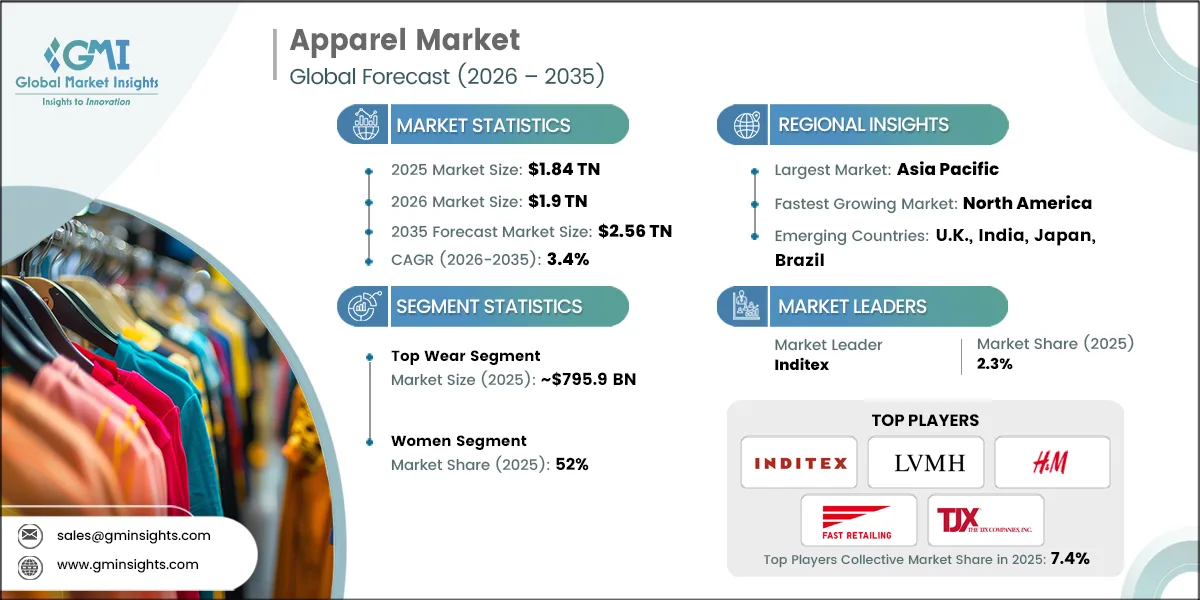
To get key market trends
Apparel Market Trends
Changing innovation and technology transformation are important for the growth of the market.
- The apparel industry is changing, with a trend towards more sustainable products. Eco-friendly materials such as organic cotton, hemp and recycled polyester are becoming popular among consumers. In 2023, production of organic cotton increased by 22%, according to the Textile Exchange, due to an increased awareness of the environment. Brands like H&M and Adidas are moving to sustainable practices, including using plant-based fabrics and dyeing techniques that conserve water, in order to meet consumer demand and adhere to environmental regulations.
- Customization has become a major trend in the apparel industry as consumers want products that are unique to them. Made-to-order clothing, embroidery and monogramming have become increasingly popular. For example, Ralph Lauren offers consumers the service of monogramming its trademark polo shirt, and Nike's By You program allows consumers to design their own sneakers.
- New technology is having an impact on the apparel industry, with the introduction of smart fabrics, wearable electronics and programmed sensors. These technologies increase functional capabilities such as the ability to adapt to temperature and monitor biometric data. For example, the smart jacket created by Levi's and Google offers users the ability to control devices from touch-sensitive fabric, and Under Armour's smart athletic wear helps users track their fitness metrics.
- Global expansion is an important goal for apparel brands as they look to growth in emerging markets. The Asia-Pacific region is seeing a growing middle-class population, which presents big opportunities for brands looking to enter the market. It is predicted by the Asian Development Bank that the region's middle class will reach over 2.5 billion by 2030, providing a very large market for those brands that can capitalize on the growing population. Brands like Zara and Uniqlo are doing their best to grow within these countries through their brands as well; therefore, these companies continue to invest in such countries as India, Indonesia, and Vietnam to leverage the demand for their apparel products.
- The Government's policies are playing an increasing role in determining the size and scope of the apparel market. For example, the European Union has created its Circular Economy Action Plan, which requires all apparel brands to have sustainable production models and to promote "waste-free" production and utilize eco-friendly materials to produce their apparel products.
Apparel Market Analysis
Learn more about the key segments shaping this market
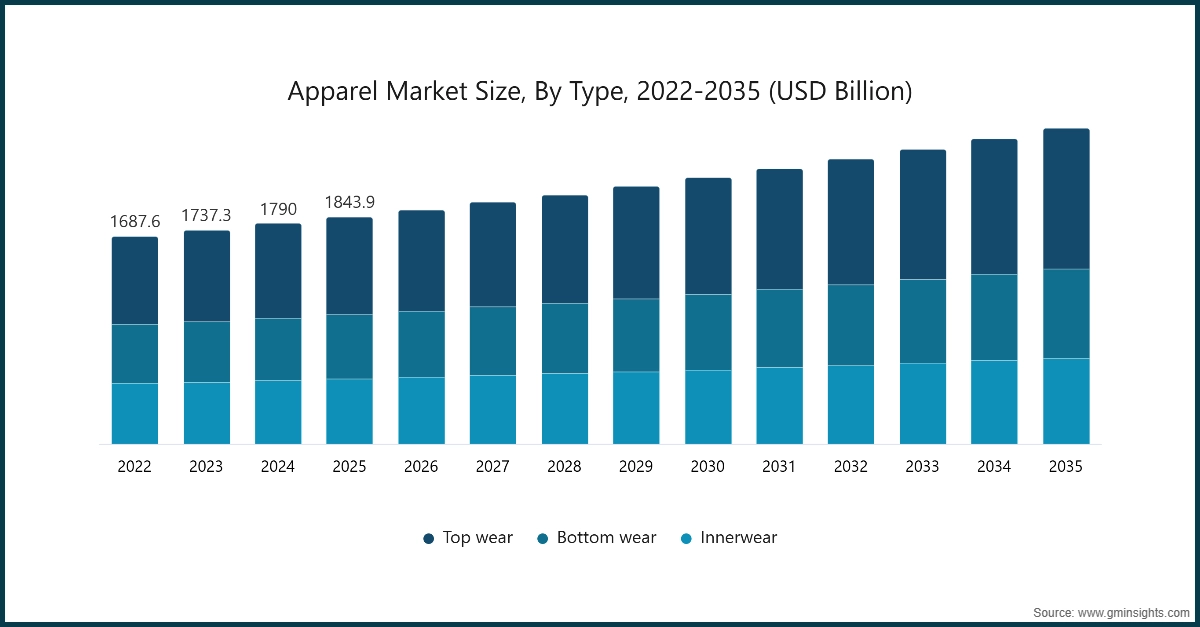
Based on product type, the apparel market is segmented into top wear, bottom wear and innerwear. The top wear segment accounts for revenue of around USD 795.9 billion in the year 2025 and is expected to reach USD 1.14 trillion by 2035.
- The growth of the apparel industry especially in the top-wear category – is due to changing consumer behavior and lifestyle . E-commerce sales of apparel grew by 15% in 2023 according to U.S Census Bureau, with top-wear products like t-shirts and blouses being two of the most purchased types. With more people working from home, there has been an increase in demand for comfy yet stylish pieces of clothing example oversized tees and graphic t-shirts, especially from millennials and Generation Z.
- An additional factor contributing to the growth of the top-wear segment is the increasing demand for gender-neutral apparel. A number of retailers such as H&M and Zara have recently launched unisex collections containing versatile clothing items including casual shirts and blouses that could be worn by anyone, regardless of their body type or personal preference, which aligns with the growing trend of consumers demanding more inclusive and sustainable clothing options.
- Another trend positively influencing designs in the top-wear category is casual sportswear. The materials that are commonly used in making activewear such as breathable and stretchable fabrics, which are being integrated into activewear tops in order to provide comfort as well as improve performance.
- Additionally, tailored high-waisted trousers and skirts paired with formal tops are trending, as they offer a balance between professional and casual attire. This trend is particularly evident in urban markets, where hybrid work models are prevalent.
- Generally, as a result of changing work environments, increased inclusivity and advancements in fabric technologies have resulted in growth of the top-wear segment of the market therefore driving all segments of that market.
Learn more about the key segments shaping this market
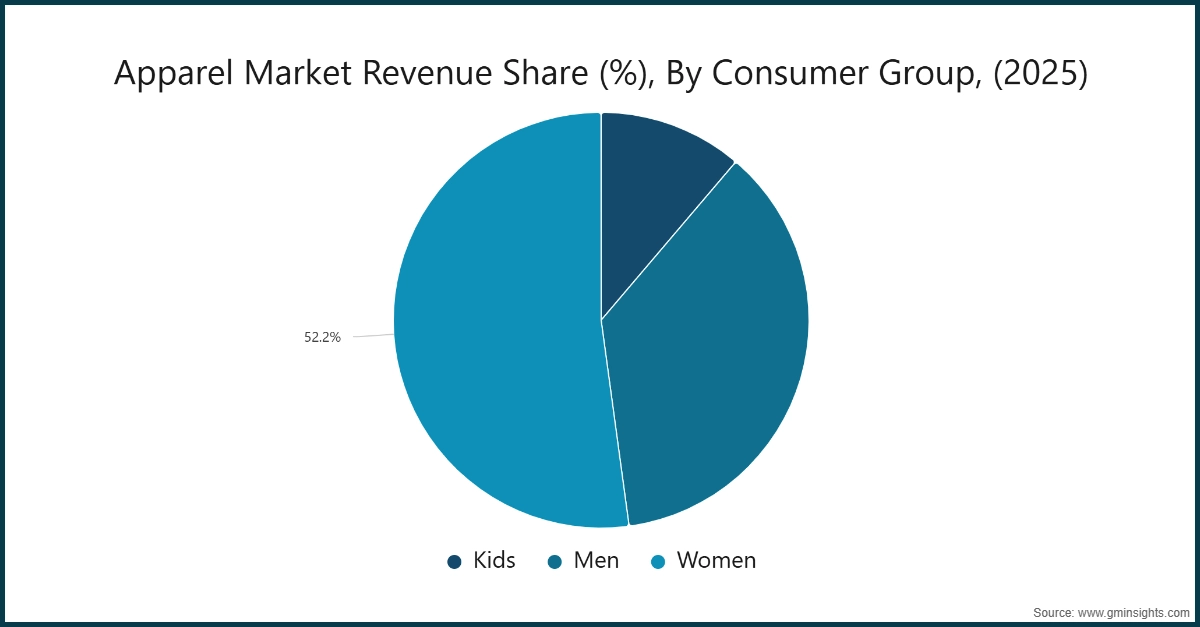
Based on the consumer group, the apparel market is bifurcated into kids, men and women. The women segments held the largest share, accounting for 52% of the market in 2025.
- The women's market has been experiencing substantial growth due to change in consumer behaviour and an increase in purchasing power. As per the U.S. Census Bureau's (2023) research on purchaser activity, women accounted for roughly 70% of overall sales in the apparel market, demonstrating that they are the primary purchasers of clothing. Usage of versatile clothing such as loungewear, sleepwear, and casual dress, which combines both comfort and style and uses soft materials such as cotton, fleece or jersey is driving this growth.
- Another component of the growing women's market is increased eco-consciousness among female consumers. Women want clothing that is produced from sustainable materials such as organic, recycled or upcycled and brands like Patagonia and Eileen Fisher are successfully marketing their eco-friendly manufacturing practices. This trend is correlated with the demand for slow fashion, carbon-neutral production methods and environmentally friendly packaging.
- Additionally, governmental initiatives are supporting the transition toward ecologically- and socially responsible apparel production. For example, the European Union Green Deal and the U.S. Inflation Reduction Act have incentivised sustainable manufacturing processes and thereby indirectly increased the demand for environmentally-responsibly produced clothing.
- Furthermore, as part of the Production Linked Incentive Scheme, the Indian Government's program also focuses on promoting the production of sustainable fabrics. The increase in e-commerce sites has helped to grow women's apparel, as women now have easy access to many types of womens wear.
- The availability of personalized recommendations and the use of online apps that enable women to virtually try on clothes are additional ways to enhance the shopping experience, which leads to increased sales. In general, the women's clothing market is positioned to experience significant growth due to sustainability trends, governmental regulations and advancements in technology used for retailing.
North America Apparel Market
Looking for region specific data?
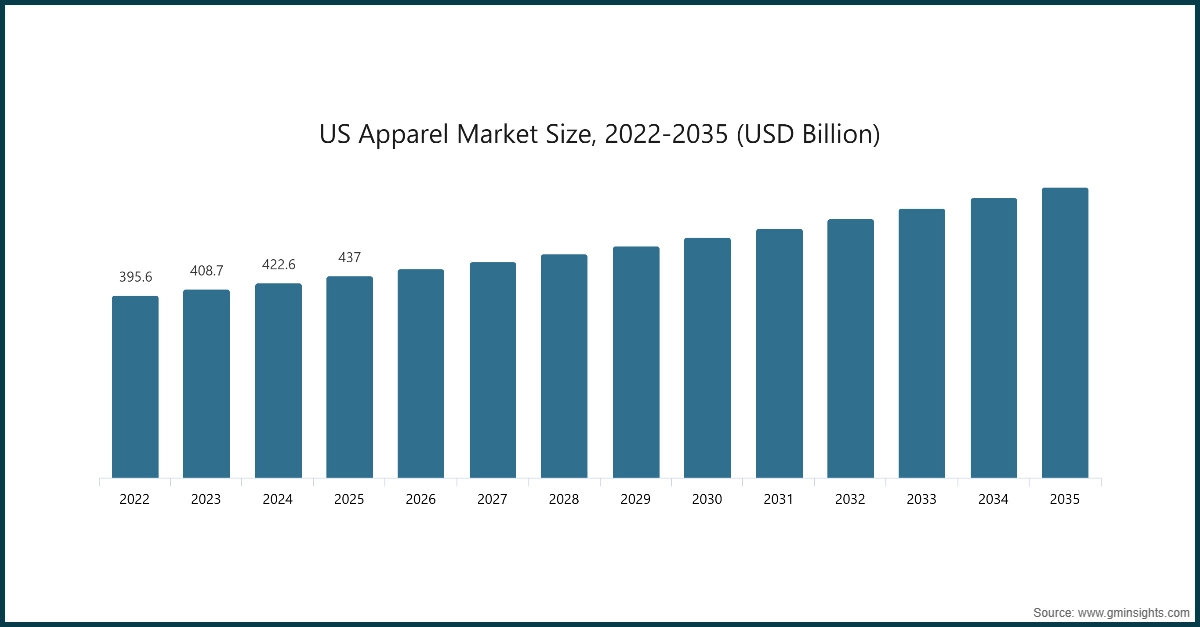
In 2025, the U.S. dominated the apparel market growth in North America, accounting for 79.7% of the share in the region.
- Growth in North America is driven by strong consumer spending patterns supported by high disposable income and a mature retail ecosystem. The U.S. leads due to a diverse apparel landscape across luxury, fast fashion, and athleisure. Robust e‑commerce penetration and rapid adoption of omnichannel services further accelerate market expansion. Innovative product categories, including performance wear and sustainable fashion, also stimulate recurring demand.
- Apparel brands in the region benefit from aggressive digital marketing, influencer-driven trends, and rapid trend cycles that keep consumption high. Retailers increasingly leverage data analytics and personalization to improve customer engagement and conversion. Continuous expansion of off‑price retail formats boosts volume growth across mass‑market consumers. Additionally, rising interest in wellness and active lifestyles fuels consistent growth in sportswear and comfort‑centric apparel.
Asia Pacific Apparel Market
Asia Pacific apparel industry is expected to grow at 3.7% during the forecast period.
- Asia Pacific’s growth is supported by rising middle‑class populations, increasing urbanization, and expanding fashion-conscious youth demographics. Rapid digital adoption encourages strong e‑commerce demand and cross‑border online fashion purchases. Local and global brands continue to scale across emerging markets like India, Vietnam, and Indonesia. The region’s preference for affordable fast fashion and value-driven apparel also reinforces consistent market expansion.
Europe Apparel Market
Europe apparel industry is expected to grow at 3.3% during the forecast period.
- Europe’s market grows steadily due to strong heritage fashion culture, established premium brands, and resilient demand for quality apparel. Sustainability-driven consumption trends encourage innovation in circular fashion, recycled materials, and slow‑fashion categories. E‑commerce integration across traditional retailers enhances accessibility and assortment variety. Additionally, tourism-driven luxury spending contributes positively in key markets like Italy, France, and the U.K.
Middle East and Africa Apparel Market
Middle East and Africa apparel industry is expected to grow at 2.6% during the forecast period.
- Growth in the Middle East and Africa is supported by expanding young populations and increasing adoption of Western fashion trends. Rising urban retail infrastructure, including malls and international brand entries, strengthens apparel accessibility. Digital commerce adoption continues accelerating, especially in Gulf markets with high smartphone penetration. Demand for modest fashion, luxury apparel, and value-driven segments creates a balanced growth environment.
Apparel Market Share
The top companies in the apparel industry include Inditex, LVMH, H&M, Fast Retailing and TJX and collectively hold a share of 7.4% of the market in 2025. These prominent players are proactively involved in strategic endeavors, such as mergers & acquisitions, facility expansions & collaborations, to expand their product portfolios, extend their reach to a broad customer base, and strengthen their market position.
- Inditex operates globally in the apparel market through fast‑fashion brands like Zara, Pull&Bear, Bershka, and Massimo Dutti, delivering rapid trend‑to‑retail collections. It focuses on integrated store‑and‑online sales to distribute fashion apparel worldwide. The company refreshes collections frequently to match fast‑moving consumer tastes. Inditex also invests heavily in store optimisation and logistics to support apparel availability.
- LVMH participates in the apparel market through its luxury fashion and leather goods maisons such as Louis Vuitton, Dior, Fendi, Loewe, and Celine. It designs, manufactures, and sells high‑end apparel driven by craftsmanship, creative direction, and premium positioning. The group expands its fashion influence through flagship stores and experiential retail. Its apparel lines anchor the Fashion & Leather Goods division, the largest contributor to group results.
- H&M operates in the global apparel market by offering affordable, trend‑driven clothing through brands like H&M, COS, Weekday, Monki, and ARKET. It emphasizes fast‑fashion cycles, delivering runway‑inspired styles quickly at mass‑market price points. The group continues expanding its apparel presence via new stores and digital platforms. Sustainability‑linked apparel collections also form a growing part of its core offering.
Apparel Market Companies
Major players operating in the apparel industry are:
- Adidas
- Dior
- Fast Retailing
- Gap
- H&M
- Hermes
- Inditex
- Kering
- LVMH
- Nike
- PVH
- Ralph Lauren
- Tapestry
- TJX
- VF
Fast Retailing competes in the apparel market through UNIQLO and GU, focusing on functional, high‑quality basics and everyday wear. It develops and sells core apparel categories such as fleece, innerwear, outerwear, and seasonal essentials. The company distributes clothing globally through an expanding store network and online channels. UNIQLO’s apparel is centered on simplicity, durability, and proprietary fabric technologies.
TJXv participates in the apparel market as a leading off‑price retailer selling branded and designer clothing at discounted prices through T.J. Maxx, Marshalls, and similar banners. It sources a wide assortment of apparel across categories, offering constant variety through its treasure‑hunt shopping model. The company plays a major role in value‑driven apparel retail. Strong merchandise availability supports consistent apparel turnover in stores.
Apparel Market Report Attributes
| Key Takeaway | Details |
|---|---|
| Market Size & Growth | |
| Base Year | 2025 |
| Market Size in 2025 | USD 1.84 Trillion |
| Market Size in 2026 | USD 1.9 Tillion |
| Forecast Period 2026-2035 CAGR | 3.4% |
| Market Size in 2035 | USD 2.56 Trillion |
| Key Market Trends | |
| Drivers | Impact |
| Rising demand for athleisure and casual wear | The shift toward comfort‑focused lifestyles and hybrid work has pushed consumers to choose versatile athleisure and casual apparel for everyday use. This trend boosts year‑round dema |
| Growth of customization and personalization | Consumers increasingly seek unique apparel that reflects individual style, driving demand for custom prints, tailored fits, and mix‑and‑match designs. This encourages brands to introduce modular styles, on‑demand production, and digital design tools for higher engagement. |
| Increased disposable income | Higher income levels in emerging and mature markets expand consumers’ ability to spend on fashion categories. This strengthens demand for both value‑driven essentials and premium apparel, supporting segment‑wide revenue growth. |
| Pitfalls & Challenges | Impact |
| Market saturation | Fluctuating prices of cotton, synthetics, dyes, and trims increase production costs, pressuring brand margins and retail pricing strategies. This volatility often disrupts supply planning and forces frequent sourcing adjustments. |
| Seasonal fluctuations | Fast‑moving trends and short fashion cycles require brands to constantly update collections and inventory. Failure to align with evolving tastes can lead to excess stock, markdowns, and weakened brand relevance. |
| Opportunities: | Impact |
| Rising demand from younger consumers for affordable fragrance | Gen Z and young millennials drive strong uptake of trend‑forward, affordable apparel refreshed at rapid cycles. This fuels expansion opportunities for brands offering quick design turnaround, digital‑first engagement, and frequent new drops. |
| Market Leaders (2025) | |
| Market Leader |
2.3% market share |
| Top Players |
Collective market share in 2025 is 7.4% |
| Competitive Edge |
|
| Regional Insights | |
| Largest Market | Asia Pacific |
| Fastest growing market | North America |
| Emerging countries | U.K., India, Japan, Brazil |
| Future outlook |
|
What are the growth opportunities in this market?
Apparel Industry News
- In February 2026, Adidas released the Hellstar x Adidas Superstar “Sandstone”, part of its 2026 collaborative apparel‑lifestyle expansion. The drop reflects Adidas’s ongoing push into cultural and fashion‑driven collaborations that merge streetwear and performance style. This release followed a series of early‑2026 launches including new AE2 models and limited‑edition lifestyle silhouettes.
- In October 2025, Nike unveiled its new Innovation Engine, uniting Nike, Jordan, and Converse design teams to accelerate athlete‑focused product creation. The launch introduced major breakthroughs including Aero‑FIT cooling apparel, the Therma‑FIT Air Milano jacket, and Project Amplify powered footwear. These technologies mark Nike’s most advanced airflow and thermal‑regulation systems to date.
- In September 2025, H&M announced a major Fall/Winter 2025 rebranding, introducing new technical apparel platforms including HEATTECH, PUFFTECH, and AIRism‑inspired innovations. The shift reinforced H&M’s move toward more functional, elevated designs aligned with sustainability goals and premium positioning. The brand also announced a store‑renovation program covering 250 locations and strengthened digital systems like RFID.
- In June 2025, Inditex confirmed strong market traction for its Spring/Summer 2025 collections, reporting that new seasonal apparel lines were well received globally. Sales grew supported by strong design execution across Zara and other brands. The company expanded with 26 new store openings tied to fashion‑forward seasonal assortments.
- In March 2025, Dior showcased its Autumn‑Winter 2025‑2026 ready‑to‑wear collection, emphasizing transformation, heritage reinterpretation, and theatrical fashion codes. Highlighting modernized crinolines, re‑engineered corsets, and revived archival pieces like the J’adore Dior T‑shirt.
The apparel market research report includes in-depth coverage of the industry, with estimates & forecasts in terms of revenue (USD Trillion) volume (Million Units) (from 2022 to 2035), for the following segments:
Market, By Product Type
- Top wear
- Shirts & T-shirts
- Coats & jackets
- Sweatshirts
- Pullover & cardigans
- Others (hats, gloves etc.)
- Bottom wear
- Trousers & jeans
- Skirts & shorts
- Joggers & leggings
- Other (socks, etc.)
- Innerwear
- Bra
- Briefs
- Others (vests, panties, etc.)
Market, By Material
- Natural
- Cotton
- Linen
- Wool
- Silk
- Others (hemp, bamboo etc.)
- Synthetic
- Polyester
- Nylon
- Rayon
- Polyamide
- Others (spandex etc.)
Market, By Price
- Low
- Medium
- High
Market, By Consumer Group
- Kids
- Men
- Women
Market, By Distribution Channel
- Online
- E-Commerce
- Company website
- Offline
- Supermarkets/Hypermarkets
- Specialty Stores
- Others (Individual stores, Departmental stores, etc.)
The above information is provided for the following regions and countries:
- North America
- U.S.
- Canada
- Europe
- Germany
- France
- UK
- Italy
- Spain
- Asia Pacific
- China
- Japan
- India
- Australia
- South Korea
- Latin America
- Brazil
- Mexico
- Argentina
- MEA
- Saudi Arabia
- UAE
- South Africa
Frequently Asked Question(FAQ) :
What was the market size of the apparel in 2025?
The market was valued at USD 1.84 trillion in 2025, with a CAGR of 3.4% expected through 2035. Factors such as rising demand for casual and athleisure wear, social media trends, higher disposable incomes, and the growth of e-commerce platforms are driving market expansion.
What is the projected value of the apparel market by 2035?
The market is projected to reach USD 2.56 trillion by 2035, driven by sustainability trends, technological advancements, and increasing global internet penetration.
What is the expected size of the apparel industry in 2026?
The market size is projected to reach USD 1.9 trillion in 2026.
How much revenue did the top wear segment generate in 2025?
The top wear segment generated approximately USD 795.9 billion in revenue in 2025 and is expected to reach USD 1.14 trillion by 2035.
What was the market share of the women’s apparel segment in 2025?
The women’s apparel segment held the largest share, accounting for 52% of the market in 2025. This growth is attributed to changing consumer behavior, increased purchasing power, and the popularity of versatile clothing.
Which region dominated the apparel sector in 2025?
The U.S. dominated the market in North America, accounting for 79.7% of the regional share in 2025. Growth was led by high disposable incomes, a mature retail ecosystem, and strong e-commerce penetration.
What are the upcoming trends in the apparel market?
Trends include eco-friendly materials, made-to-order customization, smart fabrics and wearable electronics, expansion into emerging markets, and policies supporting sustainable production.
Who are the key players in the apparel industry?
Key players include Adidas, Dior, Fast Retailing, Gap, H&M, Hermes, Inditex, Kering, LVMH, Nike, and PVH.
Apparel Market Scope
Related Reports