Summary
Table of Content

Antimicrobial (Enzymatic) Protein Hydrolysates Market
Get a free sample of this report
Form submitted successfully!
Error submitting form. Please try again.
Thank you!
Your inquiry has been received. Our team will reach out to you with the required details via email. To ensure that you don't miss their response, kindly remember to check your spam folder as well!
Request Sectional Data
Thank you!
Your inquiry has been received. Our team will reach out to you with the required details via email. To ensure that you don't miss their response, kindly remember to check your spam folder as well!
Form submitted successfully!
Error submitting form. Please try again.
Antimicrobial Protein Hydrolysates Market size
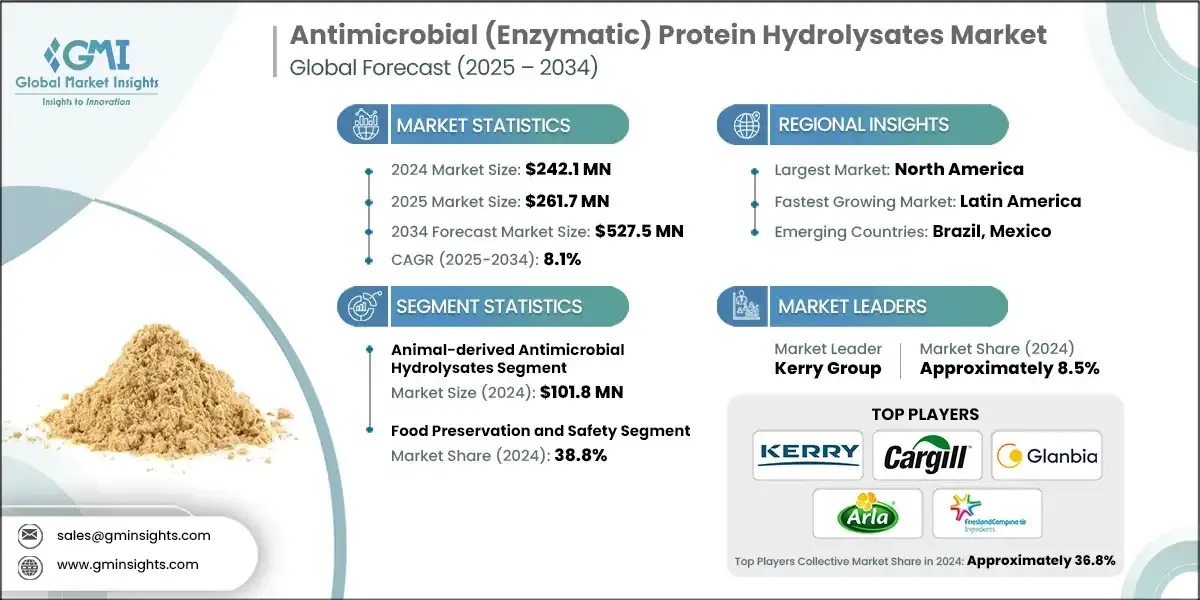
The global antimicrobial (enzymatic) protein hydrolysates market size was valued at USD 242.1 million in 2024. It is projected to grow from USD 261.7 million in 2025 to USD 527.5 million by 2034, representing 8.1% CAGR from 2025 to 2034, according to latest report published by Global Market Insights Inc.
Antimicrobial (Enzymatic) Protein Hydrolysates Market Key Takeaways
Market Size & Growth
- 2024 Market Size: USD 242.1 Million
- 2025 Market Size: USD 261.7 Million
- 2034 Forecast Market Size: USD 527.5 Million
- CAGR (2025–2034): 8.1%
Regional Dominance
- Largest Market: North America
- Fastest Growing Region: Latin America
Key Market Drivers
- Rising demand for natural food preservatives.
- Growing antibiotic resistance concerns.
- Increasing health and wellness awareness.
- Expanding applications in functional foods.
Challenges
- High production and processing costs.
- Regulatory complexity and approval challenges.
- Limited shelf life and stability issues.
Opportunity
- Dairy wastewater valorization.
- AI-driven peptide discovery.
- Emerging applications in cosmetics.
- Plant-based protein sources expansion.
Key Players
- Market Leader: Kerry Group led with over 8.5% market share in 2024.
- Leading Players: Top 5 players in this market include Kerry Group, Cargill Inc., Glanbia plc, Arla Foods Ingredients, FrieslandCampina Ingredients, which collectively held a market share of 36.8% in 2024.
Get Market Insights & Growth Opportunities
- The market of antimicrobial (enzymatic) protein hydrolysates shows a high growth rate because of the increasing amount of interest in natural and clean-label food preservatives. Since consumers and food producers are shifting towards using synthetic additives, enzyme-modified protein hydrolysates are picking up as an option to preserve the microbial growth and keep products fresh. The transition helps with lifetime shelf life and is not damaging the safety and nutritional value, which is in line with clean-label trends and regulatory requirements.
- Market growth is further being expanded by growing global concerns on antibiotic resistance. Protein hydrolysates are effective antimicrobial agents that do not add to antibiotic overuse, and therefore, can be used as the best alternatives in food processing systems and other health-related practices. Their application helps in safe antimicrobial management measures and regulatory pressures in minimizing the dependence on antibiotics in livestock and food supply chains.
- Demand also is favoring with the growth of health and wellness awareness. Consumers are demanding functional ingredients with added nutritional and bioactive qualities, which are more than just fundamental preservation. The hydrolysates containing protein, which is a rich source of peptides and amino acids, have not only been shown to have natural antimicrobial properties but also help enhance digestion, muscle repair and immune, hence their application in the nutraceutical and dietary supply preparations.
- The market is also growing owing to widening in functional foods and beverages. The manufacturers are incorporating protein hydrolysates in protein enriched snacks, beverages, sports nutrition, and infant formulas to achieve performance, nutritional and safety goals. Moreover, the yield, purity, and peptide profile customization are enhancing as the processes of enzymatic hydrolysis gain technological innovation, causing a greater rise in antimicrobial specificity and diversifying application to more industries.
To get key market trends
Antimicrobial Protein Hydrolysates Market Trends
- The tendency to clean-label and minimally processed food items can be observed, which is why manufacturers resort to substituting the synthetic antimicrobial agents with natural peptide-based solutions. This change is especially noticeable in the premium and health-conscious product lines, where transparency and the origin of ingredients are the main marketing tools.
- Multi-benefit ingredients are being incorporated into the functional food and nutraceutical industries, and there is a growing trend toward the use of protein hydrolysates which have anti-microbial and health-promoting effects. Product differentiation Brands are considering differentiating products in terms of bioactive peptides, immune-promoting properties, and digestive properties. This is broadening the scope of formulation in snacks, beverages, dietary supplements, and infant nutrition.
- The trend of customization and precision formulation is receiving momentum because of the developments in enzymatic processing. Manufacturers are redesigning the structure of peptides to achieve maximum antimicrobial activity against individual microorganisms. This tendency is moving the market to high-value and application-specific solutions instead of generalized bulk hydrolysate products to enhance its performance predictability in food, feed, and healthcare applications.
- Circular protein sourcing and sustainability are becoming increasingly important, and this trend compels producers to consider hydrolysates made by using by-products of dairy, seafood, and processing of plants. This is in line with the waste valorization policies and corporate sustainability pledges. Not only are costs on raw materials lowered through such sourcing models, but brand positioning is also elevated, especially amongst consumers of the environmentally friendly consumers of the product as well as the B2B buyers.
Antimicrobial Protein Hydrolysates Market Analysis
Learn more about the key segments shaping this market
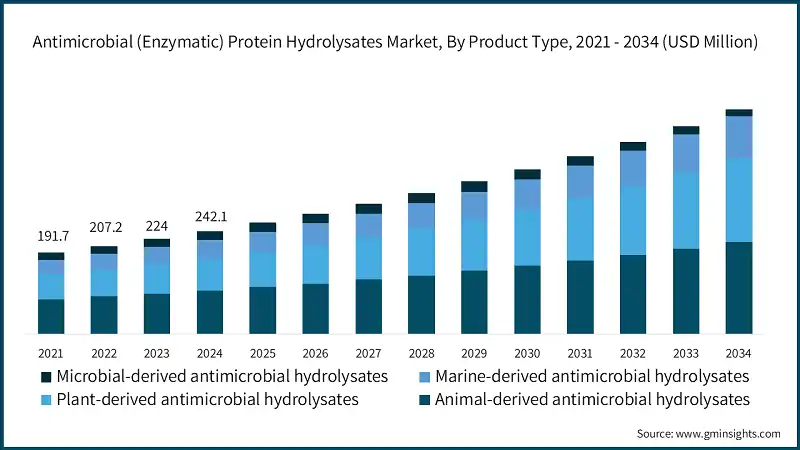
Antimicrobial protein hydrolysates market based on product type, segmented into animal-derived antimicrobial hydrolysates, plant-derived antimicrobial hydrolysates, marine-derived antimicrobial hydrolysates, and microbial-derived antimicrobial hydrolysates. The animal-derived antimicrobial hydrolysates segment was valued at USD 101.8 million in 2024, and it is anticipated to expand to 7.8% of CAGR during 2025 to 2034.
- There is a gradual increase in the use of animal-derived antimicrobial hydrolysates in food preservation, dietary supplements and clinical nutrition because of their high peptide activity and acceptability in regulatory approval processes. They are usually derived out of milk, egg, or meat proteins, and where antimicrobial efficacy is known to be effective, they are most likely to be used. Their demand is favored by their increasing application in ready-to-eat foods and in high-protein nutritional formulations that demand not only safety but also bioactive benefits.
- Plant-based antimicrobial hydrolysates are under the rapid development with the transition to vegan, allergen-free, and clean-label products. These hydrolysates, frequently derived out of soy, peas, or rice proteins are gaining popularity in functional beverages, snacks and also in meat alternative products. The better extraction and enzyme processing methods are assisting in improving taste profiles as well as antimicrobial activity and are good enough to be used in wider food and nutraceutical applications.
- Hydrolysates derived using marine and microbial sources are increasingly becoming popular because of their distinctive peptide structure and sustainability issues. Fish and algae sources obtained by the sea are considered to be helpful in supporting the practices of waste valorization and offering bioactive peptides that have high preservation capabilities.
- Hydrolysates that are microbially derived, formed by regulated fermentation, have very high consistency and can be customized, making it possible to obtain desired peptide profiles to induce desired antimicrobial effects. These segments are enjoying more R&D work between biotechnology firms and food processing companies.
Learn more about the key segments shaping this market
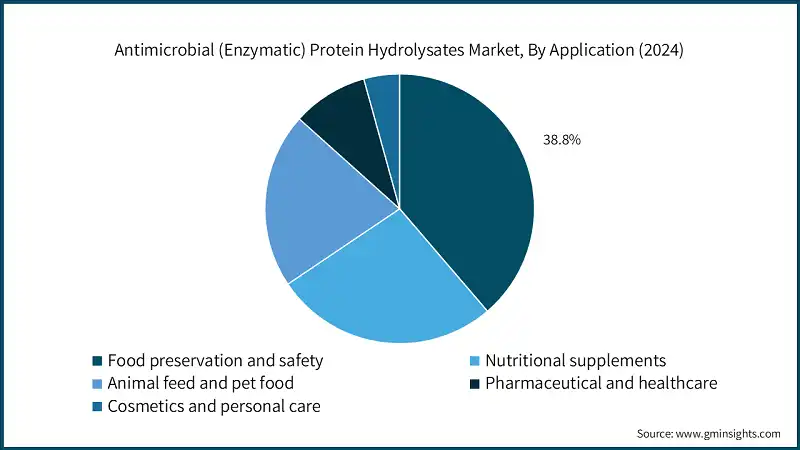
Food preservation and safety application segment was valued at USD 93.7 million in 2024, and it is anticipated to expand with a CAGR of 7.4% in the forecasted period and holds a antimicrobial protein hydrolysates market share of 38.8% in 2024.
- One of the application areas that have continued to rely on protein hydrolysates is food preservation and safety, where the protein hydrolysates are being widely applied to preserve quality and prevent the growth of microbes in processed foods, dairy products, beverages, and ready-to-eat foods. Their introduction is in line with the clean-label trend, whereby the formulators are replacing synthetic preservatives with naturally obtained peptide solutions. This helps in stabilizing shelf-life and to comply with regulatory and consumer demands to have transparent ingredient listing.
- Protein hydrolysates are also prized in nutritional supplements both on account of antimicrobial activity and in virtue of their bioactive peptide composition, which aids in muscle rehabilitation, digestive health and immune activity. The advantages of these advantages have rendered them suitable for sports nutrition, clinical nutrition and general wellness products. Meanwhile, animal feed and pet food manufactures are incorporating hydrolysates in improving gut health and decreasing antibiotic reliance within livestock systems because of continuing prohibitions of antibiotic growth regulators.
- Applications in pharmaceuticals and healthcare are coming up due to research on peptide-based therapeutic and wound-healing applications. Such hydrolysates are under development in topical preparations, oral immune-support, and infection control. The cosmetics and personal care segment also add protein hydrolysates to their antimicrobial and skin-conditioning properties, which is in line with the general trend toward microbiome-friendly and natural skin-care ingredients.
Looking for region specific data?
The North America antimicrobial (enzymatic) protein hydrolysates market accounted for USD 84.7 million in 2024 and is anticipated to show lucrative growth over the forecast period.
The use of antimicrobial (enzymatic) protein hydrolysates in North America is steadily increasing due to the growing use of clean-label preservation systems and an emphasis on food safety compliance. The region enjoys high functional food and nutraceutical industry and, thus, as a result, promotes the application of bioactive peptides that have dual nutritional/antimicrobial properties.
The pressure on manufacturers by regulatory bodies to minimize the use of chemical preservatives in packaged food is also driving manufacturers to seek enzymatic hydrolysates as a safer and natural substitute. Moreover, more production is being invested in biotechnology and in protein processing innovation which is helping in product refinement, diligence in peptide profiling and scalability in the food and healthcare sectors.
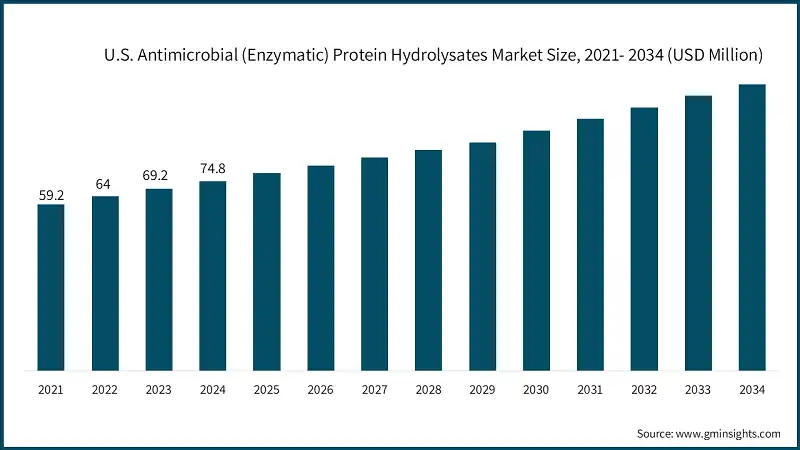
U.S. dominates the North America antimicrobial protein hydrolysates market, showcasing strong growth potential.
The U.S. is the largest player in the growth of the regional markets since it has well developed research facilities and a lot of consumer knowledge regarding natural and health promotional products. Food companies are also repacking products without artificial preservatives which are giving rise to high demand for enzymatic hydrolysates with a proven antimicrobial effect. The sports nutrition and medical food segment in the country is also offering a good growth potential since the brands also focus on bioactive functionality and digestibility.
Also, an increase in the demand of microbiome-friendly personal care formulations is favoring the use of hydrolysates in skincare and hygiene products. The further scaling and diversification of the applications is likely to be sustained by strong investments by ingredient suppliers and biotech companies.
The Europe antimicrobial protein hydrolysates market accounted for USD 67.1 million in 2024 and is anticipated to show lucrative growth over the forecast period.
The market development in Europe is boosted by the obligatory nature of the regulatory requirements on food additives that compel the companies to substitute artificial preservatives with natural and more sustainable preservatives. It has a high consumer preference for clean-label and plant-based ingredients, which has an advantage to both plant and microbial-hydrolysate segments. Peptide-based antimicrobial systems are also being used by the food and beverage manufacturers to enhance shelf life in the dairy, bakery and ready meal products. Also, the continued emphasis on the circular economy is leading to exploration of marine and agro-byproduct streams as affordable and low-waste hydrolysates. Favorable research and development funding systems also increase product development in both functional and biotech applications.
Germany dominates the Europe antimicrobial (enzymatic) protein hydrolysates market, showcasing strong growth potential.
Germany is unique because of its strong food processing industry and the strong nutraceutical and sports nutrition markets, which use hydrolysates as their preservative and performance-enhancing properties. Ingredient safety, purity and scientific validation are all emphasized in the country, with an interest in developing partnerships among academia, biotech companies and food manufacturers to maximize peptide’s structure and functionality.
The increased popularity of organic and natural personal care products has also increased the use of hydrolysates in skincare products. The investments of Germany in enzymatic processing technology, peptide production using fermentation, and sourcing of sustainable protein remain to promote the rapid product innovation and market acceptance.
Asia Pacific antimicrobial protein hydrolysates market is anticipated to grow at a CAGR of 8.2% during the analysis timeframe.
Asia-Pacific is experiencing phenomenal growth owing to the rise in consumption of processed foods, rise in health consciousness, and the surge of functional ingredients interest. The nations of the region are incorporating enzymatic protein hydrolysates into fortified food, sports nutrition drinks, and immune-support nutritional supplement. The move to natural preservation of food using antimicrobials is in line with the increasing apprehensions of contamination in food supply and quality uniformity in mass supply chains.
The aquaculture and plant protein processing industries are also strong giving access to raw materials in the form of readily available streams of raw materials that could be subjected to hydrolysate processing in order to facilitate cost effective production. Research in biotechnology and application of enzymes to extract materials, which are supported by the government, keep on boosting efficiency and quality of products in the region.
China antimicrobial (enzymatic) protein hydrolysates market is estimated to grow with a significant CAGR, in the Asia Pacific market.
China is the APAC market that is growing at the fastest rate due to the needs in high processing food and more concerns in improvement of food safety standards. The nation is also putting great efforts in bioprocessing, enzyme technology and fermentation models to manufacture specific antimicrobial peptides at large scale.
Additional growth in sports nutrition, elderly nutrition, and functional beverages is also favoring use of hydrolysates that have digestive and immune advantages. In the meantime, local manufacturers are looking at marine and vegetal raw materials in order to minimize reliance on imported animal protein. More domestic innovation and research institute partnerships are anticipated to make the products available and cost-competitive in the next few years.
The Latin America antimicrobial protein hydrolysates market accounted for 7.1% market share in 2024 and is anticipated to show lucrative growth over the forecast period.
The increasing demand in natural additives in packaged food and beverage industries is leading Latin America to use the antimicrobial protein hydrolysates. The region is also moving towards less use of antibiotics in livestock to favor the use of hydrolysates in livestock feedstuff to induce gut health and resistance to diseases.
Economic changes are pushing food industries to consider economically viable solutions to natural preservation to enhance shelf life of products in a variety of climatic conditions. The rise in health and wellness consciousness especially in urban areas is also leading to the rise in consumption of functional food and nutritional supplements that have bioactive peptides.
Brazil leads the Latin America antimicrobial (enzymatic) protein hydrolysates market, exhibiting remarkable growth during the analysis period.
The main growth center in Latin America is Brazil which is backed up by the strong agricultural base and massive meat, dairy, and aquaculture industries which provide sources of raw material to be used in the hydrolysate production. Due to the burgeoning nutraceutical market in the country, protein hydrolysates are finding their application in performance nutrition and immune-support supplements.
Moreover, the local pet fooding and livestock industries are embracing the use of hydrolysates as alternative to the use of antibiotic growth promoters in a natural way. The shift to natural antimicrobial ingredients is also promoted by government demands to improve food safety and minimize the risk of contamination. The increase of domestic production power is enhancing reliability and lowering costs of supply.
Middle East & Africa antimicrobial protein hydrolysates market is expected to grow at a CAGR of 7.8% during the analysis timeframe.
Gradual adoption of enzymatic protein hydrolysates is being observed in the Middle East and Africa region mainly due to the food safety regulations, increasing urbanization and expansion of high-end processed foods. With consumers demanding a healthier label and fresher tasting packaged products, manufacturers are considering hydrolysates as a natural preservation advantage. Also, the market of nutritional supplements and fortified food is expanding as the attention to preventive health and wellness increases. The imports are currently compensating the lack of domestic production capacity, but there are increasing strategic interests in creating regional bioprocessing capacity, particularly in high-income economies.
Saudi Arabia antimicrobial (enzymatic) protein hydrolysates market to experience substantial growth in the Middle East and Africa market in 2024.
The growth of natural and functional food ingredients is being witnessed in Saudi Arabia, as part of national health and nutrition programs. The investment in the country in building local food processing capacity is fueling trials of antimicrobial hydrolysates in the dairy and bakery product, beverage and shelf-stable product sectors.
Growing sport nutrition and wellness product consumption is also encouraging consumption of hydrolysates with digestibility and immune-promotional benefits. The focus of the regulation on decreased artificial additives is also consistent with a greater willingness of the market to accept enzyme degradation-derived alternatives. The increased partnership of local manufacturers with global ingredient distributors will increase the availability of products and their uses.
Antimicrobial Protein Hydrolysates Market Share
- Kerry Group, Cargill Inc., Glanbia plc, Arla Foods Ingredients, and FrieslandCampina Ingredients are a significant part of the global antimicrobial (enzymatic) protein hydrolysates industry and with the further standing of being fragmented with the top five players steadily holding 36.8% market share in the year 2024.
- The market of antimicrobial (enzymatic) protein hydrolysates is quite competitive, as it is influenced by the companies, which pay attention to innovative biotechnology, efficiency of protein processing, and peptide development depending on applications. Such players take the risk of investing in enzymatic hydrolysis and fermentation technology to generate peptides with desired antimicrobial activity in order to have high functional performance in food, feed, nutraceutical, and health care uses. The size, purity and bioactivity of the products that they are able to control enables them to distinguish their product portfolios and enables them to supply products reliably at industrial scale.
- Companies focus on excellent R&D cooperation with academic institutions, food producers, and biotechnological partners to remain in the market. This allows the ongoing optimization of the structure of peptides, improved insight into antimicrobial action, and customization of products according to the needs of end-use. A significant number of companies invest in clinical validation and legal compliance, so that the hydrolysates comply with the global standards in food safety and quality, and the assurance of this among B2B purchasers is enhanced.
- Competitive strength is especially dependent on sustainability and sourcing strategies with regard to raw materials. Dairy by-products, marine co-products, plant proteins, and microbial fermentation systems are all methods that firms are using to make sure that they have cost-effective and scalable raw materials. This not only lowers the volatility of the production cost but is also more aligned with the principles of the circular economy and responsible sourcing, which increases market acceptance, particularly in areas where a more concerted focus on the eco-friendly supply chain is more important.
- Businesses also continue to hold on to the market through further growth in application support services, providing formulation assistance, shelf-life testing and co-innovation programs to the food and personal care industries. Having defined their role as providing solutions to their customers and not merely as suppliers of ingredients, they enhance strategic customer relationships and increase the adoption rates within industries. Also, there are well established distribution networks worldwide and strategic mergers or joint ventures which facilitate geographic growth and market penetration in new markets.
Antimicrobial Protein Hydrolysates Market Companies
The major players operating in antimicrobial (enzymatic) protein hydrolysates industry include:
- Kerry Group
- Cargill Inc.
- Glanbia plc
- Arla Foods Ingredients
- FrieslandCampina Ingredients
- Others
- Kerry Group also concentrates on bioactive systems and functional protein systems to provide antimicrobial and preservation-support ingredients based on the intense R&D in enzymatic hydrolysis and taste-modulation. It has maintained its market niche through its unended support to food and nutrition manufacturers in formulation and a worldwide application chain that expedites commercialization.
- Cargill Inc. has diversified sourcing of proteins, precision fermentation alliances, and integrated supply chains, to maintain scale to ensure the availability of hydrolysate-grade raw materials at all times. It maintains competitiveness through investment in functional protein development and joint ventures with food producers to add value in the areas of safety, shelf-life, and clean-label placement.
- Glanbia plc reinforces its competence by its niche whey hydrolysates and its sophisticated processing facilities that produce regulated peptide profiles with functional and antimicrobial properties. The aspects that make it strong in the market include nutrition-oriented brand portfolios, and proximity co-development with sports, clinical, and medical nutrition formulators.
- Arla Foods Ingredients is competitive based on high-purity milk protein hydrolysates and close quality control throughout the farm to formulation assuring bio functionality and safety performance. Its stance is supported by the application-based research which indicates evident antimicrobial and stability benefits in infant, medical and performance nutrition systems.
- FrieslandCampina Ingredients maintains its position by developing solutions based on dairy and fermentation-derived peptide solutions with special concern to gut-immunity interactions and functional stability in highly complex matrices. Its regular pipeline updates, excellent clinical validation initiatives, and alliance with its customers contribute to keeping ahead in high-value protein hydrolysates.
Antimicrobial (Enzymatic) Protein Hydrolysates Market Report Attributes
| Key Takeaway | Details |
|---|---|
| Market Size & Growth | |
| Base Year | 2024 |
| Market Size in 2024 | USD 242.1 Million |
| Market Size in 2025 | USD 261.7 Million |
| Forecast Period 2025 - 2034 CAGR | 8.1% |
| Market Size in 2034 | USD 527.5 Million |
| Key Market Trends | |
| Drivers | Impact |
| Rising demand for natural food preservatives | Boosts adoption of enzymatic protein hydrolysates as clean-label antimicrobial agents. |
| Growing antibiotic resistance concerns | Accelerates interest in alternative bioactive peptides for food safety and health applications. |
| Increasing health and wellness awareness | Enhance consumer preference for functional foods enriched with antimicrobial hydrolysates. |
| Expanding applications in functional foods | Opens new formulation avenues for hydrolysates in immunity-boosting and gut-health products. |
| Pitfalls & Challenges | Impact |
| High production and processing costs | Limits scalability and commercial viability for widespread use. |
| Regulatory complexity and approval challenges | Slows market entry due to stringent safety and efficacy validation requirements. |
| Limited shelf life and stability issues | Restricts product integration in long-shelf-life food categories. |
| Opportunities: | Impact |
| Dairy wastewater valorization | Enables cost-effective peptide extraction from industrial byproducts, improving sustainability. |
| AI-driven peptide discovery | Speeds up identification of potent antimicrobial sequences, enhancing innovation. |
| Emerging applications in cosmetics | Diversifies market potential through skin microbiome-friendly formulations. |
| Plant-based protein sources expansion | Supports development of vegan antimicrobial hydrolysates, aligning with clean-label trends. |
| Market Leaders (2024) | |
| Market Leaders |
8.5% |
| Top Players |
Collective Market Share Approximately 36.8% |
| Competitive Edge |
|
| Regional Insights | |
| Largest Market | North America |
| Fastest growing market | Latin America |
| Emerging countries | Brazil, Mexico |
| Future outlook |
|
What are the growth opportunities in this market?
Antimicrobial Protein Hydrolysates Industry News
- In September 2025, Kemin Industries presented CJ Youtell Biotech (a division of CJ Bio) along with its fermentation plants in China. This complemented Kemin enzyme and fermentation properties and consequently increased its potential to provide bioactive and antimicrobial peptide systems-relevant to the hydrolysate marketplace as such upstream enzyme/fermentation resources can be utilized in the production of antimicrobial hydrolysates.
- In April 2025, FrieslandCampina Ingredients released its new performance and active nutrition ingredient called Nutri Whey ProHeat. The heat-stable whey protein is designed to meet the needs of performance and active nutrition products. This is not a highly specific antimicrobial hydrolysate product, but its novelty in protein processing (especially hydrolysis/heat-stability) is an indicator of a rising ability to customize peptide/protein systems, which are needed to develop antimicrobial-functioning hydrolysates.
- In May 2024, FrieslandCampina Ingredients launched its new concept, Biotis DHA Flex Powders and Biotis Fermentis, to adult nutrition with algae-based and fermented peptides+ prebiotics systems, at Vitafoods Europe. This trend has indicated growing interest in multifunctional peptide solutions (antimicrobial potential) and growing versatility of hydrolysate use in non-nutritional uses.
- In 2024, Cargill Inc. entered into partnership with ENOUGH by investing in its Series C growth financing and sign a commercial deal to utilize and sell ENOUGH fermented ABUNDA protein. This is important to the antimicrobial hydrolysates industry since the upstream sourcing of proteins and bioactive ingredient creation is reinforced by Cargill through fermentation-based proteins which make available new raw materials to be used in the production of the hydrolysates.
The antimicrobial (enzymatic) protein hydrolysates market research report includes in-depth coverage of the industry with estimates & forecast in terms of revenue (USD Million) & (Kilo Tons) from 2021 to 2034, for the following segments:
Market, By Product Type
- Animal-derived antimicrobial hydrolysates
- Milk protein hydrolysates
- Whey protein hydrolysates
- Casein hydrolysates
- Fish protein hydrolysates
- Meat protein hydrolysates
- Egg protein hydrolysates
- Plant-derived antimicrobial hydrolysates
- Soy protein hydrolysates
- Wheat protein hydrolysates
- Legume protein hydrolysates
- Cereal protein hydrolysates
- Seed protein hydrolysates
- Marine-derived antimicrobial hydrolysates
- Fish by-product hydrolysates
- Algae protein hydrolysates
- Seaweed protein hydrolysates
- Crustacean shell hydrolysates
- Microbial-derived antimicrobial hydrolysates
- Bacterial fermentation products
- Fungal hydrolysates
- Yeast-derived peptides
Market, By Application
- Food preservation and safety
- Natural preservatives
- Antimicrobial coatings
- Active packaging solutions
- Shelf-life extension
- Nutritional supplements
- Sports nutrition
- Clinical nutrition
- Infant formula
- Dietary supplements
- Functional foods
- Animal feed and pet food
- Growth promoters
- Antibiotic alternatives
- Digestive health support
- Immune system enhancement
- Pharmaceutical and healthcare
- Therapeutic peptides
- Wound care products
- Oral care applications
- Topical antimicrobials
- Cosmetics and personal care
- Antimicrobial formulations
- Skin care products
- Hair care applications
- Anti-aging solutions
The above information is provided for the following regions and countries:
- North America
- U.S.
- Canada
- Europe
- UK
- Germany
- France
- Italy
- Spain
- Rest of Europe
- Asia Pacific
- China
- India
- Japan
- South Korea
- Australia
- Rest of Asia Pacific
- Latin America
- Brazil
- Mexico
- Argentina
- Rest of Latin America
- MEA
- UAE
- Saudi Arabia
- South Africa
- Rest of Middle East and Africa
Frequently Asked Question(FAQ) :
What is the market size of the antimicrobial (enzymatic) protein hydrolysates in 2024?
The market size was valued at USD 242.1 million in 2024, with a CAGR of 8.1% expected from 2025 to 2034. The increasing demand for natural and clean-label food preservatives is driving market growth.
What is the projected value of the antimicrobial (enzymatic) protein hydrolysates market by 2034?
The market is poised to reach USD 527.5 million by 2034, driven by the adoption of enzyme-modified protein hydrolysates as a natural alternative to synthetic additives.
What is the expected size of the antimicrobial (enzymatic) protein hydrolysates industry in 2025?
The market size is projected to reach USD 261.7 million in 2025.
How much revenue did the animal-derived antimicrobial hydrolysates segment generate in 2024?
The animal-derived antimicrobial hydrolysates segment generated USD 101.8 million in 2024 and is expected to witness over 7.8% CAGR from 2025 to 2034.
What was the valuation of the food preservation and safety application segment in 2024?
The food preservation and safety application segment was valued at USD 93.7 million in 2024 and is anticipated to expand at a CAGR of 7.4% during the forecast period.
What is the growth outlook for the North America antimicrobial protein hydrolysates sector?
The North America market was valued at USD 84.7 million in 2024. The market growth is due to the rising adoption of clean-label preservation systems.
What are the upcoming trends in the antimicrobial protein hydrolysates market?
Key trends include natural peptide solutions, enzymatic precision formulation, sustainable protein sourcing, and rising use of bioactive peptides in functional foods.
Who are the key players in the antimicrobial protein hydrolysates industry?
Key players include Kerry Group, Cargill Inc., Glanbia plc, Arla Foods Ingredients, FrieslandCampina Ingredients, Crescent Biotech, Aker Biomarine, Biomega Group, and Essentia Protein Solutions.
Antimicrobial (Enzymatic) Protein Hydrolysates Market Scope
Related Reports