Summary
Table of Content

Analog Front-End (AFE) IC Market
Get a free sample of this report
Form submitted successfully!
Error submitting form. Please try again.
Thank you!
Your inquiry has been received. Our team will reach out to you with the required details via email. To ensure that you don't miss their response, kindly remember to check your spam folder as well!
Request Sectional Data
Thank you!
Your inquiry has been received. Our team will reach out to you with the required details via email. To ensure that you don't miss their response, kindly remember to check your spam folder as well!
Form submitted successfully!
Error submitting form. Please try again.
Analog Front-End IC Market Size
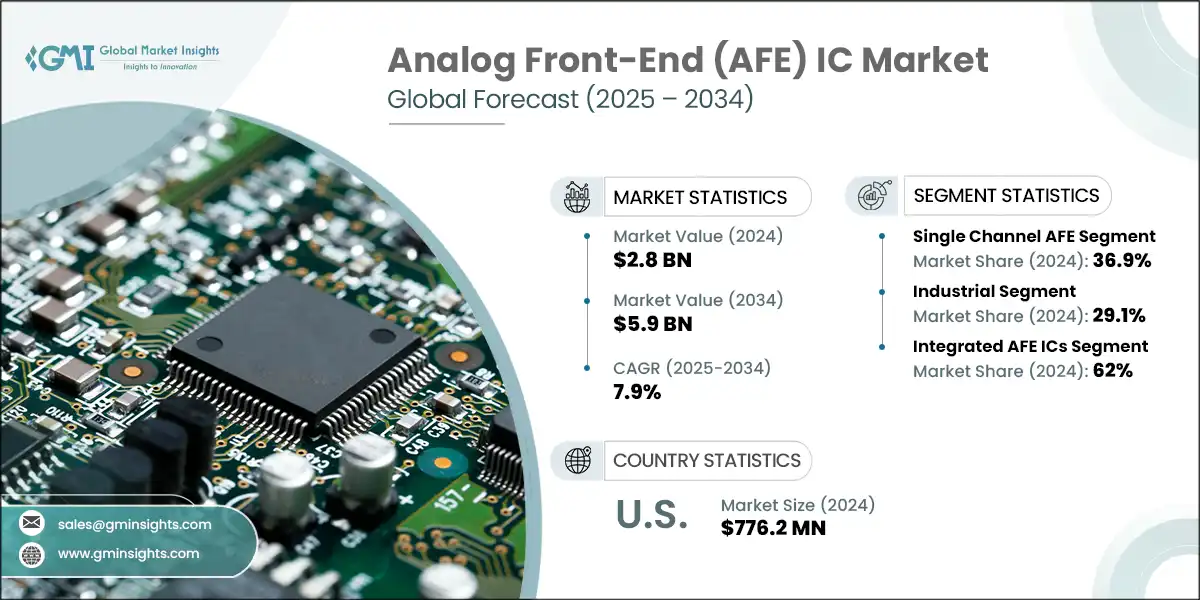
The global analog front-end (AFE) IC market size was valued at USD 2.8 billion in 2024 with a volume of 831.7 million units and it is projected to reach USD 4.3 billion in 2030 and USD 5.9 billion in 2034 with a volume of 1,539.2 million units, growing at a value CAGR of 7.9% and volume CAGR of 7.1% during the forecast period of 2025-2034.
To get key market trends
- The growth of analog front-end IC market is attributed to growth of portable & wearable medical devices, expansion of industrial automation & IIoT, advancements in wireless & high-speed communications and expansion of automotive electronics and ADAS.
- Industrial IoT adoption is a key driver of the AFE IC market. An Accenture report predicts the IIoT is expected to contribute USD 14.2 trillion to the global economy by the year 2030. This growth is supported by the increase in the deployment of smart factories and the dense sensor networks requiring precision AFEs for real-time data acquisition and conditioning. Multi-channel, low-noise AFEs allow accurate signal conversion for temperature, vibration, and pressure sensors. With an increasing focus on predictive maintenance and data-driven operations, configurable AFE solutions are in high demand.
- The rising adoption of portable and wearable medical devices, including ECG monitors, glucose meters, and ultrasound systems, significantly fuels demand for high-precision AFE ICs. For instance, the wearable healthcare device market was over USD 25 billion in 2023 according to Statista and will be over USD 76 billion by 2029. AFEs allow for efficient low-power real-time acquisition of biosignals, compact integration, wireless data transmission, and continuous monitoring which is especially useful in home healthcare.
- Based on the product, the market is segmented into single channel AFE, dual channel AFE and multi-channel AFE. Under product segment single channel segment held a largest market share of 36.9% in 2024, due to its widespread use in cost-sensitive and compact applications, including portable medical devices, consumer electronics, and basic industrial sensors, where size form factor, power efficiency, and simplicity in implementation is critical.
- In 2024, the Asia Pacific region dominated the global market with a 38.2% market share due to increase in the adoption of industrial automation, growth in consumer electronics, and increased investment in automotive electronics as well as medical devices in its emerging economies.
Analog Front-End (AFE) IC Market Report Attributes
| Key Takeaway | Details |
|---|---|
| Market Size & Growth | |
| Base Year | 2024 |
| Market Size in 2024 | USD 2.8 Billion |
| Forecast Period 2025 - 2034 CAGR | 7.9% |
| Market Size in 2034 | USD 5.9 Billion |
| Key Market Trends | |
| Drivers | Impact |
| Growth of portable & wearable medical devices | Fuels demand for compact, low-power AFEs enabling real-time biosignal acquisition drives 15% market growth. |
| Expansion of industrial automation & IIoT | Increases need for multi-channel, high-precision AFEs in smart factories contribute 18% market expansion. |
| Rising need for higher channel density & flexibility | Promote development of configurable AFEs supporting diverse sensor arrays adds 12% to market growth. |
| Advancements in wireless & high-speed communications | Boosts requirement for low-noise, high-speed AFEs in 5G and beyond accelerates market growth by ~10%. |
| Expansion of automotive electronics and ADAS | Drives demand for reliable, automotive-grade AFEs in radar and sensor fusion; supports ~14% market increase. |
| Pitfalls & Challenges | Impact |
| High design complexity and cost pressure | Increases R&D and production costs, limiting market entry for smaller players |
| Supply chain volatility and semiconductor shortages | Causes lead-time delays and price fluctuations, disrupting supply consistency |
| Opportunities: | Impact |
| Emerging applications in wearable and implantable medical devices | Drives demand for ultra-low-power, miniaturized AFEs tailored to continuous biosignal monitoring |
| Integration with AI-enabled edge devices and smart sensors | Creates opportunities for intelligent, reconfigurable AFEs with embedded processing; accelerates adoption and market expansion |
| Market Leaders (2024) | |
| Market Leaders |
18.9% market share |
| Top Players |
Collective market share in 2024 is 53.2% |
| Competitive Edge |
|
| Regional Insights | |
| Largest Market | Asia Pacific |
| Fastest Growing Market | Asia Pacific |
| Emerging Countries | India, Brazil, Mexico, Indonesia, Vietnam |
| Future outlook |
|
What are the growth opportunities in this market?
Analog Front-End IC Market Trends
- The increasing convergence of multi-channel and programmable AFEs is creating more sophisticated sensor systems for healthcare and industrial applications. This trend assists the mounting sophistication of IoT devices which need to process multiple analog inputs in real-time. The market opportunities for such configurable AFEs surged from 2022, and forecasts suggest this uptrend will persist through 2030 as a result of greater need for flexible and scalable systems in smart devices.
- The development of low-power and miniaturized AFE ICs have a marked impact on the adoption of wearable and implantable medical technologies. Such advances enable uninterrupted real-time monitoring of biosignals, which conserves battery life and improves patient comfort. Adoption from the industry escalated after 2020 in line with the global shift towards digitization of healthcare services and is expected to gain further momentum over the next decade due to increasing regulatory policies and consumer demand for portable healthcare devices.
- The adoption of automotive electronics and ADAS systems is intensifying the innovation focus on high-reliability AFEs with great precision operating in harsh conditions. Moreover, the aerospace industry’s focus on electrification and autonomous driving since 2021 has increased the demand for complex sensor fusion and radar interfacing integrated circuits. Forecasts estimate the AFEs designed for advanced driver-assistance systems will constitute a large proportion of revenue by 2030, enabling the development of safe and intelligent mobility solutions.
Analog Front-End IC Market Analysis
Learn more about the key segments shaping this market
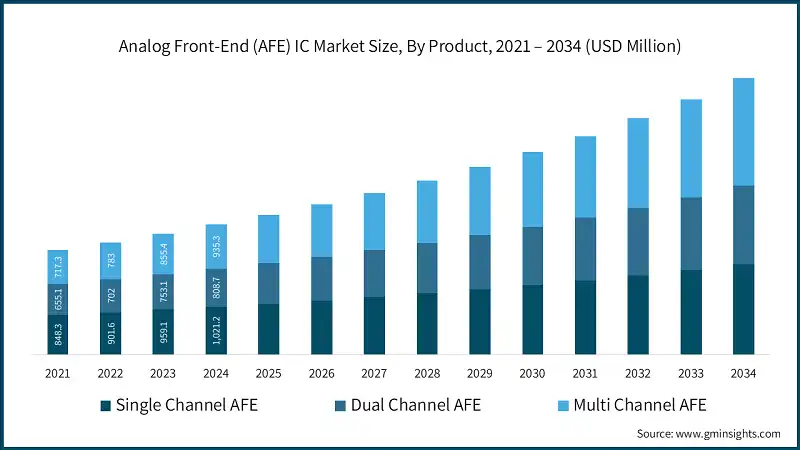
On the basis of product, the analog front-end IC market is segmented into single channel AFE, dual channel AFE and multi channel AFE.
- In 2024, single channel AFE segment held the largest market share with 36.9% of the total market. The advantages provided by single channel AFEs, such as high accuracy signal acquisition at reduced power and cost make them suitable for portable and wearable technologies. As stated by Statista, the market for global wearable healthcare devices which depends on single channel AFEs for biosignal monitoring exceeded USD 25 billion in 2023 and is expected to increase to over USD 76 billion by 2029. This trend supports the need for compact, low-power AFEs designed for high-demand consumer and medical devices.
- Multi channel AFE is the fastest growing segment in the analog front-end IC market, projected to grow at a CAGR of 9.4% during the forecast period of 2025-2034. Growth is driven by increasing adoption of complex sensor arrays in industrial automation, medical imaging, and automotive ADAS. According to the International Federation of Robotics, global robot installations rose by 10% in 2023, reflecting sustained investment in factory automation where multi-channel AFEs enable real-time, parallel data acquisition from multiple sensors.
- Manufacturers should focus on developing low-noise multi-channel AFEs that are both configurable and equipped with integrated digital interfaces. Focusing on industrial, automotive, and high-end medical device markets will enable solutions that balance channel-count, power consumption, and compact form factor.
Learn more about the key segments shaping this market
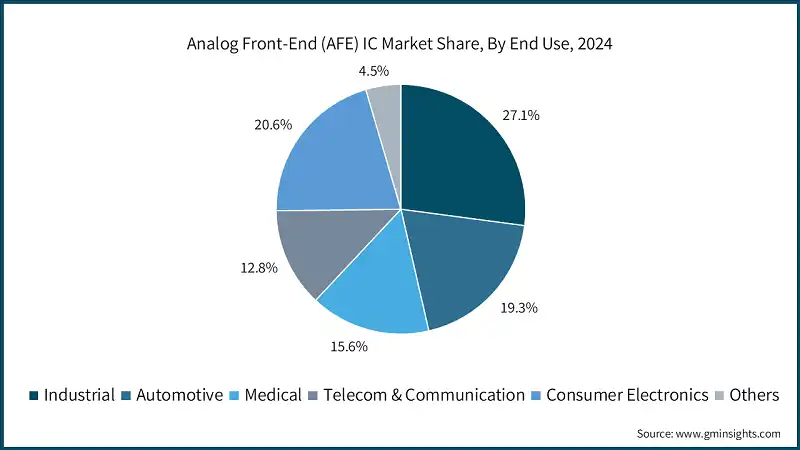
Based on end-use, the analog front-end IC market is divided into Industrial, automotive & transportation, medical & healthcare devices, telecom & communication equipment, consumer electronics & wearables, aerospace & defense, test, measurement & instrumentation, and others.
- The industrial segment market accounted for the largest market share of 29.1% in 2024. The industrial segment leads due to the accelerating adoption of Industrial IoT (IIoT) and factory automation. As reported by Statista, the worldwide industrial IoT sector is expected to grow to USD 450.9 billion by 2029, indicating strong growth for marketable connected sensors and edge devices. This need is further boosted by increasing deployment of robotics and condition monitoring systems that rely on expensive multi-channel and configurable AFEs for real-time data capture and diagnostics.
- The automotive & transportation segment is the fastest growing in the Analog Front-End (AFE) IC market, projected to register a CAGR of 10% during the forecast period. There is rapid adoption of ADAS, which is the primary driver of this growth. PARTS reports that for the 2023 model year, 10 out of 14 ADAS features exceeded 50% penetration, with five surpassing 90%. These safety-critical systems necessitate multi-channel, low-noise AFEs for real-time acquisition of data from radar, lidar, and cameras. Moreover, increased adoption of EVs strengthens the market need for precise monitoring of batteries and automotive-grade AFEs that are benchmarked against rigorously reliable standards.
- Manufacturers must focus on developing high reliability, automotive qualified AFEs that meet functional safety compliance and exceptional EMI/EMC performance. Capturing growth in this segment will depend on adopting product roadmaps with the accelerating adoption of ADAS and EV technologies.
Based on architecture, the analog front-end IC market is segmented into discrete AFE ICs, integrated AFE ICs and hybrid AFE ICs.
- The integrated AFE ICs segment market dominated the market accounting for market share of 62% in 2024. Integrated AFEs are increasingly preferred for compact designs, reduced BOM cost, and simplified system integration critical in medical, industrial, and automotive applications. According to SEMI, the global semiconductor devices supporting system integration projected to exceed USD 83 billion by 2025, driven by demand for smaller, multifunctional devices. Integrated AFEs combine multiple signal conditioning blocks on a single chip, improving noise performance and power efficiency, which is especially valuable in wearables, IIoT nodes, and ADAS modules where board space and power budgets are tightly constrained.
- Companies need to concentrate their efforts on integrated application-specific AFEs that offer enhanced digital connectivity. An example of this type of interface would be configurable channel architecture. Companies targeting compact and high density medical wearables, smart industrial sensors, and automotive radar technologies can tap into potential growth opportunities in these areas.
- The analog front-end IC market from hybrid AFE ICs segment is the second fastest growing segment, and it is projected to grow at a CAGR of 7.3% during the forecast period. Hybrid AFEs that integrate both discrete and assembled components provide a balanced solution to AFEs demanding high customization, high integration, precision, and size. They provide considerable flexibility in system design while meeting diverse performance requirements due to high precision and the need for channel scalability in complex sensor networks, multi-sensor, and fusion environments.
Looking for region specific data?
North America analog front-end IC market held a market share of 32% in 2024, due to strong investments in semiconductor design, R&D, and adoption of cutting-edge technologies across healthcare, automotive, and industrial sectors. The presence of key AFE IC manufacturers and early adoption of IIoT, ADAS, and wearable medical devices further drives the growth in this region.
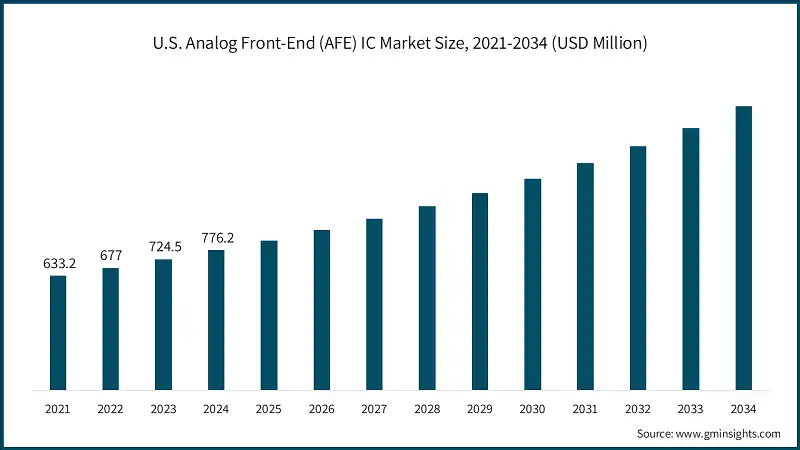
- In 2024, the U.S. analog front-end (AFE) IC market accounted for USD 776.2 million. Growth for AFE ICs is supported through the U.S. innovation leadership in the semiconductor ecosystem, and reliance on the medical devices (e.g. imaging), industrial automation, and automotive electronics. The CTA (Consumer Technology Association) reported that the shipment of wearables in the US increased by 8% in 2023, further boosting the demand for low power, miniaturized single-channel and integrated AFEs.
- Manufacturers have an opportunity to capitalise on increasing demand from the U.S. market but must design low-power, highly integrated AFE ICs for health care wearables and automotive sensor modules. Manufacturers should build strategic partnerships with local OEMs and medical device manufacturers to ensure a faster time-to-market and workable solutions with regulatory approvals.
- Canada market is projected to grow at a CAGR of 5.8% during the forecast period. Canada’s growth is underpinned by expanding industrial automation, energy management, and increasing adoption of medical wearable devices. Investments in smart manufacturing and IoT infrastructure are expected to drive demand for advanced sensor interfaces and AFEs.
- IC manufacturers need to focus on developing cost-effective and energy-efficient AFE solutions for the industrial IoT and healthcare sectors. Partnerships with Canadian tech incubators and healthcare providers can speed up adoption as well as customization to harness this rapidly growing market.
Europe analog front-end (AFE) IC market is projected to grow at a CAGR of 6.8% during 2025-2034. Europe’s growth is driven by strong adoption in automotive electronics, industrial automation, and healthcare sectors. The rise of Industry 4.0 initiatives across European countries fuels demand for precision analog interfaces in IIoT devices.
- Germany AFE IC market is expected to reach USD 370.2 million by 2034. Germany’s market growth is fueled by its leadership in automotive manufacturing, industrial automation, and healthcare technology. According to the VDA (German Association of the Automotive Industry, 2024), Germany remains Europe’s largest automotive market, with electric vehicle sales projected to exceed 30% of total vehicle sales by 2030, driving demand for automotive-grade AFEs for battery management and ADAS applications.
- IC manufacturers should tailor automotive-qualified and industrial-grade AFE solutions to meet stringent German regulatory and quality standards. Collaborations with local OEMs and automation companies can accelerate adoption in this high-value market.
- UK market was valued at USD 135.1 million in 2024. The growth of the AFE IC market is driven by rising demand from medical devices, wearable technology, and industrial IoT sectors. Rising focus on smart manufacturing and sensor integration in industrial automation is expected to gradually expand the market footprint.
- Manufacturers should prioritize scalable, energy-efficient AFE solutions tailored for the UK’s healthcare and industrial IoT markets. Strategic partnerships with local healthcare providers and industrial players can facilitate growth in this developing market segment.
Asia Pacific analog front-end (AFE) IC market is projected to grow at a CAGR of 9.2% during the forecast period of 2025-2034. The region’s rapid growth is driven by escalating demand in consumer electronics, healthcare wearables, industrial automation, and automotive sectors.
- China analog front-end IC market is expected to grow at a CAGR of 10.2% during the forecast period. China’s market expansion is driven by increasing investments in semiconductor manufacturing, electric vehicles (EVs), and industrial IoT infrastructure. According to the Semiconductor Industry Association (SIA, 2024), China’s domestic semiconductor market was valued at over USD 230 billion, accounting for nearly 55% of global semiconductor consumption. This dominance underscores strong demand for analog and mixed-signal ICs, including AFEs, across automotive, consumer electronics, and healthcare sectors.
- IC manufacturers should focus on localizing production and developing automotive-grade, high-channel-density AFEs tailored to China’s regulatory landscape. Strategic partnerships with domestic OEMs will be critical to capturing this rapidly expanding market.
- Japan accounted for a share of 25.3% of the analog front-end (AFE) IC market in Asia Pacific in 2024. Japan’s substantial share is supported by its advanced automotive electronics industry, strong medical device manufacturing base, and continued leadership in industrial automation. According to the Japan Electronics and Information Technology Industries Association (JEITA, 2024), global production by Japanese electronics and IT companies is expected to lift 6% year on year in 2024, reflecting demand for high-reliability analog ICs.
- IC makers should prioritize automotive-qualified, low-power AFEs and invest in partnerships with Japanese OEMs and Tier-1 suppliers to align with stringent quality and reliability standards. Emphasizing solutions for industrial robotics and medical imaging can also capture value in Japan’s mature, technology-driven market.
- South Korea analog front-end (AFE) IC market is expected to grow at a CAGR of 8.6% during the forecast period. Growth is driven by South Korea’s leadership in semiconductor manufacturing, 5G deployment, and advanced display technologies. According to the Korea Semiconductor Industry Association (KSIA, 2024), the country's semiconductor exports exceeded USD 140 billion, surpassing the record of USD 129.2 billion set in 2022, reflecting robust demand from automotive electronics and high-speed communication sectors.
- IC makers should focus on developing high-channel-density, power-efficient AFEs optimized for 5G and automotive applications. Strategic R&D collaboration with South Korean electronics giants can help accelerate time-to-market and innovation tailored to local industry demand.
Latin America analog front-end IC market was valued at USD 99.3 billion in 2024 due to urbanization, increased consumer electronics adoption, and heightened industrial automation in key markets like Brazil, Mexico, and Argentina.
MEA region is projected to reach USD 131.6 million by 2034, due to the widespread adoption of consumer electronics, industrial automation, and fundamental infrastructure technologies. On the consumer side, the growth of Africa’s emerging middle class along with increased mobile phone and home appliance are also fueling demand.
- UAE market is estimated to grow at CAGR of 7.3% during the forecast period. Investments towards smart cities, industrial telecommunications, and digitization of the healthcare sector are driving growth. According to the Industrial Development Bureau, the electronics sector stands out as one of the most rapidly developing industries in Abu Dhabi, accounting for 16% of Abu Dhabi’s share in the UAE’s electronics production. This indicates a strong need for integrated, low-power AFEs in volume medical devices, smart grids, and industrial automation systems.
- IC manufacturers need to design and manufacture smart economy and healthcare project specific low power AFEs to meet the needs of the UAE. Cooperating with local system integrators and the country’s innovation centers can improve penetration speed in this growing region.
- Saudi Arabia market accounted for USD 20.5 million in 2024. Growth of the AFE IC market in Saudi Arabia is driven by large-scale smart city initiatives, industrial digitalization, and healthcare modernization under Saudi Vision 2030. With investments in smart grid and medical device technologies rising increasing demand for reliable, low-power AFEs suited for harsh operating environments and precision data acquisition.
- South Africa market is projected to reach USD 26.6 million by 2034. The growth will be facilitated by the increasing investment adoption of industrial automation as well as medical devices and renewable energy systems in the country. The expanding use of IoT-powered monitoring technologies and healthcare is also spurring the demand for low-power multi-channel AFEs.
Analog Front-End IC Market Share
- The analog front-end (AFE) IC industry is competitive and highly fragmented with the presence of established global players as well as local players and startups. The top 5 companies in the global analog front-end (AFE) IC market are Analog Devices, Texas Instruments, STMicroelectronics, Infineon Technologies, NXP Semiconductors collectively accounting for a share of 53.2% in 2024.
- Analog Devices holds a significant position in the analog front-end (AFE) IC market with a market share of 18.9% in 2024. Renowned for its precision signal processing and low-noise solutions, the company serves critical applications across medical, industrial automation, and automotive sectors. Its competitive edge stems from deep analog engineering expertise, an extensive product portfolio, and strategic acquisitions that have expanded its presence in high-growth segments like healthcare wearables and automotive ADAS.
- Texas Instruments commands a market share of 15.6% in 2024, solidifying its role as a key player in the AFE IC space. Known for scalable, cost-efficient analog front-end solutions, TI addresses diverse markets ranging from industrial IoT to consumer electronics. The company’s strength lies in its broad manufacturing scale, reliable supply chain, and integration of AFEs into complete mixed-signal and microcontroller platforms that reduce design complexity for OEMs.
- STMicroelectronics held a market share of 8.2% in 2024, driven by its balanced presence across automotive electronics, industrial systems, and healthcare devices. Its competitive position is underpinned by innovations in multi-channel, low-power AFE architectures, combined with strong collaborations with European automotive and industrial OEMs to develop application-specific ICs.
- Infineon Technologies has captured 5.8% of the market share in 2024, leveraging its strength in automotive-grade and industrial-grade AFE ICs. The company benefits from its established position in safety-critical applications such as ADAS and battery management systems. Its competitive edge is built on advanced power management integration, robust quality standards, and alignment with electrification and Industry 4.0 trends.
Analog Front-End IC Market Companies
The major companies operating in the analog front-end (AFE) IC industry are:
- Analog Devices Inc.
- Texas Instruments Incorporated
- STMicroelectronics
- Infineon Technologies AG
- NXP Semiconductors
- Microchip Technology Inc.
- Monolithic Power Systems, Inc.
- Nisshinbo Micro Devices Inc.
- Analog Devices Inc., Texas Instruments Incorporated, STMicroelectronics, Infineon Technologies AG, and NXP Semiconductors are considered market leaders. These companies dominate the AFE IC market through broad product portfolios, global manufacturing scale, and deep integration with high-growth sectors such as automotive electronics, industrial automation, and medical devices.
- Microchip Technology Inc., ROHM Co., Ltd., Monolithic Power Systems, Inc., Qorvo, and Renesas Electronics Corporation are classified as market challengers. These firms compete effectively in targeted verticals by offering differentiated features like ultra-low power consumption, scalable multi-channel designs, and specialized application-focused solutions.
- Cirrus Logic, Inc., Ricoh, Nisshinbo Micro Devices Inc., and Asahi Kasei Microdevices Corporation are considered followers. Their presence is strongest in niche consumer electronics applications such as audio processing and imaging—though limited scale and diversification constrain their broader market impact.
- ams-OSRAM AG is identified as a niche player, leveraging specialization in optical and spectral sensing to deliver highly customized AFE IC solutions. This positioning supports demand in premium imaging, biometric sensors, and industrial optical applications, despite limiting broader market coverage.
Analog Front-End IC Industry News
- In November 2024, Renesas Electronics introduced new AnalogPAK programmable mixed-signal ICs, including the industry’s first programmable 14-bit SAR ADC device. These low-power, automotive-qualified AnalogPAK devices enable system function integration with reduced component count and power consumption, suitable for consumer, industrial, automotive, and communications applications.
- In June 2024, Nisshinbo Micro Devices released the NA2202/NA2203/NA2204 series, 5V AFEs with high-precision 16/20/24-bit ADCs for industrial applications, emphasizing precision and integration.
- In November 2022, NXP Semiconductors launched the NXP analog front-end (N-AFE) family focused on high-precision data acquisition and condition monitoring for factory automation. These software-configurable universal analog input devices enable the "software-defined factory," allowing operators to reconfigure smart factories easily to meet shifting market demands.
This analog front-end (AFE) IC market research report includes in-depth coverage of the industry with estimates & forecasts in terms of revenue (in USD Million) and volume (in Units) from 2021 to 2034, for the following segments:
Market, By Product
- Single channel AFE
- Dual channel AFE
- Multi channel AFE
Market, By Architecture
- Discrete AFE ICs
- Integrated AFE ICs
- Hybrid AFE ICs
Market, By End Use
- Industrial
- Process automation & control systems
- Robotics & motion systems
- Energy & power monitoring systems
- Industrial data acquisition & instrumentation
- Others
- Automotive & transportation
- ADAS
- EV battery management systems
- In-vehicle infotainment & telematics
- Motor control & powertrain
- Others
- Medical & healthcare devices
- Patient monitoring equipment
- Diagnostic imaging systems
- Implantable & wearable devices
- Laboratory & clinical instrumentation
- Others
- Telecom & communication equipment
- Wireless base stations & small cells
- RF front-ends & transceivers
- Optical communication modules
- Network monitoring & test equipment
- Others
- Consumer electronics & wearables
- Audio & voice processing
- Imaging & camera modules
- Health & fitness wearables
- Smart home & IoT devices
- Others
- Aerospace & defense
- Radar & electronic warfare systems
- Avionics & flight control systems
- Secure communication modules
- Navigation & positioning systems
- Others
- Test, measurement & instrumentation
- Oscilloscopes & analyzers
- Data loggers & handheld test devices
- Scientific & environmental instruments
- Calibration systems
- Others
- Others
The above information is provided for the following regions and countries:
- North America
- U.S.
- Canada
- Europe
- UK
- Germany
- France
- Italy
- Spain
- Netherlands
- Asia Pacific
- China
- India
- Japan
- South Korea
- ANZ
- Latin America
- Brazil
- Mexico
- Argentina
- MEA
- UAE
- Saudi Arabia
- South Africa
Frequently Asked Question(FAQ) :
Who are the key players in the analog front-end IC industry?
Key players include Analog Devices Inc., Texas Instruments Incorporated, STMicroelectronics, Infineon Technologies AG, NXP Semiconductors, Microchip Technology Inc., Monolithic Power Systems, Inc., and Nisshinbo Micro Devices Inc.
What are the upcoming trends in the analog front-end (AFE) IC market?
Key trends: multi-channel and programmable AFEs for IoT, low-power miniaturized ICs for medical tech, and high-reliability AFEs for ADAS and aerospace.
What was the valuation of the U.S. analog front-end (AFE) IC sector?
The U.S. market was valued at USD 776.2 million in 2024, supported by innovation leadership in the semiconductor ecosystem and reliance on medical devices, industrial automation, and automotive electronics.
What is the growth outlook for the automotive and transportation segment?
The automotive and transportation segment is the fastest-growing in the market, set to register a CAGR of 10% during the forecast period.
What was the market share of the single-channel AFE segment in 2024?
The single-channel AFE segment held the largest market share, accounting for 36.9% in 2024.
What was the valuation of the industrial segment in 2024?
The industrial segment led the market with a 29.1% share in 2024, led by the rapid adoption of Industrial IoT (IIoT) and factory automation.
What is the projected value of the analog front-end (AFE) IC market by 2034?
The market is poised to reach USD 5.9 billion by 2034, fueled by advancements in IIoT, ADAS systems, and the growing adoption of low-power and miniaturized ICs.
What is the market size of the analog front-end (AFE) IC in 2024?
The market size was USD 2.8 billion in 2024, with a CAGR of 7.9% expected through 2034. The market growth is driven by the increasing demand for portable and wearable medical devices, industrial automation.
Analog Front-End (AFE) IC Market Scope
Related Reports