Summary
Table of Content

Amphibious Aircraft Market
Get a free sample of this report
Form submitted successfully!
Error submitting form. Please try again.
Thank you!
Your inquiry has been received. Our team will reach out to you with the required details via email. To ensure that you don't miss their response, kindly remember to check your spam folder as well!
Request Sectional Data
Thank you!
Your inquiry has been received. Our team will reach out to you with the required details via email. To ensure that you don't miss their response, kindly remember to check your spam folder as well!
Form submitted successfully!
Error submitting form. Please try again.
Amphibious Aircraft Market Size
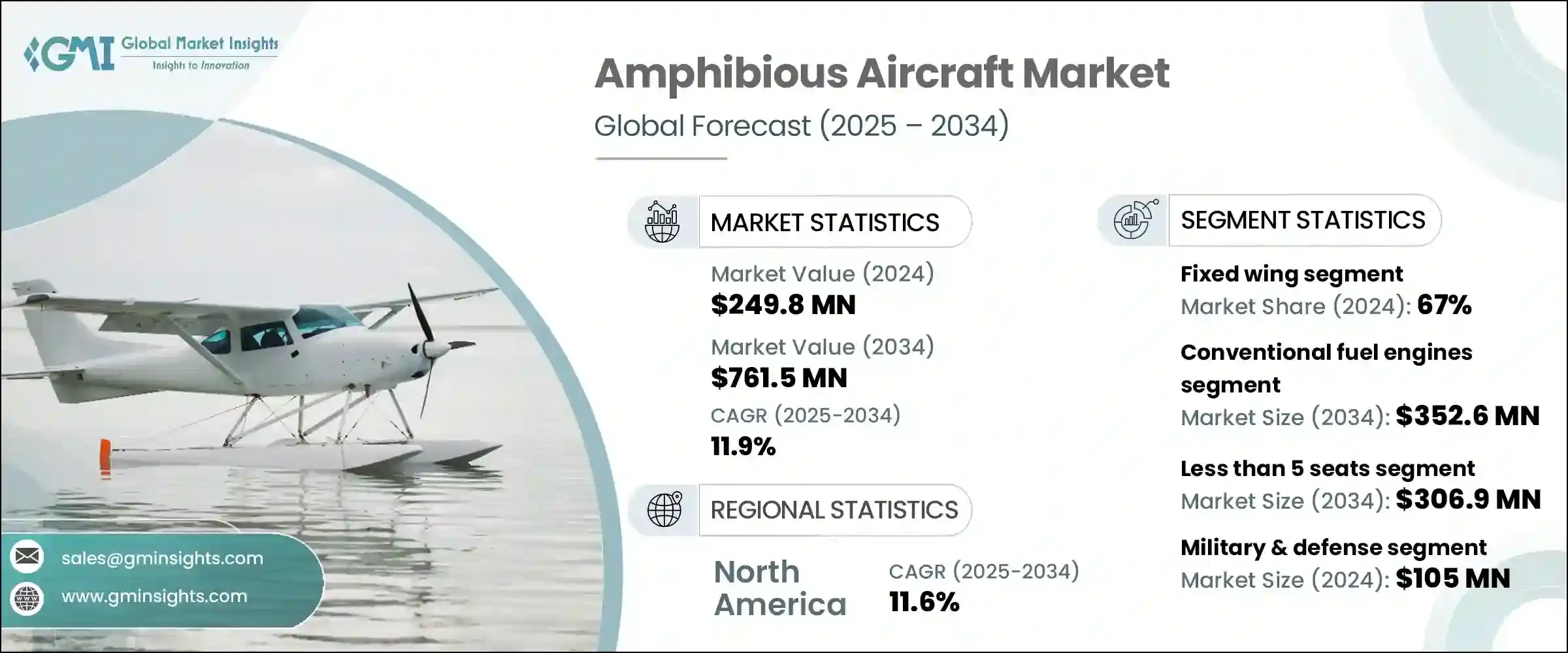
The global amphibious aircraft market was valued at USD 249.8 million and volume 1.39 thousand units in 2024 and is projected to reach USD 476 million by 2030 and USD 761.5 million by 2034 with a volume of 3.63 thousand units, growing at a CAGR of 11.9% during the forecast period.
To get key market trends
- The growth of the market can be attributed to the growing adoption of aircraft leasing to support fleet expansion and operational flexibility as well as the expansion of marine tourism and recreational activities.
- The increasing prevalence of aircraft leasing on a global scale is transforming the capital expenditure and operational scale strategies of airline companies and operators. Aircraft leasing permits operators to access more advanced models of aircraft with significantly lower investment as both commercial and specialized operators can modify fleet size and configuration in real time. This agility is particularly crucial in the case of amphibious aircraft used for coastal surveillance, remote region logistics, and tourism operations.
- Smaller operators and emerging markets targeting performance and reliability at minimal financial risk highly benefit from this leasing model. For example, VMAN, an aeroplane leasing company from GIFT City, acquired 10 next-gen ME-1A planes from Mallard Enterprises in January 2024. Companies located in different regions that prioritize maritime, islands, and offshore connectivity will witness a surge in demand for amphibious aircraft as global financial centers develop aviation leasing ecosystems.
- The growth of marine tourism sector, as well as adventure-based recreational activities is driving the demand for amphibious aircraft, that are capable of providing access to remote islands, coastal resorts, and eco-tourism regions where traditional runways are unavailable. The rebound of travel activities post-pandemic has also accelerated demand for amphibious aircraft as coastal and island economies are leaning towards tailored, flexible, and premium travel options. In Southeast Asia, the Mediterranean, and the Pacific islands, cruise tourism, island-hopping, and seaplane safaris are becoming more popular.
- Operators are investing in amphibious aircraft to serve high-net-worth individuals and tourist groups that demand advanced marine-to-aerial transport connections. This increased focus from the tourism sector not only boosts revenue but also motivates aircraft original equipment manufacturers (OEMs) to develop lighter, more fuel-efficient, and quieter aircraft models to meet eco-friendly design targets. The tourism-focused segment is anticipated to sustain robust long-term growth in the amphibious aircraft market.
- The global market is divided into aircraft type, propulsion type, seating capacity and application. Under the aircraft type segment, fixed wing aircraft held 67% of the total market in 2024, driven by their range, payload capacity, and efficiency compared to rotary-wing counterparts. Their aerodynamic effectiveness optimizes flight stability, which is beneficial to remote and frontier areas. These aircraft serve commercial as well as defense purposes in area-sensitive zones.
- On the basis of application segment, military & defense lead the market and held a major share of 42% in 2024, owing to the rising demand for multi-functional platforms that can be used in both sea and land environments. Amphibious aircraft are critical for maritime reconnaissance and anti-submarine warfare as well as search and rescue missions, troop transportation, and maritime border surveillance that need flexible cross-terrain deployment.
- North America retained the leading position in the global amphibious aircraft market, accounting for 35.1% of the market share in 2024. It continues to lead the market due to high military spending, the region’s extensive coastlines, and presence of major OEMs and operators dealing in amphibious aviation. Major operators include the US Navy and Coastguard as well as Department of Homeland security, using the aircraft for maritime patrol, surveillance, search and rescue, and disaster response missions.
Amphibious Aircraft Market Report Attributes
| Key Takeaway | Details |
|---|---|
| Market Size & Growth | |
| Base Year | 2024 |
| Market Size in 2024 | USD 249.8 Million |
| Forecast Period 2025 – 2034 CAGR | 11.9% |
| Market Size in 2034 | USD 761.5 Million |
| Key Market Trends | |
| Drivers | Impact |
| Growing adoption of aircraft leasing to support fleet expansion and operational flexibility | Accelerates fleet acquisition cycles by up to 35%, enabling smaller operators to enter niche amphibious aviation markets with reduced capital barriers. |
| Expansion of marine tourism and recreational activities | Drives demand for amphibious aircraft deployments, particularly in island and coastal tourism sectors requiring flexible air-sea access. |
| Increased use in disaster relief and humanitarian missions | Enhances operational deployment by nearly 40% in emergency-prone regions, due to amphibious aircraft’s dual-landing capability and logistical agility. |
| Modernization of naval and coast guard fleets | Stimulates procurement-driven market expansion by 25–30%, as governments prioritize multi-role aircraft for coastal surveillance, SAR, and patrol missions. |
| Rising investments in defense procurement by emerging economies | Contributes to over 20% growth in new defense contracts for amphibious platforms, especially in Asia-Pacific, South America, and Africa, supporting maritime sovereignty and border control initiatives. |
| Pitfalls & Challenges | Impact |
| High acquisition and operational costs | Limits adoption among small operators, delaying fleet expansion and market penetration in cost-sensitive regions. |
| Complex certification and regulatory approvals | Prolongs time-to-market and increases compliance burden, particularly for new entrants and emerging manufacturers. |
| Opportunities: | Impact |
| Development of hybrid and electric amphibious aircraft | Opens new avenues for sustainable aviation, attracting eco-conscious operators and regulatory support. |
| Untapped demand in island nations and remote coastal regions | Enables market expansion in underserved geographies lacking conventional runway infrastructure. |
| Integration of amphibious aircraft in emergency medical services (EMS) | Diversifies use cases, creating demand in public health and humanitarian sectors for rapid response logistics. |
| Growing participation of private charter and tourism operators | Increases fleet orders from non-government entities, expanding the market beyond defense and public use. |
| Market Leaders (2024) | Market Leader |
|
| Top Players |
Collective market share in 2024 is 42.2% |
| Competitive Edge |
|
| Regional Insights | |
| Largest Market | North America |
| Fastest Growing Market | Asia Pacific |
| Emerging Countries | India, Brazil, Indonesia, Mexico, South Africa |
| Future outlook |
|
What are the growth opportunities in this market?
Amphibious Aircraft Market Trends
- The use of autonomous and remotely piloted amphibious aircraft is revolutionizing maritime activities paradigm like surveillance, search and rescue operations, and cargo transportation and minimizing human risk and operational costs. This advancement is spurred by artificial intelligence, sensor fusion, and communication systems emerging post-2023. Adoption in the sector is anticipated to grow markedly by 2032, driven by evolving regulatory policies and maturing technologies, all while providing safer, more efficient, and economically viable operations in complex marine environments.
- Amphibious aircraft operate in harsh saltwater environments, which accelerate corrosion and increase maintenance needs. To resolve these issues, the development of more advanced nanocoating and composite materials designed to combat corrosion have emerged since 2022. These materials extends the aircraft’s operational lifespan and reduces downtimes, thus reducing maintenance costs. It is expected that a greater emphasis on material science will lead to extensive adoption of these technologies by 2030, improving reliability and operational availability of the marine fleet.
- Aerospace manufacturers are collaborating with maritime agencies to develop specialized amphibious aircraft for particular operational and environmental requirements. This move towards mission-centric modifications for search and rescue, environmental monitoring, and offshore logistics has been gaining traction since 2021. Such partnerships are expected to become a standard practice by 2033, thereby optimizing aircraft effectiveness, adaptability, and customer satisfaction through custom design solutions.
- The use of digital twin technology is on the rise in the amphibious aircraft industry, enabling virtual simulations of aircraft performance, structural assessments, and maintenance requirements of the aircraft. Since 2023, manufacturers have increasingly leveraged real time data as well as predictive analytics to fine-tune designs and cut down operational downtime. By 2031, it is expected that this approach will be widely adopted as it enhances safety, reduces lifecycle costs, and improves fleet management with proactive maintenance and scenario simulations.
Amphibious Aircraft Market Analysis
Learn more about the key segments shaping this market
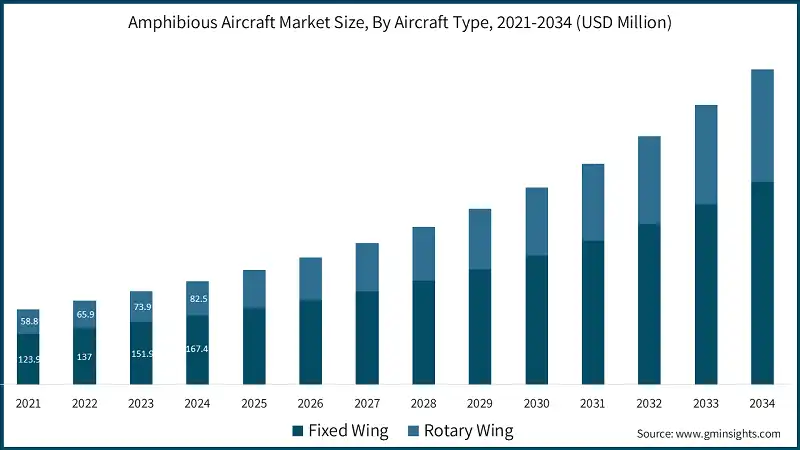
On the basis of aircraft type, the market is divided into fixed wing and rotary wing.
- The fixed wing segment dominated the market with a market share of 67% in 2024. Fixed-wing amphibious aircraft are increasingly utilized for maritime patrol, firefighting, and regional connectivity in island nations. The demand stems from increased payload capacity, range, and fuel efficiency. Contemporary models of fixed-wing aircraft have several citizen and military applications due to the incorporation of modern avionics, STOL (Short Takeoff and Landing) capabilities, and use of corrosion-resistant materials.
- To optimize multi-role utility in archipelagic states and coastal regions, OEMs should focus on digital retrofits of cockpits and lightweight composite materials. These collaborations can unlock emergency response and connectivity public-sector contracts with government involvement.
- The rotary market is projected to grow at a CAGR of 12.8% during the forecast period. Amphibious rotary-wing aircraft, especially helicopters equipped with floats or hulls, are increasingly being utilized for search and rescue (SAR) operations, offshore support, and defense logistics. This trend continues to develop with a higher emphasis being placed on vertical reach in remote areas, hybrid-electric propulsion systems, and enhanced stability for rotorcraft which are emerging as critical areas of innovation.
- Helicopter manufacturers should prioritize amphibious rotorcraft with hybrid propulsion and enhanced hover performance for civil protection and offshore missions. Partnering with energy firms and coast guards can accelerate deployment in high-risk marine zones.
Learn more about the key segments shaping this market
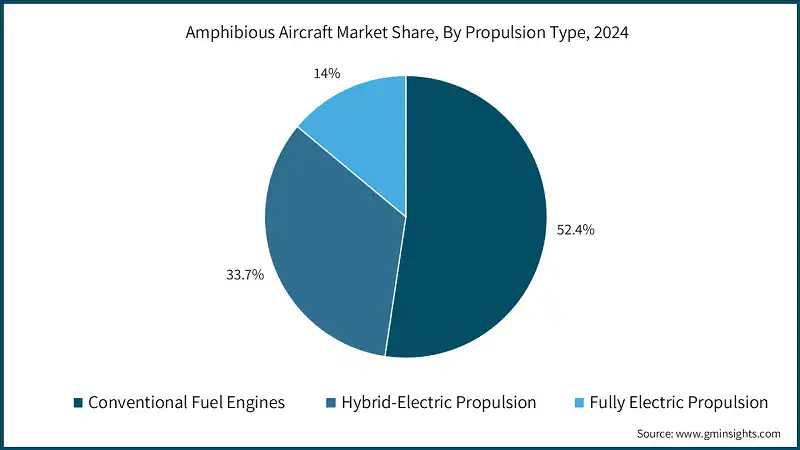
On the basis of propulsion type, the market is divided into conventional fuel engines, hybrid-electric propulsion and fully electric propulsion.
- The conventional fuel engines market is anticipated to reach USD 352.6 million by 2034. Amphibious aircraft equipped with conventional fuel dominate the current fleets because of their reliability and power output as well as their operational range. These aircraft remain popular for defense and firefighting operations where endurance and payload are critical.
- OEMs and integrators should direct their efforts towards emission control systems and fuel-efficient turboprop engines to enhance existing fleet capacities. Focusing on sustainability will appeal to government and commercial operators seeking near-term eco-friendly solutions.
- The fully electric propulsion market is projected to register a CAGR of 12.6% during the forecast period. Fully electric amphibious aircraft are emerging for inter-island transportation as well as eco-tourism. In addition to these purposes, the aircrafts will serve low-payload missions over short ranges. Moreover, distributed propulsion systems along with lightweight materials and increased battery density are enabling the development of viable prototypes.
- Startups and other original equipment manufacturers (OEMs) should consider targeting short-range regional flying opportunities with low emissions criteria. Potential partnerships with island authorities, tourism operators, and renewable energy sponsors can encourage stakeholders to adopt new emissions-neutral regional flying solutions..
On the basis of seating capacity, the market is divided into less than 5 seats, 5-10 seats, and more than 10 seats.
- The less than 5 seats market was valued at USD 306.9 million in 2034. Amphibious aircraft with under 5 seats are gaining interest in eco-tourism, pilot training, and recreational aviation. These aircrafts can be used for personal and light commercial purposes as they are economical, easy to operate, and provide access to remote coastal and inland regions. In this sub-segment, some manufacturers are developing electric versions.
- Manufacturers should collaborate with charter companies, flight schools, and tourism operators in order to drive competitiveness. Strategic partnerships with local aviation clubs and training academies can strengthen early market penetration.
- The 5-10 seats segment is anticipated to grow at a CAGR of 12.8% during the forecast period. The 5–10 seat amphibious aircraft segment is expanding for inter-island transport, charter services, and small cargo logistics. This type of aircraft is preferred by operators due to fuel efficiency.
- OEMs should prioritize modular models with a focus on low operating costs and short-runway fuel efficiency. There is potential in Southeast Asia, the Caribbean, and the Pacific Islands for improved intra-regional connectivity. Providing changeable cabins and quick conversion from passenger to cargo configurations increases operational versatility and ROI for operators.
On the basis of application, the market is divided into military & defense, commercial, and government & public sector.
- The military & defense market was valued at USD 105 million in 2024. The military's need for amphibious aircraft remains consistent, particularly for maritime reconnaissance, transportation of troops, and specialized operations. While rotary wing aircraft are useful for rapid coastal deployment, fixed-wing aircraft are more advantageous for range. Modernization efforts are focused on ISR capabilities and radar integration, as well as readiness to operate at night for Indo-Pacific and Arctic defense strategies.
- Enhancements of airframe ruggedness, mission-specific modularity, sensor integration should be primary focus of suppliers. Focusing on coastal and island defense applications in partnership with the ministries of defense may lead to long-term contracts.
- The commercial segment is anticipated to grow at a CAGR of 13.4% during the forecast period. The multifunctional application of amphibious aircraft in tourism, regional connectivity, and freight logistics is on the rise. There is a high demand for agile and low-infrastructure transport options to link remote regions. Increasing environmental regulations is driving demand for hybrid-electric propulsion systems to be used in short-haul commercial routes in developing island and remote mainland economies.
- Manufacturers should engage with airline marketing and promotional departments, cargo operators, and regional airlines by offering customizable, eco-friendly amphibious aircraft solutions. Concentrate on STOL performance and low-maintenance operational frameworks. Partnerships with local governments and investors in tourism can provide route subsidies and infrastructure development support in high-potential areas.
Looking for region specific data?
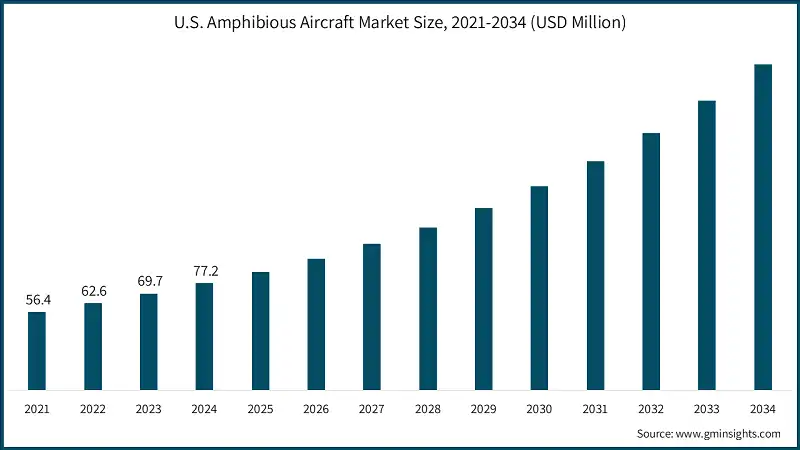
North America held a market share of 35.1% in 2024 and is expected to grow at a CAGR of 11.6% during the forecast period. North America remains a significant market for amphibious aircraft owing to military needs and increasing tourism access. The region has coastlines, clusters of islands, and remote areas which drive a requirement for both rotary and fixed-wing amphibious aircraft.
- The U.S. dominated the amphibious aircraft market, accounting for USD 77.2 million in the year 2024. In the United States, amphibious aircraft are mostly used for long range maritime surveillance, logistics, and rapid deployment service. Modernization efforts in the country that involve versatile, sea-capable aviation assets continue to receive strong institutional support, demonstrated by the USD 53.2 billion spending with the U.S. Marine Corps in 2023, as reported by Statista.
- OEMs in the aircraft industry must capitalize on the U.S. market by developing modular amphibious platforms that are corrosion resistant and have improved ISR capability. Primary adoption can be facilitated by pilot projects with the Navy and Marine Corps alongside enduring procurement partnerships that can be secured by providing lifecycle cost benefits, which strengthens the DoD's modernization strategy countering cost-in-use.
- Canada is expected to grow at a 9.3% CAGR during the forecast period. In Canada, eco-tourism drives regional air access and is boosting interest in amphibious aircraft. Statista forecasts suggest the Canadian travel and tourism market will grow to USD 17.42 billion by 2025. The growing popularity of eco-tourism along with increased accessibility to air travel will directly boost the demand for small to medium capacity amphibious aircraft in Canada.
- STOL-capable, fuel-efficient amphibious aircraft specially designed for Canada's remote regions would be ideal for regional airlines and tourism operators. Meeting eco-friendly standards and partnering with local tourism agencies and governments can create new deployment options in the underserved northern and coastal regions.
Europe accounted for 22.1% of the global amphibious aircraft market in 2024 and is expected to grow with a CAGR of 11% during the forecast period. The increasing demand for eco-tourism, regional security, and border patrol is stimulating the adoption of amphibious aircraft in Europe.
- The Germany market accounted for USD 14.1 million in the year 2024. The demand for amphibious aircraft in Germany stems from the modernization of the defense sector, especially for maritime patrol, disaster response, and NATO-aligned strategic initiatives. According to Statista, Germany's military spending amounted to USD 67 billion in 2022, signaling a shift to multi-domain, naval, and aviation capable systems.
- OEMs should offer ISR equipped aircraft to improve interoperability with NATO to Germany's defense acquisition authorities. This will streamline local integration and lifecycle support through collaboration with German aerospace contractors. Collaborations with German aerospace contractors will simplify local integration as well as lifecycle support.
- UK is expected to grow at a 12% CAGR during the forecast period. The United Kingdom is recording increased demand for amphibious aircraft servicing the tourism and regional connectivity markets, especially among Scotland’s Hebrides and other island groups. The travel and tourism market in the UK is expected to generate USD 42.11 billion by 2025, demonstrating strong growth in leisure aviation as reported by Statista.
- Manufacturers should promote small to medium-sized amphibious aircraft intended for coastal tourism and regional air connections. The primary adoption pathways can be supported with partnerships with UK tourism boards and private sector operators, especially in Southwest England and Scotland.
Asia-Pacific held a share of 29.7% in the global amphibious aircraft market and is the fastest-growing region with a 13.4% CAGR during the forecast period. The demand for amphibious aircraft in the Asia-Pacific region is accelerating due to the need for inter-island connectivity, maritime border monitoring, and relief operations.
- The market in China is anticipated to reach USD 106.4 million by the year 2034. China is expanding its amphibious aircraft capabilities for strategic maritime presence, search and rescue (SAR) operations, and civilian emergency responses. The country focuses on the South China Sea and associated island chains for strategic positioning. The domestic production of high-capacity amphibious aircraft is growing to meet self-reliance and territorial dominance objectives.
- OEMs need to investigate technology consortiums or licensing collaborations with domestic Chinese companies. Manufacturers should prioritize solutions that help government initiatives for surveillance and emergency response within controlled airspace.
- The Japan amphibious aircraft market accounted for USD 12.6 million in 2024. In Japan, amphibious aircraft are mostly used in search and rescue, coast guard operations, and for humanitarian purposes. Given Japan's unique island geography and propensity for natural disasters, there is a high demand for reliable platforms that enable quick access, extensive range. Aircraft with proven STOL capabilities and mission-specific designs are preferred in the market.
- Japan places very high standards for performance and precision. To meet these expectations, advanced avionics should be included for responsive readiness. Japanese aerospace companies can ease the regulatory barriers and localization barriers for foreign manufacturers through joint ventures.
- The India's amphibious aircraft market is anticipated to grow at a CAGR of over 14.9% during the forecast period. The demand for amphibious aircraft in India is growing due to increasing emphasis on coastal surveillance, disaster response, and inter-island connectivity, particularly the Andaman and Nicobar Islands. The government has been reviewing such platforms for both civil and paramilitary operations, focusing on indigenous production under the Make in India policy.
- Indian companies operating in the civil and defense aviation sectors should undertake the co-production and the assembly of amphibious aircraft. Integrating operational capabilities for coastal security, regional airline services, and search and rescue (SAR) will fulfill strategic requirements.
Latin America held 3.6% market share in 2024 and is anticipated to grow with a 9.8% CAGR during the forecast period. The need to access remote rainforests, riverside communities, and the island regions drives the demand for amphibious aircraft in Latin America. Countries such as Brazil, Colombia, and Chile use these aircraft for logistical purposes, firefighting, and coastal patrolling, as their infrastructure is limited and they have a high reliance on flexible transport options.
In 2024, the Middle East and Africa held a share of 9.4% and a 10.6% CAGR during the forecast period. MEA indicate increasing interest in amphibious aircraft for water surveillance, disaster relief support as well as for regional defense in countries with large coast lines or inland water bodies. There is also a growing demand from Gulf states as well as in African nations that seek civil protection and maritime security.
- Saudi Arabia accounted for a 20.1% market share in 2024. The demand for amphibious aircraft in South Africa concentrates on humanitarian missions, fishery protection, and coastal surveillance. The diverse climatic conditions along South Africa’s extensive shoreline create a need for tough and versatile operational platforms. There is a growing demand in civil aviation for tourism and remote coastal region access.
- The South Africa market is anticipated to grow at a CAGR of 12.6% during the forecast period. Saudi Arabia is exploring amphibious aircraft for border control, coast guard activities, and environmental monitoring along the Red Sea. South Africa is investing into assets that support rapid deployment, and multi-domain capabilities for civil and security applications.
- The design and construction of surveillance-ready amphibious platforms with advanced multi-spectral sensors should be prioritized by local OEMs. Partnerships with the Ministry of Interior and initiatives under Vision 2030 will assist in achieving market penetration.
- The UAE accounted for a share of 23.6% in the market in 2024. In UAE amphibious aircraft are being used for marine patrol, environmental conservation, search, and rescue missions. As the country broadens its maritime domain and disaster preparedness, there is a high demand for specialized aircraft capable of swift coastal and island deployment.
- Manufacturers should emphasize on ISR integration, modular mission flexibility, as well as Coastal Island and rapid deployment features. Active participation in regional defense exhibitions and innovation incubators will support the alignment with the goals of national security and logistics modernization.
Amphibious Aircraft Market Share
- The top five companies in market are IVON Aircraft, ShinMaywa, Aviation Industry Corporation of China, Dornier Seawings GmbH and De Havilland & De Havilland. These companies hold more than 42.2% market share.
- ICON aircraft leads the market with 15.1% of the market share in 2024. The company focuses on broadening its reach towards emerging markets for recreational aviation and tourism in Latin America and Southeast Asia. ICON strategically integrates the A5 into a lifestyle offering through partnerships with resorts and flight schools, while appealing to wealthy clients by selling limited edition models with upgraded interiors and avionics. To attract environmentally conscious and outdoor enthusiasts pilots, the company highlights styling, fuel efficiency and eco-friendly design.
- ShinMaywa Industries held 11.3% of the market share in 2024. The company implemented an export-driven strategy for India, and later the Philippines and Indonesia, in line with Japanese security treaties in the Asia Pacific region. ShinMaywa is working with Japan’s Ministry of Defense to modernize the US-2’s avionics and enhance fuel consumption while also broadening its military focused customer base.
- Aviation Industry Corporation of China (AVIC) held a market share of 7.9% in 2024. The company is servicing both domestic and regional government clients with its amphibious aircraft. In 2024, AVIC emphasized on production and certification of its amphibious aircraft as well as an enhanced focus on marketing firefighting and disaster relief missions in Southeast Asia and maritime patrols around China’s coastal provinces, further strengthening its market presence in both Asia Pacific and global level.
- De Havilland held around 4.4% of the market in 2024. The company broadened its offerings and float conversion kits via Viking Air, while investigating electric propulsion upgrades to update current fleets and adhere to new sustainability frameworks. De Havilland intends to maintain its relevance in remote and challenging markets by emphasizing lifecycle support and sustainable technology, where reliable aircraft are crucial.
Amphibious Aircraft Market Companies
Major players operating in the amphibious aircraft industry are:
- AeroVolga
- Atol Aviation
- AVIC
- De Havilland Canada
- Dornier Seawings
- Equator Aircraft
- Glasair Aviation
- Hynaero
- ICON Aircraft
- ICON Aircraft, Inc., ShinMaywa Industries, Ltd., AVIC, De Havilland Aircraft of Canada Limited, and Dornier Seawings GmbH are the leaders of the market due to their substantial market shares. These firms focus on developing multi-role versatile amphibious aircraft for both civil and military purposes. Their international expansion plans include obtaining FAA and EASA certifications, targeting emerging coastal and island markets, and advancing technologies such as fuel efficiency and avionics upgrades. Their strategic focus includes global collaboration, government contracts, and growing the supply of eco-friendly aircraft.
- Texas Inc., Maule Air, Glasair Aviation, Osprey Aircraft LLC, Legend Aircraft are challengers focused on increasing their strength by innovating in aircraft design, growing light sport and recreational amphibious models, and developing niche market sectors. These companies leverage their technical abilities and manufacturing scale to compete in regions with increasing private pilot interests and utility applications. They invest selectively in the certification process and technology updates, ultimately attempting to narrow the gap with the leaders by fulfilling specific customer needs such as affordability, pilot training, and versatility of operations.
- AeroVolga, AtolAviation, Lisa Airplanes, TL Ultralight, Vickers Aircraft Company, Jekta Switzerland SA, HYNAERO are followers with reasonable market participation. They follow strategies that usually include low-cost production, niche recreational markets, or ultralight categories. While these players provide customers an incremental approach to innovation, and effective customer support, they don't pursue broad certification or any large-scale international expansion, all the while positioning themselves as dependable providers to private owners and small operators.
- Equator Aircraft, Vickers Aircraft and Jekta Switzerland, are experimental manufacturers that serve niche markets with highly customized or ultra-light amphibious aircraft. They differentiate themselves by the ability to provide custom designs, limit the number of aircraft produced, or specialized performance features. These companies are built upon strong relationships with local customers, flexibility in manufacturing, and being responsive as opposed to volume and global reach.
Amphibious Aircraft Industry News
- In June 2025, China sanctioned the mass production of the AG600, the largest amphibious aircraft in the world. This milestone is a considerable advancement in the self-sustaining and competitive goals of China’s aviation industry while simultaneously improving its capability for disaster response and relief efforts.
- In June 2025, Jekta commenced flight trials with a 1:9 scaled demonstrator of its PHA-ZE 100 electric amphibious aircraft. This scaled model is designed to test the aircraft's aerodynamic and hydrodynamic configurations of the production aircraft and is anticipated to finish testing by September.
The amphibious aircraft market research report includes in-depth coverage of the industry with estimates & forecasts in terms of revenue (USD Million) and volume (Thousand Units) from 2021 to 2034, for the following segments:
Market, By Aircraft Type
- Fixed wing
- Rotary wing
Market, By Propulsion Type
- Conventional fuel engines
- Turboprop
- Piston
- Hybrid-electric propulsion
- Fully electric propulsion
Market, By Seating Capacity
- Less than 5 seats
- 5-10 seats
- More than 10 seats
Market, By Application
- Military & defense
- Surveillance & patrol
- Search & rescue
- Amphibious assault & transport
- Commercial
- Passenger transport
- Cargo & logistics
- Tourism
- Government & public sector
- Disaster relief
- Firefighting
- Maritime law enforcement
The above information is provided for the following regions and countries:
- North America
- U.S.
- Canada
- Europe
- Germany
- UK
- France
- Italy
- Spain
- Netherlands
- Asia Pacific
- China
- India
- Japan
- Australia
- South Korea
- Latin America
- Brazil
- Mexico
- Argentina
- MEA
- South Africa
- Saudi Arabia
- UAE
Frequently Asked Question(FAQ) :
Who are the key players in the amphibious aircraft market?
Key players include ICON Aircraft, ShinMaywa Industries, Aviation Industry Corporation of China (AVIC), Dornier Seawings GmbH, and De Havilland Aircraft of Canada.
What are the upcoming trends in the amphibious aircraft market?
Key trends include digital twin technology for predictive maintenance, autonomous amphibious aircraft, corrosion-resistant materials, and development of electric and hybrid propulsion systems.
Which region leads the amphibious aircraft market?
North America led with 35.1% market share in 2024, valued at USD 77.2 million in the U.S., owing to the high defense spending, coastal surveillance needs, and strong OEM presence.
What was the valuation of the military & defense application segment in 2024?
Military & defense accounted for 42% market share in 2024.
What is the growth outlook for rotary-wing amphibious aircraft from 2025 to 2034?
Rotary-wing aircraft are projected to grow at a CAGR of 12.8% through 2034.
How much revenue did the fixed-wing aircraft segment generate in 2024?
Fixed-wing amphibious aircraft held 67% market share in 2024. Their high payload capacity, and compatibility with both commercial and defense operations are major drivers of market growth.
What is the market size of the amphibious aircraft market in 2024?
The market size was USD 249.8 million in 2024, with a CAGR of 11.9% expected through 2034 driven by fleet leasing, marine tourism growth, and demand for remote area connectivity.
What is the projected value of the amphibious aircraft market by 2034?
The amphibious aircraft market is expected to reach USD 761.5 million by 2034, supported by defense modernization, hybrid-electric propulsion innovations, and rising use in disaster relief operations.
Amphibious Aircraft Market Scope
Related Reports