Summary
Table of Content

Aluminum Silos Market
Get a free sample of this report
Thank you!
Your inquiry has been received. Our team will reach out to you with the required details via email. To ensure that you don't miss their response, kindly remember to check your spam folder as well!
Form submitted successfully!
Error submitting form. Please try again.
Request Sectional Data
Thank you!
Your inquiry has been received. Our team will reach out to you with the required details via email. To ensure that you don't miss their response, kindly remember to check your spam folder as well!
Form submitted successfully!
Error submitting form. Please try again.
Aluminum Silos Market Size
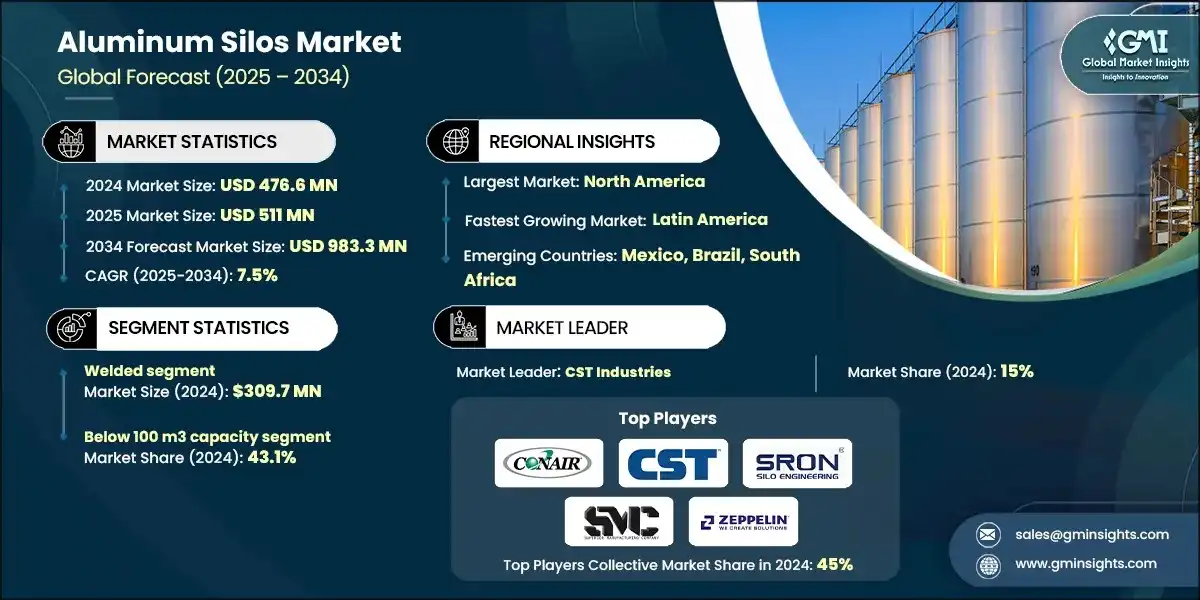
The aluminum silos market was estimated at USD 476.6 million in 2024. The market is expected to grow from USD 511 million in 2025 to USD 983.3 million in 2034, at a CAGR of 7.5% according to latest report published by Global Market Insights Inc.
To get key market trends
Global grain production is rising rapidly, which is stimulating the aluminum silo market. The USDA reports that world grain production reached over 2.8 billion metric tons in 2024, with wheat, rice, and corn dominating the largest amount. This increase requires more efficient bulk storage solutions to ensure product quality and lower post-harvest losses. Aluminum silos are becoming more popular than traditional steel and concrete silos because they do not rust and are cleaner. Cereals (FAO) have the largest harvested area of all the crops in the world and given that both developed and developing countries will need bulk storage, aluminum is a good choice to support bulk storage agencies. The demand for silos with large capacity will also increase with the development of larger footprint central grain hubs, rail heads, and terminal port systems (for export purposes). Aluminums other attributes, including strength and safety for food storage make it suitable for silo construction.
Global food safety regulations are forcing manufacturers and farm operators to upgrade their storage. The FDA Food Safety Modernization Act (FSMA) requires proactive food safety controls and storage in environments that support hygienic practices to minimize contamination. HACCP-based food safety compliance requirements established by the USDA and various international bodies also require controlled environments for grains and processed foods. The aluminum silo systems meet these standards better than any other material (e.g., porous concrete) because of their smooth inside surfaces, which are naturally resistant to microbes. The enforcement of food safety regulations is especially strong in export-oriented economies, where international standards compliance is needed to be included in the foreign supply chain and markets. As foodborne illness prevention efforts are becoming a priority internationally, the investment in advanced silo storage and systems will continue to grow, yielding a sustainable growth trajectory for an aluminum investment over time.
The ability to recycle aluminum drives significant growth in industry. Recycling aluminum uses 95% less energy than creating primary aluminum, as reported by US Geological Survey and the EPA. Global aluminum beverage can recycle rates exceeded 75% in 2023. The sustainability advantage of aluminum promotes circularity and aligns with corporate ESG commitments as well as government directives for lower carbon infrastructure. The International Aluminium Institute points out aluminum’s contribution to mitigating greenhouse gas emissions via stricter closed-loop recycling systems. In the agriculture and food processing sector, silo manufacturers are promoting products with high recycled content and targeting eco-friendly consumers. With the momentum of green financing and carbon reduction commitments growing around the world, aluminum silos will be recognized as an optimal sustainable storage solution.
Aluminum Silos Market Report Attributes
| Key Takeaway | Details |
|---|---|
| Market Size & Growth | |
| Base Year | 2024 |
| Market Size in 2024 | USD 476.6 Million |
| Market Size in 2025 | USD 511 Million |
| Forecast Period 2025- 2034 CAGR | 7.5% |
| Market Size in 2034 | USD 983.3 Million |
| Key Market Trends | |
| Drivers | Impact |
| Growing global food demand | This accelerates the need for large-scale, hygienic storage solutions, boosting adoption of aluminum silos across agriculture and food processing sectors worldwide. |
| Technological advancements in the design | Enhance operational efficiency and compliance through smart monitoring and modular systems, making aluminum silos the preferred choice for modernized supply chains globally. |
| Government support | Stimulates infrastructure investment and sustainability initiatives, creating favorable conditions for widespread deployment of aluminum silos in both developed and emerging markets. |
| Pitfalls & Challenges | Impact |
| High initial installation costs | Limits adoption among small and medium enterprises, slowing market penetration in cost-sensitive regions. |
| Maintenance challenges | Increases operational complexity and lifecycle costs, reducing long-term attractiveness for buyers seeking low-maintenance storage solutions. |
| Opportunities: | Impact |
| Integration of Smart Technologies | If manufacturers leverage this opportunity, it will transform silos from passive storage units into intelligent systems that optimize inventory management, reduce spoilage, and ensure compliance with food safety standards. This could significantly increase adoption among large-scale agricultural and food processing enterprises globally, creating a premium segment with higher margins and long-term contracts. |
| Expansion into Emerging Markets with Growing Agri-Infrastructure | Capitalizing on this opportunity would unlock substantial volume growth, as these markets are investing heavily in grain storage and processing facilities to reduce post-harvest losses. |
| Market Leaders (2024) | |
| Market Leaders |
15% market share |
| Top Players |
Collective market share in 2024 is 45% |
| Competitive Edge |
|
| Regional Insights | |
| Largest market | North America |
| Fastest growing market | Latin America |
| Emerging countries | Mexico, Brazil, South Africa |
| Future outlook |
|
What are the growth opportunities in this market?
Aluminum Silos Market Trends
One notable global trend in the aluminum silos industry is the transition towards automation and digitization for the management of storage. Across geographical regions, manufacturers and end-users are progressively utilizing IoT-enabled sensors, automated aeration systems, and cloud-based inventory applications to actively manage and track silo conditions to improve operational efficiency. The growing shift to aluminum silos is predominantly due to food safety compliance, improved spoilage minimization, and operational efficiencies particularly during larger grain operations and for a variety of industrial needs. As global supply chains continue to evolve and were added complexities, using smart technologies with aluminum silos has become an element of competitive advantage as the use of aluminum silos with adaptive technology continues to be the preference internationally.
- One of the most important technological trends is the emergence of IoT-enabled sensors and automated control systems for aluminum silos. These technologies enable temperature, humidity, and pressure to be monitored in real-time, without operator intervention being required; therefore, excess moisture or temperature variations can be identified before feeding rations become a spoilage issue. For instance, major manufacturers are rolling out cloud-based inventory management systems with predictive analytics to eliminate spoilage and be able to plan using supply chain modelling. This trend is being driven by the desire for traceability as well as food safety regulations in developed economies, as evidenced for example by changes in the US and EU food safety laws.
- On the supply side, sustainability is becoming increasingly important as a differentiator. To help reduce carbon footprints, manufacturers will shift to using aluminum with high recycled-content and closed loop recycling processes. For example, companies in Europe are taking advantage of the EU Green Deal incentives, to produce silos with potentially 75% recycled aluminum, in accordance with corporate ESG goals and mandates, and to minimize costs. This is attractive not only because it reduces production costs but also meets the demands of socially responsible purchasers in verticals like agriculture and food processing, where sustainably certified products are more widely accepted.
- There is a distinct direction within both economic and consumer contexts toward larger capacity silos and centralized storage spaces, primarily due to the consolidation of the agriculture and food manufacturing sectors. As global grain trade along with industrial scale processing continues to grow, companies are moving towards silos over 500 m³ in order to achieve economies of scale and minimize storage costs. For instance, many of the large grain exporters and agricultural suppliers currently building up their infrastructure across the Asia-Pacific region and North America are using mega silos that are complete with automated loading/unloading capabilities to accommodate the throughput for exporting terminals at such high capacities. This is indicative of another direction towards cost-cutting measures and operational efficiencies to accommodate an increasing demand for food, configuring higher capacity storage functionality than ever before.
Aluminum Silos Market Analysis

Learn more about the key segments shaping this market
Based on product type, the market is divided into welded, bolted/modular, and hybrid. The welded segment generated a revenue of USD 309.7 million in 2024.
- The primary reason welded silos occupy a majority share in the aluminum silos market is due to their construction stability and improved longevity over bolted or modular silos. Whereas bolted silos are made of panels with bolts and joints that connect the panels together, welded silos consist of plates of aluminum that are welded in a continuous manner, which mitigates the risk of leakage and minimizes contamination, critical attributes when materials to be stored are sensitive, such as food, grains, powders, and chemicals. Additionally, welded silos have a stronger structure due to their seamless design dealing with environmental stress, like wind loads or thermal expansion, to withstand long-term use with seasonal temperature fluctuations.
- Also, welded silos will ultimately require less frequent maintenance over time, as there are no joints/welds or bolts that will eventually loosen, or corrode, thus minimizing downtime and lifecycle operating costs. Therefore, welded silos provide a strong choice for those industries where reliability, cleanliness, durability and longevity are significant attributes.
Learn more about the key segments shaping this market
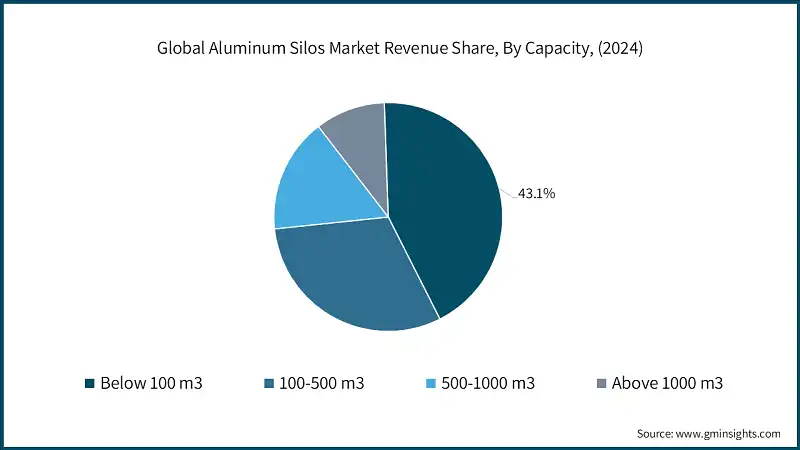
Based on the capacity, the aluminum silos market is segmented into below 100 m3, 100-500 m3, 500-1000 m3, and above 1000 m3. The below 100 m3 capacity segment held around 43.1% of the market share in 2024.
- The prevalence of aluminum silos with less than 100 m³ capacity is largely attributed to the fact that small farmers and food processors dominate the supply chain. In regions around the world (particularly in developing economies and rural areas), farms and cooperatives typically have limited land and reductions in production which calls for smaller storage solutions. These smaller silos are suited for storage of grains, seeds, and feed that can be produced and ultimately meet local demand without significant capital expenses related to infrastructure. Their low cost and simplicity of installation make them appealing to businesses where cost and simplicity of operation are prioritized.
- Urbanization and the development of decentralized processing facilities will continue to drive the demand for silos in the less than 100 m³ capacity. As small industrial and food processing units are increasingly located closer to urban centers to reduce logistics costs, there is now another pressing constraint related to space. Smaller silos provide a solution within limited footprints of storage to provide just-in-time access while maintaining local hygiene and safety standards. This is particularly prevalent with the bakery, dairy and specialty food sectors where storage requirements represent a modest requirement but demand corrosion-resistant, quality solutions.
Looking for region specific data?
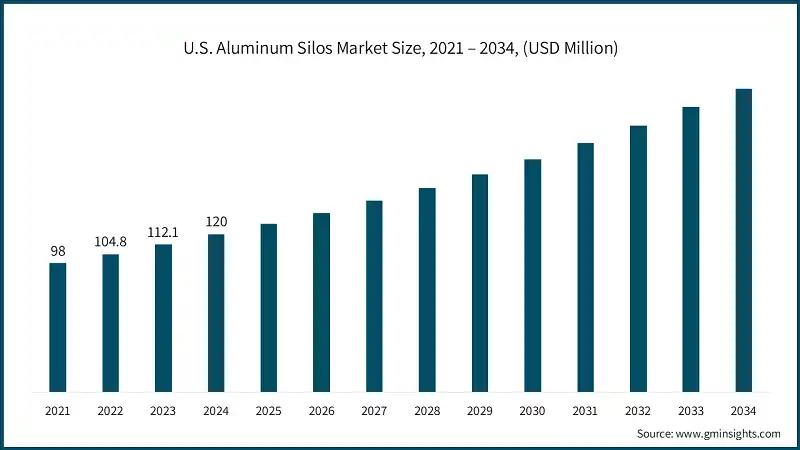
U.S. dominated the North America aluminum silos market with around 84.7% share and was valued at USD 120 million revenue in 2024.
- The U.S. has the highest growth rate, and it serves as the largest country in the North America aluminum silos industry because of the county's enough industrial base and growing agriculture and food process. For example, the United States Department of Agriculture estimates agricultural exports to be USD 176 billion in 2024, with a high contribution coming from high-value products such as dairy, meats, and grains that depend on aluminum silos for efficient bulk handling and preservation.
- In addition to this statistic, as of mid-2025, the food manufacturing subsector within this sector employed 1.77 million workers, further showcasing the existence and growth of multiple industries that depend on large volume storage infrastructure and logistical capabilities for raw materials and intermediate goods. Thus, this increase in agricultural outputs and food processing strength will place direct pressure for providing durable and hygienic bulk storage systems, making the choice of bulk aluminum silos more appealing to material handling practices.
In Europe aluminum silos market, UK leads with 25% share in 2024 and is expected to grow at 7.3% CAGR during 2025 to 2034.
- The fastest growing demand for aluminum silos in Europe is in the UK, which has a large agricultural base and a growing food manufacturing industry that requires effective and efficient bulk storage. The UK agriculture sector managed 17 million hectares of land in the UK in 2024, according to the Department for Environment, Food & Rural Affairs (Defra), representing 69% of total land area in the country, and with cereals alone managed nearly 3 million hectares of land. This extensive level of crop production, combined with total livestock numbers above 9.4 million cattle and some 31 million sheep, creates considerable demand for hygienic and durable storage solutions such as aluminum silos to maintain quality and support supply chains. In addition, in 2023, the agri-food sector accounted for about USD 176.7 billion or 6.2% of national gross value added (GVA), with food and drink manufacturing accounting for USD 42.8 billion. The above figures present both the scope and growth trajectory of industries that rely on bulk storage infrastructure.
- The UK is also a leader in the European Market because of its advanced manufacturing capabilities as well as its solid aluminum sector. Data from the government indicates that the manufacturing industry accounts for more than USD 230.6 billion a year to the economy, making it the eighth largest manufacturing economy in the world. The aluminum sector holds an even greater level of significance, employing around 17,530 workers in 2023, indicating its depth of production capacity and established systems to enable the downstream receivers to manufacture silo's. In addition, the UK possesses high recycling figures, with provisional numbers indicating that packaging waste recycling rates were up to. 75.2% in 2023, therefore enabling cost efficiency and sustainability to be implemented into the supply chain underpinning the aluminum. These structural advantages coupled with significant export figures (UK total trade was about USD 2,170.6 billion for the year ending September 2025 - up 5.1%) put the UK in the leading position, albeit the fastest growing in the aluminum silos industry.
The Asia Pacific leads the aluminum silos market; China leads with market share of around 33.8% in 2024 and is anticipated to grow with a CAGR of around 7.3% from 2025 to 2034.
- China continues to lead the Asia-Pacific region as the country with the fastest-growing demand for aluminum silos, primarily because of large-scale agricultural production and the modernization of grain storage facilities. Accordingly, the Ministry of Agriculture and Rural Affairs confirmed that China had achieved a record-grain production of 706.5 million tonnes in 2024 - the first-time production achieved levels above 700 million tonnes. The Ministry believes production levels will be even higher, reaching 709 million tonnes by 2025. To support this level of grain production, China's grain storage capacity was increased to greater than 700 million tonnes by the end of 2023, having increased 36% since 2014. Advanced technology used in grain storage facilities, such as airtight systems, thermal insulation, and green storage modules, have already gained application in harvest storage in state-owned warehouses. This supports the current effort to phase out old storage methods in favor of new hygienically viable storage facilities. This indicates a clear demand for aluminum silos that use durability and anti-corrosion properties compliant with food safety.
- China is likewise the dominant player in the regional space due to its unrivaled aluminum production and recycling abilities which ensures cost and supply security for silo manufacturing. According to the Ministry of Industry and Information Technology official data, China produced 57.79 million metric tons of aluminum in 2020, which includes 37.08 million metric tons of electrolytic aluminum, also pursuing high-value processing segments as part of its 2025-2027 high-quality development plan. In addition, the country’s resource recycling industry will reach an output value of USD 697 billion by 2025, supporting sustainability and minimizing raw material costs in aluminum-based products.
Aluminum Silos Market Share
CST Industries is leading with 15% market share. Conair Group, CST Industries, SRON Silo Engineering, Superior Manufacturing, and Zeppelin Systems GmbH collectively hold around 45%, indicating moderately consolidated market concentration. These prominent players are proactively involved in strategic endeavors, such as mergers & acquisitions, facility expansions & collaborations, to expand their product portfolios, extend their reach to a broad customer base, and strengthen their market position.
CST Industries draws on its extensive experience in the industry and its worldwide footprint to sustain its leadership position in the aluminum silos segment. The company emphasizes both product innovation and product flexibility, including innovative products such as TecTank FP that feature optimized bolt patterns and reduced hardware providing improved installation efficiencies and overall durability. CST also embraces territorial growth and strategic partnerships, having named regional representatives to strengthen its network in North America and beyond. Combining ISO-certified manufacturing capabilities, proprietary coating technologies, and integrated project management means that CST can provide high-quality low-maintenance solutions that deliver low-cost ownership and compliance with stringent public safety codes. This multi-dimensional approach allows CST to navigate competitiveness by differentiating on engineering superiority and lifecycle value.
Aluminum Silos Market Companies
Major players operating in the aluminum silos industry are:
- Bentall Rowlands Storage Systems Ltd.
- Conair Group
- CST Industries
- G.E. Silos
- Jiangsu Liangyou International Mechanical Engineering
- Mysilo
- OBIAL GmbH
- P+W Metallbau GmbH & Co. KG
- SCUTTI S.r.l.
- Shivvers Manufacturing
- SRON Silo Engineering
- Superior Manufacturing
- Symaga
- TSM Control Systems
- Zeppelin Systems GmbH
SRON Silo Engineering established a technology-driven EPC (Engineering, Procurement, and Construction) business model to become a one-stop-shop for bulk material storage and transportation solutions. Its focus is on intelligent silo systems, including IoT-based monitoring, automated material-handling systems, and energy-efficient designs to meet global sustainability targets. To drive international business development, SRON is involved in Belt and Road infrastructure projects, and already has large-scale contracts in Asia, Europe, and Africa. SRON's capacity to provide turnkey solutions from design, manufacturing, installation, to commissioning, along with its focus on green technology and tailored solutions for petrochemical and industrial products add to its competitive differential. By capitalizing on global trends, such as carbon neutrality and smart infrastructure, SRON can de-risk price-based competition and build long-term client relationships.
Superior Manufacturing has adopted a product differentiation strategy that relies on advanced customization and durability. The company manufactures silos from advanced corrosion-resistant aluminum alloys that offer low maintenance and long, useful life, a major concern for bulk storage operators in the industry. Superior Manufacturing also offers silos with a modular design that allows their customers to develop silo capacity, discharge systems, and even safety upgrades along with their operational demands. This position represents greater performance and reliability and excels at being a leading option for efficiency and value in long-term storage.
Zeppelin Systems GmbH remains an industry leader with its ability to integrate modular design into product innovation and its global service capacity. The portfolio includes modular silo systems: Bolt-Tec, Panel-Tec, and Weld-Tec. These provide flexibility in installation and cost control in a wide range of industries, including food, plastics, and chemicals. Zeppelin encourages automation and integrated process handling with fully developed automation features for storage, conveying, blending, and dosing that also include proprietary control system capability and explosion protection. The company incorporates a global network of technology centers and supports localized manufacturing/customizing characteristics to ensure speed of delivery and technical support. The company engages and appeals to high-value clients by customizing engineering and meeting structural safety requirements with reliability and efficiency. Zeppelin Systems GmbH mitigates competitive risk, either by protecting or acquiring value, by blending its traditional knowledge and insight in product design with modern modular concepts which position Zeppelin as a premium provider of high-quality product in the industrial storage solution space.
Aluminum Silos Market News
- In January 2025, Silos Spain completed the assembly of a 4,000-ton aluminum-alloy silo (model 20.63/10) for Alisur's wheat storage expansion in Chile. The silo is constructed using ProMag-coated sheet metal, an alloy of aluminum, magnesium, and zinc, which provides improved durability and corrosion resistance. The design complies with ANSI standards and includes structural reinforcement for seismic conditions per UBC 1997.
- In January 2025, Barton Fabrications, the UK's largest aluminum silo manufacturer, completed its largest-ever aluminum silo installation for Carr's Flour Scotland as part of a multi-million-pound automation and upgrade at the Kirkcaldy site. The project involved commissioning 26 aluminum silos with capacities ranging from 12 to 100 tons and heights up to 19 meters.
- In December 2024, TSC Silos completed the construction of aluminum silos for the new Solprovit Premix plant, as documented in a project video released in December 2024. The installation showcases TSC Silos' fabrication and erection capabilities for the feed and premix storage sector. The project demonstrates real-world deployment of aluminum silos in the animal feed/premix industry, highlighting the growing adoption of aluminum storage solutions in agricultural applications.
- In March 2024, ESI Eurosilo announced a state-of-the-art 50,000-tonne potato starch storage silo for Lyckeby, one of Sweden's leading potato starch producers, at their production site in Nöbbelöv, Kristianstad area. The silo, standing 43 meters tall, represents the largest potato-starch silo at the site and is the first silo of this size to be built using green (climate-improved) concrete, resulting in approximately 120,000 kg (120 metric tons) of CO2 emissions reduction compared with conventional concrete.
The aluminum silos market research report includes in-depth coverage of the industry with estimates & forecasts in terms of revenue (USD Million) and volume (Thousand Units) from 2021 to 2034, for the following segments:
Market, By Product Type
- Welded
- Bolted/Modular
- Hybrid
Market, By Aluminum Grade
- 5xxx series aluminum alloys (Al-Mg)
- Alloy 5083 (Al-Mg 4.5%)
- Alloy 5086 (Al-Mg 4.0%)
- Alloy 5052 (Al-Mg 2.5%)
- Others
- 6xxx series aluminum alloys (Al-Mg-Si)
- Alloy 6061-T6 (Al-Mg-Si Heat-Treated)
- Alloy 6063-T6 (Al-Mg-Si Extrusion Grade)
- Others
- 3xxx series aluminum alloys (Al-Mn)
- Other aluminum alloys (1xxx, 7xxx)
Market, By Customization Level
- Standard/off-the-shelf silos
- Custom-engineered silos
Market, By Capacity
- Below 100 m3
- 100-500 m3
- 500-1000 m3
- Above 1000 m3
Market, By Mounting Configuration
- Self-supporting aluminum silos
- Externally supported aluminum silos
- Load-cell supported aluminum silos
- Skid-mounted aluminum silos
Market, By End Use Industry
- Agriculture
- Chemicals
- Food processing
- Petrochemicals
- Pharmaceuticals
- Others (paper, paint and coatings, etc.)
Market, By Distribution Channel
- Direct sales
- Indirect sales
The above information is provided for the following regions and countries:
- North America
- U.S.
- Canada
- Europe
- Germany
- UK
- France
- Italy
- Spain
- Netherlands
- Asia Pacific
- China
- India
- Japan
- Australia
- South Korea
- Latin America
- Brazil
- Mexico
- Argentina
- Middle East and Africa
- South Africa
- Saudi Arabia
- UAE
Frequently Asked Question(FAQ) :
Which region leads the aluminum silos market?
North America held 84.7% share with USD 120 million in 2024. Strong agricultural base, advanced food processing industry, and sustainability initiatives fuel the region's dominance.
What are the upcoming trends in the aluminum silos market?
Key trends include integration of IoT-enabled sensors and automated control systems for real-time monitoring, adoption of high recycled-content aluminum for sustainability, shift toward larger-capacity silos (above 500 m³), and cloud-based inventory management with predictive analytics.
What is the growth outlook for China aluminum silos market from 2025 to 2034?
China aluminum silos market is projected to grow at a 7.3% CAGR till 2034, holding 33.8% market share in Asia Pacific, due to record grain production reaching 706.5 million tonnes and modernization of storage facilities.
Who are the key players in the aluminum silos market?
Key players include Bentall Rowlands Storage Systems Ltd., Conair Group, CST Industries, G.E. Silos, Jiangsu Liangyou International Mechanical Engineering, Mysilo, OBIAL GmbH, P+W Metallbau GmbH & Co. KG, SCUTTI S.r.l., Shivvers Manufacturing, SRON Silo Engineering, Superior Manufacturing, Symaga, TSM Control Systems, and Zeppelin Systems GmbH.
What was the valuation of the below 100 m³ capacity segment in 2024?
The below 100 m³ capacity segment held 43.1% market share in 2024, dominating due to widespread adoption by small farmers and food processors in developing economies.
How much revenue did the welded product type segment generate in 2024?
The welded segment generated USD 309.7 million in 2024, leading the market due to superior structural stability, durability, and reduced contamination risks.
What is the current aluminum silos market size in 2025?
The market size is projected to reach USD 511 million in 2025.
What is the market size of the aluminum silos in 2024?
The market size was USD 476.6 million in 2024, with a CAGR of 7.5% expected through 2034 driven by rising demand for large-scale, hygienic storage solutions in global agriculture and food processing sectors.
What is the projected value of the aluminum silos market by 2034?
The aluminum silos market is expected to reach USD 983.3 million by 2034, propelled by growing global food demand, technological advancements in smart monitoring systems, and government support for sustainable infrastructure.
Aluminum Silos Market Scope
Related Reports