Summary
Table of Content

All-Terrain Vehicle (ATV) Market
Get a free sample of this report
Form submitted successfully!
Error submitting form. Please try again.
Thank you!
Your inquiry has been received. Our team will reach out to you with the required details via email. To ensure that you don't miss their response, kindly remember to check your spam folder as well!
Request Sectional Data
Thank you!
Your inquiry has been received. Our team will reach out to you with the required details via email. To ensure that you don't miss their response, kindly remember to check your spam folder as well!
Form submitted successfully!
Error submitting form. Please try again.
All-Terrain Vehicle Market Size
The ATV market volume was valued at 3,95,000 Units in 2025. The market is expected to grow from 4,08,035 Units in 2026 to 5,40,627 Units in 2035 at a CAGR of 3.2%, according to latest report published by Global Market Insights Inc.
Given that outdoor recreation and utility requirements continue to increase, more people are using All Terrain Vehicles. According to the United States Bureau of Economic Analysis, outdoor recreation added more than one trillion dollars to the United States economy in 2024, resulting in an increase in the demand for vehicles that will allow people access to remote areas of the United States.
All-Terrain Vehicle (ATV) Market Key Takeaways
Market Size & Growth
- 2025 Market Size: USD 2.8 Billion
- 2026 Market Size: USD 3 Billion
- 2035 Forecast Market Size: USD 4.4 Billion
- CAGR (2026–2035): 4.5%
Regional Dominance
- Largest Market: North America
- Fastest Growing Region: Asia Pacific
Key Market Drivers
- Growth in outdoor recreation participation.
- Expansion of precision agriculture practices.
- Rising rural infrastructure and land management spending.
- Product innovation in powertrain and suspension systems.
Challenges
- Safety concerns and accident rates.
- Environmental restrictions on off road access.
Opportunity
- Electrification of off-road vehicles.
- Growth in defense and border surveillance applications.
- Aftermarket accessories and performance upgrades.
Key Players
- Market Leader: Polaris led with over 29.2% market share in 2025.
- Leading Players: Top 5 players in this market include BRP/Can-Am, Honda, Kawasaki, Polaris, Yamaha, which collectively held a market share of 80% in 2025.
Get Market Insights & Growth Opportunities
One of the main reasons for the growing demand for ruggedly built vehicles is the fact that there is a growing need for agriculture and forestry (requiring transportation capability) across rough terrain. According to the US Department of Agriculture, 900 million acres of farmland use mechanized equipment to provide support to crops and livestock, therefore increasing the need for utility vehicles in rural areas.
The factors that affect the design and adoption of all-terrain vehicles are safety and regulation compliance. In 2023, the National Highway Traffic Safety Administration reported over 70,000 all-terrain vehicle accidents had been treated in emergency departments in the United States. There has been an increased need for the implementation of safety training guidelines and safety equipment in certain areas, as demonstrated by the number of all-terrain vehicle accident reports.
The amount of recreational users of all-terrain vehicles has an impact on how manufacturers are able to engage with the market. The Bureau of Land Management reported that there are more than 300 million acres of public land designated for off-road travel, which increases the ability to access land and creates a continued high demand for durable all-terrain vehicles for use in outdoor recreation.
Environmental policies and land management regulations will greatly influence how manufacturers design and produce all-terrain vehicles. According to the Department of the Interior, there have been many new regulations and controls regarding land access to controlled/protected areas by 2024. Manufacturers will be required to improve their emissions and noise reductions in order to meet the requirements of federal land use policies.
The Global all-terrain vehicle market was estimated at USD 2.8 billion in 2025. The market is expected to grow from USD 3 billion in 2026 to USD 4.4 billion in 2035, at a CAGR of 4.5% according to latest report published by Global Market Insights Inc.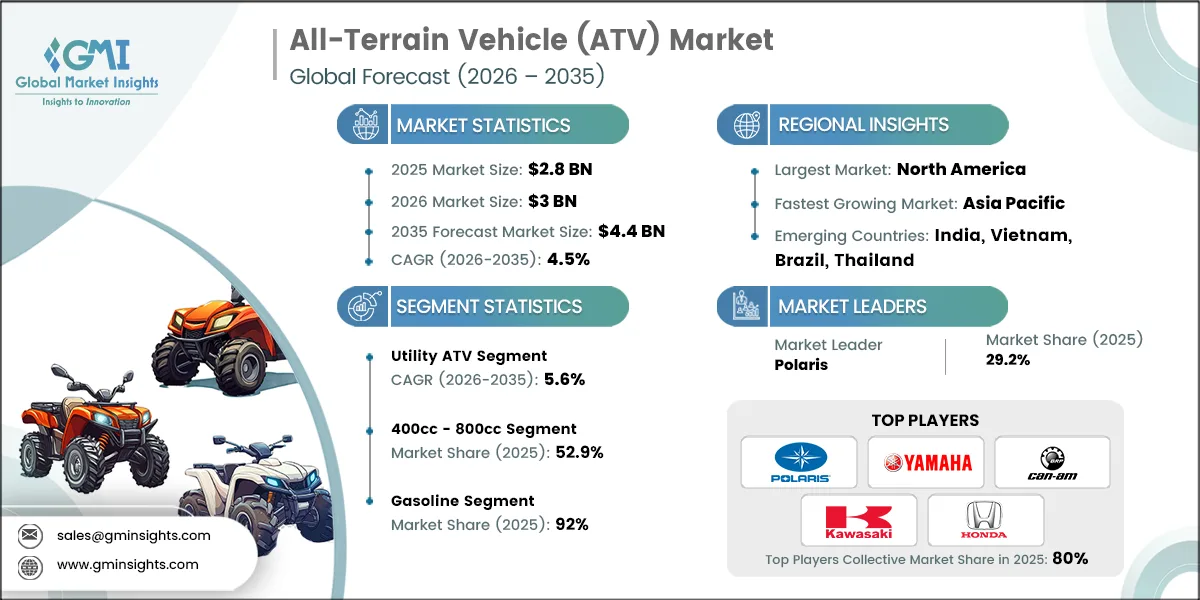
To get key market trends
All-Terrain Vehicle Market Trends
Electric ATVs are becoming more popular due to restrictions on their use in environmentally sensitive areas. In 2024, the US Department of the Interior reported that 40% of federal recreation area has limitations on noise and emissions which encourages manufacturers to develop these types of vehicles.
Utility-minded ATVs are becoming more common in agriculture and land management sectors. The US Department of Agriculture states that over 85% of farms were using mechanization to produce food by 2023 and there is also a growing demand for vehicles that can travel off-road to access rural areas.
The main influence of vehicle regulations today is still safety. According to the US Consumer Product Safety Commission, there were about 650 fatalities from year 2022 relevant to ATVs, prompting authorities to focus on helmet use and training programs as well as wider implementation of stability improvements across recreational and utility use across the world.
Digitizing public land records is also impacting user usage patterns. In 2024, the US Bureau of Land Management reported that close to 300 million acres were mapped for designated off-road access and implementing digital trail systems and monitoring where vehicles travel and their effects.
Increasingly, agencies that defend and provide emergency services are utilizing ATVs. The US Department of Homeland Security stated that border patrol and disaster response agencies raised their procurement budgets for off-road mobility vehicles in 2023, indicating they require transportation in remote and limited access locations.
All-Terrain Vehicle Market Analysis
Learn more about the key segments shaping this market
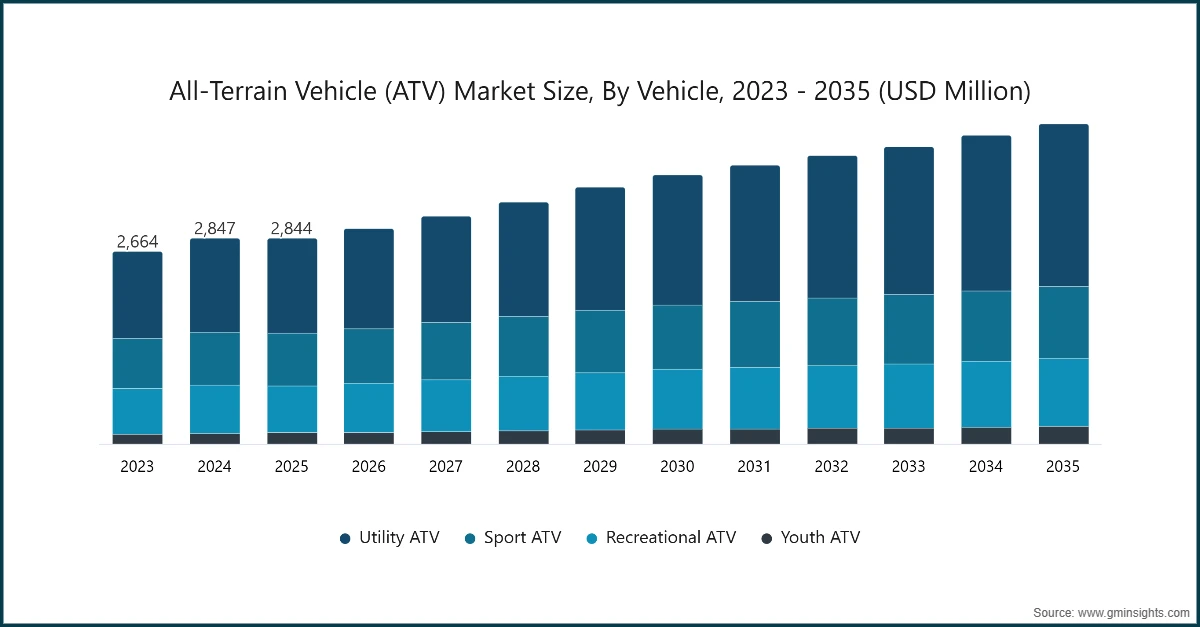
Based on vehicle, the market is segmented into utility ATV, sport ATV, recreational ATV, youth ATV. The utility ATV segment dominates the market with 56% share in 2025 and is expected to grow at a CAGR of 5.6% from 2026 to 2035.
- Demand for utility ATVs are driven by agricultural operations and land management. Approximately 85% of farms use mechanical equipment in daily operations, according to the US Department of Agriculture, which in turn supports the adoption of utility ATVs as they are regularly used for hauling, spraying, building fences and monitoring livestock.
- Demand for sport ATVs directly correlates with an increase in competitive riding and organized motorsports. The US Bureau of Land Management reports thousands of events permitted to allow off-road racing or trail riding on federal land each year, further supporting the demand for these higher powered and high-performance vehicles.
- Recreational ATVs will see continued growth based upon continued growth in both outdoor recreation and tourism. The US Bureau of Economic Analysis reports that outdoor recreation in the US accounts for more than $1 trillion in annual expenditures, with a large proportion of rural leisure spending associated with trail riding and off-road activities.
- Youth ATV adoption is driven by safety regulations and supervised use. The US Consumer Product Safety Commission has guidelines on recommended engine sizes based on age as well as the growth of training programs across several states following the report of more than 650 fatalities in 2022.
Learn more about the key segments shaping this market
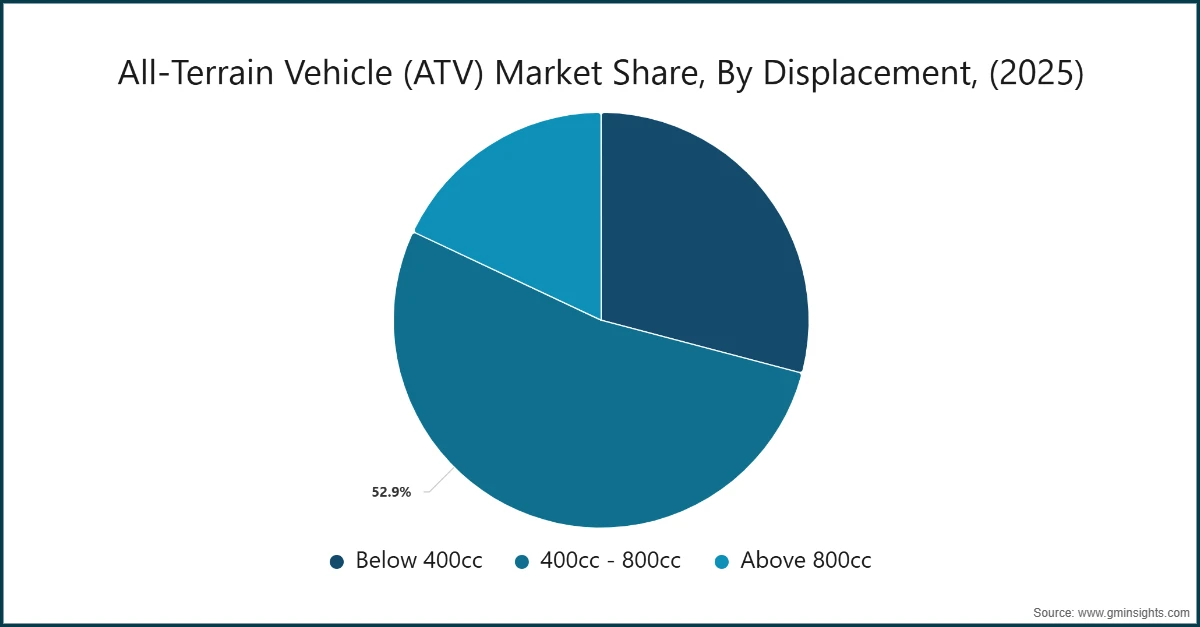
Based on displacement, the all-terrain vehicle market is divided into Below 400cc, 400cc - 800cc, above 800cc. The 400cc - 800cc segment dominates with 52.9% market share in 2025 and is growing at a CAGR of 4.6% from 2026 to 2035.
- A large number of youth and entry level recreational vehicles are less than 400c.c.s engine. The U.S. Consumer Product Safety Commission says lower engine capacity generally results in less severe injuries making them suitable for use in training programs or when being used by children in numerous states.
- The recreational off-road segment also provides support to agriculture and utility applications. According to the U.S. Department of Agriculture, mechanized vehicles represent over 85 percent of farms in the U.S. where mid displacement ATVs have sufficient torque, fuel efficiency and low maintenance costs to meet the recreational needs of farm owners.
- The use of ATVs with engine displacements over 800 c.c. is expanding; they have become common in support of heavy-duty recreational uses, defense operations and emergency response activities. The U.S. Department of Homeland Security has identified a growing number of high-power off-road vehicles operating along the United States' borders and being used in disaster response require the capability to tow loaded trailers and to operate off road in harsh terrain.
Based on fuel, the all-terrain vehicle market is segmented into gasoline, and electric. The gasoline segment dominates with 92% market share in 2025.
- Gasoline ATVs are still the preferred choice for agriculture, recreation and utility use. According to a report by the Energy Information Administration (EIA), more than 90% of all off-road vehicles used in rural areas are gas-powered because the refueling process is quick and the range is reliable.
- Gasoline-powered ATVs have an advantage because of the availability of gasoline at remote refueling stations. According to the U.S. Department of Transportation, rural fuel supply is available in more than 95% of the United States’ land area, thus allowing for uninterrupted fuel supply for farming, forestry and emergency response activities.
- Electric ATVs help comply with environmental requirements and can be used in sensitive areas. The U.S. Department of the Interior reported that in 2024, the number of locations where low-emission vehicles will be allowed to operate in national parks is increasing, as they are much quieter than their gas counterparts and produce little localized air pollution.
- Electric ATVs are being considered for use in areas where noise is regulated or where noise is otherwise a concern. The U.S. Environmental Protection Agency says that the goal of electric transportation will help meet emissions reduction goals, and the U.S. Department of Energy said electric vehicles are being tested in increasing numbers on public lands using electric vehicle pilot programs.
Based on drive, the market is divided into 2-Wheel Drive (2WD), 4-Wheel Drive (4WD), and All-Wheel Drive (AWD). The 4-Wheel Drive (4WD) segment dominates with 66% market share in 2025.
- 4-Wheel Drive (4WD) ATVs are frequently used for agriculture (forestry) and utility work. Over 85% of all farms in the US use mechanized vehicles and need to improve traction to transport tooling over dirt, mud, or slope.
- ATVs with four wheels can be used in Defense, Rescue, and Extreme Terrain applications per the Department of Homeland Security. Utilize an all-terrain vehicle as a moving platform for border patrol, and disaster response, where you have a reliable power supply, provides better control of your vehicular and safety environments.
- TVs with two wheels are primarily utilized in casual riding and in controlled settings per the BLM, several systems have to restrict the weight, and hence output, many endure and which allows for simpler vehicle operation when riding casually.
 Looking for region specific data?
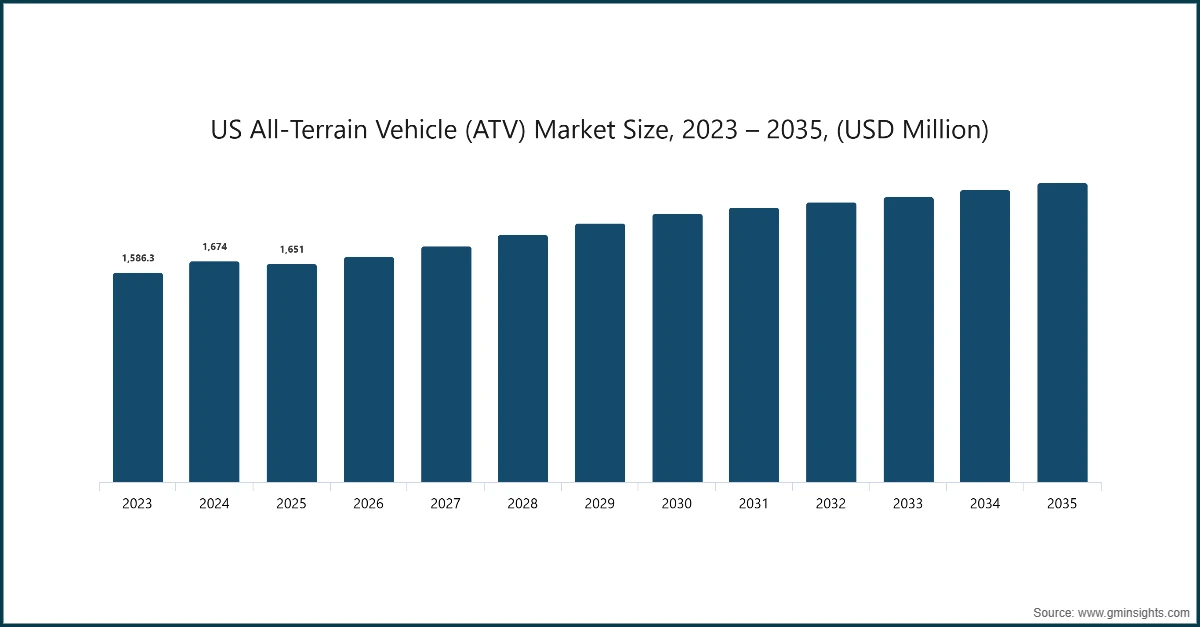
The US dominates the North America all-terrain vehicle market accounting for over 85% share and generating USD 1.7 billion in 2025.
- The ATV market in the US is a developed, heavily regulated market with a strong core of recreation and agriculture supporting the market. ATV demand is primarily focused on the rural states within the US, where off-road access land is available and farms operate year-round.
- Agricultural and ranching activity has a significant impact on how vehicles are adopted. Farmers and ranchers widely use utility ATVs for many reasons, including agriculture, fencing, livestock monitoring, transporting livestock, and inspecting fields, particularly in the Midwest and South where large tracts of land can be efficiently serviced.
- Recreational riding is supported by public land access and organized trails. Both state and federal governments manage public lands, and provide designated off-road routes for recreation, while still allowing the use of these routes within the confines of state and federal environmental and safety regulations.
- In the US, safety standards as well as compliance frameworks are and will continue to drive product specifications. Manufacturers design products to meet federal consumer safety guidelines, age restrictions and equipment requirements at the state level; therefore, manufacturers continuously upgrade braking systems, stability features, and rider protection technologies on their products.
Germany dominates Europe all-terrain vehicle market growing with a CAGR of 6% from 2026 to 2035.
- The German All Terrain Vehicle market is highly regulated due to the agricultural forestry uses of ATVs, and these regulations are impacting how the ATV is manufactured with respect to specific criteria for lighting, braking systems, and emissions.
- The agricultural operations of many regions in Bavaria, Lower Saxony, and Brandenburg are providing a means to promote and support the utility ATV for uses such as vineyard management, livestock transportation, and field inspections. In rural areas where access to farms and wooded areas is very restricted, compact vehicle dimensions and maneuverable vehicles are important attributes.
- The environmental protection policies currently in place are driving a very limited and regulated area for the recreational use of ATVs. At the federal and state level, ATV use in public forests and conservation areas has specific regulations for sound and emissions, and this has a major influence on how the vehicle is developed and how the manufacturer positions its products in the market.
China dominates the Asia Pacific all-terrain vehicle market, showcasing strong growth potential, with a CAGR of 9.4% from 2026 to 2035.
- The All Terrain Vehicle market in China is primarily focused on production with the majority of units manufactured for availability within China and for export to other countries. Industrial Clusters and manufacturers located in the provinces of Zhejiang and Chongqing to produce utility-based models which are sold to agricultural customers in China and to light industry customers as well as for export into the recreational markets of North America, Europe and Southeast Asia.
- Government policies supporting rural mechanization will gradually lead to greater usage of utility ATVs in agricultural areas; however, utility ATVs are primarily used for support within orchard management, livestock transport and monitoring of plantation crops, particularly in western and central provinces of China where terrain limits access to larger farm equipment.
- Export demand has a major impact on the configuration of the All-Terrain Vehicle Industry in China. Cost competitive ATVs produced by Chinese manufacturers and exported to North America, Europe and Southeast Asia benefit from manufacturers having the ability to provide large-scale production, local sourcing for components and an integrated supply chain to maintain price competitiveness in the Global marketplace.
- There is a very low level of recreational activity within China with regard to the use of ATV type vehicles due to limited access to land and high urban population densities throughout the country. However, there are many controlled tourism zones on the outskirts of large metropolitan areas and many private property owners throughout China that participate in opening up private property for use by ATVs. These zoning and property use changes are helping to gradually increase the level of sport and entry-level recreational ATVs.
Brazil leads the Latin American all-terrain vehicle market, exhibiting remarkable growth of 7.2% during the forecast period of 2026 to 2035.
- Brazil market has primarily driven by its broad agricultural and ranching operations. Because of the vast amount of agricultural land located primarily in states such as Mato Grosso and Goias, there is a steady demand for vehicles utilized for inspecting crops, handling livestock, as well as for monitoring properties.
- With sugarcane, soybeans, and livestock, many producers need to be able to move across uneven and expansive land. Utility ATVs are the most commonly used vehicle for short hauling, spraying, and transporting equipment, especially in areas where there are no roads or where road access is impeded by climatic conditions.
- The adoption of utility ATVs is further supported by the fact that many environmental and forestry management programs require a controlled form of mobility. The presence of utilized and greater regulated forests and conservation zones creates an increased demand for compact and rugged off-road vehicles that can perform their duties without creating significant disturbance to the earth.
- Tourism and recreational use of utility ATVs is secondary to agriculture. Still, areas that are tourism focused or properties privately owned provide some limited demand for sport and mid-weight ATV use, particularly in guided tours and rural recreation.
UAE witnessed substantial growth in the Middle East and Africa all-terrain vehicle market in 2025.
- Within the United Arab Emirates, there exists a small but extremely lucrative all-terrain vehicle industry. This is due mostly to the high level of tourist and outdoor recreational activity in this desert environment. The practice of riding sand dunes in the desert has been structured into a leisure activity with licensed tour operators working within designated areas of the desert, creating a supply and demand for ATVs.
- There is a high level of consistent demand for ATVs through the Adventure Tourism and Hospitality industries. Furthermore, resorts and tour companies owning or leasing their own fleet of ATVs for use on guided tours is an integral part of the overall visitor experience particularly for Dubai and Abu Dhabi, both of which have established programs for Desert Safari's.
- There are Government and Municipal regulations that set standards and require compliance concerning the operation of ATVs in the desert and protected areas. All operators of ATVs must carry a license and have liability insurance and the required safety equipment. The Government and Municipalities also regulate the environmental impacts of ATVs and enforce strict compliance with rider safety policy standards.
- The use of ATVs for agricultural purposes is minimal given the nature of the arid land and the equipment used on the mechanized farms. However, utility ATVs do have a niche market due to the destruction of assets through issues of security, estate management, and monitoring remote infrastructure within the high-temperature, sandy terrain.
All-Terrain Vehicle Market Share
- The top 7 companies in the all-terrain vehicle industry are Polaris, BRP Can Am, Honda, Yamaha, Kawasaki, Suzuki, and CFMoto, contributed around 87% of the market in 2025.
- Polaris is known as an established player within both the utility and recreation vehicles. Their focus is on developing high-displacement engine platforms, advanced suspension systems, and Integrated accessory offerings for use in agricultural, defense, and outdoor recreation applications.
- BRP Can Am focuses on premium design and performance-based chassis engineering when developing their line of recreational and competitive motorsport ATVs. Their sport and utility ATVs include advanced handling systems for both drivers seeking to enjoy recreation and also those participating in reclaiming land as well as competing in motorsport events in North America and select European markets.
- Honda uses its global manufacturing capabilities to develop reliable engines that provide utility and mid-displacement vehicles. Honda's focus on durability, fuel economy, and adherence to emissions standards allows them to position their products as agricultural or general-use vehicles.
- Yamaha offers a diverse mix of sport and utility products backed by their recognized motorsports brands. Yamaha integrates durable powertrains with rider centric ergonomics as part of their overall mission to enhance their brand's position within both recreational and off-road performance segment markets.
- Kawasaki is focused on providing high-performance and high-D.O.C.-level outdoor vehicles (ATVs) that meet demand for off-road use in the forestry, utility, and sport riding industries. Kawasaki has designed its products with an emphasis on torque and suspension, which enables them to operate in these types of environments.
- Suzuki sells middle-range ATV models to the market using its credentials for producing good mechanical quality and efficient use of equipment. In addition, Suzuki has an established brand in certain geographic markets as well as experience within the overall powersport's industry.
- CFMoto has been able to build brand loyalty throughout the world by providing cost-effective means of production and establishing strategic distribution partnerships. CFMoto has set up utility and recreational models aimed at cost-conscious buyers, while at the same time gradually increasing their quality and level of technology in their products and reaching out to the international market.
All-Terrain Vehicle Market Companies
Major players operating in the all-terrain vehicle industry are:
- Arctic Cat
- BRP
- CFMoto
- Honda
- Kawasaki
- Kymco
- Polaris
- Suzuki
- Textron
- Yamaha
- Demand for all-terrain vehicles (ATV’s) is being driven by agricultural mechanization, recreation (outdoor), and utility purposes in rural and some suburban environment. Demand for ATVs also coming from the agricultural sector (farm use), land management, defense, mobility and structured tourism activities. Product development is aligned to safety and performance for emissions and terrain.
- Manufacturers compete on the basis of engine displacement range, drive configuration, durability and strength of distribution systems; however, product design is greatly dictated by compliance with regulation, environmental restrictions and safety standards. Furthermore, the introduction of electric vehicles and value-orientated products will continue to shape the competitive landscape in both developed and emerging markets.
All-Terrain Vehicle (ATV) Market Report Attributes
| Key Takeaway | Details |
|---|---|
| Market Size & Growth | |
| Base Year | 2025 |
| Market Size in 2025 | USD 2.8 Billion |
| Market Size in 2026 | USD 3 Billion |
| Forecast Period 2026-2035 CAGR | 4.5% |
| Market Size in 2035 | USD 4.4 Billion |
| Key Market Trends | |
| Drivers | Impact |
| Growth in outdoor recreation participation | Increased off-road riding activities across public and private lands support consistent demand for recreational all-terrain vehicles. |
| Expansion of precision agriculture practices | Farm operators adopt utility all-terrain vehicles for field monitoring livestock management and material transport across uneven terrain. |
| Rising rural infrastructure and land management spending | Government backed rural development programs improve accessibility and operational efficiency, strengthening vehicle usage across forestry and utility applications. |
| Product innovation in powertrain and suspension systems | Improved engine efficiency enhanced suspension travel and higher load capacity increase suitability for both commercial and recreational usage. |
| Pitfalls & Challenges | Impact |
| Safety concerns and accident rates | Injury data reported by transportation safety authorities lead to stricter safety regulations and compliance costs for manufacturers. |
| Environmental restrictions on off road access | Land protection policies and emission standards limit usage areas and require continuous product adaptation. |
| Opportunities: | Impact |
| Electrification of off-road vehicles | Development of electric all-terrain vehicles support compliance with emission regulations and expanding eco sensitive zones. |
| Growth in defense and border surveillance applications | Government procurement for mobility in remote terrain creates new institutional demand channels. |
| Aftermarket accessories and performance upgrades | Demand for winches plows lighting systems and suspension kits strengthens recurring revenue streams. |
| Market Leaders (2025) | |
| Market Leader |
29.2% Market Share |
| Top Players |
Collective Market Share is 80% |
| Competitive Edge |
|
| Regional Insights | |
| Largest Market | North America |
| Fastest growing market | Asia Pacific |
| Emerging countries | India, Vietnam, Brazil, Thailand |
| Future outlook |
|
What are the growth opportunities in this market?
All-Terrain Vehicle Industry News
- In February 2026, Polaris expanded its 2026 powersports lineup with new enclosed cab RANGER models including the 2026 RANGER 1000 CAB and other utility vehicles offering all-season comfort and enhanced performance for work and outdoor use.
- In January 2026, Yamaha announced increased contingency payouts totaling nearly USD 109,000 for participants in 2026 ATV racing series across GNCC, ATV MX and WORCS events to support competitive riding efforts.
- In January 2026, Kawasaki revealed an expanded 2026 off road vehicle lineup featuring new Teryx H2 sport models and updated Brute Force 450 and Ridge utility vehicles with premium features and color options.
- In December 2025, Suzuki announced the return of its popular 2026 KingQuad ATV range as part of its motorcycle and ATV lineup, including the KingQuad 750AXi with enhanced features and performance.
- In September 2025, CFMOTO USA unveiled its 2026 CFORCE ATV and ZFORCE and UFORCE UTV lines with interior upgrades, expanded dealer distribution and new True Timber Kanati camo options across the utility and recreational range.
- In May 2025, American Honda confirmed the return of popular ATV models including the FourTrax Rancher, FourTrax Foreman 4x4 and FourTrax Foreman Rubicon for the 2026 model year, reinforcing its utility vehicle lineup.
The all-terrain vehicle market research report includes in-depth coverage of the industry with estimates & forecasts in terms of revenue (USD Mn) and volume (Units) from 2022 to 2035, for the following segments:
Market, By Vehicle
- Utility ATV
- Sport ATV
- Recreational ATV
- Youth ATV
Market, By Displacement
- Below 400cc
- 400cc - 800cc
- Above 800cc
Market, By Fuel
- Gasoline
- Electric
Market, By Drive
- 2-Wheel Drive (2WD)
- 4-Wheel Drive (4WD)
- All-Wheel Drive (AWD)
Market, By Application
- Agriculture & Farming
- Forestry
- Military & Defense
- Sports & Racing
- Recreation & Tourism
- Industrial & Utility Services
- Others
The above information is provided for the following regions and countries:
- North America
- US
- Canada
- Europe
- Germany
- UK
- France
- Italy
- Spain
- Russia
- Norway
- Netherlands
- Sweden
- Asia Pacific
- China
- India
- Japan
- Australia
- South Korea
- Singapore
- Thailand
- Indonesia
- Vietnam
- Latin America
- Brazil
- Mexico
- Argentina
- MEA
- South Africa
- Saudi Arabia
- UAE
- Turkey
Frequently Asked Question(FAQ) :
What is the market size of the all-terrain vehicle (ATV) in 2025?
The market size was USD 2.8 billion in 2025, with a CAGR of 4.5% expected through 2035, driven by growth in outdoor recreation participation, expansion of precision agriculture practices, and rising rural infrastructure spending.
What is the projected value of the all-terrain vehicle industry by 2035?
The all-terrain vehicle market is expected to reach USD 4.4 billion by 2035, propelled by increasing electrification of off-road vehicles.
What is the current all-terrain vehicle industry size in 2026?
The market size is projected to reach USD 3 billion in 2026.
How much revenue did the utility ATV segment generate in 2025?
The utility ATV segment dominated the market with a 56% share in 2025, driven by agricultural operations and land management needs, with approximately 85% of U.S. farms using mechanized equipment for hauling, spraying, fencing, and livestock monitoring.
What was the market share of the 400cc–800cc displacement segment in 2025?
The 400cc–800cc segment dominated the all-terrain vehicle market with a 52.9% share in 2025, growing at a CAGR of 4.6% from 2026 to 2035, supported by its suitability for agricultural utility and recreational off-road applications.
Which region leads the all-terrain vehicle market?
U.S. dominating with over 85% share of the North America ATV market and generating USD 1.7 billion in 2025, supported by strong agricultural demand, public land access for recreation, and established safety compliance frameworks.
What are the key trends shaping the all-terrain vehicle market?
Key trends include expanding use in precision agriculture and land management, rising procurement by defense and emergency services, digitization of public land access records, and growth of organized motorsports and recreational trail riding.
Who are the key players in the all-terrain vehicle market?
Key players include Polaris (market leader with 29.2% share), BRP/Can-Am, Honda, Yamaha, Kawasaki, Suzuki, CFMoto, Arctic Cat, Kymco, and Textron.
All-Terrain Vehicle (ATV) Market Scope
Related Reports