Summary
Table of Content

Airport Sleeping Pods Market
Get a free sample of this report
Form submitted successfully!
Error submitting form. Please try again.
Thank you!
Your inquiry has been received. Our team will reach out to you with the required details via email. To ensure that you don't miss their response, kindly remember to check your spam folder as well!
Request Sectional Data
Thank you!
Your inquiry has been received. Our team will reach out to you with the required details via email. To ensure that you don't miss their response, kindly remember to check your spam folder as well!
Form submitted successfully!
Error submitting form. Please try again.
Airport Sleeping Pods Market Size
The growth in the market can be attributed to factors such as an increase in air passenger traffic globally, the surge in extended layovers, the development of premium airport facilities, the need for optimization in airport non-aeronautical revenue growth, the adoption of digital technology for bookings and access control in airport facilities, and the development of smart airport sleeping pods incorporating AI/IoT technology in airport facilities globally.
Airport Sleeping Pods Market Key Takeaways
Market Size & Growth
- 2025 Market Size: USD 87.9 Million
- 2026 Market Size: USD 93.3 Million
- 2035 Forecast Market Size: USD 176.2 Million
- CAGR (2026–2035): 7.3%
Regional Dominance
- Largest Market: Asia Pacific
- Fastest Growing Region: North America
Key Market Drivers
- Rising global air passenger traffic demand rest facilities.
- Extended layovers increase need for short‑term rest spaces.
- Airports optimize non‑aeronautical revenue streams.
- Digital booking and contactless access adoption.
- Competitive differentiation among premium airports.
Challenges
- Operational maintenance and hygiene complexity.
- Space constraints within crowded terminals.
Opportunity
- AI/IoT smart pods for personalized rest.
- Hybrid models combining work/rest amenities.
Key Players
- Market Leader: GoSleep led with over 5.2% market share in 2025.
- Leading Players: Top 5 players in this market include GoSleep, Metronaps, Podtime, Minute Suites, NapCabs GmbH, which collectively held a market share of 18.6% in 2025.
Get Market Insights & Growth Opportunities
The market is driven by the increasing air passenger traffic globally, as passengers want to rest comfortably during their transit. In 2026, the global passenger traffic is expected to rise to 10.2 billion, as indicated by Airports Council International (ACI) World. This shows the increasing demand for short stays, which can be served by the use of airport sleeping pods due to the high number of passengers. Major airports, for instance, are increasing the number of pods at the Dubai International Airport, focusing on the comfort of passengers at the airport, which serves a high number of passengers.
Furthermore, airport sleeping pods market is driven by increased air passenger traffic, because passengers need comfortable sleeping facilities during their extended waiting periods between flights. for instance, Shanghai Pudong International Airport launched sleep pods for overnight and transit use in May 2025 to provide better service for travelers who have extended layovers and late-night connections. This implies that there is an increasing need for sleep pods in major airports, thus improving passenger service and non-aeronautical revenue generation.
The expansion of market during this time period was supported by increased passenger dwell time, heightened demand for comfort during layovers, and adoption of hybrid work/rest pods. Additional factors supporting market penetration included the growing integration of app-based booking systems, AI-assisted personalization features, and airports’ focus on generating non-aeronautical revenue from premium services.
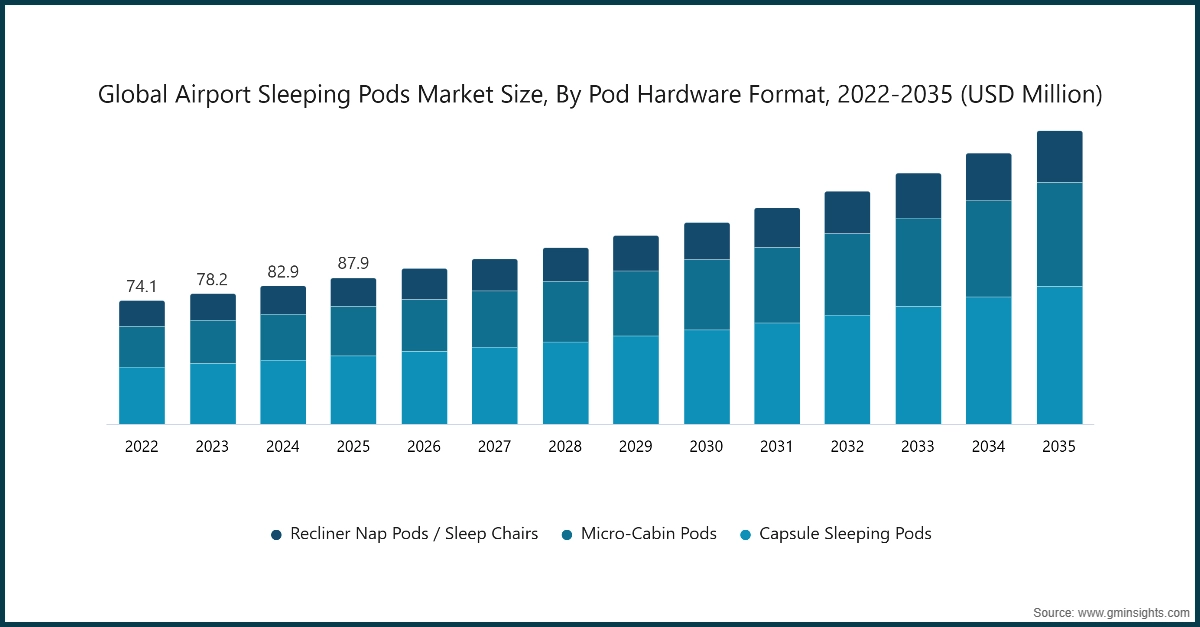
The global airport sleeping pods market was valued at USD 87.9 million in 2025. The market is expected to grow from USD 93.3 million in 2026 to USD 130.2 million in 2031 & USD 176.2 million in 2035, at a CAGR of 7.3% during the forecast period according to the latest report published by Global Market Insights Inc.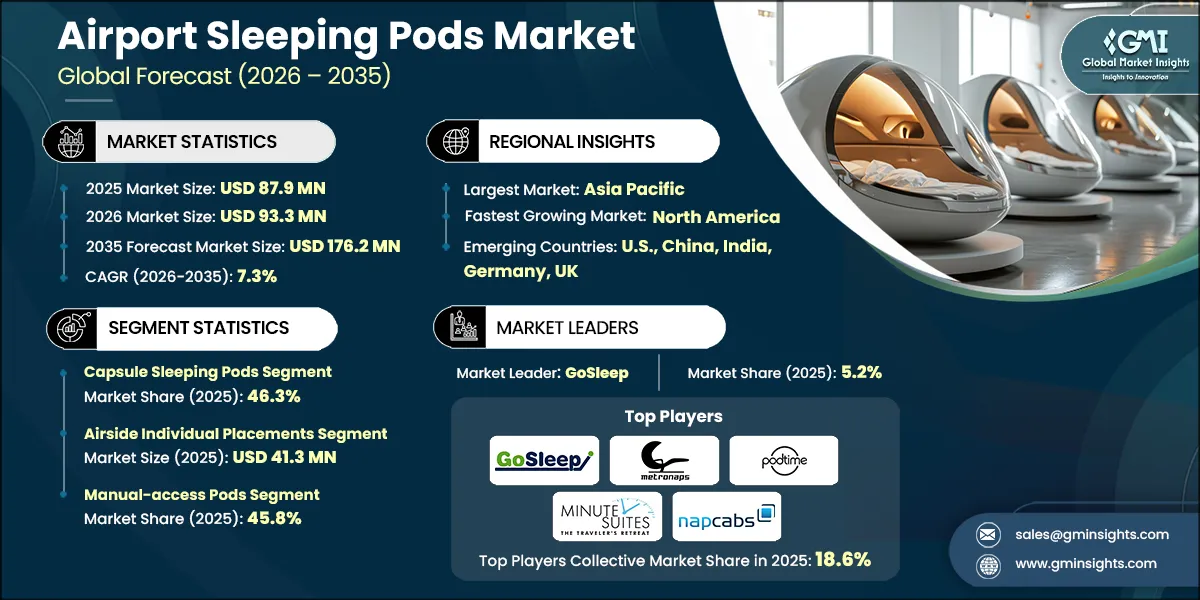
To get key market trends
Airport Sleeping Pods Market Trends
- Airports can improve terminal space usage through the implementation of modular pod designs that require less space for their operation. The trend started in 2019 when urban airports experienced both space limitations and rising passenger numbers. The period will extend until 2032 because terminal expansion projects and existing facility upgrades will continue to take place. The results of the project enable better capacity control, affordable system setups, and increased satisfaction for passengers.
- Personalization in premium segments using biometric and passenger preference technologies is a growing trend, helping pods optimize lighting, temperature, and soundscape control with machine learning algorithms. This trend began in 2021, where airports were trying to personalize their premium offerings for business travelers and high-value passengers. By 2030, continued AI and IoT enhancements will expand personalization globally. The implication is higher occupancy, stronger loyalty, and increased non-aeronautical revenue streams.
- The rise of multi-functional hybrid pods combining rest, workstations, and wellness features is gaining momentum. Initiated in 2020 to cater to business travelers seeking productivity during layovers, this trend will continue until 2030 as demand for versatile airport amenities grows. The effect is expanded usage scenarios, higher revenue per pod, and enhanced passenger experience across hub airports.
- The process of integrating cashless payment systems together with application-based access to pods is progressing at an increasing speed which results in better contactless system performance and greater operational effectiveness. The outbreak of the pandemic in 2020 caused people to become more concerned about cleanliness which led to the rise of mobile technology usage. The result of this process will create better booking systems which require fewer employees while delivering a safer and quicker travel experience to passengers.
Airport Sleeping Pods Market Analysis
Learn more about the key segments shaping this market
Based on pod hardware format, the airport sleeping pods market is divided into recliner nap pods / sleep chairs, micro-cabin pods and capsule sleeping pods.
- The capsule sleeping pods segment led the market in 2025, holding a 46.3% share, leading the market due to their compact design, privacy, and suitability for high-density airport terminals. These pods provide secure, ergonomic resting spaces for passengers, enhancing comfort during layovers and transit. Their scalability, ease of installation, and ability to integrate with booking systems make them a preferred choice for major international airports. Additionally, capsule pods support high passenger turnover and reduce congestion in waiting areas, making them ideal for both short and long layover periods.
- The micro-cabin pods segment is anticipated to grow at a CAGR of 7.8% over the forecast period. This segment is growing due to increased demand for premium, self-contained pods with increased amenities such as climate control, entertainment options, and personalization with AI technology, which are attracting business and long-haul passengers, especially in newly constructed terminals and upgraded airport lounges. Their modular design also allows airports to offer tiered services, targeting both standard and premium passenger segments, which accelerates adoption and revenue potential.
Based on deployment zone and facility model, the airport sleeping pods market is divided into airside individual placements, landside individual placements, and dedicated capsule hotel facilities.
- Airside individual placements segment dominated the market in 2025 and valued at USD 41.3 million, dominating the market. These facilities are located near the boarding gates for passengers who have short connection times or need to access the sleeping pods during their layover. These pods serve passengers with short connection times and provide easy access during layovers. Airports prefer this placement for operational efficiency and passenger convenience. They also generate non-aeronautical revenue by maximizing usage in high-traffic areas and encouraging premium service adoption. Moreover, airside placement allows frequent flyers and business travelers to rest without leaving secure zones, enhancing loyalty program benefits and overall passenger satisfaction.
- Dedicated capsule hotel facilities segment is expected to witness growth at a CAGR of 8.5% during the forecast period. The facilities provide complete service accommodation for travelers including long-distance travelers, transit passengers and passengers who arrive at airports during early morning or late-night. The improved amenities together with the booking system and privacy options lead to increased occupancy rates which result in the fast growth of capsule hotels at major international airports across the globe.
Learn more about the key segments shaping this market
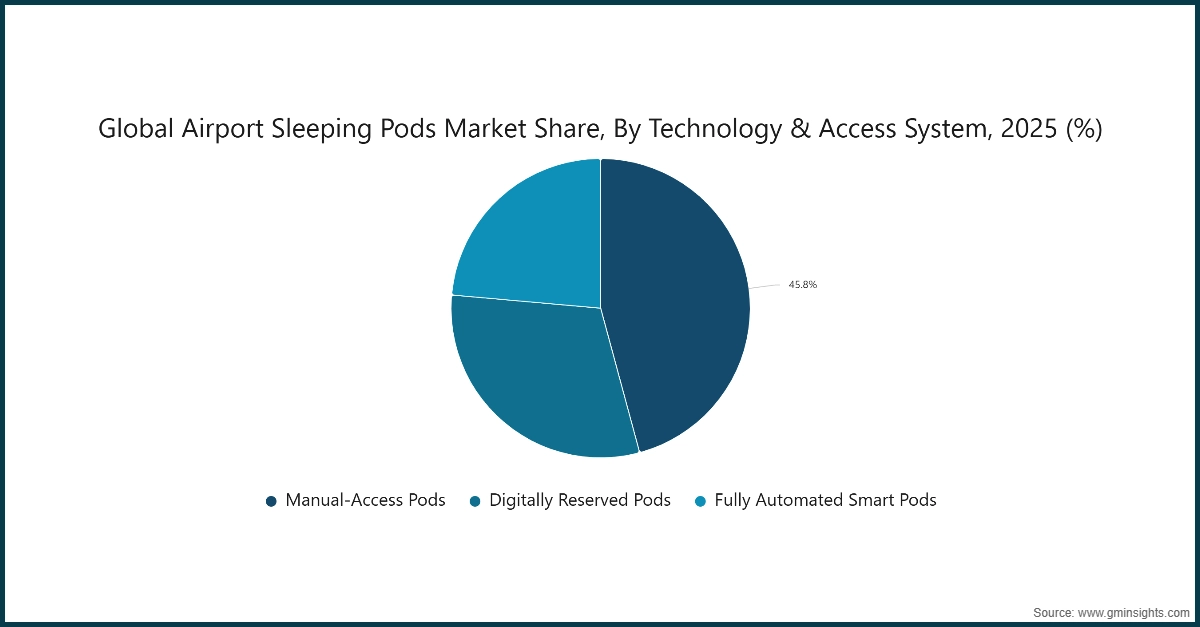
Based on technology and access system, the airport sleeping pods market is divided into manual-access pods, digitally reserved pods, and fully automated smart pods.
- Manual-access pods segment led the market in 2025 with a market share of 45.8%, leading the segment due to low installation cost and operational simplicity. These pods require minimal technology, making them ideal for small and mid-sized airports or terminals with high passenger volume but limited automation infrastructure. Their broad adoption supports initial deployment, allowing airports to offer rest services without significant capital investment or integration complexity. In addition, manual pods remain popular in regions where digital infrastructure is still developing, ensuring widespread market penetration and accessibility for all passenger types.
- Fully automated smart pods segment is expected to grow at a CAGR of 12.5% during the forecast period. These pods feature AI-assisted personalization, digital reservations, and IoT-enabled maintenance, improving operational efficiency and passenger satisfaction. Airports are increasingly adopting smart pods in line with terminal digitalization strategies, providing seamless, contactless, and premium experiences that boost occupancy rates and generate higher non-aeronautical revenue. Furthermore, integration with mobile apps and loyalty programs enhances user engagement and allows airports to collect valuable usage data for operational optimization.
Looking for region specific data?
North America Airport Sleeping Pods Market
North America held a share of 30.6% of market in 2025.
- The North American market is expanding because passenger traffic at airports has increased as major hub airports now have longer layover times and airports are trying to make passengers feel more comfortable through their premium services. The airports in the United States and Canada use sleeping pods and private rest suites to help travelers who need to sleep while they improve their experience at the airport.
- Airport authorities and private operators are investing in automated pod systems and app-based booking platforms to improve accessibility and operational efficiency. The region is expected to remain a leading adopter of advanced rest facilities, supported by high passenger volumes, strong airport infrastructure, and growing demand for premium transit services through 2035.
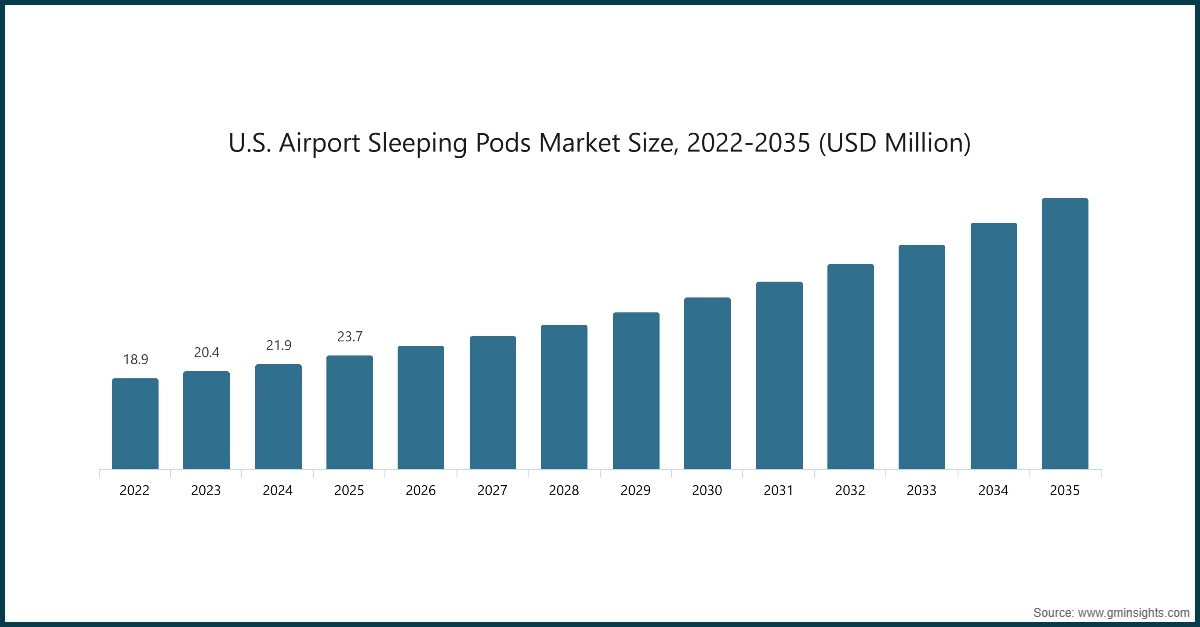
The U.S. airport sleeping pods market was valued at USD 18.9 million and USD 20.4 million in 2022 and 2023, respectively. The market size reached USD 23.7 million in 2025, growing from USD 21.9 million in 2024.
- The market in the United States is expanding as major airports increasingly prioritize passenger comfort amenities within terminal modernization programs. The three major U.S. airports Hartsfield-Jackson Atlanta International Airport, Dallas/Fort Worth International Airport and Philadelphia International Airport are now providing private sleep suites together with rest pods to assist passengers who need to wait during their extended layovers and overnight travel.
- Additionally, the U.S. Federal Aviation Administration’s Airport Terminal Program (ATP) under the Bipartisan Infrastructure Law continues to fund terminal upgrades that improve passenger facilities and traveler experience. These modernization initiatives are encouraging airports to integrate rest pods and private micro-suite services, strengthening the United States’ position as the leading market for airport sleeping pods in North America.
Europe Airport Sleeping Pods Market
Europe market accounted for USD 19.3 million in 2025 and is anticipated to show lucrative growth over the forecast period.
- Europe’s market is expanding due to strong passenger transit flows across major hub airports and the region’s focus on improving airport service infrastructure. European airports increasingly deploy compact rest facilities to accommodate passengers during overnight connections and early-morning departures.
- Airports such as London Heathrow, Amsterdam Schiphol, Helsinki, and Munich have installed dedicated sleeping pods or capsule-style rest cabins within terminals to enhance passenger comfort and monetize dwell time. European airports have started to implement pod booking through digital airport applications and self-service kiosks which will result in increased usage of these services while helping the region to develop passenger-focused airport facilities.
Germany dominates the Europe airport sleeping pods market, showcasing strong growth potential.
- Germany represents one of the most active European markets for airport sleeping pods due to the country’s large aviation hubs and strong transit passenger traffic. Frankfurt Airport, one of Europe’s busiest transfer hubs, introduced NapCabs sleeping cabins inside Terminal 1, allowing travelers to book private rest spaces directly within the secure transit area.
- Similarly, Munich Airport operates ZZZleepandGo capsule-style sleeping pods in Terminal 2, offering automated booking and short-stay accommodation for connecting passengers. The deployment of these facilities reflects Germany’s focus on improving passenger experience in high-traffic international airports and strengthening airport commercial services through premium rest amenities.
Asia Pacific Airport Sleeping Pods Market
The Asia Pacific market is anticipated to grow at the highest CAGR of 7.1% during the forecast period.
- The Asia-Pacific market is expanding rapidly due to the region’s dense aviation networks and the rise of large transit hubs connecting long-haul international routes. Airports across the region are investing in compact rest solutions to manage high passenger volumes and long connection times.
- Major airports such as Singapore Changi, Tokyo Narita, Seoul Incheon, and Hong Kong International Airport have deployed capsule-style sleeping pods, transit rest cabins, and short-stay nap facilities inside terminals. Increasing airport modernization programs and the development of large multi-terminal aviation hubs are expected to support strong adoption of sleeping pods across Asia-Pacific through the forecast period.
India airport sleeping pods market is estimated to grow with a significant CAGR, in the Asia Pacific market.
- India is experiencing a rising trend of airport sleeping pod usage as the country develops its aviation infrastructure and improves its main airport passenger facilities. The Rajiv Gandhi International Airport in Hyderabad installed transit passenger sleep pods that provide compact private resting areas which include charging stations, Wi-Fi access, and baggage storage facilities throughout the terminal space.
- In addition, airports such as Bengaluru Kempegowda International Airport and Indira Gandhi International Airport in Delhi are expanding passenger amenities and premium services to accommodate rising domestic and international traffic. These developments highlight the growing role of pod-based rest facilities in improving traveler convenience and supporting airport commercial services across India.
Middle East and Africa Airport Sleeping Pods Market
UAE market to experience substantial growth in the Middle East and Africa market.
- The market in the United Arab Emirates is witnessing growth due to its increasing reputation as a transit hub between Europe, Asia, and Africa. The major airports are spending on premium passenger services that cater to a large volume of international transfer passengers.
- Dubai International Airport has introduced “Sleep ’n fly Sleep Lounge,” which offers Igloo pods and YAWN cabins located in Terminals 1 and 3, where passengers can directly book their stay inside the terminal building for short durations of time. Similarly, Zayed International Airport in Abu Dhabi has introduced dedicated cabins for passengers to take rest during their transit hours. These initiatives demonstrate the UAE’s focus on enhancing traveler comfort and maximizing airport commercial services through innovative rest facilities.
Airport Sleeping Pods Market Share
The market is led by players such as GoSleep, Metronaps, Podtime, Minute Suites, and NapCabs GmbH. The market is led by players such as GoSleep, Metronaps, Podtime, Minute Suites, and NapCabs GmbH. These five companies collectively held for 18.6% market share in 2025. These companies are successful in dominating the market due to the innovative designs of the pods, the use of the latest passenger comfort technology, and the increasing number of pods installed at international airports around the globe. The range of the pods extends from capsule pod designs to ergonomic nap chairs, as well as completely enclosed micro cabin sleeping pods for the use of transit passengers.
Additionally, increased investments in technology are also helping these companies gain competitive advantage over others. In addition, increased partnerships are helping these companies capture a major market share of the increasing demand for short stay sleep services in international aviation hubs worldwide.
Airport Sleeping Pods Market Companies
Prominent players operating in the airport sleeping pods industry are as mentioned below:
- Aviserv
- GoSleep
- JPODS
- KOTOBUKI SEATING CO., LTD.
- Metronaps
- Minute Suites
- Nap York
- NapCabs GmbH
- Podtime
- Sleep 'n fly
- Urban Naps
- ZZZleepandGo
- GoSleep
GoSleep provide sleeping pod solutions for airports through its capsule-style pods that provide comfort to travelers. The company creates products which protect user privacy, need less space to be installed and provide both electrical power and storage capabilities. Its solutions are widely used in international airports while supporting passenger rest during long layovers and enabling airports to maximize terminal space utilization.
Metronaps specializes in designing energy recovery nap pods that are designed for delivering optimal relaxation experiences for passengers during their travels.Its products are used in airports, corporate spaces, and premium lounges, emphasizing wellness-focused rest solutions for high-performance environments.
Podtime creates sleep pod systems which use modular design to enable their systems to be installed at various transportation and commercial center locations. The company delivers compact pods that use advanced technology to provide climate control, smart lighting features and digital booking system links.
Minute Suites provides private micro-suite rest spaces primarily located inside major airports. Its units combine sleeping facilities with workspace functionality, offering travelers a quiet environment for rest, work, or relaxation during layovers. The company focuses on premium traveler experiences with hourly booking models, appealing particularly to business travelers and long-haul passengers.
NapCabs GmbH designs fully enclosed sleep cabins specifically engineered for airport environments. The company creates comfortable rest areas by using its sound insulation systems, ventilation controls and self-service access technology. Its solutions are widely installed in European airports and are recognized for their automatic booking systems and space management systems, which operate efficiently in busy terminal areas.
Airport Sleeping Pods Market Report Attributes
| Key Takeaway | Details |
|---|---|
| Market Size & Growth | |
| Base Year | 2025 |
| Market Size in 2025 | USD 87.9 Million |
| Market Size in 2026 | USD 93.3 Million |
| Forecast Period 2026-2035 CAGR | 7.3% |
| Market Size in 2035 | USD 176.2 Million |
| Key Market Trends | |
| Drivers | Impact |
| Rising global air passenger traffic demand rest facilities | Drives 25% growth by increasing traveler footfall, creating consistent demand for airport sleeping pods across international hubs and high-traffic regional airports. |
| Extended layovers increase need for short‑term rest spaces | Supports 20% growth as passengers seek convenient, secure rest options during layovers, boosting pod utilization and revenue per passenger. |
| Airports optimize non‑aeronautical revenue streams | Contributes 18% growth by leveraging sleeping pods as premium services, enhancing retail and lounge revenue without expanding terminal footprint. |
| Digital booking and contactless access adoption | Adds 17% growth through app-based reservations, keyless pod access, and automated check-in, improving customer convenience and operational efficiency. |
| Competitive differentiation among premium airports | Accounts for 20% growth as airports deploy innovative sleeping pods to enhance passenger experience, attract high-value travelers, and strengthen brand positioning. |
| Pitfalls & Challenges | Impact |
| Operational maintenance and hygiene complexity | Restrains growth as pods require frequent cleaning, sanitization, and technical upkeep. Complex maintenance workflows increase labor costs and operational downtime, limiting deployment in high-traffic terminals. |
| Space constraints within crowded terminals | Limits growth because airports must balance pod installations with retail, seating, and boarding areas. Restricted terminal space reduces pod capacity and constrains revenue potential in urban and congested airports. |
| Opportunities: | Impact |
| AI/IoT smart pods for personalized rest | Presents significant growth potential by offering adaptive lighting, climate control, sleep tracking, and user preference settings. Integration with airport apps enhances passenger personalization, increases engagement, and supports premium pricing strategies. |
| Hybrid models combining work/rest amenities | Offers opportunity by combining ergonomic workstations with restful pod spaces, catering to business travelers seeking productivity during layovers. This hybrid model expands usage scenarios, increases occupancy rates, and drives higher revenue per pod. |
| Market Leaders (2025) | |
| Market Leader |
5.2% market share in 2025 |
| Top Players |
Collective market share in 2025 is 18.6% |
| Competitive Edge |
|
| Regional Insights | |
| Largest Market | Asia Pacific |
| Fastest growing market | North America |
| Emerging countries | U.S., China, India, Germany, UK |
| Future outlook |
|
What are the growth opportunities in this market?
Airport Sleeping Pods Industry News
- In October 2025, NapCabs GmbH announced the opening of new NapCabs sleeping cabins at Stuttgart Airport Terminal 1, expanding its airport presence and providing travelers with private spaces to relax before departures or after arrival. The expansion strengthens NapCabs’ footprint in European airports and reflects growing demand for compact sleeping solutions that improve passenger comfort and optimize airport terminal space.
- In June 2025, GoSleep partnered with wellness company XWELL to install GoSleep Recovery Pods at Amsterdam Airport Schiphol, offering private rest spaces integrated within airport wellness facilities. The collaboration aims to provide travelers with comfortable recovery areas during long layovers and delays, strengthening airport passenger-experience services and expanding GoSleep’s presence in major international transit hubs.
- In February 2025, Minute Suites highlighted how its private in-terminal suites at Hartsfield-Jackson Atlanta International Airport provide families and travelers with quiet spaces for rest and relaxation during long layovers. The suites include daybeds, workstations, entertainment systems, and charging infrastructure, demonstrating the increasing role of airport rest pods in improving passenger wellbeing and productivity during travel.
The airport sleeping pods market research report includes in-depth coverage of the industry with estimates and forecast in terms of revenue (USD Million) from 2022 – 2035 for the following segments:
Market, By Pod Hardware Format
- Capsule sleeping pods
- Recliner nap pods / sleep chairs
- Micro-cabin pods
Market, By Deployment Zone & Facility Model
- Airside individual placements
- Landside individual placements
- Dedicated capsule hotel facilities
Market, By Technology & Access System
- Manual-access pods
- Digitally reserved pods
- Fully automated smart pods
Market, By End-User Application
- Primary demand segments
- Transit passengers
- Delayed or overnight passengers
- Secondary demand segments
- Airport staff & crew
- Premium / business travelers
The above information is provided for the following regions and countries:
- North America
- U.S.
- Canada
- Europe
- Germany
- UK
- France
- Spain
- Italy
- Asia Pacific
- China
- India
- Japan
- Australia
- South Korea
- Latin America
- Brazil
- Mexico
- Argentina
- Middle East and Africa
- South Africa
- Saudi Arabia
- UAE
Frequently Asked Question(FAQ) :
What was the airport sleeping pods market size in 2025?
The global market was valued at USD 87.9 million in 2025.
What is the projected value of the airport sleeping pods market by 2035?
The market is expected to reach USD 176.2 million by 2035, growing at a CAGR of 7.3% during the forecast period.
Which segment led the market by pod hardware format in 2025?
The capsule sleeping pods segment led the market in 2025, holding a 46.3% share.
What was the valuation of the airside individual placements segment in 2025?
The airside individual placements segment dominated the market in 2025 and was valued at USD 41.3 million.
Which region held the largest share of the airport sleeping pods market in 2025?
Asia Pacific is the largest market and is anticipated to grow at the highest CAGR of 7.1% during the forecast period.
What was the market share of the manual-access pods segment in 2025?
The manual-access pods segment led its category in 2025 with a market share of 45.8%.
Who are the leading players in the airport sleeping pods market?
The market is led by GoSleep, Metronaps, Podtime, Minute Suites, and NapCabs GmbH, who collectively held an 18.6% market share in 2025.
Airport Sleeping Pods Market Scope
Related Reports