Summary
Table of Content

Aircraft Ground Support Equipment Market
Get a free sample of this report
Form submitted successfully!
Error submitting form. Please try again.
Thank you!
Your inquiry has been received. Our team will reach out to you with the required details via email. To ensure that you don't miss their response, kindly remember to check your spam folder as well!
Request Sectional Data
Thank you!
Your inquiry has been received. Our team will reach out to you with the required details via email. To ensure that you don't miss their response, kindly remember to check your spam folder as well!
Form submitted successfully!
Error submitting form. Please try again.
Aircraft Ground Support Equipment Market Size
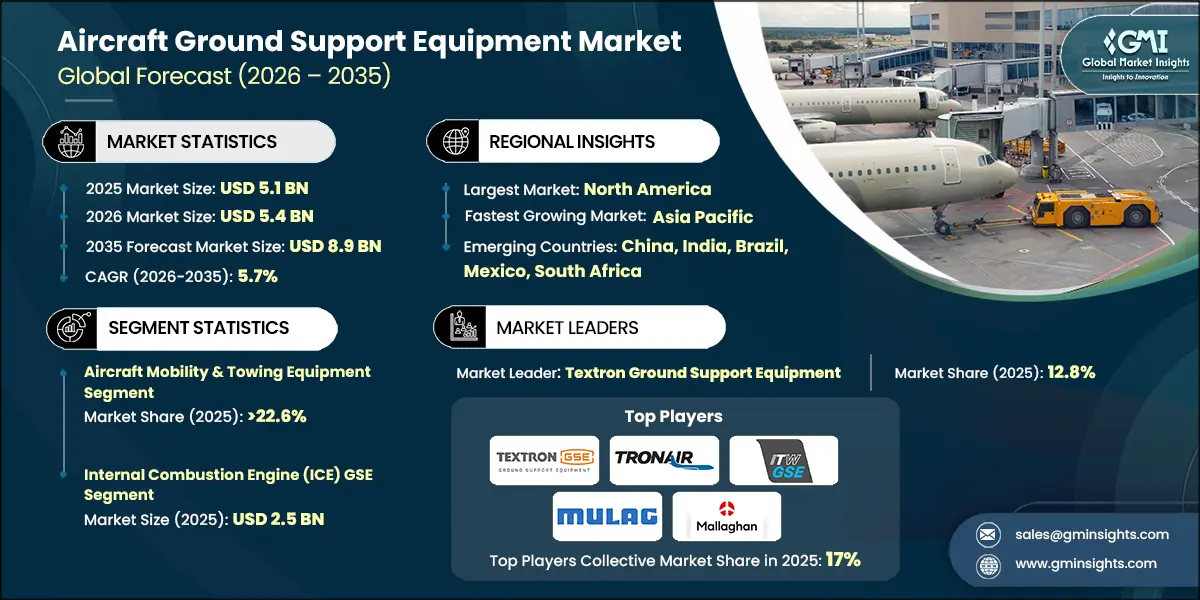
The global aircraft ground support equipment market was estimated at USD 5.1 billion in 2025. The market is expected to grow from USD 5.4 billion in 2026 to USD 8.9 billion by 2035, at a CAGR of 5.7% during the forecast period of 2026–2035, according to latest report published by Global Market Insights Inc.
Aircraft Ground Support Equipment Market Key Takeaways
Market Size & Growth
- 2025 Market Size: USD 5.1 Billion
- 2026 Market Size: USD 5.4 Billion
- 2035 Forecast Market Size: USD 8.9 Million
- CAGR (2026–2035): 5.7%
Regional Dominance
- Largest Market: North America
- Fastest Growing Region: Asia Pacific
Key Market Drivers
- Rapid airport expansion and the rise in modernization.
- Increasing air cargo operations.
- Growing passenger traffic and the expanding air travel industry.
- Rising focus on the security & safety of airports.
- Rising Focus on Operational Efficiency and Automation.
Challenges
- High Initial Costs.
- Infrastructure Limitations.
Opportunity
- Adoption of Electric and Sustainable Ground Support Equipment.
- Integration of Smart Technologies and Digital Solutions.
Key Players
- Market Leader: Textron Ground Support Equipment led with over 12.8% market share in 2025.
- Leading Players: Top 5 players in this market include Textron Ground Support Equipment, Tronair, ITW GSE, MULAG, Mallaghan, which collectively held a market share of 17% in 2025.
Get Market Insights & Growth Opportunities
The market includes equipment that offers operational support to aircraft while on the ground including maintenance equipment, towing equipment, refueling equipment, cargo handling equipment, passenger service equipment, ground power equipment that allow for the safe, efficient and timely operation of airports and airlines globally.
The steady increase in global air passenger traffic is increasing demand for efficient ground handling operations. Airports and airlines are acquiring other types of equipment such as more aircraft and increasing their turnaround frequency to improve their operating profits thus increasing the market demand for aircraft ground support equipment to support the management of baggage, refueling, towing and maintenance activities. For instance, in February 2026, Airbus partnered with Thai Airways International to develop the FHS component support to contain the airline’s new A321neo fleet, which increased the demand of air passenger traffic.
The continued development of new airport construction and expansion of existing airports to support larger numbers of aircraft movement creates a greater need for adjacently advanced ground support equipment. Developing regions are in the process of upgrading their airport infrastructures to accommodate increased aircraft movements which has increased the adoption of technologically advanced, reliable and scalable ground support systems. For instance, in February 2026. Menzies Aviation contracted with Kempegowda International Airport, India to provide ground handling equipment for both domestic and international traffic.
Airports and airlines are increasing their use of electric and hybrid ground support equipment to reduce long-term carbon emissions and operational costs. Further, the strict environmental laws and sustainability mandates are encouraging the replacement of diesel-powered ground support equipment with electric and hybrid ground support equipment which will continue to support the long-term growth of this market. For instance, in May 2024, Rushlift GSE expanded its GSE service in the UK to develop a large electric and hybrid ground support equipment.
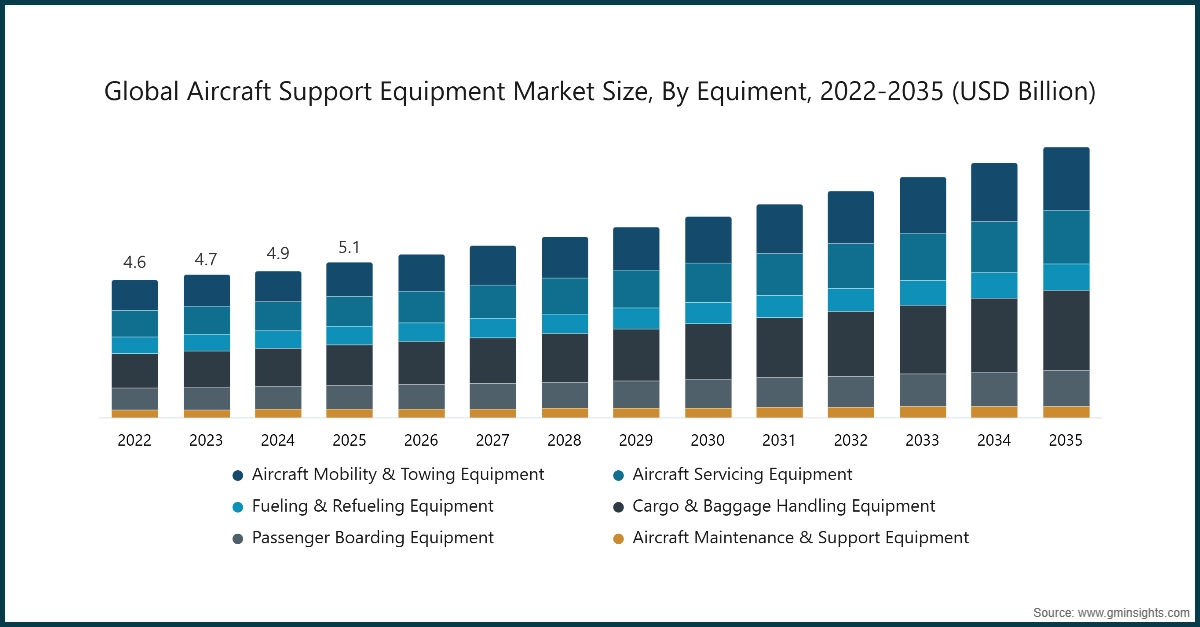
Between 2022 and 2024, the aircraft ground support equipment market experienced significant growth, rising from USD 4.5 billion in 2022 to USD 4.9 billion in 2024. A major trend during this period was growing demand for ground support equipment resulting from an increase in commercial, cargo, and military aircraft fleets. Airlines are increasing the size of their fleets and as such increasing their demand for additional vehicles such as towing tractors, loaders, and maintenance equipment to support these operations and provide safe ground handling. For instance, in January 2026, the Indian defense ministry has progressed with a USD 35 billion plan to acquire 114 Rafale fighters to boost squadron strength. This includes manufacturing and assembling in India, which led to increasing the demand for the ground support equipment.
Airports are working on automating their processes and improving turnaround time by reducing ground handling mistakes. Digital technology adoption is becoming the leading trend in the market with real-time monitoring, predictive maintenance, and safer equipment becoming primary factors driving market growth. For instance, in October 2023, Marubeni Corporation partnered with Assaia aviation to provide ApronAI to Southeast Asia. The aims of this partnership is to expand the scope of its exclusive distribution rights for ApronAI to Southeast Asia.
To get key market trends
Aircraft Ground Support Equipment Market Trends
- Smart sensors, IoT connectivity, telematics, and data analytics in aircraft ground support equipment will provide greater operational visibility & fleet management. The rapid monitoring of the use of equipment, the status of maintenance, and the performance of equipment will improve response time to make decisions at airports and reduce delays in airport operations.
- For instance, in September 2025, The Port Authority of New York and New Jersey(PANYNJ) and JFK Millennium Partners (JMP) signed an agreement to implement a shared fleet of electric ground support equipment at JFK airport. The aims of this partnership is to reduce emissions, increase efficiency, and decrease operating costs through managed access to electric equipment, thereby enhancing sustainability & modernization efforts throughout the airport, for multiple airlines and ground handling providers.
- The increased demand for less expensive and higher quality aircraft ground support services can be attributed to the increased use of automation and the digitization of airport ground operations. More advanced forms of equipment such as the use of hybrid propulsion systems, advanced power system equipment and automatic aircraft loading and unloading systems combined with the use of an airport management application will allow operators to reduce aircraft turnaround times and increase operational safety and reliability in the apron areas of airports through the use of a centralized control and operation center.
- Also, as the number of airports that use unified ground operations platforms continues to increase, it is expected that the demand for aircraft ground support equipment will rise in terms of the equipment's capability to provide real-time data processing, predictive maintenance capability & automated workflow on the airport ground support equipment. Cloud fleet management systems will continue to support the growth of scalable, interoperable, and efficient airport infrastructure supporting many locations and large airport areas.
Aircraft Ground Support Equipment Market Analysis
Learn more about the key segments shaping this market
The market was valued at USD 4.5 billion and USD 4.7 billion in 2022 and 2023, respectively. The market size reached USD 5.1 billion in 2025, growing from USD 4.9 billion in 2024.
Based on equipment, the market is segmented into aircraft mobility & towing equipment, aircraft servicing equipment, fueling & refueling equipment, cargo & baggage handling equipment, passenger boarding equipment, and aircraft maintenance & support equipment. The aircraft mobility & towing equipment segment accounted for over 22.6% of the market share in 2025.
- The aircraft mobility & towing equipment segment holds the largest share in the aircraft ground support equipment market, driven by the growing demand for reliable, high-capacity towing solutions continues to increase because of increased flight operations, an increase in the size of fleets, and an increase in frequency of towing needs. In addition, increasing amounts of congestion at the airports and a need to have aircraft positioned more efficiently than before will create additional opportunities for companies that manufacture forwarding and towing systems.
- Manufacturers should focus on creating advanced, durable, energy-efficient aircraft mobility and towing systems to meet the growing demand. To improve operational efficiency, decrease turnaround times, and assist airports in managing increasing flight operations while providing an umbrella of safety and reliability, manufacturers should emphasize electric and hybrid solutions, automation, and real-time tracking.
- The cargo & baggage handling equipment segment in the aircraft ground support equipment market is expected to witness significant growth, projected to expand at a CAGR of 7.1% during the forecast period. This growth is driven by the increase in volume of shipments, airports and airlines are investing in modern loaders, conveyors, and automated systems for handling luggage to effectively manage larger quantities. Additionally, the implementation of smart technologies, real-time tracking, and automation will increase operational efficiencies, decrease turnaround times, and provide safe handling of cargo and baggage.
- Manufacturers should focus on developing high-capacity cargo and baggage handling equipment that contain a high level of automation, smart sensors, and real-time tracking. To support increased volumes of passengers and cargoes, decrease turnaround times, and service the growing e-commerce and air freight component should be of importance to manufactures.
Learn more about the key segments shaping this market
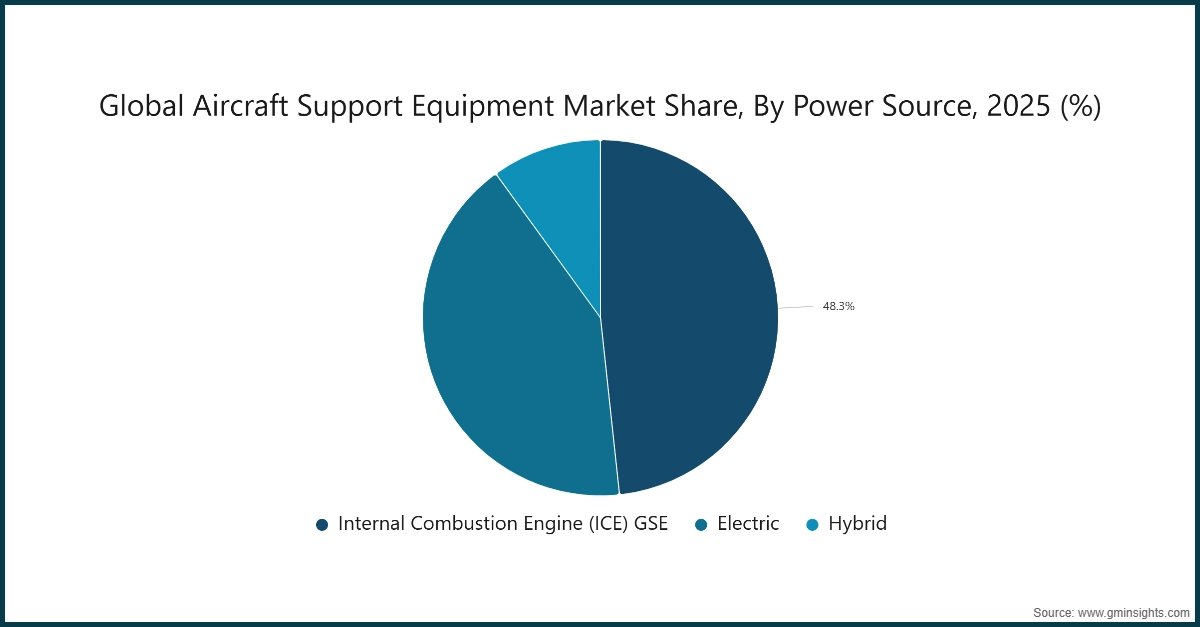
Based on the power source, the aircraft ground support equipment market is segmented into internal combustion engine (ICE) GSE, electric, and hybrid. The internal combustion engine (ICE) GSE segment dominated the market in 2025 with a revenue of USD 2.5 billion.
- The internal combustion engine (ICE) GSE segment holds the largest share of the aircraft ground support equipment industry, due to their power capacity, reliability, and access to ICE-powered equipment in airports. ICE equipment is also very versatile and can be used for many different types of ground handling tasks, making them highly preferred over electric-powered equipment when it comes to heavy-duty ground handling operations, longer run-time use, and versatility across many different types of ground handling tasks.
- Manufacturers should focus on investing in improving the fuel-efficiency, durability, and emissions performance of ICE-powered equipment. Additionally, manufacturers should develop ICE-powered equipment that is high efficiency, reliable, and provides versatility to meet the growing demand of airports and airlines for heavy-duty airport ground support equipment that is both operationally efficient, sustainable, and can be utilized for a duration of time, while at the same time minimizing the long-term operational cost of purchasing ICE-powered equipment to support the diversity of ground-handling tasks they have.
- The electric segment in the aircraft ground support equipment market is anticipated to witness significant growth with a CAGR of over 8.5% during the forecast year, driven by increasing demand for sustainable airport operations, increased governmental regulations on environmental issues, and the desire to mitigate carbon footprints, airports and airlines are investing in electric tugs, loaders, and electrical ground power units to mitigate high fuel costs and reduce operational noise.
- The advancement in battery technologies, as well as the ability to achieve longer run times for batteries, coupled with the integration of smart fleet management systems will all continue to promote the use of electric-powered ground support equipment, thus, improving the efficiency, safety and environmentally friendly elements of ground-handling operations.
- Manufacturers should continue to focus on the development of electric ground support equipment that is more efficient in terms of energy use, has longer battery-life and produces fewer emissions. Improving the overall layout of electric-based equipment to include improved durability, greater performance, and improved smart integration will assist airports and airlines in meeting their sustainability goals, reduce their overall operating costs, minimize operational noise and improve operational efficiency and safety of their ground-handling operations.
Looking for region specific data?
The North America aircraft ground support equipment market dominated with a market share of 41.1% in 2025.
- The North America market is rapidly growing due to an increase in passenger and cargo traffic through airports, airport modernization projects taking place, and a growing acceptance of electric-powered/automated GSE as well. The increase in demand for new technologies will lead to more efficient, sustainable and advanced GSE investments by airports.
- Manufacturers need to concentrate their efforts on producing advanced, efficient and sustainable GSE for airports. In particular, manufacturers should create electric-powered, automated and high-capacity GSE to help meet the growing demand for both passenger and cargo aircraft, support modernization projects and improve operational efficiency, safety and environmental compliance in both commercial/cargo and military airport operations.
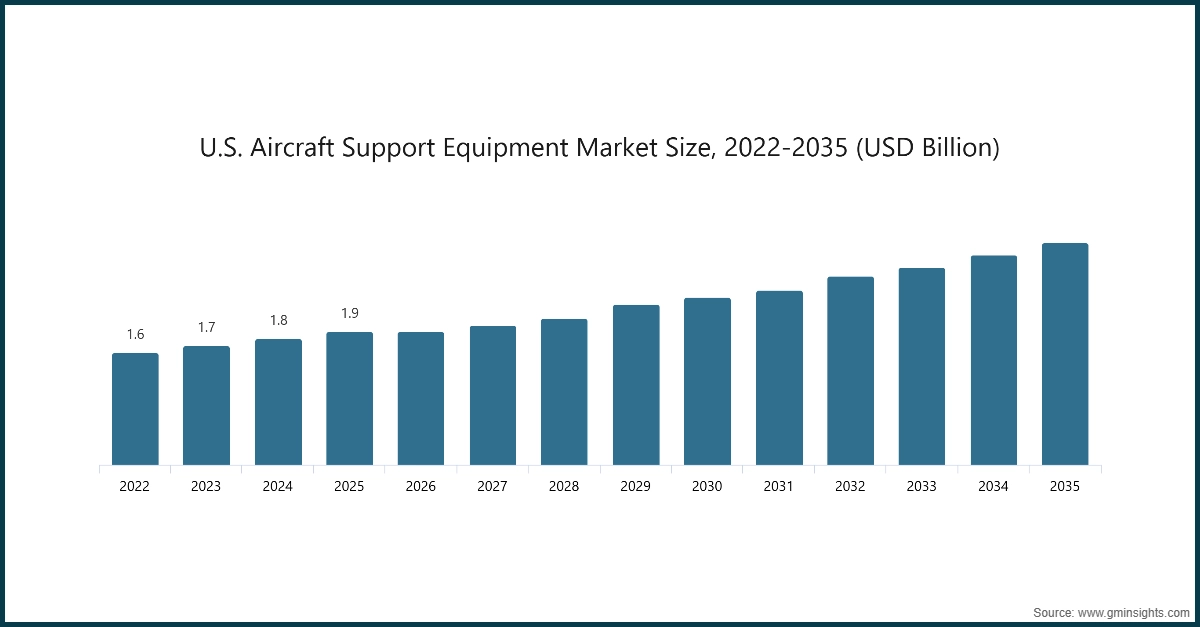
The U.S. aircraft ground support equipment market was valued at USD 1.6 billion in 2022 and USD 1.7 billion in 2023, reaching USD 1.9 billion in 2025, up from USD 1.8 billion in 2024.
- The U.S. is the leading market for aircraft ground support equipment due to the increasing amount of passenger and cargo traffic at its airports, the continued expansion and modernization of its airport infrastructures, and the increasing purchase and installation of electric-powered, automated and high-efficiency ground support equipment at commercial, cargo and military airports throughout the U.S.
- Manufacturers need to form partnerships with airlines, airport authorities, and aviation service providers to address the growing need for advanced, reliable and sustainable ground support equipment and also improve operational efficiency, safety and environmental standards for airport operations in the U.S.
The Europe aircraft ground support equipment market accounted for USD 1.2 billion in 2025 and is anticipated to witness strong growth over the forecast period.
- Europe holds a significant share of the aircraft ground support equipment industry, supported by the presence of increasing air traffic density, established airport facilities, and an increasing amount of capital investment toward upgrading these facilities. This combined with the heightened level of regulatory scrutiny towards sustainability and increased adoption of electric and automated ground support equipment within Europe, also drives growth in the regional market.
- Manufacturers should focus on developing energy-efficient, low-emissions, and automated GSE that meet the unique needs of the European airport system. By focusing on compliance with regulations, reliability, and the use of intelligent technology, manufacturers can aid in achieving sustainable development objectives, additionally they may support the airport modernization efforts within their respective regions and assist their customer base with increased operational efficiency and safety requirements.
Germany dominates the Europe aircraft ground support equipment market, showcasing strong growth potential.
- Germany holds a substantial share in the aircraft ground support equipment industry due to It has an exceptionally well-developed aviation industry with the largest population of aircraft flying through major hubs and having some of the most advanced ground handling techniques in place. In addition, Germany has invested heavily in airport operations that use technologically advanced, energy efficient, and safety-oriented approaches to operate airports.
- Manufacturers must develop the highest quality, energy efficient and technologically advanced ground support equipment for use at German airports. Specifically focusing on electric and automated products, durability, and compliance with Germany’s strict safety and environmental regulations will help fulfill the operational requirements of airlines, strengthen the relationship between the airline, airport operators and ground handling service providers, and help achieve the goal of being a sustainable industry.
The Asia-Pacific aircraft ground support equipment market is anticipated to grow at the highest CAGR of 7.8% during the analysis period.
- The Asia Pacific aircraft ground support equipment industry is growing rapidly because of the increasing number of low-cost airline networks, the rise of regional connectivity, and an increase in the investment into the construction of new airports and secondary airports. The growing need for improved ground handling efficiencies and economical ground support equipment will also contribute to the continued growth of this market in developing and emerging economies.
- Manufacturers need to produce cost-effective, durable and scalable ground support equipment which fits various size airports throughout Asia Pacific. Companies with design flexibility, low maintenance, and gradual electrification will meet the operational needs of many of the growing low-cost carrier operators and capitalize on the rapid growth of airport infrastructure development in both developing and emerging economies.
The China aircraft ground support equipment market is estimated to grow at a significant CAGR of 10.5% from 2026 to 2035.
- China is the largest market for ground support equipment (GSE) is due to the rapid growth of both passenger and freight air transportation and the construction and improvements being made at airports, therefore, there is an increasing need for electric-powered and automated ground support equipment (GSE) and government initiatives to encourage increased efficiency and sustainability throughout the airport environment.
- Manufacturers should focus on providing adaptable, reliable, and technologically advanced GSE products such as electric tugs, automated loaders, and smart fleet management systems. Manufacturers should also focus on leveraging government initiatives, participating in airport modernization efforts, and taking advantage of technological developments to improve their presence within the commercial, cargo, and military segments of the aviation industry.
The Latin America aircraft ground support equipment market was valued at USD 397.3 million in 2025, driven by rising air passenger and cargo traffic, airport modernization projects, and growing adoption of electric and automated ground support equipment.
The Middle East and Africa market is projected to reach USD 310.4 million by 2035, driven by increasing air traffic, airport expansions, modernization initiatives, and rising adoption of advanced and automated GSE.
In Saudi Arabia, the aircraft ground support equipment market is set to experience substantial growth in 2025.
- Saudi Arabia is emerging as a key growth hub for the aircraft ground support equipment industry, driven by rise in regional and global air travel as well as significant governmental funding for aviation and logistics projects will position Saudi Arabia as a principal growth site for the Airport ground support equipment (GSE) sector.
- Manufacturers should focus on providing highly durable, high-capacity, weather-resistant GSE to Saudi Arabia's large airport development projects will have a distinct competitive advantage. As operational demands continue to increase, making electric and automated solutions a focus, developing strong local partnerships, and providing after-sales service, will strengthen manufacturers' long-term positioning and competitiveness within this rapidly developing market.
Aircraft Ground Support Equipment Market Share
The market for aircraft ground support equipment is expanding rapidly due to increasing demand for innovative, high-performance, and automated ground handling services for commercial/cargo/military airports. The leading companies in the market Textron Ground Support Equipment, Tronair, ITW GSE, MULAGm, and Mallaghan comprise approximately 17% of the overall market share of the aircraft ground support equipment industry. Due to their strong partnerships and collaborations with other important players in the aviation industry such as airlines, airport authorities, and technology companies, these five companies drive innovation within the aircraft ground support equipment industry through research and development of new products, services, and solutions.
New entrants and smaller niche players within the aircraft ground support equipment industry continue to develop and market high-performance, scalable, and energy-efficient ground support equipment leveraging advancements in technology, research & development, and collaboration strategies. The results of these innovations are increased aircraft turnaround time, improved safety for all aircraft operations, and global acceptance of sustainable automated ground handling services.
Aircraft Ground Support Equipment Market Companies
Some of the prominent market participants operating in the aircraft ground support equipment industry include:
- AERO Specialties, Inc.
- Air+MAK Industries Inc.
- ATEC Inc
- Bliss‑Fox
- Clyde Machines
- Global Ground Support LLC
- ITW GSE
- Kalmar Motor AB
- Mallaghan
- MULAG
- Oshkosh AeroTech
- Sinfonia Technology Co. Ltd.
- Textron Ground Support Equipment
- TLD Group
- Tronair
- Unitron
- Wollard International
Textron Ground Support Equipment is prominent in aircraft ground support equipment industry. An estimated 12.8% market share held by Textron Ground Support Equipment. They provide high-level performance, reliable GSE solutions, also by way of tugs, loaders, ground power units and automated handling systems. Strength and breadth of their R&D and product portfolio help establish Textron's position in the marketplace among commercial, cargo and military airport operations alike.
Mallaghan has a significant share in aircraft ground support equipment with about 1.3% of the market. They provide advanced tugs, loaders, and support systems for airlines and airport operators. Additionally, by developing new technologies with innovative design concepts and scalable solutions, Tronair assists all types of airports and ground-handling operations to improve efficiency, safety and operational performance levels.
ITW GSE supplies ground support equipment to all types of commercial, cargo, and military airports, such as ITW GSE's R&D and presence globally, as well as their ability to provide scalable solutions will continue driving operational efficiencies and safety as well as providing new advanced, automated, energy-efficient ground handling systems to users throughout the world.
Aircraft Ground Support Equipment Market Report Attributes
| Key Takeaway | Details |
|---|---|
| Market Size & Growth | |
| Base Year | 2025 |
| Market Size in 2025 | USD 5.1 Billion |
| Market Size in 2026 | USD 5.4 Billion |
| Forecast Period 2026-2035 CAGR | 5.7% |
| Market Size in 2035 | USD 8.9 Million |
| Key Market Trends | |
| Drivers | Impact |
| Rapid airport expansion and the rise in modernization | Rapid airport expansion and modernization of around 35% of market demand. Rapid expansion and modernization of airports increase aircraft movements and operational complexity. New terminals, runways, and upgraded facilities require advanced ground support equipment for towing, power supply, baggage handling, and maintenance, driving demand for efficient, high-capacity, and technologically advanced equipment across airports worldwide. |
| Increasing air cargo operations | Increasing air cargo operations attained 20% in terms of market growth. The growth of air cargo operations, driven by e-commerce and time-sensitive logistics, increases the need for specialized ground support equipment. Cargo loaders, pallet transporters, and handling systems are required to manage higher freight volumes efficiently, boosting demand for reliable and heavy-duty ground support solutions. |
| Growing passenger traffic and the expanding air travel industry | Growing passenger traffic and expanding air travel industry attained 20% of market growth. Rising passenger traffic leads to higher aircraft turnaround frequency and airport congestion. To manage increased boarding, baggage handling, and servicing needs, airlines and airports invest in additional ground support equipment, ensuring smoother operations, reduced delays, and improved passenger experience. |
| Rising focus on the security & safety of airports | Rising focus on airport security and safety about 15% market expansion. Increasing emphasis on airport security and safety drives demand for compliant, well-maintained ground support equipment. Airports are adopting modern equipment with enhanced safety features, monitoring systems, and regulatory compliance capabilities to reduce ground accidents and ensure safe aircraft handling operations. |
| Rising Focus on Operational Efficiency and Automation | Rising focus on operational efficiency and automation contributes approximately 10% of market growth. Airports are prioritizing operational efficiency and automation to reduce turnaround time and labor dependency. Automated and digitally enabled ground support equipment supports real-time tracking, predictive maintenance, and process optimization, increasing demand for smart, connected ground handling solutions. |
| Pitfalls & Challenges | Impact |
| High Initial Costs | High initial costs associated with purchasing advanced aircraft ground support equipment limit adoption, especially among small and mid-sized airports. Capital-intensive investments, along with expenses for installation, training, and maintenance, slow replacement cycles and discourage rapid deployment of modern or automated ground support solutions. |
| Infrastructure Limitations | Infrastructure limitations at older or regional airports restrict the adoption of advanced ground support equipment. Inadequate charging stations, limited apron space, and outdated layouts hinder the use of electric, automated, or large-capacity equipment, slowing market demand despite growing air traffic and modernization efforts. |
| Opportunities: | Impact |
| Adoption of Electric and Sustainable Ground Support Equipment | The global push toward sustainability creates strong opportunities for electric and hybrid aircraft ground support equipment. Airports and airlines are investing in low-emission solutions to meet environmental regulations, reduce fuel costs, and achieve carbon reduction targets, driving demand for next-generation, energy-efficient ground handling equipment. |
| Integration of Smart Technologies and Digital Solutions | The integration of IoT, automation, and data analytics into ground support equipment presents significant growth opportunities. Smart GSE enables real-time equipment tracking, predictive maintenance, and operational optimization, helping airports reduce downtime, improve safety, and enhance efficiency across ground handling operations. |
| Market Leaders (2025) | |
| Market Leader |
12.8% market share in 2025 |
| Top Players |
Collective market share in 2025 is 17% |
| Competitive Edge |
|
| Regional Insights | |
| Largest Market | North America |
| Fastest growing market | Asia Pacific |
| Emerging countries | China, India, Brazil, Mexico, South Africa |
| Future outlook |
|
What are the growth opportunities in this market?
Aircraft Ground Support Equipment Industry News
- In September 2024, Textron GSE partnered with Equipmake to develop The Safeaero 220E and represents Textron's commitment to creating an environmentally sustainable development and operation of an electric GSE product that can be used worldwide to improve operational capacity with zero emissions as well as meeting airport environmental sustainability goals.
- In May 2025, Global Ground Support launched the GTV 5000 Glycol Transfer Vehicle. This vehicle has been specifically designed to enhance the efficiency of developing and managing high volume transfers of glycol liquids for deicing aircraft through the use of state of the art quality monitoring equipment, a high transfer capacity and a reduced turnaround time.
- In August 2025, Global Ground Support partnered with Paragon Aviation Group further improving the level of quality support that is provided to FBOs and operators and enhancing the delivery of GSE support and complete lifecycle fleet service to all GSE operators on a worldwide basis.
- In September 2025, TLD Group partnered with ASARA Mobility and BKJ Airports to launch its next generation electric ground service equipment at various airports throughout India to improve operational capabilities and to achieve sustainability goals.
The aircraft ground support equipment market research report includes in-depth coverage of the industry, with estimates & forecast in terms of revenue (USD billion) from 2022 to 2035, for the following segments:
Market, By Equipment
- Aircraft mobility & towing equipment
- Pushback tractors
- Tugs and tractors
- Others
- Aircraft servicing equipment
- Ground power units (GPUs)
- Pre-conditioned air units (PCAs/ACUs)
- Deicing & anti-icing equipment
- Air start units (ASUs)
- Others
- Fueling & Refueling Equipment
- Fuel Trucks
- Fuel Hydrant Systems
- Cargo & Baggage Handling Equipment
- Belt Loaders
- Cargo Loaders
- Cargo Dollies & Baggage Carts
- Others
- Passenger Boarding Equipment
- Passenger Boarding Bridges
- Passenger Stairs
- Others
- Aircraft Maintenance & Support Equipment
Market, By Automation Level
- Conventional/Manual-Operated GSE
- Semi-automated / assisted GSE
- Autonomous GSE (AGVS)
Market, By Power Source
- Electric GSE
- Internal Combustion Engine (ICE) GSE
- Diesel-powered GSE
- Gasoline-powered GSE
- Hybrid GSE
Market, By End Use
- Commercial aviation
- Passenger airlines
- Cargo airlines
- Military & defense aviation
The above information is provided for the following regions and countries:
- North America
- U.S.
- Canada
- Europe
- Germany
- UK
- France
- Italy
- Spain
- Netherlands
- Rest of Europe
- Asia-Pacific
- China
- Japan
- India
- South Korea
- Australia
- Rest of Asia-Pacific
- Latin America
- Brazil
- Mexico
- Argentina
- Rest of Latin America
- MEA
- Saudi Arabia
- UAE
- South Africa
- Rest of MEA
Frequently Asked Question(FAQ) :
What is the market size of the aircraft ground support equipment in 2025?
The market size was USD 5.1 billion in 2025, with a CAGR of 5.7% expected through 2035 driven by rising air passenger traffic, airport expansion, and increasing adoption of electric and hybrid equipment.
What is the projected value of the aircraft ground support equipment market by 2035?
The aircraft ground support equipment market is expected to reach USD 8.9 billion by 2035, propelled by automation, IoT-based monitoring, predictive maintenance, and sustainability initiatives.
What is the current aircraft ground support equipment market size in 2026?
The market size is projected to reach USD 5.4 billion in 2026.
What was the market share of aircraft mobility & towing equipment segment in 2025?
Aircraft mobility & towing equipment segment held over 22.6% market share in 2025, driven by growing demand for reliable towing solutions due to increased flight operations and fleet sizes.
What was the valuation of internal combustion engine GSE segment in 2025?
Internal combustion engine (ICE) GSE segment dominated with USD 2.5 billion in 2025, driven by power capacity, reliability, and versatility for heavy-duty ground handling operations.
What is the growth outlook for the electric segment from 2026 to 2035?
Electric segment is anticipated to grow at a CAGR of over 8.5% till 2035, driven by sustainable airport operations, environmental regulations, carbon reduction goals, and battery technology advancements.
Which region leads the aircraft ground support equipment market?
North America dominated with 41.1% market share in 2025, driven by increasing passenger and cargo traffic, airport modernization projects, and adoption of electric-powered and automated GSE.
What are the upcoming trends in the aircraft ground support equipment market?
Key trends include increased automation and digitization with hybrid propulsion and automatic loading systems, and growing adoption of unified ground operations platforms with real-time data processing and predictive maintenance capabilities.
Who are the key players in the aircraft ground support equipment market?
Key players include Textron Ground Support Equipment, Tronair, ITW GSE, MULAG, Mallaghan, AERO Specialties, Air+MAK Industries, ATEC Inc, Bliss-Fox, Clyde Machines, Global Ground Support, Kalmar Motor, Oshkosh AeroTech, Sinfonia Technology, TLD Group, Unitron, and Wollard International.
Aircraft Ground Support Equipment Market Scope
Related Reports