Summary
Table of Content

Aircraft Engine Market
Get a free sample of this report
Form submitted successfully!
Error submitting form. Please try again.
Thank you!
Your inquiry has been received. Our team will reach out to you with the required details via email. To ensure that you don't miss their response, kindly remember to check your spam folder as well!
Request Sectional Data
Thank you!
Your inquiry has been received. Our team will reach out to you with the required details via email. To ensure that you don't miss their response, kindly remember to check your spam folder as well!
Form submitted successfully!
Error submitting form. Please try again.
Aircraft Engine Market Size
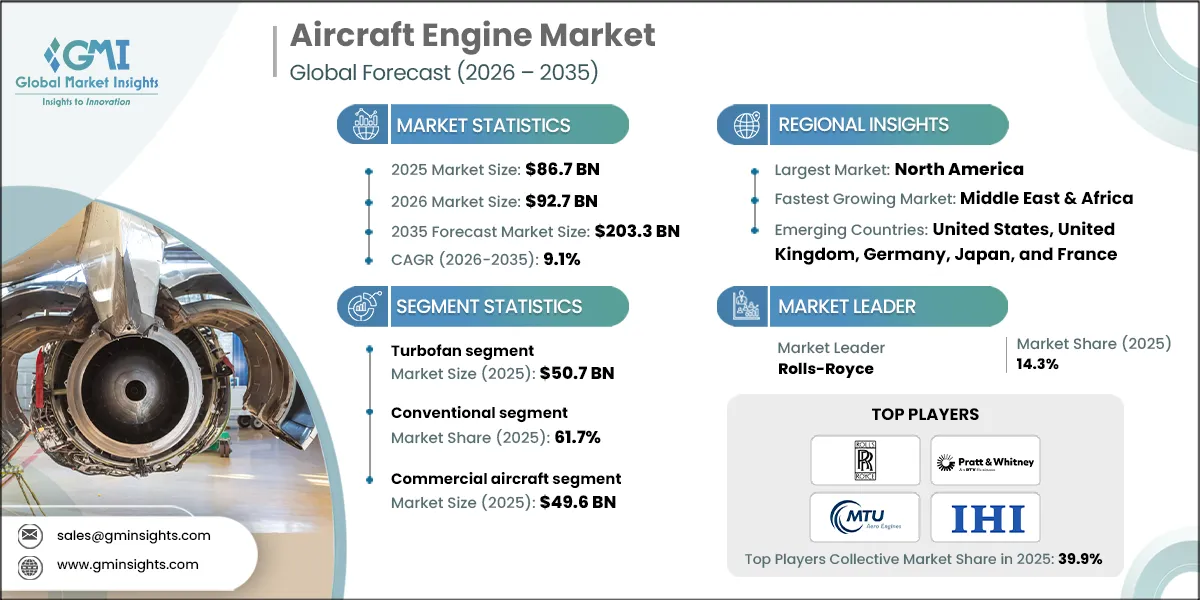
The global aircraft engine market was valued at USD 86.7 billion in 2025. The market is expected to grow from USD 92.7 billion in 2026 to USD 138.2 billion in 2031 and USD 203.3 billion in 2035, at a CAGR of 9.1% during the forecast period, according to the latest report published by Global Market Insights Inc.
Aircraft Engine Market Key Takeaways
Market Size & Growth
- 2025 Market Size: USD 86.7 Billion
- 2026 Market Size: USD 92.7 Billion
- 2035 Forecast Market Size: USD 203.3 Billion
- CAGR (2026–2035): 9.1%
Regional Dominance
- Largest Market: North America
- Fastest Growing Region: Middle East & Africa
Key Market Drivers
- Rising air travel demand.
- Technological advancements in engine efficiency.
- Expansion of Engine Aftermarket and MRO Services.
- Increased investment in emerging aircraft technologies.
- Increasing Defense and Military Aviation Modernization.
Challenges
- High Research and Development (R&D) costs.
- Supply Chain and Manufacturing Constraints.
Opportunity
- Growth of Hybrid-Electric and Sustainable Propulsion Technologies.
- Expansion of Engine Aftermarket and Predictive Maintenance Services.
Key Players
- Market Leader: Rolls-Royce led with over 14.3% market share in 2025.
- Leading Players: Top 5 players in this market include Rolls-Royce, Pratt & Whitney (RTX), MTU Aero Engines AG, IHI Corporation, which collectively held a market share of 39.9% in 2025.
Get Market Insights & Growth Opportunities
The market for aircraft engine is expanding, owing to rising air travel demand, expansion of engine aftermarket and MRO services, increasing defense and military aviation modernization, increased investment in emerging aircraft technologies, and growth of low-cost carriers and regional aviation.
The rising demand for air travel is a major contributor to the growth of the aircraft engine market. This is due to the increasing number of passengers directly affecting the fleet size and the aircraft activity which results in greater use of aircraft engines. When an airline adds a large number of passengers, it needs modern, fuel-efficient engines to support the new aircraft deliveries and replace old, aging fleets. This encourages aftermarket services and the sale of new engines. For instance, according to an IATA report, in 2024, global air passenger traffic grew by 10.4% when compared to 2023. This traffic growth also surpassed demand recorded in the pre-COVID-19 era, which shows that air travel continues to grow worldwide.
The increasing emphasis towards modernization of defense and military aviation are strengthening the aircraft engine market alongside the ongoing government efforts to replace their military fleets with state-of-the-art and high-performing aircraft. Modernized fleets include military transport aviation, military rotary wing and military fighter aircraft, all requiring high-performing, reliable and fuel efficient engines that can withstand the demanding conditions of battle. As a result, there will be a higher demand for engines and contracted military long term maintenance and repair of the aircraft. Additionally, advanced engine technologies such as digital controls, adaptive materials, and stealth-compatible designs are increasingly integrated into military programs, further boosting market opportunities. For instance, according to the FY2025, U.S. Department of Defense budget, USD 61.2 billion was allocated for aircraft procurement and research and development, reflecting the scale of ongoing modernization and its direct impact on engine demand.
The aircraft engine market refers to the design, production, sales, service, and overhaul of engines which are used to power fixed-wing aircraft and/or gyroplane/rotary-wing aircraft. An aircraft engine is responsible for transforming fuel energy into thrust power or shaft power in an aircraft and provides such functions as takeoff, climb, cruise, maneuvering, and landing.
To get key market trends
Aircraft Engine Market Trends
- Aircraft engine manufacturers are concentrating on the next generation of turbofans and more efficient and effective propulsion systems with even higher bypass ratios and more efficient burning of costs. Engine manufacturers want more fuel and emissions burning engines because airlines want and need to comply with more stringent regulations. Demand for more efficient engines to comply with the new fuel and emissions is driving new fleet procurement and long-term aftermarket service contracts as older fleets are being retired.
- The incorporation of predictive analytics, IoT sensors, and digital engine health monitoring is changing the maintenance landscape. MRO providers and airlines are starting to use data-driven predictive solutions to determine component usage to eliminate unscheduled downtimes and optimize maintenance planning. This data predicts unscheduled engine downtime and facilitates improved planning to enhance engine reliability which decreases life cycle costs. This predictive capability creates new revenue service and operational efficiencies across military and commercial fleets.
- More research and initial testing are currently being done on hybrid electric and alternative propulsion designs for the purpose of lowering fuel usage and carbon emissions at a regional level and for short-range travel. These designs utilize systems where there's added electric assist alongside hybrid powertrains.
- The need to sustain and reduce emissions is driving change in the industry and government forecasts reflect this shift. As indicated in the FAA Aerospace Forecast FY 2025-2045, general aviation aircraft powered by turbines will continue to be in operation, with annual flights expected to increase by 3.2% for the years 2023 to 2045. Engine technology will continue to be advanced, along with the use of cleaner fuels and efficiency improvements that will be incorporated into the system.
Aircraft Engine Market Analysis
Learn more about the key segments shaping this market
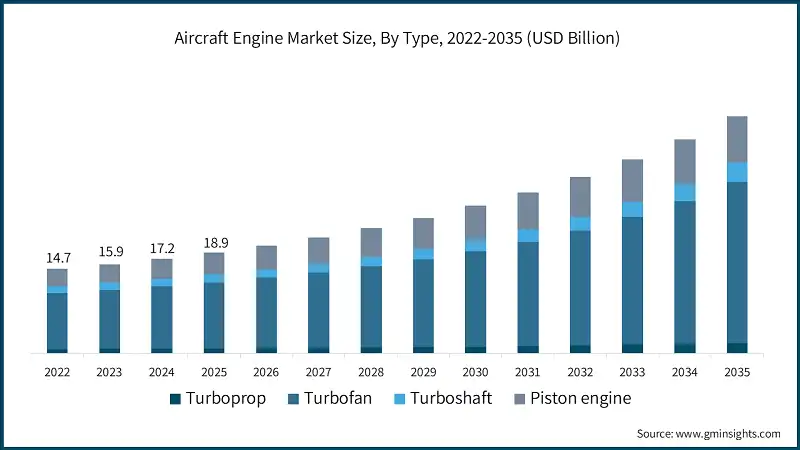
Based on type, the market is segmented into turboprop, turbofan, turboshaft, and piston engine.
- The turbofan segment was valued at USD 50.7 billion in 2025. Rising demand for fuel-efficient narrow-body and wide-body aircraft is accelerating adoption of advanced turbofan engines in commercial aviation fleets.
- Stricter global emissions and noise regulations are driving airlines to replace older engines with next-generation turbofan technologies.
- The turboshaft segment is expected to grow at a CAGR of over 9.2% by 2035. The market has been increasing steadily in the turboshaft category as commercial and military helicopters and unmanned aircraft (UAVs) use these engines continue to grow.
- These engines are widely used in military applications and some commercial applications. Due to their excellent power-to-weight ratio and reliability in various environments, they are quite popular and are suitable for missions requiring flexibility and precision.
Learn more about the key segments shaping this market
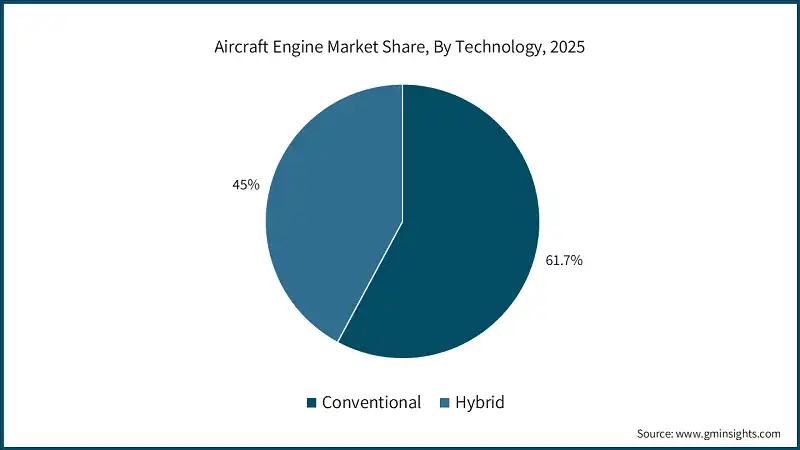
On the basis of technology, the aircraft engine market is segmented into conventional and hybrid.
- The conventional segment held market share of 61.7% in 2025. With the modernization of airlines' fleet, the demand for conventional engines is increasing. New and improved aircraft burn less fuel, resulting in more and more airlines replacing their old aircraft with these new models.
- These new models burn less fuel and emit less harmful substances into the atmosphere. Therefore, new environmental policies can be followed without spending too much.
- Moreover, the increasing global air travel further propels the demand for reliable, fuel-efficient conventional engines, particularly in single-aisle and wide-body commercial aircraft.
- The hybrid segment is expected to grow at a CAGR of 8.7% during the forecast period. This growth is largely driven by the need for sustainability, airline emissions reduction goals, and the quick acceptance of hybrid propulsion systems in short-haul and regional aircraft.
- Furthermore, technological advancements in electric motor integration and energy storage improve performance and feasibility of hybrid engines.
- Manufacturers should channel their resources into developing R&D on hybrid systems, and collaboration with providers of batteries and electric appliances can help acquire the current market needs.
Based on application, the aircraft engine market is segmented into commercial aircraft and military aircraft.
- The commercial aircraft segment held market share of over 61% and accounted for USD 49.6 billion in 2025. There is a growing demand for air travel which in turn encourages airlines to update their fleets and replace old aircraft with more fuel-efficient and technologically advanced models. Therefore, the procurement of modern turbofan engines, and also fuel-efficient long-term aftermarket services, is increased.
- For instance, the FAA Aerospace Forecast projects U.S. airline passenger enplanements will grow steadily through 2045, supporting sustained demand for new engines and maintenance services as airline operations expand.
- The increasing focus by the airlines on the lowering of operational costs and the impact of aviation fuel on climate change is greatly encouraging the purchase of next-generation engines. Fuel-efficient engines burn less fuel, have a lower cost of maintenance, and satisfy the requirements of the International Civil Aviation Organization. As a result of this, there is a greater demand for engines, as well as aftermarket maintenance contracts, within the growing commercial aviation marketplace.
- The military aircraft is expected to grow at a CAGR of 11.2% during the forecast period. The defense modernization initiatives of major nations are leading to an increased demand for advanced military aircraft such as fighters, transport aircraft, and helicopters.
- The governments are investing in the next generation of propulsion systems, which possess increased thrust, fuel efficiency, and reliability, thus increasing engine sales and service life contracts for defense forces globally.
- Engine OEMs should accelerate development of high-performance, adaptable military propulsion technologies and secure multi-year defense service agreements with national forces.
Looking for region specific data?
North America Aircraft Engine Market
North America dominated the global market with a market share of 43.4% in 2025.
- According to the FAA Aerospace Forecast FY 2025-2045, commercial airline operations are forecast to grow at around 1.9 % annually, with U.S. airline passenger traffic expanding over the long term, leading to higher engine utilization and replacement cycles. This sustained growth in demand translates directly into greater procurement and maintenance requirements for aircraft engines.
- The strong recovery and subsequent growth in commercial aviation in North America create a favorable environment for increased demand for new aircraft engines and related support services. The US airline industry is increasing capacity and retiring an old aircraft fleet with a new generation of fuel-efficient engines.
- The defense budget in North America remains a driver for developing advanced propulsion systems for fighters, transport, and helicopter aircraft.
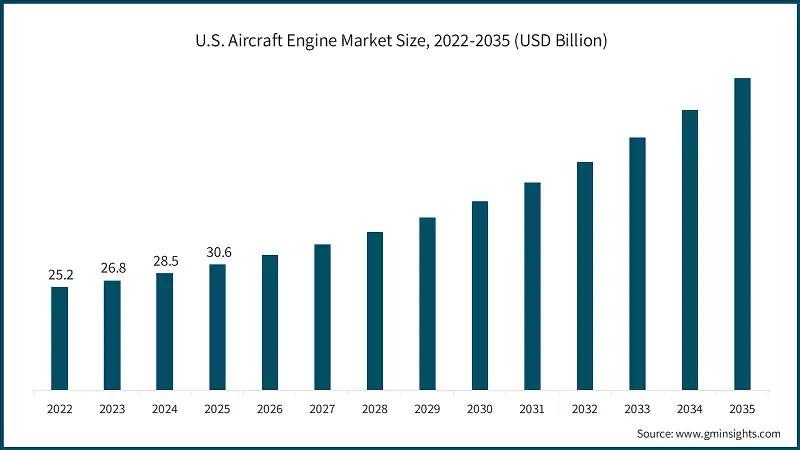
The U.S. aircraft engine market was valued at USD 25.1 billion and USD 26.7 billion in 2022 and 2023, respectively. The market size reached USD 30.6 billion in 2025, growing from USD 28.5 billion in 2024.
- The U.S. commercial aviation sector continues to grow, with robust flight operations increasing demand for new engines and aftermarket support.
- Higher usage rates of domestic and international airline services require aircraft operators to invest in more fuel-efficient turbofan engines and service agreements, which supports both sales and service revenue channels in the aircraft industry.
- The U.S. Department of Defense has promoted market growth through contracts for the next-generation propulsion system.
- These developments have led to transformations in the military aviation engines sector, which increases the level of competition between manufacturers to meet the demands of modern combat.
Europe Aircraft Engine Market
Europe market accounted for USD 19.3 billion in 2025 and is anticipated to show lucrative growth over the forecast period.
- The European Union Aviation Safety Agency (EASA) reports that aircraft CO2 emissions in Europe must reduce by up to 50% by 2050 compared with 2005 levels, pushing airlines and manufacturers to adopt fuel-efficient and sustainable engine technologies. Compliance with these regulations drives demand for advanced engines and retrofitting solutions.
- European governments are investing in fighter jets, transport aircraft, and helicopters to modernize their defense capabilities.
- These programs create demand for high-performance engines and aftermarket support, including MRO services, spares, and upgrades, boosting the market across NATO and non-NATO member countries in the region.
Germany dominated the Europe aircraft engine market, showcasing strong growth potential.
- Germany’s growing domestic and regional aviation sector is driving demand for modern, fuel-efficient engines in both commercial and regional aircraft.
- Germany's expanding regional and domestic aviation market is propelling demand for new and more efficient jet engines for both commercial and regional aircraft.
- To improve operational requirements, passenger demand, and lower emissions, air travel companies are migrating from older jet engines. This need creates a predominately positive market for aftermarket jet engine services and new jet engine original equipment manufacturers.
Asia Pacific Aircraft Engine Market
The Asia Pacific market is anticipated to grow at a CAGR of 9.3% during the analysis timeframe.
- Asia Pacific is witnessing strong air travel growth driven by rising middle-class populations, increasing tourism, and expanding low-cost carrier networks.
- According to India’s Ministry of Civil Aviation, the country aims to increase domestic air passenger traffic from 460 million in 2025 to over 1 billion by 2040, reflecting broader Asia Pacific growth trends.
- Several Asia Pacific countries, including China, Japan, and Australia, are modernizing fighter jets, transport aircraft, and helicopters.
- This drives demand for high-performance military engines, long-term MRO contracts, and technological collaboration, offering growth opportunities for both domestic and international engine manufacturers in the region.
China aircraft engine market is estimated to grow with a CAGR of 10.3% during the forecast period, in the Asia Pacific aircraft engine industry.
- China’s commercial aviation sector is expanding rapidly due to increasing domestic and international air travel.
- Airlines are upgrading their fleets with fuel-efficient turbofan and turboprop engines to cut operational costs and conform to ecological and environmental regulations, fueling the need for engine replacements and engine related long-term maintenance contracted across the primary and regional flying companies.
- According to the Civil Aviation Administration of China (CAAC) 2025 report, China plans to expand its civil aviation fleet to over 9,000 aircraft by 2035, reflecting aggressive domestic and regional market growth. This expansion directly fuels demand for aircraft engines, spares, and aftermarket services.
Latin American Aircraft Engine Market
Brazil leads the Latin American market, exhibiting remarkable growth during the analysis period.
- Brazil’s domestic aviation market is growing with rising passenger traffic and expanding low-cost carrier networks.
- Brazil is also planning to modernize military aircraft, including upgrades to transport and surveillance, as well as helicopters.
- These program upgrades create a need for dependable and high-performance military aircraft. This will allow engine producers to keep a value of their domestic market, as there will be a need for long-term maintenance agreements and collaborative domestic technological support. The aftermarket support for military production will also create opportunities.
Middle East and Africa Aircraft Engine Market
South Africa market to experience substantial growth in the Middle East and Africa market in 2025.
- South Africa continues to invest in upgrading its military aircraft fleets, including fighter jets, transport aircraft, and helicopters.
- These programs drive demand for high-performance engines, spares, and long-term maintenance services, providing opportunities for both domestic and international engine manufacturers operating in the defense segment.
- Furthermore, the region’s domestic and regional aviation sector is expanding, driven by rising tourism, business travel, and low-cost carrier operations.
Aircraft Engine Market Share
Strategic advancements and innovative technologies shape relationships between manufacturers, aircraft OEMs, and specialized aerospace technology companies. Companies such as Rolls-Royce, Pratt & Whitney (RTX), MTU Aero Engines AG, and IHI Corporation comprise of 39.9% of the market share and promote the strengthening of research and development (R&D) to address the major issues of fuel efficiency, reliability, and emissions (commercial, military, and regional).
These major companies formed relationships in multiple avenues such as partnerships, joint ventures, mergers, and acquisitions to increase engine development and certification speed, improve commercialization efforts, and enhance the scope of their global service networks. Smaller innovative companies and niche technology firms address the market demand with hybrid-electric engines, digital engines, sustainable engines, and propulsion systems. These ecosystems promote engine fleet modernization, rapid technological advancements, and long-term market growth.
Aircraft Engine Market Companies
Prominent players operating in the aircraft engine industry are as mentioned below:
- Enjet Aero
- Engine Alliance
- Safran Group
- Pratt & Whitney (RTX)
- Rolls-Royce
- MTU Aero Engines AG
- CFM International
- General Electric Company
- ITP Aero
- IHI Corporation
- Textron Inc.
- Mitsubishi Heavy Industries Aero Engines, Ltd.
- Rolls-Royce
Rolls-Royce held 14.3% of the market in 2025, driven by advanced turbofan and turboshaft engines, a wide global service network, and strong partnerships with commercial and military aircraft OEMs. Its advantage comes from pairing high-performance propulsion systems with long-term maintenance, repair, and overhaul (MRO) contracts, which has encouraged broad adoption among commercial airlines, regional operators, and defense clients worldwide.
Pratt & Whitney (RTX) held 11.7% of the market in 2025, driven by its next-generation geared turbofan engines, focus on fuel efficiency, and strategic partnerships with major aircraft makers. Its mix of innovative propulsion tech, proven reliability, and strong lifecycle support makes Pratt & Whitney a preferred choice for both commercial and military operators.
MTU Aero Engines AG captured 8.3% of the market by offering high-performance military and commercial engines and maintaining advanced maintenance solutions. The company’s competitive edge over other players is their engineering capabilities, in-house manufacturing of engine components, and effective collaborations with leading global OEMs as aftermarket service providers and operational dependability.
IHI Corporation had 5.6% of the market, with a focus on turbofan and turboshaft engines for business, regional, and defense aircraft. The company’s strength is providing dependable operational propulsion systems with developed digital monitoring and maintenance solutions for operational efficiency and prolonged engine support for clients in the global market.
Aircraft Engine Market Report Attributes
| Key Takeaway | Details |
|---|---|
| Market Size & Growth | |
| Base Year | 2025 |
| Market Size in 2025 | USD 86.7 Billion |
| Market Size in 2026 | USD 92.7 Billion |
| Forecast Period 2026 - 2035 CAGR | 9.1% |
| Market Size in 2035 | USD 203.3 Billion |
| Key Market Trends | |
| Drivers | Impact |
| Rising air travel demand | Fleet expansion and replacement drive engine sales and services, contributing ~30% to market growth. |
| Technological advancements in engine efficiency | Fuel-efficient, low-emission engines reduce operational costs, supporting adoption and growth of ~25%. |
| Expansion of Engine Aftermarket and MRO Services | Lifecycle management and maintenance contracts generate recurring revenue, impacting ~20% of the market. |
| Increased investment in emerging aircraft technologies | Hybrid-electric and sustainable propulsion R&D accelerates innovation, contributing ~15% to market expansion. |
| Increasing Defense and Military Aviation Modernization | Upgrades and new procurements for military aircraft drive engine demand, accounting for ~10% of growth. |
| Pitfalls & Challenges | Impact |
| High Research and Development (R&D) costs | Extensive investment in engine design, testing, and certification limits new entrants and strains OEM budgets, slowing introduction of next-generation, fuel-efficient, and hybrid-electric engines. |
| Supply Chain and Manufacturing Constraints | Dependence on specialized components and precision materials creates bottlenecks, delays production schedules, and restricts timely engine deliveries, impacting both commercial and defense aircraft programs. |
| Opportunities: | Impact |
| Growth of Hybrid-Electric and Sustainable Propulsion Technologies | Will drive adoption of hybrid-electric and sustainable propulsion systems across commercial, regional, and business aircraft globally. |
| Expansion of Engine Aftermarket and Predictive Maintenance Services | Will drive demand for predictive maintenance and aftermarket services, supporting long-term engine reliability and operational efficiency. |
| Market Leaders (2025) | |
| Market Leaders |
14.3% Market Share |
| Top Players |
|
| Competitive Edge |
|
| Regional Insights | |
| Largest Market | North America |
| Fastest Growing Market | Middle East & Africa |
| Emerging Countries | United States, United Kingdom, Germany, Japan, and France |
| Future outlook |
|
What are the growth opportunities in this market?
Aircraft Engine Industry News
- In September 2025, Honeywell unveiled a new small-thrust-class aircraft engine specifically designed for uncrewed military operations, targeting the growing drone and autonomous systems market.
- In December 2025, the Rolls-Royce BAESL MRO Venture Joint Facility located in Beijing opened. This move allows the company to offer overhaul services for Trent 700, Trent XWB-84, and Trent 1000 engines in the premiere engines overhauls in 2026.
- In November 2025, Hindustan Aeronautics Limited (HAL) signed a landmark USD 1 billion contract with GE Aerospace for the procurement of 113 F404-GE-IN20 engines to power India's Tejas Mk1A fighter fleet. Deliveries are scheduled to occur between 2027 and 2032.
- • In May 2024, Hanwha Aviation announced the launch of its lease and trading platform, Hanwha Aviation. The platform provides offerings and solutions for the lease and trade process of commercial and military aircraft and engine hardware assets and robust solutions.
- In October 2024, Safran Aircraft Engines in Paris, France, kicked off a USD 1 billion investment plan to expand and modernize its global maintenance, repair, and overhaul (MRO) network. The aim is to integrate with the expanding fleet of LEAP engine worldwide with composite materials.
The aircraft engine market research report includes in-depth coverage of the industry with estimates & forecasts in terms of revenue (USD Billion) from 2022 to 2035, for the following segments:
Market, By Type
- Turboprop
- Turbofan
- Turboshaft
- Piston engine
Market, By Component
- Turbine
- Compressor
- Gearbox
- Exhaust system
- Fuel system
- Others
Market, By Technology
- Conventional
- Hybrid
Market, By Application
- Commercial aircrafts
- Narrow-body
- Wide-body
- Regional jets
- Turboprop/helicopters
- Military aircrafts
- Fighter aircraft
- Transport aircraft
- Special mission aircraft
- Military helicopters
- Unmanned aerial vehicle
The above information is provided for the following regions and countries:
- North America
- U.S.
- Canada
- Europe
- Germany
- UK
- France
- Spain
- Italy
- Netherlands
- Asia Pacific
- China
- India
- Japan
- Australia
- South Korea
- Latin America
- Brazil
- Mexico
- Argentina
- Middle East and Africa
- Saudi Arabia
- South Africa
- UAE
Frequently Asked Question(FAQ) :
What is the market size of the aircraft engine industry in 2025?
The market size for aircraft engine was valued at USD 86.7 billion in 2025, driven by rising global air travel demand and increasing aircraft fleet utilization.
What is the current aircraft engine market size in 2026?
The aircraft engine industry is projected to reach USD 92.7 billion in 2026 as airlines accelerate fleet expansion and engine replacement programs.
What is the projected value of the aircraft engine industry by 2035?
The market is expected to reach USD 203.3 billion by 2035, growing at a CAGR of 9.1% due to fleet modernization, expanding aftermarket services, and defense aviation investments.
What is the growth outlook for the aircraft engine market from 2026 to 2035?
The aircraft engine industry is anticipated to grow at a CAGR of 9.1% during 2026–2035, supported by demand for fuel-efficient engines, increasing MRO activity, and adoption of advanced propulsion technologies.
How much revenue did the turbofan engine segment generate in 2025?
The turbofan engine segment generated USD 50.7 billion in 2025, leading the market due to strong demand from narrow-body and wide-body commercial aircraft programs.
What was the market share of conventional engine technology in 2025?
Conventional engine technology accounted for 61.7% of the aircraft engine market in 2025, supported by widespread deployment in single-aisle and wide-body commercial aircraft fleets.
What is the growth outlook for hybrid aircraft engines?
Hybrid aircraft engine technology is projected to grow at a CAGR of 8.7% through 2035, driven by sustainability goals, emissions reduction initiatives, and advances in electric propulsion systems.
Which region leads the aircraft engine market?
The U.S. market reached USD 30.6 billion in 2025, reflecting strong domestic aviation activity and defense procurement. Growth is driven by high aircraft utilization rates, fleet renewal with fuel-efficient engines, and sustained U.S. defense modernization programs.
What are the key trends shaping the aircraft engine industry?
Major industry trends include development of next-generation fuel-efficient engines, expansion of engine aftermarket and predictive maintenance services, and growing investment in hybrid-electric and sustainable propulsion technologies.
Who are the key players in the aircraft engine market?
Key market players include Rolls-Royce, Pratt & Whitney (RTX), MTU Aero Engines AG, IHI Corporation, Safran Group, General Electric Company, and CFM International.
Aircraft Engine Market Scope
Related Reports