Summary
Table of Content

Aircraft Ejection Seat Market
Get a free sample of this report
Form submitted successfully!
Error submitting form. Please try again.
Thank you!
Your inquiry has been received. Our team will reach out to you with the required details via email. To ensure that you don't miss their response, kindly remember to check your spam folder as well!
Request Sectional Data
Thank you!
Your inquiry has been received. Our team will reach out to you with the required details via email. To ensure that you don't miss their response, kindly remember to check your spam folder as well!
Form submitted successfully!
Error submitting form. Please try again.
Aircraft Ejection Seat Market Size
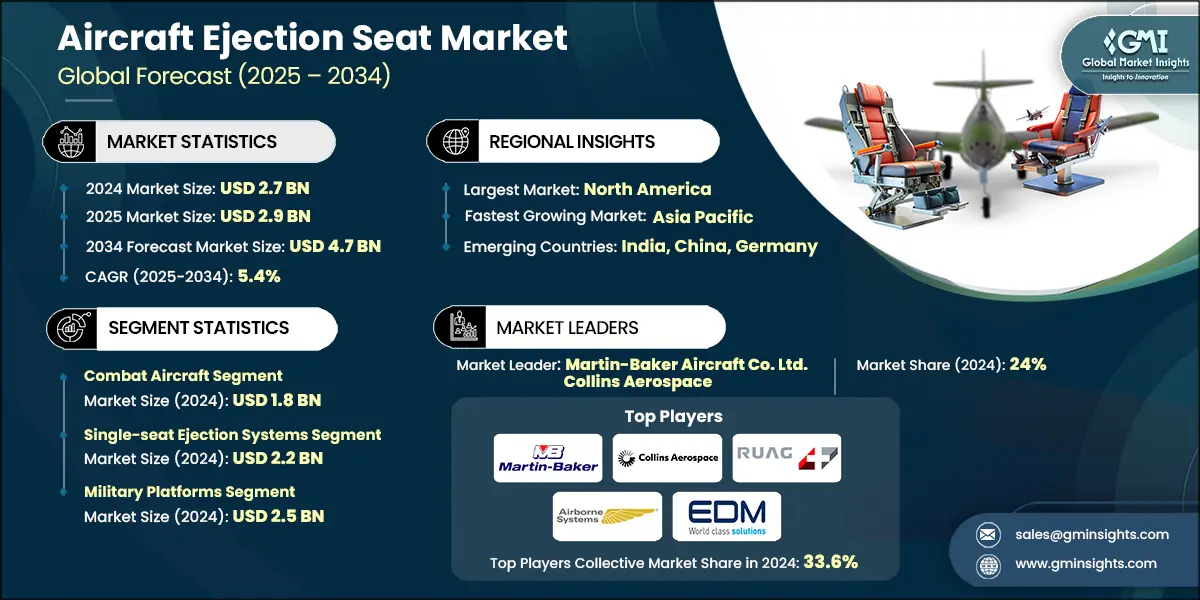
The global aircraft ejection seat market was valued at USD 2.7 billion in 2024 with a volume of 22,846 thousand units The market is expected to grow from USD 2.9 billion in 2025 to USD 3.7 billion by 2030 and USD 4.7 billion by 2034 with a volume of 52,630 thousand units growing at a value CAGR of 5.4% and a volume CAGR of 8.7% during the forecast period of 2025–2034, according to Global Market Insights Inc.
Aircraft Ejection Seat Market Key Takeaways
Market Size & Growth
- 2024 Market Size: USD 2.7 Billion
- 2025 Market Size: USD 2.9 Billion
- 2034 Forecast Market Size: USD 4.7 Billion
- CAGR (2025–2034): 5.4%
Regional Dominance
- Largest Market: North America
- Fastest Growing Region: Asia Pacific
Key Market Drivers
- Increasing Fighter Aircraft Acquisition.
- Technological Improvements in Ejection Systems.
- Enhanced pilot survivability demands advanced ejection systems.
- Emerging Fighters Upgrade and Life Extension Programs.
- Increasingly Self-Reliant in Their Defense Manufacturing.
Challenges
- High cost to develop and maintain.
- Complex integration with various aircraft.
Opportunity
- Expansion of Defense Budgets Around the World.
- Growth of Next Generation Ejection Seats.
- Retrofit and Upgrade Existing Aircraft Fleets.
- Partnerships with Indigenous Players and Local Production.
Key Players
- Leading Players: Top 5 players in this market include Martin-Baker Aircraft Co. Ltd., Collins Aerospace, RUAG Group, Airborne Systems Inc., EDM Limited, which collectively held a market share of 33.6% in 2024.
Get Market Insights & Growth Opportunities
- The growth in the aircraft ejection seat market is propelled by increasing fighter aircraft acquisition, technological improvements in ejection systems, enhanced pilot survivability demands advanced ejection systems, emerging fighters upgrade and life extension programs and increasingly self-reliant in their defense manufacturing.
- Rising procurement of fighter aircraft is a key growth driver for the market. For instance, Germany has ordered 20 additional Eurofighter jets to be delivered by autumn 2025 with 38 already in pipeline. In December 2024 Spain signed a contract with the NATO Eurofighter and Tornado Management Agency (NETMA) for the purchase of 25 Eurofighter aircraft as part of its Halcón II program. Each new aircraft requires an ejection seat system, ensuring a steady demand for both new production and retrofits, thereby bolstering manufacturer revenues and technological development.
- The growing focus on pilot survivability is one of the primary drivers of the aircraft seat ejection market, encouraging investment in advanced, reliable ejection systems that enhance safety during emergency situations. A study published in the journal Aviation, Space, and Environmental Medicine by the Royal Air Force Centre of Aviation Medicine analyzed 232 RAF rocket-assisted ejection cases. It reported an 89.2% overall survival rate for those using rocket-assisted ejection seats, with survivability reaching 95.7% when ejection occurred within the aircraft’s operational envelope. The data also clearly demonstrated that while there are some risk of injury such as spinal fractures, head injuries, and parachute landing mishaps, ejection seats greatly improve the chances of surviving an otherwise fatal emergency, and provide an extremely significant level of safety for aircrew in high-risk environments.
- In 2024, North America dominated the global aircraft ejection seat market with a share of 41.9% in 2024.North America is the largest market for aircraft ejection seats, as a result of military modernization, the cost of defense, technological advancements, and innovations. As of 2025, the U.S. Department of Defense plans to acquire 2,456 F-35s: 1,763 F-35A (Air Force), 353 F-35B (Marines), and 273 F-35C (Navy) under its long-term modernization strategy.
To get key market trends
Aircraft Ejection Seat Market Trends
- The increasing integration of smart ejection systems is a key trend in the aircraft ejection seat industry. These systems leverage advanced sensors and real-time data analysis to precisely optimize ejection timing, significantly improving pilot safety during emergencies. This trend started in the mid-2010s, encouraged by new sensors and analytics capabilities. It is getting traction based on improved safety for pilots and less chance of ejecting. The overall adoption peaked in the early to mid-2020s, based on technology maturation. The ACES II seat has saved more than 700 pilot lives. The ACES II ejection seat has reduced the rate of spinal injuries during ejection to less than 1%, a significant improvement over 20-40% for ejection prior to the ACES II.
- Another major trend is the growing adoption of zero-zero ejection technology, which allow pilot to safely eject at both zero airspeed and zero altitude as well as dramatic incidences of ejection survival rates. This trend began in the 1970s, as the initial attention was given to the `zero-zero` ejection seats systems that allow for safe ejection at zero altitude and air speed and is now accelerating because of the increasing levels of survivability. This trend may continue to influence the evolution of ejection seat technology have by introducing zero-zero systems for new aircraft into the 2030's while safety standards evolve.
- A significant trend in the aircraft ejection seat market is the utilization of advanced lightweight materials, particularly carbon composites. This trend started in 2018 and is mostly focused on enhanced pilot safety and reducing weight on the aircraft. The trend is starting to accelerate owing to increased strength-to-weight ratios, improved ergonomics, and improved survivability. The trend is expected to maximize between 2026–2028 due to demands for new military aircraft with more advanced systems requiring effective ejection systems.
- According to the U.S. Government Accountability Office (GAO), the Boeing 787 Dreamliner, which flew its maiden flight in 2009 has 50% of its structural weight in composite materials. This trend sets a strong precedent for broader integration of advanced lightweight materials across both commercial and defense aviation sectors.
Aircraft Ejection Seat Market Analysis
Learn more about the key segments shaping this market
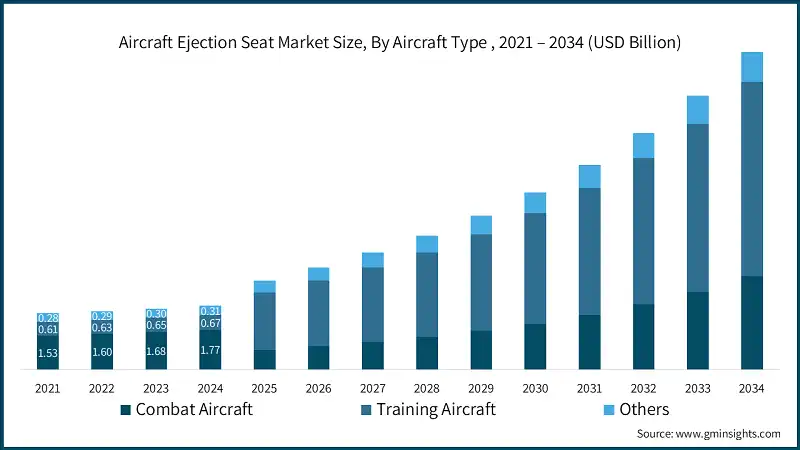
Based on aircraft type, the market is segmented into combat aircraft, training aircraft and others.
- The combat aircraft segment was valued at USD 1.8 billion in 2024, driven by increasing defense budgets, modernization programs, growing geopolitical tensions, and the need for advanced pilot safety systems (like zero-zero ejection seats).
- Manufacturers should emphasis include developing lighter, more reliable ejection seats (as pilot safety defense priorities evolve) with better smart technologies, improving retrofits for legacy aircraft designs, and furthering support of emerging markets with affordable modular designs.
- The training aircraft segment is anticipated to grow with a CAGR of 4.3% during the forecast period of 2025 – 2034, driven by the growth of international pilot training programs, the rising demand for sophisticated safety features such as zero-zero ejection seats, and modernization of training fleets around the world.
- Manufacturers should focus on improving ejection seat safety features specific to training aircraft, developing low-cost and easy to maintain safety systems, and contracting with simulation and monitoring systems to facilitate pilot training and lower operational risk where possible.
Learn more about the key segments shaping this market
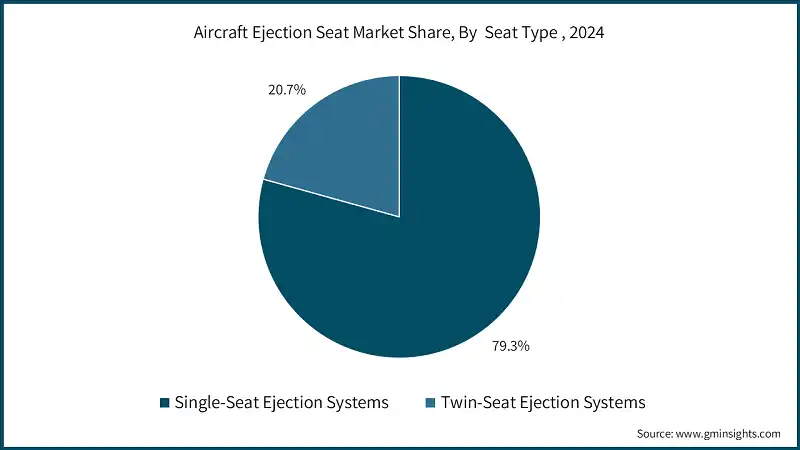
Based on seat type, the aircraft ejection seat market is segmented into single-seat ejection systems and twin-seat ejection system.
- The single-seat ejection systems was the largest segment and was valued at USD 2.2 billion in 2024.This growth is mainly driven by demand for frontline fighter jets, demand for advanced and sophisticated safety features such as ejection seats, and modernization of single-seat combat aircraft fleet with modernization efforts around the world.
- Manufacturers should focus on research to develop lighter, more compact single seat ejection seat systems to improve reliability, and should consider the potential of smart sensors for real time health monitoring, to improve and extend integration with next-generation fighter aircraft while meeting dominant defense priorities and modernization issues.
- The twin-seat ejection system segment is anticipated to grow with a CAGR of 4.3% during the forecast period of 2025 – 2034, driven by growing demand for advanced trainer and multi-role aircraft and modernization efforts focused on pilot safety in dual-seat configurations.
- Manufacturers should focus on developing advanced twin-seat ejection systems, addressing increasing operational strains on hastening pilot safety through improved crew synchronization and safety for both crewmen, and developing updated configurations on multi-role and trainer aircraft to meet global rises in dual-seat operational demand.
Based on the end use application, the aircraft ejection seat market is segmented into military platforms and research institutes.
- The military platforms segment was the largest market and was valued at USD 2.5 billion in 2024, driven by growing government defense budgets around the world, evolving ejection seat system technology, demand for pilot safety, and global efforts to revamp militaries fleets of military aircraft battalions.
- Market players should consider innovating low weight, high-efficiency ejection seat technology, considering evolving military requirements to support retrofit on aged legacy fleets, and innovating new advances digital monitoring and smart safety features the most recently fielded aircraft.
- The research institutes segment was the fastest growing segment and is anticipated to grow with a CAGR of 7.6% during the forecast period of 2025-2034, driven by increased investments to support aerospace safety research, new generation ejection technologies development, and defense agencies partnering.
- Manufacturers should focus on fostering partnerships with Canadian and US based research institutes, invest in R&D projects looking for new and innovative ejection seat technologies, and fast-tracking next generation safety systems to sustain leadership.
Looking for region specific data?
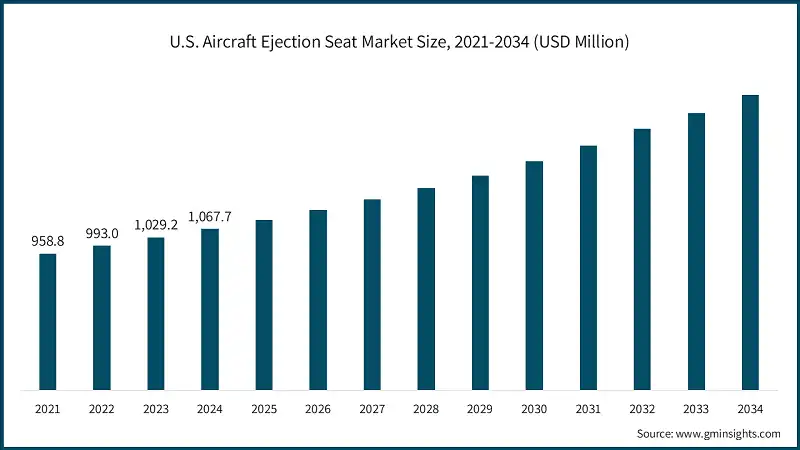
North America aircraft ejection seat market was valued at USD 1.2 billion in 2024 and is anticipated to grow with a CAGR of 4.9% during the forecast period of 2025 – 2034. The market is propelling due to the growing emphasis on pilot safety and survivability during combat operations, and increasing demand for the retrofitting of legacy aircraft with modern ejection systems.
- U.S. market was valued at USD 1.1 billion in 2024. The market is growing due to the combination of increased defense spending, modernization projects of the U.S. Air Force fleet, and improvements to pilot safety technologies like zero-zero ejection seats.
- U.S. manufacturers should focus on improving ejection seat, tailor ability to accommodate a variety of aircraft, continuing to invest in advanced materials to reduce weight, implementing AI technology for added pilot safety, and enhancing aftermarket support and maintenance systems to maximize aircraft use.
- The Canada aircraft ejection seat market is anticipated to grow with a CAGR of 5.9% during the forecast period of 2025-2034. The market is growing steadily due to patching together funding for upgrades to aging fleets of aircraft, working with various international defense partners and increased use of advanced training simulators.
- Companies should focus on creating low-cost retrofit modifications, improving ejection seat effectiveness and reliability, improving products to work in cold weather and collaborate with Canadian defence and training organizations.
The aircraft ejection seat industry in Europe is anticipated to grow with a CAGR of 4.3% during the forecast period of 2025 – 2034. The growth is being driven by increase in European defense budgets, advances in ejection seat technology and collaborating with NATO partner defence agencies.
- The aircraft ejection seat market in Germany is anticipated to grow with a CAGR of 5.2% during the forecast period of 2025-2034, driven by rising demand for trainer aircraft, enhanced maintenance and support services and integration of digital monitoring systems.
- Manufacturers should focus on developing lightweight, modular ejection seats, upgraded integrated system that enhance digital monitoring, and enhanced retrofitting and support in developing activities to adapt to Germany's changing defense landscape.
- The UK aircraft ejection seat market is anticipated to surpass USD 101.2 million by 2034. The UK market is growing due to the upgrade of its legacy combat aircraft fleets as well as government funding for aerospace modernization and innovation.
- Manufacturers should be focused on how to advance their development of innovative ejection seats, enhancing integration with controller next-generation aircraft, availability of retrofit capabilities, and the development of better after-sales support and training services in the UK market.
The Asia Pacific aircraft ejection seat market held 26.6% market share in 2024 and is growing at a 6.6% CAGR during the forecast period of 2025-2034. The market continues to grow due to national circumstance owing to rising geopolitical tensions and engagements into conflicts, as well as ramping up of indigenous defense manufacturing.
- The market in the India was valued at USD 191.5 million in 2024. The market is driven by national military development strategies that are accelerating under exploration of defense export initiatives, increased engagement opportunities through joint military exercises, and the government's policy "Make in India'.
- Manufacturers should focus on developing locally manufactured, cost-effective ejection seats, enhancing technology transfer partnerships, customizing products for Indian military requirements, and expanding after-sales support and training services within India.
- The China aircraft ejection seat market is projected to grow significantly with a CAGR of 6.9 % during the forecast period of 2025-2034. The market is driven by developing next-gen fighter jets and national military strategizing on emphasis on self-nation.
- Companies must prioritize innovating advanced, reliable ejection seats tailored to next-gen aircraft, investing in domestic R&D, enhancing manufacturing capabilities, and strengthening collaborations with China’s defense sector to support self-reliance goals.
- The Japan aircraft ejection seat market is projected to grow significantly with a CAGR of 4.9% during the forecast period of 2025-2034. The aircraft ejection seat industry in Japan is witnessing growth due to increased emphasis on self-defense capability enhancements and government-supported R&D in aerospace.
- Manufacturers must commit to developing higher-performance ejection seats suitable for Japan’s advanced fighter jets, increase local manufacturing partnerships, spend substantial resources investing in R&D on other safety enhancements, and adhere to strenuous regulatory standards.
Latin America aircraft ejection seat market held 4.5% market share in 2024 and is growing with a CAGR of 5.1% during the forecast period of 2025-2034. The market is witnessing continuous growth due to growth in joint military training exercises, increased government focus on air sovereignty and air defense systems, and modernization of air defense systems.
Middle East & Africa market was valued at USD 331 million in 2024. The market is propelled due to rising geopolitical tensions, increased military aircraft acquisitions, government defense modernization programs, and strategic investments in advanced aerospace technologies.
- The South Africa aircraft ejection seat market is projected to grow with a CAGR of 5% during the forecast period of 2025-2034. The ejection seat market is witnessing stable growth due to enhanced regional defense initiatives, development of local aerospace capacities, and more focused plans regarding the operational readiness of air forces.
- Manufacturers must focus on developing ejection seats that are tailored to regional needs, work to form agreements with partners in South Africa for local development, deploy improved ejection seats so they work in the capabilities of harsh environments, and commit to providing adequate maintenance support to improve air force readiness in South Africa.
- The Saudi Arabia aircraft ejection seat market is projected to grow with a CAGR of 7.5% during the forecast period of 2025-2034, driven by government vision 2030 defense focus and strategic procurement of advanced aircraft.
- Manufacturers should focus on developing more sophisticated and reliable ejection seats to accommodate more sophisticated aircraft, enhancing local production capacity, and providing significant training and after-sales service in line with Saudi Arabia's Vision 2030 defense objectives.
- The UAE market was valued at USD 92.4 million in 2024. The market is expanding due to adoption of next generation fighter jets, strategic military alliances and partnerships and deployment infrastructure for pilot training.
- Manufacturers must focus on development of advanced, compatible ejection seats for next-generation jets, strengthening collaboration with UAE defense organizations, and elevating the OEM pilot training support and aircraft maintenance services to respond better the evolving standards in the marketplace.
Aircraft Ejection Seat Market Share
- The top 5 companies are Martin-Baker Aircraft Co. Ltd., Collins Aerospace, RUAG Group, Airborne Systems Inc. and EDM Limited collectively hold around 33.6% of the market share in 2024, indicating a consolidated market concentration driven by established supplier relationships and technological barriers to entry.
- Martin-Baker Aircraft Co. Ltd. holds a major position in the aircraft ejection seat market, accounting for 14.7% of the total market share in 2024. Martin-Baker is the world-wide expert in ejection seats having supplied more than 75,000 seats in total and having served most Western fighter aircraft. Its established excellence with reliability, continuous innovation in zero-zero seats, and the broadest range pilot safety solutions solidify their position as the market leader.
- Collins Aerospace held 9.26% of the total market share in 2024. Collins Aerospace has dominance within the sector through its ACES ejection seat line, which is widely used in U.S. defense military aircraft. They are backed by RTX Corporation. They are innovating using advanced materials and focus on ergonomics pilot’s desires for survivability.
- RUAG Group is a key player in the aircraft ejection seat market and holds 4.3% of the total market share in 2024, RUAG continues to grow its reach in the market through customized offers in ejection systems, maintenance and upgrades. They continue to provide service and reliability and support service for legacy and modern aircraft to several European defense forces.
- Airborne Systems Inc. held 3.2% of the total market share in 2024. Airborne Systems specializes in ejection seat components, survival systems, and parachute solutions. By supplying highly reliable, certified systems to both military and commercial aviation customers, the company secures a solid share, particularly in retrofit and auxiliary safety solutions.
- EDM Limited held 2.0% of the total aircraft ejection seat market share in 2024. EDM Limited manufactures precision-engineered aircraft ejection seat components and complete systems, emphasizing quality and regulatory compliance. Its niche expertise in supporting smaller fleets and providing retrofit solutions allows it to retain a stable market share globally.
Aircraft Ejection Seat Market Companies
Some of the prominent market participants operating in the aircraft ejection seat industry include:
- Martin-Baker Aircraft Co. Ltd.
- Collins Aerospace
- RUAG Group
- Airborne Systems Inc.
- EDM Limited
- Survival Equipment Services Ltd.
- NPP Zvezda
- Safran SA
- AmSafe Bridport Ltd.
- BAE Systems
- Tencate Advanced Armor
- Parachute Laboratories Inc.
- Quickstep Technologies
- Vector Aerospace
- Cobham Plc
- QinetiQ Group Plc
- Butler Parachute Systems Inc.
- Lockheed Martin
- Northrop Grumman
- Hindustan Aeronautics Limited
- Martin-Baker, Collins Aerospace, Safran SA, RUAG, Lockheed Martin, and Northrop Grumman influence the market through technical innovation, international access, and close defence relationships. They are the leaders in aerospace safety, ejection systems, and integrated military systems in leading defence markets and drive the establishment of standards and a pathway for industry improvements.
- Airborne Systems, BAE Systems, EDM Limited, AmSafe Bridport, and Vector Aerospace are the followers who provide the defence sector with specialized products such as parachutes, training systems, and MRO activity. While they provide essential solutions that help to sustain operational capability, by their nature they are of limited economic scale, market share, and influence compared to large-scale global competitors.
- RUAG, HAL, QinetiQ, Cobham, and Quickstep Technologies are the challengers as they still possess some capabilities, make reasonable investments in innovation and have some niche capability. They provide value by supporting military modernization, defence and aerospace technologies, and the international tenders to keep up in the continuing modernization agenda with recognition of the historic gap to the market leaders.
- Tencate Advanced Armor, NPP Zvezda, Parachute Laboratories, Butler Parachute Systems, and Survival Equipment Services are considered niche players providing specialized solutions in ballistic protection, pilot safety, parachute systems, and survival equipment/gear.
Aircraft Ejection Seat Market Report Attributes
| Key Takeaway | Details |
|---|---|
| Market Size & Growth | |
| Base Year | 2024 |
| Market Size in 2024 | USD 2.7 Billion |
| Market Size in 2025 | USD 2.9 Billion |
| Forecast Period 2025 - 2034 CAGR | 5.4% |
| Market Size in 2034 | USD 4.7 Billion |
| Key Market Trends | |
| Drivers | Impact |
| Increasing Fighter Aircraft Acquisition | Boosts demand for advanced ejection seats, driving market growth through fleet modernization and pilot safety upgrades. |
| Technological Improvements in Ejection Systems | Enhance ejection seat safety and reliability, increasing adoption and fueling growth in the aircraft ejection seat market globally. |
| Enhanced pilot survivability demands advanced ejection systems | Attention to and high regard for pilot survivability in combat and emergency situations compel air forces to procure exceptional high-performance ejection systems for high-risk missions and stealth aircraft. |
| Emerging Fighters Upgrade and Life Extension Programs | Most upgrades involve new onboard electronic systems and weapons for the upgraded fleets but also lead to the ongoing demand for replacements of aging ejection seats. |
| Increasingly Self-Reliant in Their Defense Manufacturing | Countries developing fighters such as India, Turkey, and South Korea, with programs like Tejas and KF-21, will eventually drive the domestic development and production of ejection seats. |
| Pitfalls & Challenges | Impact |
| High cost to develop and maintain | Hinder innovation, limit production scale, and increase overall procurement expenses. |
| Complex integration with various aircraft | Complex integration with various aircraft slows deployment, increases design costs, and limits compatibility, delaying advancements in the ejection system market. |
| Opportunities: | Impact |
| Expansion of Defense Budgets Around the World | Creates opportunities for aircraft ejection seat upgrades, driving demand, innovation, and increased procurement across militaries. |
| Growth of Next Generation Ejection Seats | Next-generation ejection seats enhance pilot safety, boost market demand, drive innovation, and create growth opportunities in the aircraft safety industry. |
| Retrofit and Upgrade Existing Aircraft Fleets | Improves safety, extends aircraft lifespan, and increases market demand for modernization solutions. |
| Partnerships with Indigenous Players and Local Production | Boost economic growth, reduce costs, enhance supply chains, and increase market accessibility in aircraft ejection seats. |
| Market Leaders (2024) | |
| Market Leaders |
Top 2 companies hold 24.0 % market share |
| Top Players |
Collective market share in 2024 is 33.6% |
| Competitive Edge |
|
| Regional Insights | |
| Largest Market | North America |
| Fastest growing market | Asia Pacific |
| Emerging countries | India, China, Germany |
| Future outlook |
|
What are the growth opportunities in this market?
Aircraft Ejection Seat Industry News
- In 2024, Martin-Baker developed the innovative US18E ejection seat that is made specifically for the F-16 aircraft with its narrower cockpit. The US18E is based on the very successful US16E seat used in the F-35, however, the US18E has new advanced passive head and neck protection, such as airbag-like cushions, as well as active arm restraints for the pilot's safety in an emergency ejection.
- In 2024, Martin-Baker Aircraft Co. Ltd. formalized a strategic technology transfer agreement with India to supply advanced ejection seats for the indigenous TEJAS MK-2 fighter jet. This partnership supports India’s ambitious “Make in India” initiative, aiming to boost domestic aerospace manufacturing and reduce reliance on foreign imports.
- In 2023, Collins Aerospace introduced the cutting-edge ACES 5 ejection seat, featuring significant advancements such as passive head and neck protection, enhanced spinal injury mitigation, and a modular design that simplifies maintenance.
The aircraft ejection seat market research report includes in-depth coverage of the industry with estimates and forecasts in terms of revenue in (USD million) & volume in (Units) from 2021 – 2034 for the following segments:
Market, By Aircraft Type
- Combat aircraft
- Training aircraft
- Others
Market, By Seat Type
- Single-seat ejection systems
- Twin-seat ejection systems
Market, By Fit
- Line-fit
- Retrofit
Market, By Component
- Rocket motors / catapult systems
- Parachutes
- Canopy jettison systems
- Others
Market, By End Use Application
- Military platforms
- Research institutes
The above information is provided for the following regions and countries:
- North America
- U.S.
- Canada
- Europe
- Germany
- UK
- France
- Spain
- Italy
- Netherlands
- Asia Pacific
- China
- India
- Japan
- Australia
- South Korea
- Latin America
- Brazil
- Mexico
- Argentina
- Middle East and Africa
- Saudi Arabia
- South Africa
- UAE
Frequently Asked Question(FAQ) :
What is the market size of the aircraft ejection seat industry in 2024?
The aircraft ejection seat market was valued at USD 2.7 billion in 2024 and is expected to grow at a CAGR of 5.4% through 2034, driven by increasing fighter aircraft acquisition and advancements in pilot safety technologies.
What is the current aircraft ejection seat market size in 2025?
The aircraft ejection seat industry is projected to reach USD 2.9 billion in 2025.
What is the projected value of the aircraft ejection seat industry by 2034?
The market size for aircraft ejection seat is expected to reach USD 4.7 billion by 2034, driven by technological improvements in ejection systems and rising demand for pilot survivability.
How much revenue did the combat aircraft segment generate in 2024?
The combat aircraft segment generated USD 1.8 billion in 2024.
What was the valuation of the single-seat ejection systems segment in 2024?
The single-seat ejection systems segment was valued at USD 2.2 billion in 2024.
What is the growth outlook for twin-seat ejection systems from 2025 to 2034?
Twin-seat ejection systems are projected to grow at a CAGR of 4.3% from 2025 to 2034.
Which region leads the aircraft ejection seat market?
The U.S. held the largest market share, with a valuation of USD 1.1 billion in 2024. Growth is driven by increased defense spending, modernization of the U.S. Air Force fleet, and advancements in pilot safety technologies.
What are the upcoming trends in the aircraft ejection seat industry?
Key trends include the integration of smart ejection systems with advanced sensors, adoption of zero-zero ejection technology, and increased use of lightweight carbon composite materials for enhanced pilot safety and aircraft efficiency.
Who are the key players in the aircraft ejection seat market?
Key players include Martin-Baker Aircraft Co. Ltd., Collins Aerospace, RUAG Group, Airborne Systems Inc., and EDM Limited, collectively holding 33.6% of the market share in 2024.
Aircraft Ejection Seat Market Scope
Related Reports