Summary
Table of Content

Aircraft Aftermarket Parts Market
Get a free sample of this report
Form submitted successfully!
Error submitting form. Please try again.
Thank you!
Your inquiry has been received. Our team will reach out to you with the required details via email. To ensure that you don't miss their response, kindly remember to check your spam folder as well!
Request Sectional Data
Thank you!
Your inquiry has been received. Our team will reach out to you with the required details via email. To ensure that you don't miss their response, kindly remember to check your spam folder as well!
Form submitted successfully!
Error submitting form. Please try again.
Aircraft Aftermarket Parts Market Size
The global aircraft aftermarket parts market was valued at USD 49.3 billion in 2024. The market is expected to grow from USD 53.2 billion in 2025 to USD 78.5 billion by 2030 and USD 108.8 billion by 2034 growing at a value CAGR of 8.3% during the forecast period of 2025–2034, according to Global Market Insights Inc.
Aircraft Aftermarket Key Takeaways
Market Size & Growth
- 2024 Market Size: USD 49.3 Billion
- 2025 Market Size: USD 53.2 Billion
- 2034 Forecast Market Size: USD 108.8 Billion
- CAGR (2025–2034): 8.3%
Key Market Drivers
- Increasing Aircraft Fleet Size.
- Increased Demand for Air Travel.
- Increased Technology in Aircrafts.
- Focus on Maintenance, Repair, and Overhaul (MRO).
- Affordability of Aftermarket Parts.
Challenges
- Risks of counterfeit and low-quality parts.
- Complex Regulatory Compliance.
Opportunity
- Rapid Growth of the Asia-Pacific Aviation Sector.
- Implementation of Advanced Manufacturing Technologies.
- Increase in Airlines Outsourcing MRO.
- Growth of Regional and Business Aircraft Fleets.
Key Players
- Market Leader: The Boeing Company led with over 33.1% market share in 2024.
- Leading Players: Top 5 players in this market include The Boeing Company, Airbus SE, RTX Corporation, GE Aerospace, Honeywell International Inc., which collectively held a market share of 63.6% in 2024.
Get Market Insights & Growth Opportunities
- The growth of the aircraft aftermarket parts market is significantly driven by increasing aircraft fleet size, increased demand for air travel, increased technology in aircrafts, focus on maintenance, repair, and overhaul (MRO), and affordability of aftermarket parts.
- The increasing aircraft fleet size, including commercial jets, military aircraft, and cargo planes, is driving demand for aftermarket parts. For instance, Boeing estimated the commercial aircraft fleet to reach 50,000 aircraft by 2044. This growth boosts the need for maintenance, repairs, and replacements to ensure safety, compliance, and operational efficiency across expanding global fleets. Federal Aviation Administration (FAA's) Air Traffic Organization (ATO) provides service to more than 44,000 flights and more than 3 million airline passengers across more than 29 million square miles of airspace every day. Rising aircraft fleets will directly boost demand for aftermarket parts, supporting maintenance and operational efficiency.
- The growing demand for air travel is a key driver of the aircraft aftermarket parts market. As passenger volumes rise, airlines expand operations and fleets, leading to increased maintenance needs, part replacements, and upgrades to ensure safety, reliability, and compliance with aviation regulations. In April 2024, the International Air Transport Association (IATA) reported international air travel demand increased 10.8% compared to the previous year.
- In 2024, North America dominated the global aircraft aftermarket parts market with a share of 38.1% and a value of USD 18.8 billion in 2024 due to the presence of large airlines, major MRO providers, and established airline, and aircraft OEMs, driving aftermarket parts consumption. The FAA Aerospace forecast that the U.S. mainline jet fleet will grow from 4,832 in 2023 to 6,894 by 2044 indicating that the push towards aftermarket services is probably growing as well.

To get key market trends
Aircraft Aftermarket Parts Market Trends
- key trend in the aircraft aftermarket parts industry is predictive maintenance using AI and data analytics, which started gaining traction around the mid-2010s. This trend is accelerating because it allows airlines to predict component failures, minimize unexpected down time, and optimize maintenance schedules. The prediction maintenance trend has been facilitated by the growth of the IoT and big data, and is growing rapidly in adoption, with further growth expected at its peak in early to mid-2020s, as airlines continue to promote efficiency and minimize costs. For instance, the U.S. Department of Defense (DoD) in the Fiscal Year 2024 budget request proposed USD 1.8 billion on artificial intelligence initiatives for which predictive maintenance technologies could be included.
- The rapid growth of the aircraft aftermarket parts market, driven by rising global air travel and increased demand for maintenance, repair, and overhaul (MRO) services, is a key trend. This highlights the essential role of parts supply and advanced servicing in ensuring aviation operational reliability. This trend began from the early 2010s onwards when airline fleets were increasing and their fleets were aging. Airlines are exploring aftermarket solutions and products to accrue the aircraft availability and decrease their operational costs. The peak of this market to occur in the 2030s, as fleets continue to grow and complexities arise in providing the timely and efficient replacements of parts to ensure safe operations. According to ACI World and ICAO, global passenger traffic will reach 9.5 billion in 2024, exceeding pre-pandemic levels, and by 2042 will surpass 19.5 billion, twice that of 2024.
Aircraft Aftermarket Parts Market Analysis
Learn more about the key segments shaping this market
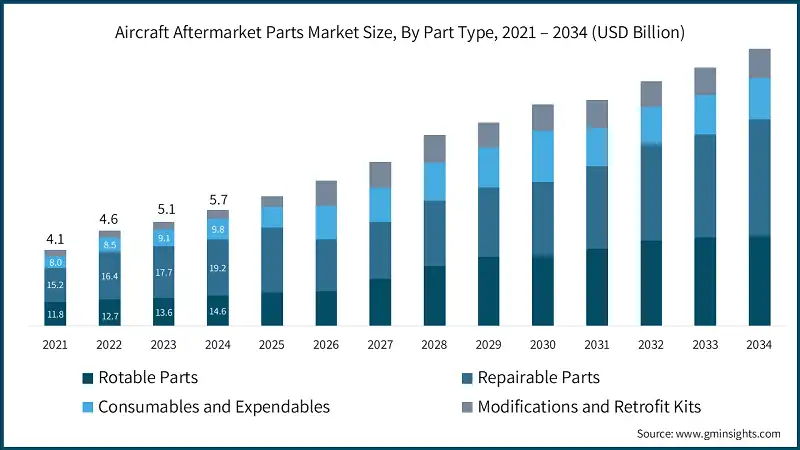
Based on part type, the market is segmented into rotable parts, repairable parts, consumables and expendables and modifications and retrofit kits.
- The repairable parts was the largest market and was valued at USD 19.2 billion in 2024. This segment is driven by increased demand for cost-effective component refurbishment and an increasing focus by airlines on reducing maintenance costs.
- Companies are focused on repairable parts growth by expanding certified repair networks, investing in advanced technologies, offering complete MRO services, incorporating predictive analytics, and promoting sustainability to improve efficiencies and expand cost savings.
- The rotable parts segment is anticipated to grow with a CAGR of 7.6% during the forecast period of 2025 – 2034. This segment is growing due to the increased global demand for air travel, aging aircraft fleets which need maintenance sooner than later, the new technological advancements in predictive maintenance and expanding regional aviation markets, mostly in the Asia-Pacific and Middle East.
- Manufacturers should improve the durability and efficiency of rotable components, build predictive maintenance capabilities and enhance supply chain systems to meet increased levels of demand in new regional markets like Asia-Pacific.
Learn more about the key segments shaping this market
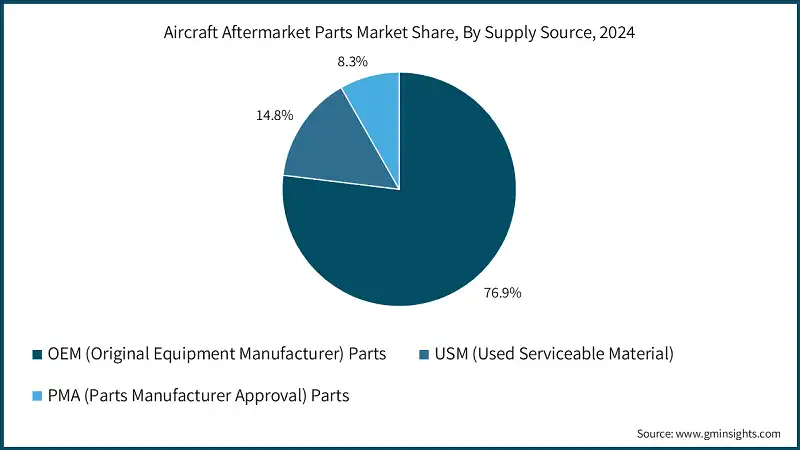
Based on supply source, the aircraft aftermarket parts market is segmented into OEM (original equipment manufacturer) parts, USM (used serviceable material), and PMA (parts manufacturer approval) parts.
- The OEM (original equipment manufacturer) was the largest segment and was valued at USD 37.9 billion in 2024. A major reason for growth is due to airlines' preference for genuine parts, compliance to the rules and regulations, warranty support for parts, and the need for high-quality, reliable components to ensure optimal aircraft performance.
- Companies must prioritize strengthening OEM alliances, implement quality control, improve warranty service, and invest in innovation to meet regulatory standards, and demand from airlines for legitimate and reliable parts that increase aircraft performance and safety.
- The PMA (parts manufacturer approval) parts is the fastest-growing market and is anticipated to grow with a CAGR of 11.2% during the forecast period of 2025-2034. Segment is fuelled by airlines' increasing demand for cost-effective certified aftermarket components.
- Manufacturers are focused on the growth of certified aftermarket solutions, improving quality assurance, increasing production capability, and investing in technology to meet airlines' needs for compliant and economical parts on a global scale.
Based on the end user, the aircraft aftermarket parts market is segmented into airline, maintenance repair and overhaul (MRO), original equipment manufacturers (OEMs), military and defense organizations and others.
- The airline was the largest market and was valued at USD 20.3 billion in 2024. This segment is propelled by air travel demand, growth in fleet size, and strict safety regulations that dictate schedules for maintenance and replacement.
- Companies will have to prioritize achieving efficiencies in supply chains and offer timely decomposing of parts, and new and improved maintenance mechanisms, to accommodate airlines that are building and operating fleets, while adhering to safety restrictions, complying with airworthiness, and improving the reliability of their operation and minimizing down-time.
- The maintenance repair and overhaul (MRO) segment is anticipated to grow with a CAGR of 8.4% during the forecast period of 2025 – 2034. Segment is driven by increasing focus on reducing aircraft downtime, expansion of regional air travel markets and increased consideration for sustainable and environmentally friendly maintenance practices.
- Manufacturers should focus on providing sustainable maintenance solutions, improved rapid repair technologies, and regionally sustained support to minimize downtime for aircraft in use to cater for the growing demand in air travel markets that are emergent.
Looking for region specific data?
North America aircraft aftermarket parts market held 38.1% market share in 2024 and is growing at a 7.7% CAGR during the forecasted period of 2025-2034, driven by increased fleet size, better maintenance technology, strict safety regulations, and major capital investment from government in aerospace-infrastructure and defense modernization programs.
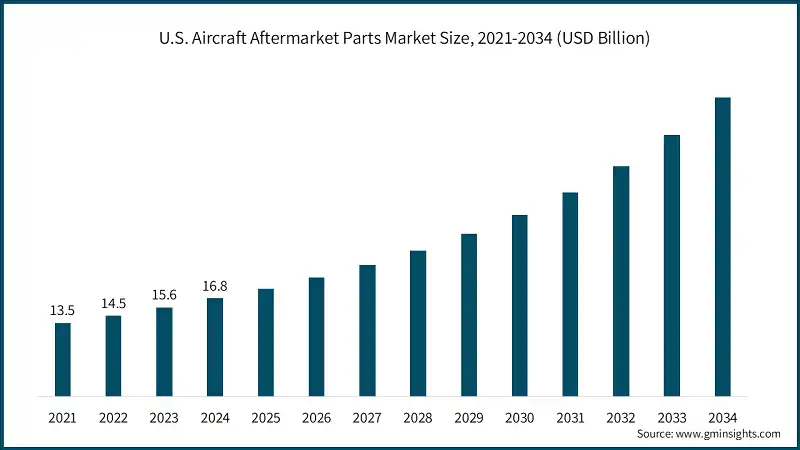
- The aircraft aftermarket parts industry in the U.S. was valued at USD 16.8 billion in 2024. U.S. market is steadily increasing primarily due to strong airline operations, the number of available airport options, increasing domestic and international travel, and higher innovative maintenance technology adoption supports the aftermarket parts market in the US.
- To capitalize on the increased U.S. market, manufacturers should benefit from introducing new maintenance technology, making more parts available, collaborating with airlines, and fulfilling new safety requirements.
- Canada aircraft aftermarket parts market is projected to grow significantly with a CAGR of 7.1% during the forecast period of 2025-2034. The market is driven by expanding cargo and business aviation sectors, introducing new technologies in MRO, increasing investment in airport infrastructure and growing initiatives for sustainability and regulatory compliance.
- For manufacturers to meet the evolving demands within Canada's booming cargo and business aviation sectors, manufacturers should incorporate new MRO technologies, focus on sustainable options, improve supply chain for parts and support infrastructure growth.
Europe held a 26.6% share in 2024 and a 7.3% CAGR. The growth of the European market is driven by aviation safety regulations, growing low-cost carriers, modernization of fleets, rising cross-border traffic and investment in sustainable aviation.
- The German aircraft aftermarket parts market was valued at USD 3.1 billion in 2024, driven by high aerospace density, strong MRO expertise and a strategic geographic location.
- To leverage Germany's aerospace density and locational advantages, companies should continue to build MRO capacity and capability using new technologies, improve supply chains and logistics, and continue to build collaborations and partnerships with other companies at a regional and national level.
- The UK industry is anticipated to surpass USD 2.9 billion by 2024. The market in the UK is currently witnessing high growth due to a strong aerospace base, a need for increased maintenance, and governments developing a significant investment in clean technology.
- To capitalize on the growing aftermarket parts market in the United Kingdom, companies should focus on clean and sustainable technologies, better maintenance services, and collaborating better with the United Kingdom aerospace sectors.
The Asia Pacific aircraft aftermarket parts Market held 25.7% market share in 2024 and is growing at a 10.6% CAGR during the forecast period of 2025-2034, market is growing because of numerous fleet expansions and increasing air travel demand.
- The aircraft aftermarket parts industry in the India was valued at USD 1.5 billion in 2024. India's market is driven by fast growth of low-cost carriers, fleet renewing, increasing investments in airport infrastructure, and more demand for efficient maintenance and repair services.
- Manufacturers must focus on creating cost effective parts, improving support for low-cost carriers, investing in partnerships to help finance local infrastructure, and provide effective and resilient maintenance and repair systems to take advantage of the increasing aftermarket parts market in India.
- The China aircraft aftermarket parts market is projected to grow significantly with a CAGR of 12% during the forecast period of 2025-2034. China’s market is driven by the rapid growth of domestic air travel, large-scale fleet renewals, government support to the aerospace sector, increasing MRO investments, and increasing demand for modern and cost-effective maintenance solutions.
- Civil Aviation Administration of China (CAAC) anticipates the air transport industry will carry 780 million passengers in 2025, which is an increase of 50 million from the record 2024 numbers. This goal shows a strong growth path for the aviation industry in China with the consequent effect of increasing aircraft operations and increased demand for MRO services and aftermarket parts.
- Manufacturers should focus on improving domestic manufacturing capacity, investing in MRO technologies, improving government cooperation, and offering affordable and quality maintenance solutions so that they take advantage of China's rapid growth of air transport aftermarket parts.
- The Japan aircraft aftermarket parts market is projected to grow significantly with a CAGR of 9.4% during the forecast period of 2025-2034. Japan's market is growing because of aging fleets, continued growth of domestic and international air travel, strong government support for aviation innovation, stringent safety regulations, and investments in advanced maintenance and repair technologies.
- Manufacturers should concentrate on new maintenance technologies, compliance to strict safety regulations, supporting fleet modernization, and close collaboration with government programs so that they can capitalize on the growth of the Japan aftermarket parts market for aircraft.
Latin America aircraft aftermarket parts market held 4.9% market share in 2024 and is growing with a CAGR of 6.8% during the forecasted period of 2025-2034. The aircraft aftermarket parts industry is expanding with various demand signals, increase in passenger traffic, and the growth of low-cost carriers (LCC's).
The Middle East & Africa market was valued at USD 2.3 billion in 2024.The aircraft aftermarket parts industry is propelling due to investment in airport infrastructure, the increasing availability of air travel and air cargo and its strategic location as an international aviation centre is driving the aircraft aftermarket parts markets.
- The South Africa market is projected to grow with a CAGR of 4.2% during the forecast period of 2025-2034. The South Africa aircraft aftermarket parts industry is driven by a rising interest in private and business aviation, development of pilot training, and increasing demand for spare parts.
- Manufacturers should concentrate on providing tailored solutions for private and business aviation, development of pilot training, and making sure that the right spare parts are available at the right time, and of high quality when they are needed to capitalize on growth opportunities in the South Africa market.
- The Saudi Arabia aircraft aftermarket parts market is projected to grow with a CAGR of 4.6% during the forecast period of 2025-2034, driven by rising air passenger traffic and cargo demand and growth in pilot training and aviation education programs.
- Manufacturers should focus on enhancing parts availability, investing in advanced training solutions, improving maintenance turnaround times, and fostering strong partnerships with local aviation authorities to support Saudi Arabia’s growing aviation sector.
- The UAE aircraft aftermarket parts market was valued at USD 536 million in 2024. The market in the UAE is growing because of its emerging regional cargo hubs, the increase in private and business aviation, and the need to come up with sustainable aviation solutions.
- Companies should enhance supply chain management, invest in sustainable maintenance technology, expand service networks, and create individual solutions that will help meet the UAE’s emerging cargo, private aviation, and sustainability initiatives.
Aircraft Aftermarket Parts Market Share
- The top 5 companies are The Boeing Company, Airbus SE, RTX Corporation, GE Aerospace, Honeywell International Inc. and collectively hold around 63.6% of the market in 2024, indicating a consolidated market concentration driven by established supplier relationships and technological barriers to entry.
- The Boeing Company held 18.3% of the total market share in 2024. Boeing is a leading global aerospace company with a complete aftermarket services support (spare parts, maintenance, repair and overhaul) model. The aftermarket business line provides support to a very large commercial fleet of defense aircraft and centers on better aircraft reliability and reduced total cost of ownership through solutions and digital tools.
- Airbus SE also held 14.8% of the total market share in 2024. Airbus provides aftermarket support service that consist of parts supply, component rehabilitation and digital services to maximize availability of fleets. The company utilizes global reach and technology to provide tailored maintenance solutions with an emphasis on improving customer experience and efficiency for both commercial and military operators.
- RTX Corporation is a key player in the aircraft aftermarket parts market and holds 13.2% of the total market share in 2024 , due to its wide variety of products, strong relationships within the industry, excellent use of technology, worldwide service capabilities, and unwavering focus on quality, reliability, and customer support, RTX Corporation can be considered the leader in the aircraft aftermarket parts business.
- GE Aerospace held 9.4% of the total market share in 2024 because of its strong technological innovations, extensive global service network, diversified product portfolio, strategic partnerships with airlines and MRO providers, and consistent investment in research and development.
- Honeywell International Inc. achieved a 7.9% market share in 2024 due to its advanced aerospace technologies, comprehensive aftermarket service offerings, strong customer relationships, and focus on digital solutions that enhance aircraft efficiency and safety.
Aircraft Aftermarket Parts Market Companies
Some of the prominent market participants operating in the market include:
- AAR Corp.
- Airbus SE
- AJW Group
- Apollo Aerospace Components Ltd.
- Aventure International Aviation Services LLC
- Bombardier Inc.
- Eaton Technologies
- GE Aerospace
- GKN Aerospace
- HEICO Corporation
- Honeywell International Inc.
- Houston Precision Fasteners (HPF)
- Martin-Baker Aircraft Co. Ltd.
- Meggitt PLC
- Moog Inc.
- Parker Hannifin Corporation
- Rolls-Royce plc
- RTX Corporation
- Safran Group
- Textron Aviation
- The Boeing Company
- TP Aerospace
- In the aircraft aftermarket, leaders such as RTX, Honeywell, GE Aerospace, Safran, Rolls-Royce, Boeing, and Airbus offer significant market share, global reach, broad product lines, and strong advancement in innovation to provide complete solutions and maximum support for commercial and military aviation around the world.
- Followers like AJW Group, Apollo Aerospace, Eaton, Martin-Baker, HPF, and TP Aerospace maintain steady positioning with reliability, specialized components, and services, relying more on partnerships and less on aggressive innovation or sizeable market share.
- Challengers like Parker Hannifin, GKN Aerospace, Meggitt, Textron, Moog, Bombardier, HEICO, and AAR are taking market share with higher quality products, diversifying their product portfolios, and expanding their aftermarket services to narrow the gap with leaders.
- Niche players like Aventure International specialize in singular products, services, or parts of the world to provide companies with niche expertise and specialized aftermarket support to meet the specific needs of a specialized or localized aviation market.
Aircraft Aftermarket Report Attributes
| Key Takeaway | Details |
|---|---|
| Market Size & Growth | |
| Base Year | 2024 |
| Market Size in 2024 | USD 49.3 Billion |
| Market Size in 2025 | USD 53.2 Billion |
| Forecast Period 2025 - 2034 CAGR | 8.3% |
| Market Size in 2034 | USD 108.8 Billion |
| Key Market Trends | |
| Drivers | Impact |
| Increasing Aircraft Fleet Size | Increase number of global aircraft will increase demand for maintenance/ replacement parts and greatly increase aftermarket part demand. |
| Increased Demand for Air Travel | Increased passenger demand will increase aircraft utilization thereby creating more maintenance and part replacements that support aftermarket growth. |
| Increased Technology in Aircrafts | More technologically advanced parts will require specialized aftermarket parts and parts upgrades/ substitutions which in turn support aftermarket innovation and expands the types of replacement parts available in the aftermarket. |
| Focus on Maintenance, Repair, and Overhaul (MRO) | With emerging focus on safety and aircraft longevity, demand for MRO has increased and continues to increase demand for aftermarket parts and aftermarket services. |
| Affordability of Aftermarket Parts | Affordability of aftermarket parts will provide alternatives to OEM parts, convincing airlines to implement their use thereby expanding the market. |
| Pitfalls & Challenges | Impact |
| Risks of counterfeit and low-quality parts | Higher costs cause costs to rise above security and/or cause production costs to be above scaling, while also affecting cost for acceptance of products in military connector production. |
| Complex Regulatory Compliance | The strict military standards increase the cycle and the cost to complete projects on time and deliver the compliant connector solutions on time. |
| Opportunities: | Impact |
| Rapid Growth of the Asia-Pacific Aviation Sector | The growth of air travel and the expansion of fleets in the Asia-Pacific (APAC) region has created a major new market with a substantial customer base, which is broadly increasing the demand for aftermarket parts in this emerging market. |
| Implementation of Advanced Manufacturing Technologies | Advanced manufacturing technologies are offering new approaches, while also minimizing production time, and production costs to increase the availability of parts and reduce the turnaround times of aircraft repairs. |
| Increase in Airlines Outsourcing MRO | More airlines, MRO servicers and third-party providers turn to outsourcing MRO services from their fleets, therefore creating a bigger aftermarket service provider for both business and parts sale |
| Growth of Regional and Business Aircraft Fleets | The growth of airline fleets of regional jets and business aircraft are providing aftermarket services, which are niche, therefore offering aftermarket parts and services catering to these niche segments. |
| Market Leaders (2024) | |
| Market Leaders |
Top 2 companies held 33.1% market share |
| Top Players |
Collective market share in 2024 is 63.6% |
| Competitive Edge |
|
| Regional Insights | |
| Largest Market | North America |
| Fastest Growing Market | Asia-Pacific |
| Emerging Country | India and China |
| Future Outlook |
|
What are the growth opportunities in this market?
Aircraft Aftermarket Parts Industry News
- In March 2024, ITT Inc. launched product lines of innovative aftermarket solutions from its ITT Aerospace Controls and Enidine brands for operators of commercial, business, and civil aircraft and support the safety and comfort of passengers. ITT Aerospace Controls feature its line of rotary actuators, linear actuators, gate valves, ball valves, butterfly valves and pumps, which ensure highly reliable operations for aircraft fuel and water systems.
- In March 2024, ITOCHU Corporation (ITOCHU) made strategic investment in Killick Aerospace (Killick) a global provider of aftermarket solutions for airlines, maintenance, repair, and overhaul organisations (MROs), lessors, and asset managers. This investment signifies ITOCHU’s entry into the aircraft aftermarket sector, complementing its existing aircraft leasing operations.
The aircraft aftermarket parts market research report includes in-depth coverage of the industry with estimates and forecasts in terms of revenue in (USD Billion) from 2021 – 2034 for the following segments:
Market, by Part Type
- Rotable Parts
- Avionics systems and modules
- Landing gear assemblies
- Wheels and brakes
- Others
- Repairable Parts
- Engine blades and hot section components
- Hydraulic actuators & pumps
- Heat exchangers
- Electrical generators and starters
- Others
- Consumables and Expendables
- Filters
- Fasteners and rivets
- Seals and gaskets
- O-rings
- Others
- Modifications and Retrofit Kits
- Avionics upgrades (ADS-B, SATCOM)
- Cabin interior refurbishment kits
- Winglet retrofit kits
- In-flight entertainment & connectivity systems
- Others
Market, by Supply Source
- OEM (original equipment manufacturer) parts
- USM (used serviceable material)
- PMA (parts manufacturer approval) parts
Market, by Platform
- Commercial
- Narrow body
- Wide body
- Cargo aircraft
- Civil helicopters
- Regional jets
- Military
- Fighters
- Transport aircraft
- Military helicopters
- Business Jets
Market, by End Use
- Airlines
- Maintenance, repair, and overhaul (MRO) providers
- Original equipment manufacturers (OEMs)
- Military and defense organizations
- Others
The above information is provided for the following regions and countries:
- North America
- U.S.
- Canada
- Europe
- Germany
- UK
- France
- Spain
- Italy
- Netherlands
- Asia Pacific
- China
- India
- Japan
- Australia
- South Korea
- Latin America
- Brazil
- Mexico
- Argentina
- Middle East and Africa
- Saudi Arabia
- South Africa
- UAE
Frequently Asked Question(FAQ) :
What is the market size of the aircraft aftermarket parts market in 2024?
The market size was USD 49.3 billion in 2024, with a CAGR of 8.3% expected through 2034 driven by rising aircraft fleet size, increasing MRO demand, and affordability of aftermarket parts
What is the current aircraft aftermarket parts industry size in 2025?
The market size is projected to reach USD 53.2 billion in 2025
What is the projected value of the aircraft aftermarket parts market by 2034?
The market size for aircraft aftermarket parts is expected to reach USD 108.8 billion by 2034, driven by global fleet expansion, increasing air travel demand, and adoption of predictive maintenance technologies
How much revenue did the repairable parts segment generate in 2024?
Repairable parts generated USD 19.2 billion in 2024, leading the market due to demand for cost-effective refurbishment and airlines’ focus on reducing maintenance costs
What was the valuation of OEM supply source segment in 2024?
OEM parts dominated the market at USD 37.9 billion in 2024. Growth was supported by airline preference for genuine, regulation-compliant parts with warranties and higher reliability
What is the growth outlook for PMA parts from 2025 to 2034?
PMA (Parts Manufacturer Approval) components are projected to grow at an 11.2% CAGR through 2034, driven by airlines’ increasing demand for cost-effective certified aftermarket alternatives
Which region leads the aircraft aftermarket parts market?
The U.S. market was valued at USD 16.8 billion in 2024. Growth is supported by strong airline operations, expanding domestic and international travel, and adoption of advanced maintenance technologies
What are the upcoming trends in the aircraft aftermarket parts industry?
Key trends include adoption of predictive maintenance powered by AI and data analytics, use of advanced manufacturing for faster turnaround, and rising outsourcing of MRO services to enhance efficiency and reduce downtime
Who are the key players in the aircraft aftermarket parts market?
Key players include The Boeing Company, Airbus SE, RTX Corporation, GE Aerospace, and Honeywell International Inc., collectively holding 63.6% market share in 2024
Aircraft Aftermarket Scope
Related Reports