Summary
Table of Content

Air Cargo Container Market
Get a free sample of this report
Form submitted successfully!
Error submitting form. Please try again.
Thank you!
Your inquiry has been received. Our team will reach out to you with the required details via email. To ensure that you don't miss their response, kindly remember to check your spam folder as well!
Request Sectional Data
Thank you!
Your inquiry has been received. Our team will reach out to you with the required details via email. To ensure that you don't miss their response, kindly remember to check your spam folder as well!
Form submitted successfully!
Error submitting form. Please try again.
Air Cargo Container Market Size
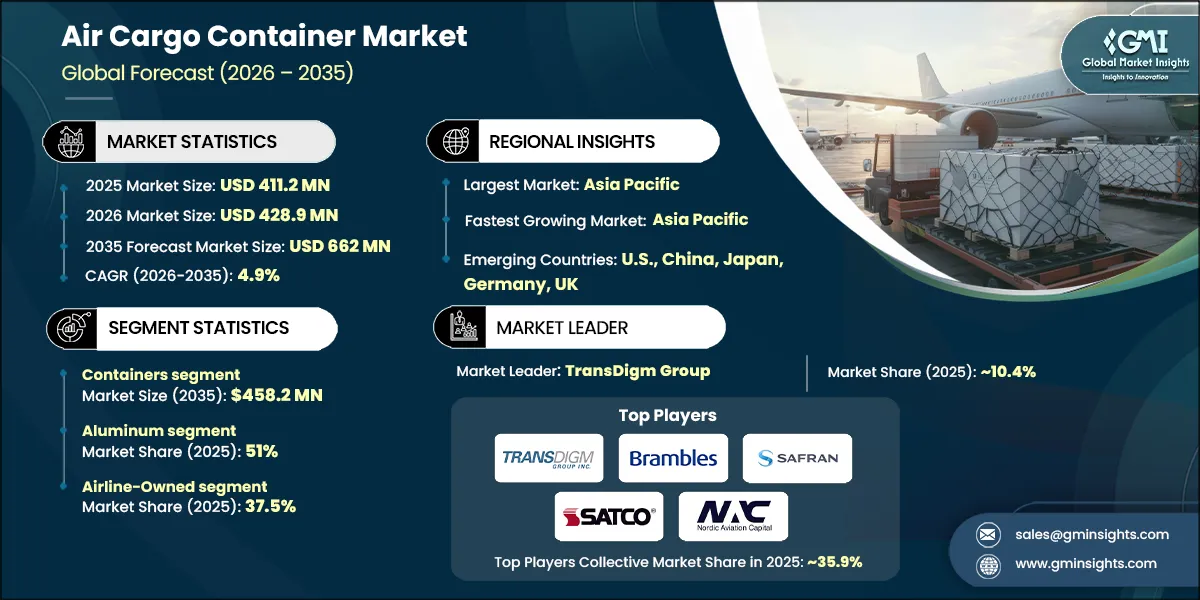
The global air cargo container market was valued at USD 411.2 million in 2025. The market is expected to grow from USD 428.9 million in 2026 to USD 662 million in 2035, at a CAGR of 4.9% during the forecast period according to the latest report published by Global Market Insights Inc.
Air Cargo Container Market Key Takeaways
Market Size & Growth
- 2025 Market Size: USD 411.2 Million
- 2026 Market Size: USD 428.9 Million
- 2035 Forecast Market Size: USD 662 Million
- CAGR (2026–2035): 4.9%
Regional Dominance
- Largest Market: Asia Pacific
- Fastest Growing Region: Asia Pacific
Key Market Drivers
- Growth in international trade and cargo flights.
- Expansion of airline fleets & new routes.
- Technological advancements in ULDs.
- Expansion of e-commerce & express delivery.
- Growing demand for lightweight and fuel-efficient ULDs.
Challenges
- High capital investment and maintenance costs.
- Complicated supply chain management for ULDs.
Opportunity
- Use of lightweight and high-strength container materials.
- Expansion of cold-chain air cargo services.
Key Players
- Market Leader: TransDigm Group led with over 10.4% market share in 2025.
- Leading Players: Top 5 players in this market include TransDigm Group, Brambles, Safran, Satco Products, NORDIC AVIATION, which collectively held a market share of 35.9% in 2025.
Get Market Insights & Growth Opportunities
The market for air cargo containers is expanding, owing to the growth driven by the Material Revolution in ULD construction, characterized by the shift from traditional aluminum containers to lightweight composite and hybrid materials. Hence, the transition enhances operational efficiency by reducing container weight, thereby decreasing aircraft fuel consumption and increasing payload capacity. Composites also offer superior durability and corrosion resistance, enabling longer lifecycle performance and reduced maintenance costs. Airlines and logistics providers are increasingly adopting these advanced materials to improve sustainability and operational economics in response to rising fuel prices and carbon emission regulations.
The air cargo container market serves as a critical component of the air freight ecosystem, providing standardized containers and pallets that facilitate efficient loading, unloading, and cargo handling across commercial and cargo aircraft. The market encompasses the manufacturing, sale, and leasing containers, including standard, temperature-controlled, and specialized units, as well as pallets utilized by airlines, freight forwarders, and logistics operators. With an estimated 1 million ULDs in operation worldwide according to IATA, the market is witnessing steady growth driven by expanding global trade, rising e-commerce volumes, and increasing demand for rapid, reliable air cargo services.
Another key factor in reshaping the market is the proliferation of digital ULD technologies. Integration of IoT sensors, RFID tags, and GPS tracking enables real-time monitoring of container location, temperature, and security status. These technologies enhance supply chain visibility, optimize asset utilization, and minimize loss or damage, particularly for high-value or temperature-sensitive shipments such as pharmaceuticals, perishables, and biotech cargo. Airlines and logistics operators leveraging digital ULD solutions are better equipped to manage pooled, leased, or airline-owned containers efficiently across global networks.
Furthermore, the air cargo container market is poised for further expansion driven by continued innovation in lightweight materials, digitally connected containers, and increasing demand for temperature-controlled and specialized logistics solutions. The convergence of material advancements and digital technologies is creating new opportunities for ULD manufacturers and service providers to offer higher-value, performance-oriented solutions while addressing the evolving needs of global air cargo operations.
To get key market trends
Air Cargo Container Market Trends
- The air cargo container market is undergoing a significant material transformation, with composite containers increasingly replacing traditional aluminum units. Composites offer lighter weight and enhanced durability, enabling airlines to improve fuel efficiency and operational performance while aligning with sustainability initiatives and carbon reduction goals.
- The rise of composites and aluminum containers continue to play a role in airline fleets. However, ongoing modernization programs and the push for lightweight, energy-efficient solutions are gradually reducing aluminum’s prominence, reflecting a broader industry trend toward innovative, high-performance container materials.
- The integration of IoT and sensor technologies into air cargo containers is transforming asset management. Digital ULDs enable real-time tracking of location, temperature, and handling conditions, improving container utilization, reducing losses, and enhancing security, particularly for high-value shipments in complex global logistics networks.
- Airlines and ULD operators are increasingly leveraging digital container technologies to optimize fleet management. Smart containers provide actionable insights that enhance efficiency, reduce operational risks, and streamline logistics processes, supporting a shift toward predictive, technology-driven supply chain operations in air cargo.
- The growth of temperature-sensitive cargo is driving demand for specialized cold-chain containers. Pharmaceuticals, biologics, and perishable goods require reliable, temperature-controlled solutions, prompting airlines and logistics providers to invest in high-value ULDs that ensure safe transport while supporting the expansion of healthcare and life sciences air cargo operations.
Air Cargo Container Market Analysis
Learn more about the key segments shaping this market
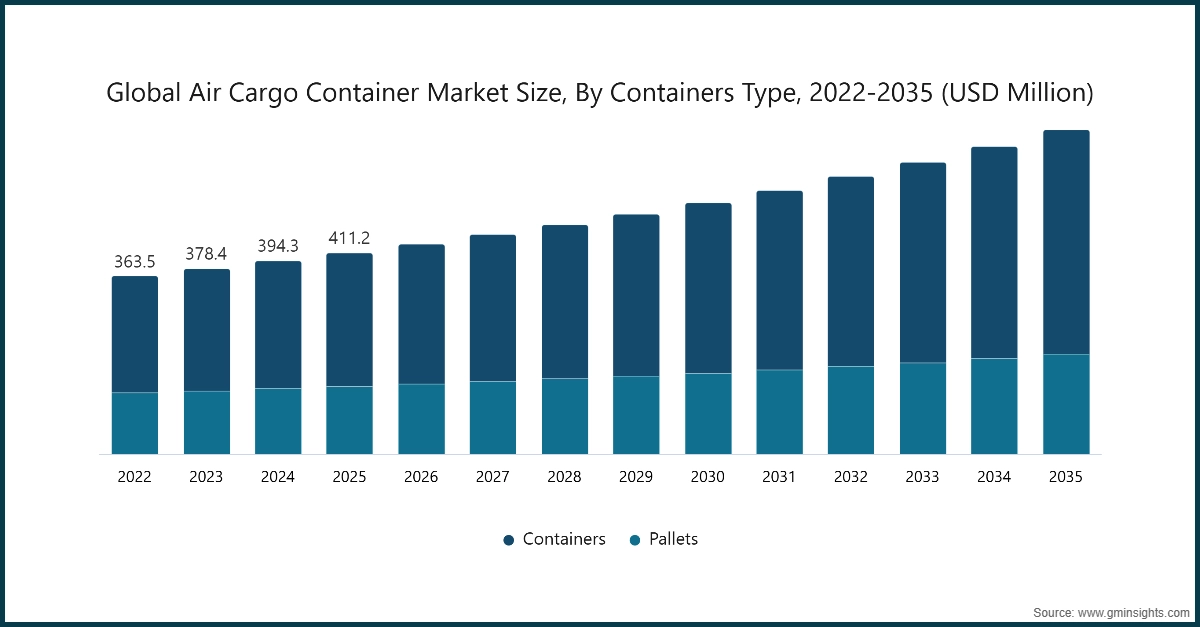
On the basis of containers type, the market is segmented into containers and pallets.
- The containers segment is anticipated to reach USD 458.2 million by 2035. The segment is driven by the need for secure, standardized units that protect sensitive goods, optimize cargo space, support temperature-controlled shipments, and improve operational efficiency across global air freight networks. Air cargo containers are rigid, standardized units designed for efficient loading, unloading, and secure transport of goods across aircraft. They include standard, temperature-controlled, and specialized containers, enabling airlines and logistics providers to optimize cargo space, protect sensitive shipments, and improve operational efficiency. Containers form the backbone of air freight operations globally, supporting high-value and high-volume cargo transport.
- The pallets segment was valued at USD 137.9 million in 2025 and is anticipated to grow at a CAGR of 4% over the forecast period. It is driven by bulk shipment efficiency, faster loading and unloading, reduced handling costs, and versatility in transporting high-volume or irregular-shaped cargo, supporting cost-effective and streamlined air freight operations. Air cargo pallets are flat platforms used to consolidate and transport bulk shipments efficiently. Standardized for aircraft compatibility, they allow rapid loading and unloading while minimizing cargo handling time. Pallets are widely used for bulk commodities, industrial goods, and e-commerce parcels, enhancing supply chain efficiency and ensuring safe, organized, and cost-effective air cargo operations.
On the basis of material, the air cargo container market is divided into Aluminum, Composite, Plastic / Thermoplastic, and Hybrid / Mixed-Material.
- The aluminum segment held a market share of 51% in 2025 due to their cost-effectiveness, proven durability, and widespread regulatory acceptance. Airlines favor aluminum ULDs for their established performance, ease of repair, and lower upfront investment compared to advanced materials. The extensive installed base, compatibility with existing fleets, and suitability for high-utilization routes drive continued demand, particularly among cost-sensitive carriers, regional airlines, and operators prioritizing standardized, easily maintainable cargo equipment.
- The composite segment is anticipated to grow at a CAGR of 6.1% during the forecast period 2026 – 2035, driven by airline focus on fuel efficiency, sustainability mandates, and fleet optimization. Lightweight composite materials reduce aircraft weight, enabling fuel savings, higher payload capacity, and lower emissions. Despite higher initial costs, long-term operational savings and improved lifecycle performance accelerate adoption. Growing regulatory pressure for carbon reduction and increasing use in premium, temperature-controlled, and high-value cargo segments further drive demand for composite ULDs.
 Learn more about the key segments shaping this market
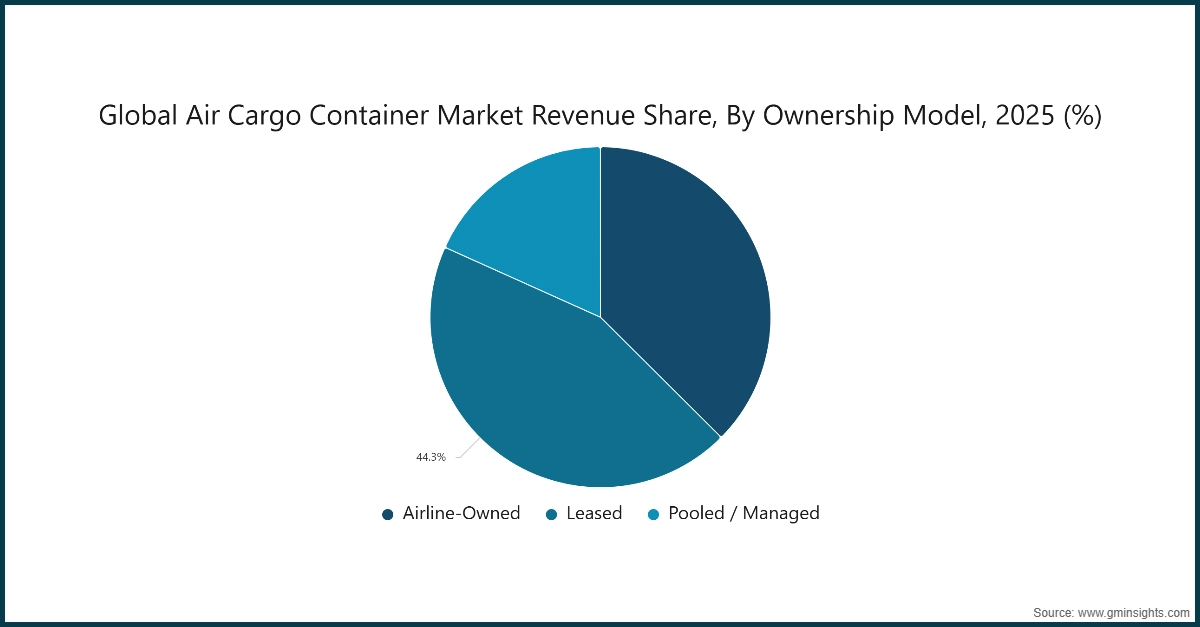
On the basis of Ownership Model, the air cargo container market is divided into Airline-Owned, Leased, and Pooled / Managed.
- The Airline-Owned segment held a market share of 37.5% in 2025. Airline-owned air cargo containers remain widely used due to greater operational control, long-term cost efficiency, and asset availability assurance. Airlines with stable cargo volumes prefer ownership to avoid recurring lease costs and ensure container compatibility across their fleets. This model is driven by established cargo carriers, large airlines with dedicated freight operations, and operators prioritizing customization, predictable utilization, and direct control over maintenance, scheduling, and deployment across core routes.
- The Leased segment is anticipated to grow at a CAGR of 6.2% during the forecast period 2026 - 2035. Leased air cargo containers are driven by capital expenditure reduction, operational flexibility, and scalability. Airlines increasingly adopt leasing models to avoid high upfront investment and to align container availability with fluctuating cargo demand. Leasing enables rapid fleet expansion, access to modern and digitally enabled ULDs, and outsourced maintenance support. This model is particularly attractive to low-cost carriers, seasonal operators, and airlines undergoing fleet modernization or network expansion.
North America Air Cargo Container Market
Looking for region specific data?
The North America air cargo container market size accounted for 23.5% of the revenue share in 2025.
- North America remains a mature and high-intensity market, supported by strong e-commerce fulfillment activity and the continued expansion of express integrator fleets operated by FedEx, UPS, and DHL. High shipment velocity, short delivery windows, and hub-and-spoke distribution models are driving sustained demand for containers and pallets. Additionally, major cargo carriers are actively modernizing aging ULD fleets to improve fuel efficiency, asset utilization, and compliance with evolving operational standards.
- While the region faces near-term headwinds from potential trade policy shifts and regulatory uncertainty in 2026, long-term market fundamentals remain robust. North America benefits from well-established logistics infrastructure, high air freight penetration, and strong demand from e-commerce, pharmaceuticals, and high-value manufacturing sectors. According to FAA industry data, the region’s high air cargo intensity supports consistent container replacement and upgrade cycles, positioning the market for stable, long-term growth despite short-term volatility.
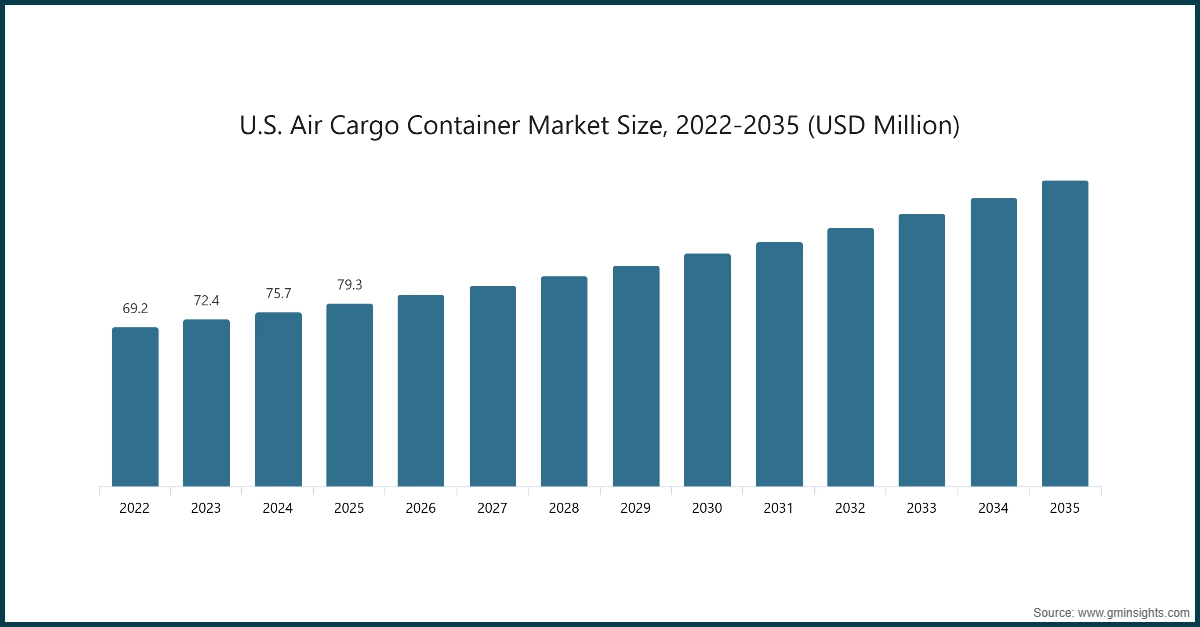
The U.S. air cargo container market was valued at USD 69.2 million and USD 72.4 million in 2022 and 2023, respectively. The market size reached USD 79.3 million in 2025, growing from USD 75.7 million in 2024.
- The United States leads global e-commerce and express delivery operations, with integrators such as FedEx and UPS operating extensive freighter fleets. High shipment velocity, short delivery cycles, and hub-centric logistics models drive continuous demand for air cargo containers with high utilization and rapid turnaround requirements.
- U.S. airlines are increasingly modernizing aging cargo fleets and associated ULD assets to improve fuel efficiency, regulatory compliance, and operational reliability. Replacement of legacy aluminum containers with lightweight and digitally enabled ULDs is supporting sustained equipment demand across domestic and international air cargo routes.
Europe Air Cargo Container Market
Europe air cargo container industry accounted for USD 91.3 million in 2025 and is anticipated to show lucrative growth over the forecast period.
- Europe represents a sustainability-driven air cargo container industry, shaped by stringent environmental regulations and emissions reduction mandates under European Union Aviation Safety Agency (EASA) guidelines. Airlines across the region are actively aligning cargo operations with broader EU climate objectives, prioritizing fuel efficiency and carbon reduction. This regulatory environment is accelerating demand for lightweight air cargo containers, particularly composite ULDs, as carriers seek measurable reductions in aircraft operating weight and emissions.
- European carriers are increasingly investing in premium, next-generation ULD solutions to support fleet modernization and compliance with evolving sustainability standards. The accelerated adoption of composite and digitally enabled containers is creating higher-value demand compared to global averages. Strong intra-European trade flows, advanced airport infrastructure, and the region’s leadership in green aviation initiatives further support above-average market growth, positioning Europe as a key innovation hub within the market.
- Germany dominates the Europe market, showcasing strong growth potential. In Germany, the air cargo container market is witnessing steady growth driven by the country’s strong export-oriented economy, high-value manufacturing shipments, and expanding pharmaceutical logistics sector.
- The presence of major air cargo hubs, advanced logistics infrastructure, and airline focus on lightweight, sustainable ULD solutions is further supporting demand for modernized air cargo containers across domestic and international trade routes.
Asia Pacific Air Cargo Container Market
The Asia Pacific air cargo container industry is anticipated to hold dominant share of 36.4% in 2025 and is expected to grow at the highest CAGR of 5.5 % during the forecast period.
- The Asia Pacific air cargo container industry is experiencing rapid growth due Asia-Pacific represents the fastest-growing regional market for air cargo containers, supported by strong manufacturing output, expanding trade flows, and rising air freight penetration. The region’s leadership is anchored in China’s export-driven manufacturing base, India’s rapid economic growth, and Southeast Asia’s increasing role as a global e-commerce and fulfillment hub. High shipment volumes across electronics, automotive components, and consumer goods are driving sustained demand for standardized containers and pallets across regional and international cargo routes.
China air cargo container market is estimated to grow with a CAGR of 6.2%, in the Asia Pacific market.
- China remains a key growth engine within Asia-Pacific, supported by extensive dedicated freighter operations and strong outbound export activity. The country’s dominance in electronics and industrial goods manufacturing drives high ULD utilization rates and frequent replacement cycles.
- Meanwhile, India and Southeast Asian economies are witnessing rising investments in airport infrastructure, logistics modernization, and cross-border e-commerce, further strengthening container demand. These structural factors position Asia-Pacific for above-average long-term growth within the market.
Latin American Air Cargo Container Market
The Latin America market, valued at USD 20 million in 2025. Latin America represents an emerging growth market for air cargo containers, supported by expanding trade activity, rising e-commerce penetration, and increasing integration with North American and global supply chains.
- The region’s air cargo demand is driven by exports of perishables, pharmaceuticals, automotive components, and high-value manufactured goods. Improving airport infrastructure, expanding freighter capacity, and growing reliance on air transport for time-sensitive shipments are strengthening container utilization across major regional hubs.
- Brazil and Mexico act as primary growth anchors, supported by strong industrial output, cross-border trade, and growing express logistics networks. Mexico’s role as a near-shoring destination for North American manufacturing and Brazil’s expanding agribusiness and pharmaceutical exports are increasing demand for standardized and temperature-controlled ULDs. While infrastructure and cost challenges remain, continued investments in logistics modernization and e-commerce fulfilment position Latin America for sustained, above-average long-term growth in the market.
Middle East and Africa Air Cargo Container Market
UAE air cargo container industry to experience substantial growth in the Middle East and Africa market in 2025.
- The Middle East & Africa air cargo container industry is driven by the region’s role as a global air freight transit hub and expanding international trade connectivity. Middle Eastern carriers leverage strategic geographic positioning, advanced airport infrastructure, and growing dedicated freighter fleets to support high-volume transshipment cargo.
- In Africa, rising pharmaceutical distribution, perishables exports, and improving logistics infrastructure are increasing air cargo activity. Together, these factors are driving steady demand for standardized, temperature-controlled, and lightweight ULDs across regional and intercontinental routes.
Air Cargo Container Market Share
- The air cargo container industry is moderately consolidated, led by established manufacturers such as TransDigm Group, Brambles, Safran, Satco Products, and NORDIC AVIATION, which together account for a significant 35.9% share of global demand. These companies benefit from strong relationships with airlines and cargo operators, global leasing and distribution networks, and broad portfolios covering standard, temperature-controlled, and specialized unit load devices (ULDs). Continuous investments in lightweight materials, advanced insulation, digital tracking, and regulatory compliance enable them to meet strict aviation safety standards and support pharmaceutical, perishables, and high-value cargo transport.
- Despite the presence of major players, the market remains partially fragmented, with regional manufacturers and niche suppliers catering to specific aircraft types, routes, or cargo requirements. Smaller players compete through cost-effective containers, customized designs, flexible leasing models, and localized support. This competitive landscape drives innovation in durability, weight reduction, and smart container technologies, allowing both premium and value-focused air cargo container solutions to coexist and support steady global market growth.
Air Cargo Container Market Companies
Prominent players operating in the air cargo container industry are as mentioned below:
- TransDigm Group
- Brambles
- Safran
- ACL Airshop
- DoKaSch GmbH
- Envirotainer AB
- CSafe
- Satco Inc.
- PalNet GmbH
- VRR Aviation
- Nordisk Aviation
- aerotuf
TransDigm Group is a well-established supplier in the air cargo container market, holding an estimated share of ~10.4%. The company offers highly reliable and durable cargo container components and systems used in both commercial and defense aviation. Strong investments in R&D, proprietary designs, and long-term airline and OEM relationships strengthen its competitive position across passenger, freight, and military air transport applications.
Brambles is a leading provider in the air cargo container and logistics market, holding an estimated share of ~9.1%. The company specializes in reusable pallets, crates, and containers through its CHEP pooling system, enhancing supply chain efficiency and reducing operational costs. Strong investments in digital tracking, asset management solutions, and global logistics networks reinforce Brambles’ competitive position across retail, consumer goods, and industrial air freight operations.
Safran is a key player in the air cargo container market, offering advanced unit load devices and cargo handling solutions through its aerospace portfolio. Backed by strong R&D, global manufacturing capabilities, and deep airline partnerships, Safran delivers lightweight, high-performance, and scalable container solutions that improve fuel efficiency, cargo safety, and operational reliability for commercial and defense aviation customers.
Air Cargo Container Market Report Attributes
| Key Takeaway | Details |
|---|---|
| Market Size & Growth | |
| Base Year | 2025 |
| Market Size in 2025 | USD 411.2 Million |
| Market Size in 2026 | USD 428.9 Million |
| Forecast Period 2026-2035 CAGR | 4.9% |
| Market Size in 2035 | USD 662 Million |
| Key Market Trends | |
| Drivers | Impact |
| Growth in international trade and cargo flights | Rising global trade volumes and expanding air cargo flight operations are fueling demand for air cargo containers and pallets. Increased import-export activities, particularly between Asia, North America, and Europe, necessitate higher container availability to optimize aircraft cargo utilization. Airlines and freight operators are adding capacity and fleet rotations to meet surging demand, driving sustained ULD adoption. This structural growth in international air freight contributes significantly to market expansion and supports the long-term increase in container utilization worldwide. |
| Expansion of airline fleets & new routes | The growth of global airline fleets and launch of new cargo and passenger routes is increasing demand for air cargo containers. Each new freighter aircraft requires ~15-25 ULDs for operational deployment, creating immediate equipment demand. Expanded operations require additional ULDs to optimize aircraft payload utilization and support rising freight volumes. |
| Technological advancements in ULDs | Integration of IoT, RFID, and GPS tracking in air cargo containers enables real-time monitoring of location, temperature, and security. These advancements enhance supply chain visibility, optimize container utilization, and reduce losses, driving adoption across airlines and logistics operators. |
| Expansion of e-commerce & express delivery | The cross-border e-commerce, growing ~12–15% annually, is driving robust demand for air cargo containers. E-commerce shipments require specialized handling and higher container turnover, while express integrators like FedEx, UPS, and DHL operate dedicated ULD fleets with increased utilization. The shift from passenger belly-hold cargo to freighter operations further elevates ULD intensity per ton, with e-commerce parcels needing 10–15% more container capacity than traditional cargo, contributing approximately ~2.2% to the market’s overall growth. |
| Growing demand for lightweight and fuel-efficient ULDs | Regulatory pressures and sustainability mandates are accelerating adoption of lightweight ULDs, particularly composite containers. Airlines pursuing IATA’s net-zero 2050 goal benefit from reduced aircraft weight, achieving fuel savings of $200–500 per ULD annually. Despite a ~15–25% price premium, composites deliver rapid ROI, driving market growth and contributing approximately ~1.5% to the overall growth. |
| Pitfalls & Challenges | Impact |
| High capital investment and maintenance costs | The air cargo container market faces significant capital intensity challenges, as premium composite and digitally-enabled ULDs cost ~50–100% more than traditional aluminum units. For mid-size airlines, full fleet replacement can require USD 1.5–2.5 million upfront, delaying modernization. Competing investment priorities and budget constraints are expected to reduce market growth by approximately 0.8% annually. |
| Complicated supply chain management for ULDs | The air cargo container market faces complex supply chain challenges, such as managing airline-owned, leased, and pooled ULDs across global networks require precise tracking, coordination, and timely maintenance. Inefficient container utilization, mismatched rotations, and regional logistical bottlenecks can delay operations and increase costs, acting as a key restraint that slows adoption and constrains overall market growth potential. |
| Opportunities: | Impact |
| Use of lightweight and high-strength container materials | The adoption of lightweight and high-strength materials, including composites and hybrid constructions, is creating significant opportunities in the air cargo container market. These advanced materials reduce aircraft fuel consumption, increase payload capacity, and extend container lifecycle. Airlines investing in such ULDs can achieve operational efficiencies while supporting sustainability goals, making this a key growth driver for container manufacturers. |
| Expansion of cold-chain air cargo services | The growth of cold-chain air cargo services for pharmaceuticals, vaccines, perishables, and biotech products is boosting demand for specialized temperature-controlled containers. As global healthcare and perishable logistics expand, airlines and logistics providers require reliable ULDs capable of maintaining strict temperature ranges, offering premium pricing potential and long-term market growth in the high-value, temperature-sensitive segment. |
| Market Leaders (2025) | |
| Market Leader |
~10.4% Market Share |
| Top Players |
Collective Market Share is ~35.9% |
| Competitive Edge |
|
| Regional Insights | |
| Largest Market | Asia Pacific |
| Fastest growing market | Asia Pacific |
| Emerging countries | U.S., China, Japan, Germany, UK |
| Future outlook |
|
What are the growth opportunities in this market?
Air Cargo Container Industry News
- In April 2025, Air Transat and Unilode Aviation Solutions extended their ULD management partnership until 2026. Unilode will continue to provide, digitalize, and maintain lightweight containers and pallets, supporting Air Transat’s fleet growth, schedule flexibility, cost efficiency, and sustainability efforts, while enabling the airline to focus on passenger operations and network expansion.
- In September 2022, Sonoco ThermoSafe expands its Pegasus ULD fleet, offering advanced passive temperature-controlled containers for global pharmaceutical shipments. Certified for aircraft lower decks, Pegasus ULDs reduce handling, customs delays, and costs. Available through partner airlines and service stations with FAA 145-certified MRO and preconditioning facilities, they ensure safe, efficient, on-time, and on-temperature transport.
- In September 2022, Unilode Aviation Solutions extended its ULD management partnership with Saudia Cargo until 2028. The agreement covers 21,000 containers and pallets across 90 wide-body aircraft. Unilode will continue providing lightweight, fuel-efficient units, including upgraded solid-door and AKE containers, supporting operational efficiency, cost savings, and sustainability initiatives.
The air cargo container market research report includes in-depth coverage of the industry with estimates and forecast in terms of revenue in USD Million from 2022 – 2035 for the following segments:
Market, By Containers Type
- Containers
- Standard containers
- Refrigerated/Insulated containers
- Specialized containers
- Pallets
- Standard pallets
- Specialized pallets
Market, By Material
- Aluminum
- Composite
- Plastic / Thermoplastic
- Hybrid / Mixed-material
Market, By Ownership Model
- Airline-owned
- Leased
- Pooled / Managed
The above information is provided for the following regions and countries:
- North America
- U.S.
- Canada
- Europe
- Germany
- UK
- France
- Spain
- Italy
- Netherlands
- Asia Pacific
- China
- India
- Japan
- Australia
- South Korea
- Latin America
- Brazil
- Mexico
- Argentina
- Middle East and Africa
- South Africa
- Saudi Arabia
- UAE
Frequently Asked Question(FAQ) :
What was the market size of the air cargo container in 2025?
The market size was valued at USD 411.2 million in 2025, growing at a CAGR of 4.9% till 2035. The market is driven by advancements in lightweight composite materials and increasing demand for operational efficiency in air freight.
What is the projected value of the air cargo container market by 2035?
The market is poised to reach USD 662 million by 2035, led the forecast period, fueled by the adoption of advanced materials and digital technologies.
What is the expected size of the air cargo container industry in 2026?
The market size is expected to reach USD 428.9 million in 2026.
What was the market share of the Airline-Owned segment in 2025?
The Airline-Owned segment held a 37.5% market share in 2025, attributed to its operational control, cost efficiency, and asset availability benefits.
What was the valuation of the North America air cargo container sector in 2025?
North America accounted for 23.5% of the market in 2025, supported by strong e-commerce activity and the expansion of express integrator fleets.
What are the upcoming trends in the air cargo container market?
Adoption of lightweight composites, IoT-enabled sensor integration, rising temperature-sensitive cargo demand, and digital ULDs for real-time tracking and predictive supply chains.
Who are the key players in the air cargo container industry?
Key players include TransDigm Group, Brambles, Safran, ACL Airshop, DoKaSch GmbH, Envirotainer AB, CSafe, Satco Inc., PalNet GmbH, and VRR Aviation.
Air Cargo Container Market Scope
Related Reports