Summary
Table of Content

AI Watermarking Market
Get a free sample of this report
Form submitted successfully!
Error submitting form. Please try again.
Thank you!
Your inquiry has been received. Our team will reach out to you with the required details via email. To ensure that you don't miss their response, kindly remember to check your spam folder as well!
Request Sectional Data
Thank you!
Your inquiry has been received. Our team will reach out to you with the required details via email. To ensure that you don't miss their response, kindly remember to check your spam folder as well!
Form submitted successfully!
Error submitting form. Please try again.
AI Watermarking Market Size
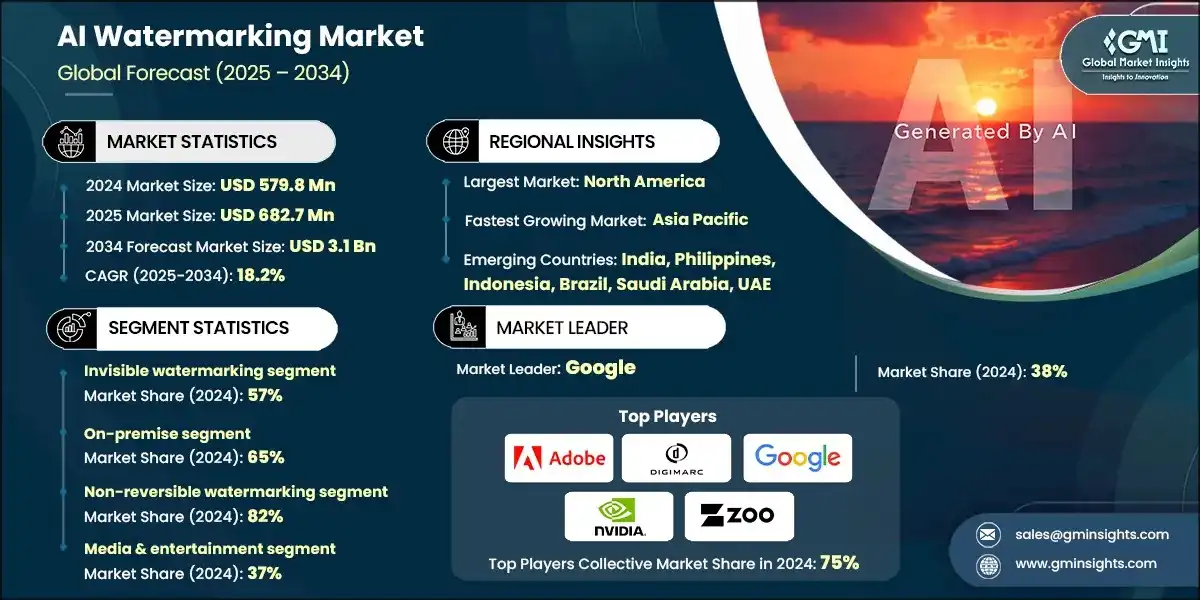
The global AI watermarking market was estimated at USD 579.8 million in 2024. The market is expected to grow from USD 682.7 million in 2025 to USD 3.1 billion in 2034, at a CAGR of 18.2%, according to latest report published by Global Market Insights Inc.
AI Watermarking Market Key Takeaways
Market Size & Growth
- 2024 Market Size: USD 579.8 Million
- 2025 Market Size: USD 682.7 Million
- 2034 Forecast Market Size: USD 3.1 Billion
- CAGR (2025–2034): 18.2%
Key Market Drivers
- Rising Deepfake & AI-Generated Content Threats.
- Regulatory Pressure for Content Authentication.
- Rise in consumer demand for content verification.
- Increase in AI model integration.
Challenges
- Technical Implementation Complexity.
- High Development & Integration Costs.
Opportunity
- Increase in compliance requirements.
- Rise in consumer awareness.
- Surge in cross-industry collaborations.
Key Players
- Market Leader: Google led with over 38% market share in 2024.
- Leading Players: Top 5 players in this market include Adobe, Digimarc Corporation, Google, NVIDIA Corporation, ZOO Digital Group, which collectively held a market share of 75% in 2024.
Get Market Insights & Growth Opportunities
The increasing use of generative AI, large language models, and synthetic media has increased the urgency to use watermarking on AI. The expansion is led by hyper scale integration, compliance of the enterprise and content authenticity programs. Watermarking provides traceability, tamper-resistance, and regulatory compliance over digital systems.
In October 2024, Google DeepMind, Adobe, and AWS released Synthetic image and text updates, Content Credentials, and watermarking on Amazon Bedrock Titan models, respectively. OpenAI, Microsoft, and other vendors also launched provenance APIs, which guarantee enterprises and creators access to secure watermarking services that are AI-ready.
A variety of potential regulatory measures, including the EU AI Act or US state-level bills are pushing businesses toward the use of watermarking to verify content authenticity. Standards such as C2PA and provenance metadata provide interoperability, lessening the chances of false information and establishing confidence in digital chains of supply.
The COVID-19 pandemic stimulated the remote workflow, the cloud-native content production, as well as the distribution of digital media. This changed the need to use watermarking and provenance technology to ensure the authenticity of news, education, and enterprise collaboration platforms as well as an uptake in the use of SaaS-based watermarking APIs.
The proliferation of deepfakes, large-volume models of generative AI and multimodal content (text, image, video, audio) drives the need to operate with a high-performance watermarking engine. Companies and platforms are investing in greater visibility, Metadata-based and model embedded watermarks that facilitate real time searching, interoperability, and adherence to transparency standards.
The AI watermarking market is controlled by North America with hyperscale expansions by AWS, Google, Microsoft and Adobe and good regulatory support. Existing solutions, such as Digimarc, Arista, and OpenAI partnerships, promote scalable, watermarking-protected, and cyber-secure watermarking in industries.
Asia-Pacific is the fastest-growing region, and China, India, and Japan invest in AI watermarking as a part of Digital India Mission, Society 5.0, and the Chinese programs of data authenticity. The rapid adoption of AI watermarking technologies is caused by heavy advancement in generative AI usage, city smart programs, and content platforms.
To get key market trends
AI Watermarking Market Trends
- AI watermarking is also becoming more popular to verify the authenticity of AI-generated content, curb it, and keep a check on its transparency. Advanced watermarking is a part of generative models, which offers invisible identifiers, increases trust, reduces risks of misinformation, and helps protect copyright. Provenance systems automate verification procedures, enhance cybersecurity, and provide an opportunity to monitor tampering in real-time, which guarantees safe and cost-efficient digital processes.
- For example, in June 2025 the government of South Korea required AI content labeling, with visible and invisible watermarks on synthetic media. The law, which will come into effect in January 2026, should prevent misinformation and deepfakes and requires businesses to implement effective watermarking and provenance solutions to be compliant with the regulation.
- AI watermarking systems are becoming cloud-powered, API-based, and loosely coupled and can be effortlessly incorporated into CMS, social platforms, and organizational IT workflows. Modular architecture provides scalability, scalable deployment and interoperability with such standards as C2PA. This allows platforms and hyperscale operators to dynamically scale capacity, observe authenticity in real-time, and enable high-throughput AI content delivery with less downtime and enhanced compliance nimbleness.
- AI content provenance and digital twins are helping organizations to recreate detection conditions, check authenticity in a wide range of conditions, and forecast the vulnerability to tampering. Centralized management platforms provide full visibility, remote control and forensic reporting, which cut down the operation costs and minimize the risks of misinformation. These systems can be used to boost decision-making by enabling creators, enterprises, and regulators to have credible records of AI-generated property that can be verified.
AI Watermarking Market Analysis
Learn more about the key segments shaping this market
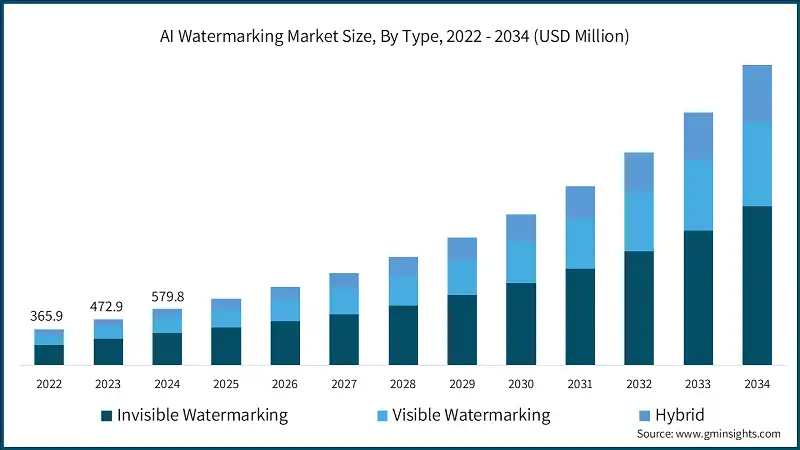
Based on type, the market is divided into invisible watermarking, visible watermarking, and hybrid. The invisible watermarking segment dominated the AI watermarking market, accounting for around 57% in 2024 and is expected to grow at a CAGR of over 17% through 2034.
- The AI watermarking industry is dominated by the invisible watermarking segment because it provides robust protection without affecting the visual or perceptual quality of the generated content. Invisible watermarks are embedded directly into text, images, audio, or video outputs at the algorithmic or model-generation level, making them resistant to simple editing, cropping, or compression. Since they are not noticeable to the human eye or ear, creators, enterprises, and regulators can ensure authenticity without disrupting user experience or content aesthetics.
- In April 2025, adobe extended its Content Credentials system including invisible watermarking. The update enables creators to add new tamper-resistant metadata to digital assets without visual modification, providing enterprises with a trusted compliance mechanism of authenticity and copyright in pipeline content of large-scale AI.
- Furthermore, invisible watermarking is very scalable and compliant with regulations in such frameworks as the EU AI Act and C2PA. It allows forensic verification, anti-tampering and copyright protection, which are becoming more vital to publishers, cloud providers and hyperscale operators who use generative AI models.
- The hybrid segment within the AI watermarking market is expected to experience a CAGR of more than 20% because it combines the benefits of the invisible and visible watermarking. It provides transparency on the user-side, as well as tamper-proof authentication on the back end, and is thus very suitable in one that is driven by compliance, government policies, and in environments that need a balance between trust, usability, and forensic reliability.
Learn more about the key segments shaping this market
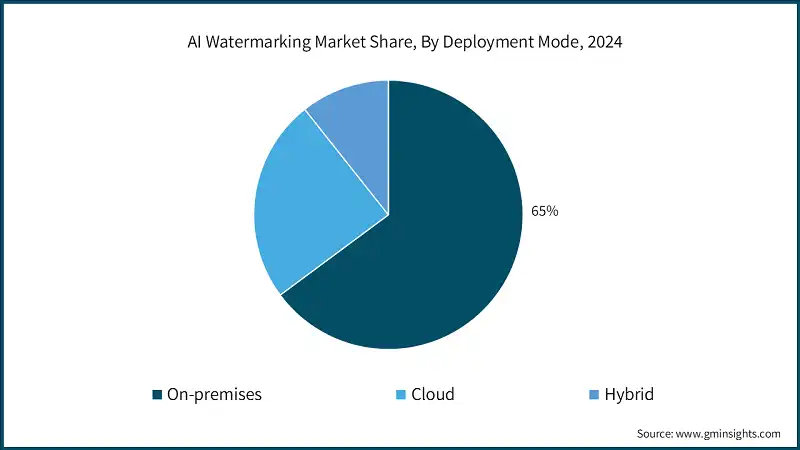
Based on deployment mode, the market is segmented into on-premises, cloud, and hybrid. The on-premise segment dominates the market accounting for around 65% share in 2024 and is expected to grow at a CAGR of over 17.5% from 2025-2034.
- The on-premise segment has the highest portion of AI watermarking market since financial institutions, government agencies, defense agencies, and other entities with sensitive data would like to use in-house deployment due to their desire to have a greater level of control and security. Watermarking on premises prevents any exposure of confidential data or AI generated material to outside attack or even third-party data breach. This model facilitates adherence to internal IT policy, as well as data protection policies in the region.
- On-premise solutions are more customizable and integrable, as well, than cloud-only. Companies can adapt the watermarking processes to their current systems and implement their own security systems and have a quick-detecting ability. These are the benefits that on-premise watermarking represents an attractive option to companies concerned with controlling data, authentication, and protecting content.
- For example, in February 2025, EchoMark introduced enterprise-grade forensic watermarking APIs, which have full on-premise deployment options. Big banks embraced the system to secure sensitive reports so that local processing is used instead of passing confidential information to external cloud servers.
- The hybrid will grow by over 21% at the CAGR in the AI watermarking market because it will be able to provide the benefits of on-premise deployment with the scalability and flexibility of cloud services. Hybrid models enable firms to handle sensitive data on-premises and scale AI content identification, provenance confirmation, and compliance controls on cloud resources. Such a two-sided methodology will guarantee efficiency in its operations, compliance with regulations, and optimization of costs.
Based on technology, the market is segmented into reversible watermarking, non-reversible watermarking. Non-reversible watermarking segment is expected to dominate the market with around 82% share due to its high level of robustness and security. Unlike reversible methods, non-reversible watermarking permanently embeds identifiers into digital assets, making removal or alteration extremely difficult.
- Non-reversible watermarking is the top performer in the AI watermarking market since it is highly resistant to tampering, removal, and alteration. The watermarks are also permanently embedded on the content so that they cannot be altered even in case of changes such as compression, cuts, or format shift. Such dependability makes it suitable in those industries where security and trust are needed, namely government, defense, and financial services. It can also be used to track and authenticate content, and this may be beneficial in detecting modified or unauthorized AI generated content.
- Irreversible watermarking also helps companies that have regulation, including the EU AI Act, and new standards of digital security like C2PA. Companies, mass media, and scale operators use this technology to protect intellectual property and filter the sharing of content and reduce the risk of legal liability. As the popularity of deepfakes and synthetic media continues to grow, one can rely on this as a valid action that can be taken to have trust in digital content.
- For examples, in April 2024, AWS introduced permanent watermarking to Titan models on Amazon Bedrock, which enables businesses to stamp indelible marks on AI-generated outputs. This further improved compliance with the copyright laws and provided forensic grade traceability in the event of unauthorized usage or modification of synthetic material.
- The reversible watermarking segment is projected to have the highest CAGR of over 19% because it can be used to reconstruct original content without it being distorted. This is an important requirement of sensitive applications in healthcare, BFSI and government applications where data accuracy, integrity and precision cannot be compromised during authentication and verification.
Based on end use, the market is divided into BFSI, healthcare, media & entertainment, government & defense, retail & e-commerce, and others. The media & entertainment dominated the AI watermarking market with 37% share in 2024.
- The media & entertainment sector dominates in the AI watermarking industry since this sector is the leading sector to embrace the use of generative AI in the creation, distribution, and streaming of content. As AI-generated images, videos, music, and other engaging media rapidly grow, studios, publishers, and streaming sites are starting to incorporate watermarks as a means of copyright safeguarding and content authentication. Watermarking guarantees the rights of the creators, prevents piracy and assists viewers to differentiate between original and manipulated or deep fake content.
- In addition, watermarking has gained momentum in response to the increasing need for content safety in digital delivery and protection of brands in entertainment platforms. In both combination and hybrid watermarking, media companies are looking to apply compliance, attribution, and monetization methods. The sector remains at the top of market revenues, making it the largest end-use category as content consumption increases across OTT, gaming, and social platforms.
- For instance, in July 2025, the next-generation audio watermarking technology, which was unveiled by Digimarc, implants inaudible digital identifiers in audio. It allows checking authorship, detecting leaks and accurately recording royalty even in noisy and compressed clips as short as one second, safeguarding human and AI-generated output.
- Furthermore, the government & defense category will experience the fastest growth in the AI watermarking market due to the increasing risk of deepfakes, fake news, and computer attacks on national security and citizens. Watermarking is being embraced by governments around the world to secure both the integrity of official messages and the security of classified information as well as digital identities. Such solutions are useful in identifying its manipulated media to ensure that there is no misapplied synthetic content in sensitive fields such as defense tactics, military intelligence and election campaigns.
Looking for region specific data?
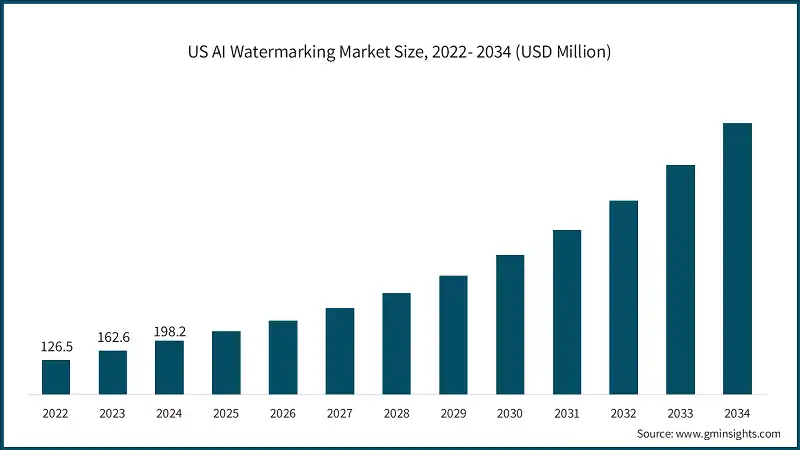
US dominated the AI watermarking market in North America with around 85% share and generated USD 198.2 million in revenue in 2024.
- The U.S. market is the largest in North America, driven by widespread adoption of generative AI, regulatory compliance initiatives, and enterprise demand for secure content authentication. The adoption of watermarking to safeguard intellectual property, prove provenance, and fight deepfakes is a highly expensive undertaking in large media houses, streaming platforms, and government agencies invest substantially. The ability to integrate with cloud-native environments and AI content monitoring tools will allow scaling to the needs of operations that have energy efficiency, though with high throughput and accuracy.
- Moreover, engagements with such prominent technology providers like Adobe, AWS, Google, and Digimarc are enhancing adoption. High-performance AI clusters, hybrid deployment frameworks, and enterprise grade forensic watermarking solutions can enable organizations to safely handle multi-cloud workflows, identify manipulated content in real-time, and ensure solid compliance both in the media, government, and corporate contexts.
- For example, in July 2025, Digimarc Corporation introduced its second-generation audio watermarking. The development is meant to resolve the issues of the evolving audio ecosystem so that the creators can be compensated rightly and the sensitive content can be strongly safeguarded in the era of the generative AI.
- Canada will become the most rapidly growing market in North America as more people implement generative AI in media, BFSI, and government, more groups invest in secure AI content verification, and the government promotes digital provenance and watermarking products to counter deepfakes and misinformation.
The AI watermarking market in Germany is expected is expected to grow at 16.2% CAGR between 2025 and 2034.
- Europe accounts for approximately 29% of the AI watermarking industry in 2025 and is projected to grow at a CAGR of over 17%. The growth is supported by the rising use of generative AI in the media, government, and corporate spheres and the regulatory practices that ensure content authenticity and copyright protection and transparency. The region is experiencing major investments in AI watermarking solutions of secure distribution of digital contents, brand protection and adherence of new AI content labeling standards.
- Germany is the leader in the European AI watermarking market because of the highly developed IT environment, digitalization projects, and emphasis on content security. Government initiatives of AI governance, digital provenance and media authentication speed up adoption. Businesses and media outlets are collaborating with vendors like Aleph Alpha, neuroflash, Adobe, and AWS to roll out scalable watermarking systems, and research centers are collaborating to innovate in forensic watermarking, deepfake detection and hybrid deployment models. This ecosystem makes Germany the main center of the development and implementation of AI watermarking technology in Europe.
- In July 2025, Germany announced a bold AI strategy to make 10 percent of its GDP be AI-driven by 2030. The strategy involves the construction of AI gigafactories, the growth of quantum computing, and the improvement of digital infrastructure, which will make Germany a leader in the field of AI and digital technologies.
- The UK has the strongest market growth rate in Europe, which is supported by the growing use of generative AI in media, government, and corporate applications, growing regulatory attention to the authenticity of content, collaborations with international watermarking providers, and investments in forensic watermarking, hybrid deployment strategies, and AI-based content verification systems.
The AI watermarking market in China is expected to experience significant and promising growth from 2025 to 2034.
- Asia-Pacific accounts for over 24% of the market in 2025 and is the fastest-growing region with a CAGR of more than 20%. The growth is driven by rapid adoption of generative AI in the media, government, and enterprise industries, heightened awareness of content authenticity and mass investment in the modernization of digital infrastructure in China, India, Japan, and Southeast Asia.
- China is the dominant player in the APAC market with widespread AI watermarking solution implementations in hyperscale cloud campuses, enterprise IT, and smart city projects. Huawei, Inspur, and ZTE are domestic firms that provide AI-based watermarking and content authentication services, which can be used to perform invisible, and hybrid watermarking in media to ensure content ownership and detect deepfakes. Government programs such as digital governance, safe use of AI and protection of intellectual property also further spur growth in the market.
- India is the most rapidly developing market in the region due to the Digital India and financing of AI-based media checking systems. Business and content platforms are moving towards hybrid and cloud-based watermarking technologies to protect AI-generated content, facilitating the use of copyright to ensure more trust in the digital media ecosystem.
- For instance, in December 2024, the IndiaAI Mission released its second round of Expression of Interest (EoI), soliciting Indian academic institutions, start-ups, R&D organizations and companies to offer tools and frameworks to assist in ethical and responsible AI.
The AI watermarking market in Brazil is expected to experience steady growth from 2025 to 2034.
- Latin America holds about 5% of the AI watermarking industry in 2025, expanding at a steady CAGR of around 19%. The expansion is also driven by the rising level of implementing generative AI within the media and entertainment sectors, as well as advertising, and the growing need to authenticate content in financial services and e-commerce. The rise of smart city initiatives, investment in 5G, and 5G-based digital transformation initiatives is driving the demand to implement AI-based watermarking technologies to protect authenticity and the legal aspects of copyright in the various industries.
- Brazil occupies the leading position in the regional AI watermarking market, which is characterized by a fast-evolving digital economy and one of the earliest adopters of AI-powered applications in the media, fintech, and e-commerce. Companies are deploying watermarking tools to check AI-created content, fight deepfakes, and safeguard intellectual property. The intensive state initiatives to achieve digital governance, combined with the investment of global technology providers in AI and cloud computing systems, reinforced the leadership of Brazil in the use of watermarking.
- The Mexican market is the most rapidly developing in Latin America, which is boosted by the adoption of cloud services, the expansion of digital banking, and the rapid development of online retail business. As the government is undertaking the modernization of the IT infrastructure, as well as investment in smart city projects, enterprises are progressively incorporating watermarking tools to verify the authenticity of digital assets, ensure consumer trust, and adhere to international regulations of AI-based content.
- In February 2024, Microsoft revealed USD 1.3 billion investment in Mexico across three years to grow its AI and cloud infrastructure, the largest investment it has made in the country to date. Watermarking solutions become more widespread based on AI governance and digital trust frameworks under the stimulation of such massive projects.
The AI watermarking market in UAE is expected to experience significant and promising growth from 2025 to 2034.
- The Middle East & Africa (MEA) account for approximately 2% of the overall AI watermarking business in 2025 and shows consistent growth due to fast decline of cloud technology, business digitalization, and IT ecosystem modernization. Governments in the region are also focusing on AI governance, content authenticity, and cybersecurity, which is fueling the adoption of AI watermarking in the protection of copyright, in deepfake detection and in brand protection. The development of 5G infrastructure, the development of e-commerce, and the presence of global technological companies in regional AI-ready data centers also mean that MEA is becoming a potential hub of watermarking solutions.
- UAE is the leading market in MEA AI watermarking, due to the state-initiated digital innovation strategies, the high rate of AI integration in financial services and government administration, and the vigorous growth of e-commerce. Watermarking is rapidly becoming a tool employed by enterprises to verify AI-created media, protect intellectual property and adhere to the international standards of content provenance. Large cloud providers by AWS, Microsoft, and Google have already released localized AI and watermarking-enabled solutions, enhancing the UAE as the leader in trusted AI ecosystems.
- Saudi Arabia will be the most rapidly growing economy in MEA due to ambitious Vision 2030 initiative and substantial investments in AI, cloud, and smart city initiatives. The digitization at a rapid pace of the healthcare sector, retail, and financial sectors is contributing to the use of watermarking technologies to guarantee sure, verifiable, and regulatory compliant AI materials. The collaboration with international watermarking providers and national research and development efforts are also boosting the scalability of watermarking solutions, turning Saudi Arabia into the most rapidly expanding market in the area.
- For examples, in October 2024, Saudi Public Investment Fund (PIF) and Google Cloud joined forces to establish a hotspot of AI in and around Dammam. The hub will assist the cloud infrastructure, generative AI models, and AI tools, which will form the basis of watermarking and verification technologies.
AI Watermarking Market Share
- The top 7 companies in the AI watermarking industry are Google, Adobe, Digimarc, NVIDIA, IMATAG, Verimatrix, and ZOO Digital, contributed around 79% of the market in 2024.
- Google focuses on embedding watermarking directly into its generative AI ecosystem, particularly through its DeepMind division. The company has introduced SynthID, a tool for invisibly watermarking AI-generated images, with plans to extend it to text and video. Google’s strategy centers on building trust in AI outputs, aligning with global content provenance standards, and partnering with regulators and platforms to counter misinformation and deepfake misuse.
- Adobe integrates watermarking into its Content Authenticity Initiative (CAI) and Content Credentials framework. The company embeds tamper-proof metadata and watermarks in outputs from Firefly (its generative AI suite). Adobe’s strategy emphasizes transparency, creator attribution, and industry-wide adoption by working with the Coalition for Content Provenance and Authenticity (C2PA). By embedding watermarking into creative workflows, Adobe seeks to balance AI creativity with copyright protection and ethical content distribution.
- Digimarc positions itself as a pioneer in digital watermarking with a deep patent portfolio. Its strategy targets brand protection, anti-counterfeiting, and copyright enforcement. The company offers invisible watermarking for images, packaging, and documents, often tied to authentication services. In the AI context, Digimarc collaborates with media, retail, and government clients to secure digital supply chains and protect intellectual property, making its services central to content provenance and anti-piracy initiatives.
- NVIDIA embeds watermarking capabilities into its AI inference and generative frameworks to safeguard synthetic media. Its strategy is to integrate watermarking into GPU-accelerated pipelines, ensuring that image and video outputs carry identifiers for authenticity checks. NVIDIA collaborates with industry coalitions like C2PA to set technical standards, while also supporting developers via SDKs and APIs. By positioning watermarking as part of trustworthy AI, NVIDIA enhances its leadership in AI infrastructure and content security.
- IMATAG specializes in invisible watermarking for images, used by publishers, agencies, and rights holders. Its strategy is to protect media assets across the web by enabling tracking of usage and detecting unauthorized copies. In AI, IMATAG works to watermark synthetic content and extends its monitoring tools for deepfake detection. By offering SaaS-based watermarking solutions, it appeals to media, creative industries, and corporations needing copyright enforcement at scale.
- Verimatrix leverages its heritage in digital rights management (DRM) and video security. Its AI watermarking strategy targets streaming media, broadcasters, and OTT platforms, focusing on forensic watermarking that identifies pirated streams or content leaks back to the source. Verimatrix integrates watermarking into video delivery pipelines, enabling real-time monitoring and takedown. This positions the company as a key player for copyright protection and anti-piracy in the entertainment sector.
- ZOO Digital, known for media localization and distribution, integrates watermarking into its digital supply chain to protect content for Hollywood studios and streaming platforms. Its strategy is to safeguard pre-release and localized versions of films/series with forensic watermarking to prevent leaks. By embedding AI-driven watermarking in subtitling and dubbing workflows, ZOO ensures compliance with studio security standards and strengthens its role as a trusted partner in global media distribution.
AI watermarking Market Companies
Major players operating in the AI watermarking industry are:
- Adobe
- Digimarc
- IMATAG
- Meta Platforms
- Microsoft
- NVIDIA
- OpenAI
- Verimatrix
- ZOO Digital
- Companies in the AI watermarking market are focusing on adding watermarking to broader content authenticity systems. They are embedding invisible or tamper-proof markers into AI-generated images, videos, and audio to ensure transparency and build trust. Many firms are working with coalitions and standards organizations to improve compatibility and encourage adoption across social media, publishing, and enterprise platforms.
- The market is expanding through SaaS delivery models and partnerships with cloud providers, media platforms, and AI developers. These collaborations make it easier to integrate watermarking technologies into creative workflows and digital supply chains. By combining innovation with accessibility, the industry aims to speed up adoption, make watermarking a standard part of content governance, and support long-term market growth.
AI Watermarking Market Report Attributes
| Key Takeaway | Details |
|---|---|
| Market Size & Growth | |
| Base Year | 2024 |
| Market Size in 2024 | USD 579.8 Million |
| Market Size in 2025 | USD 682.7 Million |
| Forecast Period 2025 - 2034 CAGR | 18.2% |
| Market Size in 2034 | USD 3.1 Billion |
| Key Market Trends | |
| Drivers | Impact |
| Rising Deepfake & AI-Generated Content Threats | The exponential growth of deepfakes and AI-generated misinformation has heightened global concern. AI watermarking addresses these threats by embedding identifiers that verify authenticity, ensuring protection for individuals, enterprises, and media platforms while enhancing trust in digital ecosystems. |
| Regulatory Pressure for Content Authentication | Governments and international regulators are enforcing transparency laws requiring AI-generated content to be labelled or authenticated. This regulatory push drives adoption of watermarking technologies, positioning them as essential compliance tools and reinforcing accountability across industries where authenticity directly impacts reputation and security. |
| Rise in consumer demand for content verification | End-users increasingly seek clarity on whether content is human-made or AI-generated. Watermarking solutions meet this demand by providing visible or invisible authenticity markers, empowering consumers with trust in media consumption and helping brands maintain credibility amid rising digital skepticism. |
| Increase in AI model integration | AI watermarking is becoming natively embedded in generative AI models, platforms, and cloud workflows. This integration ensures that all outputs carry provenance markers by default, streamlining adoption, scaling security, and positioning watermarking as an industry-standard layer of trustworthy AI ecosystems. |
| Pitfalls & Challenges | Impact |
| Technical Implementation Complexity | Watermarking technologies face challenges in balancing invisibility, robustness, and efficiency. Implementing solutions across diverse formats images, audio, video requires advanced algorithms and infrastructure, often creating deployment hurdles that slow adoption and raise integration risks in large-scale or latency-sensitive environments. |
| High Development & Integration Costs | Developing resilient watermarking systems and embedding them into enterprise workflows demands significant investment. High initial costs, combined with ongoing maintenance and scalability requirements, restrict smaller organizations from adoption, making affordability a barrier in broader market penetration. |
| Opportunities: | Impact |
| Increase in compliance requirements | Expanding regulations across sectors like finance, healthcare, and government create opportunities for watermarking as a compliance solution. Organizations adopting watermarking can demonstrate accountability, reduce legal risks, and meet strict audit requirements, opening lucrative markets in regulated industries globally. |
| Rise in consumer awareness | As misinformation becomes more visible, consumers increasingly value transparency and trust. This shift opens opportunities for watermarking technologies to provide user-facing authenticity markers, empowering individuals to recognize AI-generated content and fostering stronger relationships between brands, platforms, and audiences. |
| Surge in cross-industry collaborations | Watermarking providers are partnering with tech platforms, media companies, and governments to establish common standards. These collaborations expand interoperability, accelerate adoption, and strengthen trust ecosystems, unlocking large-scale opportunities and ensuring global consistency in digital content authentication and provenance. |
| Market Leaders (2024) | |
| Market Leaders | 38% market share |
| Top Players |
Collective Market Share in 2024 is 75% |
| Competitive Edge |
|
| Regional Insights | |
| Largest Market | North America |
| Fastest Growing Market | Asia Pacific |
| Emerging Country | India, Philippines, Indonesia, Brazil, Saudi Arabia, UAE |
| Future Outlook |
|
What are the growth opportunities in this market?
AI watermarking Industry News
- In July 2025, Digimarc, a global leader in digital watermarking, launched its next-generation audio watermarking technology. Designed for the evolving audio landscape, the solution enhances authorship verification, ensures fair compensation for creators, and provides advanced protection for sensitive content, particularly in the era of generative AI.
- In June 2025, Google introduced visible watermarks on all videos produced with its latest AI model, Veo 3. The watermark, faint white text, is subtle during casual viewing but clearly visible upon closer inspection. Complementing Google’s SynthID invisible watermark, this step reinforces content authenticity and provides users with a reliable method to identify AI-generated video.
- In August 2024, Verance unveiled a new open-standard watermarking solution to strengthen AI provenance in broadcast television. This technology allows social media platforms to verify the authenticity of broadcast content uploaded by users, helping combat misinformation and AI-generated disinformation. The solution enhances public trust in media while addressing societal risks linked to false information.
- In August 2024, OpenAI updated its text watermarking system, significantly improving accuracy and effectiveness against localized tampering, such as paraphrasing. However, the system remains less robust against global tampering methods, including translation, rewording via another generative model, or inserting and removing special characters, making it potentially vulnerable to circumvention by sophisticated actors.
The AI watermarking market research report includes in-depth coverage of the industry with estimates & forecasts in terms of revenue ($Bn) from 2021 to 2034, for the following segments:
Market, By Type
- Invisible watermarking
- Visible watermarking
- Hybrid
Market, By Technology
- Reversible watermarking
- Non-reversible watermarking
Market, By Deployment Mode
- On-premises
- Cloud
- Hybrid
Market, By Content
- Image watermarking
- Video watermarking
- Audio watermarking
- Others
Market, By Application
- Authentication & security
- Copyright protection
- Branding & marketing
- Others
Market, By End Use
- BFSI
- Healthcare
- Media & entertainment
- Government & defense
- Retail & e-commerce
- Others
The above information is provided for the following regions and countries:
- North America
- US
- Canada
- Europe
- Germany
- UK
- France
- Italy
- Spain
- Russia
- Nordics
- Asia Pacific
- China
- India
- Japan
- Australia
- South Korea
- Philippines
- Indonesia
- Latin America
- Brazil
- Mexico
- Argentina
- MEA
- South Africa
- Saudi Arabia
- UAE
Frequently Asked Question(FAQ) :
What is the market size of the AI watermarking industry in 2024?
The global market size for AI watermarking was valued at USD 579.8 million in 2024, with a CAGR of 18.2% through 2034, driven by rising deepfake threats and demand for secure content authentication.
What is the current AI watermarking market size in 2025?
The market is projected to reach USD 682.7 million in 2025, supported by AI model integration and growing regulatory compliance.
What is the projected value of the AI watermarking market by 2034?
The market is expected to reach USD 3.1 billion by 2034, led by multi-modal watermarking, regulatory adoption, and expansion of generative AI.
How much revenue did the media & entertainment segment generate in 2024?
The media & entertainment segment generated the largest share at 37% in 2024.
What was the valuation of the on-premises deployment segment in 2024?
On-premises deployment held 65% market share in 2024.
What is the growth outlook for hybrid deployment from 2025 to 2034?
Hybrid deployment is projected to grow at 21% CAGR through 2034, combining on-premises security with cloud scalability.
Which region leads the AI watermarking market?
The U.S. led with USD 198.2 million in 2024, accounting for 85% of North America’s share. Growth is fueled by generative AI adoption, regulatory push, and strong investments from Google, Adobe, AWS, and Digimarc.
What are the upcoming trends in the AI watermarking industry?
Key trends include invisible watermarking in generative AI models, hybrid visible+invisible solutions, blockchain integration for provenance, and regulatory mandates for content authenticity.
Who are the key players in the AI watermarking market?
Major players include Google, Adobe, Digimarc, NVIDIA, IMATAG, Verimatrix, ZOO Digital, OpenAI, Meta, and Microsoft.
AI Watermarking Market Scope
Related Reports