Summary
Table of Content

AI in Government and Public Services Market
Get a free sample of this report
Form submitted successfully!
Error submitting form. Please try again.
Thank you!
Your inquiry has been received. Our team will reach out to you with the required details via email. To ensure that you don't miss their response, kindly remember to check your spam folder as well!
Request Sectional Data
Thank you!
Your inquiry has been received. Our team will reach out to you with the required details via email. To ensure that you don't miss their response, kindly remember to check your spam folder as well!
Form submitted successfully!
Error submitting form. Please try again.
AI in Government and Public Services Market Size
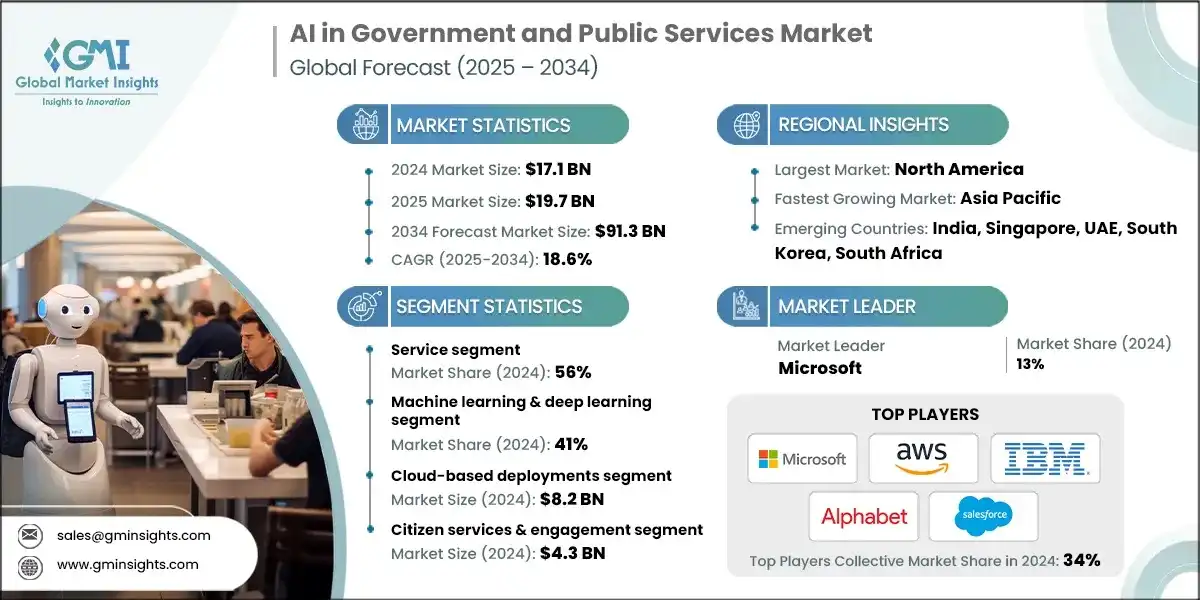
The global AI in government and public services market size was valued at USD 17.1 billion in 2024. The market is expected to grow from USD 19.7 billion in 2025 to USD 91.3 billion in 2034, at a CAGR of 18.6%, according to latest report published by Global Market Insights Inc.
AI in Government and Public Services Market Key Takeaways
Market Size & Growth
- 2024 Market Size: USD 17.1 Billion
- 2025 Market Size: USD 19.7 Billion
- 2034 Forecast Market Size: USD 91.3 Billion
- CAGR (2025–2034): 18.6%
Regional Dominance
- Largest Market: North America
- Fastest Growing Region: Asia Pacific
Key Market Drivers
- Demand for Operational Efficiency & Cost Reduction.
- Rising Citizen Expectations for Digital Services.
- Need for Data-Driven Policy and Decision-Making.
- Enhanced Public Safety and Security.
Challenges
- Data Privacy, Security, and Ethical Concerns.
- High Initial Investment and Legacy System Integration.
Opportunity
- Proactive and Predictive Public Services.
- Improved Urban Planning and Smart City Development.
Key Players
- Market Leader: Microsoft led with over 13% market share in 2024.
- Leading Players: Top 5 players in this market include Microsoft, AWS, IBM, Alphabet, Salesforce, which collectively held a market share of 34% in 2024.
Get Market Insights & Growth Opportunities
AI in government and public services sector is experiencing significant transformation, driven by advancements in technology and a growing emphasis on digital governance. Governments worldwide are increasingly adopting AI to enhance operational efficiency, improve citizen engagement, and streamline service delivery. AI is being utilized to automate repetitive administrative tasks such as data processing, document handling, and citizen interactions, enabling faster workflows and freeing resources for strategic initiatives.
For instance, In September 2025, the Integrated Command and Control Centre (ICCC) inauguration utilize AI in public services in Tirumala, India. This facility is the country's first AI-powered command center for pilgrims, utilizing over 6,000 AI cameras and high-performance computing to manage crowd density, enhance safety, and improve cybersecurity at the renowned temple complex. Developed through a public-private partnership, the ICCC exemplifies how AI can transform public service delivery by integrating physical and cyber operations to enhance the pilgrim experience and resilience.
In COVID-19 pandemic, AI technologies were instrumental in managing lockdowns and enforcing public health measures. For instance, in France, AI-driven monitoring systems were deployed in cities like Cannes to analyze CCTV footage for compliance with social distancing and mask-wearing protocols. These systems alerted authorities in real-time to potential breaches, facilitating prompt enforcement actions without storing personal data, thereby balancing public health objectives with privacy concerns.
North America led the AI in government and public services market. This leadership is attributed to substantial investments in AI infrastructure, innovation hubs, and supportive policies focused on digitizing public sector operations. The region hosts a mature ecosystem of AI vendors, research institutions, and government agencies collaborating on pilot projects and scaled AI deployments. For instance, in September 2025, the U.S. General Services Administration (GSA) has partnered with Meta to facilitate government-wide use of Llama, its open-source AI models, making them more accessible to all federal departments and agencies.
Asia-Pacific is emerging as the fastest-growing region in AI in government and public services market. Governments across the region are investing heavily in AI to enhance public service delivery, improve governance, and address challenges such as urbanization and aging populations. For instance, South Korea has announced plans to boost its 2026 budget by 8.1%, with a sizable portion allocated to AI research and industrial policies, reflecting a strategic focus on AI-driven growth. Similarly, Malaysia is investing in data centers to support its digital economy, aiming to become Southeast Asia's digital hub.
To get key market trends
AI in Government and Public Services Market Trends
Governments are making expected moves towards the integration of AI to improve real-time decision making, predictive analytics, and automated service delivery. This is primarily due to the need for increased responsive governance and resource allocation. In 2024, federal agencies released 59 AI regulatory documents compared to only 29 in 2023, demonstrating an increased pace of development of regulatory frameworks.
Governments will be able to process vast amounts of data in an instant as the technology integration will support objectives ranging from traffic management to emergency response coordination. Governments will need to focus more on transparency, fairness, and accountability regarding AI use, as governments develop comprehensive frameworks and regulations governing ethical use. This is in response to growing public concerns surrounding algorithmic bias and transparency surrounding government directives and decisions. The OECD indicates that now 70% of nations are using AI to assist with internal processes, and 33% are using it in policy development, concerned with drafting some ethical guidelines.
Some large technology companies are developing cloud-based AI and data service management suits that are packed with trusted security designed for government use. There is a particularly positive trend toward cloud deployment models as more government agencies see the clear cost savings of not maintaining infrastructure and improved access. This trend is likely to help provide an impetus for some broader digital transformation objectives across public sector institutions.
AI can handle routine duties, such as data entry, answering citizen inquiries, and administration, can also assist in managing schedules and priorities, increasing efficiencies, and improving the use of staffing resources, which manages time and budget savings. Accenture suggests that AI could increase 42% of public service working hours. CBO estimates that AI will increase productivity by $480 billion annually government wide. This driver is about 25% of the market growth activity, as agencies look to be more efficient in the operation to operate while moderating their budget.
AI-enabled citizen service apps include chatbots on government websites, phone-based virtual assistants, and able to provide tailored service suggestions, based on citizen profiles and needs. In these areas, AI can provide service to citizens 24/7, lower wait times in providing answers to citizen service issues, reduce fatigue in responding to citizen queries, and provide the same quality service across platform channels.
AI in Government and Public Services Market Analysis
Learn more about the key segments shaping this market
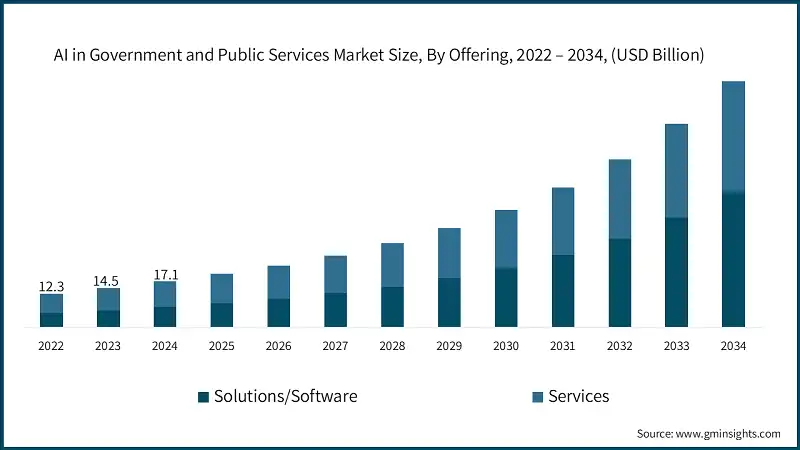
Based on offering, the AI in government and public services market is divided into solution/software and services. The service segment dominated the market accounting by around 56% in 2024 and is expected to grow at a CAGR of 16% from 2025 to 2034.
- The services segment encompasses implementation consulting, system integration, training, maintenance, and ongoing support requirement for successful AI adoption in public sector organizations. Public sector organizations frequently turn to consulting to determine feasible use cases for new AI implementation, create roll-out plans, and ensure compliance with regulations. According to the OECD, high upfront costs and the challenges posed by implementation with legacy systems are key barriers to AI adoption in government, highlighting the need for professional services.
- Gravity, a leading North American provider of disclosure and budgeting automation, recently released its next-generation platform which includes Gravity Disclosure Studio and Gravity Engagement Studio, both powered by Gravity AI. The platform allows government teams to prepare comprehensive financial reports in hours instead of months, while maintaining compliance, ensuring accessibility and improving engagement with the community.
- The solutions/software portion of the market is ramping up as AI platforms further mature and government agencies become comfortable deploying AI built into commercial solutions personally. This higher CAGR 21% shows sign the market is moving from consulting-heavy implementations to standardized solutions/software being deployed. Cloud-based AI solutions are especially appealing for government entities that want to reduce infrastructure costs and increase speed of deployment, thus encouraging faster, enabled adoption across several agencies.
Learn more about the key segments shaping this market
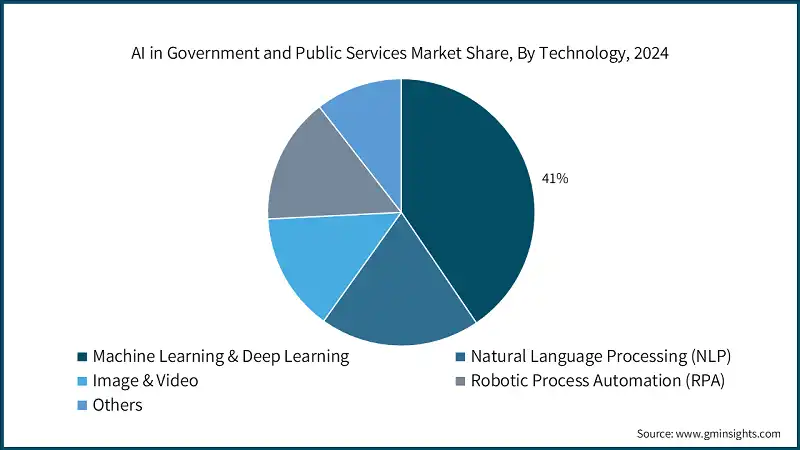
Based on technology, the AI in government and public services market is categorized into machine learning & deep learning, natural language processing, image & video, robotic process automation, and others. Machine learning & deep learning segment dominates the market with 41% share in 2024, and the segment is expected to grow at a CAGR of 17% between 2025 and 2034.
- Machine Learning and Deep Learning technology are the basis for most government AI applications, facilitating predictive analytics, pattern recognition, and automated decision making across multiple use cases. Government agencies are utilizing these technologies in applications such as fraud detection, risk measurement, resource optimization, and policy outcome modeling.
- The Congressional Budget Office states that a significant investment is necessary to train frontier AI models, which indicates the level of sophistication with ML/DL methods being implemented in government contexts. CDC also became the first federal agency to deploy a generative AI (GenAI) chatbot to all staff, which has helped to save over USD 3.7 million in labor costs and has demonstrated a 527% return on investment. The agency developed 55 AI solutions, or use cases, which illustrate the power of AI for outbreak prevention as well as operational efficiencies.
- Image & Video Analysis technologies are witnessing robust growth at 22.44% CAGR, which is indicative of growing use case applications for public safety, border security, infrastructure monitoring, and regulatory compliance. The National Conference of State Legislatures reported that public safety and securities are the largest application revenue share, attributed to the significance that AI video analytics assumes for predictive policing and quick response. Government agencies are deploying computer vision systems for traffic monitoring, facility security, and automated inspection functions, resulting in demand for image & video analysis capabilities that require specialization.
Based on deployment mode, the AI in government and public services market is divided into cloud-based, on-premises, and hybrid. Cloud-based deployments dominate the market and was valued at USD 8.2 billion in 2024.
- Government agencies have increasingly preferred cloud-based deployments, resulting from reduced infrastructure costs, increased scalability, and readiness for advanced AI capabilities with limited or low upfront cloud investment. The higher growth rate for cloud-based solutions reflects government agencies being more confident in cloud security, and cloud solutions specific to government clients, meeting the higher levels of compliance and security requirements for government organizations.
- For instance, in August 2025, Google Cloud partnered with Singapore to develop secure AI services, with rigorous data residency commitments for the enterprises and agencies they work with. Gemini AI is available on Google Distributed Cloud air-gapped systems for cloud workloads with high-security requirements.
- On-premises remains relevant for government organizations with strict data sovereignty requirements, or uses classified information, or have legacy systems to integrate, the reduction in growth reflects the challenges of working with, and managing on-premises infrastructure for AI staying within a company's data estate, as well as the total cost of ownership for AI on-premises as compared to cloud.
- Federal agencies and defense entities typically favor on-premises experiences for sensitive applications while needing the most control over their data, along with an air-gapped environment, when a cloud option may not provide the same level of control.
Based on applications, the AI in government and public services market is divided into citizen services & engagement, public safety & security, healthcare & social services, defense & national security, administrative efficiency, smart cities & urban management, and others. The citizen services & engagement segment dominates the market and was valued at USD 4.3 billion in 2024.
- Citizen Services & Engagement applications include AI powered portals, chat-bots, virtual assistants, and personalized solutions to improve citizen interactions with government agencies. Surveys show that 51 percent of public-sector leaders use AI on a daily or weekly basis, showing AI's inclusion as part of the normal operations and daily routines for citizen services. Growth in this segment is fueled by citizen expectations for digital services that meet the convenience and efficiency of the private sector.
- Government agencies are implementing AI solutions to provide 24-hour service access, improve response time, and total service consistency and quality. For example, Westminster City Council announced in October 2025 that they would use Snowflake to rethink how they democratize their data and to better serve residents, deliver vital cost savings through operational efficiencies, and provide data driven solutions to solve complex societal needs.
- Administrative Efficiency applications also show exceptional growth at 24% CAGR as government agencies recognize AI's potential for streamlining operations and reducing costs. Applications include automated document processing, workflows, resource allocations, and performance analytics, showing a 42% improvement in the working time of public services that can be augmented through AI use. Government organizations are implementing AI solutions to automate normal operations, enhance processing times, and support improved decision accuracy.
Looking for region specific data?
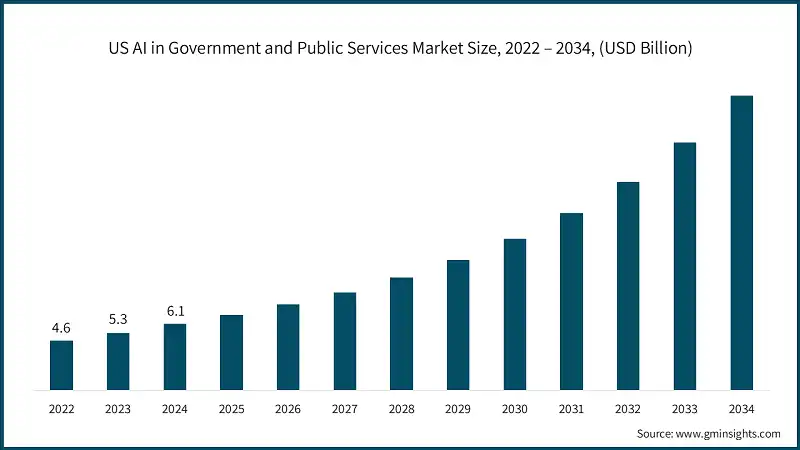
The US dominated North America AI in government and public services market with revenue of USD 6.1 billion in 2024.
- US is the global leader in the AI market due in no small part to heavy government investment into AI, a developed technological infrastructure, and vendor ecosystems.
- According to the Federal Reserve, the United States has around 74% of the global share in high-end AI compute capacity. This is the foundation for a significant deployment of AI by government agencies. The United States has established a rich partnership between government agencies and technology vendors along with rich AI research capabilities and regulatory policies for adoption of AI.
- For example, In September 2025, Microsoft and the United States General Services Administration recently announced their comprehensive agreement to provide a portfolio of productivity, cloud and AI services, including Microsoft 365 Copilot at no cost (up to 12 months) for millions of existing Microsoft G5 users, to support agencies in their rapid adoption of secure and compliant advanced AI tools that will improve operations, strengthen security and support innovation for the people of America.
- Similarly, Canada is becoming a global leader in AI and recent advancements in research, talent, and entrepreneurship are creating a wave of innovation. It is the G7 leader in research output per capita.
- For example, the Advanced Analytics Solutions Centre at Immigration, Refugees and Citizenship Canada has been utilizing AI-based models to triage applications for temporary and permanent residence and find applicants who can be automatically identified as being eligible.
UK AI in government and public services market will grow tremendously with CAGR of 16.4% between 2025 and 2034.
- The United Kingdom is a key market that is placing a significant value proposition on the ethical deployment of AI and regulatory compliance. Many Governments agencies within that country are embracing AI innovation while balancing the mix of many existing privacy laws governing the public sector, including the new AI regulatory frameworks targeting AI solutions.
- In 2023, the UK government issued the Artificial Intelligence Opportunities Action Plan, which provides an overarching strategy for the UK government to take full advantage of AI to increase growth and productivity and to provide benefits, both concrete and practical, to the public in the UK.
- The UK Government makes an explicit commitment to and interventions in the AI industry, which includes investing publicly through funding and other initiatives. In January 2025, the government of the UK announced a new strategic direction: embedded AI as a key lever in the transformation of public services. This direction, from the Department for Science, Innovation, and Technology (DSIT), was executed with the introduction of Humphrey, an AI tool for civil service officers.
- Similarly, Germany was amongst the vanguards in Europe, pledging more than double the public investment into AI, compared to the United Kingdom or France and was home to more than 100 AI startups. In 2025, Germany is spending ~USD 2 billion on artificial intelligence. This investment is more than any other or any other technology. The Federal Ministry of Research, Technology and Space had allocated these resources as part of its AI action plan.
The AI in government and public services market in China will experience robust growth during 2025-2034.
- Asia-Pacific accounts for 24% of the AI in government and public services industry and has the highest growth potential with a CAGR of 21%. China displays the most growth potential of any major country owing to significant investments into AI. The country's growth is underpinned by large populations that require government services, urbanization leading to smart city solutions, and government policy supporting adoption in the public sector. China manages national AI strategy taking a comprehensive approach that encompasses significant deployment of government-focused AI in citizen services, urban management, and administrative efficiency.
- In India, The Ministry of Electronics and Information Technology (MeitY) of India see the AI program as an umbrella initiative for utilizing transformative technologies to encourage inclusion, innovation, and adoption for social impact. The increased acceptance of AI has raised governance requirements on many fronts - many formulating across the areas of data protection, intellectual property rights, liabilities, accountability, and social justice are often independent areas that require concurrent resolution.
- Similarly, the Japanese government's AI investment strategy is aimed at committing USD 65 billion by 2030, whereby USD 13.2 billion has been committed for the two years of 2024-2025. Japan is one of the first countries to approve artificial intelligence governance regulation legislation arriving at a bill intended to support innovation and development whilst understanding there may be risks.
The AI in government and public services market in Brazil will experience significant growth between 2025 & 2034.
- Latin America holds an 3% share of the market in 2024. In Latin America, Brazil represents the largest market for AI in government and public services due to strong governmental support and enterprise adoption. To promote the responsible and ethical use of AI, Brazil's AI framework is based on the Brazilian National AI Strategy (EBIA) and the Brazilian Artificial Intelligence Plan (PBIA 2024-2028).
- The strategic objectives, focused in 4 major areas, aim to place Brazil at the forefront of AI engagement globally while ensuring the ethical, responsible, and transparent use of technology. The federal government has earmarked USD 4.28 billion to improve computational capacity overall, and for the Santos Dumont supercomputer, but also to develop local capacity for AI and language modelling.
- Mexico is seeking to tackle the challenges associated with regulatory approaches on artificial intelligence. However, their approaches are in various positions and, hence, may reflect different regulatory priorities or capacities. The Mexican government is working on a law covering AI as it pertains to dubbing, animation, and voice acting, to prevent the unlawful cloning of a voice or sound in these creative copyrights. The National Copyright Institute is working with over 128 other associations and expected to have a reform of copyright in place before the end of the year.
The AI in government and public services market in UAE is expected to experience robust growth between 2025 & 2034.
- Abu Dhabi intends to become the world's first fully AI-native government across all digital services by 2027. The Abu Dhabi Government announced the "Abu Dhabi Government Digital Strategy 2025-2027", which furthers the emirate's ambitions for an AI-powered government. The AI Strategy aims to improve government performance on multiple levels; and uses AI to deliver a variety of services across key sectors, including health, space, transport, energy, water, technology, education, and traffic.
- Saudi Arabia's advancements in AI regulation, ethical frameworks, and adoption strategies ensure these modern technologies adopted responsibly. This means enabling innovation while also utilizing a framework that protects rights and interests for all beneficiaries.
- Saudi Arabia's AI ambition is part of Vision 2030, Saudi Arabia's plan for economic diversification and social reform. Similarly, the Saudi Arabia AI and Innovation Blockchain Center (SAAIBC) supports platforms, products, and people working at the intersection of blockchain and AI.
AI in Government and Public Services Market Share
The top 7 companies in the market are Oracle, AWS, Salesforce, Cognizant, Alphabet, IBM, and Microsoft. These companies hold around 38% of the market share in 2024.
- Microsoft holds a market share of 13% of the market and utilizes its robust Azure Government cloud platform and AI capabilities for public sector use. Microsoft holds a leading position by providing an integrated cloud infrastructure combined with AI developer support and government-specific compliance certifications.
- IBM has a strong position and good entrenchment with its Watson AI platform and extensive government consulting business. IBM's approach to AI revolves around enterprise grade AI solutions with a depth of capability in natural language processing, decision support systems, and automated reasoning. IBM’s government practice consists of specialized teams with security clearances who are grounded in an understanding of government operations.
- Amazon Web Services (AWS) is maximizing its extensive cloud infrastructure with its AWS GovCloud, which provides cloud environments specific to government customers that have security and compliance requirements. AWS provides more than 200 AI and machine learning services including Amazon SageMaker for model building, Amazon Rekognition for images tasks, and Amazon Comprehend which has natural language processing capabilities.
- Alphabet’s Google Cloud Platform focuses on capabilities in data analytics and machine learning; it delivers specific AI solutions for government use. Their platform for machine learning and AI is called Vertex AI, and its Document AI service focuses on the need for governmental institutions, which specialize in processing and analyzing documents.
- Oracle provides enterprise AI solutions integrated with its database and application platforms. Oracle's AI offerings focus on business process automation, predictive analytics, and intelligent applications that enhance government operations. The company's government solutions address enterprise resource planning, human capital management, and citizen service delivery through AI-enhanced applications.
AI in Government and Public Services Market Companies
Major players operating in the AI in government and public services industry include:
- Accenture
- Alphabet
- Amazon Web Services
- Cognizant
- IBM
- Microsoft
- NVIDIA
- Open AI
- Oracle
- Salesforce
- The AI government and public services marketplace is characterized by a great deal of competition, with large technology companies like Microsoft, Alphabet, and IBM. These companies hold a substantial industry expertise and consulting experience to help build scalable solutions by integrating AI into various areas of government operations.
- Microsoft unrivalled its position due to a unique offering, a fully integrated offer of cloud infrastructure, tools to develop AI functionality, and compliance certifications built specifically for government. IBM is also in a strong competitive position through its Watson AI platform, its government dedicated consulting services, and its strengths within federal agencies as well as for defense contractors.
- AWS takes advantage of its wide- breadth of cloud infrastructure and AI/ML services through AWS GovCloud to provide government technical infrastructures and services within compliant cloud environments, including specific cloud environments for sensitive workloads.
- Alphabet's Google Cloud Platform has a model to assist with data analysis and machine learning type capabilities and specialize in AI applications for government use, including capabilities in document analyses and citizen service automation. Salesforce offers customer relationship management solutions with enhanced AI features to help government service delivery and citizen engagement.
- Regional champions represent a large part of the competitive landscape. These companies will utilize deep government relationships, security clearances, and specialized knowledge in either government operations specifically, or just government, to effectively compete against the larger technology companies.
- Emerging players are gaining market traction by focusing on specific AI technologies or applications particularly relevant to government operations. These companies offer automated machine learning platforms that enable government agencies to develop AI models without extensive data science expertise.
AI in Government and Public Services Market Report Attributes
| Key Takeaway | Details |
|---|---|
| Market Size & Growth | |
| Base Year | 2024 |
| Market Size in 2024 | USD 17.1 Billion |
| Market Size in 2025 | USD 19.7 Billion |
| Forecast Period 2025 – 2034 CAGR | 18.6% |
| Market Size in 2034 | USD 91.3 Billion |
| Key Market Trends | |
| Drivers | Impact |
| Demand for Operational Efficiency & Cost Reduction | Automates routine tasks (data entry, queries), streamlines workflows, and optimizes resource allocation, leading to significant savings in time and budget. |
| Rising Citizen Expectations for Digital Services | Pushes governments to adopt AI-powered portals, chatbots, and personalized services to match the convenience and speed offered by the private sector. |
| Need for Data-Driven Policy and Decision-Making | AI analyzes vast datasets (economic, social, health) to identify trends, model policy outcomes, and enable more effective, evidence-based governance. |
| Enhanced Public Safety and Security | AI is used for predictive policing, traffic management, cyber threat detection, and emergency response coordination, improving overall security and resilience. |
| Pitfalls & Challenges | Impact |
| Data Privacy, Security, and Ethical Concerns | Elevated risk of public backlash and legal challenges over the use of sensitive citizen data, leading to strict regulations and slowed adoption. |
| High Initial Investment and Legacy System Integration | Significant upfront costs for technology and expertise, coupled with the difficulty of integrating AI with outdated government IT systems, creates major financial and technical hurdles. |
| Opportunities: | Impact |
| Proactive and Predictive Public Services | Shifts from reactive to proactive service delivery such as predicting infrastructure maintenance needs, identifying at-risk individuals for social welfare, and preventing fraud. |
| Improved Urban Planning and Smart City Development | AI can optimize energy grids, manage waste collection routes, reduce traffic congestion, and help plan sustainable urban environments. |
| Market Leaders (2024) | |
| Market Leaders |
13% Market Share |
| Top Players |
Collective market share in 2024 is 34% |
| Competitive Edge |
|
| Regional Insights | |
| Largest Market | North America |
| Fastest growing market | Asia Pacific |
| Emerging countries | India, Singapore, UAE, South Korea, South Africa |
| Future outlook |
|
What are the growth opportunities in this market?
AI in Government and Public Services Industry News
- In January 2025, The U.S. Department of Homeland Security has officially started its wide-ranging AI Safety and Security Board, introducing new guidelines for AI utilization across federal entities. The initiative establishes mandatory AI impact assessments for federal AI systems that process citizen data, with implementation beginning in July 2025.
- In January 2025, Microsoft Corporation extended its contract with the U.S. General Services Administration for $2.1 billion to offer AI-driven cloud services across federal agencies through 2028. The contract includes advanced AI features that provide document processing, automation of citizen services, predictive analytics, and specific provisions for classified data.
- In December 2024, IBM announced Watson Government AI a specialized platform designed only for use in the public sector. Watson's platform has pre-built models for regulatory compliance, policy analysis, as well as automation of citizen services, and security features to meet FedRAMP High authorization standards.
- In November 2024, The Google Cloud Platform began to support its Government AI Accelerator program, focused on providing resources for tailored AI development for federal, state, and local government agencies. The program offered technical consulting services, tailored training, along with advanced AI models adjusted for government use cases.
The AI in government and public services market research report includes in-depth coverage of the industry with estimates & forecasts in terms of revenue ($Bn) from 2021 to 2034, for the following segments:
Market, By Offering
- Solutions/Software
- Services
- Consulting & Advisory
- System Integration & Deployment
- Training & Education
- Support & Maintenance
Market, By Technology
- Machine Learning & Deep Learning
- Natural Language Processing (NLP)
- Image & Video
- Robotic Process Automation (RPA)
- Others
Market, By Deployment Mode
- On-Premises
- Cloud-Based
- Hybrid
Market, By Application
- Citizen Services & Engagement
- Digital Assistants & Chatbots for Public Queries
- Multilingual Translation for Public Communication
- Personalized Government Portals
- Public Safety & Security
- Surveillance & Monitoring
- Crime Prediction & Analysis
- Emergency Response Systems
- Healthcare & Social Services
- Disease Prediction & Outbreak Control
- Smart Resource Allocation (hospitals, clinics)
- Benefits & Welfare Distribution Monitoring
- Defense & National Security
- Threat Detection & Analysis
- AI-driven Cybersecurity Systems
- Military Decision Support Systems
- Administrative Efficiency
- Smart Cities & Urban Management
- Others
Market, By End use
- Federal/National government
- State/Provincial government
- Local/Municipal government
- Others
The above information is provided for the following regions and countries:
- North America
- US
- Canada
- Europe
- UK
- Germany
- France
- Italy
- Spain
- Belgium
- Netherlands
- Sweden
- Asia Pacific
- China
- India
- Japan
- Australia
- Singapore
- South Korea
- Vietnam
- Indonesia
- Latin America
- Brazil
- Mexico
- Argentina
- MEA
- South Africa
- Saudi Arabia
- UAE
Frequently Asked Question(FAQ) :
What is the market size of AI in government and public services in 2024?
The market size was USD 17.1 billion in 2024, with a CAGR of 18.6% expected through 2034. The growth is driven by advancements in technology, digital governance, and the adoption of AI to enhance operational efficiency and citizen engagement.
What is the projected value of the AI in government and public services market by 2034?
The market is projected to reach USD 91.3 billion by 2034, fueled by AI integration in real-time decision-making, predictive analytics, and automated service delivery.
What is the expected size of the AI in government and public services market in 2025?
The market size is projected to reach USD 19.7 billion in 2025.
How much revenue did the service segment generate in 2024?
The service segment generated approximately 56% of the market revenue in 2024 and is expected to witness over 16% CAGR till 2034.
What was the valuation of the machine learning and deep learning segment in 2024?
The machine learning and deep learning segment accounted for 41% of the market share in 2024 and is set to expand at a CAGR of 17% between 2025 and 2034.
What is the growth outlook for the citizen services and engagement segment?
The citizen services and engagement segment was valued at USD 4.3 billion in 2024, driven by AI-powered portals, chatbots, virtual assistants, and personalized solutions to improve citizen interactions with government agencies.
Which region leads the AI in government and public services sector?
The United States dominated the North American market with revenue of USD 6.1 billion in 2024. The U.S. leads globally due to significant government investments, advanced technological infrastructure, and a strong vendor ecosystem.
What are the upcoming trends in the AI in government and public services market?
Key trends include cloud-based AI, ethical frameworks, real-time data processing, and AI-enabled citizen services.
Who are the key players in the AI in government and public services industry?
Key players include Accenture, Alphabet, Amazon Web Services, Cognizant, IBM, Microsoft, NVIDIA, Open AI, Oracle, and Salesforce.
AI in Government and Public Services Market Scope
Related Reports