Summary
Table of Content

Artificial Intelligence in Drug Discovery Market
Get a free sample of this report
Form submitted successfully!
Error submitting form. Please try again.
Thank you!
Your inquiry has been received. Our team will reach out to you with the required details via email. To ensure that you don't miss their response, kindly remember to check your spam folder as well!
Request Sectional Data
Thank you!
Your inquiry has been received. Our team will reach out to you with the required details via email. To ensure that you don't miss their response, kindly remember to check your spam folder as well!
Form submitted successfully!
Error submitting form. Please try again.
Artificial Intelligence in Drug Discovery Market Size
The use of artificial intelligence in drug discovery is rapidly growing owing to the increasing prevalence of various chronic and life-threatening diseases, growing awareness of artificial intelligence tools and their clinical and economic benefits among pharmaceutical companies, and the development of advanced forms of AI-driven platforms. According to Science Direct, AI-discovered molecules have an 80–90% success rate in phase I, substantially higher than previous average outcomes. In addition, the growing burden of chronic and rare diseases, along with advancements in machine learning and data integration systems, is further contributing to market expansion.
Moreover, the high adoption rate among various pharmaceutical and biotech startups along with research institutions, particularly in regions with strong digital infrastructure, is stimulating innovation. For instance, National Institutes of Health (NIH) reported that AI has the potential to transform the drug discovery process, offering improved efficiency, accuracy, and speed, stimulating the market for AI therapeutics.
Artificial Intelligence in Drug Discovery Market Key Takeaways
Market Size & Growth
- 2025 Market Size: USD 3.1 Billion
- 2026 Market Size: USD 4 Billion
- 2035 Forecast Market Size: USD 43.9 Billion
- CAGR (2026–2035): 30.5%
Regional Dominance
- Largest Market: North America
- Fastest Growing Region: Asia Pacific
Key Market Drivers
- Increasing prevalence of complex and chronic diseases.
- Data explosion and digitization in healthcare.
- Advancements in AI algorithms and computing power.
- Growing collaboration between tech and pharma companies.
Challenges
- Data quality and integration issues.
- Regulatory and ethical concerns.
Opportunity
- Expansion of personalized and precision medicine.
- Emergence of generative AI in molecule design.
Key Players
- Market Leader: Isomorphic Labs (Alphabet Inc.) led with over 3.2% market share in 2025.
- Leading Players: Top 5 players in this market include Isomorphic Labs (Alphabet Inc.), Insitro, Insilico Medicine, Recursion Pharma, Schrödinger, which collectively held a market share of 11.8% in 2025.
Get Market Insights & Growth Opportunities
The AI in drug discovery market is defined as the segment of the pharmaceutical and biotechnology industry focused on the application of AI technologies to accelerate and optimize the drug discovery process. This includes a range of AI-driven solutions such as deep learning models, natural language processing, predictive analytics, and generative algorithms used for target identification, lead optimization, drug repurposing, de novo drug designing, and preclinical testing. Key players include Isomorphic Labs (Alphabet Inc.), Insitro, Insilico Medicine, Recursion Pharma, and Schrödinger. These players are driving the market growth by leveraging large-scale biological data, proprietary AI platforms, and strategic collaborations with pharmaceutical companies to enhance discovery efficiency, reduce development timelines, and increase the probability of successful drug candidates.
The market has witnessed steady historical growth from USD 1.5 billion in 2022 to USD 2.4 billion in 2024. The growth is driven by the rising number of AI-integrated research projects, especially among biotech firms and academic institutions. Thus, the rapid increase in demand for faster, cost-effective drug development is creating an ever growing need for robust AI platforms that rely heavily on big data analytics and cloud-based computing.
Further, growing concerns over research and development productivity, stringent requirements for higher standards in precision medicine, and an increasing shift towards personalized therapies, is stimulating the demand for AI platforms. The market is further strengthened by growing investment in digital healthcare infrastructure in emerging economies, particularly in the Asia-Pacific and Latin America. The artificial intelligence in the drug discovery market is poised for significant growth owing to rising research and development initiatives aimed at developing novel AI models with improved interpretation abilities, and minimal bias. Thus, the growing demand for efficient drug discovery, coupled with advancements in AI technologies and pharmaceutical innovation, is fostering growth within the AI-driven drug discovery market.
The global artificial intelligence in drug discovery market was estimated at USD 3.1 billion in 2025. The market is expected to grow from USD 4 billion in 2026 to USD 43.9 billion in 2035, growing at a CAGR of 30.5%, according to the latest report published by Global Market Insights Inc.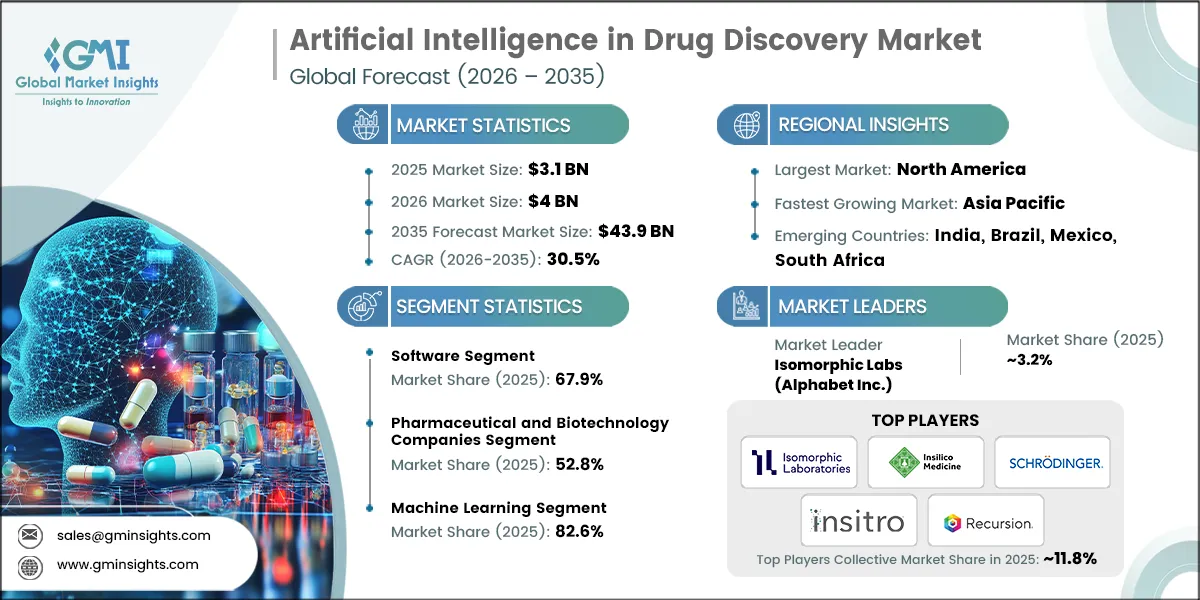
To get key market trends
Artificial Intelligence in Drug Discovery Market Trends
- The global AI in drug discovery market is undergoing rapid transformation, driven by the rising demand for faster, cost-effective drug development across therapeutic areas. The increasing prevalence of chronic diseases such as cancer, neurological disorders, and rare genetic conditions is escalating the need for AI-powered discovery platforms.
- Further, growing interest in precision medicine and personalized therapies is expanding the demand for AI tools that can analyse genomic, proteomic, and clinical data.
- AI is enabling early-stage intervention and target identification, reducing the time and cost associated with traditional drug discovery pipelines. Advances in machine learning, deep learning, and natural language processing are driving a shift toward non-invasive, data-driven drug development.
- Pharmaceutical companies are increasingly adopting AI to optimize clinical trial design, patient recruitment, and outcome prediction, improving trial success rates.
- Public-private partnerships and government-backed innovation programs are accelerating AI integration in drug discovery, especially in North America and Europe.
- AI platforms are evolving toward cloud-based, scalable solutions, allowing broader access for biotech startups, academic institutions, and mid-sized pharma firms.
- Regulatory bodies are beginning to define frameworks for AI validation, ensuring transparency, reproducibility, and ethical use of AI in drug development.
- The market is witnessing a rise in AI-powered molecule generation tools, such as generative models that design novel compounds with optimized pharmacological profiles.
- Integration of multi-omics data and real-world evidence is enhancing the predictive power of AI models, enabling more accurate drug candidate selection.
- AI is being used to repurpose existing drugs, identifying new indications and accelerating time-to-market for treatments with known safety profiles.
- Overall, the AI in drug discovery market is evolving toward precision-based, scalable, and collaborative ecosystems, reshaping the future of pharmaceutical innovation.
Artificial Intelligence in Drug Discovery Market Analysis

Learn more about the key segments shaping this market
Based on the component, the AI in drug discovery market is categorized into software and services. The software segment is further bifurcated into on-premise and cloud-based. The software segment has asserted its dominance in the market by securing a significant market share of 67.9% in 2025 and is anticipated to grow at a CAGR of 30.2% over the forecast years.
- The software segment has emerged as the cornerstone of the artificial intelligence in drug discovery industry, as organizations increasingly rely on digital platforms to manage large-scale biomedical datasets and execute complex predictive analyses.
- Software solutions underpin core AI-driven workflows, including target identification, de novo molecule design, and virtual screening.
- Continuous advancements in machine learning and deep-learning architectures are central to this growth. These technologies enable high-throughput data analysis, structure–activity relationship modeling, and large-scale medicinal chemistry simulations.
- The shift toward cloud-based deployment further strengthens the segment, allowing biotech companies, particularly mid-sized players, to access scalable computing power without substantial capital investment in on-premise infrastructure.
- The services segment, on the other hand, is anticipated to grow at a CAGR of 31.1% over the forecast years. Growth in this segment is being driven by the increasing tendency of biopharmaceutical organizations to outsource AI-enabled drug discovery activities in order to accelerate R&D timelines and address internal infrastructure constraints.
Based on the technology, the global AI in drug discovery market is segmented into machine learning and other technologies. The machine learning segment is further bifurcated into deep learning, supervised learning, unsupervised learning, and other machine learning technologies. The machine learning segment has asserted its dominance in the market by securing a significant market share of 82.6% in 2025.
- Machine learning (ML) has established itself as the core engine of market due to its capacity to analyze and learn from heterogeneous datasets, including chemical libraries, genomic profiles, and clinical trial records.
- This capability enables more accurate predictive modelling and accelerates decision-making across early-stage drug development, positioning ML as a foundational pillar of next-generation discovery platforms.
- Its integration with real-world evidence and clinical trial data further supports personalized medicine approaches, making it a critical enabler of precision therapeutics.
- Moreover, the machine learning segment benefits from advancements in cloud infrastructure, scalable computing, and open-source frameworks. These tools allow for rapid model deployment, continuous learning, and real-time feedback loops.
- The segment also gains momentum from partnerships between pharma companies and AI startups, fostering innovation in algorithm design and data integration across drug discovery pipelines.
Based on the application type, the global artificial intelligence in drug discovery market is classified into molecular library screening, target identification, drug optimization and repurposing, de novo drug designing, and preclinical testing. The molecular library screening segment dominated the market and was valued at USD 1.2 billion in 2025. The segment is projected to grow at a CAGR of 30.2% during the forecast period.
- The molecular library screening segment has emerged as the dominant category due to its ability to process millions of compounds in silico, significantly reducing the need for physical assays. These AI-driven platforms leverage deep learning and predictive modelling to identify promising candidates with optimal pharmacokinetic and pharmacodynamic profiles.
- Moreover, the integration of high-throughput screening data, cheminformatics, and cloud-based computing has further enhanced scalability and precision, making it a cornerstone of modern drug discovery workflows.
- In contrast, the target identification segment is gaining momentum due to its transformative impact on precision medicine and disease biology understanding. AI algorithms are increasingly used to analyse multi-omics data, uncovering novel druggable targets and elucidating complex disease pathways.
- The preclinical testing segment remains a foundational application, particularly in validating drug safety and efficacy before clinical trials. AI tools are being used to simulate biological responses, predict toxicity, and optimize dosing strategies, thereby reducing reliance on animal models and improving translational outcomes.
Based on the therapeutic area, the global artificial intelligence in drug discovery market is classified into oncology, neurodegenerative diseases, inflammatory, infectious diseases, metabolic diseases, rare diseases, cardiovascular diseases, and other therapeutic areas. The oncology segment accounted for the highest market revenue of USD 1.4 billion in 2025.
- The oncology segment dominated the market owing to the high volume of cancer cases diagnosed globally, coupled with high adoption of precision medicine and high volume of oncology-focused research and development investments.
- According to the WHO, more than 20 million cancer cases and about 9.7 million deaths were found in 2022.
- AI-integrated platforms are enabling pharmaceutical companies to uncover hidden patterns in tumour biology, simulate drug interactions, and prioritize compounds with the highest therapeutic potential.
- Additionally, regulatory support for AI-based oncology trials and the rise of digital pathology and radiomics are accelerating its adoption in both early and late-stage development.
- On the other hand, the neurodegenerative diseases segment is gaining momentum due to the increasing prevalence of conditions such as Alzheimer’s, Parkinson’s, and ALS, coupled with the complexity of their pathophysiology.
- Further, the inflammatory diseases segment remains a key focus area, particularly in autoimmune and chronic inflammatory conditions like rheumatoid arthritis, psoriasis, and IBD. AI is being used to model immune system responses, predict flare-ups, and identify patient subgroups most likely to benefit from targeted therapies.

Learn more about the key segments shaping this market
Based on the end use, the global artificial intelligence in drug discovery market is classified into pharmaceutical and biotechnology companies, contract research organizations (CROs), and other end users. The pharmaceutical and biotechnology companies segment held the largest market share of 52.8% in 2025.
- The pharmaceutical and biotechnology companies’ segment is growing due to the increasing number of companies and significant investments in AI platforms, strategic collaborations with tech firms, and internal AI-driven innovation programs.
- Moreover, these organizations are leveraging AI to analyse real-world data, predict drug efficacy, and identify novel compounds with higher success potential. The growing emphasis on personalized medicine, coupled with regulatory support for AI-enabled drug development, has made this segment a key driver of market growth.
- The contract research organization (CROs) segment is anticipated to grow at a CAGR of 31%. Growth is being driven by the strategic expansion of AI capabilities within CROs, including investments in advanced computational infrastructure, recruitment of data scientists and AI specialists, and the integration of AI-powered technologies across drug discovery workflows.

Looking for region specific data?
North America AI in Drug Discovery Market
The North America market dominated the global artificial intelligence in drug discovery industry with a market share of 47.7% in 2025.
- The market is stimulated due to high adoption rates of AI-platforms among pharmaceutical companies and increasing investment in AI infrastructure and research and development.
- The North America region has a supportive and strong regulatory ecosystem, with agencies such as the FDA that help promote digital health initiatives and AI validation frameworks that escalate market adoption.
- Major tech and pharma collaborations in countries such as the U.S. and Canada, with partnerships between AI startups and leading drug manufacturers across the region, are advancing the development of next-generation therapeutics and expanding the reach of AI platforms.
The U.S. artificial intelligence in drug discovery market was valued at USD 0.7 billion and USD 0.8 billion in 2022 and 2023, respectively. The market size reached USD 1.4 billion in 2025, growing from USD 1.1 billion in 2024.
- The rising incidence of chronic diseases such as diabetes, cancer, and neurodegenerative disorders is stimulating the use of AI tools that provide faster and more targeted drug development.
- Precision medicine initiatives in the U.S. are driving demand for AI platforms that can analyse genomic and clinical data to create personalized therapies.
- The expansion of telehealth services is enabling remote patient monitoring and decentralized clinical trials, supporting AI-driven drug discovery, drug screening, and improving access to diverse datasets.
Europe Artificial Intelligence in Drug Discovery Market
Europe market accounted for USD 1 billion in 2025 and is anticipated to show lucrative growth over the forecast period.
- Rising awareness and adoption of AI-powered drug discovery services in Europe, along with increasing government initiatives to strengthen digital healthcare infrastructure, is anticipated to drive growth across the region.
- Advancements in AI-driven drug discovery technologies, including predictive modelling, generative molecule design, and multi-omics integration, are boosting demand for scalable and cost-effective solutions throughout Europe.
- Countries such as UK, Italy, and Spain are strengthening national production of drugs, improving access to high-cost advancements for patients.
Germany artificial intelligence in drug discovery market is anticipated to witness considerable growth over the analysis period.
- Germany is emerging as a strategic center for AI-driven drug discovery, with companies such as PharmAI and Molecular Health leading innovation in predictive modeling, clinical decision support, and data-driven therapeutic development.
- Several companies have been investing and taking initiatives for the development of drug using AI.
- For instance, in September 2025 Merck KGaA announced a partnership with Siemens to accelerate AI deployment across drug discovery and biomanufacturing, integrating digital workflows, automation, and scientific intelligence platforms to move therapies faster from lab to patient.
- Further, Germany’s strong focus on artificial intelligence in precision medicine and expanding telehealth infrastructure is enabling scalable, personalized drug discovery services, supported by robust academic research and government-backed digital health initiatives.
Asia Pacific Artificial Intelligence in Drug Discovery Market
The Asia Pacific market is anticipated to grow at the highest CAGR of 31.2% during the analysis timeframe.
- The region consists of key markets including China, India, Japan, South Korea, and Australia, where rising diseases and growing healthcare investments are stimulating demand for advanced drug solutions.
- Additionally, the rapidly evolving healthcare system and high disposable income levels enhance access to professional drug solutions.
China artificial intelligence in drug discovery market is predicted to grow significantly over the forecast period.
- The high number of patents in the country related to market is stimulating the market, as China leads globally in AI-driven drug discovery patent filings, with a significant portion focused on generative AI applications in pharmaceuticals. This positions China as a major force in AI-driven pharmaceutical innovation.
- Moreover, multibillion-dollar partnerships with global pharma giants highlight China's growing influence, escalated by fast development timelines, lower costs, and a state-backed biotech ecosystem.
- According to Jefferies, in Q1 2025, Chinese companies accounted for 32% of global biotech licensing deal value, up from 21% in 2023 and 2024, reflecting China’s rapid shift from generic manufacturing to cutting-edge drug discovery leadership.
Latin America Artificial Intelligence in Drug Discovery Market
Brazil is experiencing significant growth in the Latin America market due to the increasing demand for advanced healthcare technologies and precision medicine solutions.
- The rising prevalence of chronic diseases in Brazil, particularly among aging populations and individuals with lifestyle-related risk factors, is driving demand for AI-powered drug discovery platforms.
- Hospitals, research institutions, and pharmaceutical companies are facing increased pressure to accelerate drug development timelines, prompting the adoption of AI-driven strategies to improve efficiency and outcomes.
- In addition, government efforts to digitize healthcare, promote innovation in pharmaceutical research, and strengthen regulatory frameworks are stimulating the adoption of artificial intelligence in drug discovery across public and private health sectors.
Middle East and Africa AI in Drug Discovery Market
Saudi Arabia artificial intelligence in drug discovery industry is poised to witness substantial growth in Middle East and Africa market during the forecast period.
- The increasing complexities in disease profiles and improving diagnostic capabilities are stimulating market demand for AI-driven personalized drug discovery approaches in Saudi Arabia, which is driving market growth.
- Government incentives under Vision 2030, along with the expansion of digital health infrastructure and local pharmaceutical innovation, are escalating demand across public and private healthcare sectors. These efforts are modernizing healthcare delivery and accelerating drug development nationwide.
Artificial Intelligence in Drug Discovery Market Share
The global market is highly fragmented, experiencing accelerated expansion, driven by rising research and development costs, increasing demand for precision medicine, and the need for faster, more cost‑effective therapeutic development. Top 5 players, including Isomorphic Labs (Alphabet Inc.), Insitro, Insilico Medicine, Recursion Pharma, and Schrödinger collectively hold approximately 11.8% market share in the global market. These companies are actively investing in generative AI engines, multimodal biological data integration, and cloud‑based molecular simulation frameworks that enhance target identification, lead optimization, and clinical trial design. The market is also rapidly diversifying beyond traditional small‑molecule discovery into biologics engineering, protein‑folding prediction, and AI‑guided drug repurposing.
Key trends influencing industry growth include scalable cloud‑HPC infrastructures, collaborative partnerships between tech giants and pharmaceutical innovators, fully automated in silico‑first workflows, and expanding adoption of AI‑based toxicity prediction to minimize preclinical failures. Additionally, strategic investments, cross‑sector consortia, and global regulatory support for digital‑first research and development approaches are enabling companies to meet evolving scientific, economic, and compliance requirements positioning AI‑powered platforms as essential tools for next‑generation drug innovation.
Artificial Intelligence in Drug Discovery Market Companies
Few prominent players operating in the artificial intelligence in drug discovery industry includes:
- Isomorphic Labs (Alphabet)
- Microsoft Corporation
- NVIDIA Corporation
- International Business Machines Corporation
- Schrödinger
- Recursion Pharmaceuticals
- Insilico Medicine
- BenevolentAI
- Atomwise
- Insitro
- Deep Genomics
- Iktos
- Deargen
- 9Bio Therapeutics
- Aureka Biotechnologies
- CellCodex Technology Limited
- chAIron
- DenovAI Biotech
- Examol
- Helical.AI
- Orakl Oncology
- Therenia
Isomorphic Labs leverages advanced AI models built on DeepMind’s protein-structure prediction breakthroughs (e.g., AlphaFold) to accelerate target identification and drug design. Its unified AI drug design engine supports multiple therapeutic areas and drug modalities, aiming to transform discovery workflows and shorten development timelines.
Insitro integrates machine learning with large-scale biological data generation to uncover disease mechanisms and identify novel therapeutic targets. The company collaborates with pharmaceutical partners to apply AI models to oncology and small-molecule drug development, highlighting its data-centric discovery strategy.
Insilico Medicine operates a full-stack AI platform (Pharma.AI) combining target discovery, generative molecule design, and clinical trial prediction capabilities. Its generative AI approach has enabled rapid advancement of AI-designed candidates into clinical studies, demonstrating accelerated discovery cycles.
Recursion employs its Recursion OS platform that merges large-scale biological data, automated experimentation, and machine learning to identify targets and design optimized molecules. High-throughput automated labs and computer-vision-driven cellular imaging generate massive datasets that power predictive AI models for drug discovery.
Artificial Intelligence in Drug Discovery Market Report Attributes
| Key Takeaway | Details |
|---|---|
| Market Size & Growth | |
| Base Year | 2025 |
| Market Size in 2025 | USD 3.1 Billion |
| Market Size in 2026 | USD 4 Billion |
| Forecast Period 2026-2035 CAGR | 30.5% |
| Market Size in 2035 | USD 43.9 Billion |
| Key Market Trends | |
| Drivers | Impact |
| Increasing prevalence of complex and chronic diseases | Rising global burden of diseases like cancer, neurological disorders, and rare genetic conditions is driving demand for faster and more targeted drug discovery solutions. |
| Data explosion and digitization in healthcare | Availability of vast biomedical datasets, including genomics, proteomics, and clinical records, is fuelling the adoption of AI for pattern recognition and drug target identification. |
| Advancements in AI algorithms and computing power | Progress in deep learning, natural language processing, and cloud computing is enhancing the accuracy and scalability of AI-driven drug discovery platforms. |
| Growing collaboration between tech and pharma companies | Strategic partnerships between AI startups and pharmaceutical giants are accelerating innovation and commercialization of AI-based drug discovery tools. |
| Pitfalls & Challenges | Impact |
| Data quality and integration issues | Inconsistent, biased, or incomplete datasets can hinder model performance and lead to unreliable drug predictions. |
| Regulatory and ethical concerns | Lack of standardized frameworks for AI validation and concerns over data privacy may slow down regulatory approvals and market adoption. |
| Opportunities: | Impact |
| Expansion of personalized and precision medicine | AI enables tailored drug development based on individual genetic profiles, improving treatment efficacy and reducing adverse effects. |
| Emergence of generative AI in molecule design | Generative models are revolutionizing drug discovery by creating novel compounds with optimized pharmacological properties. |
| Market Leaders (2025) | |
| Market Leader |
Market share is ~3.2% |
| Top Players |
Collective market share is ~11.8% |
| Competitive Edge |
|
| Regional Insights | |
| Largest Market | North America |
| Fastest growing market | Asia Pacific |
| Emerging countries | India, Brazil, Mexico, South Africa |
| Future outlook |
|
What are the growth opportunities in this market?
Artificial Intelligence in Drug Discovery Industry News
- In February 2025, 9Bio Therapeutics participated in an initiative with CQDM, IVADO, Molecular Forecaster, and Aramis Biotechnologies to advance preclinical oncology programs. The companies worked together to apply AI‑driven structural biology, biophysics, and plant-based antibody production to accelerate targeted cancer therapy development. This collaboration strengthened 9Bio Therapeutics oncology pipeline by supporting validation of its AI‑guided antibody discovery platform.
- In February 2025, Alphabet advanced its move into AI‑enabled drug discovery by integrating quantum computing tools like the Willow Chip and Quantum Echoes with generative AI systems. Alphabet also aligned its AI‑first biology approach with Teva to translate computational drug designs into clinical and commercial pathways.
- In February 2023, Google Cloud introduced AI-powered tools to accelerate drug discovery and precision medicine, aiming to reduce the overall costs of drug discovery. The collaboration involves the target and lead identification suite, which aids in predicting protein structures and understanding amino acid functionality, and the Multi-omics Suite, focused on interpreting genomic data for precision therapeutics.
- In September 2023, BenevolentAI signed a strategic collaboration with Merck to leverage BenevolentAI's powerful end-to-end AI platform capabilities to accelerate drug discovery and development processes. Through this collaboration, Merck aimed to gain access to an expert team of interdisciplinary drug discovery scientists from BenevolentAI to identify and develop innovative compounds across various therapeutic areas such as neurology, oncology, and immunology. This strategy is expected to expand company’s development sector.
- In August 2022, Atomwise, announced a significant strategic collaboration with Sanofi, a global pharmaceutical company. This collaboration aims to leverage Atomwise's advanced artificial intelligence (AI) technology to accelerate the discovery of potential therapeutic compounds for multiple targets identified by Sanofi. This has helped Atomwise's to strengthen its AI technology and Sanofi's drug discovery expertise to accelerate the translation of promising research into novel therapeutic candidates.
The artificial intelligence in drug discovery market research report includes in-depth coverage of the industry with estimates and forecast in terms of revenue in USD Million from 2022 - 2035 for the following segments:
Market, By Component
- Software
- On-premises
- Cloud-based
- Services
Market, By Technology
- Machine learning
- Deep learning
- Supervised learning
- Unsupervised learning
- Other machine learning technologies
- Other technologies
Market, By Application Type
- Molecular library screening
- Target identification
- Drug optimization and repurposing
- De novo drug designing
- Preclinical testing
Market, By Therapeutic Area
- Oncology
- Neurodegenerative diseases
- Inflammatory
- Infectious diseases
- Metabolic diseases
- Rare diseases
- Cardiovascular diseases
- Other therapeutic areas
Market, By End Use
- Pharmaceutical and biotechnology companies
- Contract research organizations (CROs)
- Other end users
The above information is provided for the following regions and countries:
- North America
- U.S.
- Canada
- Europe
- Germany
- UK
- France
- Italy
- Spain
- Netherlands
- Asia Pacific
- China
- Japan
- India
- Australia
- South Korea
- Latin America
- Brazil
- Mexico
- Argentina
- Middle East and Africa
- South Africa
- Saudi Arabia
- UAE
Frequently Asked Question(FAQ) :
What is the market size of the artificial intelligence in drug discovery market in 2025?
The global market was valued at USD 3.1 billion in 2025, driven by increasing prevalence of chronic and complex diseases, rapid adoption of AI-driven platforms by pharmaceutical companies, and advancements in machine learning technologies.
What is the projected size of the artificial intelligence in drug discovery market in 2026?
The market is expected to reach USD 4 billion in 2026, supported by growing collaborations between AI startups and pharmaceutical giants, along with expanding investments in digital healthcare infrastructure.
What is the forecast value of the artificial intelligence in drug discovery market by 2035?
The market is projected to reach USD 43.9 billion by 2035, growing at a CAGR of 30.5% during the forecast period, owing to advancements in generative AI, predictive analytics, and multi-omics data integration.
What is the long-term growth outlook for the AI in drug discovery industry?
The industry is anticipated to witness strong double-digit growth through 2035, driven by rising demand for faster and cost-effective drug development, expanding precision medicine initiatives, and increasing use of AI in target identification, molecule design, and preclinical testing.
How much revenue did the molecular library screening segment generate in artificial intelligence in drug discovery industry in 2025?
The molecular library screening segment generated USD 1.2 billion in 2025, maintaining its dominance due to its ability to process millions of compounds in silico and significantly reduce reliance on physical assays.
Which therapeutic area led the AI in drug discovery market in 2025?
Oncology led the market with USD 1.4 billion in 2025, supported by the rising global cancer burden and strong adoption of AI-powered precision medicine approaches in oncology research.
Which region dominates the artificial intelligence in drug discovery market?
North America dominated the market with a 47.7% revenue share in 2025, driven by strong regulatory support, high AI adoption among pharmaceutical companies, and substantial R&D investments across the region.
Who are the key players operating in the AI in drug discovery industry?
Major companies operating in the industry include Isomorphic Labs (Alphabet Inc.), Insitro, Insilico Medicine, Recursion Pharmaceuticals, Schrödinger, Microsoft Corporation, NVIDIA Corporation, International Business Machines Corporation, BenevolentAI, and Atomwise.
Artificial Intelligence in Drug Discovery Market Scope
Related Reports