Summary
Table of Content

AI & Analytics in Military and Defense Market
Get a free sample of this report
Form submitted successfully!
Error submitting form. Please try again.
Thank you!
Your inquiry has been received. Our team will reach out to you with the required details via email. To ensure that you don't miss their response, kindly remember to check your spam folder as well!
Request Sectional Data
Thank you!
Your inquiry has been received. Our team will reach out to you with the required details via email. To ensure that you don't miss their response, kindly remember to check your spam folder as well!
Form submitted successfully!
Error submitting form. Please try again.
AI & Analytics in Military and Defense Market Size
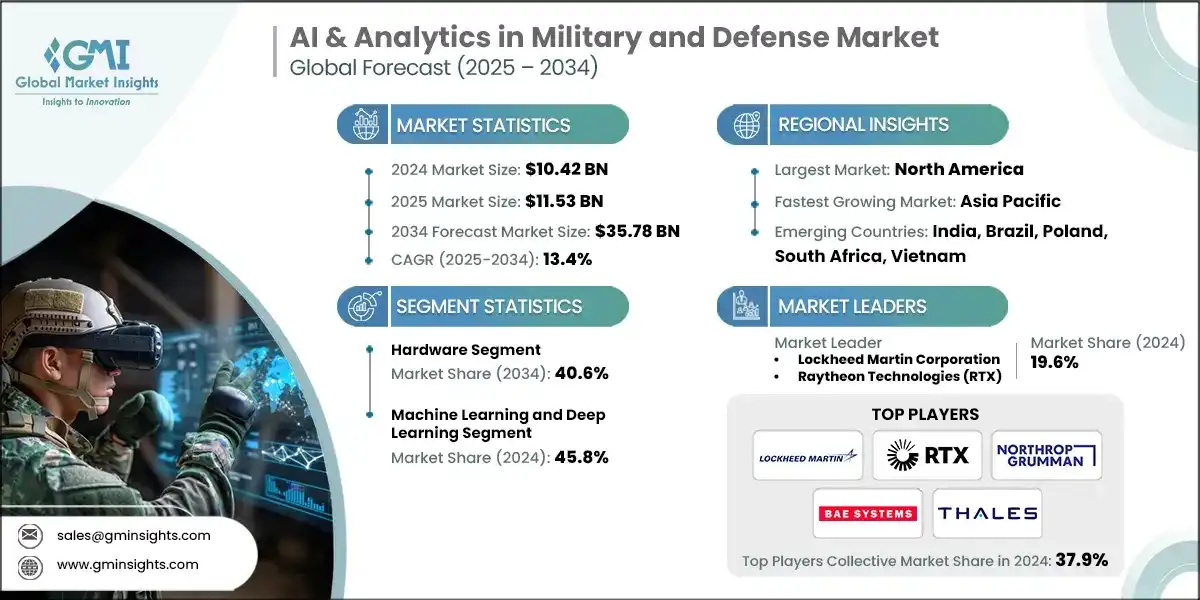
According to a recent study by Global Market Insights Inc., the global AI & analytics in military and defense market was valued at USD 10.42 billion in 2024 and is projected to grow from USD 11.53 billion in 2025 to USD 35.78 billion by 2034, at a CAGR of 13.4%.
AI & Analytics in Military and Defense Market Key Takeaways
Market Size & Growth
- 2024 Market Size: USD 10.42 Billion
- 2025 Market Size: USD 11.53 Billion
- 2034 Forecast Market Size: USD 35.78 Billion
- CAGR (2025–2034): 13.4%
Key Market Drivers
- The improvement in autonomous systems advancement.
- Increasing emphasis on cybersecurity enhancement.
- Rising demand for real-time decision-making, that elevate AI analytics platforms.
- Growing integration of AI in multi-domain operations to coordinate land, sea, air, space, and cyber missions at machine speed.
- Increasing government spending.
Challenges
- High implementation costs..
- Data security and privacy concerns..
Opportunity
- Expansion of AI-Powered Battlefield Healthcare and Soldier Monitoring.
- Integration of AI in Autonomous and Next-Generation Defense Vehicles.
Key Players
- Market Leader: Lockheed Martin Corporation led with over 19.6% market share in 2024.
- Leading Players: Top 5 players in this market include Lockheed Martin Corporation, Raytheon Technologies (RTX), Northrop Grumman Corporation, BAE Systems plc, Thales Group, which collectively held a market share of 37.9% in 2024.
Get Market Insights & Growth Opportunities
- The growth of the AI & analytics in military and defense market is attributed to factors such as the improvement in autonomous systems advancement, increasing emphasis on cybersecurity enhancement, rising demand for real-time decision-making, that elevate AI analytics platforms, growing integration of AI in multi-domain operations to coordinate land, sea, air, space, and cyber missions at machine speed, and increasing government spending.
- The advancement of autonomous systems is a pivotal growth driver for AI and analytics in the military and defense sector. These systems improve the efficiency of operations, minimize human risk, and make decisions in real-time. Association of Uncrewed Vehicle Systems International (AUVSI) stated in 2025, the U.S. Department of Defense has allocated more than USD 47 billion in uncrewed systems in the last five years, representing a 650 percent increase in the number of uncrewed systems patent filings worldwide since 2016.
- The increasing government spending is further fuelling the growth in market. For instance, the U.S. FY2025 request totals roughly USD 849.8 billion, with expanding allocations to AI-related enablers and digital modernization, which reinforces near-term procurement and pilots maturing into programs of record. Multi-country efforts in Europe are focusing investment in dual-use AI and defence-specific uses, including competitive funding through the European Defense Fund that emphasizes autonomy, cyber, and advanced analytics.
- North America dominates the regional market with 37.7% market share due to rising demand for enhanced situational awareness, autonomous systems, and predictive maintenance. Strong government investments, advanced R&D infrastructure, and leading defense contractors drive adoption, ensuring technological superiority and operational efficiency against evolving threats. According to Stockholm International Peace Research Institute, In 2024 North American military spending rose by 5.7 per cent to USD 1,027 billion.
To get key market trends
AI & Analytics in Military and Defense Market Trends
- The Department of Defense is accelerating capacity through initiatives to field waves of attritable, human-on-the-loop platforms that can swarm, sense, and strike, a move that reduces personnel exposure and extends persistence in contested environments. These platforms combine computer vision, ML inference on edge compute, and secure comms to execute ISR and targeting tasks without continuous control, and they’re steadily moving into maritime and ground roles too. The real driver here is the shrinking decision timeline. If a platform can classify and track threats locally, the OODA loop tightens dramatically. This trend will have a medium term impact as autonomy extends from ISR to more complex mission sets.
- Militaries are shifting to AI-enabled cyber defense systems & software that are built on anomaly detection, behavioural analytics, and autonomous playbooks that can contain intrusions at machine speed. Electronic warfare is adopting similar tactics such as models sift signal intelligence, identify jamming patterns, and optimize countermeasures dynamically across the spectrum, creating an arms race in model quality and data advantage. These cyber enhancements add to growth momentum as budgets migrate to persistent monitoring and automated response capabilities. Programs that will show measurable mean-time-to-detect and mean-time-to-respond reductions will secure priority funding.
- AI and advanced analytics are transforming military maintenance and logistics by predicting equipment failures, optimizing supply chains, and reducing downtime. This trend started around 2017 with pilot programs in aircraft and naval fleets and is now impacting readiness and operational efficiency across multiple platforms. Defense forces are increasingly integrating AI analytics for global asset management. This trend is expected to remain dominant through 2034 as predictive maintenance becomes standard practice in military operations worldwide.
AI & Analytics in Military and Defense Market Analysis
Learn more about the key segments shaping this market
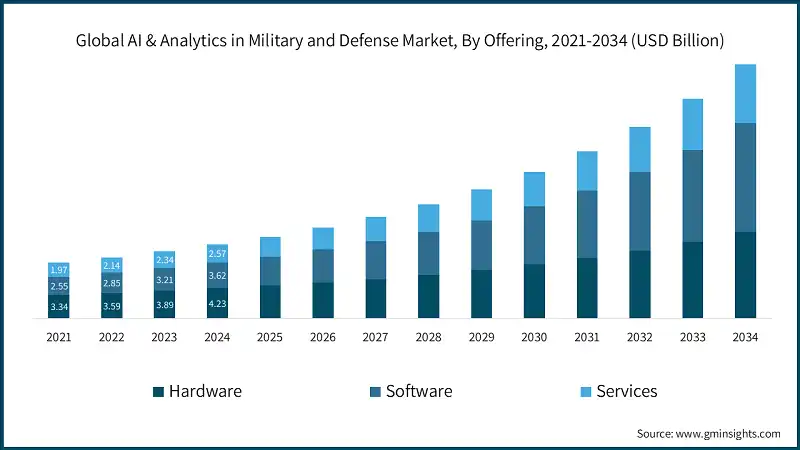
On the basis of offering, the AI & analytics in military & defense market is segmented into hardware, software, and services.
- Hardware continues to anchor deployments at 40.6% market share in 2024 as defense forces procure rugged compute, secure radios, and sensor suites to push inference to the tactical edge under EW pressure.
- The AI & analytics in military and defense industry is layering more capability into soldier systems and fixed installations, but it’s software that’s accelerating at fastest growth with the CAGR of 15.7%, as militaries scale decision support, predictive maintenance, and ISR automation into operational workflows.
- The AI & analytics in military and defense market is also witnessing a pivot to open, modular architectures so primes, and software specialists can co-develop and integrate with less friction. This favors vendors with reusable model libraries and pipelines for data quality, labeling, and assurance capabilities that directly influence mission outcomes and procurement scoring.
- Services round out 24.7% market share in 2024 by knitting solutions into mission systems, training operators, and hardening cyber posture through accreditation and continuous monitoring.
- Looking ahead, software-defined upgrades will dominate incremental value capture as model lifecycles shorten and edge deployments become routine in C2, ISR, and EW.
Learn more about the key segments shaping this market
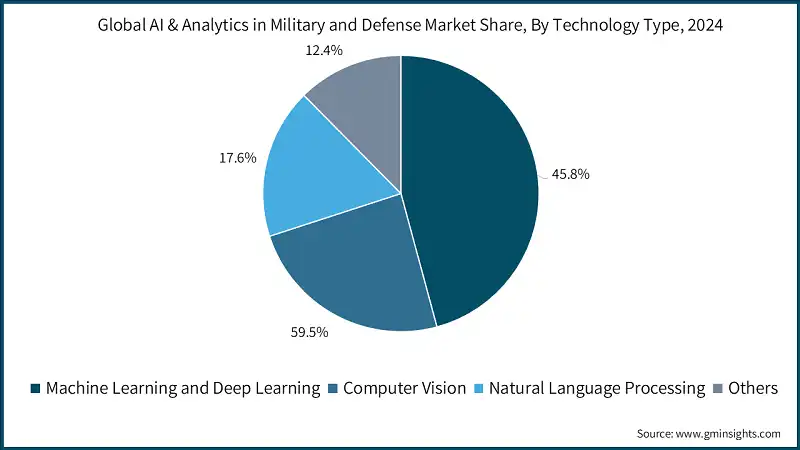
Based on the technology type, the AI & analytics in military & defense market is segmented into machine learning and deep learning, computer vision, natural language processing, and others.
- Machine learning and deep learning lead with 45.8% market share in 2024 as neural networks and predictive analytics assume target recognition, logistics optimization, and maintenance scheduling in live operations.
- Computer vision was at 24.2% market share in 2024 and records the highest growth with imagery exploitation, maritime surveillance, and adversary detection growing from strategic ISR to tactical edge devices.
- Natural language processing held 17.6% market share in 2024 as a result of comms monitoring to intelligence triage, while the other technologies segment (including robotics, quantum-resilient crypto, and advanced simulation) holds 12.4% market share and provide specialized advantages in high-end missions.
- As inference moves into contested spaces, militaries need robust MLOps such as versioning, telemetry, adversarial testing, and retraining pipelines that can run on classified clouds and edge nodes. This is driving new program requirements and longer-term O&S contracts tied to model assurance. Vendors that prove measurable reductions in time-to-detect, false positives, and fuel or spares consumption will have the edge.
Looking for region specific data?
North America AI & analytics in military and defense market was valued at USD 3.93 billion in 2024 and is anticipated to grow with a CAGR of 13.7% during the forecast period of 2025 - 2034. North America’s remains the largest region, supported by U.S. procurement, RDT&E, and a strong industrial base with secure cloud and DevSecOps pathways that compress accreditation timelines.
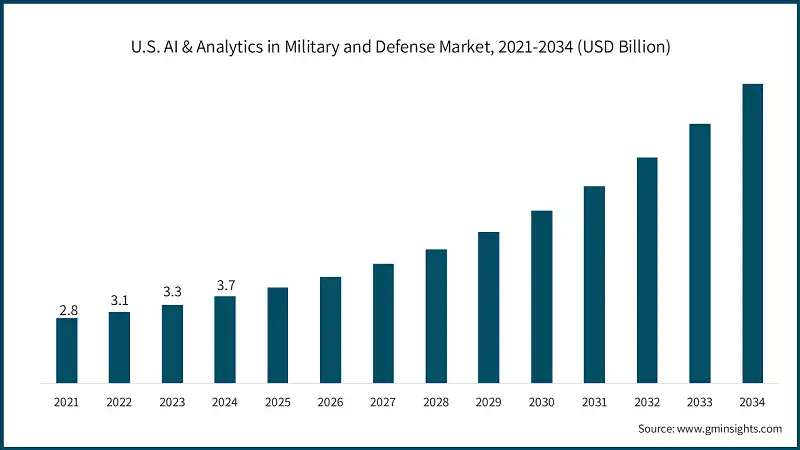
- U.S. dominated the AI & analytics in military and defense market and was valued at USD 3.7 billion in the year 2024. The U.S. AI ecosystem inside defense is scaling through offices like CDAO and funding that supports autonomy, cyber, and data fabrics across services. The United States market benefits from mature primes able to integrate AI into mission systems at pace.
- The AI & analytics in military and defense market in Canada is anticipated to surpass USD 1.1 billion by 2034. This market builds momentum via NORAD modernization and space-ISR investments. The market is expected to witness more open-architecture mandates and software-defined upgrades across air and maritime programs.
The AI & analytics in military and defense market in Europe is anticipated to grow with a CAGR of 12.6% during 2025 to 2034. The European market advances via EU initiatives and national strategies that emphasize interoperability and ethical AI guardrails.
- Major countries such as Germany, France, and the UK are investing in autonomy, cyber/EW, and space situational awareness with primes and research institutions working in tandem. NATO’s focus on standardization and data sharing is pushing common specs that make cross-border deployments more practical.
- The Germany AI & analytics in military and defense market was valued at USD 740.9 million in 2024 and the France market size exceeded USD 467.8 million in 2024, are anchoring regional capability builds, while the UK market navigates integration with continental initiatives post-Brexit and is anticipated to grow with a CAGR of 13.4% during the forecast period.
The AI & analytics in military and defense market in Asia Pacific is the fastest growing market and is anticipated to grow with a CAGR of 15.1% during the forecast period, with China expanding capacity and India, Japan, South Korea, and Australia rapidly scaling autonomy, maritime ISR, and missile defense modernization.
- China AI & analytics in the military and defense market is expected to grow to USD 4.53 billion by 2034. China market spearheads regional volume, with the India market propelling on budget growth for indigenous AI and aerospace initiatives.
- Japan AI & analytics in military and defense and South Korea AI & analytics in military and defense markets focus on missile defense, EW, and space, and the Australian market progresses through AUKUS collaboration and autonomous system investments.
- The Asia-Pacific market will experience sustained double-digit growth as regional security balances and industrial policy converge.
This AI and analytics in military and defense market in Latin America is expected to exceed USD 644 million by 2034. To improve operational effectiveness and strategic capacity in line with evolving security threats, Latin American countries are re-equipping their militaries with new and improved technologies such as AI and analytics.
The AI and analytics market for defense and military in the Middle East and Africa is expected to grow at a rate of 11.2% annually during the forecast period. The budgets of countries in this region are immensely rising to deal with the emerging threats and geopolitical crisis in the region. This increased expenditure is creating investment in hi-tech AI and analytics to enhance military capacities.
- The South African AI and analytics market for military and defense is valued at USD 58.1 million in 2024. The country is also investing more in its military to improve security forces. This is evident in the growing use of AI technologies to boost surveillance, cybersecurity, and operational efficiency.
- The AI & analytics in military & defense market in Saudi Arabia is projected to grow with a CAGR of 11.1% during the forecast period. The Vision 2030 of Saudi Arabia pays a lot of attention to the diversification of the economy, making substantial investments in AI and defense technologies to promote the national security and technological capacity.
- Manufacturers should partner with Saudi companies and government agencies to co-develop AI-driven defense solutions, aligning with Vision 2030 objectives and leveraging local expertise.
- The AI & analytics in military & defense market in UAE is anticipated to surpass USD 636.3 million by 2034. The UAE is also implementing AI in its military interests, whereby the country has strategic alliances with international technology companies to boost its military capacity with superior AI technologies.
AI & Analytics in Military and Defense Market share
- The AI & analytics in military & defense market is a highly competitive and fragmented market with many big and small companies within the market. Lockheed Martin Corporation, Raytheon Technologies (RTX), Northrop Grumman Corporation, BAE Systems plc, and Thales Group, are the key players in the AI & analytics in military & defense market. These companies collectively account for 37.9% of the total market share in 2024.
- Lockheed Martin is in the lead with 11.21% market share, with integrated platforms (e.g., Aegis, F-35) and software-defined additions such as sensor fusion, predictive maintenance, and CV-enabled targeting support.
- RTX maintains depth in radar, EW and missile defense, and incorporates AI to classify and engage across domains. The edge compute and secure processing architecture benefits Northrop Grumman with autonomous systems and space-based platforms.
- BAE Systems and Thales offer European leadership, which incorporates EW, secure comms, and platform integration with AI-enabled analytics to support situational awareness and decision support. The top five together account for roughly 37.90%, while the rest of the field includes General Dynamics, IBM, Palantir, L3Harris, and Boeing, all of which augment legacy strengths with AI analytics layers or autonomy-focused upgrades. Still, the door remains open for newer players with niche strengths, especially in MLOps, synthetic data, and autonomy stacks.
AI & Analytics in Military and Defense Market Company
The top prominent companies operating in the AI & analytics in military and defense industry include:
- Lockheed Martin Corporation
- Raytheon Technologies (RTX)
- Northrop Grumman Corporation
- BAE Systems plc
- Thales Group
- General Dynamics
- IBM Corporation
- Palantir Technologies
- L3Harris Technologies
- Boeing
- Charles River Analytics
- SparkCognition
- Leidos
- Anduril Industries
- Shield AI
- Helsing
- Safran
- Rafael Advanced Defense Systems
- Rheinmetall AG
- Booz Allen Hamilton
Lockheed Martin Corporation, Raytheon Technologies (RTX), Northrop Grumman Corporation, BAE Systems plc, Thales Group, General Dynamics, Boeing, L3Harris Technologies, are the dominant player in the market. Lockheed Martin integrates platform with AI pipelines to achieve fusion, target, and maintenance, and Skunk Works advances next-gen autonomy and mission systems research. RTX scales AI to radar, EW and missiles, and proves performance with exercises and live fires that challenge targeting in clutter and unfavourable weather.
Northrop Grumman is an autonomous, space-focused company, integrating AI into unmanned systems and resilient satellite systems to enable ISR and comms. BAE Systems strengthens EW and cyber using AI analytics to deliver situational awareness and long-term protection at the platform level. Thales produces radar, secure communications and cyber analytics, and integrates aerospace experience with defense-qualified software packages. General Dynamics integrates AI into combat and maritime systems, improving threat detection and operational workflows. Boeing integrates autonomy and analytics into aircraft and unmanned systems to boost mission planning, maintenance, and flight safety. L3Harris brings together EW, SIGINT, and secure comms with AI to detect, classify and respond faster to contested spectrum.
IBM Corporation, Palantir Technologies, Leidos, Rheinmetall AG, and Safran, are the key challengers in the market. IBM introduces watsonx-powered analytics to intelligence, logistics, and cyber, hardened development tools in secure environments. Palantir provides fused situational awareness and course-of-action analysis based on data integration and AI-enabled intelligence platforms. Leidos connects AI layers with integration, intelligence, cyber, and logistics to large government programs. Rheinmetall packages AI-enhanced situational awareness and autonomy with land systems. Safran introduces aerospace and optronics experience along with AI-enabled sensing and navigation.
Rafael Advanced Defense Systems are the Booz Allen Hamilton followers in the market. Rafael advances missile systems and EW, adding AI to targeting and engagement loops. Booz Allen Hamilton supports AI adoption with consulting, model assurance, and training for secure deployment environments.
Charles River Analytics, Spark Cognition, Anduril Industries, Shield AI, and Helsing are the niche players in the market. Charles River Analytics contributes research-grade autonomy, HMT, and decision support tailored to mission specifics. Spark Cognition applies predictive analytics and AI cyber to protect critical infrastructure and defense installations. Anduril pushes software-defined autonomy and sensing with fast iteration cycles and vertically integrated hardware/software stacks. Shield AI develops autonomous aircraft and collaborative autonomy, enabling teams of platforms to execute complex missions. Helsing concentrates on software upgrades for extant platforms, with European regulatory alignment and AI assurance focus.
AI & Analytics in Military and Defense Market Report Attributes
| Key Takeaway | Details |
|---|---|
| Market Size & Growth | |
| Base Year | 2024 |
| Market Size in 2024 | USD 10.42 Billion |
| Market Size in 2025 | USD 11.53 Billion |
| Forecast Period 2025 - 2034 CAGR | 13.4% |
| Market Size in 2034 | USD 35.78 Billion |
| Key Market Trends | |
| Drivers | Impact |
| The improvement in autonomous systems advancement | Drives 24% of market growth as AI-powered analytics enhance autonomous defense platforms, enabling adaptive navigation, target identification, and mission execution with minimal human input. |
| Increasing emphasis on cybersecurity enhancement | Supports 21% of market growth as AI-driven analytics provide advanced threat detection, anomaly recognition, and predictive defense against sophisticated cyberattacks. |
| Rising demand for real-time decision-making, that elevate AI analytics platforms | Contributes 20% to market growth as AI and analytics platforms deliver rapid situational awareness, predictive modelling, and instant battlefield insights. |
| Growing integration of AI in multi-domain operations to coordinate land, sea, air, space, and cyber missions at machine speed | Accounts for 18% of market growth by enabling seamless coordination of land, sea, air, space, and cyber missions at machine speed. |
| Increasing government spending | Adds 17% to market growth as defense budgets worldwide prioritize AI-driven modernization initiatives. |
| Pitfalls & Challenges | Impact |
| High implementation costs. | Restrains 22% of market growth as deploying AI-driven analytics requires significant investment in infrastructure, advanced hardware, and skilled personnel. |
| Data security and privacy concerns. | Limits 20% of market growth since military data is highly sensitive, and reliance on AI analytics raises risks of breaches, espionage, and adversarial attacks. |
| Opportunities: | Impact |
| Expansion of AI-Powered Battlefield Healthcare and Soldier Monitoring | Will drive market growth as AI analytics will enable real-time health monitoring, injury prediction, and remote diagnostics for soldiers |
| Integration of AI in Autonomous and Next-Generation Defense Vehicles | Will contribute to growth by enabling autonomous navigation, predictive maintenance, and threat detection in land, air, and naval defense platforms |
| Market Leaders (2024) | |
| Market Leaders |
Top 2 company accounts for 19.6% market share |
| Top Players |
Collective market share in 2024 is 37.9% |
| Competitive Edge |
|
| Regional Insights | |
| Largest Market | North America |
| Fastest Growing Market | Asia Pacific |
| Emerging Country | India, Brazil, Poland, South Africa, Vietnam |
| Future Outlook |
|
What are the growth opportunities in this market?
AI & Analytics in Military and Defense Market News
- In January 2023, Lockheed Martin started incorporating AI technologies into the Aegis Combat System lifecycles. The action increased the fleet capabilities and tackle the new threats. The company is agile, urgent, and cost-effective in innovation to provide mission-focused defense.
- In September 2023, Safran acquired Preligens, an artificial intelligence (AI) aerospace and defense company. Preligens was rebranded as Safran.AI following the acquisition that was worth USD 244 million. It is now under Safran Electronics & Defense, which complements Safran with AI-based aerospace and defense technologies.
The AI & analytics in military & defense market research report includes in-depth coverage of the industry with estimates and forecasts in terms of revenue in (USD Million) from 2021 - 2034 for the following segments:
Market, By Offering
- Hardware
- Software
- AI model development & training software
- Data analytics platforms
- Cyber threat detection software
- Others
- Services
- Deployment & integration
- Upgrades & maintenance
- Others
Market, By Technology Type
- Machine learning and deep learning
- Supervised learning
- Unsupervised learning
- Reinforcement learning
- Computer vision
- Object detection and classification
- Facial recognition systems
- Image and video analytics
- AR-based situational awareness
- Natural language processing
- Speech recognition
- Text analytics & mining
- Language translation systems
- Others
Market, By Application
- Intelligence, Surveillance & Reconnaissance (ISR)
- Satellite intelligence
- Aerial surveillance systems
- Ground-based surveillance
- Maritime surveillance
- Cybersecurity and electronic warfare
- Threat detection and response
- Network security
- Electronic countermeasures
- Cyber defense systems
- Command, Control, Communications & Intelligence (C3I)
- Command and control systems
- Communication networks
- Intelligence analysis
- AI-based decision support
- Logistics and supply chain
- Predictive maintenance
- Inventory management
- Transportation optimization
- Others
- Training and simulation
- Virtual reality training
- Combat simulation
- Scenario planning
- Others
- Others
Market, By Platform
- Airborne
- Fighter aircraft
- Special mission aircraft
- Helicopters
- Unmanned aerial vehicles (UAV)
- Land
- Military fighting vehicles (MFV)
- Unmanned ground vehicles (UGV)
- Weapons systems
- Naval
- Ships
- Submarines
- Unmanned marine vehicles (UMVs)
- Spaces
- Satellite systems
- Space surveillance
- Communication satellites
Market, By End Use
- Military
- Army
- Navy
- Air force
- Space force
- Marines
- Intelligence agencies
- National intelligence services
- Military intelligence
- Cyber intelligence
- Homeland security
- Border protection
- Emergency response
- Counter terrorism
The above information is provided for the following regions and countries:
- North America
- U.S.
- Canada
- Europe
- Germany
- UK
- France
- Spain
- Italy
- Netherlands
- Asia Pacific
- China
- India
- Japan
- Australia
- South Korea
- Latin America
- Brazil
- Mexico
- Argentina
- Middle East and Africa
- Saudi Arabia
- South Africa
- UAE
Frequently Asked Question(FAQ) :
What is the market size of the AI & analytics in military and defense in 2024?
The market size was USD 10.42 billion in 2024, with a CAGR of 13.4% expected through 2034 driven by autonomous systems advancement, cybersecurity enhancement, and real-time decision-making demands.
What is the projected value of the AI & analytics in military and defense market by 2034?
The AI & analytics in military and defense market is expected to reach USD 35.78 billion by 2034, propelled by multi-domain operations integration, government spending increases, and battlefield healthcare expansion.
What is the current AI & analytics in military and defense market size in 2025?
The market size is projected to reach USD 11.53 billion in 2025.
How much market share did the hardware segment hold in 2024?
Hardware held 40.6% market share in 2024, anchoring deployments with rugged compute, secure radios, and sensor suites for tactical edge operations.
What was the market share of machine learning and deep learning segment in 2024?
Machine learning and deep learning led with 45.8% market share in 2024, with neural networks and predictive analytics handling target recognition, logistics optimization, and maintenance scheduling.
What is the growth outlook for the software segment from 2025 to 2034?
Software segment is projected to grow at a CAGR of 15.7% through 2034, fueled by scaling decision support, predictive maintenance, and ISR automation into operational workflows.
Which region leads the AI & analytics in military and defense market?
The North America AI & analytics in military and defense market was valued at USD 3.93 billion in 2024 and is projected to grow at a 13.7% CAGR from 2025 to 2034.
What are the upcoming trends in the AI & analytics in military and defense market?
Key trends include integration with multi-domain decision platforms, advancements in edge AI and high-performance computing, expansion of AI-powered battlefield healthcare, and autonomous defense vehicle integration.
Who are the key players in the AI & analytics in military and defense market?
Key players include Lockheed Martin Corporation, Raytheon Technologies (RTX), Northrop Grumman Corporation, BAE Systems plc, Thales Group, General Dynamics, IBM Corporation, Palantir Technologies, L3Harris Technologies, Boeing, Charles River Analytics, SparkCognition, Leidos, Anduril Industries, Shield AI, Helsing, Safran, Rafael Advanced Defense Systems, Rheinmetall AG, and Booz Allen Hamilton.
AI & Analytics in Military and Defense Market Scope
Related Reports